
Building a persistent virtual realm like World of Dypians means engineering a delicate balance between Unreal-powered visual immersion and trustless multi-chain settlement, where architectural missteps directly jeopardize user assets and overall gameplay stability.
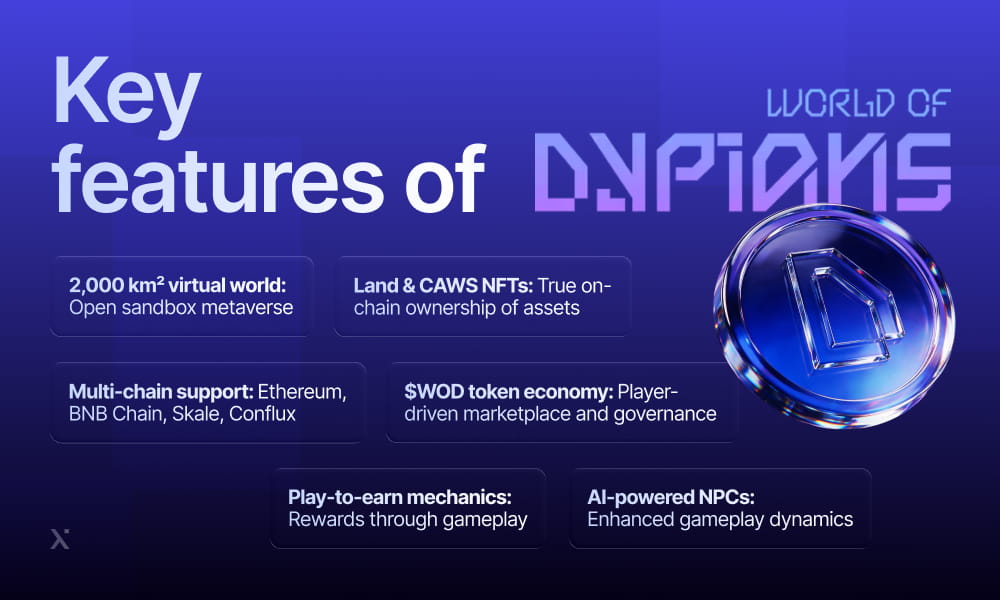
World of Dypians (WoD) has set a distinct benchmark across the decentralized gaming scene. By combining high-fidelity graphics powered by Unreal Engine with deep decentralized finance mechanics, multi-chain NFT economies, and persistent virtual land plots, it demonstrates what modern Web3 games look like when they mature past simplistic click-to-earn mechanics. This evolution mirrors a broader sector expansion, with the global Web3 gaming market reaching $37.55 billion in 2025 as enterprise studios prioritize sustainable player economies over short-term speculation.
When enterprise leaders and Web3 founders explore the cost of developing a comparable decentralized application, they quickly discover that such an undertaking spans game software engineering, distributed ledger deployment, multiplayer networking, and high-frequency on-chain asset settlement. Understanding the complete financial scope requires a detailed inspection of architecture, core engineering stages, and operational overhead, which this guide breaks down step by step.
Why building a World of Dypians equivalent requires substantial effort and capital
Replicating a title of this scale is fundamentally different from rolling out a standard browser-based DeFi yield farming dashboard or a static NFT marketplace development project. World of Dypians merges traditional AAA game development workflows with decentralized network protocols, requiring specialized engineering across multiple technical layers.
Real-time performance and state synchronization
In high-definition multiplayer environments, character movement, world rendering, combat interactions, and physics calculations occur in real time at 60 or 120 frames per second. Blockchains, on the other hand, operate on probabilistic finality and block production intervals measured in seconds or milliseconds.
Bridging client-side gaming interactions with smart contract development without introducing high gas costs or unbearable latency demands an intricate dual-layer state design, where authoritative game servers resolve immediate actions while ledger layers record permanent state transitions.
Sustainable tokenomics and asset valuation
Balancing the token economy represents an immense mathematical and economic hurdle. Game assets must retain tangible value while sustaining active player reward loops over extended periods.
In unregulated peer-to-peer markets, poorly structured reward emissions cause catastrophic hyperinflation within weeks of launch. Designing non-custodial staking pools, dynamic equipment minting mechanics, and seasonal tournament prize structures calls for specialized economic modeling to guarantee long-term retention.
Smooth Web3 user onboarding
Web3 onboarding introduces friction that technical teams must overcome through clean software engineering. Traditional players expect seamless email or social sign-ups and rapid client downloads without technical prerequisites.
Blockchain game development traditionally requires browser extensions, seed phrases, gas management, and complex transaction approvals. Bridging that divide demands account abstraction and automated gas sponsorship, adding specialized backend layers to the development scope.
For companies looking to scope out these architectural demands before committing full engineering resources, starting with professional MVP development services provides a clear framework to validate core gameplay loops and on-chain mechanics with controlled capital allocation.
Architectural challenges and production trade-offs in Web3 MMORPGs
| Development domain | Primary technical hurdle | Production solution |
| State management | Divergence between 60+ FPS game ticks and block confirmation delays | Off-chain authoritative calculation paired with periodic state commit anchors |
| Tokenomics design | Runaway emission inflation devaluing secondary market assets | Dynamic sink utilities, asset wear cycles, and competitive tournament buy-ins |
| Player access | Wallet connection barriers and network gas dependencies | Account abstraction (ERC-4337) with integrated paymasters and social logins |
How Canton Solves the Privacy Problem for Institutional On-Chain Finance

Tokenizing Gilts, Eurobonds and Gold: Default-Tested Mobile Collateral on Canton
Core technology stack required for high-performance Web3 games
A production-grade MMORPG dApp operates through three distinct technological layers: the client-side presentation engine, high-throughput backend services, and a resilient distributed ledger layer.
Technologies for the front-end and gaming client
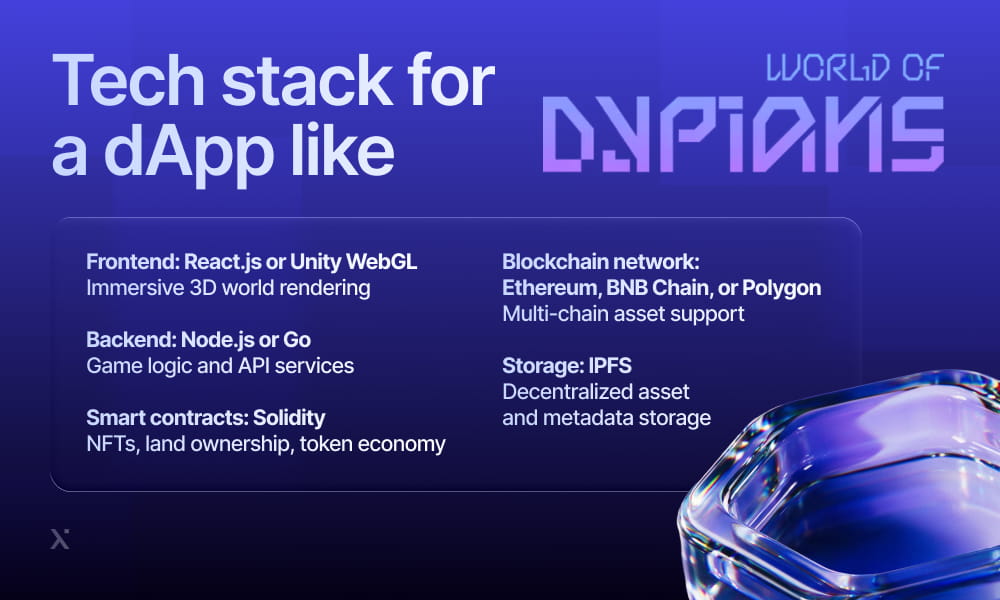
The visual client handles rendering, spatial audio, physics simulation, and user interaction. For an immersive 3D world comparable to World of Dypians, game studios turn to established game engines:
- Unreal Engine 5: An industry-standard engine employing Nanite virtualized geometry and Lumen global illumination to render high-density landscapes without manual LOD generation.
- Unity: A versatile alternative supporting C# scripting, ideal for multi-platform delivery across PC, macOS, and mobile devices. Unity benefits from mature SDKs provided by major gaming ecosystems like Immutable and third-party Web3 gaming toolkits.
- Web3 wallet connectors: Direct embedded integrations using wallet connection libraries that allow in-game browser interactions, hardware wallet authentication, and WalletConnect v2 session handshakes.
- Client-side data caching: Local persistent storage through SQLite or encrypted flat files to cache non-critical world state, inventory thumbnails, and player preference presets.
Data exchange and network protocol architecture in Web3 gaming
| Communication channel | Primary data transmitted | Transport protocol | Update frequency |
| Client to game server | Player inputs, spatial movement vectors, combat targeting | UDP / WebSockets | Real-time (30–60 Hz tick rate) |
| Game server to database | Match session state, chat records, dynamic quest logs | gRPC / TCP | Continuous sub-second streaming |
| Backend to smart contracts | Reward distribution claims, asset minting tickets | JSON-RPC (EVM/Solana) | Batched on demand / milestone triggers |
| Indexer to client UI | Token balances, secondary NFT listings, leaderboard ranks | GraphQL / HTTPS REST | Polled or event-driven webhooks |
Technologies for the backend and networking layer
Real-time interactions cannot query distributed ledgers directly on every user action. The server-side infrastructure functions as an authoritative arbiter between the game client and the blockchain:
- Authoritative game servers: Frameworks like Heroic Labs Nakama, Photon Fusion, or custom headless Unreal Engine server instances running inside containerized environments (Kubernetes/Docker) on AWS or Google Cloud Platform.
- Distributed database clusters: High-performance NoSQL engines such as MongoDB, Redis, or ScyllaDB to preserve sub-millisecond leaderboard entries, chat histories, active sessions, and transient player coordinates.
- Event indexers and data streaming: The Graph nodes or self-hosted RPC ingestion pipelines that listen to smart contract events and update the central database whenever a player mints, trades, or stakes an in-game asset.
- Transaction relayers and paymasters: Specialized microservices using Biconomy, OpenZeppelin Defender, or Gelato to handle gas abstraction, batching on-chain mints and subsidizing player interactions without interrupting game flow.
Selecting appropriate baseline frameworks requires structured technical evaluation. Engineering teams leveraging enterprise-grade dApp development services can reliably establish this tech stack while preventing common architectural bottlenecks that cripple multiplayer performance at launch.

Building an Altcoin Ecosystem in 2026: Costs, Risks, and Critical Development Decisions
Daml Smart Contract Audit Cost in 2026: A Guide to Pricing and Peace of Mind
Multi-chain ecosystem selection: Ethereum, Solana, and beyond
World of Dypians expanded its ecosystem across multiple virtual machine environments to capture liquidity from diverse communities. When architecting an equivalent virtual universe, teams must assess the functional trade-offs among networks.
Decentralized network layer comparison for gaming ecosystems
| Network layer | Core performance metrics | Primary gaming function |
| Ethereum base layer | Highest global TVL Absolute security guarantees |
Premium sovereign asset registry and foundational governance settlement |
| Layer 2 rollups | Fast finality (0.5s – 2s) Low gas overhead (~$0.01) |
High-frequency in-game interactions and routine contract calls |
| Solana network | Sub-second slots (400ms) High throughput (2,000+ TPS) |
Low-latency loot distribution and rapid micro-transactions |
For settlement of primary ecosystem governance tokens and high-value sovereign assets, foundational protocols engineered via dedicated blockchain development remain essential.
Instead of deploying full gameplay logic across every target chain, keep your dynamic game state and high-velocity asset minting restricted to a low-cost execution network like Solana or an L2 rollup. Then, use burn-and-mint lockup contracts to let players bridge only high-tier, fully upgraded sovereign assets to Ethereum L1 for secondary market liquidity. This prevents fragmented liquidity across smaller pools while shielding your players from paying standard base-layer gas fees during routine gameplay.
EVM chains and Layer 2 solutions
Building on the Ethereum Virtual Machine provides immediate access to the largest developer tooling ecosystem and capital base. When teams deploy on EVM, they frequently split execution: high-value virtual real estate sits on L1 or major sidechains, while daily quest payouts run on Layer 2 rollups like Arbitrum, Optimism, or Polygon zkEVM.
Teams investing in targeted Ethereum development gain institutional-level security assurances and native integration with deep automated market makers, decentralized credit markets, and dominant secondary NFT trading platforms.
From Chaos to Compliance: How Cryptocurrency Regulation Is Shaping Up

Exploring Solana Development: Core Features, Industry Use Cases, and Future Trends
Alternative high-performance ecosystems
Not all gaming loops tolerate EVM block latencies. High-frequency item crafting, player-to-player tipping, and rapid loot box mechanics often perform better on non-EVM runtimes that support parallel transaction execution.
Choosing Solana dApp development unlocks 400-millisecond block times and micro-penny transaction fees through Rust-based smart contracts. This enables near-instant on-chain item generation without requiring custom L3 appchains.
Implementing ERC-4337 smart contract accounts or native Solana session keys removes the requirement for users to approve wallet popups for every sword swing or quest turn-in. By leveraging programmatic session keys, the game client can sign transactions on behalf of the user within strict allowances (e.g., maximum daily gas spend, restricted interactions to specific contract methods). This provides a traditional game feel while retaining trustless decentralized ownership in the background.
The end-to-end development lifecycle of a Web3 game
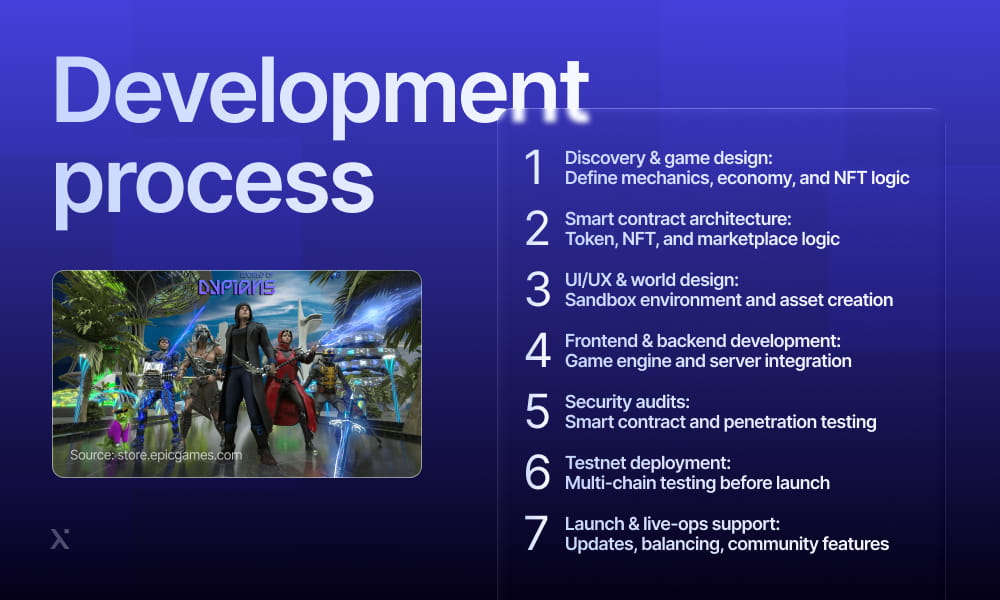
Creating a robust decentralized title follows a structured pipeline where game production and blockchain engineering proceed in parallel rather than as separate afterthoughts.
Conceptualization and system architecture
During the initial scoping stage, software architects and game system designers draft technical specifications detailing how the on-chain and off-chain worlds communicate.
- Tokenomics framework design: Defining hard caps, staking yields, token sinks, reward distributions, and deflationary burn mechanisms.
- Architectural blueprinting: Mapping out API gateways, game server orchestration, database schemas, and RPC node failover strategies.
- Smart contract specification: Drafting interface definitions, inheritance structures, permission models, and role-based access controls.
- Security parameter mapping: Identifying threat vectors such as client memory tampering, automated sybil farming, and transaction front-running.
UI/UX and environmental game design
World of Dypians relies on detailed environmental realism. The design phase establishes both the visual presence of the virtual realm and the interactive interface connecting Web2 gamers with Web3 protocols:
- Environmental concept art and 3D modeling: Creating modular terrain, architectural assets, monster rigs, weapon models, and seasonal event decorations.
- Animation and visual FX: Implementing bone weight rigs, character skeletal animations, particle systems, and audio-visual cues for spells and combat abilities.
- Web3 wallet UX/UI design: Engineering streamlined interfaces for balance checks, inventory inspections, marketplace bids, and staking pools that minimize cognitive load.
- Spatial audio and UI integration: Constructing responsive HUD overlays that display server ping, real-time token balances, and pending transaction status bars without cluttering the screen.
Engineering: Game client, backend, and smart contracts
The engineering phase forms the core of the project timeline. Multiple specialized teams work concurrently across different codebases:
- Game client engineers: Implement character controllers, camera behaviors, networking prediction, input buffering, and asset streaming inside the game engine.
- Backend systems engineers: Build high-throughput microservices in Go, Node.js, or Rust to process authentication, maintain matchmaking queues, and manage chat channels.
- Blockchain developers: Write smart contracts using Solidity, Vyper, or Rust. They implement token standards, land lease contracts, and decentralized prize pool logic.
- DevOps engineers: Set up continuous integration and deployment pipelines, container registries, and server auto-scaling groups to manage live traffic fluctuations.
The architectural complexity of coordinating cross-chain gaming mechanics matches the rigor required when building enterprise financial platforms; teams familiar with the cost to develop a crypto exchange like OKX will recognize similar engineering principles regarding real-time order matching and high-volume ledger synchronization.
Quality assurance and smart contract security audits
Testing a decentralized game requires both classical QA testing and formal cryptographic verification:
- Gameplay balance and stress testing: Deploying hundreds of simulated bot clients to stress-test server tick rates, physics calculations, and multiplayer packet synchronization.
- Smart contract unit testing: Running comprehensive test suites using Foundry or Hardhat with automated fuzzing to expose edge-case logic failures.
- Third-party security reviews: Engaging external firms to conduct smart contract audit, verify access control boundaries, and identify reentrancy vulnerabilities.
- Penetration testing: Assessing backend API endpoints, socket connections, and cloud configurations against denial-of-service and privilege escalation attacks.
Production milestones and verification criteria for Web3 titles
| Production stage | Core technical objective | Readiness verification criteria |
| Architectural alignment | Map on-chain state limits against gameplay network packets | System spec approved with gas ceiling formulas and latency budgets |
| Vertical slice validation | Connect engine client to local test contracts | Single playable room running 60 FPS with wallet-authenticated inventory |
| Closed testnet alpha | Benchmark multiplayer load and contract stress limits | 500+ concurrent simulated users without packet drops or transaction reversions |
| Mainnet dress rehearsal | Verify deployment scripts, proxy configurations, and relayer funding | Dry-run deployment on target testnets with sign-off from third-party auditors |

Ethereum Development from A to Z: Features, Use Cases, and Costs
The Real Price Tag Behind a Kraken-Style Exchange: A Builder's Field Guide
Detailed cost breakdown: What goes into the budget?
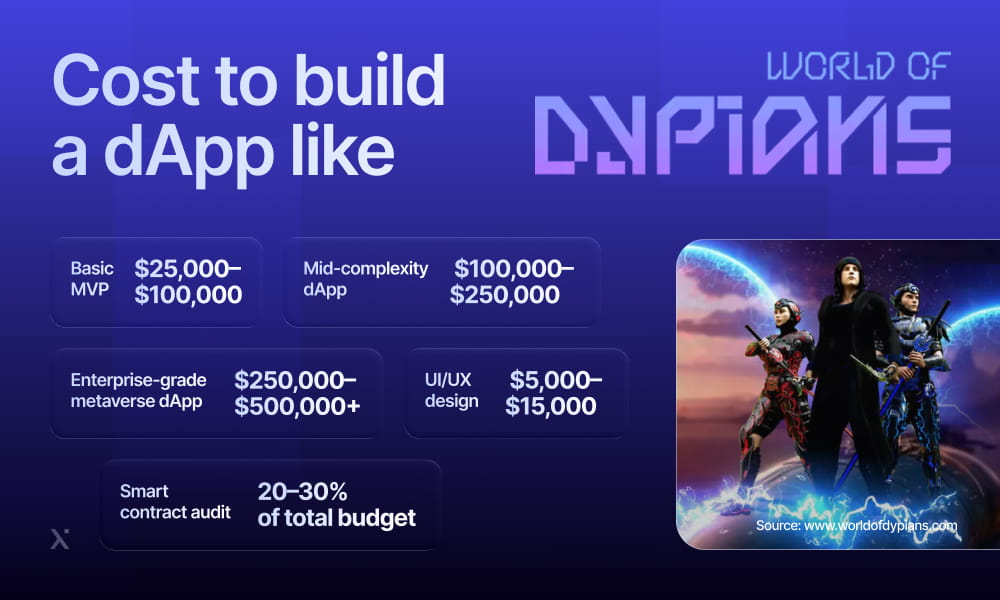
Budgeting for a high-end decentralized application like World of Dypians depends on geographic team distribution, graphics fidelity, network complexity, and feature scope. Total costs typically range from $100,000 for a lean and functional MVP to over $500,000 for a feature-rich, high-fidelity production release.
The resource planning requirements mirror the architectural considerations detailed in our breakdown of building a Bybit-like crypto exchange, where back-office reliability, financial reconciliation, and deterministic transaction execution dictate the overall budget.
Design and 3D modeling expenses
- Conceptual sketches and art direction: $8,000 – $20,000
- 3D environment asset creation (modular world tiles, foliage, dungeons): $12,000 – $45,000
- Character models, skin variations, and rigging: $7,000 – $30,000
- Visual effects (VFX) and sound design: $3,000 – $15,000
Total estimated design expenditure: $30,000 – $110,000.
Smart contract engineering and Web3 integration
- Fungible reward token and staking pools: $5,000 – $15,000
- ERC-721 / ERC-1155 virtual property and NFT equipment contracts: $8,000 – $25,000
- Decentralized marketplace and auction contracts: $5,000 – $20,000
- Cross-chain token bridges and multi-chain mint relayers: $7,000 – $30,000
Total estimated smart contract expenditure: $25,000 – $90,000.
Multiplayer backend and game client engineering
- Game client mechanics (movement, combat, inventory, spatial UI): $20,000 – $130,000
- Multiplayer server orchestration, spatial synchronization, and tick rate optimization: $12,000 – $85,000
- Web3 SDK integration, wallet handshake, and gasless transaction relays: $6,000 – $40,000
- Off-chain database caching, event indexing, and player profile sync: $7,000 – $45,000
Total estimated engineering expenditure (NOT MVP but a full-scale product): $45,000 – $300,000.
Enterprise founders planning complex architectures can reference our research on how to develop a crypto exchange like Binance to understand how high-throughput transactional backends are priced and resourced.
Infrastructure, live maintenance, and ongoing operational costs
Deploying a decentralized gaming universe is not a one-time capital investment. Live operations (LiveOps) demand ongoing resource commitments to maintain servers, update content, and secure networks.
Server hosting and RPC infrastructure
Dedicated multiplayer instances require active compute clusters. Running low-latency game servers across North America, Europe, and Asia on AWS GameLift or bare-metal providers costs between $3,000 and $8,000 monthly for an initial concurrent player base of 2,000 to 5,000 users.
Furthermore, querying distributed ledgers directly at high frequency requires enterprise-tier node providers such as Alchemy, QuickNode, or Infura. Premium dedicated RPC tiers with dedicated global endpoints typically cost between $1,000 and $3,000 per month.
Smart contract upgrades and security maintenance
Smart contracts in gaming ecosystems are rarely static. As seasonal updates, expansion packs, and rebalanced economies roll out, proxy contract implementations (such as OpenZeppelin ERC-1967 UUPS or transparent upgradeable proxies) must be maintained.
Each significant logic migration demands re-audit cycles. Maintaining an active bug bounty program on Immunefi or HackenProof with reserved payouts costs between $20,000 and $50,000 annually, providing an active defense layer against potential exploits.
To benchmark network gas overheads and contract operational costs accurately, developers can review our comprehensive analysis of Ethereum dApp development metrics and live runtime expenses.
How to Build a P2P Crypto Exchange: Development Process, Tech Stack & Pricing Explained

The Complete Guide to MVP Development for Healthcare: Navigating Costs, Compliance, and Scaling
Security considerations for high-value Web3 gaming dApps
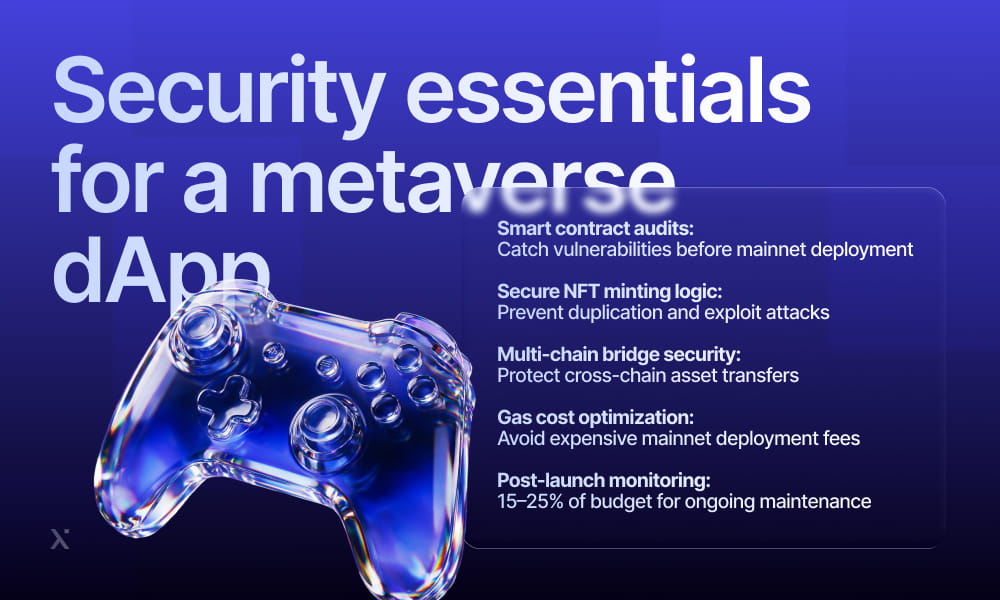
Securing Web3 game development pipelines requires safeguarding both off-chain client-server environments and immutable on-chain state. While a vulnerability in a traditional MMORPG might lead to duplicated gold or cosmetic items that can be rolled back via database backups, a vulnerability in a decentralized gaming contract can lead to immediate, irreversible loss of liquidity.
In-game economy vulnerabilities and exploit paths
Attackers target decentralized gaming ecosystems using both traditional game exploits and decentralized finance exploit techniques:
- Reentrancy and state desynchronization: If a staking contract updates user balances only after calling an external wallet address, an attacker can reenter the withdraw function to drain prize pools.
- Predictable pseudo-randomness: Relying on block timestamps or block hashes for loot drops, combat critical hits, or NFT attribute generation invites miner manipulation and deterministic front-running. Robust games integrate decentralized oracles like Chainlink VRF (Verifiable Random Function) to guarantee tamper-proof randomness.
- Oracle manipulation in automated marketplaces: If in-game item values rely on low-liquidity liquidity pools, malicious actors can deploy flash loans to distort relative asset values, purchase discounted game items, and dump them back into secondary markets.
- Client-side memory manipulation: Players using tools like Cheat Engine or custom memory injection hooks can alter client-side coordinates, movement speeds, or hit registration if the server fails to re-simulate physical actions.
To stop players from forging in-game achievements and claiming unearned rewards on-chain, successful Web3 titles use off-chain cryptographic attestation. When a player completes a high-tier dungeon, the authoritative game server validates the match log, signs a completion ticket using an ephemeral server-held private key, and transmits it to the player. The on-chain reward contract verifies this cryptographic signature (via ecrecover) before minting the token or item, preventing malicious minting attempts.
Technical and design pitfalls to avoid
Building a sophisticated virtual world involves navigating several persistent development pitfalls.
Excessive on-chain state storage
A frequent architectural error is attempting to store volatile game parameters on-chain. Writing character position data, durability losses, experience points, or inventory slot arrangements directly into smart contract storage creates unbearable gas overhead.
- Solution: Keep real-time combat attributes, coordinate points, and ephemeral inventory state within high-speed off-chain databases. Commit state changes to the distributed ledger only during significant milestones, such as dungeon exits, item crafting events, or peer-to-peer trades.
High friction onboarding and transaction latency
Forcing users to sign transactions during combat or exploration breaks immersion. Requiring users to manage gas tokens on five different networks alienates casual players who are unfamiliar with decentralized finance mechanics.
- Solution: Implement seamless social log-in mechanisms via multi-party computation (MPC) wallets, provide sponsored gas abstractions via paymasters, and allow players to purchase assets using fiat debit/credit options via integrated fiat-to-crypto checkout gateways.
Hyperinflationary reward loops
Many first-generation Web3 games prioritized aggressive token emissions to attract early users, resulting in steep economic declines when secondary market demand softened.
- Solution: Build multi-faceted utility loops. World of Dypians addresses this with diverse token utility: land purchases, equipment repairs, custom mount skins, entry fees for seasonal tournaments, and marketplace fee burns. When item consumption matches or exceeds the rate of reward generation, the underlying economy remains resilient.
Before committing to a single network architecture, review our analysis on comparing dApps across protocols to evaluate how transaction throughput, validator decentralization, and gas structures impact long-term gameplay stability.
Web3 Insurance App Development: Why It Matters and How It Works in Real Life

What is the Cost to Develop a Crypto Wallet App Like Ledger?
Estimating timelines across different project scopes
The roadmap to launch varies depending on visual fidelity, smart contract complexity, and operational scale.
- Proof of concept (2 – 3 months): Demonstrates fundamental smart contract interactions, basic wallet connections, and a minimal 3D character controller operating in a sandbox environment.
- Playable alpha / Vertical slice (4 – 6 months): Features a single polished zone, basic combat loops, one functioning NFT inventory collection, and an operational testnet token economy.
- Public beta release (6 – 9 months): Multi-zone open exploration, functional multiplayer synchronization, integrated staking pools, primary decentralized marketplace, and mobile or PC client installers.
- Full production release (12 – 18+ months): Expansive open world, cross-chain asset support, advanced guild structures, seasonal tournament systems, and dynamic AI-driven quest mechanics.
| Release tier | Timeline | Capabilities | Target audience |
| Proof of Concept | 8 – 12 Weeks | Single-room movement, basic wallet sign-in, testnet mock mint | Internal stakeholders, angel investors |
| Vertical Slice | 16 – 24 Weeks | 1 dungeon zone, 3 enemy types, playable combat, live NFT inventory | Private beta testers, VC funding rounds |
| Public Beta | 28 – 36 Weeks | Multi-zone map, active multiplayer, staking contracts, marketplace | Early adopter community, guild partners |
| Enterprise Launch | 48 – 72 Weeks | Open world MMORPG, cross-chain bridges, tournament live events | Global Web2 & Web3 gaming market |
For a broader perspective on budgeting and development timelines across various decentralized applications, read our in-depth breakdown of dApp development cost factors.
Why partner with PixelPlex to build your next-generation dApp?
Developing a game of this magnitude requires a technology partner capable of bridging high-performance graphics engines with bulletproof distributed ledger architecture. We bring over a decade of technical innovation to complex decentralized projects.
Engineering advantages PixelPlex brings to Web3 gaming
| Technical capability | Architectural implementation | Production payoff |
| Pioneering ledger mastery | Proprietary cross-chain bridges and custom VM logic engineered since 2013 | Zero reliance on unvetted third-party middleware |
| Unified engine & chain talent | Native C++/Rust engineers working alongside Solidity developers | Sub-millisecond sync between Unreal tick rates and smart contracts |
| Formal security verification | Mathematical invariant proofs and proactive exploit vectors stress-testing | Complete contract resilience against flash-loan and state-drain exploits |
| Turnkey systems delivery | Algorithmic tokenomics balanced directly against cloud-scale matchmaking | Production-ready infrastructure engineered to absorb day-one traffic surges |
The next two to three years represent a decisive turning point for decentralized entertainment, as frictionless account abstraction and mature Layer 2 rollups finally align Web3 infrastructure with mainstream gamer expectations.
If you are set on building a persistent world rather than a fleeting seasonal trend, we bring the architectural depth to turn that ambition into production reality. We engineer self-sustaining digital nations designed to thrive under extreme scale. Bring your boldest architectural vision to PixelPlex, and let us forge a decentralized gaming powerhouse that sets the benchmark for the next decade of interactive entertainment. Get in touch with our team today to begin.
FAQ
Building a production-grade Web3 gaming title ranges from $100,000 for a streamlined vertical slice up to $500,000 or more for a feature-rich, high-fidelity MMORPG.
A complete development cycle generally takes between 12 and 18 months depending on graphics fidelity, game mechanics, and network integrations.
Yes, Unreal Engine integrates smoothly with diverse distributed networks using custom C++ plugins and RPC endpoints that connect to EVM chains, Solana, and other Layer 1 protocols.
The most significant cost drivers are high-fidelity 3D modeling and animation, authoritative real-time multiplayer networking, and comprehensive smart contract security audits.
Protecting the economy requires dynamic token sinks, land repair fees, tournament entry stakes, and balanced token emission schedules that match real asset consumption.
Yes, third-party security audits are essential to identify potential reentrancy bugs, access control flaws, and economic exploits before locking real assets on-chain.
Account abstraction removes wallet popup confirmations, enables gasless transactions via paymasters, and lets users create secure embedded wallets using social logins.
Dedicated server frameworks like Nakama, Photon Fusion, or custom headless Unreal Engine instances hosted on scalable container clusters offer the lowest latency and highest stability.
Ongoing monthly server, cloud hosting, and enterprise-grade RPC infrastructure expenses typically range from $4,000 to $11,000 depending on active player counts.
PixelPlex delivers battle-tested smart contract modules, scalable backend blueprints, and seasoned game engine developers to compress your development roadmap while maintaining institutional-grade security.