
Many businesses no longer view blockchain as a short-term trend. For many, it has become a way to build new products, automate transactions, and create internal digital economies within their platforms.
Not every altcoin project revolves around speculation anymore. Today, tokens are increasingly used across larger blockchain ecosystems, from DeFi platforms and payment infrastructure to tokenized real-world assets (RWAs), AI-driven platforms, gaming economies, and digital asset management systems.
At the same time, the gap between launching a token and creating a functioning altcoin ecosystem has become much more noticeable. Writing the token itself is usually the easy part. The real work begins with everything around it: smart contracts, wallet integration, liquidity setup, transaction logic, infrastructure stability, and tokenomics that still make sense once the ecosystem starts growing after the first wave of users. Decisions made at the architecture stage often determine whether a project can scale in the future or face technical and security issues after launch.
That is one of the main reasons why altcoin development costs vary so widely. A standard token on an existing blockchain may take weeks to deploy. A more complex ecosystem with staking, governance, cross-chain functionality, custom smart contracts, and enterprise-grade security requires a completely different level of engineering effort.
The rise in demand for altcoin development services has also led to a growing number of projects that were not designed for long-term scaling. In some cases, the problems come from weak infrastructure. In others, security flaws or architectural limitations only appear once the ecosystem starts gaining users. Understanding how these systems are built from the start helps businesses estimate costs more realistically and avoid major technical rework in the future.
Altcoin Development: Why You Need to Create Your Own Altcoin
The Real Cost of Stablecoin Development: What You Pay For and Why
What counts as an altcoin today?
The word “altcoin” used to mean almost any cryptocurrency other than Bitcoin. Technically, that definition still applies. In practice, the market has become much more complicated.
Altcoins today serve very different purposes depending on the ecosystem behind them. Some are optimized for payments, others support DeFi applications, blockchain gaming, tokenized assets, or interoperability between networks. There are also projects where the native token powers an entire blockchain infrastructure used by millions of people.
For many blockchain products, the token functions as a tool inside the ecosystem rather than a separate asset. It may be tied to payments, governance, staking, rewards, platform access, or other interactions happening across the network.
Common types of altcoins
| Type | Main purpose | Examples |
| Platform altcoins | Support dApps and smart contracts | Ethereum, Solana |
| Payment altcoins | Fast and low-cost transactions | Litecoin, Stellar |
| Stablecoins | Designed to maintain stable value | USDT, USDC |
| Governance tokens | Voting and protocol management | UNI, MKR |
| Privacy coins | Anonymous transactions | Monero, Zcash |
| Interoperability tokens | Connect different blockchains | Polkadot, Cosmos |
| Meme coins | Community-driven digital assets | DOGE, SHIB |
| Security tokens | Represent regulated digital assets | POLYX |
| Play-to-earn tokens | Support gaming economies | SAND, AXS |
These categories are not just different labels for cryptocurrencies. Each type of altcoin is built for a different purpose and comes with its own technical requirements. A payment-focused token optimized for fast and cheap transactions is developed differently from a governance token used inside a DeFi protocol or a gaming token supporting thousands of in-game interactions every minute.
This has a significant impact on both the complexity and cost of development. In most cases, a token is just one component in a much larger system. Teams still need to create and test smart contracts, execute custom multi-currency crypto wallet development, plan for scalability, manage liquidity, and ensure the stability of the ecosystem once users begin interacting with it.

Web3 Smart Contract Development: Building the ‘Brain’ of Your Web3 Project

Building Strategic Value with Blockchain FinTech App Development
What drives businesses to develop altcoins
A few years ago, most altcoin projects were closely tied to crypto speculation and aggressive fundraising campaigns. Today, businesses usually approach blockchain as infrastructure rather than a short-term experiment. Tokens are increasingly used inside real products and ecosystems rather than treated as standalone digital assets.
Recent growth in tokenized assets, AI-integrated platforms, and modular blockchain ecosystems has also expanded the number of business models built around altcoin infrastructure. One company may launch an altcoin to reduce payment friction, while another uses it to support DeFi functionality, digital ownership, or customer rewards. This has also increased demand for DeFi wallet development, as platforms need user-facing infrastructure for storing assets, executing transactions, and interacting with decentralized protocols. In many cases, the wallet becomes the main access point connecting users with the broader token ecosystem.
Often, the token becomes part of the platform infrastructure itself, connecting transactions, users, and services across the ecosystem. With blockchain-based ecosystems, companies can build their own rules around payments, governance, rewards, access, and user activity instead of adapting to the limitations of traditional financial infrastructure.
Common business reasons for launching an altcoin
| Goal | How altcoins support it |
| Ecosystem ownership | Build an internal economy around the platform |
| Transaction automation | Execute operations through smart contracts |
| Fundraising | Support token sales and community funding |
| Loyalty systems | Reward users and increase retention |
| DeFi functionality | Enable staking, lending, swaps, and governance |
| Tokenized assets | Digitize ownership and asset management |
| Governance | Let users vote on ecosystem decisions |
| Digital payments | Simplify global transactions and settlements |
| Monetization | Create additional revenue streams |
Launching an altcoin also gives businesses much more freedom in how they structure the economics behind the product. Teams can decide how tokens are distributed, how staking works, how fees are handled, how rewards are earned, and how governance decisions are made, instead of relying on rules imposed by traditional financial systems.
Potential benefits of altcoin development
A successful altcoin usually plays a much bigger role than just handling transactions. Depending on the product, it can support staking, governance, user incentives, platform activity, and other mechanisms that keep the ecosystem growing over time.
Some of the most common advantages include:
- Stronger control over token supply and economic models
- Governance systems tailored to the needs of the ecosystem
- Faster, more transparent digital transactions
- New monetization opportunities through staking, transaction fees, or platform activity
- Higher user engagement and stronger community retention
- Better interoperability between blockchain services and platforms
- Easier scaling as the ecosystem grows
- Additional revenue streams tied to network usage and activity
Of course, these advantages only work when the underlying infrastructure is stable and secure. Tokenomics may look strong on paper, but weak smart contracts, scalability bottlenecks, or poorly planned architecture can create serious problems after launch. Many companies also rely on blockchain consulting early in development to evaluate architecture decisions, scalability requirements, security risks, and long-term infrastructure costs before launch.

More Than Just Storage: How Crypto Wallet Rewards Programs Build Loyalty and Drive Growth

Protecting Ideas: How Blockchain Is Becoming the Guardian for Your Creations
How altcoins are actually developed
The real challenge is building the infrastructure. Developers need to choose the right blockchain architecture, define how transactions are validated, develop secure smart contracts, and make sure the ecosystem can scale without running into performance or security issues later. Early in development, teams usually decide whether to build on top of an existing blockchain or create their own network infrastructure. That choice affects development time, security, scalability, infrastructure requirements, and overall project cost.
Building on existing blockchain networks
Most altcoins today are built on existing blockchain networks instead of running on independent chains. For businesses, this is usually the faster and more practical option since much of the infrastructure already exists, and the development process becomes far less complex.
Popular options include:
| Blockchain | Common use cases | Main advantage |
| Ethereum | DeFi, NFTs, Web3 platforms | Largest smart contract ecosystem |
| Solana | High-performance dApps and gaming | Fast transactions and low fees |
| Polygon | Scalable Ethereum-based applications | Lower transaction costs |
| Avalanche | DeFi and enterprise ecosystems | High throughput |
| BNB Chain | Trading and consumer apps | Strong ecosystem support |
| Tron | Payment-focused applications | Low-cost transfers |
| Base | Ethereum Layer-2 applications | Lower fees and scalability |
| Arbitrum | DeFi and scalable Ethereum applications | Lower fees with mature Ethereum tooling |
| Cosmos SDK | Appchains and interoperable networks | Flexible modular blockchain architecture |
Some examples in the table represent native ecosystem tokens tied to larger blockchain networks such as Ethereum or Solana.
Most established blockchain ecosystems already have the core infrastructure in place. Projects get access to validators, wallets, developer frameworks, and liquidity infrastructure without having to build everything themselves.
Most projects rely on token standards that simplify deployment and compatibility:
- ERC-20 — the most widely used Ethereum token standard
- BEP-20 — BNB Chain token standard compatible with EVM-based applications
- SPL — Solana token standard optimized for high-speed transactions
Using an established blockchain removes a large part of the infrastructure workload, allowing teams to concentrate on smart contracts, platform functionality, and ecosystem development rather than low-level network architecture.
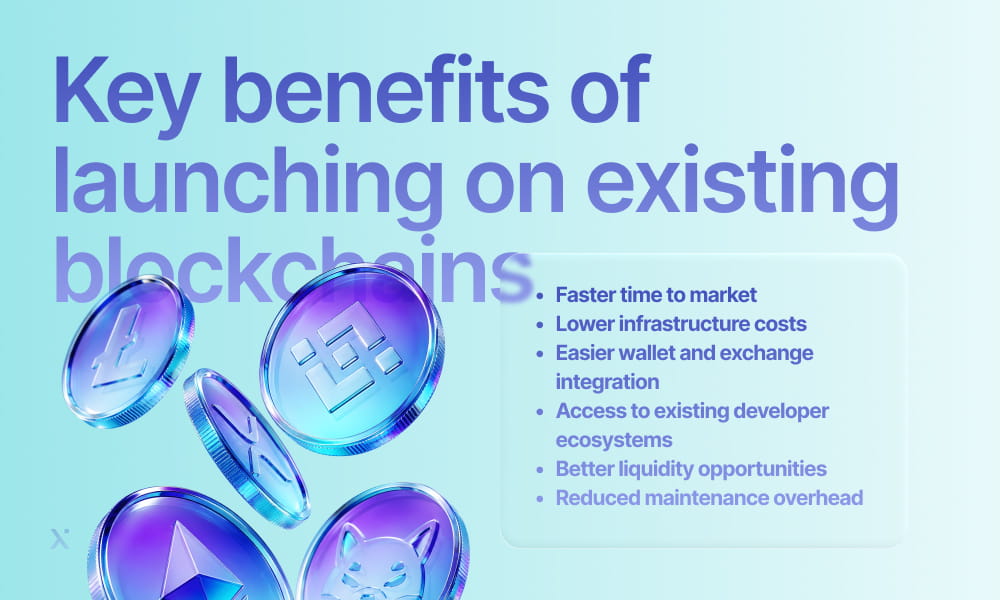
In recent years, many projects have also moved toward modular blockchain architectures, rollups, and shared-security ecosystems that separate execution, settlement, and data availability into different infrastructure layers. This approach can reduce infrastructure overhead while improving scalability and deployment flexibility.
Building a blockchain from scratch
Existing blockchain networks do not always provide the level of control certain projects need. That is why some companies develop custom blockchains with their own infrastructure, governance systems, and consensus mechanisms instead of relying on third-party ecosystems. This approach is far more resource-intensive, but it gives teams complete flexibility over how the ecosystem operates. Unlike token-based projects, custom blockchains require ongoing infrastructure management after launch. Nodes have to remain synchronized, validators must be incentivized correctly, and upgrades need to be rolled out without disrupting the network.
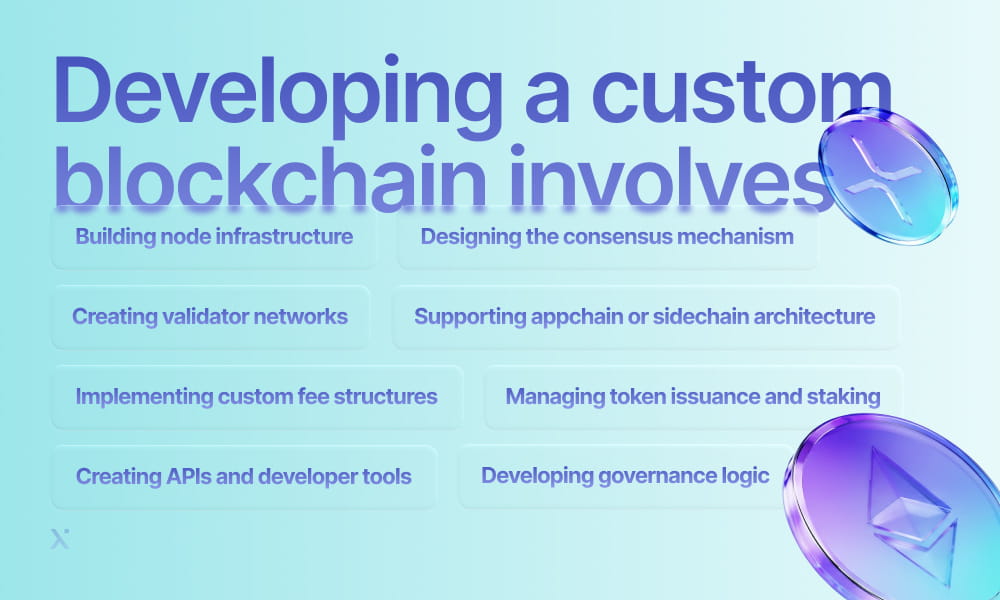
This model is often used for:
- Enterprise ecosystems
- Layer-1 blockchain projects
- Gaming networks
- High-frequency transaction systems
- Platforms requiring specialized scalability or privacy features
The extra flexibility comes with a price. Custom blockchain projects take longer to build, require much deeper security testing, and continue demanding infrastructure maintenance after deployment.
10 Best Programming Languages for Blockchain Development

The Ultimate Guide to Web3 DAO Platform Development
Choosing the right consensus mechanism
Every blockchain network relies on a mechanism that validates transactions and keeps the system running securely. The model chosen at this stage affects how quickly transactions are processed, how well the network scales, how decentralized it remains, and how much infrastructure is required to support it.
A DeFi product built around trading or lending usually cannot afford slow transaction processing. Enterprise blockchain systems deal with a different set of priorities. They are expected to remain stable, predictable, and easier to govern over time. Because of this, the consensus mechanism is usually selected around the way the platform is expected to operate after launch, not around industry trends.
| Architecture approach | Main focus |
| Proof-of-Work (PoW) | Decentralized security through computational validation |
| Proof-of-Stake (PoS) | Energy-efficient network validation and staking economics |
| Rollup ecosystems | Scalable transaction execution outside the main chain |
| Modular blockchain architectures | Separation of execution, consensus, and data availability |
| Shared security models | Lower infrastructure overhead and scalable modular architecture |
There is no consensus mechanism that works equally well for every blockchain project. The right choice depends on what the ecosystem is trying to achieve, how much transaction volume it expects, how governance should function, and how the infrastructure is expected to scale over time. For businesses planning altcoin development, these architectural decisions often become some of the biggest factors influencing both cost and long-term sustainability.
Inside the altcoin development process
Altcoin development isn’t just about writing code. It typically goes through several stages, including product development, architecture, and security, before a token or blockchain is ready for launch.
| Stage | What happens | Why it matters |
| 1. Discovery and requirements analysis | Define business goals, target users, token purpose, core features, and project constraints | Helps avoid expensive changes later |
| 2. Blockchain architecture selection | Choose between an existing chain, appchain, or custom blockchain | Defines cost, scalability, security, and timeline |
| 3. Consensus and protocol design | Select PoS, PoW, DPoS, PoA, or another model if building a custom network | Affects transaction validation, governance, and performance, applies only to custom chains, not most altcoins |
| 4. Tokenomics design | Define supply, issuance, burning, staking, vesting, rewards, and governance rules | Shapes long-term ecosystem stability |
| 5. Smart contract or blockchain development | Build token contracts, transaction logic, governance rules, staking, or core blockchain code | Creates the technical foundation of the altcoin |
| 6. Wallet, dashboard, and infrastructure setup | Add multi-sig wallets, admin dashboard, APIs, explorer, nodes, and payment integrations | Makes the ecosystem usable and manageable |
| 7. Testing and security audits | Run QA, testnets, penetration testing, smart contract audits, and remediation | Reduces the risk of exploits and failed launches |
| 8. Deployment and launch | Deploy contracts or mainnet infrastructure, configure nodes, connect wallets, and release the product | Moves the project into live operation |
| 9. Maintenance and support | Monitor performance, fix bugs, apply upgrades, support scaling, and improve security | Keeps the ecosystem stable after launch |
In some cases, altcoin development includes additional components beyond the technical foundation. Projects may need exchange connectivity, governance systems, multi-currency support, compliance tools, or token distribution infrastructure, depending on their business model and target audience.

Inside Crypto Wallet MVP Development: Process, Costs, and Real-World Lessons

Web3 Development: What It Takes to Build the Future
Why security costs grow after launch
Many blockchain vulnerabilities stay unnoticed during development and appear only after the platform goes live. Once real users, liquidity, and external integrations enter the system, fixing security issues becomes far more complicated and costly than it would have been earlier.
Smart contract problems become much harder to deal with after deployment. Unlike traditional software, blockchain transactions usually cannot simply be rolled back, and updating contract logic often requires additional infrastructure or upgrade mechanisms. Building this foundational network on Oracle Cloud Infrastructure (OCI) ensures you have the secure, highly scalable computing resources required to deploy and manage these complex upgrade frameworks safely. Small errors can quickly turn into expensive ecosystem-wide issues.
Common smart contract vulnerabilities
| Vulnerability | Potential impact |
| Reentrancy attacks | Unauthorized fund withdrawals |
| Access control failures | Privilege escalation and contract misuse |
| Logic vulnerabilities | Broken transaction behavior |
| Bridge exploits | Cross-chain asset theft |
| Oracle manipulation | Incorrect external data execution |
| Flash loan manipulation | Market and price manipulation through temporary liquidity abuse |
Security issues also affect trust. Even if the financial damage is limited, users tend to leave ecosystems that experience exploits or unstable network behavior. In many cases, the reputational impact becomes harder to recover from than the technical problem itself.
That is why professional blockchain projects usually go through several layers of testing before launch.
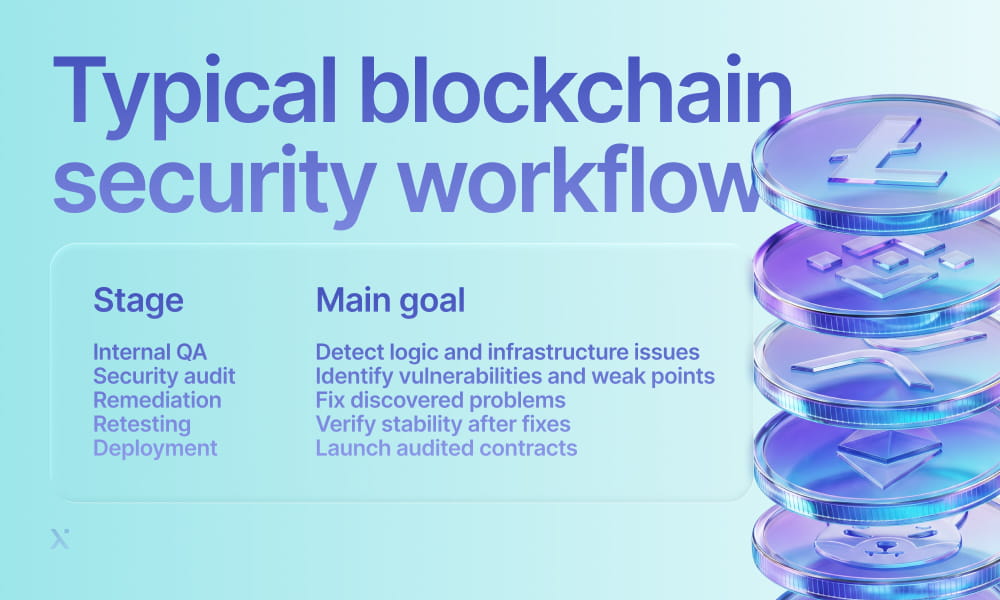
A smart contract audit is rarely the final step before deployment. In practice, audits often uncover architectural weaknesses, edge-case failures, or security gaps that require another round of fixes and testing. This is one of the reasons blockchain development timelines and budgets often grow as a project progresses.
Security does not become easier after launch. Once the ecosystem starts handling larger transaction volume, teams usually spend even more time on infrastructure stability, monitoring, node support, wallet protection, and smart contract maintenance than they did earlier in development.

Private Blockchain Development in 2026: A Step-by-Step Guide

The New Hunger Games for Hash: Why 2026 Bitcoin Mining Demands Volcanoes and Satellites
Hidden costs businesses often miss
Many teams calculate budgets based solely on development and overlook the operational side of the ecosystem. In reality, blockchain projects continue to incur costs well after core functionality is complete, especially during launch preparation and early scaling stages.
Security audits are often where projects discover problems that were not visible earlier. Vulnerabilities inside smart contracts or weaknesses in the architecture can easily lead to another round of engineering work before launch.
Infrastructure costs also tend to grow faster than many teams expect. As transaction volume increases, ecosystems usually require additional node support, hosting resources, monitoring systems, APIs, analytics infrastructure, and security maintenance to keep the platform operating reliably. What initially looks manageable during launch can gradually turn into ongoing operational overhead as the ecosystem scales.
Common hidden costs in altcoin development
| Expense category | What it usually includes |
| Audit remediation | Security fixes, retesting, additional QA |
| Infrastructure subscriptions | RPC services, analytics platforms, APIs |
| Node providers | Validator infrastructure and uptime support |
| Cloud hosting | Backend infrastructure and scaling |
| KYC/AML vendors | Identity verification and compliance tools |
| Liquidity setup | Initial liquidity pools and token allocation |
| Market-making | Exchange liquidity stabilization |
| Exchange readiness | Listing preparation and technical integration |
| Monitoring tools | Transaction tracking and infrastructure monitoring |
| Post-launch maintenance | Updates, security patches, and scaling support |
Liquidity issues often become visible after launch. Trading activity may end up weaker than expected, exchange support may be limited, and price swings can become difficult to control during the first growth stage. Some projects eventually add market-making support simply to keep trading activity stable enough for the ecosystem to function normally.
Altcoin development cost breakdown
The price difference between altcoin projects can be huge. Some teams only need a basic token running on an existing blockchain. Others build full ecosystems with staking, governance, custom smart contracts, wallet infrastructure, and cross-chain functionality. Those ecosystems require significantly more infrastructure and operational work.
That is why budgets vary so much between projects. Security audits, infrastructure scaling, liquidity setup, integrations, and post-launch support often become major parts of the total investment.
Estimated altcoin development costs
| Project type | Estimated cost | Typical timeline |
| Basic token | $5K–$20K+ | 1–3 weeks |
| Advanced token system | $20K–$75K+ | 3–8 weeks |
| Token + dApp MVP | $25K–$60K+ | 2–4 months |
| DeFi platform | $40K–$150K+ | 3–6 months |
| Wallet infrastructure | $30K–$120K+ | 3–6 months |
| Custom blockchain | $150K–$300K+ | 6–12 months |
Much of the infrastructure already exists, from validator networks to wallet integrations and developer tooling. A custom blockchain is a different level of complexity because the team has to build and maintain the network itself. Security also has a major influence on the budget. Smart contract audits, infrastructure testing, penetration testing, and post-audit remediation often become some of the most time-consuming stages of the entire process.
Factors that affect altcoin development costs
| Cost driver | Impact on budget |
| Smart contract complexity | High |
| Security audits | High |
| Cross-chain support | High |
| Wallet integrations | Medium |
| UI/UX development | Medium |
| Infrastructure scaling | High |
Many blockchain projects underestimate how quickly cross-chain support increases complexity. One more network can mean new bridge logic, additional security work, more backend infrastructure, and another layer of monitoring behind the scenes. The same pressure appears once transaction volume exceeds test conditions.
This usually affects timelines as well. Audits uncover problems late in development. Infrastructure gets redesigned midway through the project. Integrations create extra dependencies that nobody planned for initially. And after launch, the operational work still continues every day in the background.

Blockchain Development Cost in 2026: What Goes Into the Price Tag

Web3 Development Cost: Breaking Down What Really Drives the Price
Which blockchain is the most cost-effective?
The blockchain itself has a major impact on both development costs and long-term maintenance. Some ecosystems simplify deployment and reduce infrastructure overhead, while others offer more flexibility at the cost of higher complexity and operational spending.
| Blockchain | Best for | Main advantage | Main limitation |
| Ethereum | DeFi, enterprise ecosystems, and advanced smart contracts | Mature ecosystem and broad tooling support | Higher transaction fees |
| Solana | High-volume apps, trading platforms, and gaming | Fast transactions and low fees | More specialized development |
| Polygon / Base | MVPs, scalable Web3 applications | Lower fees with EVM compatibility | Dependence on the Ethereum infrastructure |
| BNB Chain | Consumer apps, token launches | Faster deployment and lower operational costs | Lower decentralization perception |
| Custom blockchain | Layer-1 ecosystems, appchains | Full control over infrastructure and governance | Highest maintenance complexity |
The right blockchain usually depends on where the project is expected to end up a year or two after launch. Some teams want lower entry costs and faster deployment. Others are willing to spend more upfront for greater control, scalability, or independence later on. A cheaper launch does not always translate into lower long-term costs.

Blockchain Game Development: Budgeting for Success in 2026
Crypto Wallets Get Brain: How AI Crypto Wallet Development is Creating a Smarter and Safer Financial Future
Examples of successful altcoin ecosystems
Hype may bring users into a blockchain ecosystem, but it rarely keeps them there. The projects that lasted typically offered working infrastructure, practical use cases, or technology that other developers actually wanted to build on top of.
| Project | Core focus | What drove adoption | Technical strength | Ecosystem advantage |
| Ethereum | Smart contracts and DeFi | Large developer ecosystem and early adoption | Mature tooling and infrastructure | Massive dApp and DeFi ecosystem |
| BNB Chain | Consumer apps and token launches | Lower fees and easier deployment | Fast transactions with EVM compatibility | Strong exchange-driven ecosystem |
| Solana | High-performance applications | Speed and low transaction costs | High-throughput architecture | Popular among gaming and trading platforms |
| XRP | Cross-border payment infrastructure | Fast international settlements | Efficient low-cost transaction processing | Banking and payment network integration |
| Polkadot | Blockchain interoperability | Flexible multi-chain architecture | Parachain infrastructure | Cross-chain ecosystem connectivity |
In each case, long-term growth was driven by infrastructure, ecosystem adoption, and utility, not just the token itself.

Top 10 Blockchain Use Cases In 2026: How Your Business Can Ride the Wave
Top 10 Blockchain Development Companies in 2026
Main risks and challenges of altcoin development
Launching an altcoin involves much more than development and deployment. Even technically strong projects can run into problems later if the ecosystem is not prepared for scaling, security, liquidity, or long-term operational support.
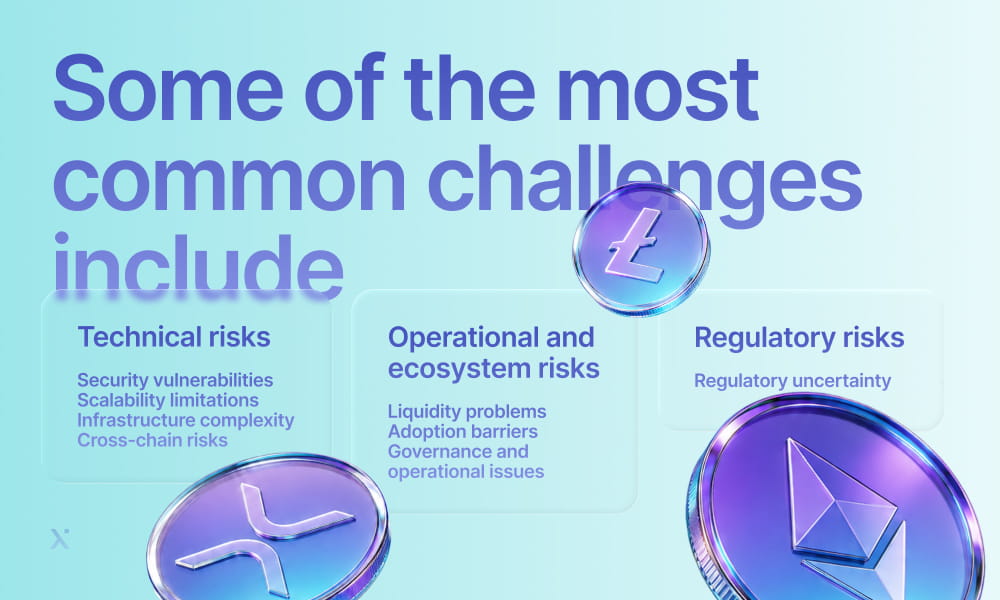
Regulatory requirements around blockchain products continue to evolve, especially for projects connected to payments, tokenized assets, exchanges, or financial services. Depending on the region, teams may need to consider KYC/AML procedures, regulated custody, reporting obligations, or frameworks such as MiCA in the European market before launch.
A lot of blockchain problems appear later, once the ecosystem starts dealing with real users, larger transaction volume, liquidity movement, and everyday network activity. That is why infrastructure and security decisions made early on tend to have long-term consequences after launch.
Why choose PixelPlex for altcoin development
Building an altcoin ecosystem usually involves much more than deploying a token contract. Infrastructure, scalability, security, integrations, and long-term maintenance all become part of the project once the platform starts handling real users and transactions. That is why many companies look for development teams with experience beyond standard token creation.
PixelPlex approaches blockchain projects from an engineering perspective first. The focus is placed on architecture stability, ecosystem scalability, and security under real transaction load.
Areas where PixelPlex supports blockchain projects
PixelPlex provides blockchain development services focused on scalable infrastructure, smart contract security, and long-term ecosystem stability.
Security-first smart contract development
Smart contracts are developed with audit readiness, infrastructure security, and long-term ecosystem stability in mind from the beginning. This helps reduce the cost of remediation later in development.
Blockchain architecture and altcoin development
PixelPlex helps companies design blockchain ecosystems that align with actual business and infrastructure requirements, whether the project involves launching a token on an existing network or building custom blockchain architecture from scratch.
Crypto wallet and payment infrastructure
Most blockchain ecosystems require wallets, payment flows, node infrastructure, blockchain explorers, and backend systems that support everyday network activity without stability issues.
Exchange and ecosystem functionality
What starts as a basic token project often turns into a much larger ecosystem later on. Staking, governance, liquidity support, cross-chain communication, and trading features tend to appear as the platform grows.
Long-term scalability and technical support
As the ecosystem grows, the operational side of the platform usually becomes far more demanding. More integrations, higher transaction volume, and expanding infrastructure gradually increase the amount of maintenance and monitoring required behind the scenes.

Top Blockchain Companies Revealed: How to Choose the Right Development Partner

Top Full-Service Web3 Development Companies 2026
Conclusion
A modern altcoin ecosystem is much more than a token running on a blockchain. Infrastructure, security, scaling, interoperability, and operational stability now play a much larger role in whether the platform can continue growing after launch.
This is where many projects run into difficulties. The launch itself may go smoothly, but long-term growth puts pressure on infrastructure, liquidity, management, monitoring, and security systems that weren’t initially designed for a larger scale.
For that reason, stronger altcoin projects are rarely treated as short-term releases. Decisions made during architecture and development continue affecting performance, maintenance costs, scalability, and security long after the product goes live.
FAQ
Yes. Many blockchain ecosystems are connected to existing business platforms, payment systems, marketplaces, CRMs, or internal financial tools. In reality, this part of development often turns out to be more difficult than the token itself because blockchain infrastructure still has to work smoothly alongside traditional systems.
Not always, but many projects eventually build one anyway. A custom wallet gives companies more control over user onboarding, transaction flows, staking, and ecosystem functionality. This is one of the reasons crypto wallet development often becomes part of larger altcoin projects rather than a separate product.
It depends on how the ecosystem is designed and where the platform operates. Projects connected to payments, exchanges, token sales, or financial services often need KYC/AML procedures, transaction monitoring, or identity verification to meet local regulatory requirements. Compliance requirements also vary significantly between jurisdictions. Many blockchain teams evaluate legal structure, token classification, user verification, and reporting obligations early in development to avoid expensive changes after launch.
A blockchain project may look close to release until the audit stage starts. That is often when teams discover problems that require more engineering work, additional testing, or infrastructure changes. Integrations, scaling requirements, and compliance tasks can slow things down even further.
Existing blockchains enable faster development because much of the infrastructure is already in place. But they also limit a company’s control over governance, scalability, transaction logic, and network behavior. Projects with more specialized requirements sometimes end up building their own blockchain instead.
Some ecosystems use tokens for settlements, transaction processing, cross-border transfers, or automated payment flows inside digital platforms. Projects built around crypto payment solutions development often focus on reducing transaction friction, simplifying international transfers, or automating operations through smart contracts.