
Healthcare IT still has some very basic problems. Patient data is spread across multiple systems that don’t connect well. A hospital, a lab, and an insurance provider often work with separate records. Moving that data takes time, and sometimes it doesn’t happen at all. That affects both speed and quality of care.
Security is still a weak spot. Most systems keep data in one place, which makes them easier targets. If something goes wrong, a single breach can expose a huge amount of sensitive information. On top of that, patients rarely know who is using their data or why.
Because of this, the industry is starting to move away from traditional models. Decentralized approaches are getting more attention, not as a trend, but as a way to solve long-standing issues.
This is where partnering with an experienced enterprise blockchain consulting company to deploy bespoke Web3 development services become relevant. It changes how data is handled. Instead of being stored and controlled in one place, information is distributed, access is transparent, and actions can be automated through smart contracts. Patients can manage permissions, while providers can trust the integrity of the data they receive.
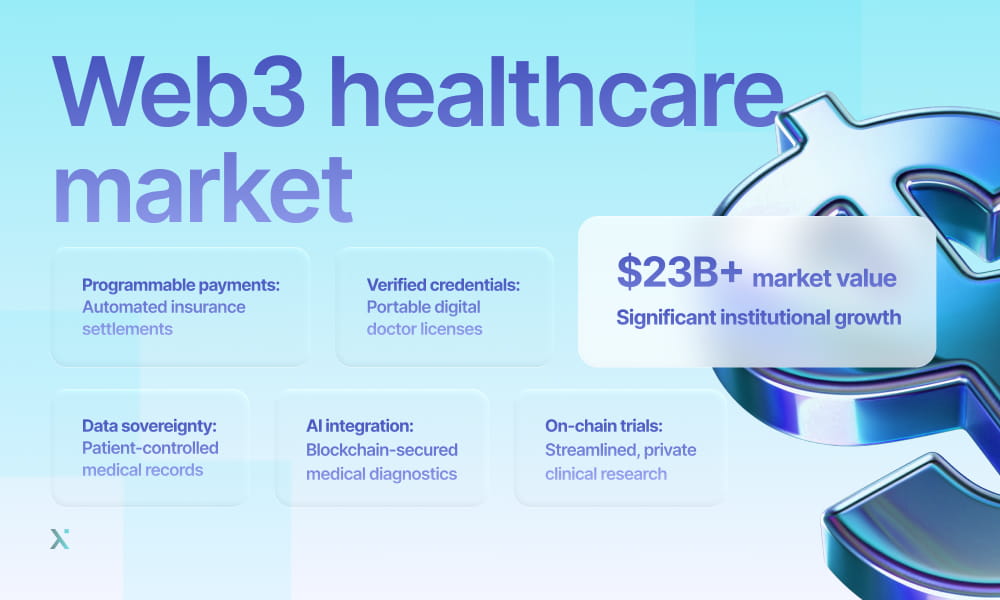
Web3 is already making its way into healthcare. Patients manage data access on some platforms. Clinical trials use blockchain to keep information reliable. System access is handled through decentralized identity. These solutions are live and working.

Web3 Development: What It Takes to Build the Future

Popular Web3 Hacks Analysis and Prevention Tips
Why Web3 matters in healthcare
In today’s systems, patient data is basically held by providers. If someone needs access, it goes through them, not the patient. Most people don’t even know who’s using their data or why.
With Web3, the situation changes quite simply. Patients themselves decide who to grant access to, and can just as easily revoke it. This isn’t an optional feature added later; it’s been part of the system from the very beginning.
Interoperability without friction
Healthcare systems don’t really interoperate with each other. Each healthcare provider maintains its own data, so even simple information exchange requires additional effort or individual integration. This is why the same information is often duplicated or transmitted with delays.
Web3 takes a different route. Instead of moving data back and forth, providers can work with a shared layer. The data stays consistent, and access becomes much simpler.
Data integrity that you can verify
Medical data has to be right. But in regular systems, it’s not always clear if something was changed or when. Sometimes it takes extra effort just to double-check it.
Integrating blockchain in healthcare handles this in a much more straightforward way. Once data is written, you can’t quietly edit it. Any change shows up. That’s why records, prescriptions, and test results are easier to trust.
Automation through smart contracts
A lot of things in healthcare still run by hand. Claims, patient consent, and even simple data sharing often go through several people and take time.
Smart contracts cut out a lot of that back-and-forth. Once the rules are set, the system just does the job. No chasing approvals, no extra steps. It makes the whole process faster and leaves less room for mistakes.
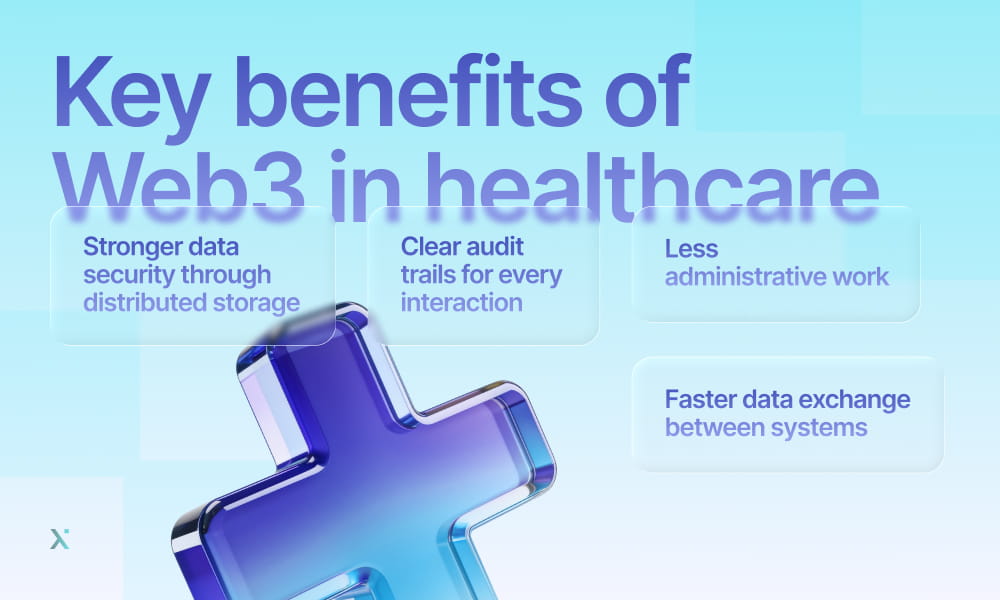
This isn’t theoretical. These changes deal with the same problems healthcare teams run into every day. You can see the difference more clearly when you compare how things work today and how they look in a Web3 setup.
Traditional vs. Web3 healthcare challenges
| Challenge | Web2 approach | Web3 approach |
| Data ownership | Controlled by providers | Controlled by patients |
| Interoperability | Limited, system-specific | Built to work across systems |
| Security | Centralized, high risk | Distributed, harder to compromise |
| Trust | Based on institutions | Based on code and verification |

Healthy Data, Happy Patients: A Masterclass in Blockchain Healthcare App Development

Artificial Intelligence Applications in Healthcare
Web3 vs. Web2 in healthcare systems
The difference between Web2 and Web3 in healthcare isn’t just technical. A Web3 consulting company understands how it affects system architecture, data movement, and control.
Web2 systems are built in a pretty standard way. Data sits on central servers, access is handled inside the system, and APIs connect different parts. It works, but it’s not very flexible. Everything depends on one control point, which makes scaling or sharing data slower than it should be.
Web3 takes a different approach. There’s no single system in charge. Data and control are spread across the network. Access is linked to a user’s wallet, and a lot of actions can run on their own through smart contracts. It changes how systems handle trust and security.
Here’s how that looks in practice:
| Feature | Web2 | Web3 |
| Architecture | Centralized | Decentralized |
| Data storage | Stored on servers | Blockchain + decentralized storage |
| Access control | Managed by roles | Managed through wallets |
| Automation | API-based | Smart contract-based |
| Compliance | Handled manually | Built into system logic |
This shift isn’t about replacing one stack with another for the sake of it. It’s about removing bottlenecks caused by central control and making systems easier to trust and scale.

How to Enable Healthcare Digital Transformation
Healthy Data, Happy Patients: A Masterclass in Blockchain Healthcare App Development
Real-world Web3 healthcare use cases
Web3 works best in healthcare when several parties need access to the same information, but no one wants to rely entirely on someone else’s system. That’s why most successful applications are tied to data sharing, verification, and identity management.
Medical record management
Medical records are still spread across different systems. A hospital has one version of the data, a lab has another, and insurance providers keep their own records. Because of that, patients often end up filling out the same forms again or requesting documents manually.
The idea behind Web3 is to reduce all that duplication. Rather than keeping separate copies everywhere, systems can work through a shared access model. Patients stay in control of access, while providers get more reliable information.
This helps reduce:
- Duplicate records
- Delays in data exchange
- Manual verification work
Clinical trial data tracking
Clinical trials generate huge amounts of sensitive data, and keeping that data accurate is critical. Even small inconsistencies can create compliance issues or affect research results.
Blockchain adds traceability to the process. Once trial data is recorded, every update becomes visible and time-stamped. That makes it much harder to alter information without leaving a record behind.
For research teams, this means:
- Clearer audit trails
- Better data integrity
- Easier compliance reporting
Drug supply chain verification
Counterfeit drugs remain a serious problem in global medical supply chains. Tracking products between manufacturers, distributors, and pharmacies is not always a simple task.
Blockchain makes it easier to track where medication has been and who handled it along the way. Every transfer gets recorded, so it’s much simpler to confirm where a drug came from and spot problems during transportation or storage.
This is especially useful for:
- High-value medications
- Temperature-sensitive products
- International supply chains
Telemedicine and digital identity
Telemedicine platforms deal with a lot of sensitive information, so secure access matters. The problem is that traditional login systems are often one of the weakest parts of the setup.
Web3 moves identity away from centralized systems. Users control their credentials through wallets or encrypted identity layers, while platforms only get the information required for verification.
This makes remote healthcare platforms:
- More secure
- Easier to manage across providers
- Less dependent on password-based access systems
Most successful Web3 healthcare software development projects follow the same principle: solve a specific operational problem first, then build the blockchain layer around it.

Top 10 Blockchain Use Cases In 2026: How Your Business Can Ride the Wave
What is Web3? Notable Use Cases
Successful Web3 healthcare solutions
Web3 in healthcare is not starting from scratch. A few projects have already tested these ideas in real conditions. Some gained traction, others showed what works and what doesn’t. Looking at them helps to understand where the value actually comes from.
Medicalchain
Medicalchain focused on one of the biggest issues in healthcare: fragmented medical records. The platform allows patients to store their health data and share it with providers when needed.
The platform succeeded by focusing on access control. Instead of trying to redesign the entire healthcare system, Medicalchain solved an obvious problem: who owns medical data and who has access to it. Using blockchain makes access transparent while ensuring record consistency.
Patientory
Patientory built a system for managing health information across different providers. It combines blockchain with secure storage and gives users a single place to manage their data.
The key strength is usability. Many blockchain projects struggle with real adoption, but Patientory focused on making the system usable for both patients and providers. It shows that technology alone is not enough; the product has to fit into existing workflows.
BurstIQ
BurstIQ went a bit further than just storing data. It built a platform where healthcare data can be shared, analyzed, and managed across different parties.
The platform focuses heavily on controlled data exchange. Data isn’t just stored; it can be shared in a controlled way between organizations. That’s especially useful for research, AI, and any kind of collaboration.
These examples illustrate a common pattern. Web3 is effective in healthcare when it addresses a specific problem rather than trying to replace everything at once.
- Focus on data ownership and access
- Build around real workflows
- Keep user experience simple
- Use blockchain where it adds value, not everywhere

Top Blockchain Companies Revealed: How to Choose the Right Development Partner
PixelPlex and the ICP Alliance Are Teaming Up to Build the Future of Web3
How Web3 healthcare software development works
Developing a medical product on a Web3 platform typically begins well before the actual development. Teams first need to understand how data will flow within the system, what compliance rules the system has to meet, and where blockchain truly makes sense.
1. Discovery and compliance analysis
This stage defines the foundation of the project. Teams gather requirements, map user flows, and analyze regulations like HIPAA or GDPR.
At this point, developers also decide:
- What data can go on-chain
- What should stay off-chain
- How patient access will work
- What integrations are needed
In healthcare, these decisions affect almost everything later on.
2. Architecture design
Web3 healthcare systems are usually split into two parts: blockchain infrastructure and off-chain storage.
Blockchain handles:
- Permissions
- Transaction history
- Smart contracts
- Verification logic
Off-chain systems store large or sensitive medical files.
The goal here is balance. Putting everything on-chain is expensive and impractical, especially in healthcare.
3. Smart contract development
Smart contracts automate routine actions inside the platform.
They can handle:
- Patient consent
- Access permissions
- Insurance workflows
- Secure data sharing
Once the conditions are met, the action happens automatically. This removes a lot of manual coordination.
4. Frontend and wallet integration
Even if the backend is based on blockchain, users still expect the product to be easy to use.
At this stage, teams build:
- Dashboards
- Patient portals
- Provider interfaces
- Authentication flows
- Wallet connections
Most users should barely notice blockchain working underneath the system.
In many healthcare products, wallet functionality is integrated into the authentication layer, especially in systems built around decentralized identity and controlled data access. This often requires custom Web3 wallet development rather than standard crypto wallet integrations.
5. Security testing and audits
Healthcare and blockchain are both sensitive environments, so security testing becomes critical.
This stage usually includes:
- Smart contract audits
- Penetration testing
- Infrastructure checks
- Compliance validation
One overlooked vulnerability can expose both patient data and platform logic.
6. Deployment and scaling
After launch, the platform still needs ongoing support.
Teams continue working on:
- Infrastructure monitoring
- Performance optimization
- Scaling
- Updates and patching
- Security maintenance
As the number of users grows, the system has to remain stable without slowing down access to data.
Most projects also include additional planning around HIPAA and GDPR compliance, blockchain network selection, tokenomics if tokens are part of the product, and integration with legacy healthcare systems.
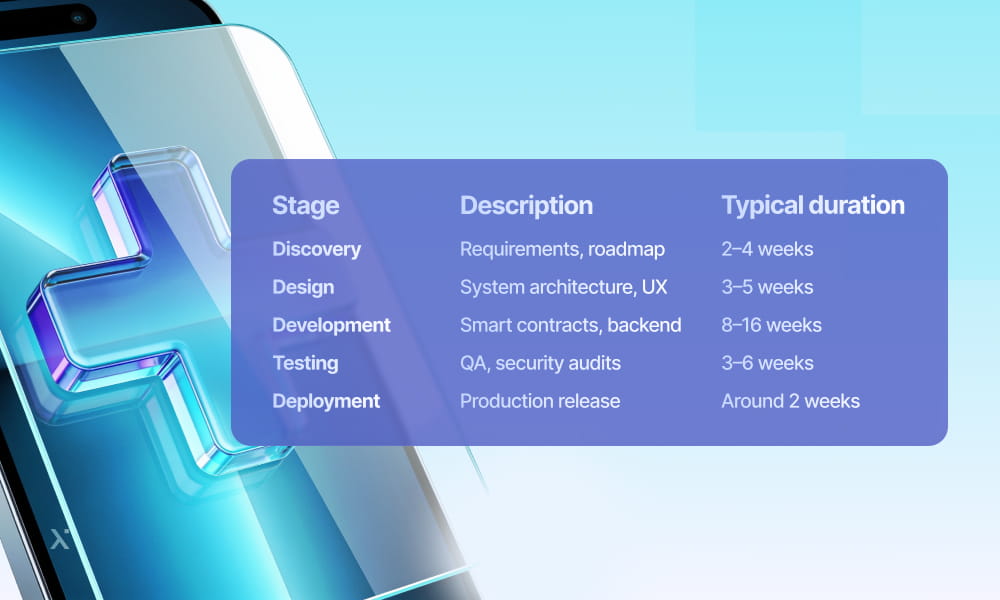
Development stages breakdown

A Comprehensive Guide to Blockchain Application Development

10 Best Programming Languages for Blockchain Development
What does Web3 healthcare development cost?
The cost of a Web3 platform for healthcare depends on more than just functionality. Healthcare products have more stringent security and compliance requirements and present integration challenges than most Web3 applications.
A simple MVP and an enterprise-grade platform can differ significantly in both architecture and development effort.
Estimated development costs
| Complexity | Features | Estimated cost |
| MVP | Basic medical records, wallet login | $60K–$120K |
| Mid-level platform | Smart contracts, integrations, and user roles | $120K–$300K |
| Enterprise solution | Full ecosystem, AI modules, compliance infrastructure | $300K+ |
These numbers can vary (depending on integrations and compliance scope), but they give a realistic picture of what Web3 healthcare projects usually cost.

Planning Web3 App Development Cost: Team, Timeline, And Hidden Expenses

Web3 Development Cost: Breaking Down What Really Drives the Price
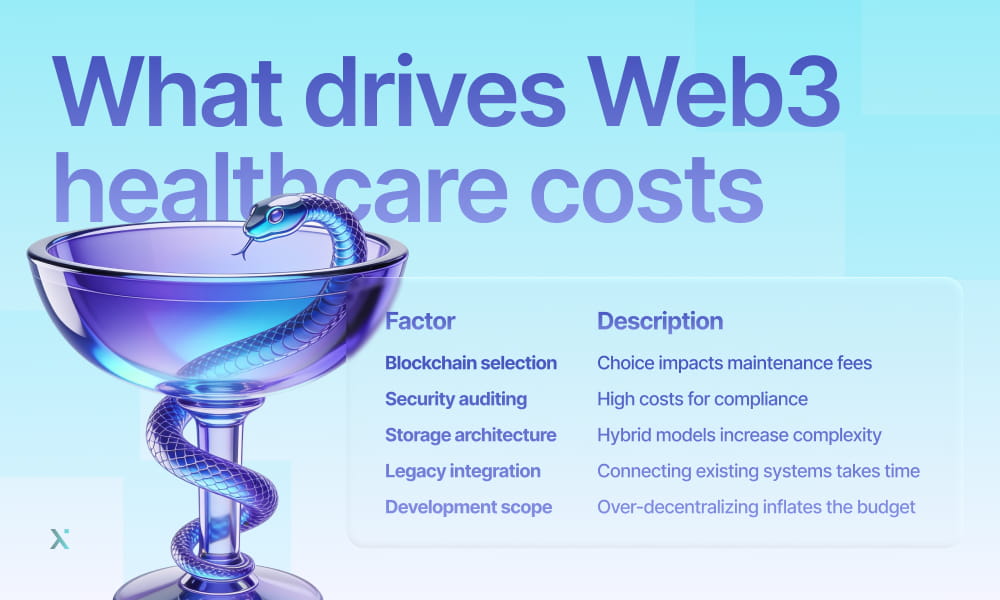
What affects the final cost
Blockchain choice
The blockchain itself impacts both development and long-term maintenance costs.
For example:
- Ethereum offers a mature ecosystem but higher transaction fees.
- Polygon reduces costs and improves scalability.
- Hyperledger is often chosen for private healthcare environments.
The right option depends on privacy needs, transaction volume, and system architecture.
Security requirements
Healthcare software can’t afford weak security. Smart contract audits, penetration testing, encryption, and compliance checks add both time and cost to development.
In many projects, security becomes one of the largest parts of the budget.
Data storage model
Most healthcare platforms use a mix of on-chain and off-chain storage.
Blockchain is usually reserved for:
- Verification
- Permissions
- Transaction records
Sensitive medical files are typically stored separately in secure databases or decentralized storage systems like IPFS.
The more complex the storage architecture is, the higher the development cost becomes.
Integrations with existing systems
Very few healthcare companies build systems from scratch. Most need integrations with:
- EHR/EMR platforms
- Payment systems
- Insurance infrastructure
- Hospital databases
- Analytics tools
Integrations usually take more time than planned because most legacy healthcare systems were never built for decentralized technology.
The biggest cost mistake companies make is trying to add blockchain everywhere. In practice, successful Web3 healthcare software development focuses on specific problems where decentralization actually improves the product.
Rules around blockchain and medical data are evolving, legacy systems are difficult to integrate with, and scaling can become an issue over time. On top of that, many users are not familiar with Web3 tools yet.
Complete Guide to Web3 Wallet Development and Its Costs

The Power of Blockchain for Startups: Advantages and Use Cases
What comes next for Web3 healthcare
Healthcare is not going to switch to Web3 overnight. Adoption will most likely happen step by step, especially in parts of the system where data exchange and identity verification are still difficult to manage.
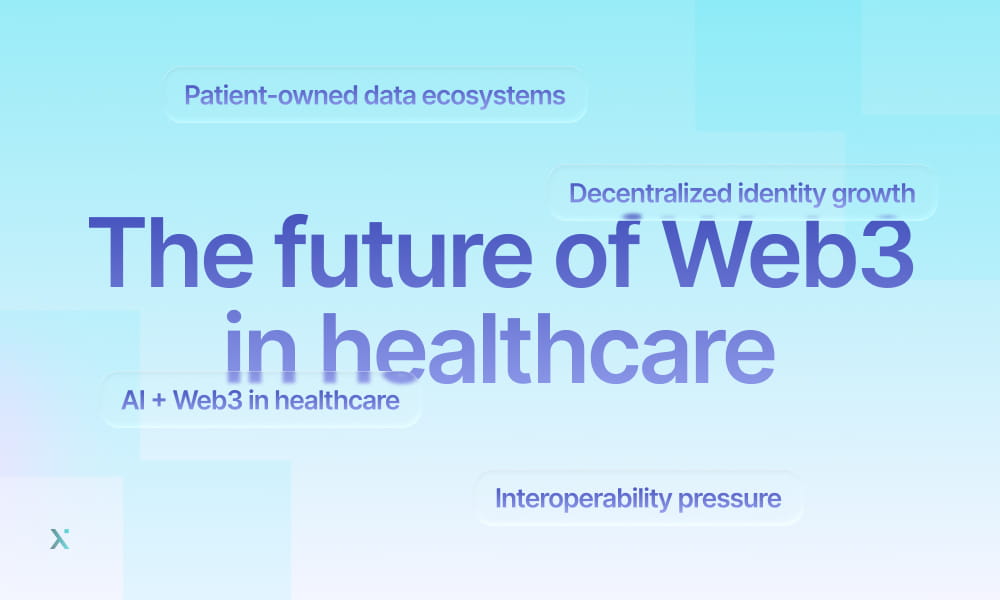
AI adoption will likely increase demand for reliable healthcare data infrastructure. Healthcare companies need large amounts of reliable data to train models, and that creates more pressure around transparency, consent, and access control. Patient-owned data ecosystems and decentralized identity systems are likely to become more common as interoperability requirements continue to grow.
The direction is becoming clearer: healthcare systems need better ways to share data securely without giving up control over it. That’s where Web3 is starting to fit in.

Chatbots in Healthcare: New Wave of AI

Agentic AI in Healthcare: EVERYTHING You Need to Know
Why companies choose PixelPlex for Web3 healthcare app development
Healthcare projects on Web3 come with a different level of complexity. Teams have to think about security, compliance, and integrations from the very beginning, not later in development.
That’s why experience matters here, especially experience beyond blockchain alone.
PixelPlex has been working with blockchain technologies for more than 15 years, helping companies build secure products across healthcare, fintech, supply chain, and other heavily regulated industries. Our team works on the full development cycle, from architecture planning to deployment and long-term support.
In healthcare projects, the most important factor is usually not the blockchain itself, but how well the system fits into real-world workflows. This includes:
- Secure data handling
- Stable infrastructure
- Integration with existing healthcare platforms
- Scalable architecture
- User-friendly interfaces for both patients and providers
PixelPlex approaches Web3 app development with that in mind. Instead of forcing decentralization into every layer, we focus on where it actually improves the product.
For healthcare companies exploring engagement-focused products, Web3 mechanics can also be combined with gamified wellness platforms and Web3 loyalty systems.
Security remains a major part of every delivery process. Smart contract audits, infrastructure protection, access management, and compliance planning are built into development from the beginning, not added later as separate services.
From MVPs to enterprise healthcare platforms, PixelPlex helps companies move from Web3 concepts to products that can operate in real environments.

Top Full-Service Web3 Development Companies 2026

Top 10 Blockchain Development Companies in 2026
Conclusion
Healthcare systems are under pressure to become more connected, secure, and transparent, but traditional infrastructure was not built for that level of coordination. Web3 is not a universal fix, and it does not need to replace everything that already exists. What it can do is solve specific problems around data access, trust, and interoperability in ways that older systems struggle to handle.
Companies that benefit most from Web3 in healthcare tend to use it selectively to improve workflows, reduce friction, or give patients greater control over their data. This hands-on approach will likely define the next stage of Web3 app development services.
FAQ
Yes. A lot of healthcare platforms use blockchain without involving crypto payments or public tokens at all. The focus is usually on secure data sharing, identity management, and tracking access to information.
This is possible, especially for products built on data exchange, patient access to information, or digital identification. Many startups start with a small MVP instead of a full-fledged decentralized ecosystem and gradually expand the blockchain layer.
It’s critical. Healthcare professionals and patients are unlikely to adopt a platform if basic interactions feel complicated. That’s why many projects invest heavily in Web3 website development to make patient portals, dashboards, and onboarding flows feel familiar and easy to use.
Yes. AI systems need large amounts of reliable data, and that creates challenges around access, transparency, and permissions. Blockchain can help track where data comes from and who is allowed to use it.
Some companies are starting to explore this approach. Health apps, rehabilitation platforms, and preventative medicine programs are increasingly using reward mechanisms to increase user engagement. In these cases, Web3 game development concepts can be applied to create tokenized incentives, achievement systems, or long-term participation models.
Trying to decentralize everything at once. The strongest projects usually focus on one operational problem first, such as identity management, secure data sharing, or auditability, and build from there.