Our Canton blockchain development covers private financial workflows, tokenized assets and the apps around them. Get Daml contracts, wallet connections and a launch plan owned by one engineering team.
Daml contracts and audits
Wallets and CIP-0103 connection
Validators and participant nodes
Data, monitoring and compliance
Product and network operators
Proof from products and network operations
PixelPlex builds and operates products on Canton. That gives your team a partner responsible for live releases, wallet behavior and network operations.
4 + 1
Featured Apps and an asset issuer
We run four Featured Apps and an asset issuer on MainNet, so release plans account for live operations.
6
Validator nodes we operate
We operate six validator nodes, so upgrades, traffic top-ups and node monitoring are routine work for our team.
250K+
Console Wallet registered users
We built and run Console Wallet, bringing tested signing and release practices to your project.
CIP-0103
Co-authored with Digital Asset
We co-wrote the dApp Standard, approved on 29 January 2026, which lets apps use any compliant wallet.
A dedicated Canton team covers Daml contracts, integrations, audits and node operations in one scope.
Member
Canton Foundation
As a General Foundation Member, we work on CIPs and are an alternate voting member of the Accountability Committee.
Canton clients
Agreements, code and operations
What is Canton blockchain development?
Canton blockchain development is building apps on the Canton Network with Daml smart contracts that encode who signs, sees and acts. Canton Network development services cover the nodes that host parties, plus wallets, tokens and data.
Daml smart contracts
Templates record agreements. Choices let designated controllers act under the ledger’s authorization rules.
Nodes and synchronizers
Participant nodes store only their parties’ contracts. Synchronizers order encrypted messages without reading them.
Wallets, tokens and data
CIP-0103 connects wallets without moving keys. CIP-56 is the token standard. Indexed data serves users and operators.
Network and workflow planner
Plan your build before the first line of Daml
Compare network ownership, test bond-for-cash settlement and assign operating duties before scoping the release.
Network and settlement planInteractive tool
Build planner
Explore the screens
Choose the operating boundary
Decide who runs the network
Weigh shared settlement against dedicated infrastructure and a hybrid route to test.
Design decision
Pick a network model
Who connects, who orders, who pays
Your partiesOn any validator
Global SynchronizerRun by Super Validators
TrafficPaid in Canton Coin
Any party on Canton can trade with yours. The sending node pays traffic in Canton Coin, and Featured Apps earn rewards on the activity they create.
Who connects, who orders, who pays
Invited partiesKnown members only
Your synchronizerRun by you or a group
RulesSet by its operators
You decide who joins and who runs the sequencer and mediator. Fits a consortium or one institution with known members and data residency rules.
Who connects, who orders, who pays
Your partiesOne identity on both
Your synchronizerPrivate workflows
SettlementOn the global network
Trades are built on your synchronizer and settle on the global one. Canton 3.5 still marks multi-synchronizer support as alpha, so we pilot it on TestNet first.
Global Synchronizer
Who runs the synchronizer
Super Validators operate it under Canton Foundation governance.
Who can join
Register parties through an approved validator host, your own or a provider.
What each party sees
Parties see authorized contracts, not every trade on the shared network.
What you pay for
The sending node pays for traffic in Canton Coin by payload size and recipient count.
Fits
Apps needing shared settlement across the public network.
Private synchronizer
Who runs the synchronizer
Your organization or appointed operators run sequencer and mediator nodes.
Who can join
Known parties join under your access rules, using shared party identities.
What each party sees
The same sub-transaction privacy applies. Messages stay on infrastructure you choose.
What you pay for
Your operator funds infrastructure, backups and upgrades.
Fits
High-volume flows with known firms or data residency requirements.
Hybrid
Who runs the synchronizer
Dedicated operators run the private sequencer and mediator.
Who can join
The same party identities work on both connected synchronizers.
What each party sees
Parties see only permitted data when a private trade moves to the Global Synchronizer.
What you pay for
Budget for dedicated infrastructure and public-network settlement traffic.
Fits
Consortia settling with outside parties. Alpha in Canton 3.5, so pilot on TestNet.
Check both sides of the trade
Keep delivery and payment together
Check permissions, then try a trade whose cash leg cannot complete.
Ready to settleNothing settledSettled
1,000 bonds for cash
Delivery versus payment on Canton
WorkflowDvP settlementBoth signed
SynchronizerGlobal Synchronizer
SignatoriesSeller and buyer
SignaturesBoth parties authorize their part of the trade.
PrivacyOnly authorized parties see their permitted trade data.
Atomic settlementCash and bonds move in one committed transaction.
Both legs are funded and both parties signed. The trade is ready to settle in one transaction.
What each party sees
The same trade, three different views. Canton shares each part only with the parties in it.
Seller and buyer
Both legs, because they signed the trade and each leg involves them.
Registrar and cash issuer
Only the leg they record: the bond transfer or the cash payment.
Every other party
Nothing. Their nodes never receive the trade data.
Assign the work after launch
Give every operational duty an owner
Assign traffic funding and reporting duties before users depend on the app.
After launch
Validator and node upkeep
Assign an owner for access controls, backups and recovery before accepting client activity.
Traffic and Canton Coin
Assign a funding owner so an empty traffic balance does not stall submissions.
Featured App obligations
Keep the Canton Coin lock above the threshold. Report after the first month, then quarterly.
Monitoring and compliance
Route failed commands and risk flags to staff with the access needed to investigate.
We build web and mobile apps with back ends on the Ledger API. Connect business instructions to permitted commands and return readable outcomes to users.
Our dApp development covers the user workflow as well as command submission and failure handling.
04
Wallets and CIP-0103 connections
Connect user wallets and institutional signing providers through one standard interface. Decide who approves commands without tying the app to one wallet.
Model issuance, transfer approval and redemption in Daml. Set transfer rules before launch so supported wallets can handle the asset.
Use our tokenization solutions to scope issuer permissions and holder eligibility before coding.
06
Validators and participant nodes
We prepare the sponsor request and approvals, then set up party hosting, traffic top-ups and upgrades. Since April 2026, validators earn from paid traffic.
Canton Loop paired the wallet with an integrated validator node we delivered.
07
Featured App launch
Prepare the launch evidence, audit status and transaction controls for review. Institutional applicants also need two customer referrals.
CC View has held Featured App status since 1 December 2025.
08
Interoperability and integration
Choose between LayerZero, Chainlink CCIP and USDCx via Circle’s xReserve. We compare release authority and pool custody before integration.
Use MVP development to validate one agreement flow with real participants before committing to the integrations and operating scope of a wider release.
Products we own and operate
Products that keep our engineers accountable
Operating our own Canton products exposes the decisions clients face after launch. We bring that experience into data access, signing flows and operational handover.
Explorer and data APIFeatured App
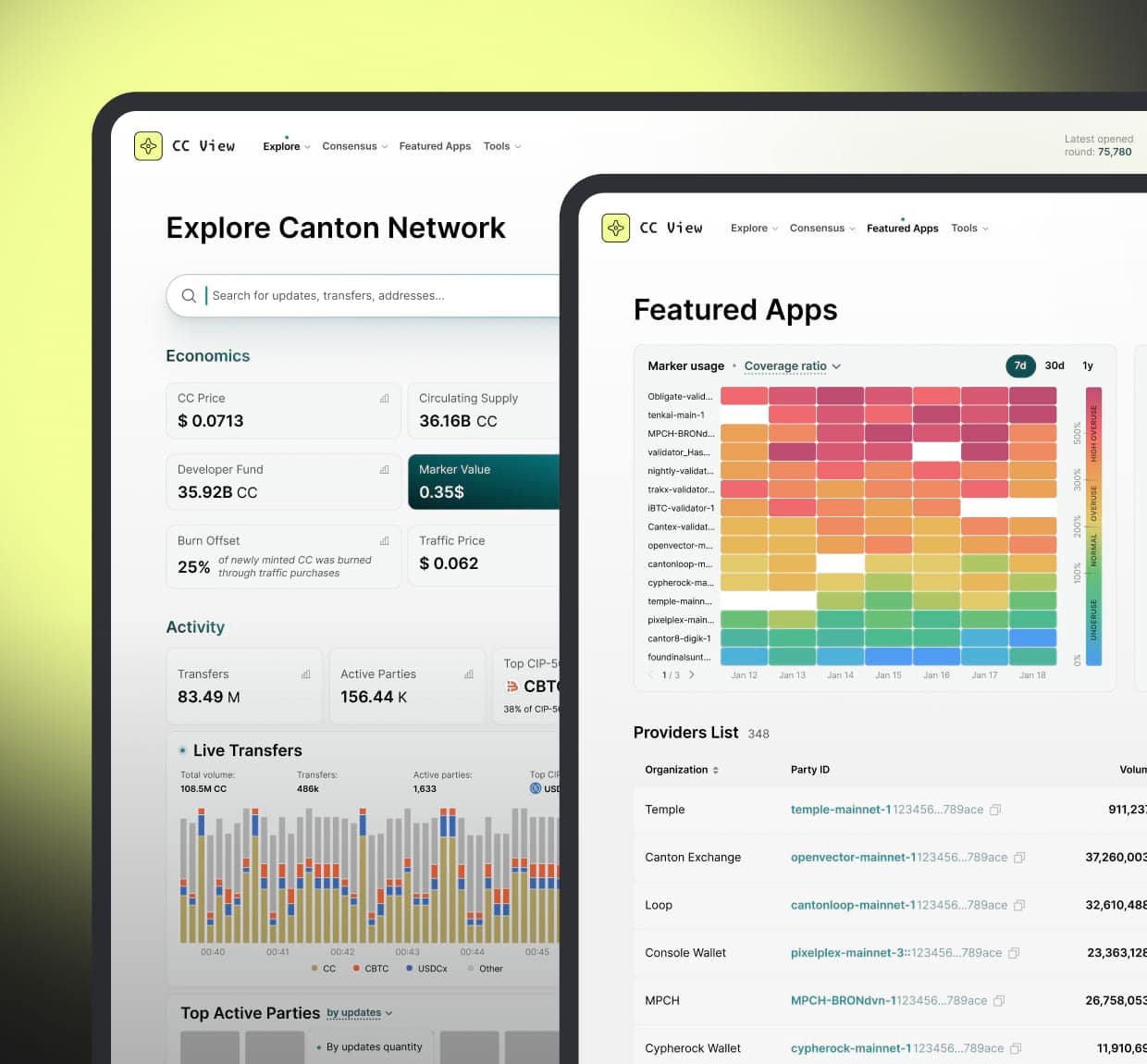
CC View
Give operations teams structured ledger history through REST and WebSocket endpoints. Shipping an explorer helps us design data access without forcing teams to parse raw updates.
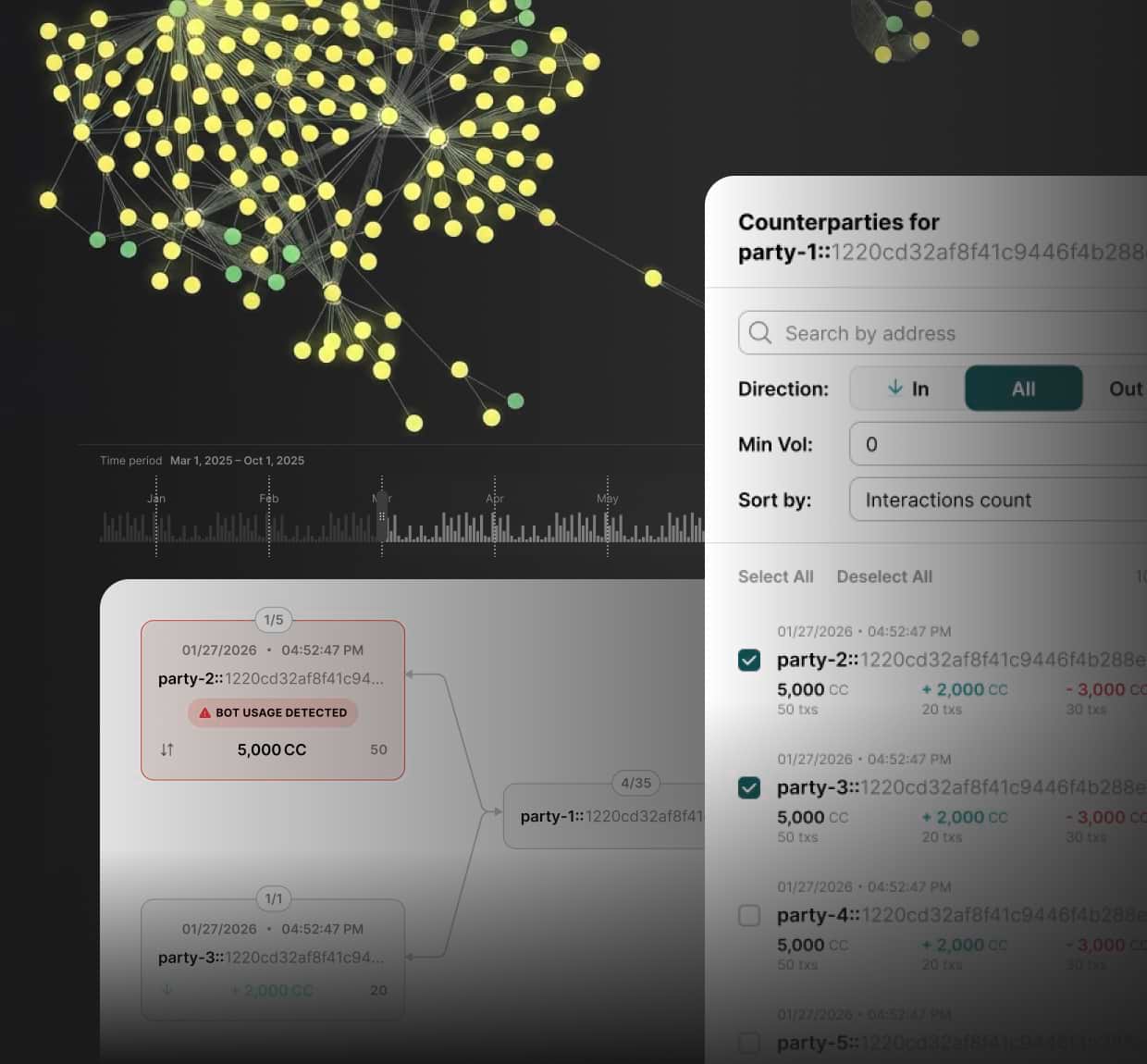
Help compliance teams examine how parties relate and document findings. Building this workflow informs the evidence handling we plan for private financial apps.
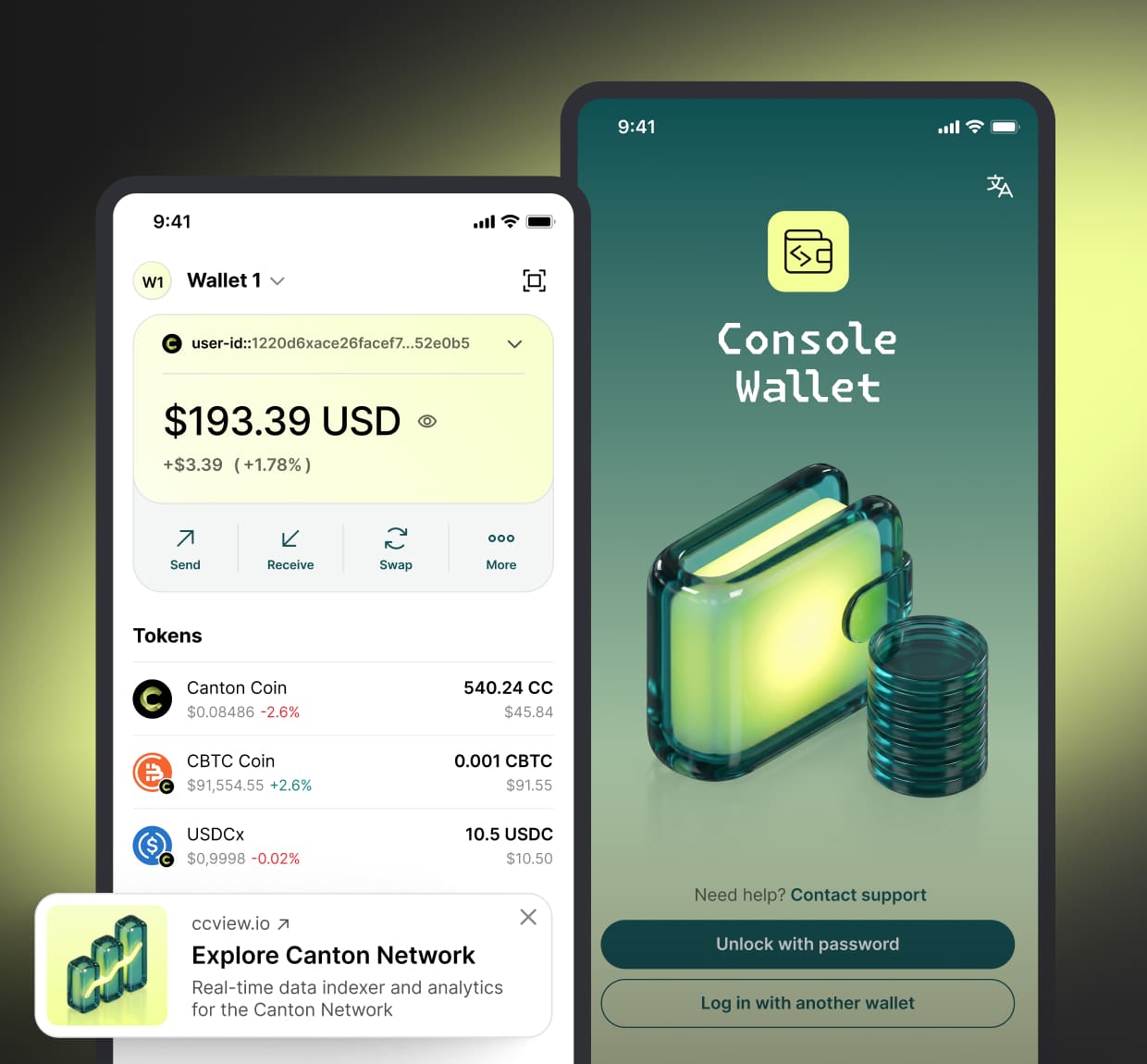
Handle CIP-56 tokens across browser and mobile, with clear signing and risk checks. Our wallet work gives client teams tested approval patterns to use in their own interfaces.
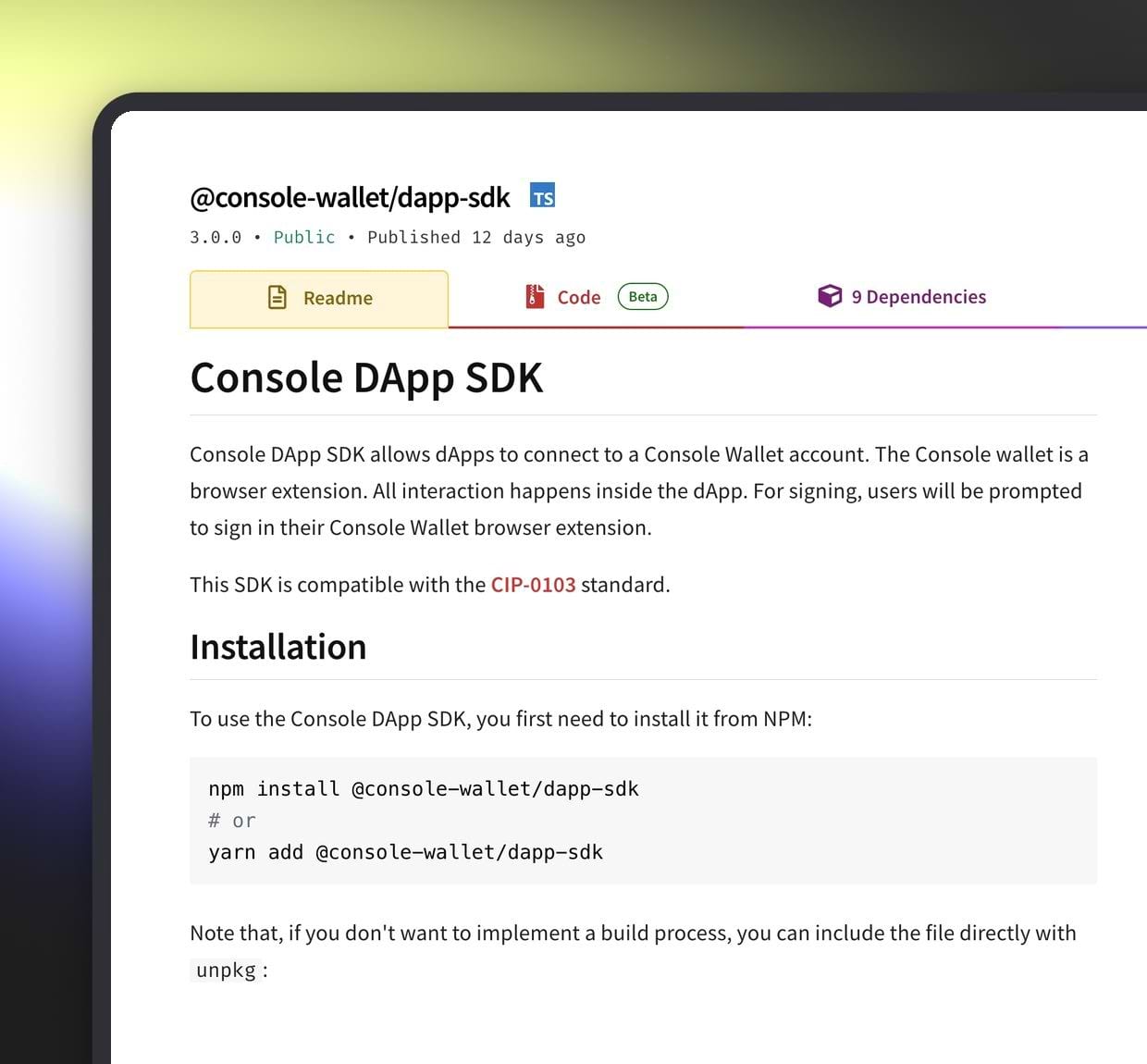
Connect Console Wallet through a kit on npm. It handles connection, message signing, Daml commands, balances and transfers, so your team can focus on workflows.
CC Tag maps readable names to a party through the Canton Name Service, and all our products sit in CC Suite.
Use cases with defined roles
Financial workflows that need shared trust
Broadridge’s Distributed Ledger Repo platform on Canton processed $7.5 trillion in September 2026. Each workflow needs its own party rules and settlement logic.
Choose the first workflow by agreement complexity and participant readiness, not just by the asset you want to issue.
Architecture choices
An app tech stack built around permissions
We design a Canton app from the agreement outward. Daml defines authority, the wallet controls signing, and the data layer serves only the activity each party may access. Interfaces and operations follow those boundaries.
01
Interfaces
Web app
Give users a clear path from an instruction to a reviewable ledger action and confirmed result.
Mobile app
Keep approvals readable on a small screen without changing the browser workflow’s party permissions.
Admin console
Let operations staff manage permitted workflows and investigate commands that did not complete.
02
Wallets and identity
CIP-0103 connection
Connect any compliant wallet. Keys stay with the user’s wallet, not with the application.
Keys and passkeys
Choose passkeys for individuals or external signing for institutions before designing approvals.
Canton names
Resolve readable names to a party so users can check recipients before authorizing transfers.
03
Daml contracts
Templates and choices
Encode signatories, observers and choice controllers in Daml for ledger-enforced authorization.
CIP-56 tokens
Use CIP-56 for balances and transfers, with registries and atomic DvP in the asset workflow.
Smart Contract Upgrade
Check package compatibility so new versions do not break agreements already on the ledger.
04
Ledger and data
Ledger API
Read contracts and submit commands through the Ledger API on your parties’ participant node.
Indexed data
Index authorized history for quick queries without reconstructing every event for interfaces and reports.
Event streams
Send webhooks and alerts when transfers or contract events need user or staff action.
05
Network and operations
Participant node
Host parties and store only their contracts, with access boundaries mapped before onboarding.
Validator
Plan validator onboarding, traffic funding and version upgrades before launch, with routine work assigned.
Monitoring
Track node health, traffic balance and failed commands to prioritize operator attention.
Keep integrations separate from agreements so a later Ethereum connection can be scoped without replacing the core Daml model.
Controls for private markets
Security, privacy and compliance controls
Sub-transaction privacy limits who can see ledger data. Monitoring must run where your organization has permission to read it.
Daml audits and tests
A Daml smart contract audit checks authorization, asset logic and failure paths. Tests cover rejected actions as well as successful settlement.
Party and privacy design
Map who signs, who observes and who acts before coding. Review each party’s visibility to prevent an observer role from exposing more than intended.
Keys and signing
Use passkeys where users prefer no seed phrases. Connect institutional signing providers without making the application the custodian of user keys.
Transaction monitoring
CC Trace follows fund flows across hops and maps counterparty relationships. Investigators document findings together in one shared workspace.
Sanctions and risk screening
Intercepta screens Canton parties against OFAC, EU, UK and UN sanctions lists. Through CC View, it scores Canton Coin and token flows for risk in real time.
Node operations and upgrades
Harden validator access, review version changes and assign incident response duties. Test recovery procedures before relying on them during an outage.
Run tracing on your own participant node when investigators need a private deployment tied to your organization’s permitted contract data.
Client delivery
Canton case studies
As a Canton Network development company, PixelPlex has delivered wallets and identity tools, built a client bridge and supported exchange engineering.
Canton Loop
For FiveNorth, we built a passkey wallet with Canton Name Service and its own validator node. It was a Featured App within days of launch and earned the client revenue from Canton’s incentive layer.
$3M
Revenue for the client
Top 10
Validator rank
2.5 months
Consultation to MVP
Delivered: Wallet design and engineering from first consultation through MVP.
5N ID records reusable KYC status in a Daml contract, with no personal data on-chain. Connected apps read the proof through on-chain consent, so a user verifies once instead of at every app.
2 min
To verify a user
Up to 60%
Less signup churn
2.5 months
Consultation to MVP
Delivered: Verification and consent logic in two custom Daml contracts, plus an API-first wallet integration.
PixelPlex supported Ekiden through launch. The institutional derivatives exchange pairs a central limit order book and off-chain matching with deferred on-chain settlement.
Built for a client and operated by CCBridge Inc., CC Bridge screens transfers against sanctions lists and known scam flows. Releases need a signed authorization, and failed transfers are refunded.
2
Mainnets: Ethereum, Canton
3
Screening checkpoints
~10 min
Typical transfer
Delivered: Token bridge and a private payout route to a fresh one-time Ethereum address.
Our Canton development process from discovery to MainNet
A focused Canton Network development release needs a bounded workflow and overlapping tracks. Each phase ends with a deliverable you can review.
Phase123456789101112
01
Discovery and network design
Weeks 1 to 2: agree on counterparties, privacy boundaries and the node host before locking the release scope.
Weeks 1 to 2
Workflow scope
Network decision
02
Daml model and architecture
Weeks 2 to 4: test the Daml agreement model on DevNet and map interfaces to each party’s permitted actions.
Weeks 2 to 4
Agreement model
Access map
03
Contracts and integrations
Weeks 3 to 9: build Daml contracts and back-end services, then connect data and settlement flows.
Weeks 3 to 9
Contract package
Integration tests
04
Interfaces and wallet connection
Weeks 6 to 10: deliver user screens and wallet approval flows against the same contract acceptance tests.
Weeks 6 to 10
User interfaces
Signing flow
05
Audit, tests and MainNet launch
Weeks 9 to 12: audit Daml logic, test failure paths and confirm operational owners before production launch.
Weeks 9 to 12 and on
Audit findings
Launch checklist
CC View: 1.5 months to production
Canton Loop: 2.5 months to MVP
This 12-week plan covers a focused first release. Our 2026 Canton guide: proof of concept 1 to 3 months, pilot 3 to 6, enterprise deployment 6 to 18+. Validator onboarding and the Featured App request run alongside.
For a Canton app takeover, an older Daml app or an Ethereum workflow port, we start with an inventory of contracts and integrations, then plan the move.
Budget by scope
How much does Canton development cost?
Scope sets the cost of Canton Network development services. Workflow complexity, node ownership and integration depth change the effort. PixelPlex estimates each phase after a scoping call.
What changes the scope
Network model and nodes
Managed hosting reduces operations work. Your own nodes add recovery and upgrade duties.
Daml workflows and parties
More roles and approval paths mean more contract logic, authorization tests and review cycles.
Integrations and data
Existing APIs ease connection work. Custom data mapping and historical imports add effort.
Wallets and interfaces
One signing flow is narrower than separate consumer, institutional and mobile experiences.
Traffic and Featured App reports
More recipients mean more traffic. Featured Apps report after month one, then each quarter.
Audits and compliance
Cross-party settlement and external asset routes need broader testing and compliance review.
Ways to start
Discovery sprint
Resolve the network choice and build a scoped delivery plan before committing to implementation.
Pilot or MVP on Canton
Validate one workflow with defined participants, then use the results to set the scope of a wider release.
Dedicated Daml developers
Extend your product team with engineers accountable for a sustained contract, integration or upgrade backlog.
Bring the workflow and target launch window. We will separate first-release work from later phases.
An operating engineering team
Why choose PixelPlex as your Canton Network development company
Our Canton Network development services treat launch as a handover. Before MainNet, every node, traffic and reporting duty has a named owner and a tested procedure.
We run what we build
The upgrade, traffic and reporting routines we follow for our own MainNet apps become checklist items in your delivery plan.
We help write the standards
Your integration questions go to the engineers who co-wrote CIP-0103, the dApp Standard, with Digital Asset.
One team from Daml to compliance
Keep contract permissions, app behavior and risk controls in one delivery plan, with named owners for each acceptance test.
2007
Founded, in blockchain since 2013
450+
Delivered projects
100
In-house engineers
250+
Clients
Client feedback
What clients and partners say
4.9
4.9
5
“CC View has been a godsend for me.”
Eric Saraniecki
Co-Founder and Head of Network Strategy, Digital Asset
IVPAY
“Every task was completed exactly on time, with precise adherence to requirements and timely adjustments whenever needed.”
ET
Eugene Tkachevsky
CBDO, IVPAY
“I had a pretty good idea of where I wanted to go, but PixelPlex can bring a lot of knowledge about blockchain.”
Erno Kiss
CEO, Rinne Technologies
Planning answers
Frequently asked questions
Resolve the network, operating and delivery choices that determine the scope of your project.
Canton Network development services turn financial agreements into Daml smart contracts and usable applications. PixelPlex scopes the network model, implements the application and integrates the systems needed to operate it. The delivery boundary includes launch responsibilities, not only contract code.
Cost follows the network model, Daml workflows and integrations. Wallet scope, traffic planning and compliance reviews also change the effort. PixelPlex estimates each phase after a scoping call, separating implementation work from ongoing operations.
A focused first release can take 12 weeks. Our Canton development guide (June 2026) puts proof of concept at 1 to 3 months, a business pilot at 3 to 6 months and enterprise deployment at 6 to 18+ months. CC View reached production in 1.5 months. Canton Loop went from first consultation to MVP in 2.5 months.
Choose the Global Synchronizer for public-network settlement and a private synchronizer for high-volume flows among known firms or data residency needs. A private operator owns availability, backups and upgrades. Canton Coin operations always use the Global Synchronizer, whatever the wider application design.
Running your own validator is optional. Use a node-as-a-service provider or a partner’s participant node. Your own node needs a Super Validator sponsor, which you can request from the Canton Foundation, plus TestNet and MainNet approval. Reviews take about two weeks, IP allowlisting 2 to 7 days. MainNet admits up to 35 validators a week.
Only Featured Apps earn app rewards in Canton Coin. Deploy on MainNet, apply to the Canton Foundation and pass committee review and a governance vote. Before the vote, each app party must lock 5 million CC, or 25 million CC for asset issuers. Dropping below that lock ends the status. Rewards are moving to traffic-based accounting.
Only the sending node pays for traffic, based on payload size and recipient count. A free allowance refills every 20 minutes. Extra traffic burns Canton Coin at a dollar-denominated price per megabyte set by vote. Coin transfers have no separate fee. Your app can estimate traffic cost before submission.
Daml puts signatories, observers and permitted actions into the agreement model. Solidity contracts cannot be ported unchanged. Daml developers rewrite the workflow, then verify that authorization and settlement behavior match the intended business rules.
Existing apps can migrate with contract and integration changes. Rebuild Daml 2 packages with the 3.x SDK and port integrations to Ledger API v2. Use dpm and Smart Contract Upgrade. For Ethereum or another ledger, map asset state and permissions before rewriting contracts and moving data.
CIP-0103 gives apps a vendor-neutral connection to wallets and signing providers. The Console DApp SDK supports wallet connection, message signing and Daml command submission. Network access stays separate from key management, so an institution can choose its signing provider without changing the app’s connection model.
Assets move through bridges or atomic swaps. Live routes include LayerZero, Chainlink CCIP and Circle’s xReserve for USDCx. On 22 July 2026, PixelPlex joined Arqitech, MPCH and sFOX in the first live non-custodial cross-chain atomic swaps on Canton MainNet: Canton Coin for USDC on Ethereum mainnet. Every party kept its own keys.
Daml smart contracts need an audit because enforced permissions can still encode the wrong business rules. A focused single-template audit takes 1 to 2 weeks. Multi-party workflows with interoperability testing take 3 to 4 weeks. Test authorization failures and atomic settlement as well as successful paths.












 Ready to settleNothing settledSettled
 SignaturesBoth parties authorize their part of the trade.


 Ledger API
 CIP-0103 wallets
 Data APIs
 Ethereum bridges