As a cryptocurrency exchange development company, PixelPlex has shipped exchanges for novice and professional traders, web and mobile apps, and arbitrage platforms. You get a crypto exchange platform built for your markets.
CEX, DEX, P2P, and hybrid
Web, mobile, and trading APIs
Compliance and licensing support
Own trading software
Exchange product basics
What is cryptocurrency exchange development?
Cryptocurrency exchange development is the design and build of a digital asset trading venue: matching, balances, funding, compliance, and administration. It covers the exchange software and the controls a team needs to run the venue every day.
Matching and trading
A matching engine applies price and time rules, updates the order book, records fills, and publishes market data.
Funds and settlement
A double-entry ledger records deposits, trades, fees, and withdrawals so balances and settlement reconcile.
Compliance and operations
KYC, AML, permissions, case review, reports, support, and security records make the venue controllable.
Decision workspace
Decide how to build a crypto exchange
Compare centralized, decentralized, and hybrid models. Then test a withdrawal review and map the operating work behind the exchange.
Exchange decision workspaceInteractive tool
Product choices
Explore the screens
Compare funds, matching, and control
Choose the operating model
Compare who controls funds, how prices form, where liquidity comes from, and which compliance model fits.
Design decision
Pick an exchange model
Where funds sit, how orders match
TraderDeposits to an exchange account
Matching engineOrder book on exchange servers
SettlementInternal ledger, on-chain payouts
The exchange holds client funds and matches orders off-chain. Deposits and withdrawals are the on-chain moments, so custody and screening sit there.
Where funds sit, how orders match
WalletSigns from a self-custodial wallet
Pool or bookAMM pool or on-chain order book
On-chainSettles trade by trade
Users keep their keys and settle every trade on-chain. Liquidity, contract audits and fair ordering decide the product.
Where funds sit, how orders match
TraderSigns from an own account
MatchingOff-chain order book
SettlementOn-chain, per trade or batch
Orders match off-chain at order book speed. Settlement runs on-chain, so client funds stay in user-controlled accounts or smart contracts.
Centralized (CEX)
Who holds client funds
The operator or its selected provider controls client funds and signing policies.
How orders match
Orders meet in a matching engine and order book. Trades form the market price.
Liquidity
Market makers, external venues, and operator inventory support depth and tighter spreads.
Compliance controls
KYC, AML, limits, case review, and security controls suit operator-held accounts.
Fits
Fits managed listings, account trading, fiat rails, and direct operator support.
Decentralized (DEX)
Who holds client funds
Users trade from their own accounts. Smart contracts hold or route assets by design.
How orders match
Pools price swaps, or an on-chain order book matches user-approved orders.
Liquidity
Liquidity providers fund pools, while routing can combine depth across sources.
Compliance controls
Address screening, interface limits, and smart contract security shape compliance.
Fits
Fits on-chain swaps, token ecosystems, open markets, and user-controlled assets.
Hybrid
Who holds client funds
Users retain control through their accounts or smart contracts until settlement.
How orders match
Off-chain matching adds speed. On-chain settlement uses user accounts or smart contracts.
Liquidity
Market makers and connected pools can supply depth through a shared routing layer.
Compliance controls
KYC, AML, address checks, and settlement security cover both operating layers.
Fits
Fits teams seeking order book speed with verifiable on-chain asset settlement.
Review security before release
Approve, hold, or block a withdrawal
See how address risk, account changes, limits, and approval policy route a request for release or review.
Ready to releaseBlocked by screeningReleased
Withdraw 2.5 BTC
Withdrawal request
Tobc1q8z…7f3kSaved 14 days ago
NetworkBitcoin network
Network fee0.00018 BTC
Address screeningScore 12 of 100. Clear verdict, with no hold added.
Account controlsIdentity status, session, and withdrawal lock checks pass.
Withdrawal limitWithin this account’s daily withdrawal limit.
All checks pass. The withdrawal can be released.
What the operator sees before release
A review pattern for hot wallet withdrawals. Rules and thresholds follow your policy.
Destination risk, scored
Each address gets a 0 to 100 risk score and a block, warn or clear verdict before funds move.
Limits and account state
Daily limits, recent account changes and withdrawal locks are checked per request.
Approvals by policy
Large amounts need a second approver. Every decision lands in the audit trail.
Map daily work after launch
Assign the operating queues
Turn listings, liquidity, reconciliation, support, and reporting into owned workflows with permissions and records.
After launch
Listings and networks
Review asset data, chain support, confirmations, market setup, and deposit or withdrawal status.
Liquidity and market making
Track spreads and depth, manage market makers, and alert when liquidity falls below policy.
Treasury and reconciliation
Reconcile the ledger against external balances and route corrections through approvals.
Support and reporting
Handle funding cases, trade disputes, user requests, fee reports, and operator audit records.
InterfacesWeb terminaliOSAndroidREST and WebSocket API
Each queue becomes a permissioned workflow with alerts and audit records inside the crypto exchange platform.
Designed around your exchange model.
A scoping call settles the model, markets, liquidity sources, compliance scope, and first-release priorities.
Exchange build options
Our cryptocurrency exchange development services
New exchanges, trading modules, integrations, and crypto exchange software development for exchanges already trading, delivered by one team.
01
Centralized exchanges
Create account-based trading with crypto and fiat funding, a matching engine, order book, market and limit orders, fee tiers, listings, and back-office control.
MVP development is a practical way to test demand, onboarding, trading behavior, and operator workflows when building a crypto exchange for one market before expansion.
Role-based modules
Crypto exchange software features for traders, operators, and compliance teams
Each role on the exchange gets its own screens, permissions, and records. In cryptocurrency exchange software development, we link trader actions and operator decisions in one audit trail.
For traders
Traders need clear prices, predictable order entry, accurate balances, and visible account controls so they can act and verify outcomes.
Real-time charts and market data
Market and limit orders
Order book and trade history
Deposits and withdrawals
Portfolio and balance views
API keys and account security
For operators
Operators need configurable markets, controlled account actions, and linked financial records so daily work remains traceable.
Asset and market listings
Fee and tier configuration
Liquidity and spread controls
User and role management
Reconciliation and reports
Security alert handling
For compliance teams
Compliance teams need linked identity, transaction, and trade evidence so reviewers can act consistently and produce audit records.
KYC and KYB case queues
AML transaction monitoring
Travel Rule data exchange
Market abuse surveillance
Holds, limits, and approvals
Audit records and exports
Mobile trading products
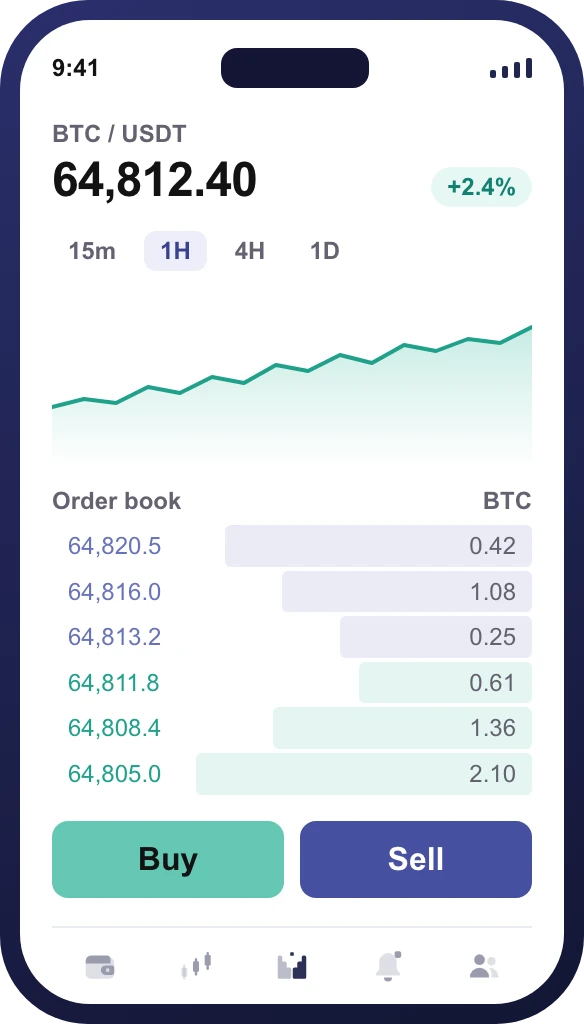
Crypto exchange app development
PixelPlex builds native iOS and Android crypto exchange apps with the same accounts, balances, and order flow as the web terminal. We have built mobile exchange apps, including Bitnetwork’s web and mobile venue.
Onboarding and account security
Identity and phone verification
2FA and biometric login
Device and session controls
Anti-phishing and allowlists
Trading
Live prices and depth
Market and limit orders
Order book and charts
Order history and fills
Deposits and payments
Crypto deposit addresses
Withdrawal review status
Bank and card funding
Fiat payment history
Alerts and support
Price and order alerts
Deposit and withdrawal alerts
In-app chat and tickets
Account security notices
App store rules for crypto exchange software, regional regulation, and payment options decide the app scope.
Shipped in Bitnetwork: web and mobile apps
Trading system design
Crypto exchange tech stack and architecture
PixelPlex designs the tech stack so the same orders always produce the same trades, balances stay exact, and every service can recover. In crypto exchange software development, each service has one job and clear records.
01
Interfaces
Web trading terminal
Shows order books, charts, balances, order entry, history, and account controls in one interface.
Mobile apps
Native iOS and Android apps with biometric login, push alerts, and quick order entry for trading on the go.
Trading APIs
REST and WebSocket access lets traders and market makers place orders and receive live data.
02
Trading core
Matching engine
Keeps books in memory, matches by price, then time, and journals every event, so a book can be rebuilt after a restart.
Risk engine
Checks balances and limits before each trade, monitors positions, and applies margin rules for derivatives.
Market data
Streams prices, depth, and trades in real time, then forms candles for charts and downstream feeds.
03
Funds
Ledger
Uses double-entry records for every balance change and remains the source of truth for reconciliation.
Wallet infrastructure
Separates hot, warm, and cold tiers, with MPC signing and withdrawal limits and approvals set for each network.
Fiat payments
Connects bank and card payments through licensed partners and matches every movement in the ledger.
04
Compliance
KYC and KYB
Ties identity and business verification results to account access, limits, and review states.
AML screening
Scores deposit and withdrawal addresses before funds move and routes risky activity for review.
Trade surveillance
Flags wash trading, spoofing, and related abuse patterns for an investigator to review.
05
Operations
Back office
Controls listings, fees, users, support, reports, and roles through permissioned operator screens.
Monitoring and recovery
Tracks metrics, sends alerts, verifies backups, and tests failover before it is needed.
Security layer
Encrypts data, protects keys with hardware security modules or MPC, controls access, and logs actions.
As crypto exchange development continues, new networks plug into the asset layer of the cryptocurrency exchange software, leaving the matching engine untouched.
Security engineering
Crypto exchange security: funds, trades, and access
Security starts with the threat model and runs through code review, release checks, and daily operations. Each control has an owner, evidence, and a response path.
Custody and withdrawals
Separate hot, warm, and cold tiers. Apply MPC signing, amount limits, allowlists, holds, and multi-step approvals before release.
Account security
Use 2FA, device and session controls, anti-phishing codes, withdrawal allowlists, login alerts, and step-up checks for sensitive actions.
Platform security and testing
Encrypt data, control access, filter DDoS traffic, review code, and run penetration testing against public and operator paths.
Proof of reserves and reconciliation
Reconcile the ledger against on-chain and provider balances. Define reserve and liability snapshots, verification rules, and exception handling.
Smart contract security
For DEX and hybrid designs, audit settlement, pool, and administrative contracts before launch. Track findings through remediation and retesting.
Incident response and monitoring
Monitor service health, access events, trades, and transfers. Run escalation, containment, recovery, communication, and evidence procedures.
Licensing and controls
Crypto exchange compliance and licensing
We help you get licensed and certified. We build the controls regulators and auditors check, then prepare the technical documentation and evidence for license applications and audits.
MiCA (EU)
VASP registration
KYC and KYB
Travel Rule
ISO/IEC 27001
SOC 2
Compliance scope follows the target markets and exchange model. The engineering team works alongside the client’s legal counsel throughout the process.
Licensing support
For MiCA authorization in the EU or VASP registration elsewhere, we prepare the technical documents, control maps, and evidence a license application needs.
KYC and KYB onboarding
Connect identity and business verification to account states, trading limits, review queues, evidence retention, and periodic refresh rules.
AML screening and the Travel Rule
Share Travel Rule data with other providers. Intercepta, a real-time AML screening service, scores each address 0 to 100 and returns a block, warn, or clear verdict before funds move.
Market surveillance and reporting
Flag wash trading, spoofing, unusual order behavior, and reportable events. Case records keep each decision, and exports support regulatory reporting.
Security certification readiness
Map controls to ISO/IEC 27001 and SOC 2 readiness. Organize policies, access records, test results, and penetration test reports.
Network integrations
Networks your crypto exchange platform can list
A modular asset layer lets a crypto exchange platform list new networks without changing matching, balances, or market administration.
Canton Network
List Canton Coin and CIP-56 tokens with a team that co-authored CIP-103 and runs a validator. Our Canton blockchain development work covers each connection to the network.
Ethereum and EVM networks
List Ethereum, BNB Chain, Polygon, and Base assets with native and token deposits, fees, confirmations, and withdrawals, built by our Ethereum development team.
Bitcoin and UTXO chains
UTXO chains need address formats, unspent outputs, fee selection, replacement rules, and controlled withdrawals. Our Bitcoin development team handles each one.
Solana, TON and Tron
Solana, TON, and Tron integrations follow each chain’s account, message, fee, and confirmation model. See our Solana development and TON development services.
Each connection covers indexing, confirmations, fee handling, and signing. Testing, operator alerts, and a security review precede listing.
Delivery route
White label crypto exchange software vs custom development
Choose white label crypto exchange software when standard trading and administration fit. Choose custom cryptocurrency exchange software when execution or ownership must differ.
White labelCustom development
Time to launch
White label: A configured base shortens product design and core build work.
Custom: More discovery and engineering precede release.
Upfront budget
White label: Lower initial build scope, with platform and vendor fees to assess.
Custom: Higher upfront cost, spent on features you own.
Matching and trading
White label: Standard matching engine, common orders, and defined extension points.
Custom: Matching engine rules, order types, APIs, and recovery logic fit the venue.
Compliance and custody
White label: Prebuilt connectors and policies are adapted to the target markets.
Custom: Controls and signing architecture follow markets, licenses, and risk.
Brand and user experience
White label: Branding changes within the layouts and flows the base permits.
Custom: Research and design shape each trader and operator workflow.
Ownership and scaling
White label: Ownership and scaling options follow the platform agreement.
Custom: The business owns the code and controls scaling decisions.
Who it fits
White label: Teams testing a standard spot market with limited differentiation.
Custom: Operators whose model depends on distinct logic or integrations.
For teams that want a ready base, review the white label crypto exchange route, its configurable modules, integration boundaries, and ownership terms.
Delivered trading products
Crypto exchange platforms we have built
As a crypto exchange development company, PixelPlex has built products for professional traders, first-time users, institutional teams, and arbitrage operators.
Professional web and mobile exchange
Client project
Bitnetwork
Bitnetwork was built for professional traders. The goal was provable security with fast, competent support, while custom layouts grouped the market views needed for each decision.
18
Trading pairs
20+
Trading modules
3
Types of 2FA
Delivered: Web and mobile terminals, identity checks, customizable workspaces, fee controls, administration, and support workflows.
OTC Hawk compares prices across connected venues, splits orders, automates execution, and manages team approvals and client portfolios from one product.
REST + WS
APIs plus a UI
24/7
Market access
Same-day
Settlement
Delivered: Aggregation, automated and delayed orders, arbitrage logic, portfolio controls, and settlement workflows.
One platform automated cross-border BTC buying and local resale for South African traders. Another applied profitability and balance rules to multi-venue strategies.
5
Exchanges in one build
Dozens
Potential trades checked per second
3-way, 4-way
Strategies
Delivered: Order matching, trade distribution, profitability rules, balance thresholds, administration, and automated execution.
To build a crypto exchange, PixelPlex overlaps product, architecture, integration, security, and operating work while keeping release gates and ownership clear.
Phase123456789101112131415161718192021222324
01
Discovery and compliance scope
Define users, markets, assets, order flows, roles, license path, controls, and first-release priorities.
Weeks 1 to 3
Market and user scope
Control map
02
Architecture
Map matching, risk, balances, funding, APIs, data flow, access, recovery, and integration boundaries.
Weeks 2 to 7
System blueprint
Failure paths
03
Build and integrate
Build trader and operator interfaces, trading services, payments, networks, compliance, and reporting.
Weeks 5 to 19
Trading core
Integrated interfaces
04
Security and load testing
Run security reviews, penetration tests, recovery checks, contract audits, and workload tests.
Weeks 15 to 21
Security test record
Load test record
05
Launch and operate
Prepare deployment, monitoring, support, reconciliation, incident procedures, and controlled releases.
Weeks 20 to 24 and on
Launch runbook
Operations handoff
The plan shows a 24-week first release. Our guide puts a basic MVP at 3 to 5 months and a full-featured custom exchange at 9 to 12 months or more. Arbitrage builds average about 3 months.
For an existing venue, PixelPlex can take over the codebase, add networks, or replace a matching engine while current operations and migration risks shape the plan.
Budget planning
How much does crypto exchange development cost?
Custom exchange projects start from $200K. The budget grows with specialized matching and order logic, more markets and their licensing work, fiat rails, mobile apps, and external integrations.
From
$200K
Custom exchange projects. Your estimate follows the scoping call.
What changes the budget
Exchange model and markets
CEX, DEX, P2P, and hybrid designs require different account, settlement, and operating flows.
Matching engine and orders
Special order types, recovery rules, and advanced risk controls add core engineering.
Liquidity setup
More market makers, connected venues, routing rules, and monitoring increase integration work.
Compliance and licensing
More target markets add control mapping, evidence, reporting, and license application work.
Networks and fiat rails
Each chain and payment rail needs integration, reconciliation, testing, and operator tooling.
Mobile apps and integrations
More mobile surfaces, external services, and custom APIs expand build and testing scope.
Common build routes
A focused first release
Validates a defined market, core order flow, onboarding, funding, administration, and operating assumptions.
A full trading platform
Covers broader markets, advanced order logic, multiple funding routes, deeper administration, and scale planning.
Infrastructure for a live business
Adds trading, liquidity, compliance, or network modules to a product with users and operating processes.
Share the model and target markets to receive a scoped release route, dependencies, and budget range.
Exchange economics
How a crypto exchange makes money
A crypto exchange platform earns from trading charges and service fees. The fee model has to cover liquidity, security, and support while staying clear to users.
Trading fees
Maker and taker tiers charge for executed trades and can vary by market, account level, or incentive program.
Spreads on instant buy and convert
The venue quotes a buy, sell, or conversion price and retains a disclosed difference from its execution price.
Withdrawal fees
A flat or variable charge can cover network expense, processing, and the operational cost of releasing funds.
Listing fees
Approved asset issuers may pay for technical integration, review, market setup, and ongoing listing support.
Derivatives and margin fees
Revenue can come from trade fees, funding charges, borrowing rates, liquidation charges, or a defined spread.
Staking and earn products
The operator can retain a disclosed share of rewards or charge for access, management, or early withdrawal.
Fee settings live in the admin panel, so operators change tiers and market rules without a new release.
Admin fee settings shipped in Bitnetwork · FunShape
Why PixelPlex
Why choose PixelPlex as your crypto exchange development company
An exchange software development company must understand the venue after launch, not just its interface. Our cryptocurrency exchange development services keep trading, security, and compliance in one team.
Exchanges for different traders
We have built exchanges for professional traders and for first-time traders in Japan, so the interface and order flow follow your audience.
Trading infrastructure of our own
OTC Hawk, our own software, aggregates prices across exchanges and automates execution, so liquidity and execution are familiar ground.
Compliance inside the product
KYC, screening, and surveillance connect to accounts and withdrawals from the first release, which is what licensing reviews look for.
2007
Founded, in blockchain since 2013
450+
Delivered projects
100
In-house engineers
250+
Clients
Client feedback
What clients say about delivery
4.9
4.9
5
“They’re talented developers who write good code and tackle challenging projects.”
Patrick Dai
CEO and Founder, Qtum Foundation
“They often work faster than I do, which I greatly appreciate.”
Joe Jones
CEO, StreamSettles
Buyer questions
Cryptocurrency exchange development FAQ
Answers on scope, timing, architecture, liquidity, security, licensing, mobile apps, and networks.
A cryptocurrency exchange development company turns a trading business model into working exchange software and operating controls. As an exchange software development company, PixelPlex designs matching, funding, liquidity, and security, builds KYC and AML workflows, and supports the venue after launch.
Custom exchange projects start from $200K. The total grows with specialized matching and order logic, the number of markets and licenses, networks and fiat rails, mobile apps, and external integrations.
Building a crypto exchange can take 3 to 5 months for a basic MVP, 6 to 8 months for a medium-complexity venue, and 9 to 12 months or more for a full-featured custom exchange. PixelPlex can plan a 24-week first release when scope and dependencies fit that schedule.
Choose a centralized exchange for managed accounts and order book trading, a decentralized exchange for user-approved on-chain trades, or a hybrid exchange for off-chain matching with on-chain settlement. The decision follows fund control, liquidity, compliance, and user workflow.
A crypto exchange needs a tech stack that separates interfaces, matching, risk, market data, balances, payments, compliance, and operations. The tech stack also needs a recovery journal, a double-entry ledger, security controls, monitoring, backups, and clear integration boundaries.
A new exchange gets liquidity from market makers, connected venues, operator inventory, or funded on-chain pools. Launch planning sets spread and depth targets, routing rules, incentives, balance limits, monitoring, and operator responses when a market falls below policy.
A matching engine compares compatible buy and sell orders under defined price and time rules. It records fills, updates the order book, sends events to balances and market data, rejects invalid orders, and uses a journal to rebuild its state after a restart.
Client funds are kept secure through separated hot, warm, and cold tiers, MPC signing, withdrawal limits, approvals, access controls, and reconciliation. Account security adds 2FA, session checks, allowlists, monitoring, and tested incident response.
An exchange needs the licenses its target markets and services require, such as MiCA authorization in the EU or a VASP registration elsewhere. PixelPlex helps you get licensed: we build the required controls and prepare the technical documentation and evidence with your legal counsel.
Yes, PixelPlex builds mobile crypto exchange apps for iOS and Android and has shipped them, including Bitnetwork’s web and mobile apps. Each crypto exchange app shares accounts, balances, order flow, verification, funding, alerts, support, and account controls with the web terminal.
Yes, PixelPlex can add Canton and other networks to an existing exchange. The work covers asset rules, transaction indexing, deposits, withdrawals, confirmations, fees, signing, ledger mapping, testing, monitoring, and operator procedures.
Yes. After launch, PixelPlex can run monitoring and incident response, ship updates, add markets and networks, and extend compliance as you enter new markets. Support follows your team and operating model.



 Ready to releaseBlocked by screeningReleased
 Address screeningScore 12 of 100. Clear verdict, with no hold added.


 Web terminal
 iOS
 REST and WebSocket API




 White label
 Custom development


