Behind every seamless P2P crypto exchange is a carefully built system of architecture, security layers, and trading logic. What feels instant is really order matching, escrow, and dispute handling working in sync behind the scenes. So how is a platform like this actually built?
Let’s start with the basics: what are P2P exchanges even for? A P2P crypto exchange is a platform where users trade cryptocurrencies directly with each other, typically using escrow systems to secure transactions until both sides fulfill their terms.
Unlike centralized exchanges that control order books, custody, and execution, or decentralized exchanges that rely purely on on-chain liquidity pools, P2P platforms sit somewhere in between — they facilitate trust, matching, and dispute resolution while still keeping asset control largely in users’ hands.
This is also why many businesses work with a P2P crypto exchange software development company: these platforms require very deep technical expertise. As a firm specializing in this space, we know how important it is to understand the full process before building one, which is why we created this guide for you.
Read on to see how everything fits together.
Key features a reliable P2P crypto exchange must have
While it is true that P2P crypto exchange development is quite complicated, what is easy when it comes to technology handling large sums of money, really? Let’s start little by little and break down the core features every secure and scalable platform needs.
| Feature | What it’s for |
| User verification and KYC/AML | Confirms user identity, prevents fraud, and ensures compliance with financial regulations. |
| Multi-currency and fiat support | Allows users to trade different crypto and deposit/withdraw usual currencies like USD or EUR. |
| Escrow smart contracts | Temporarily locks crypto during a trade to make sure neither party can cheat until both sides fulfill conditions. |
| Real-time chat and dispute resolution | Lets buyers and sellers communicate and resolve issues if something goes wrong in a transaction. |
| Multi-payment integrations | Supports various payment methods like bank transfers, cards, and local payment systems for flexibility. |
| Crypto wallet infrastructure | Stores and manages user funds securely within the platform. |
| Reputation and rating systems | Builds trust by letting users rate each other based on trade history and reliability. |
| Fraud prevention systems | Detects suspicious behavior, prevents scams, and reduces financial risk on the platform. |
Developing a P2P crypto exchange: why blockchain protocol selection matters
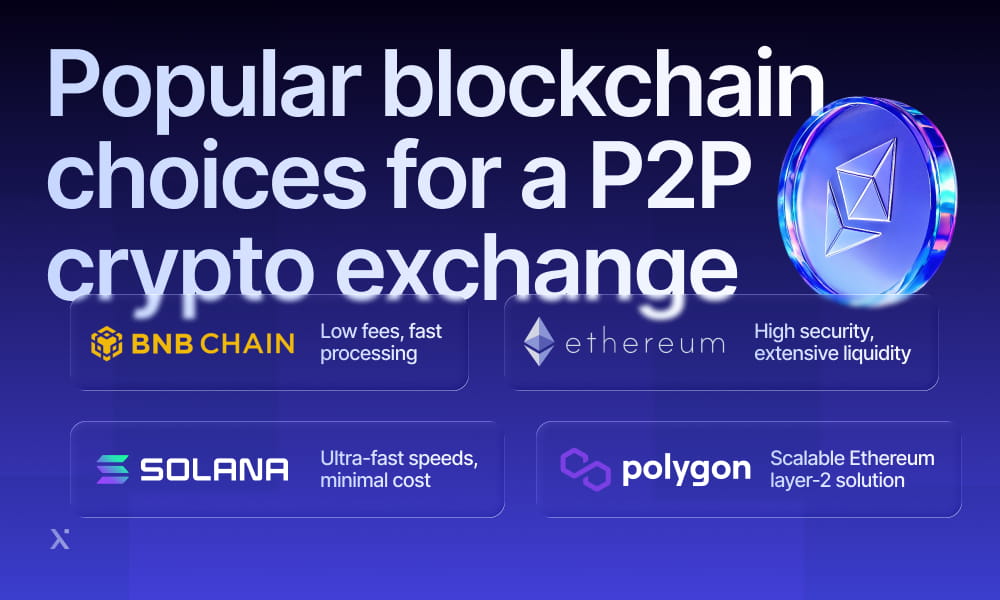
There are many blockchain protocols available today, with new ones emerging almost every year. However, most P2P crypto exchanges are built on established networks like Ethereum and BNB Chain, or high-performance options such as Solana and Polygon. The reason is simple: these networks offer the right balance of security, liquidity, developer tooling, and user adoption needed to support real trading activity at scale.
Let’s see how these blockchain protocols impact P2P crypto exchanges.
| Blockchain | How it affects a P2P crypto exchange | Ecosystem & development nuances |
| Ethereum | Strong smart contract capabilities and high security, but higher gas fees and slower transactions during congestion. | Largest developer ecosystem with extensive tooling (Solidity, libraries), but higher deployment costs and competition. |
| BNB Chain | Faster and cheaper transactions, suitable for retail-focused P2P platforms. | EVM-compatible, easy migration from Ethereum, strong Binance ecosystem support and liquidity access. |
| Solana | Extremely high throughput and low latency, ideal for scalable trading systems. | Non-EVM architecture requires specialized development (Rust), steeper learning curve but high performance potential. |
| Polygon | Layer 2 scaling with low fees and Ethereum compatibility, perfect for scalable exchanges. | Strong Ethereum compatibility, easy integration, growing ecosystem for scalable DeFi and dApps. |
So, what to choose, you’re wondering? Here are our recommendations:
- Startup/MVP platforms (small budget, fast launch, testing idea) — BNB Chain or Polygon
These are ideal for early-stage products because they offer low transaction fees, fast deployment, and strong EVM compatibility. Teams can build quickly, iterate features, and avoid high infrastructure costs while validating product-market fit.
- Retail-focused regional platforms (high user volume, fiat-heavy P2P trading) — BNB Chain
BNB Chain works well for consumer-facing P2P exchanges thanks to low fees, fast transactions, and strong ecosystem support, especially when quick onboarding and cost efficiency are priorities.
- Scalable global exchanges (high security + long-term growth) — Ethereum and Layer 2 solutions like Arbitrum
Ethereum provides the strongest security and developer ecosystem, while Layer 2 solutions reduce gas fees and improve scalability. This is what platforms aiming for long-term stability and institutional-grade trust typically choose.
- High-performance trading platforms (speed-critical, high-frequency systems) — Solana
Best suited for advanced P2P models where transaction speed and throughput are super important. However, it requires more complex development and specialized engineering talent because Solana’s system is Rust-based.
Comparing DApps Across Protocols: Why Your Blockchain Choice Can Break Everything

Ethereum DApp Development: How It Works and What You’ll Pay
All in all, the choice of a blockchain depends heavily on business size, target market, and long-term goals. In P2P crypto exchange software development, this decision is strategic rather than purely technical. It affects transaction speed, fees, smart contract capabilities, integration complexity, and even the user experience.
Many businesses also opt for blockchain development services to ensure proper architecture design, scalability planning, and secure implementation from the start.
P2P crypto exchange development tech stack and essentials
Below is a breakdown of the main technologies and essentials typically used in P2P crypto exchange development.
| Component | Technology, tools | Purpose |
| Frontend | React.js, Next.js, Vue.js | Builds responsive and interactive user interfaces for trading, order books, and dashboards |
| Backend | Node.js, Python (Django/FastAPI), Go | Handles business logic, API requests, user management, and trade processing |
| Blockchain integration | Ethereum, Bitcoin, Web3.js, Ethers.js | Connects exchange to blockchain networks for wallet operations, transactions, and smart contracts |
| Smart contracts | Solidity, Rust, C++ | Automates escrow, trade execution, and dispute resolution in a trustless manner |
| Database | PostgreSQL, MongoDB, Redis | Stores user data, trade history, order books, and session caching |
| P2P communication | WebSockets, WebRTC | Enables real-time peer-to-peer order matching and chat functionality |
| Security layer | JWT, OAuth2, SSL/TLS, encryption libraries | Ensures authentication, secure data transmission, and fraud prevention |
| Wallet integration | MetaMask, Trust Wallet SDKs | Enables secure asset storage and user-controlled fund management |
| Matching engine | Custom high-frequency trading engine (C++, Go, Rust) | Matches buy/sell orders instantly with minimal latency |
| DevOps & infrastructure | Docker, Kubernetes, AWS/GCP/Azure | Guarantees scalability, deployment automation, and system reliability |
| Monitoring & analytics | Prometheus, Grafana, ELK Stack | Tracks system performance, logs, and trading activity in real time |
A well-designed stack for P2P crypto exchange development focuses heavily on security, real-time performance, and decentralized transaction handling. It guarantees that users can trade directly without intermediaries while maintaining trust and efficiency.
Your Practical Guide to Creating a Decentralized Cryptocurrency Exchange

Centralized Crypto Exchange Development Explained: From Architecture to Launch
Main challenges in P2P exchange development: what to watch out for
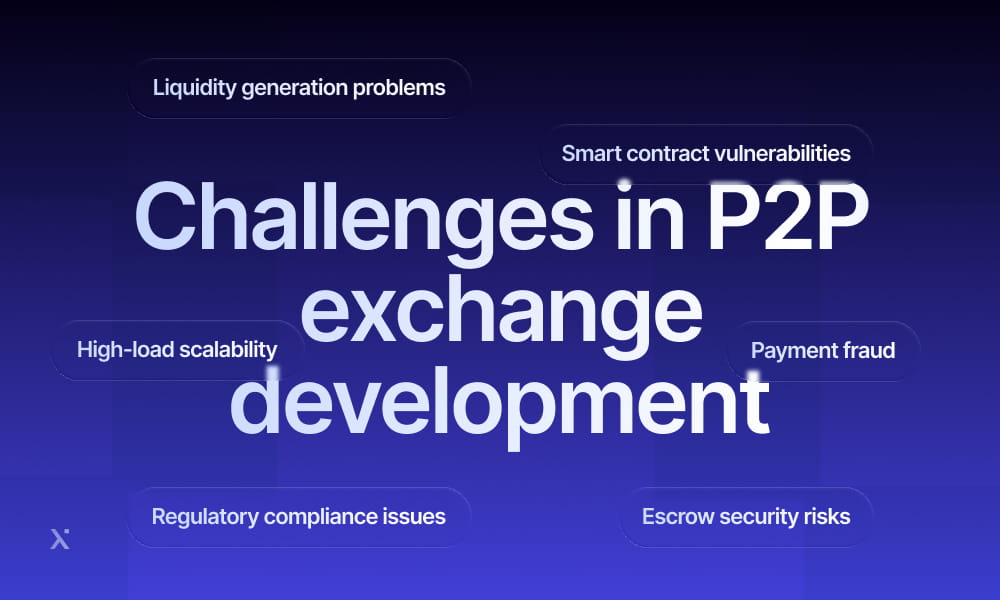
In P2P crypto exchange development, building a secure and scalable peer-to-peer trading platform comes with several technical, financial, and regulatory challenges.
Since P2P exchanges rely on direct user-to-user transactions without intermediaries, even small weaknesses in system design, security architecture, or regulatory compliance can lead to significant operational risks.
Now we can take a closer look at the key challenges and how to effectively address and avoid them:
- Liquidity generation problems
P2P platforms often struggle to maintain enough active buyers and sellers, which can slow down trade execution.
How to avoid it: Implement liquidity incentives, marketing programs, and hybrid liquidity models that combine P2P and centralized liquidity pools.
- Escrow security risks
Users may experience asset loss or manipulation during transactions if escrow mechanisms are weak.
How to avoid it: Use multi-signature wallets, audited smart contracts engineered through rigorous Solana dApp development practices, and automated escrow release conditions to eliminate vulnerabilities.
- Payment fraud and chargebacks
Fraudulent payments and reversed transactions can heavily impact platform credibility and user funds.
How to avoid it: Integrate fraud detection systems, KYC/AML verification, and escrow-based settlement before releasing crypto. Crypto payment solutions development can also help by enabling secure, automated, and transparent transactions.
Crypto Payment Gateway: Costs, Benefits, Implementation

What You Should Know About the True Cost of Building a Crypto Wallet Like MetaMask
- Regulatory compliance challenges
Different jurisdictions impose varying rules on crypto trading, KYC, and reporting requirements.
How to avoid it: Build a compliance-ready architecture with modular KYC/AML systems and region-based restrictions.
- High-load scalability
Sudden spikes in trading activity can overload matching engines and slow down transactions.
How to avoid it: Partnering with experts for cloud migration consulting allows you to deploy microservices architecture, load balancing, caching layers, and cloud-native scaling solutions that prevent order execution lag during volume surges.
- Smart contract vulnerabilities
Bugs or exploits in smart contracts can lead to irreversible financial losses.
How to avoid it: Conduct third-party audits, formal verification, bug bounty programs, and continuous security testing.
If something feels off, don’t ignore it — double-check, run another audit, and verify every security layer before moving forward in P2P crypto exchange development.
P2P crypto exchange development process: step-by-step guide
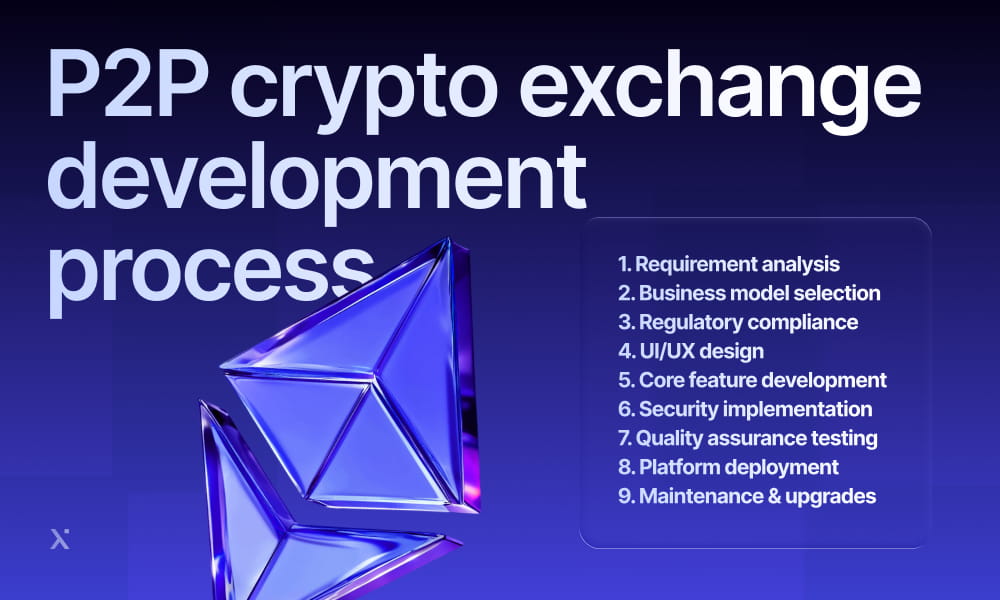
The P2P crypto exchange development process involves much more than just building a trading platform. Businesses need to focus on security, compliance, user experience, and scalability at the same time to create a really reliable marketplace for peer-to-peer crypto trading.
Here is a simple step-by-step guide to help you understand the complete development journey.
1. Requirement analysis
First, you need to define your business goals, target audience, preferred cryptocurrencies, and supported payment methods. This helps you create a clear development strategy and avoid unnecessary changes later in the project.
2. Business model selection
Next, you will choose the right exchange model for your business. You can build an escrow-based marketplace, a hybrid platform, or a feature-rich P2P ecosystem depending on your business objectives and user expectations.
3. Regulatory compliance
At this stage, you need to make sure your platform follows legal and regulatory requirements in your target regions. This usually includes implementing KYC and AML verification processes.
4. UI/UX design
Now, you will focus on designing a simple and user-friendly interface. Your users should be able to register, complete transactions, manage wallets, and communicate with traders without any confusion.
5. Core feature development
Here, you need to build the essential functionalities of the exchange, including custom multi currency crypto wallet development, escrow systems, payment gateway integration, order matching, trading dashboards, and real-time notifications.
6. Security implementation
Next, you will strengthen your platform with advanced security measures such as two-factor authentication, encryption protocols, multi-signature wallets, and fraud detection systems to protect user assets and data.
7. Quality assurance testing
Before launch, you need to test every feature carefully. This includes checking transaction flows, platform performance, security vulnerabilities, and overall usability to ensure a smooth trading experience.
At this stage, you should also conduct a smart contract audit to identify coding errors, loopholes, and potential security risks before the platform goes live.

From Code to Confidence: Inside Smart Contract Audit Pricing

Web3 Smart Contract Development: Building the ‘Brain’ of Your Web3 Project
8. Platform deployment
Once testing is complete, you will deploy the platform on secure and scalable infrastructure. Many businesses also launch a beta version first to gather user feedback before the official release.
9. Maintenance and upgrades
After launch, you need to continuously monitor the platform, fix technical issues, improve security, and introduce new features to keep your exchange competitive and user-friendly.
As you can see, P2P exchange development involves complex technologies, security measures, compliance requirements, and smart contract audits. That’s why many businesses choose professional P2P crypto exchange development services to speed up launch, reduce technical risks, and build a secure platform tailored to their specific business goals.
How much does P2P crypto exchange development cost?
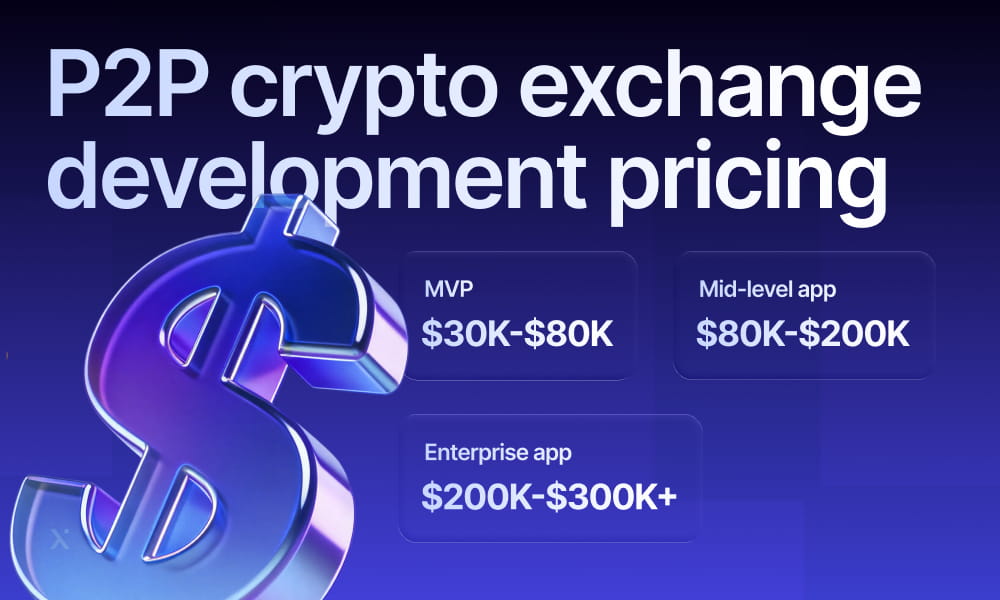
The cost of P2P crypto exchange development depends on many factors, such as:
- UI/UX design — Custom interfaces and smooth user experiences require additional design and development effort.
- Security features — Advanced security measures such as 2FA, encryption, anti-fraud systems, and smart contract audits increase development costs.
- Blockchain integration — Supporting multiple blockchains and cryptocurrencies requires more technical resources.
- Compliance implementation — KYC/AML verification systems and legal compliance features add to the overall budget.
- Third-party integrations — Payment gateways, liquidity providers, analytics tools, and APIs may require additional setup costs.
- Scalability requirements — Enterprise platforms designed for high trading volumes need stronger infrastructure and performance optimization.
And now let’s talk numbers. Here are the estimated P2P crypto exchange development costs depending on the platform size and complexity.
| Development type | Estimated timeline | Estimated cost |
| MVP development | 2-6 months | $30,000-$80,000 |
| Mid-level platform | 6-8 months | $80,000-$200,000 |
| Enterprise exchange | 8-12+ months | $200,000-$300,000+ |
Beyond the initial development cost, businesses should also consider ongoing maintenance expenses. These include server hosting, security updates, bug fixes, API maintenance, and continuous performance optimization. Regular upgrades for compliance, new features, and blockchain changes can also add to long-term costs.
If you hire a team that provides P2P crypto exchange development services, you should also discuss these costs with them in advance. The best team is one that offers full-cycle services, including ongoing maintenance and support.
Top 3 successful and profitable P2P crypto exchanges
In the world of P2P crypto exchange development, studying successful platforms helps understand how leading exchanges scale, attract users, and generate revenue. Below is a quick overview of three major P2P crypto exchanges and their business strategies.
| Exchange | Launch date | Core competitive advantage | Monetization model | Key business results |
| Binance P2P | 2019 | Massive global user base with deep liquidity and strong trust ecosystem | Zero-fee P2P trading supported by ecosystem revenue (ads fees, premium services) | Became one of the highest-volume P2P trading platforms worldwide with strong user retention |
| Bybit P2P | 2022 | Seamless user experience with strong derivatives trading integration | Competitive spreads, exchange-driven revenue, and promotional campaigns | Fast-growing P2P segment backed by strong derivatives exchange traffic |
| LocalCoinSwap | 2018 | Fully decentralized, non-custodial trading model with wide payment options | Trading fees, listing fees, and premium services | Established niche presence as a decentralized alternative to centralized exchanges |
These three exchanges show that there is no single formula for success in P2P crypto exchange development. Each platform has grown by focusing on a clear strength — whether it’s liquidity, user experience, or decentralization.
For new businesses, the conclusion is quite simple: choose a clear positioning, understand your target users, and build a platform that solves real trading needs better than existing solutions.
Top 3 P2P crypto exchange development companies
Choosing the right partner for crypto P2P exchange application development plays a key role in building a secure, scalable, and user-friendly trading platform. Below are three well-known companies with strong expertise in blockchain and crypto exchange development.
PixelPlex
With over 11 years of experience in blockchain development, PixelPlex focuses on building secure and high-performance P2P exchange systems. They also provide white label crypto exchange development services to help businesses quickly launch fully customized trading platforms under their own brand.
This P2P crypto exchange development company delivers:
- Scalable platform architecture designed around transaction flow, user roles, and compliance needs
- Core trading engine development with built-in dispute resolution and security controls
- Escrow system integration to ensure safe and trust-based transactions
- Wallet and payment integrations for smooth fiat and crypto operations
- Regulatory compliance support including KYC/AML implementation
They have also worked on advanced trading solutions for professional users and cross-border crypto systems, so their knowledge is not just theoretical — they have hands-on experience building and scaling real-world blockchain platforms that handle complex trading workflows and high transaction volumes.
OTC Crypto Exchange Development: From RFQ to Settlement

Crypto Arbitrage Bot Development: What Actually Works in 2026
Antier Solutions
Antier Solutions is a well-known blockchain development company offering full-cycle P2P crypto exchange development services for startups and enterprises.
Their team delivers advanced P2P exchange systems with high-speed matching engines, smart contract-based escrow, multi-layer security, and strong encryption protocols. Their platforms also support verified user profiles, multi-currency and fiat transactions, integrated KYC/AML providers, dispute resolution systems, and flexible payment methods.
In addition, they enhance trading flexibility through features like cross-chain swaps, reputation systems, and AI-driven tools for fraud detection and smarter order matching.
Blockchain App Factory
Blockchain App Factory delivers customized P2P crypto exchange solutions with a strong focus on fast deployment and modular architecture. They are known for offering white-label and semi-custom exchange solutions that help businesses enter the market quickly without compromising core functionality.
Their platforms include multi-cryptocurrency support, automated KYC/AML verification, secure trading engines, crypto swap functionality, and multi-currency wallets. They also provide essential infrastructure such as payment gateway integration, multi-factor authentication, admin dashboards, and preferred trader selection features.
Conclusion
P2P crypto exchange development is all about designing a secure financial ecosystem where trust, speed, and transparency work together. From architecture and blockchain selection to security layers, compliance, and cost planning, every decision in trading platform development directly shapes how your platform performs and scales in the real world.
As we’ve seen throughout this guide, successful P2P exchanges rely on a careful balance of technology, user experience, and risk management. Whether you’re launching an MVP or a global trading platform, the goal is to build step by step, prioritize security from day one, and choose a tech stack that can grow with your business.
In many cases, businesses also turn to blockchain consulting to validate their architecture decisions, refine their product strategy, and ensure they’re building on the most efficient and scalable foundation before development begins.
FAQ
Escrow holds the cryptocurrency during a transaction to ensure neither party can cheat. It is released only when both parties fulfill their obligations, ensuring trust in a trustless environment.
A P2P crypto exchange allows users to trade directly with each other, while centralized exchanges act as intermediaries. In P2P crypto exchange development, the focus is on building escrow systems, trust mechanisms, and peer matching rather than order book custody.
They typically earn revenue through transaction fees, listing fees, premium memberships, advertisement placements, and sometimes withdrawal or dispute resolution fees.
Essential security features include escrow protection, encrypted wallets, 2FA authentication, anti-phishing mechanisms, DDoS protection, and real-time fraud detection systems.
With proper architecture, P2P platforms are highly scalable. Cloud infrastructure, microservices, and optimized databases help handle increasing user demand.
The future is driven by decentralization, AI-based fraud detection, faster cross-border payments, and increased regulatory clarity. These features make platforms even more secure and user-friendly.