
Since you’re here, we’ll take a wild guess — you’ve heard of blockchain. And that means you’ve heard of Ethereum, the platform that made decentralized applications, or dApps, possible. So how do you build on it?
Ethereum has been at the center of the decentralization movement since 2015. What began as an experimental smart contract platform has grown into the foundation of a thriving ecosystem that today powers thousands of decentralized applications.
The numbers behind that growth are really impressive, we must say. Over the past ten years, Ethereum has seen more than 234 million unique active wallets and 452 million dApp transactions. DeFi leads the way, with NFTs and gaming close behind. Yes, dApps now serve a wide range of use cases, not only crypto and finance.
The developer community is expanding just as quickly. Between January and September 2025 alone, over 16,000 new developers joined the ecosystem, bringing the total to 31,869 active developers — the largest community in blockchain. With so many builders contributing, Ethereum continues to be one of the most welcoming places to start developing your own dApp.
At PixelPlex, we haven’t stayed aside either. Our blockchain development team has been actively building and contributing to Ethereum-based solutions for years. That’s why we wrote this article — to help businesses and developers better understand the real opportunities behind Ethereum dApp development today.
Why exactly Ethereum?
Ethereum remains a pioneer of smart contract platforms and has evolved into the most widely adopted environment for building scalable, secure dApps. For many businesses, it’s still the top choice thanks to its maturity, tooling, and large developer community.
How Ethereum dApps differ from other blockchain protocols
While multiple blockchain networks now support decentralized applications, they differ significantly in terms of performance, cost, and ecosystem size.
We have prepared a table that highlights how Ethereum compares with other major platforms often considered by businesses. Take a closer look.
| Blockchain | Launch year | Real-time TPS | Gas fees | Ecosystem maturity |
| Ethereum | 2015 | 15-250 (L1), thousands on L2 | Medium–High (lower on L2) | Very large, most established |
| Solana | 2020 | 3,000-4,000 | Very low | Growing rapidly |
| BNB Chain | 2020 | 200-250 | Low | Large DeFi-focused ecosystem |
| Polygon | 2020 | 60-140 | Very low | Strong Ethereum-aligned ecosystem |
| Avalanche | 2020 | 100-450 | Low | Growing, enterprise-friendly |
Comparing DApps Across Protocols: Why Your Blockchain Choice Can Break Everything

How to Select The Best Blockchain Platform for Your Project

Blockchain Analysis Explained: Use Cases & Data Insights
When to choose Ethereum for your dApp
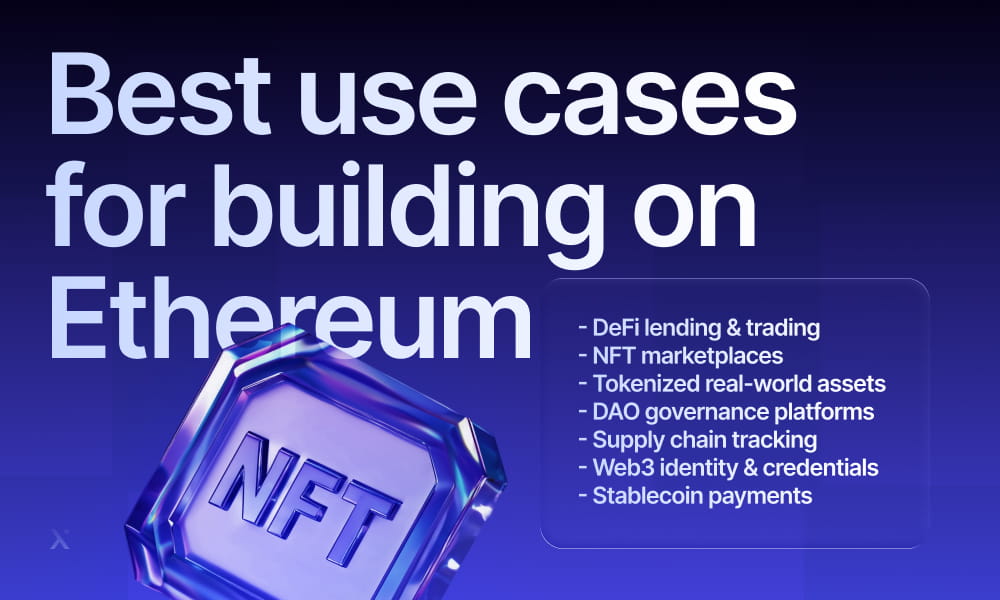
Ethereum is ideal when reliability and ecosystem integration matter more than raw speed. It also makes sense for projects that benefit from established standards and long-term support.
| Use case | Why Ethereum fits best | Examples |
| DeFi lending or trading platforms | Deep liquidity and composability across protocols | Uniswap, Aave |
| NFT marketplaces | Widely adopted NFT standards and marketplace compatibility | OpenSea |
| Tokenized assets & real-world asset platforms | Mature token standards and custody integrations | ERC-20, ERC-721 implementations |
| DAO governance platforms | Established governance infrastructure | Snapshot |
| Enterprise supply chain tracking | Strong security and transparency for audits | AgriChain; U.S., Italian, and Swiss government-led supply tracking initiatives |
| Web3 identity & credential systems | Broad wallet and identity support | MetaMask |
| Stablecoin-based payment platforms | Largest stablecoin liquidity and adoption | USDC, Tether |
As you can see, the decentralized ecosystem continues to favor Ethereum because it offers the most balanced combination of security, developer support, and real-world adoption.
Despite newer and faster networks, Ethereum remains the most reliable and future-proof foundation thanks to its mature infrastructure, strong standards, and large ecosystem.
Main challenges of Ethereum dApp development
Although building on Ethereum does offer many advantages, you should also be aware of several practical challenges, such as:
- Gas fee volatility — transaction costs fluctuate depending on network congestion.
- Scalability limitations on Layer 1 — throughput is lower compared to newer chains.
- Smart contract security risks — bugs can lead to irreversible financial losses.
- Complex user experience — wallets, signatures, and gas settings may be confusing for new users.
- Upgradeability constraints — deployed contracts are difficult to modify.
- Cross-chain integration complexity — bridging assets introduces technical and security considerations.
- Specialized developer requirements — Solidity expertise and Web3 architecture knowledge are needed.
The good news is that most of these limitations can be mitigated. Here’s how you and your development team can overcome them to build your own Ethereum dApp:
| Challenge | How to handle it |
| Gas fee volatility | Use Layer 2 solutions, batch transactions, and optimize contract logic |
| Scalability limitations | Deploy on rollups or scaling networks such as Polygon |
| Smart contract security risks | Conduct several major audits, use tested libraries, and implement bug bounty programs |
| Complex user experience | Add gas abstraction, social login, and simplified wallet onboarding |
| Upgradeability constraints | Use proxy patterns and modular smart contract architecture |
| Cross-chain integration complexity | Rely on trusted bridges and limit unnecessary cross-chain operations |
| Specialized developer requirements | Hire experienced Web3 developers or partner with blockchain-focused teams |

Ethereum Development from A to Z: Features, Use Cases, and Costs
A Comprehensive Guide to Blockchain Application Development
Ethereum dApp architecture explained
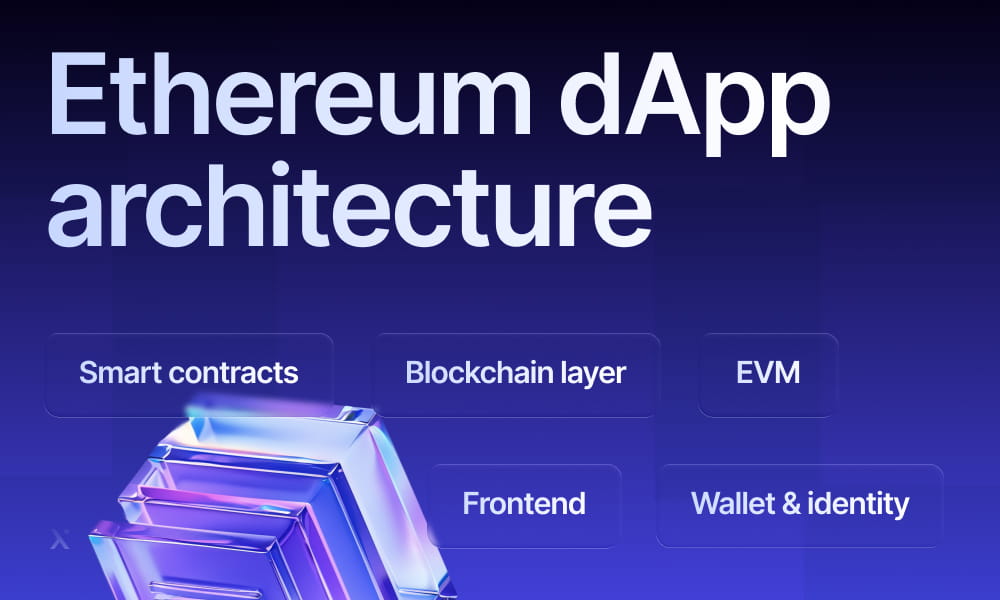
Understanding how to create a dApp on Ethereum starts with recognizing that every Ethereum-based application is made up of several interconnected layers. Each layer plays a specific role in making the application secure, functional, and user-friendly.
| Layer | What it does |
| Smart contracts | Contains the core business logic and rules of the entire dApp |
| Blockchain layer (Mainnet/Layer 2) | Executes transactions and stores data in a decentralized way |
| Execution layer (EVM) | Runs smart contract code consistently across all nodes |
| Frontend | User interface that interacts with wallets and smart contracts |
| Wallet & identity | Handles user authentication, signatures, and asset control |
And now let’s see why this specific architecture matters.
Smart contracts as the core of Ethereum dApps
At the heart of every Ethereum dApp are smart contracts. These are self-executing programs that define the application’s rules, manage digital assets, and automatically enforce agreements without intermediaries.
Once deployed to the blockchain, they run exactly as written and operate autonomously across the network. This means that no single party can change the logic or manipulate the outcomes. This immutability is what makes them powerful, but also why careful Ethereum smart contract development, planning, and testing are so important before deployment.
Ethereum Smart Contracts: The Hard Parts Made Clear

Web3 Smart Contract Development: Building the ‘Brain’ of Your Web3 Project
The Ethereum Virtual Machine (EVM)
The Ethereum Virtual Machine is the core execution engine that powers smart contracts on Ethereum.
In simple terms, it works like a global computer where every node in the network runs the same code at the same time, so transactions and smart contracts are processed identically everywhere in the world. This consistent behavior provides strong security and makes the system reliable.
Because of this shared execution environment, developers can build decentralized applications that don’t rely on a central server, yet still behave in a stable and predictable way across the entire network.
Ethereum mainnet or Layer 2 solutions?
When designing a dApp on Ethereum, one of the most important decisions you will need to make is where to deploy it — directly on the mainnet or on a Layer 2 network. The same consideration applies to DeFi wallet development services, as wallet functionality, transaction costs, and supported interactions need to match the networks and protocols the product is built around.
The Ethereum mainnet is the most secure and decentralized option. It’s best suited for applications where trust, value protection, and long-term reliability are the main priorities, such as high-value DeFi protocols or critical infrastructure. The trade-off is higher transaction costs and slower processing during periods of network congestion.
Layer 2 solutions, on the other hand, are designed to reduce those limitations. They process transactions faster and at significantly lower cost while also benefiting from Ethereum’s underlying security. This makes them a strong choice for consumer-facing apps, gaming platforms, and high-frequency interactions.
In reality, many modern projects use a hybrid approach. They keep core logic or settlement on mainnet while moving most user activity to Layer 2 to achieve both security and scalability.
Gas fees and transaction costs
Every action on an Ethereum dApp requires gas fees, which compensate validators for processing and securing transactions. These costs are dynamic and can change significantly depending on how busy the network is and how complex the transaction is.
Gas fees mainly depend on:
- Network demand: when many users are active, fees increase due to competition for block space.
- Transaction complexity: simple transfers cost less than interacting with complex smart contracts.
- Base fee mechanism (EIP-1559): automatically adjusts fees based on congestion levels.
- Execution size: more computational steps or storage usage increase total cost.
The fees may reach the following levels for different types of transactions:
- Simple ETH transfer: $0.5-2 during normal network activity
- Token swap: $5-25 depending on congestion
- NFT minting: $10-80+ during high demand periods
- Complex DeFi interaction: can exceed $50 on Ethereum mainnet during peak usage
On Layer 2 networks like Polygon, the same actions often cost fractions of a cent to a few cents.
Because of this variability, teams focusing on DeFi dApp development often optimize smart contracts, reduce on-chain computations, and use Layer 2 scaling to make applications more affordable for users.
Security and its best practices for Ethereum dApps
Security is a critical part of Ethereum dApp development services, since vulnerabilities in smart contracts can lead to irreversible losses once deployed on Ethereum. For this reason, security needs to be considered from the very beginning of development, not added at the end.
Best practices include:
- Writing clean, minimal, and easy-to-review smart contract code
- Using well-tested libraries such as OpenZeppelin
- Avoiding unnecessary on-chain complexity to reduce attack surfaces
- Implementing strict access control and permission management
- Testing thoroughly under real-world and stress conditions
Before launching, smart contracts should always undergo professional audits. These audits help uncover vulnerabilities, logic errors, and potential attack vectors before deployment. For businesses, smart contract audits also act as a strong trust signal, often required by serious users, partners, and investors before adoption.
A strong architecture is what makes dApps secure, scalable, and cost-efficient in real usage. Our Ethereum dApp development services help you implement these principles into a fully functional product.
Ethereum dApp development: the process
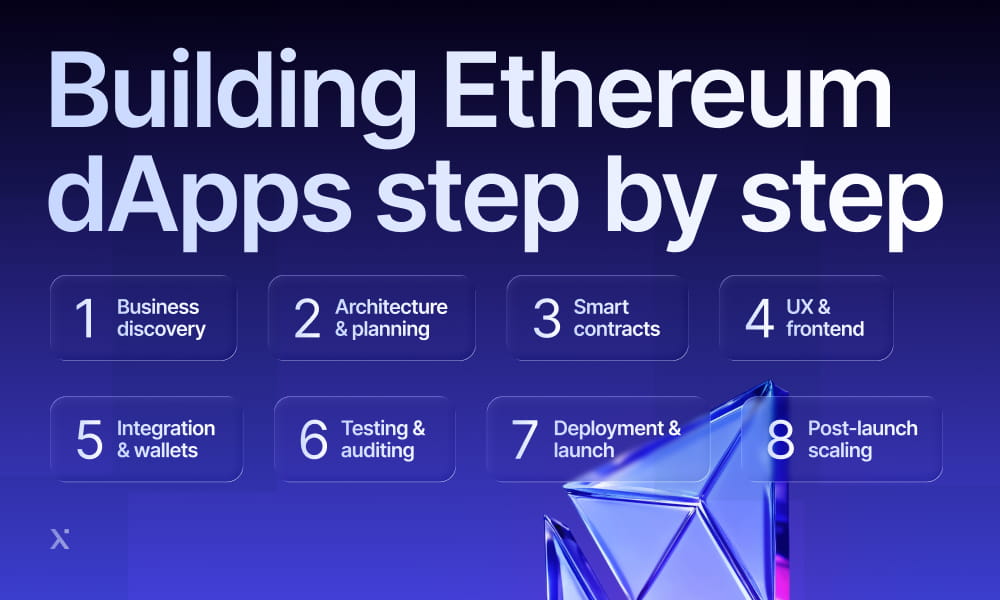
So, how do you build a dApp on Ethereum? You need to approach development as a structured, step-by-step process tailored to your business goals. Whether you’re looking to improve transparency, automate workflows, or launch a blockchain-based product, Ethereum provides a flexible and reliable foundation for your solution.
Here is a practical roadmap that we designed based on our experience. It will help your team move confidently from idea to deployment. Most importantly, it keeps usability, security, and scalability as the main priorities.
Step 1. Business discovery and use case validation
You start by clearly defining the business problem your dApp is meant to solve. At this stage, you look at whether blockchain and decentralization actually add real value, who your target users are, and what key features your product should include.
This step is important because it keeps things practical — it helps you avoid building unnecessary complexity and ensures your investment is focused on real business results like lowering costs, improving transparency, or creating new revenue opportunities.
Step 2. Solution architecture and technical planning
Next, you shape the technical foundation of your application. You determine which components will run on-chain, what will remain off-chain, and how your system will integrate with existing tools.
This phase also includes tokenomics design. Your team will select the token model, define permissions, and plan scalability options.
Step 3. Smart contract development
Once the architecture is ready, your team starts building smart contracts that power your dApp’s core logic. These contracts handle transactions, enforce rules automatically, and remove the need for intermediaries.
At this stage, it’s essential to think about efficiency and long-term use. That means optimizing gas costs, planning for future upgrades, and making sure everything meets relevant compliance requirements.
Well-built smart contracts will reduce risks and guarantee your application behaves reliably and predictably.

Smart Contract Development Cost Demystified: What Every Business Should Know
Step 4. User experience and frontend development
This is the part your users actually see and interact with, so you should keep things simple and intuitive. You design easy flows for things like connecting wallets, making transactions, and getting started with the app.
A clear and smooth experience enables more people to adopt your dApp and makes it easier for non-technical users to feel comfortable using blockchain features.
Step 5. Integration and wallet connectivity
Once the interface of your Ethereum dApp is ready, you connect it with Web3 tools and wallet providers. This allows users to securely log in, sign transactions, and interact with smart contracts. Done properly, this integration creates a smooth link between your frontend and the Ethereum network while keeping everything secure and reliable.
Step 6. Testing and security auditing
Before launch, everything is carefully tested to make sure it works as expected. This includes checking smart contracts, validating the user interface, and running the application on Ethereum test networks.
Security audits are especially important for business use cases that deal with digital assets or sensitive data.

From Code to Confidence: Inside Smart Contract Audit Pricing
Step 7. Deployment and launch
Once everything has been tested, you deploy your smart contracts to the Ethereum mainnet and make your dApp available to users. At the same time, you set up monitoring tools to track performance, user activity, and transactions. Plan your launch really carefully so that everything runs smoothly and users have a stable experience from day one.
Step 8. Post-launch support and scaling
After launch, the focus shifts to improving and growing your product. You can add new features, optimize performance, or use Layer 2 solutions to lower transaction costs.
Ongoing updates and improvements will help your dApp stay relevant and continue supporting your business as it evolves.
| Step | Description |
| 1. Business discovery & validation | Define the problem, users, and value of using blockchain |
| 2. Architecture & planning | Design system structure and plan tokenomics, permissions, and scalability |
| 3. Smart contract development | Build secure contracts that power core dApp logic |
| 4. UX & frontend development | Create simple interfaces for easy user interaction |
| 5. Integration & wallets | Connect wallets and Web3 tools for secure blockchain interaction |
| 6. Testing & auditing | Test functionality and security before launch |
| 7. Deployment & launch | Deploy to Ethereum and monitor performance |
| 8. Post-launch scaling | Improve, optimize, and expand features over time |
When followed correctly, this process gives businesses a clear path from idea to a fully functional Ethereum dApp.
For best results, it’s a good idea to work with experienced Ethereum dApp development services.
How much does Ethereum dApp development cost?
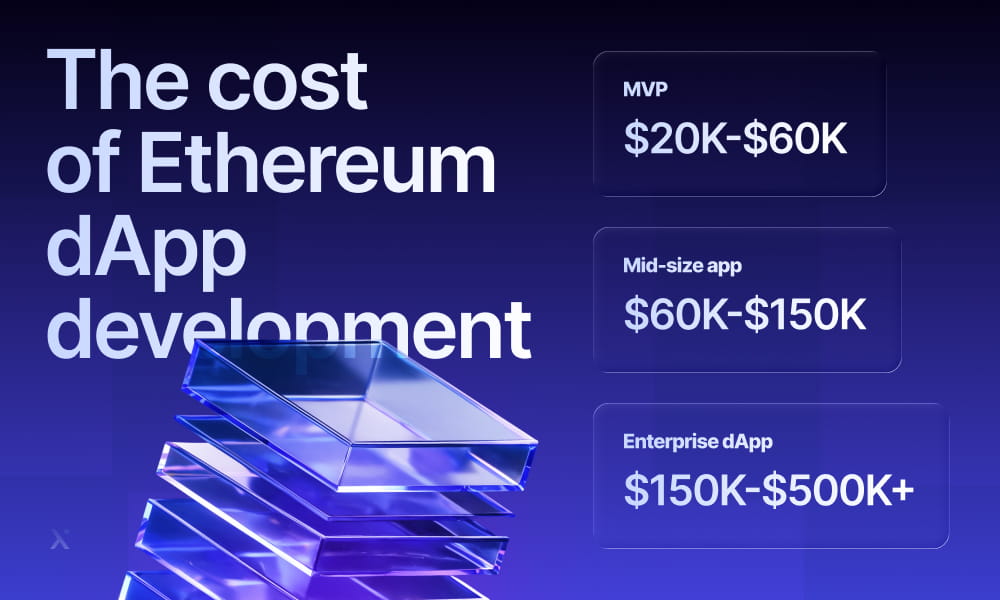
Now moving on from the question of how to build an Ethereum dApp to — how much does it actually cost? Well, it depends on the size and scale of your future application. Are you aiming to build an MVP first, start with a mid-sized application, or are you confident enough to go for an enterprise-level dApp?
In this section, we’ll break down the key cost factors so you can better estimate your budget.
MVP (Minimum Viable Product)
An MVP is the fastest and most cost-efficient way to enter the market. It usually focuses on a single core feature set and is designed to test your idea with real users before scaling.
| Category | Estimate |
| Cost | $20,000-$60,000 |
| Timeline | 4-12 weeks |
| Scope | Basic smart contracts, simple UI, wallet integration |
| Best for | Validating ideas and testing product-market fit |
Mid-size application
A mid-sized Ethereum dApp includes more advanced functionality, better UI/UX, and stronger backend and blockchain integration. It is suitable for businesses that already validated their idea and are ready to scale.
| Category | Estimate |
| Cost | $60,000-$150,000 |
| Timeline | 2-6+ months |
| Scope | Advanced smart contracts, user dashboard, integrations, improved security |
| Best for | Growing products with active users |
Enterprise-level dApp
Enterprise dApps are complex, scalable systems built for large organizations or high-traffic platforms. They require strong security, advanced architecture, and careful planning for ongoing maintenance.
This is where it’s especially important to work with a team that provides Ethereum development services and understands all the nuances of the blockchain and how to make it work for your business.
| Category | Estimate |
| Cost | $150,000-$500,000+ |
| Timeline | 4-12+ months |
| Scope | Multi-module architecture, high scalability, audits, integrations, custom infrastructure |
| Best for | Large-scale platforms and enterprise use cases |

Blockchain Development Cost in 2026: What Goes Into the Price Tag

Blockchain for Business: Beyond Cryptocurrency to Real-World Value
How and when Ethereum-based dApp development pays off
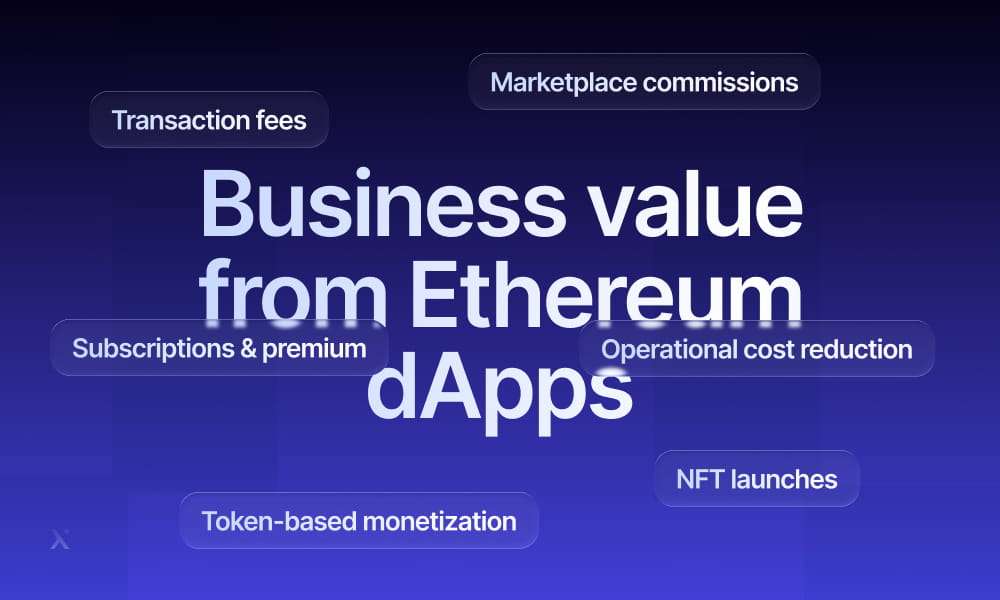
For you as a business, it’s quite clear that investing in an Ethereum-based dApp is not solely about adopting new technology. It’s also about creating new revenue streams, reducing operational costs, and improving efficiency.
The return on investment (ROI) depends on your business model, user adoption, and how effectively your application solves real problems.
Below are the most common ways businesses generate value:
- Transaction fees. You can charge small fees for actions within your dApp, such as swaps, transfers, bookings, or marketplace transactions. Even low fees can generate steady revenue as user activity grows.
- Token-based monetization. Many businesses introduce utility tokens that power access to features, governance, or premium functionality.
- Subscription or premium features. You may offer advanced tools, analytics, or priority access as paid features, creating predictable recurring income.
- Marketplace commissions. If your dApp connects buyers and sellers, you can earn a percentage from each transaction.
- Operational cost reduction. Automation through smart contracts removes intermediaries and reduces manual processes, which directly improves profit margins even without new revenue.
- Tokenized asset sales or NFT launches. Some dApps generate upfront funding by issuing digital assets, memberships, or tokenized access rights.
Now let’s take a look at typical payback timelines. How long it takes to recover your investment depends on adoption speed and monetization strategy. In many business scenarios:
- MVP-level dApps — 3 to 9 months if user adoption is quick
- Mid-size applications — 6 to 18 months with steady growth
- Enterprise-level platforms — 12 to 24+ months, but with higher long-term returns
ROI is typically achieved faster when you launch with a clear monetization model from the very start. It also helps to begin with an MVP and scale gradually as user demand grows. Another idea is using Layer-2 solutions. They can reduce transaction costs and make your dApp more attractive to users.
User experience is just as important as the technical foundation of your application. Focusing on UX/UI design encourages adoption, while automating business processes lowers operational expenses and improves overall efficiency.

More Than Just Storage: How Crypto Wallet Rewards Programs Build Loyalty and Drive Growth
Why partner with PixelPlex for Ethereum dApp development
The answer is simple: we know our craft. Ethereum architecture, smart contracts, Layer 2 solutions, security audits — we’ve been working with these technologies since the early days after Ethereum was released. Our Ethereum dApp development services cover the full lifecycle, from idea validation and architecture design to deployment, scaling, and ongoing support.
As an experienced ethereum dApp development company, we specialize in building secure, scalable, and business-driven solutions tailored to your goals.
Our team also has proven multi-chain experience in production, with Ethereum-based solutions successfully deployed on networks such as Polygon, Arbitrum, and BNB Chain. We place a strong emphasis on security, which is why every smart contract undergoes third-party audits, OpenZeppelin-standard checks, and thorough manual and automated testing before going live on mainnet.
Whether you’re launching an MVP or developing an enterprise-level platform, our developers help you move faster, reduce risks, and turn your blockchain idea into a reliable product.
Conclusion
Ethereum continues to evolve, but its core value for businesses remains the same: a reliable foundation for building transparent, automated, and scalable digital products. It is suitable for launching a new Web3 service, optimizing internal workflows, or exploring token-based business models, as Ethereum provides the tools and ecosystem to support long-term growth.
With a clear strategy, the right architecture, and experienced development support, turning your idea into a production-ready dApp becomes a structured and manageable process. By planning costs, timelines, and ROI in advance, you can confidently move forward and unlock the real business potential of Ethereum-based solutions.
FAQ
No. Many dApps work without native tokens. Tokens are only needed if your business model includes incentives, governance, or in-app economies.
Yes, but only if upgradeability is planned in advance using proxy patterns. Otherwise, deployed smart contracts are immutable.
Most projects support MetaMask, WalletConnect, and Coinbase Wallet to cover both desktop and mobile users.
Not always. Projects often use IPFS, Arweave, or hybrid storage depending on whether data must be immutable and censorship-resistant.
Instead of usernames and passwords, users authenticate by signing messages with their crypto wallets. This signature proves ownership of the wallet without exposing any private data or requiring traditional login credentials.
Yes. Cross-chain bridges and interoperability protocols allow Ethereum dApps to interact with other ecosystems. For example, a DeFi application on Ethereum can enable users to transfer assets from networks like Polygon or BNB Chain to access liquidity or lower transaction fees.