
If Bitcoin introduced blockchain to the world, Ethereum made it programmable and paved the way for much of Web3 development. But what does that actually mean for developers and businesses building on it today?
Ethereum development has been growing quickly in popularity as more people and companies explore blockchain-based solutions. From decentralized apps to Web3 platforms, Ethereum has become one of the main ecosystems where developers choose to build their new digital products.
The market reflects this steady expansion as well: the Ethereum space is expected to grow from about $50.16 billion in 2025 to $58.54 billion in 2026, representing a solid 16.7% CAGR.
Since demand for dApps shows no signs of slowing down, Ethereum development is likely to continue evolving rapidly. This growth is driven by both innovation in the developer ecosystem and wider adoption across numerous industries.
With our hands-on expertise in Ethereum development services, we understand the technical and practical challenges involved in building on this ecosystem. In this article, we’ll break down the main concepts and help you make sense of everything step by step.
What is Ethereum and why is it important?
Ethereum is a blockchain platform that enables individuals and businesses to develop and run decentralized applications, or dApps. Unlike traditional systems that depend on a central server or provider, Ethereum operates on a distributed network. This makes applications more transparent, secure, and less dependent on any single point of control.
It is especially important because it enables smart contract development. Smart contracts are self-executing programs that automatically carry out actions when certain conditions are met. They help companies automate processes, reduce intermediaries, and improve efficiency in areas like payments, agreements, supply chain management, digital identity, and many others.
Ethereum Smart Contracts: The Hard Parts Made Clear

Web3 Smart Contract Development: Building the ‘Brain’ of Your Web3 Project
Ethereum development also boasts a strong developer ecosystem, mature tools, and growing adoption across industries. This is why it has become a practical choice for businesses looking to experiment with or scale decentralized technologies.
| Key facts about Ethereum | |
| Category | Details |
| Launch year | 2015 |
| What is it? | A blockchain platform for building dApps |
| Native currency | Ether (ETH) |
| Main feature | Smart contracts |
| Network type | Decentralized, open-source blockchain |
| Consensus mechanism | Proof-of-Stake (since “The Merge” upgrade in 2022) |
| Key advantage | Enables trustless and transparent transactions without intermediaries |
| Developer ecosystem | Large global community with strong open-source tools and support |
Core features of Ethereum development
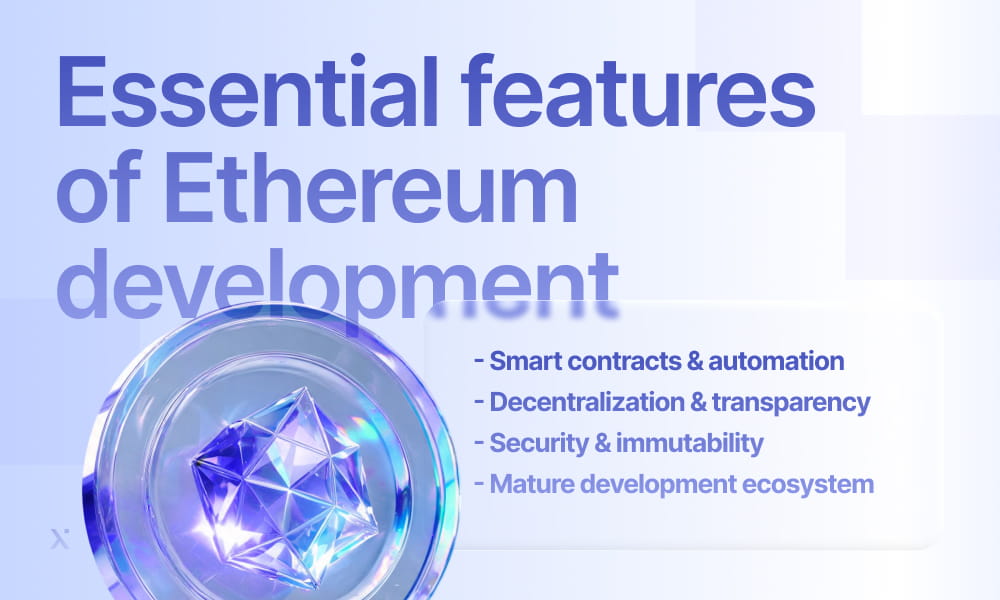
Ethereum development is based on several core concepts that make it a powerful platform for building dApps. Below are the main features that define how development on Ethereum works:
- Smart contracts and automation: Ethereum played a pioneering role in bringing smart contracts into real-world use. Instead of relying on manual processing or third parties, Ethereum smart contract development focuses on building logic that runs directly on the blockchain, which helps streamline operations and reduce friction in digital processes.
- Decentralization and transparency: the Ethereum network is run by many independent computers rather than a single central authority. This decentralized structure makes the system more open and resilient. At the same time, all transactions are recorded on a public ledger, which ensures transparency and allows anyone to verify activity on the network.
- Security and immutability: once information is added to the Ethereum blockchain, it cannot be changed or removed. This creates a strong level of trust in the data stored on the network. However, it also means that any mistakes in smart contract code or incorrect data entries cannot be easily fixed after deployment, which is why it’s extremely important to develop and test them carefully.
- Ecosystem and developer tools: Ethereum has a mature development ecosystem supported by tools and technologies like Solidity, the primary programming language for smart contracts. These contracts are executed on the Ethereum Virtual Machine (EVM), which acts as a global computing layer, ensuring that code runs consistently across all nodes in the network. Solidity + EVM = the ability to build and deploy decentralized applications reliably at scale.
However, there is a fly in the ointment. As more companies and users continue to use Ethereum-based applications, the network faces challenges such as congestion and higher transaction costs.
The good news is that these issues can be addressed. Developers are actively working on protocol improvements and Layer 2 solutions, which process transactions off the main chain while still benefiting from Ethereum’s security. These upgrades help improve performance, reduce costs, and make the network more efficient for everyday use.

What Are Layer 2 Blockchain Scaling Solutions and What Benefits Do They Offer?
Ethereum vs other blockchains: does it really stand out?
Ethereum is often seen as the leading platform for building dApps, but, of course, it’s not the only blockchain that developers use. Networks like Solana, Binance Smart Chain, Polkadot, and Cardano also offer strong capabilities, each with its own strengths. So the real question is — what makes Ethereum development different?
In many cases, it does stand out because of its maturity, large developer community, and strong ecosystem of tools and applications. However, other blockchains often compete by offering faster transactions or lower fees. The choice usually depends on the specific needs of a project, such as scalability, cost, or decentralization level.
| Blockchain | Strengths | Limitations | Best known for |
| Ethereum | Largest developer ecosystem, strong security, extensive tooling | Higher gas fees, scalability challenges | DApps, DeFi, NFTs |
| Solana | Very fast transactions, low fees | Network stability concerns in the past | High-performance apps, NFTs, gaming |
| Binance Smart Chain (BSC) | Low fees, fast transactions, EVM compatibility | More centralized compared to others | DeFi apps, low-cost token launches, Binance ecosystem projects |
| Polkadot | Strong interoperability between blockchains | More complex architecture, smaller ecosystem | Cross-chain communication |
| Cardano | Research-driven development, strong focus on security | Slower feature rollout | Academic approach to blockchain systems |
Overall, Ethereum remains the most widely adopted platform, especially for complex and advanced applications where security and stability are top priorities.
While newer blockchains compete on speed and cost, Ethereum continues to lead in trust, adoption, and developer activity. This is exactly what keeps it at the center of today’s blockchain development.
Popular use cases and solutions built on Ethereum
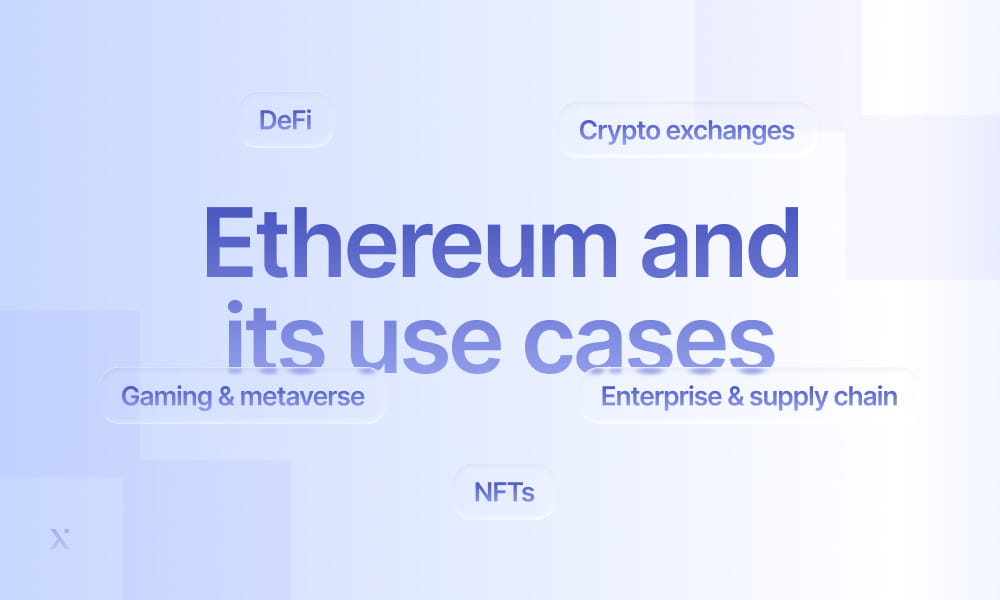
Ethereum supports a broad range of real-world applications thanks to its flexibility, strong security model, and large developer ecosystem. Below are some of the most common Ethereum development use cases, along with examples.
Decentralized finance (DeFi)
DeFi applications recreate traditional financial services such as lending, borrowing, and trading, but using smart contracts instead of banks. This allows users to interact directly with protocols, thereby reducing fees and increasing accessibility. Ethereum is widely used here because of its security, liquidity, and well-established standards that make different apps work together seamlessly.
Examples:
- Uniswap — a decentralized exchange for token swaps
- Aave — a protocol that lets users to lend and borrow crypto assets
Non-fungible tokens (NFTs)
NFTs are unique digital assets that prove ownership of items like art, music, or virtual goods on the blockchain. Ethereum became the foundation for NFT development due to its early adoption of token standards like ERC-721, which made it easier to create and trade these assets across platforms.
Examples:
- OpenSea — one of the largest NFT marketplaces out there
- Rarible — a platform for minting and selling NFTs
Cryptocurrency exchanges
These platforms allow users to trade digital assets directly from their wallets without having to rely on centralized authorities or intermediaries. Ethereum is a popular choice because of its robust smart contract capabilities and deep liquidity across tokens.
So, these days it plays a central role in cryptocurrency exchange development, especially for decentralized exchanges.
Examples:
- Uniswap — automated token exchange
- SushiSwap — a community-driven decentralized trading platform

Cryptocurrency Exchange Development Cost: Key Factors & Estimates

Centralized Crypto Exchange Development Explained: From Architecture to Launch
Gaming and metaverse projects
Blockchain games and virtual worlds let users truly own, trade, and monetize in-game assets. Ethereum is often used because it supports NFTs and secure ownership — they are essential for creating player-driven economies.
Examples:
- Axie Infinity — a play-to-earn game with tradable characters
- Decentraland — a virtual world where users can buy, rent, and develop digital land
Enterprise and supply chain solutions
Companies utilize Ethereum to improve transparency, traceability, and efficiency in their operations. Smart contracts can automate workflows, while the blockchain ensures that data cannot be altered. Ethereum is chosen for its reliability, global network, and ability to integrate with existing systems.
Examples:
- Aura Blockchain Consortium — a platform founded by luxury brands to track product authenticity, ownership, and lifecycle using blockchain technology
- OriginTrail — a decentralized knowledge graph used for supply chain transparency and data sharing
Blockchain Supply Chain Application Development and When It Fits
| Use case | What it is | Why Ethereum | Examples |
| DeFi | Finance without banks | Secure, liquid, interoperable | Uniswap, Aave |
| NFTs | Ownership of digital assets | Strong standards, wide adoption | OpenSea, Rarible |
| Crypto exchanges | Trading without intermediaries | Smart contracts, deep liquidity | Uniswap, SushiSwap |
| Gaming & metaverse | Virtual worlds with owned assets | NFT support, secure ownership | Axie Infinity, Decentraland |
| Enterprise solutions | Business tracking & automation | Transparent, reliable | Aura Blockchain Consortium, OriginTrail |
As these use cases continue to expand, many organizations turn to an experienced Ethereum application development company to design and build solutions that are secure, scalable, and aligned with their business goals.
How different industries are embracing Ethereum development
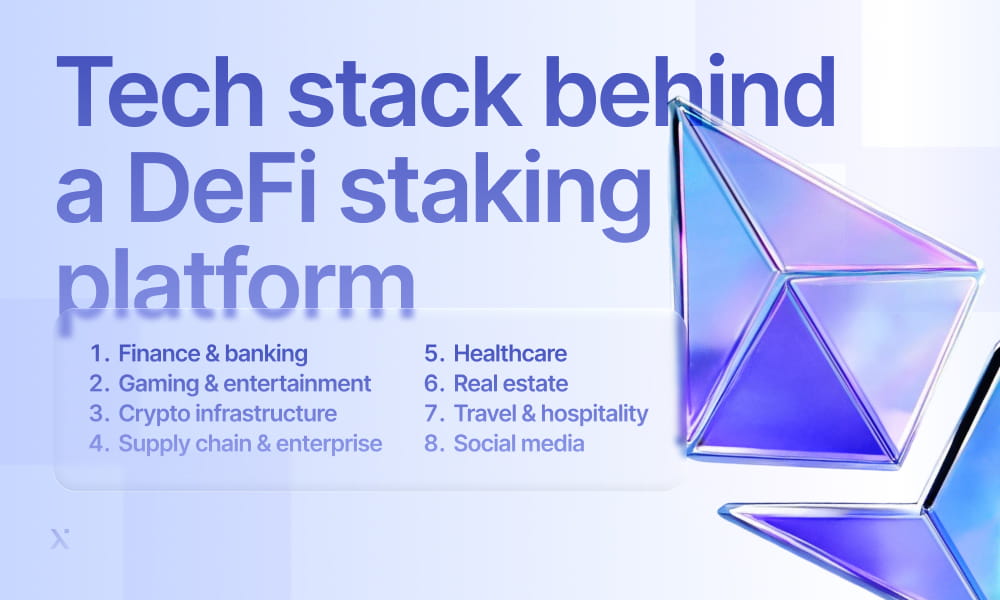
Ethereum is no longer limited to crypto enthusiasts or developers. Today, many industries are actively exploring and adopting it to improve efficiency, transparency, and digital ownership. Let’s take a look at them.
Finance and banking
The financial sector was one of the first to adopt Ethereum. Banks, fintech startups, and DeFi platforms use it to build faster and more transparent systems for payments, lending, and trading. Ethereum helps reduce the need for intermediaries and enables near real-time settlement of transactions.
Many companies also rely on specialized dApp development services to build secure financial applications on this blockchain.
Secure smart contracts, rigorous audits, and strong development practices are essential for success. Don’t take security lightly.
Gaming and entertainment
The gaming industry was quick to start using Ethereum to give players true ownership of in-game assets like skins, characters, and virtual land. This has created entirely new play-to-earn game (P2E) economies where players not only enjoy the game and earn rewards within it, but can also transfer assets to other platforms, sell them, or build entire collections that they truly own.
A professional Ethereum game development company or providers of Ethereum game development services help build these blockchain-based games where users gain real ownership of their assets, while businesses benefit from new revenue models and more engaged, active communities.

Blockchain Game Development: Budgeting for Success in 2026
Crypto infrastructure and wallets
As adoption grows, secure storage and management of digital assets has become essential. Crypto wallet development plays a key role here, enabling users to store, send, and receive cryptocurrencies safely. These wallets are often the first entry point for users into the Ethereum ecosystem.
Supply chain and enterprise
Businesses use Ethereum to record every step of a product’s journey on the blockchain, from production to delivery. Each update is stored in a way that cannot be altered, which helps verify authenticity and reduce fraud. It also allows companies to automate approvals, tracking, and settlements, making operations faster and lowering administrative costs.
Healthcare
Healthcare providers are exploring Ethereum development to securely store and share patient data between hospitals, labs, and insurers. Blockchain helps ensure data integrity, reduces duplication of records, and improves privacy control for patients while maintaining transparency where needed.
Real estate
The real estate industry is using Ethereum to simplify property transactions and reduce paperwork. Smart contracts can automate agreements, verify ownership, and speed up property transfers. This reduces reliance on intermediaries and makes the buying and selling process more efficient.
Travel and hospitality
In the travel industry, Ethereum is being tilized to simplify bookings, loyalty programs, and identity verification. Smart contracts can automate hotel reservations and reduce fraud in ticketing systems. It also helps create transparent reward systems for frequent travelers.

Pack Your Digital Bags: Why Your Travel Business Needs Blockchain
Social media
Social media platforms also got into Ethereum development to give users more control over their data and content. Instead of centralized ownership, users can potentially own their profiles, posts, or digital identities. Blockchain-based incentives can also reward content creators more fairly.
| Industry | How Ethereum is used | Example |
| Finance | Payments, DeFi, trading platforms | Lending, exchanges |
| Gaming | Digital ownership, P2E games | NFTs, in-game assets |
| Crypto infrastructure | Secure storage and transactions | Wallet applications |
| Supply chain & enterprise | Tracking, automation, transparency | Product verification |
| Healthcare | Secure data sharing | Patient records |
| Real estate | Automated transactions | Property transfers |
| Travel & hospitality | Booking automation, loyalty systems | Ticketing, rewards |
| Social media | Digital identity, creator rewards | Content ownership |
Our Ethereum blockchain development services help businesses design and build dApps, automate processes with smart contracts, and create transparent, trust-based systems that improve efficiency and reduce operational costs.
Cost of Ethereum development: from MVPs to large enterprise apps
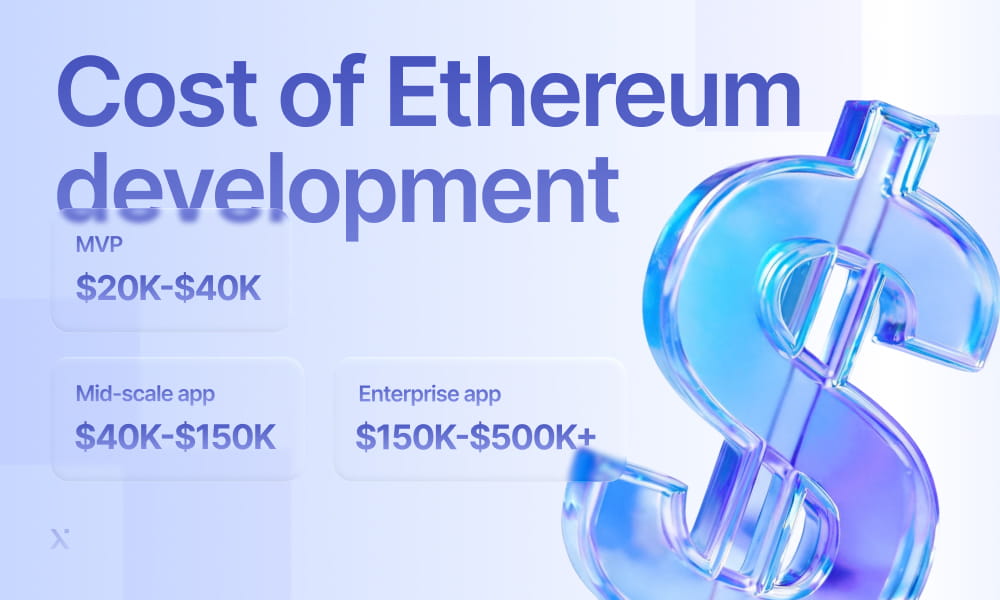
The cost of Ethereum development varies widely depending on the type of application, its complexity, and the industry it is built for. A simple prototype for a startup will cost far less than a fully scalable enterprise system used in finance, supply chain, or healthcare. On average, pricing is shaped not only by size, but also by how advanced the blockchain logic needs to be.
Other key factors include the complexity of smart contracts, required security level, number of integrations like wallets, APIs, external systems, UI/UX design, scalability needs, and whether a full security audit is required. Industry regulations can also increase development effort, especially in finance and healthcare.
MVP
MVPs are used to test ideas quickly and validate product-market fit without building full-scale infrastructure.
| Category | Details |
| Industries | Web3 startups, gaming prototypes, simple DeFi tools |
| App types | Basic dApps, token projects, simple NFT platforms |
| Scope | Limited features, basic smart contracts |
| Timeline | 1-3 months |
| Estimated cost | $20,000-$40,000 |
Mid-scale commercial application
These applications are typically used by startups or growing businesses that already have users and need scalable blockchain infrastructure.
| Category | Details |
| Industries | Gaming platforms, DeFi apps, supply chain tools, NFT marketplaces |
| App types | Feature-rich dApps, wallets, trading platforms, NFT ecosystems |
| Scope | Multiple smart contracts, integrations, user dashboards |
| Timeline | 2-5 months |
| Estimated cost | $40,000-$150,000 |
Enterprise-grade Ethereum platform
Enterprise solutions are built for long-term scalability, strict compliance requirements, and integration with existing business systems.
| Category | Details |
| Industries | Finance, logistics, healthcare, real estate, enterprise systems |
| App types | Large-scale DeFi platforms, enterprise supply chain systems, payment networks |
| Scope | Advanced smart contracts, high security, Layer 2 integration, complex architecture |
| Timeline | 4–12+ months |
| Estimated cost | $150,000-$500,000+ |
If you’re still not sure about the budget or have specific requirements you want to discuss and estimate in detail, you can hire an Ethereum development company that will consult you on the costs and scope of the project.
This is usually included in various companies’ Ethereum application development services to help businesses define clear requirements, choose the right technical approach, and plan a realistic development roadmap before starting the project.

Enterprise Blockchain: Prom Promise to Profit

Blockchain Development Cost in 2026: What Goes Into the Price Tag
What makes PixelPlex the right choice for your Ethereum project
At PixelPlex, we make Ethereum development simple and easy to use. We build smooth onboarding experiences with clear wallet flows and easy integrations with MetaMask, WalletConnect, or custom wallets, so users can start quickly without confusion.
As an Ethereum blockchain development company, we can develop directly on Ethereum or use Layer 2 solutions to make apps faster and more cost-efficient. Every project goes through careful testing and security checks based on OpenZeppelin standards and real-world attack scenarios. We work across smart contracts, DeFi, NFTs, fintech, and other industries, building secure and scalable solutions.
With over 10 years of experience in blockchain development and in Ethereum DApp development services specifically, we’ve been part of this space since the beginning. Over time, we’ve built many solutions using Ethereum and Layer 2 technologies, helping businesses turn ideas into real products that work in the real world.
| Facts about PixelPlex Ethereum development services | |
| End-to-end Ethereum dApp development | Covers everything from planning and smart contracts to deployment and support |
| Projects delivered | 450+ |
| Industry scale | $1.2B raised by clients |
| Experience strength | Enterprise-grade dApps + audited smart contracts (0 exploits reported) |
What the future holds for Ethereum development
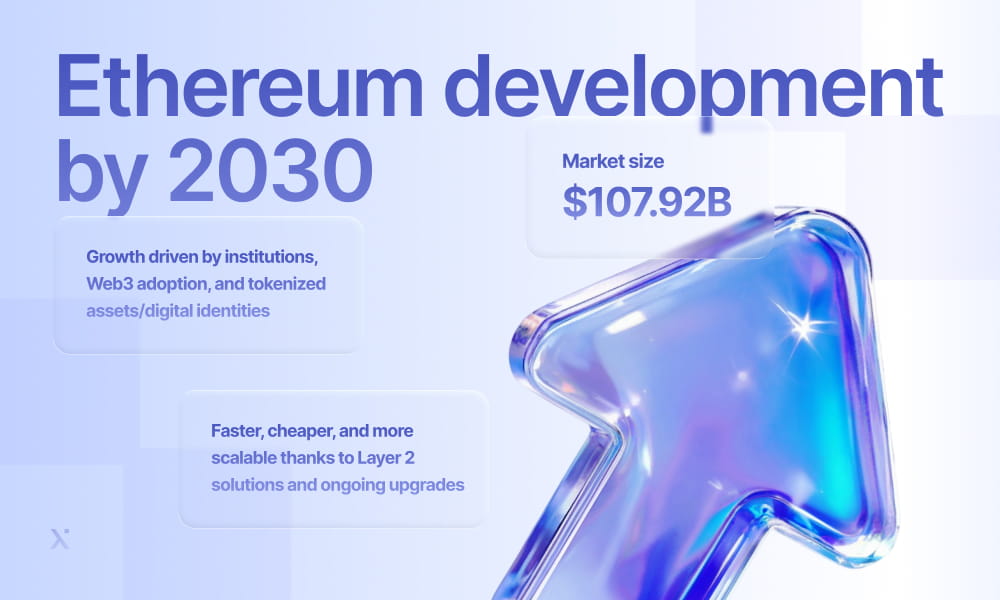
Ethereum is expected to keep growing as more businesses start using blockchain technology. The Ethereum development market is likely to expand quickly over the next few years and could reach $107.92 billion by 2030, with steady double-digit growth each year. According to Research and Markets, this growth is being driven by more interest from large institutions, the rise of Web3 apps, and the use of tokenized assets and digital identities.
At the same time, improvements in scalability, such as Layer 2 solutions, are making the network faster, cheaper, and more efficient, while also supporting safer and more compliant applications.
Another reason for Ethereum’s growth is the increasing use of cloud-based technologies. By combining decentralized computing with smart contracts, Ethereum reduces the need for traditional centralized systems and improves transparency, security, and control over data.
As these trends continue, Ethereum is likely to remain an important technology for the future of digital services and online platforms.
FAQ
Key factors include project goals, target users, regulatory requirements, budget, scalability needs, and whether blockchain is truly necessary for the use case.
Yes, Ethereum apps can be integrated with traditional systems using APIs, oracles, and middleware. This allows businesses to combine blockchain functionality with their existing infrastructure.
Security can be improved through code audits, thorough testing, using proven libraries, implementing access controls, and following best practices in Ethereum smart contract development.
Smart contract audits help identify vulnerabilities, bugs, or logic errors before deployment. Since contracts cannot be easily changed after launch, so auditing is critical to prevent financial losses and security breaches.
Ethereum apps can generate revenue through transaction fees, subscription models, token sales, staking mechanisms, or premium features. In DeFi, for example, platforms often earn a small fee from each transaction or trade.
Tokens can represent value, access rights, ownership, or incentives within an application. They are often used to reward users, enable governance, or power internal economies.
While the main network has limitations, scalability can be improved using Layer 2 solutions, sidechains, or hybrid architectures. This makes Ethereum more suitable for large-scale business applications.
If you don’t have in-house blockchain expertise, working with an Ethereum application development company can help you build secure, scalable solutions and avoid costly mistakes.