Some let their tokens chill in their wallets, hoping they’ll magically grow, while others put them to work in DeFi staking and actually earn rewards. Are you building the next tool to help clients earn while they sleep? If so, this article is a must-read.
The global DeFi crypto staking market is booming, valued at $3.8 billion in 2025 and projected to reach $22.6 billion by 2034. Popular Proof-of-Stake blockchains like Ethereum, Solana, and Cardano are driving this growth. At the same time, DeFi innovations such as liquid staking allow users to earn rewards across multiple protocols.
More institutions are also joining the DeFi staking scene, and clearer regulations are making compliant platforms even more appealing. This opens up a great opportunity for businesses to partner with a trusted crypto exchange development provider to build platforms that help clients earn passive income while their tokens stay active. Leveraging expert blockchain development consulting can help enterprises safely navigate these market shifts, enabling them to create secure, scalable solutions that maximize token utility.
PixelPlex, a company specializing in blockchain and DeFi staking platform development, enables businesses to create secure, scalable solutions that maximize token utility. This article is their guide for developers and companies aiming to grow revenue with such platforms.
What is DeFi staking, and which staking platform features matter most?
DeFi staking helps both individuals and businesses make the most of their crypto assets. For users, it’s a way to earn rewards by putting tokens to work — securing networks, providing liquidity, participating in governance, and generating a yield. Instead of letting crypto just sit in a wallet, staking turns it into a productive asset for passive income.
For businesses looking to build their own DeFi staking platforms, the goal is to offer users secure, scalable solutions, maximize token utility, and provide a seamless experience that encourages adoption. By focusing on the right features, businesses can create competitive platforms that attract users and grow with the market.
To see how these ideas work in practice, let’s look at some examples of popular DeFi staking platforms, the assets they support, and the yields they offer:
- Binance — supports BTC, ETH, BNB, and more; yield: 2-12% APY
- DeFi Swap — supports a wide range of DeFi tokens; yield: 5-15% APY
- Kraken — supports ETH, DOT, ADA; yield: 4-7% APY
- Uniswap — provides liquidity pools for many ERC-20 tokens; yield: 3-20% APY
Here, APY means annual percentage yield. It shows how much an investment grows in a year, including compound interest.
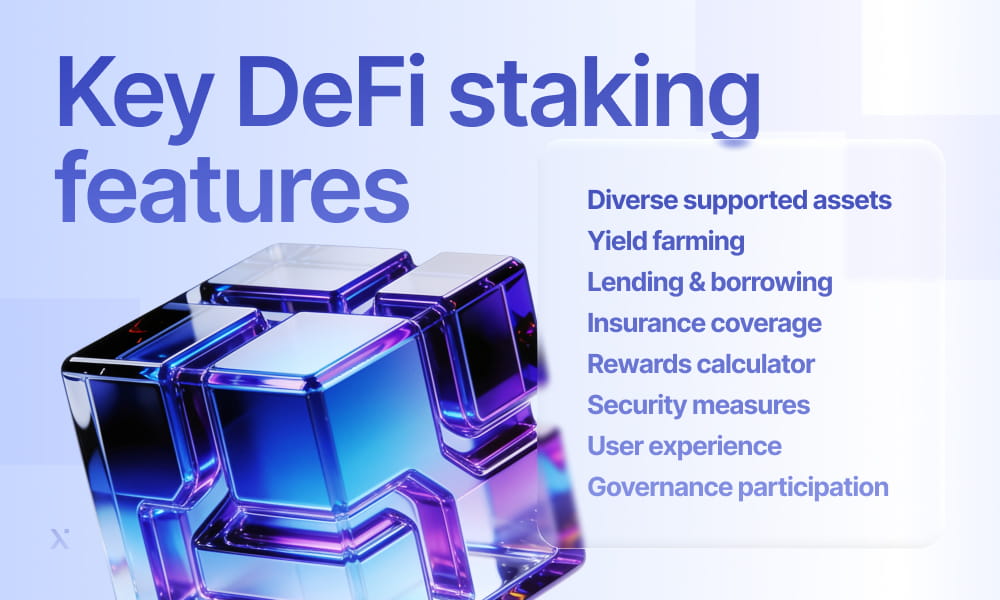
Yes, DeFi staking platform development can be highly rewarding, but its effectiveness depends on the platform’s features. The table below highlights the core features to consider:
| Feature | Why it matters |
| Diverse supported assets | Broad token options attract more users and increase platform utility |
| Yield farming | Users can earn additional rewards by providing liquidity to specific pools, increasing engagement and returns |
| Lending & borrowing | Allows users to lend their crypto or borrow against it, adding flexibility and new revenue opportunities for businesses |
| Insurance coverage | Protects staked assets and builds user trust |
| Rewards calculator | Helps estimate potential returns and plan strategies effectively |
| Security measures | Audits and multi-layer protections reduce risk and protect assets |
| User experience | Simple interfaces and reporting make staking accessible and manageable |
| Governance participation | Allows users to vote on platform changes, boosting engagement and loyalty |
Is building a DeFi staking platform hard? Here’s the truth
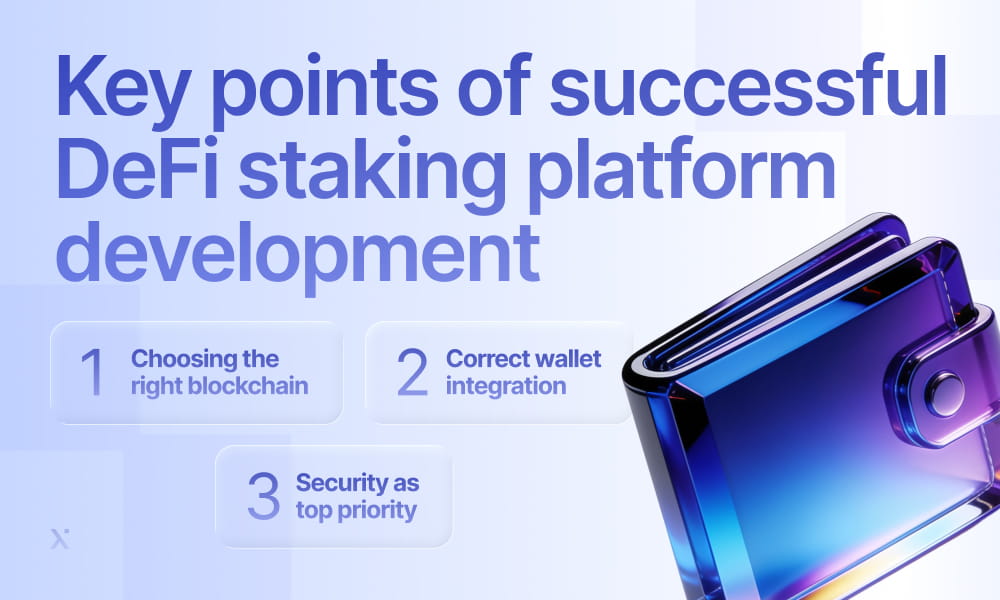
As with any project involving large sums of money — whether fiat or crypto — it’s a big responsibility to build it safely and correctly, with as few mistakes as possible. DeFi staking platforms are more complex than traditional financial solutions because they are decentralized and blockchain-based. This means that every decision, from choosing the right blockchain to custom DeFi wallet development or wallet integration and securing smart contracts, affects performance, security, and user trust.
In order to build robust, scalable, and easy-to-navigate platforms, businesses should plan very carefully, work with the most trustworthy and experienced DeFi staking platform development team, and follow best practices that we also talk about right here.
Choosing the right blockchain
The blockchain you choose forms the foundation of your staking platform. It determines speed, security, transaction costs, and the types of tokens you can support. Different blockchains are popular for different reasons, and picking the one that fits your goals is essential.
| Blockchain | Transaction speed, TPS | Transaction fees | Ecosystem advantages | Why companies choose it for DeFi staking |
| Ethereum | ~15-30 | Medium-high | Access to thousands of ERC-20 tokens, mature DeFi tools, strong liquidity | Large developer community, highly secure, widely adopted for DeFi projects |
| Binance Smart Chain | ~160 | Low | Strong adoption in DeFi, integrated with Binance ecosystem, easy token bridging | Fast and low-cost transactions, compatible with Ethereum tools |
| Solana | 3,000-4,000 | Very low | Growing DeFi ecosystem, NFT and staking support, scalable for mass adoption | High throughput, low latency, ideal for platforms expecting heavy activity |
| Polygon | ~7,000 | Very low | Compatible with Ethereum dApps, easy migration for existing projects, lower gas fees | High throughput, low latency, lower costs for users, ideal for mass adoption of DeFi platforms |
| Avalanche | ~4,500 | Low | Fast finality, cross-chain DeFi integration, supports both ERC-20 and native tokens | High performance and low latency, strong for DeFi applications |

Blockchain Development Cost in 2026: What Goes Into the Price Tag
Wallet integration
Wallet integration is the bridge between your platform and your users’ crypto. Done right, it builds trust, ensures security, and simplifies staking for everyone. Focus on these key elements:
- Support popular wallets: MetaMask, Trust Wallet, Coinbase Wallet, and WalletConnect are widely used. Supporting them increases adoption.
- Simple onboarding: Users should be able to connect, stake, and track rewards in a few clicks. Too many steps can drive them away.
- Cross-platform access: Ensure the platform works on both desktop and mobile wallets. Mobile-first design is increasingly important today.
- Transaction transparency: Display pending, confirmed, and completed transactions clearly, so users understand exactly what’s happening with their assets.
- Private key security: Never store users’ private keys on your servers — wallets should remain under users’ control.
Some businesses even go further by investing in crypto wallet development. They create their own proprietary wallets to have full control over security, features, and branding, while providing a fully integrated staking experience for users.

More Than Just Storage: How Crypto Wallet Rewards Programs Build Loyalty and Drive Growth

Inside Crypto Wallet MVP Development: Process, Costs, and Real-World Lessons
Security as top priority
Security isn’t optional, period. It’s truly the foundation of user trust and platform credibility. Here are the key points for building a truly secure DeFi staking platform:
- Smart contract audits: have all contracts audited by reputable firms to prevent vulnerabilities. We recommend multiple audits for more complex systems.
- Multi-layer protection: Combine on-chain and off-chain security measures, such as firewalls, DDoS protection, and monitoring tools.
- Insurance coverage: Partner with DeFi insurance providers to protect staked assets against hacks or protocol failures.
- Bug bounties: Offer rewards for developers or ethical hackers who find vulnerabilities. This encourages continuous improvement.
- Regular updates: Keep all smart contracts and platform software up to date to prevent exploits.
- Clear risk communication: Be transparent with users about risks, fees, and staking conditions. Trust is built not just on security, but on honesty.
Don’t hesitate to spend on strong security today. It can save you far more in losses, reputation damage, and operational costs down the road.
What tech stack powers DeFi staking platform development?
When it comes to development of DeFi staking platform solutions, the tech stack is what sets the foundation for DeFi security, scalability, and user experience. Typically, DeFi staking platforms combine blockchain infrastructure, smart contract frameworks, frontend tools, and security layers. Let’s take a closer look.
| Layer | Technologies | Purpose |
| Blockchain infrastructure | ||
| Blockchain networks | Ethereum, BNB Chain, Polygon, Solana | Hosts staking smart contracts and processes transactions |
| Smart contracts | ||
| Smart contract languages | Solidity, Rust, Vyper | Defines staking logic, rewards, and token mechanics |
| Smart contract frameworks | Hardhat, Truffle, Foundry, Anchor | Development, testing, and deployment of contracts |
| Frontend | ||
| Frontend | React, Next.js, Vue | User dashboard for staking, rewards tracking |
| Web3 integration | Ethers.js, Web3.js, Wagmi | Connects frontend to blockchain |
| Wallet integration | MetaMask, WalletConnect, Coinbase Wallet | Enables users to stake tokens securely |
| Security layers | ||
| Security tools | OpenZeppelin, Slither, MythX | Smart contract auditing and protection |
| Supporting/Optional backend | ||
| Backend | Node.js, NestJS, Python | Handles indexing, analytics, and off-chain services |
| Database | PostgreSQL, MongoDB, Redis | Stores platform analytics and user metadata |
| Indexing & data | The Graph, SubQuery | Fetches blockchain data efficiently |
With this tech stack, you’re all set to build a secure and scalable DeFi staking platform. Its structure makes it easy to expand features, connect with additional blockchains, and grow seamlessly as more users come on board.

Web3 Smart Contract Development: Building the ‘Brain’ of Your Web3 Project

Ethereum Smart Contracts: The Hard Parts Made Clear
Profitability of DeFi staking platforms explained
Now that we understand how staking works and the technology behind it, the big question for your business is: what’s in it for me? How exactly can DeFi staking platform development generate revenue and become a profitable venture?
The simplest and most obvious source of revenue is staking fees. When users lock their tokens into your platform, you can take a small percentage of their rewards as a platform fee. This way, you will have a reliable, ongoing income stream directly tied to user activity.
If your platform includes yield farming, you can charge a commission on users’ farming rewards, which also encourages more engagement. And with DeFi lending features, your platform can earn interest from collateralized loans as well.
A well-designed platform doesn’t just earn money from fees — it also attracts and engages users. Active users explore features like yield farming or lending, participate in governance, and interact with platform tokens as rewards. All this contributes to the growth of your platform and generates additional revenue over time.
| Revenue source | How it works | How it benefits you |
| Staking fees | Take a small percentage of user rewards | Provides steady, recurring income |
| Yield farming commissions | Charge fees on farming rewards | Encourages active platform use and boosts revenue |
| Lending interest | Earn interest from loans using staked assets | Adds another source of income |
| Token incentives | Use platform tokens for rewards or governance | Increases user engagement and liquidity |
Combine staking fees, yield farming, and lending to maximize returns. More features mean more ways for your platform to earn and grow.
DeFi staking development: a complete step-by-step workflow
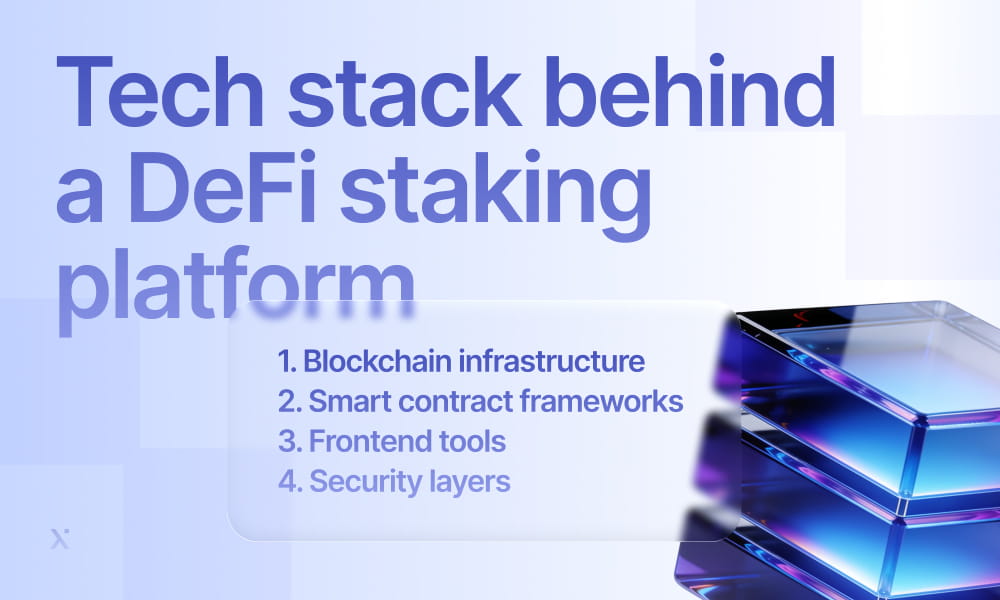
DeFi staking development may seem complicated at first. From designing smart contracts to integrating yield farming and lending features, there are many aspects that require careful attention and expertise because missing even one step can lead to technical issues or security risks.
That’s why many businesses rely on professional DeFi staking platform development services to guide them through the entire process. They ensure that each stage is handled efficiently and safely.
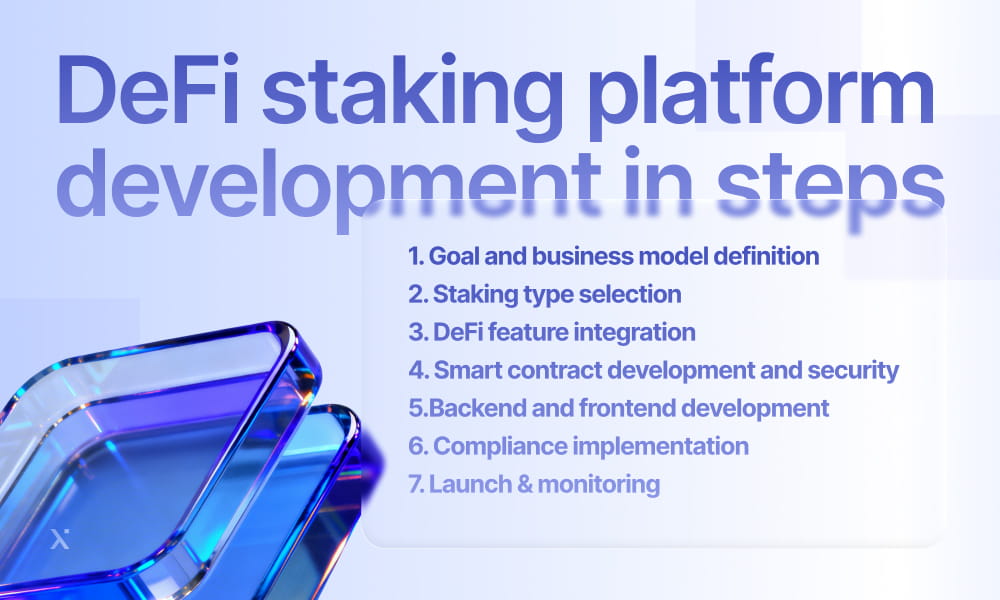
So, let’s take a closer look at all the essential steps to building a successful DeFi staking platform.
Step 1. Define your platform goals and business model
Before writing a single line of code, you should clarify your objectives. Will your platform focus solely on staking, or will it integrate DeFi lending or yield farming features?
Also, identify your revenue streams such as staking fees, yield farming commissions, or lending interest. It helps you design a business model that’s both attractive to users and sustainable.
Step 2. Choose the type of staking and understand its challenges
There are several staking models you can offer:
- On-chain staking where users lock tokens directly on the blockchain to secure a network. This is straightforward but may require managing validator nodes and handling slashing risks.
- Delegated staking where users delegate tokens to validators. It’s easier to implement but depends heavily on validator performance.
- Liquid staking where users receive tokenized representations of their staked assets, which can be traded or used in other DeFi products. While highly flexible, it introduces complexity in smart contracts and reward calculations.
3. Integrate complementary DeFi features
Many successful platforms combine staking with:
- DeFi yield farming development. It enables users to stake or farm their tokens across multiple pools. This maximizes rewards while also increasing platform engagement.
- DeFi lending platform development. This option offers collateralized loans using staked or liquid tokens. It opens additional revenue streams and keeps users within your ecosystem.
These features would make your platform more attractive and give your users a complete, all-in-one financial experience.

What Is Yield Farming and Why Is It So Popular?

DeFi Vaults Explained: How to Turn Lazy Crypto Into an Automated Yield Machine
4. Smart contract development and security audits
Smart contract development is a critical part of your DeFi staking platform development. These contracts form the backbone of your system as they manage staking logic, reward distribution, and user interactions.
On top of everything else, make sure to prioritize thorough code audits to prevent exploits, integrate multi-signature wallets for added security, and test your platform across different network scenarios.
Keep in mind that security is the most important part of your staking platform, and smart contracts are at the heart of it.
5. Backend and frontend development
Your platform should offer a smooth and enjoyable user experience. The backend takes care of reward calculations, staking pools, and integration with other DeFi protocols, while the frontend makes it easy for users to stake or “unstake” tokens, track rewards in real-time, and explore lending or yield farming opportunities. A clean, intuitive interface not only reduces friction but also builds trust with your users.
6. Compliance and legal considerations
Even though DeFi is decentralized, we can’t ignore legal compliance. Depending on your target market, you may need:
- KYC/AML procedures
- Licensing for virtual asset services
- Disclaimers for staking risks and rewards
Consulting legal experts early ensures your platform can operate smoothly without any regulatory surprises later.
7. Launch, monitor, and optimize
After launch, your work isn’t really done. Keep a close eye on smart contracts, validator performance, and how your users are engaging. Use analytics to fine-tune reward structures, add new yield farming pools, or expand lending options.
You need to do everything possible to keep making your platform better for your users every step of the way.
| Step | Actions |
| 1. Define goals & business model | Decide platform focus and revenue streams |
| 2. Choose type of staking | Pick on-chain, delegated, or liquid staking. Consider complexity, validator management, and risks |
| 3. Integrate DeFi features | Add yield farming or lending options to boost rewards, engagement, and user experience |
| 4. Smart contracts & security | Build core contracts for staking and rewards. Perform audits, multi-sig integration, and testing for safety |
| 5. Backend & frontend | Backend manages calculations and pools, frontend makes staking, reward tracking, and DeFi features easy to use |
| 6. Compliance | Implement KYC/AML, licenses, and disclaimers. Consult legal experts to avoid regulatory issues |
| 7. Launch, monitor & optimize | Track performance, user engagement, and rewards. Continuously improve the platform for users |
Estimating the cost of DeFi staking platform development
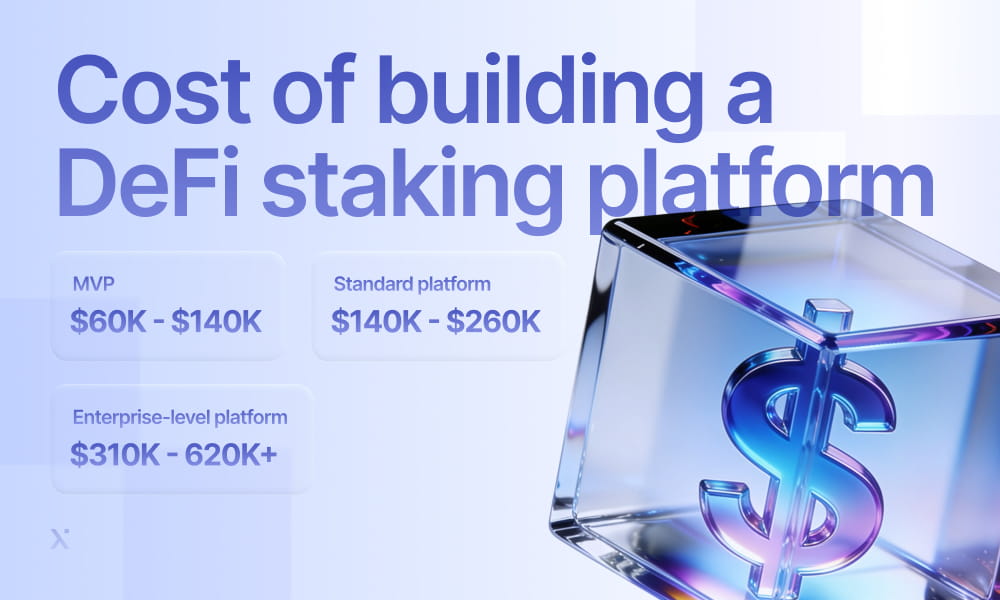
The cost of building a DeFi staking platform can vary depending on how complex you want it to be and the features you plan to include. To give you a clear picture, we’ve broken down typical development costs by platform size.
1. MVP (Minimum Viable Product)
MVP development focuses on core staking functionality with basic UX/UI and one or two staking types. It’s ideal for testing market demand before investing heavily.
| Feature | Estimated cost |
| Smart contract development | $20,000-$40,000 |
| Frontend & backend (basic) | $20,000-$40,000 |
| Security audit | $10,000-$30,000 |
| Testing & deployment | $10,000-$30,000 |
| Total estimated cost | $60,000-$140,000 |

From Concept to Customers: MVP Web Development That Delivers Proof
How to Approach SaaS MVP Development Without Wasting Time or Budget
2. Middle-size standard platform
A standard platform includes more sophisticated UI/UX, multiple staking models (e.g., delegated, liquid staking), and integrations with yield farming or lending modules.
| Feature | Estimated cost |
| Smart contract suite | $30,000-$60,000 |
| Frontend & backend | $30,000-$60,000 |
| Multiple audits & security layers | $30,000-$70,000 |
| Integrations (yield farming, lending) | $40,000-$70,000 |
| Total estimated cost | $130,000-$260,000 |
3. Enterprise-level platform
Enterprise solutions are designed for large user bases, institutional features, multi‑chain support, compliance, and advanced scalability.
| Feature | Estimated cost |
| Full smart contract architecture | $80,000-$150,000+ |
| Frontend & backend | $80,000-$120,000+ |
| Full security program & multiple audits | $70,000-$150,000+ |
| Compliance, multi‑chain, oracles | $80,000-$200,000+ |
| Total estimated cost | $310,000-620,000+ |
No matter where you start, you can always turn to dedicated staking platform development services to calculate everything, build according to a specific plan, and avoid unnecessary expenses.
Why PixelPlex stands out in DeFi staking platform development
PixelPlex is a company that has been providing DeFi development services for more than a decade and understands all the ins and outs of this industry. Their experience allows businesses to move from idea to launch fast and with confidence.
This DeFi staking platform development company combines deep technical expertise with a strong portfolio of successful projects:
- 11 years in the blockchain domain
- 450+ successful projects delivered
- 200+ smart contracts deployed on mainnet
- 2 unicorns created with over $1B in value
- $1.2B raised by clients
When it comes to specialized DeFi staking platforms, here is what PixelPlex offers:
| Service | What it includes |
| DeFi consulting | Market research, business model design, tokenomics planning, feature selection, and technical architecture recommendations |
| DeFi platform development | End-to-end platform development with staking dashboards, reward distribution systems, validator integrations, and user management features |
| DeFi smart contract development | Custom smart contracts for staking logic, reward calculations, liquidity mechanisms, governance, and security-focused contract architecture |
| Cross-chain integration | Integration with multiple blockchains, cross-chain staking support, bridge connectivity, and oracle-based data synchronization across networks |
| Integration and support | Integration with wallets, analytics tools, lending or yield farming modules, plus ongoing maintenance, monitoring, and performance optimization |
With such well-rounded expertise and a comprehensive service offering, PixelPlex stands out as a reliable partner for your business. They will help you build a secure, scalable DeFi staking platform and achieve your goals with precision.

How to Build a DeFi Platform: a Step-by-Step Guide Based on PixelPlex’s Expertise
Conclusion
DeFi staking platform development brings together technology, security, and business strategy. Choosing the right blockchain and tech stack, planning features, estimating costs, and ensuring compliance — every single step plays an important role in building a successful solution. When done right, businesses can create platforms that generate revenue, attract users, and grow alongside the expanding DeFi ecosystem.
Whether you’re starting with MVP web development or ready to launch an enterprise-level product, careful planning and the right support make all the difference. Keep your focus on security, scalability, and user experience, and you’ll be able to launch a competitive DeFi staking platform that helps your clients earn more while reaching your business goals.
FAQ
Legality varies by jurisdiction and regulatory interpretation. Some countries treat staking as a technical service, while others classify it as an investment product. You must review local financial and crypto regulations before launching.
You may need a license if your platform is considered a financial service provider or virtual asset service provider (VASP). This often applies when you custody user funds or actively manage staking on their behalf. Licensing requirements differ widely across regions.
Many jurisdictions require platforms to implement KYC and AML procedures to prevent illicit activities. This is especially true if users deposit funds through your interface. Non-custodial platforms may still face indirect compliance expectations.
Users deposit tokens into a smart contract, which then participates in network validation or yield strategies. The contract automatically calculates and distributes rewards. Users can often withdraw or “unstake” their assets after a set period.
Rewards are usually based on the amount staked, staking duration, and protocol-specific rules. Some platforms adjust yields dynamically based on network performance or total staked assets. Fees may also affect the net reward received by users.
Security depends on smart contract quality and protocol design. Audited contracts, bug bounties, and multi-signature controls reduce risks. Non-custodial platforms are generally safer because users retain control over their assets.
Risks include smart contract vulnerabilities, network slashing (penalties for validator misbehavior), and token price volatility. Liquidity risks may also occur if assets are locked in long-term staking contracts.
Most platforms provide dashboards showing staked amounts, reward rates, and pending payouts. Some integrate notifications, analytics, or historical reward charts. APIs can also allow external wallets or portfolio trackers to monitor performance.