
Building software in most industries allows for shipping it rough. Breaks and flaws are patched in the next sprint. In healthcare, that approach is risky. When your product touches patient data and clinical decisions, a "move fast and break things" mentality might cost you users, compliance, trust, and even someone's health.
There’s a piece of wordplay that captures why this niche is so unforgiving: in health-tech, success arrives when your minimum viable product (MVP) flawlessly automates your client’s MIPS Value Pathway (MVP). Two different MVPs, one product. Founders who understand that double meaning instantly signal real domain expertise to the institutional buyers who actually sign the checks.
The opportunity is enormous. According to GlobeNewswire’s Digital Health Global Market report, the sector is projected to climb to $1.2 trillion at a CAGR of 18.10% by 2033 from $230.8 billion in 2023. The growth is driven by AI-powered digital assistants, telehealth adoption, and a wave of strategic mergers and acquisitions. That is exactly why MVP development for healthcare deserves its own playbook. The generic startup checklist simply does not apply here.
A healthcare MVP is not a half-finished app with a few screens missing. It is a fully secure, functional core that solves one specific clinical or patient problem and nothing more. The goal is deliberately narrow: validate your riskiest assumptions, gather real feedback from actual patients or clinicians, secure funding, and prove the concept while keeping financial risk low.
At PixelPlex, we understand that the first compliance review of a healthcare MVP is far more important than numerous features that buyers don’t need. We wrote this guide so your healthcare software development project reaches a live pilot intact.
What qualifies as an MVP for healthcare?
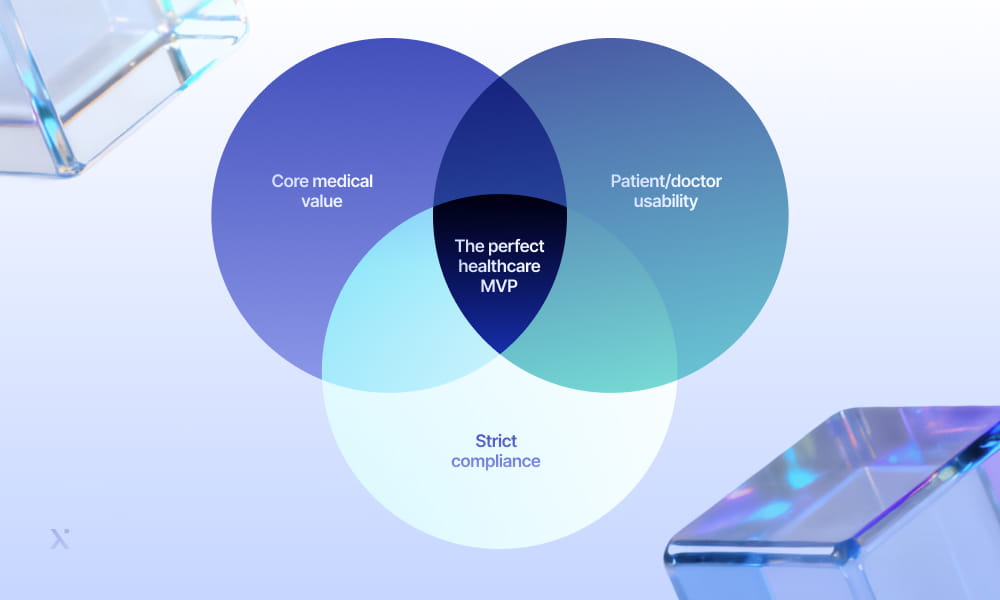
A genuine healthcare MVP lives at the intersection of three non-negotiable forces:
- It has to deliver real clinical value.
- It has to be usable for the patients and clinicians who touch it every day.
- It has to satisfy strict regulatory compliance.
Drop any one of the three and the product collapses: a compliant app nobody can use is as dead on arrival as a delightful app that leaks patient data.
That is why ordinary MVP development and MVP development for healthcare are different. Features like dark-mode toggle, animated onboarding, etc. are optional, while end-to-end encryption, audit logging, and clinical accuracy are a must. Function comes before frills, and should include being legally compliant on launch day.
Scope the core functionality tightly. Skip the entire hospital management suite and focus on a single user journey such as booking a telehealth call, refilling a prescription, or logging a daily vital sign. One job, done safely and done well, is already a sign of future success.
There is also a quieter definition of “value” that founders routinely miss. In healthcare software, value is dictated by the Centers for Medicare & Medicaid Services (CMS). A feature that helps a provider hit a required quality measure directly affects their reimbursement, which makes it core MVP scope.
The table below lines up a standard tech MVP against a healthcare one so the extra weight on every dimension is easy to see.
| Feature area | Standard tech MVP | Healthcare MVP |
| Security | Basic authentication | End-to-end encryption, MFA, tamper-proof audit logs |
| Compliance | Standard terms of service | HIPAA / GDPR / PIPEDA, signed BAAs |
| Core value | Entertainment or convenience | Improved clinical outcomes or access to care |
| Validation | Beta users, A/B testing | Clinical validation, supervised pilot programs |
| Financial / ROI | User growth, subscribers, ad clicks | CMS alignment (MIPS/MVP scoring), reimbursement eligibility |

AI MVP Development: How to Validate Ideas Fast Without Breaking the Budget

From Concept to Customers: MVP Web Development That Delivers Proof
What makes healthcare different?
Three subtleties separate healthcare builds from everything else, and each one reshapes how you plan the work.
- The first is stakes. A bug in a food-delivery app means a cold dinner, while a bug in a clinical app can mean a missed diagnosis or a dosing error. That single fact raises the bar on testing, validation, and accountability across the whole of your MVP development effort.
- The second is data interoperability. Your app almost never lives in a vacuum, so it has to exchange information with the internal EHR systems of hospitals and clinics. If it cannot read from and write to those systems cleanly, clinicians will quietly abandon it.
- The third is your audience, because you are usually building for two very different people at once. The patient wants radical simplicity and the provider wants dense and complete clinical data on a single screen. A reliable healthcare MVP web development company serves both without diluting either experience.
Before you write a line of code, it helps to know which rulebooks govern your data. The standards below appear in nearly every health-tech project.
| Standard / regulation | Region | Primary focus | What it means for your MVP |
| HIPAA | USA | Protected Health Information (PHI) privacy | Encryption and access controls baked in before launch |
| GDPR | Europe | Comprehensive citizen data protection | Consent flows and data portability by design |
| HL7 / FHIR | Global | Interoperability between medical systems | Your integration layer must speak these natively |
| FDA SaMD | USA | Software functioning as a medical device | Triggers ISO 13485 documentation and formal risk assessment |
If you are coming to health-tech from another industry, you will soon find these five abbreviations in vendor calls, compliance reviews, and budget line items. Everyone around will assume you already know them. Here is the shorthand.
- PHI — any data that can identify a patient; touch it and HIPAA applies.
- BAA — the contract that lets a vendor legally handle PHI on your behalf.
- RBAC — users see only the data their role requires.
- MFA — a second login factor, effectively mandatory for clinical systems.
- SaMD — if your app diagnoses or recommends treatment, the FDA may regulate it as a device.
Difficulties that may arise and how to solve them
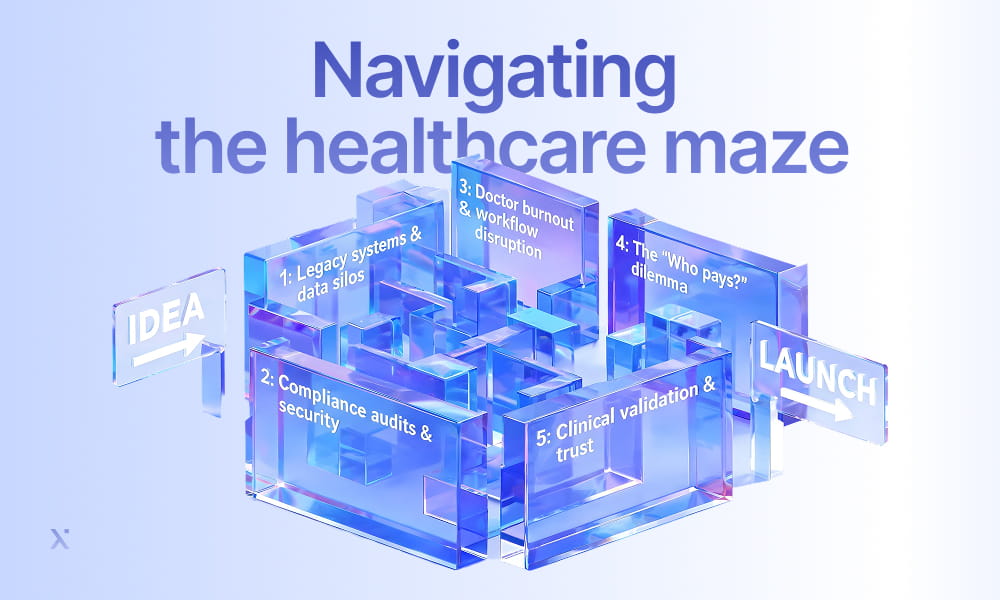
Mapping a healthcare product from idea to launch involves overcoming several obstacles that appear during the development process. Below are the five of them most obvious with the risks and solutions.
Legacy systems and data silos
Healthcare is notorious for running on outdated infrastructure, and your sleek modern app will inevitably need to talk to an on-premise EHR that feels like it was built in the 1990s.
The risk: shipping an isolated app that forces doctors or patients to double-enter data. If it does not sync with their existing systems, it gets abandoned within weeks.
The solution: build with interoperability standards from the beginning. Use modern APIs like FHIR and HL7, and instead of wiring directly into fragmented hospital systems, route through an integration platform such as Redox or Lyniate that acts as a universal translator for your MVP.
Compliance audits and security
In consumer tech you can launch a buggy beta. In healthcare, a single data breach or compliance failure can trigger massive fines and an immediate shutdown.
The risk: treating HIPAA, GDPR, or FDA Software-as-a-Medical-Device rules as an afterthought you will “handle before launch.”
The solution: compliance-as-a-service. Do not build your own compliant cloud from scratch. Sign Business Associate Agreements with pre-audited hosts like AWS for Health, Aptible, or Vanta to handle encryption, audit logging, and access control, freeing your team to focus on the product. A dedicated security audit and risk management partner can close the remaining gaps.
Doctor burnout and workflow disruption
Clinicians are buried under screens, clicks, and constant alert fatigue. They do not want another app, another login, or another dashboard to babysit.
The risk: designing an MVP that technically works but adds three extra minutes to every patient consultation.
The solution: zero-friction UX. Your MVP must be a painkiller, not a vitamin. Surface your insights directly inside the clinician’s existing EHR interface where possible, and if it has to be standalone, make it automate a hated administrative task such as transcription or coding to instantly buy back their time.
Before you build, run the idea through three questions:
- Does it remove a task clinicians already do, instead of adding a new one?
- Can you measure the minutes or clicks it saves in a single shift?
- Does it live inside a tool they already open every day?
Three yeses means you have a painkiller worth paying for. Mostly noes means it is a vitamin — pleasant, easy to cancel, and a hard sell to a busy practice.
The “who pays?” dilemma
Healthcare is a multi-sided market in which the user, the beneficiary, and the payer are frequently three different parties.
The risk: building an MVP that patients love and doctors find useful, but that nobody will pay for out of pocket and no insurer will reimburse.
The solution: identify the economic buyer early, and let CMS point the way. In 2024, CMS expanded MIPS Value Pathways to 16 specialized tracks, including Primary Care, Women’s Health, and Mental Health. Align your software to automatically track and report the four quality measures required by a provider’s specific pathway, and your product shifts from a nice-to-have clinical tool into an essential asset that prevents Medicare penalties and unlocks incentive bonuses.
Clinical validation and trust
Healthcare is evidence-based to its core. You cannot sell software to a hospital by praising your algorithm. You have to prove it is safe, unbiased, and effective.
The risk: spending the entire budget on the product and leaving nothing to fund the pilot study that proves it improves outcomes.
The solution: the lean pilot. Partner with one forward-thinking clinic or a small patient advocacy group early, offering the MVP at or below cost in exchange for joint case studies, co-authored research, and brutally honest real-world feedback.
Here’s a summary of possible challenges and ways to address them:
| Challenge | Impact on MVP | Recommended fix |
| Strict regulations | Slows development speed | Hire a healthcare compliance consultant early |
| Legacy Integration | Bloats the technical budget | Use middle-layer APIs (like Redox or Lyniate) |
| Doctor adoption | High churn rate post-launch | Involve clinicians in the initial wireframing phase |
| Payer / ROI hurdles | Admins reject purchases with unclear financial value | Align telemetry with CMS MIPS Value Pathways to automate quality reporting |

Agentic AI in Healthcare: EVERYTHING You Need to Know

AI for Drug Development: How to Turn Scientific Data into Better Decisions
The healthcare MVP development process
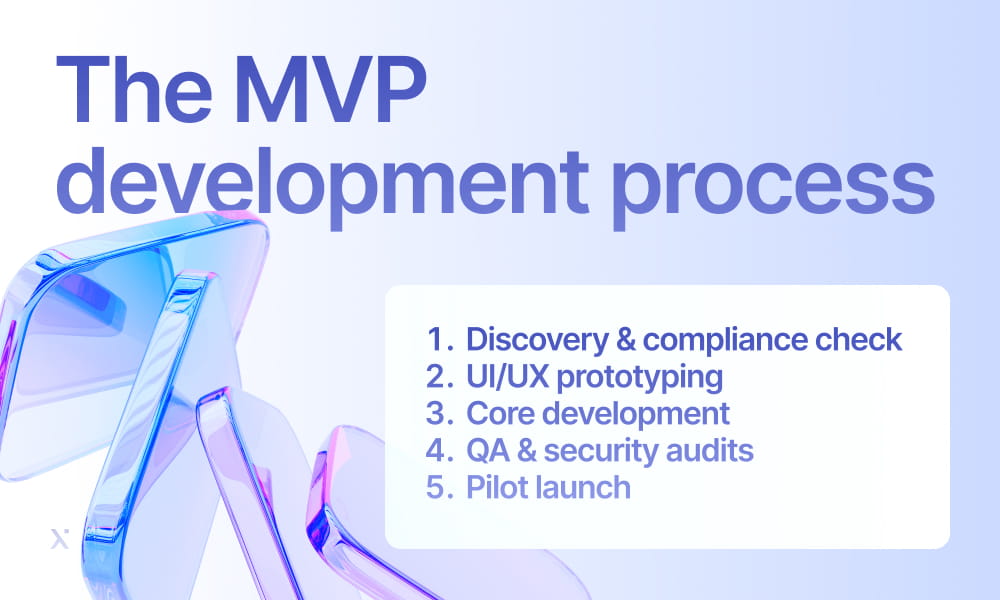
Disciplined MVP development follows a fixed sequence, and in healthcare the order is non-negotiable because security and legal scoping come first. Five stages take you from idea to a live pilot. The temptation is always to jump straight into building, but in our experience the projects that reach a pilot on time and on budget are the ones that respect this order and refuse to let scope creep in at every step.
-
-
1. Discovery and compliance check
-
You validate the core idea and map the legal requirements in parallel, defining which regulations apply before any design work begins. This is where you settle the questions that are painful to revisit later: whether the product qualifies as Software as a Medical Device, which data-residency rules apply, and who the economic buyer actually is. We usually run a simple data-flow map and a HIPAA gap analysis at this stage, then capture the findings in a Product Requirements Document so nothing important is left to assumption once the build begins.
-
3. Core development
-
-
4. QA and security audits
-
-
-
5. Pilot launch
-
2. UI/UX prototyping
Designers map the user journey and test clickable prototypes with real stakeholders. They try to catch friction long before it becomes expensive code. A Figma prototype put in front of three or four practicing clinicians will surface more usable insight than weeks of internal debate. The subtlety we stress to every team is to test with the people who will use the tool mid-shift, not only the executives who approved it, and to design for accessibility from the very first screen.
Engineers build the architecture with a heavy bias toward backend security, wiring the application to the EHR networks it depends on through standards like FHIR and HL7. Stacks may vary, including React or React Native on the front end, a Node.js, Python, or .NET back end on a HIPAA-eligible cloud like AWS or Azure. The main rule is unchangeable: build audit logging and role-based access in from the first commit, never as a later patch. We also keep real patient data out of every development environment and test against synthetic records instead, which keeps the team productive without ever putting protected information at risk.
Testers run penetration testing and compliance validation, and this is the one stage you should never compress to save a week. A healthcare build needs a security review against the OWASP basics, load testing for anything real-time like telehealth video, and, ideally, an independent third-party audit before a single patient touches the system. Catching a misconfigured access rule here costs a fraction of catching it after a breach.
You release to a closed group, often a single clinic, and start gathering the real-world data that will justify the next round of investment. The teams that learn the most run the pilot alongside the existing workflow at first, keep a developer on call through the opening weeks, and recruit one or two clinician champions to model the tool for their peers. That early feedback becomes the backbone of your post-pilot roadmap.
MVP development phases bring the following outcomes to the project:
| Phase | Main objective | Key deliverable |
| 1. Discovery | Define problem and legal scope | Product Requirements Document |
| 2. Design | Map the user journey | Interactive clickable prototype |
| 3. Build | Code the application | Functional beta software |
| 4. Validate | Ensure safety and security | Security audit & QA report |
| 5. Launch | Gather real-world data | Pilot program deployment |
How much does MVP development for healthcare cost?
Budgeting honestly keeps your project from dying halfway through. An MVP app development company may charge from $50,000 to well over $200,000 for building a healthcare MVP, and that figure is driven by structural and regulatory necessities. The price climbs because the work demands specialized developers, legal consultations, and heavy security infrastructure that consumer apps simply never touch.
The starting point also varies a lot by what you are building. The table below gives indicative MVP ranges for common healthcare app types, before deeper integrations or a heavier compliance scope push them up or down.
| App type | What a lean MVP usually covers | Approximate MVP cost |
| Appointment scheduling | Provider search, calendar sync, automated reminders | $40,000 – $70,000 |
| Dental practice app | Online booking, digital intake forms, reminders | $45,000 – $80,000 |
| Telehealth / video visits | Secure video, scheduling, in-call clinical notes | $60,000 – $120,000 |
| E-pharmacy / medication delivery | Prescription upload, catalog, ordering, delivery tracking | $70,000 – $150,000 |
| Symptom checker / triage | Guided question flow, results, referral routing | $60,000 – $140,000 |
| Remote patient monitoring | Wearable data ingestion, dashboards, alerting | $90,000 – $180,000 |
| AI medical imaging | Image upload, model inference, clinician review | $120,000 – $250,000+ |
These figures are general starting points. The exact number swings with integration depth, security scope, and target region.
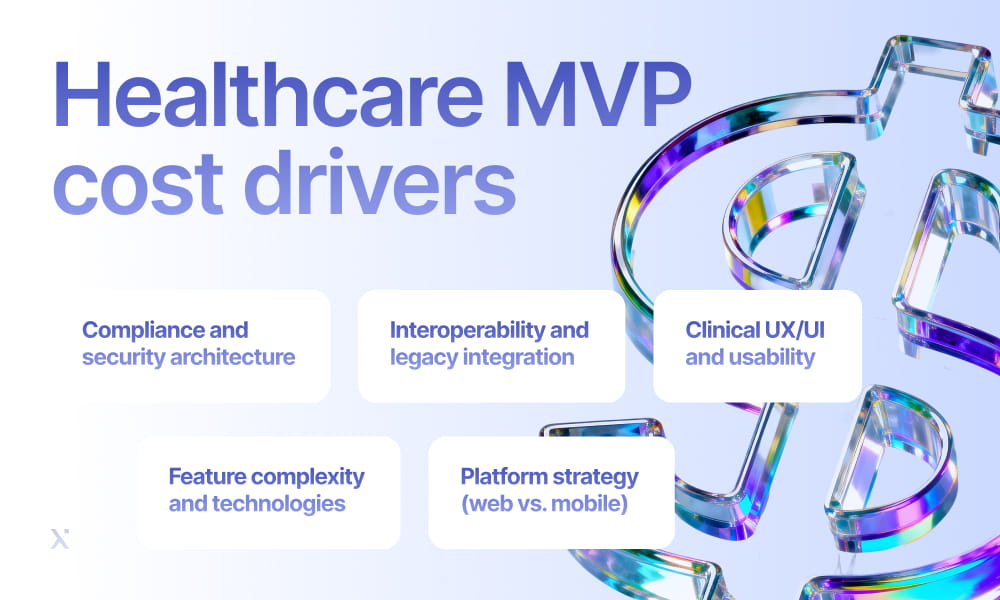
Five drivers do most of the damage to the budget.
Compliance and security architecture
Healthcare software requires privacy by design. Security forms the foundation of the build and cannot be bolted on before launch. Handling PHI mandates end-to-end encryption at rest and in transit, multi-factor authentication, and strict role-based access control. Tamper-proof audit trails that log who viewed or changed patient data often add $15,000 to $40,000 to core engineering, and FDA Software-as-a-Medical-Device classification raises the baseline further through ISO 13485 documentation and formal risk assessments.
Interoperability and legacy integration
A standalone app that forces double data entry is rejected instantly, so most MVPs must sync with existing hospital infrastructure. Connecting to major EHR/EMR systems like Epic, Cerner, or athenahealth through FHIR or HL7 is genuinely complex. A read-only integration runs $15,000 to $30,000, while bidirectional integration that writes back into the patient chart can easily exceed $50,000 per platform. E-prescribing, insurance claims, and lab-result ingestion each mean wiring into another highly regulated medical network.
Clinical UX and usability
Design here is high-stakes, because a confusing interface is a direct threat to patient safety, not a minor annoyance. The design phase runs long precisely because the product has to slot into a clinician’s workflow without adding clicks. A cardiology workflow looks nothing like a mental-health workflow, so specialty-specific charting templates and intake forms demand deep domain expertise and repeated user testing.
Feature complexity and technologies
The core functions you choose dictate the size and caliber of the team you need. Telehealth infrastructure adds live HD video, secure messaging, and scheduling, all of which inflate backend and hosting costs. Deploying chatbots in healthcare for patient intake and support adds natural-language design on top. Layering in AI and machine learning for symptom triage requires specialized engineers and rigorous bias mitigation. computer vision in healthcare for medical imaging means yet another model to train and validate. Remote patient monitoring, meanwhile, demands scalable pipelines for continuous data from wearables.
Platform strategy
The platforms you target scale your engineering hours directly. A responsive web app paired with serverless app development is the most cost-effective starting point. Building native iOS and Android apps simultaneously means distinct codebases (or a cross-platform framework like React Native) and can raise front-end costs by 30% to 50%.

How to Approach SaaS MVP Development Without Wasting Time or Budget

Healthy Data, Happy Patients: A Masterclass in Blockchain Healthcare App Development
Ways to save
Trimming the bill is less about cutting features than about not paying for the same work twice. A few levers, drawn from recent HealthTech cost analyses, save real money without creating compliance debt:
- Start from a compliant baseline instead of building one. A HIPAA-ready cloud environment built from scratch adds four to eight weeks and is usually one of the largest fixed costs. Pre-audited, open-source infrastructure templates can remove that expense item. Reusable device-connectivity layers do the same on the hardware side, erasing the $30,000 to $80,000 you would otherwise spend wiring up wearables one integration at a time.
- Scope for certification. Developing an MVP doesn’t mean the smallest solution that will technically pass the certification. Aim for the smallest product genuinely useful to clinicians. Cutting a feature forces a costly recertification when you add it back. So, getting the scope right in the first four weeks is estimated to save $50,000 to $150,000 in recertification and rework.
- Hire a team that already knows the rules. Do not try to save from a cheaper hourly rate. A compliance-architecture mistake will cost you far more to fix. Specialists may charge more per hour, but their pre-built compliance patterns and real EHR experience will cut total project cost by 20% to 30%.
For US-facing products, you can use one more lever to cut investment. Let the 2024 MIPS Value Pathways cap your scope. Because CMS only requires providers to report on four targeted quality measures within a pathway, your MVP only needs to automate those four data points. That single constraint trims your database architecture and frontend scope, saving tens of thousands of dollars while keeping the product highly relevant to buyers.
Compare the estimated costs of startup and enterprise MVPs:
| Cost factor | Startup MVP | Enterprise MVP |
| Scope | Single standalone feature | Module integrating with existing systems |
| Compliance | Basic HIPAA setup | Complex multi-region compliance |
| Integration | None or basic API | Deep EHR/EMR bidirectional sync |
| Estimated cost | $40,000 – $80,000 | $100,000 – $250,000+ |
Three healthcare MVPs that started small and scaled big
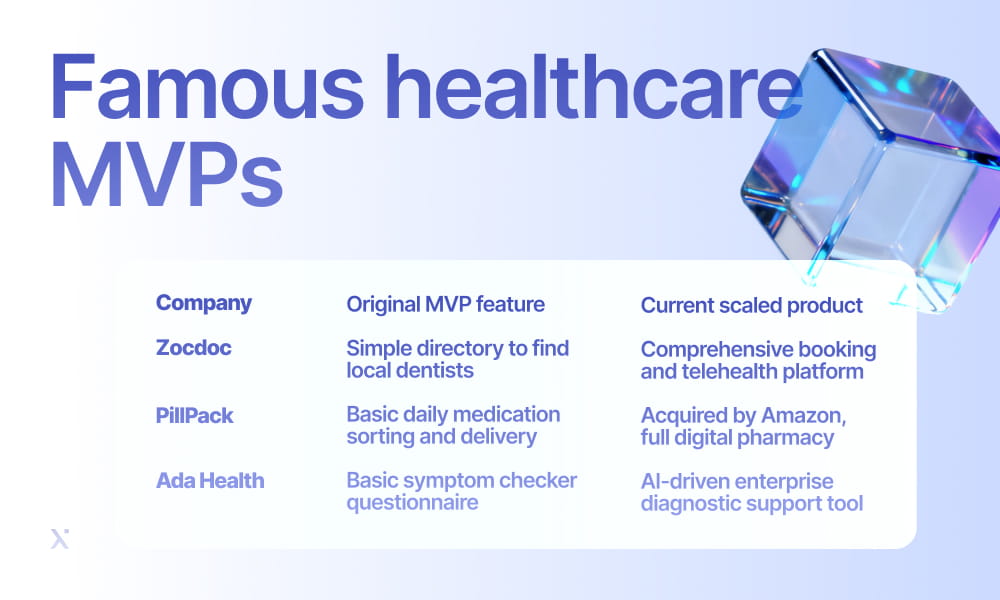
The strongest argument for a lean approach is that the giants of digital health all began as tightly constrained products. Each of the companies below proved one narrow assumption before adding anything else.
Zocdoc
The company did not launch as the multi-specialty marketplace it is today. In 2007, its founders shipped a highly constrained MVP: a simple web directory that let patients find and book appointments with dentists in Manhattan. By limiting scope to one specialty in one city, they proved that patients wanted online booking and that providers wanted to fill last-minute cancellations. Zocdoc now spans nearly every specialty across the United States with deep calendar, telehealth, and insurance integrations.
PillPack
The project set out to solve medication non-adherence for people juggling multiple prescriptions. As a startup-in-residence at the design firm IDEO, its MVP tested one thing, the design and usability of presorted daily medication packets and a frictionless online signup. By proving that removing the friction of sorting pills built fierce loyalty, the team validated the case for a full digital pharmacy. PillPack was eventually acquired by Amazon for just under $1 billion to anchor Amazon Pharmacy.
Ada Health
Ada launched in 2011. Its first product, “Ada DX,” was a clinical decision-support tool built strictly for doctors, using Bayesian probabilistic reasoning to help diagnose rare diseases. After years of refining the medical knowledge base with clinicians, the team realized patients could use the technology directly, pivoted in 2016, and launched the consumer symptom-assessment app that now completes millions of assessments worldwide.

Exploring 6 Blockchain Use Cases in Healthcare: A Detailed Overview with Examples

Top 10 Blockchain Use Cases In 2026: How Your Business Can Ride the Wave
Choosing a partner for healthcare MVP development services
The vendor you pick shapes your timeline, your budget, and your odds of passing a compliance audit. Look past the portfolio gloss for the things that actually de-risk a clinical build: ISO 27001 certification, a willingness to sign BAAs, and demonstrable past work shipping HIPAA- and FHIR-compliant products. Global IT giants bring scale and deep legacy experience. Boutique healthcare agencies bring concentrated regulatory know-how. The right answer depends entirely on your stage and ambition.
Evaluate your development partner:
| Vendor type | Best suited for | Key advantage |
| Global IT giants | Large enterprises | Massive scale, deep legacy experience |
| Niche healthcare Agencies | Funded startups | Deep knowledge of HIPAA and FHIR standards |
| Freelance teams | Bootstrapped founders | Lower cost, high flexibility |
A vendor who answers these crisply has done it before. One who improvises has not.
- Are you ISO 27001 certified, and will you sign a BAA?
- Can you show a shipped healthcare product that integrates with Epic, Cerner, or athenahealth via FHIR?
- Who owns the code and the IP once the engagement ends?
- How do you handle penetration testing and tamper-proof audit logging?
- What does support look like during the pilot, when bugs are most likely to surface?
This is where healthcare MVP software development services from a specialist partner earn their keep, because the difference between a compliant pilot and a stalled one usually comes down to experience.
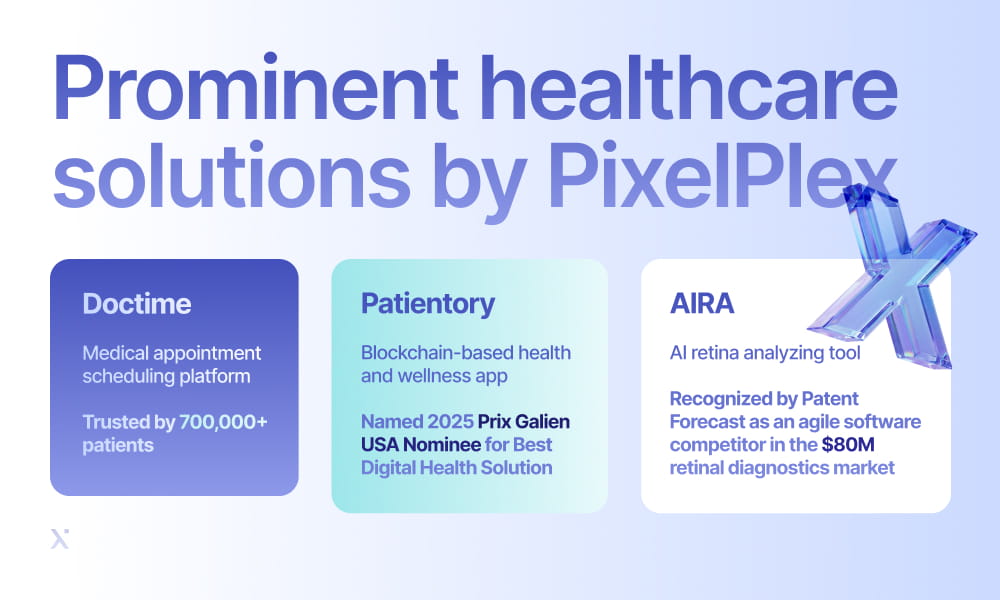
PixelPlex has shipped healthcare products across exactly these constraints.
Doctime, our medical appointment scheduling platform, is now trusted by more than 700,000 patients.
Patientory, a blockchain-based health and wellness app, was named a 2025 Prix Galien USA nominee for Best Digital Health Solution.
Our retinal diagnostics tool, AIRA, makes the case for a software-first MVP most clearly of all. Patent Forecast lists AIRA as a competitor to hardware-heavy giants like Tesseract Health, which raised $80 million, and RetinAI, which partners with Novartis. While those rivals lean on expensive, multi-million-dollar physical hardware patents, AIRA entered the $80 million retinal diagnostics market purely on the strength of advanced machine learning.
It is living proof that a lean, capital-efficient software MVP can go toe to toe with heavily funded incumbents, which is the entire promise of disciplined MVP development.

ChatGPT Integration: How Companies Turn AI Into Real Operational Advantage

Inside Machine Learning Development: What Businesses Should Know
Life after the MVP: scaling, funding, and future mandates
Shipping the pilot is the starting line. What you do with the data you gather decides whether the product grows or quietly dies.
Begin with rigorous data analysis, leaning on healthcare business intelligence to review clinical outcomes alongside the friction points where users hesitated or dropped off. Those numbers are the raw material for your next move. Then use that pilot evidence to secure funding, turning concrete outcomes into a credible Seed or Series A pitch. From there, scaling means graduating from a single pilot clinic to a regional rollout and finally adding the nice-to-have features you deliberately cut during the MVP phase.
There is also a clock you can use to your advantage. CMS will officially require multi-specialty groups to report as subgroups starting in the 2026 performance year. Engineer your software to support subgroup data segmentation now, and you position your company as an indispensable tool for healthcare groups scrambling to comply with an impending federal mandate. Founders who explore custom software development with this deadline in mind tend to convert that urgency into sales.
Final thoughts
The digital health market is expanding too fast and the regulatory environment shifting too often for a generic startup playbook to keep up. Winning teams treat compliance as architecture, tie every feature to a real economic buyer, and ship one narrow, secure, clinically valuable product before they build anything else. Done right, healthcare MVP software development services let you validate the idea, win funding, and earn clinician trust without betting the company on a single launch.
As we said at the start, we built this guide because we want founders avoid mistakes. Our healthcare software development team exists to help you skip them and reach a live pilot with your budget and your reputation intact. Reach out to PixelPlex, and let us build a secure, scalable healthcare product together.
FAQ
A healthcare MVP is a fully secure, functional core product that solves one specific clinical or patient problem. It is not a feature-complete platform, and it must be clinically accurate and legally compliant from day one, which is what makes building one a discipline of its own.
The cost reflects requirements consumer apps never face: end-to-end encryption, tamper-proof audit trails, multi-factor authentication, and integration with legacy EHR systems. Specialized developers, legal consultations, and security infrastructure all add up, which is why budgets in this sector start higher than elsewhere.
In most cases, yes. Syncing with systems like Epic or Cerner through FHIR or HL7 is usually essential. A read-only integration is more affordable, while bidirectional sync that writes back to the patient chart is the larger investment.
Timelines vary with scope, but the five phases of discovery, design, build, validation, and pilot launch typically span several months. Security and compliance work happens up front, so the early phases of MVP development often take longer in healthcare than founders expect.
Prioritize ISO 27001 certification, a readiness to sign Business Associate Agreements, and a track record of shipping HIPAA- and FHIR-compliant products. A specialist healthcare development partner brings the regulatory fluency that turns a stalled compliance review into a smooth one.
You analyze clinical outcomes and user friction, use the pilot data to raise Seed or Series A funding, and scale from one clinic toward a regional rollout while adding the features you cut earlier. Building for the 2026 CMS subgroup-reporting mandate now also gives your roadmap a built-in sense of urgency.