
Meteora turned one idea, smarter on-chain liquidity, into one of Solana's busiest DeFi engines, so what would it really take to build something in the same league?
In the first half of 2026, Meteora reportedly processed more than $32 billion in trading volume and returned over $140 million in fees to liquidity providers. Numbers like that pull founders toward the same market, and the first practical question is always the same one about budget. This guide breaks down the technology, the process, the honest cost ranges, and the traps that quietly inflate a DeFi build.
The honest starting point is that there is no single price tag, because a dApp like World of Meteora can mean very different things to different teams. One founder wants a lean liquidity pool with a clean interface, while another wants the full stack of vaults, bonding curves, and launch tools that took Meteora years to refine. Each version sits at a different point on the cost curve, and the gap between them can run into hundreds of thousands of dollars.
What actually moves the number is rarely the part people expect. The interface and the marketing site are the cheaper half, while the smart contracts, the security audits, and the economic modeling are where most of the budget goes. Before you commit a single dollar, it helps to understand what you are building, how it gets built, and where the hidden costs sit, and that is exactly what the rest of this article walks through.
Why a product like World of Meteora is a heavy lift
Meteora is not a single feature you can copy over a weekend. It is a liquidity layer with several financial products stacked on top of it, and each one carries its own math, its own risk model, and its own smart contracts. Rebuilding that scope is a real engineering commitment, not a template job.
The reason comes down to what the protocol touches. A system like this handles other people’s money in real time, across volatile markets, with no room for downtime or rounding errors. Every module has to stay correct under heavy load, correct during a price crash, and correct when someone actively tries to game it.
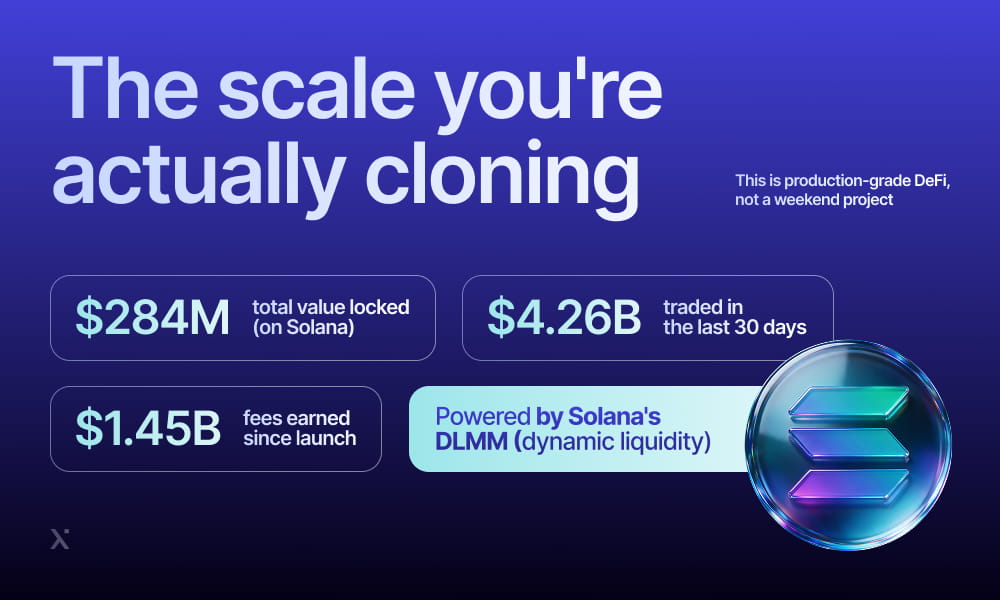
That standard is what separates a serious DeFi build from a hobby project. It also explains why so much of the work happens before any code exists, in modeling and planning rather than in a rush to ship. Teams doing realistic dApp development for a liquidity protocol spend its first weeks on economics and math, not on shipping screens.
Scale raises the bar even higher. Meteora captured more than 15% of Solana’s total DEX volume and sat among the top platforms next to Raydium and Orca, so reaching even a fraction of that means designing for throughput from the very first commit. Careful protocol selection matters here, which is exactly why comparing dApps across protocols is worth doing before you write anything.
None of this is meant to scare you off. It is meant to set expectations, because the founders who succeed with a Meteora-style product are the ones who treat it as serious dApp development from day one.
Teams often assume they can fork an open-source AMM and ship in a month. In practice, a fork hands you yesterday’s design plus every bug the original team has already patched, and code you do not fully understand. You then spend more on audits and rewrites than a clean build would have cost. A fork is a reference point, not a shortcut.

Tokenizing Gilts, Eurobonds and Gold: Default-Tested Mobile Collateral on Canton

Canton Development and a New Vision for Blockchain in Finance: Use Cases, Features, and Cost
What World of Meteora actually is
Before you can price a build, you need a clear picture of what you are building. Meteora is best understood as a stack of connected products rather than one app, and every layer adds engineering weight. DeFi dApp development diverges from ordinary app work at exactly this point, because each layer manages live capital rather than static content.
At its core sits the Dynamic Liquidity Market Maker, or DLMM, which organizes liquidity into discrete price bins instead of spreading it thinly across an infinite range. Around that core, Meteora runs a Dynamic AMM, dynamic vaults that route idle capital into strategies, and dynamic bonding curves for token launches. The governance token, MET, launched in October 2025 with a fixed supply of one billion.
The main building blocks you would need to recreate include:
- A concentrated, bin-based liquidity engine that lets providers place capital at specific price points.
- Dynamic vaults that move idle liquidity into yield strategies automatically.
- A launch mechanism such as bonding curves or presale vaults for new tokens.
- Fee-sharing and reward logic that keeps liquidity providers coming back.
Each of these touches the same nerve, which is capital efficiency. The whole appeal of a Meteora-style product is that it earns more from the same pool of liquidity, and that is also the exact idea behind liquidity mining and the incentive models that keep DeFi pools deep.
Getting that logic right is where most of the engineering hours go. A pool that miscalculates a bin, misprices a fee, or mishandles a withdrawal does not just annoy users, it also loses their money, which is why the bar for correctness here is so much higher than in ordinary apps.
Core modules of a Meteora-style dApp
| Module | What it does | Why it is hard to build |
| Dynamic Liquidity Market Maker (DLMM) | Concentrates liquidity into discrete price bins | Bin math must stay precise under fast price moves |
| Dynamic AMM | Pooled trading with adaptive fees | Fee logic has to react to volatility without draining LPs |
| Dynamic vaults | Auto-routes idle capital into yield strategies | Strategy switching adds cross-protocol risk |
| Bonding curves and launch vaults | Bootstraps liquidity for new tokens | Anti-bot and fair-launch rules are easy to get wrong |
The technology stack behind a Meteora-style dApp
A DeFi protocol of this kind has two very different halves. The user-facing app looks like a normal web product, while the money logic lives on-chain and behaves nothing like a traditional backend.
Good dApp development means treating both halves with equal care. A brilliant interface wired to fragile contracts is a liability, and airtight contracts behind a confusing screen never attract liquidity in the first place.
The stack itself is not exotic. Most of the tools are the same ones a normal web team already uses, and the difference is what they are pointed at. A Meteora-style protocol asks that stack to price liquidity, track thousands of positions, and stay correct while the market moves under it, and that shift in demands is what separates it from a typical dApp.
What makes a Meteora-style stack different
Before the layer-by-layer breakdown, it helps to name the parts that actually change. Most dApps read and write simple on-chain state, such as a balance or an ownership record. A liquidity protocol runs live financial math on every interaction, so four things get heavier than usual:
- Real-time pricing, because bins and pools have to react to each trade instead of showing a static value.
- High-frequency state, because positions, fees, and yields update every few seconds rather than once in a while.
- Money-grade correctness, because a rounding error here is a direct loss, not a cosmetic bug.
- Automation, because vaults and keepers act on their own schedule without a user pressing a button.
Keep those four in mind, because they are the reason each layer below carries more weight than it would in an ordinary app.

Blockchain Development Cost in 2026: What Goes Into the Price Tag

Top Full-Service Web3 Development Companies 2026
Frontend
The frontend is what convinces a liquidity provider to trust you with capital, so it has to feel fast and honest. Most teams reach for React or Next.js, TypeScript, and a charting library that can render price bins, pool depth, and live yields without lag. Front-end dApp development here is unusually data-heavy, so performance work starts early rather than as a final polish.
What differs from a standard dApp frontend is the amount of live financial data on screen at once. A typical dApp shows a balance and a button, while a Meteora-style app shows moving charts, position ranges, and yield figures that all update together. The client pieces that carry the most weight are:
- Wallet adapters for Phantom, Solflare, or MetaMask, which have to connect on the first try.
- A real-time data layer that keeps prices, balances, and positions in sync every few seconds.
- Visual tools for concentrated liquidity, such as bin and range selectors that ordinary apps never need.
- Clear risk messaging, so users understand what a range or a vault actually does before they deposit.
That last point is easy to underestimate, because a confusing pool screen quietly costs you deposits. Clean Solana dApp development on the client side often decides whether people stay or leave after a single visit.
Backend and on-chain logic
The on-chain layer is the real product, and it is unforgiving. On Solana this means programs written in Rust, usually with the Anchor framework, deployed to handle pools, swaps, fee accrual, and vault routing. Back-end dApp development on Solana rewards engineers who know Rust and its concurrency model well, since sloppy code here is both slow and unsafe.
This is the layer where a Meteora-style protocol looks least like a normal dApp. A simple dApp might store a record and move a token, while a liquidity protocol runs pricing math, splits fees, and rebalances capital inside the contracts themselves. On EVM chains the equivalent is Solidity contracts, which is one of the first forks in the road during early blockchain development planning, since the choice shapes your language, your tooling, and a large part of your budget.
The contract layer usually breaks into a few distinct programs rather than one big file:
- A core pool program that holds liquidity and executes swaps.
- A fee and reward module that tracks what each provider is owed.
- A vault or strategy program that moves idle capital toward yield.
- An access and upgrade layer that controls who can change what, and how.
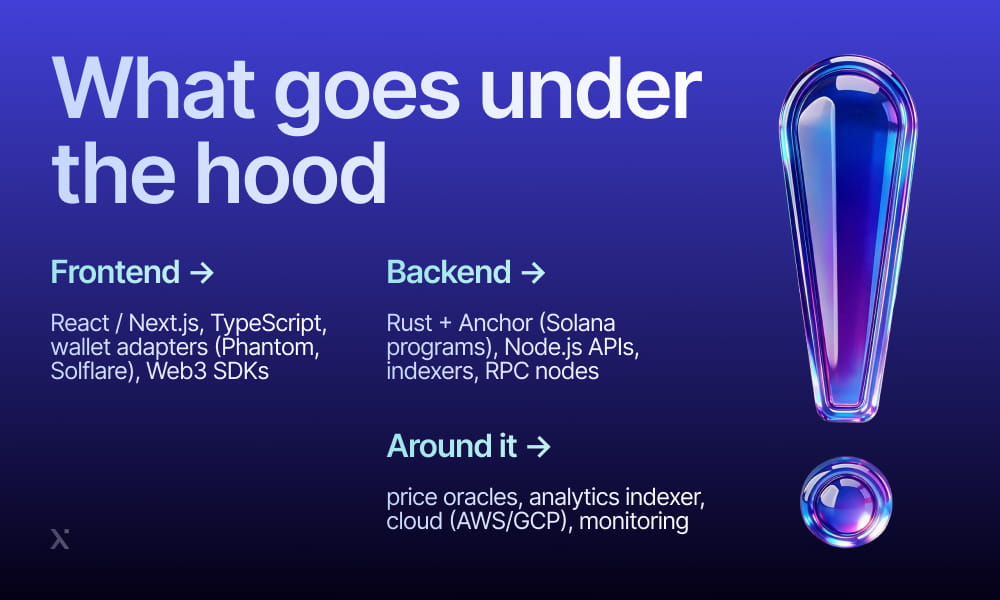
Off-chain services
Even a decentralized protocol needs supporting infrastructure, and this is the part founders most often forget to budget for. The contracts handle the money, but they cannot answer a fast query or trigger themselves on a timer, so a set of off-chain services fills the gap.
The pieces that a Meteora-style protocol leans on the most are:
- Indexers that turn raw chain data into fast, searchable queries for the app.
- Keeper bots that trigger time-based actions, such as vault rebalances, without human input.
- Oracles that feed reliable prices into the contracts.
- Monitoring and alerting that watch for anything unusual around the clock.
Oracles deserve special attention, because a manipulated price feed is one of the most common ways DeFi protocols lose funds. A single bad number pushed into a contract can drain a pool in one transaction, so the feed has to be both accurate and hard to game. Teams building on EVM often lean on mature tooling here, where oracle and indexing patterns are well established after years of use, and that maturity is a real reason some founders choose Ethereum development even when raw speed is not their top priority.
Typical tech stack for a Meteora-style dApp
| Layer | Common technologies | Purpose |
| Frontend | React or Next.js, TypeScript, wallet adapters | Interface, wallet connection, live data |
| Smart contracts (Solana) | Rust, Anchor | Pools, swaps, fees, vault logic |
| Smart contracts (EVM option) | Solidity, Foundry or Hardhat | Same logic on Ethereum-compatible chains |
| Off-chain services | Indexers, keeper bots, oracles | Data queries, automation, price feeds |
| Infrastructure | RPC nodes, monitoring, cloud hosting | Uptime, scaling, observability |

Crypto Arbitrage Bot Development: What Actually Works in 2026

What You Should Know About the True Cost of Building a Crypto Wallet Like MetaMask
The development process, step by step
A protocol like this is built in stages, and skipping any of them usually shows up later as either a security hole or a blown budget. The sequence below is the same one we follow on serious DeFi engagements. Each stage of dApp development feeds the next, so a shortcut taken early almost always resurfaces as rework later.
- Discovery and economic design, where the token model, fees, and incentives are defined.
- Architecture, where the contract structure and data flows are mapped.
- Design, where the interface and user journeys are drawn and tested.
- Development, where contracts and the app are built in parallel.
- Testing and auditing, where everything is stressed before it touches real money.
- Launch and support, where the protocol goes live and is watched around the clock.
Discovery and architecture
Discovery is where you decide what the protocol rewards and how it stays solvent. The tokenomics, fee splits, and vault strategies are modeled here, often in spreadsheets and simulations well before any code exists.
A weak model at this stage cannot be quietly patched later without breaking user trust, so it pays to slow down and get it right. MVP development services help launch a focused first version that is not trying to ship every Meteora feature at once.
Architecture then turns that model into a technical plan. It defines how contracts are split, how they talk to each other, and where the upgrade points live, which sets the shape of everything that follows.
Design
Design in DeFi is not decoration. A liquidity provider is about to lock capital into a smart contract, and the interface has to make the risk, the reward, and the mechanics obvious at a glance.
Good design here also lowers support load and user error. When people understand exactly what a bin, a range, or a vault does, they make fewer costly mistakes and trust the protocol enough to deposit more.

DeFi Vaults Explained: How to Turn Lazy Crypto Into an Automated Yield Machine

Social Media on Blockchain: Why It’s the Next Big Digital Revolution
Development
Development runs on two tracks at once. Smart contract engineers build and unit-test the on-chain logic, while frontend engineers build the app against a testnet deployment, and keeping the two in sync avoids nasty surprises at the end.
This phase is also where integrations land, and they are rarely plug and play. Connecting wallets, oracles, bridges, and external protocols takes real work, so reliable blockchain integration services can save weeks when a protocol has to talk to systems it does not control.
Every external dependency is also a new thing to secure and test. A protocol is only as safe as the weakest system it trusts, which is why integrations get the same scrutiny as the core contracts.
Testing
Testing a DeFi protocol goes far beyond checking that buttons work. The types you cannot skip are:
- Unit tests for every contract function and edge case.
- Integration tests that check how modules behave together.
- Fork and simulation testing against real chain state.
- Economic stress tests that model attacks and extreme market moves.
Only after these passes does an external audit make sense. Auditing code that has not been thoroughly self-tested wastes money, because auditors end up flagging issues the team should have caught on its own.
Ongoing and support costs
A protocol is not finished when it ships. It needs monitoring, upgrades, oracle maintenance, incentive top-ups, and a clear plan for the day something goes wrong.
Incentives are their own budget line and one of the trickiest to get right. If your growth plan depends on rewarding liquidity providers, the emissions that fund those rewards become a recurring expense you must model carefully from the start.
Infrastructure is the other quiet cost that grows with usage. As volume rises, so does your bill for nodes, hosting, and sometimes dedicated compute, and that spend rarely shrinks once real trading activity picks up.
How much does it cost to develop a dApp like World of Meteora?
Here is the part everyone scrolls to first. The honest answer is a range, because the final figure depends on scope, chains, and how many of Meteora’s modules you actually recreate.
What follows are realistic bands based on real DeFi builds rather than marketing numbers. The cost of dApp development for a protocol like this is driven by scope far more than by any hourly rate. As a baseline, a focused DeFi dApp with a working liquidity engine and a clean interface tends to start around $65,000 and climbs quickly as modules are added.
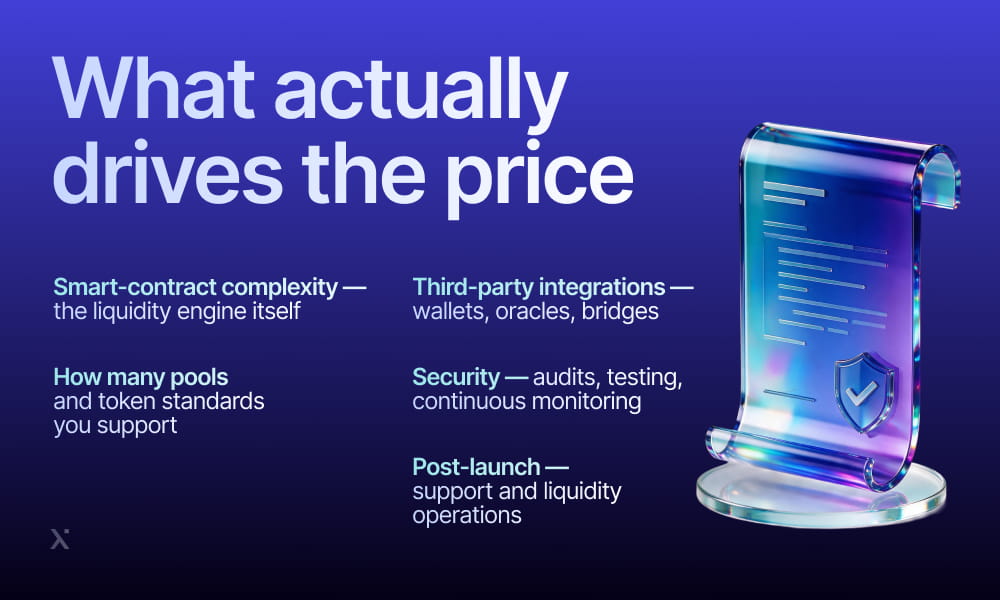
For broader context, our own Web3 app development cost breakdown puts a proof of concept at roughly $25,000 to $60,000, an MVP at $80,000 to $180,000, and a full product at $200,000 and up. A Meteora-style protocol sits at the ambitious end of that scale.
Design cost
Design usually takes a smaller slice of the total, but it is not the place to cut corners. For a protocol with multiple products, expect roughly $15,000 to $40,000, depending on how many flows need to be designed and user-tested.
Complex data visualizations push that figure higher. Live bin charts, position managers, and vault dashboards are harder to design and build than a standard app screen, and they are exactly the parts users judge you on.

The Agent Payments Protocol (AP2): A New Standard for Autonomous Commerce

From Code to Confidence: Inside Smart Contract Audit Pricing
Development cost
Development is the largest line item by a wide margin. Smart contract engineering, the app, off-chain services, and integrations together typically land between $120,000 and $400,000 or more for a serious build.
The type of protocol you are also building also shifts the number. A trading-heavy product overlaps a lot with DeFi exchange development, where MVP packages often start near $45,000 and grow with liquidity features, routing, and cross-chain support.
Benchmarks from large platforms make the pattern clear. A deep look at how much it costs to develop a crypto exchange like Binance shows how quickly figures climb once you add matching engines, custody, and serious throughput, and a liquidity protocol follows the same curve.
Estimated cost by workstream
| Workstream | Typical range (USD) | Notes |
| Discovery and economic design | $10,000 to $30,000 | Tokenomics, simulations, architecture |
| UI and UX design | $15,000 to $40,000 | Scales with number of products and charts |
| Smart contract development | $60,000 to $200,000+ | Largest driver; grows with each module |
| Frontend and app development | $40,000 to $120,000 | Live data, wallets, dashboards |
| Off-chain services and integrations | $25,000 to $80,000 | Indexers, keepers, oracles, bridges |
| Security audits | $20,000 to $100,000+ | Often several rounds for a real launch |
Security and audit cost
Audits deserve their own line because a Meteora-style protocol will usually need more than one. A single reputable smart contract audit tends to start around $5,000 for a small scope and rises fast with complexity.
A multi-module DeFi protocol can spend $50,000 or more across several audit rounds. This is spending that prevents catastrophic losses, so it is one of the last places a sensible team tries to save.
Experienced DeFi dApp development services teams plan audits into the timeline from the start rather than as a last-minute checkbox. That way, fixes stay cheap because they happen before launch instead of after an incident.
Recurring annual costs after launch
| Item | Estimated annual range (USD) | Purpose |
| Infrastructure and RPC | $20,000 to $120,000 | Nodes, hosting, monitoring |
| Maintenance and upgrades | $60,000 to $200,000 | Bug fixes, new features, chain upgrades |
| Security monitoring and re-audits | $30,000 to $150,000 | Ongoing protection and reviews |
| Liquidity incentives | Highly variable | Rewards to attract and keep liquidity |
A useful rule of thumb from real Web3 builds is that roughly 70% to 80% of the work is conventional web and mobile software, and only 20% to 30% is the blockchain part. That smaller slice, though, carries most of the risk and most of the audit cost. Budgeting as if the whole thing were only smart contracts is how projects run out of money before launch.

Inside Crypto Wallet MVP Development: Process, Costs, and Real-World Lessons
Canton Network Wallet Development: A Guide on How to Do It Right (and What It'll Cost You)
Why security is not optional in a protocol like this
Security in DeFi is not a feature you add at the end. It is the product, because a liquidity protocol holds pooled capital in public, upgradeable code, and every mistake is both visible and permanent. Security-first dApp development is the only kind that survives contact with real markets.
The scale of the threat is easy to underestimate. According to Chainalysis, more than $3.4 billion in crypto was stolen in 2025, with a single exchange breach accounting for $1.5 billion of that total.
For a protocol modeled on Meteora, the attack surface is wide. The main entry points a team has to defend include:
- Smart contract bugs such as reentrancy, rounding errors, and flawed access control.
- Oracle manipulation, where a fake price drains a pool.
- Economic attacks that exploit incentive or fee logic rather than code.
- Bridge and integration risks inherited from external protocols.
Each of these has sunk real projects. The only reliable defense is layered, combining careful design, thorough testing, multiple audits, and live monitoring after launch, and cutting any single layer tends to be the most expensive decision a DeFi team ever makes.
Many exploits are not code bugs at all. They are economic flaws, where the contracts do exactly what they were told, and what they were told is wrong. That is why our engineers run economic simulations, modeling flash loans, sudden depegs, and coordinated withdrawals, before an audit even begins. Code that passes every unit test can still be drained if the incentives behind it are broken.
Common pitfalls that inflate the budget
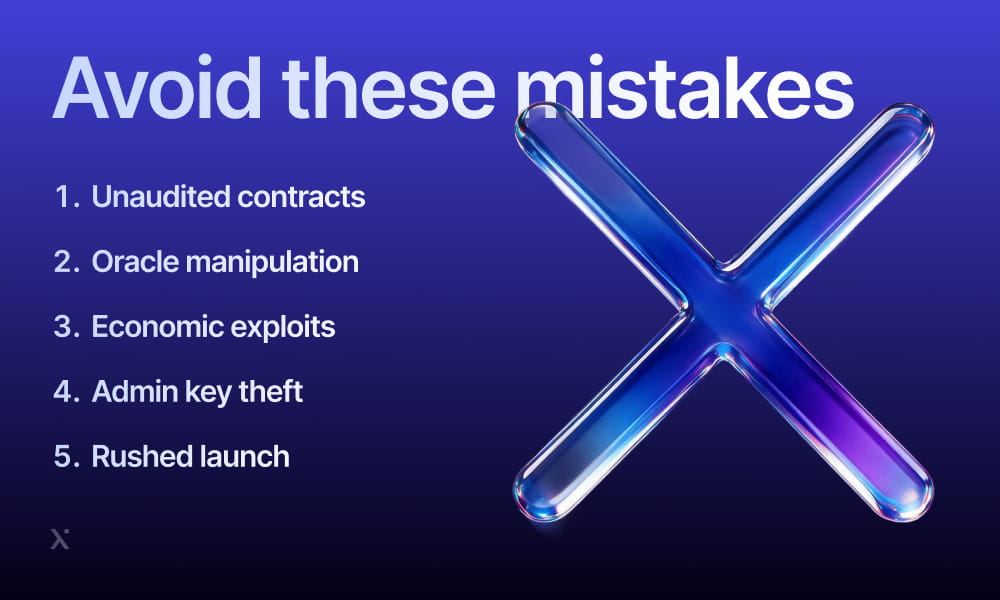
Most DeFi budgets do not blow up because of the core build. They blow up because of avoidable mistakes that surface late, when they are expensive to fix, and knowing the pattern helps you plan around it. Most dApp development overruns trace back to decisions made in the first month, not the last week.
The traps we see most often are:
- Underestimating audits and treating them as a formality rather than several rounds of real work.
- Building every feature at once instead of proving a focused MVP first.
- Ignoring liquidity bootstrapping, so the protocol launches to empty pools.
- Choosing the wrong chain and paying to migrate later.
Scope creep is the quietest killer of the four. Founders often start with a clean DLMM clone, then keep adding vaults, launchpads, and cross-chain features mid-build, and each addition sounds small on its own.
Each one, though, adds contracts, tests, and audits, which is exactly the dynamic explored in cost breakdowns like the cost to develop a crypto exchange like OKX. Deciding your scope early and holding the line on it is one of the cheapest ways to protect a budget.
The wrong chain choice is just as costly, only later. Comparing throughput, fees, and finality before you commit is far cheaper than switching networks after launch, since a migration means re-auditing and redeploying everything you have already built.
Then there is the trap of copying a big name without respecting its true cost. A product that looks simple on the surface, like a wallet or a basic swap, often hides a large engineering bill underneath, and that hidden work is what breaks a naive estimate.
Assuming a familiar product is cheap to rebuild is how timelines slip and budgets double. The teams that avoid it are the ones that price the hidden backend work honestly before they start.

Smart Contract Development Cost Demystified: What Every Business Should Know

Centralized Crypto Exchange Development Explained: From Architecture to Launch
How the chain choice changes the number
The blockchain you pick is not just a technical decision. It sets your fees, your speed, your available talent, and a large share of your budget, and a Meteora-style product leans on high throughput and low fees, which is why it lives on Solana.
Solana keeps attracting DeFi builders for measurable reasons. In early 2026 it ranked first across all chains for monthly DEX volume, and its total value locked reached an all-time high, which means deep liquidity and active users are already in place.
Getting the chain wrong is an expensive thing to undo, since a later migration means re-auditing and redeploying the whole protocol. Cost studies of infrastructure-heavy products, such as building a Kraken-style crypto exchange, show how much the underlying platform choice drives the final bill.
For a liquidity protocol, launching where the volume already lives is a genuine advantage. You are not just building a product, you are building it next to the trading activity that makes liquidity provision worthwhile.
That said, EVM chains still make sense for some products, and the cost profile differs. A comparable build on Ethereum carries its own patterns and price tags, which is why a focused read on Ethereum dApp development cost is worth the time before you commit either way.
Chain choice trade-offs for a liquidity dApp
| Factor | Solana | Ethereum (L1) | EVM Layer 2 |
| Transaction fees | Very low | High | Low |
| Speed and finality | Fast | Slower | Fast |
| Contract language | Rust or Anchor | Solidity | Solidity |
| Liquidity depth | Strong for DEX volume | Deepest overall | Growing |
| Best fit | High-frequency liquidity apps | Blue-chip DeFi | Cost-sensitive scaling |
Why PixelPlex is the right team to build it
Building a protocol that holds real money is not the place to learn on the job. It calls for a team that has shipped DeFi before, broken it in testing on purpose, and knows where the expensive mistakes hide. Our dApp development teams have delivered this exact class of protocol before, which is why our estimates tend to hold up in practice.
The reasons clients trust us with this class of project include:
- More than 17 years in software and over a decade in blockchain, with 450 or more delivered projects.
- More than one million secure smart contract executions across live systems.
- In-house audit expertise, so security is built in rather than bolted on late.
- Coverage of Solana, Ethereum, Polygon, and newer networks under one roof.
Our clients have collectively raised over $1.2 billion, and our audit team has supported unicorn-level companies. That track record matters most on exactly this kind of build, where one overlooked flaw can undo everything else you got right.
Strong dApp development services are the difference between a protocol that earns trust and one that becomes a cautionary story. We treat every liquidity build as a system that has to survive real markets, not a demo that only has to look good.
Just as important, we plan for the full lifecycle rather than a single handoff. We help model the token economics, ship a focused MVP, run the audits, and stay on after launch to monitor and improve the protocol, which is what keeps a Meteora-style build on time and on budget.
FAQ
A serious custom build usually starts around $65,000 for a focused version and often runs from $200,000 to $500,000 or more once you add multiple products, several audits, and cross-chain support. The final number depends on how many of Meteora’s modules you recreate.
A focused MVP typically takes three to five months. A full protocol with vaults, launch mechanics, and multiple audits usually runs eight to twelve months or longer, depending on scope and testing depth.
Solana is the natural home for a high-throughput liquidity protocol thanks to low fees and fast finality. EVM chains make sense when your users and liquidity already live there, so the choice should follow your market rather than the hype.
The Dynamic Liquidity Market Maker concentrates liquidity into discrete price bins instead of spreading it across an infinite range. This makes capital more efficient, which is the main reason a Meteora-style product can attract deep liquidity.
A liquidity protocol holds pooled capital in public code, so a single bug can be catastrophic. Multiple audits, plus economic testing, are what keep a project off the long list of DeFi exploits.
You can, but it rarely saves what people expect. A fork brings code you do not fully understand and still needs its own audits and rewrites, so the savings tend to disappear once the security work begins. Even products that look simple, as the breakdown of how to build a crypto platform like SafePal shows, hide far more engineering than a quick fork suggests.
Expect recurring spend on infrastructure, maintenance, security monitoring, re-audits, and liquidity incentives. These can total six figures a year for an active protocol, so they belong in the plan from the start.
At minimum you need smart contract engineers, frontend developers, a designer, a security auditor, and a product lead who understands DeFi economics. Many teams also add a DevOps engineer for infrastructure and monitoring. Good dApp development pairs these roles tightly, so the contracts and the interface never drift apart.
Most protocols use incentives such as fee sharing and yield rewards to bootstrap early liquidity. The trick is funding those rewards sustainably, since overspending drains the treasury and underspending leaves pools empty.
Not always. A protocol can launch with core liquidity features first and add a token later once there is real usage, and rushing a token before product-market fit tends to create more risk than value.