
In the first half of 2026, the total spot and derivatives trading volume across global digital asset platforms crossed tens of trillions of dollars. This immense financial activity draws regular enterprises into the market, all searching for reliable ways to handle high transaction loads.
Understanding the early phases of digital asset ventures can feel overwhelming for many management teams. Startups often fail because they miscalculate the technical costs or underestimate the compliance burdens. During 2025, over sixty percent of new platforms suffered from poor execution speed or security vulnerabilities within their first three months of operation.
To prevent such costly errors, you must understand what goes into building a high-capacity platform. Because setting up a secure ecosystem requires deep technical expertise, our crypto wallet development team at PixelPlex regularly creates these architectural guides to share our direct knowledge. Our specialists understand how complex it is to synchronize asset storage with high-speed order matching, which is why we want to break down the actual investments needed for a project of this scale.
What defines a Binance-style marketplace?
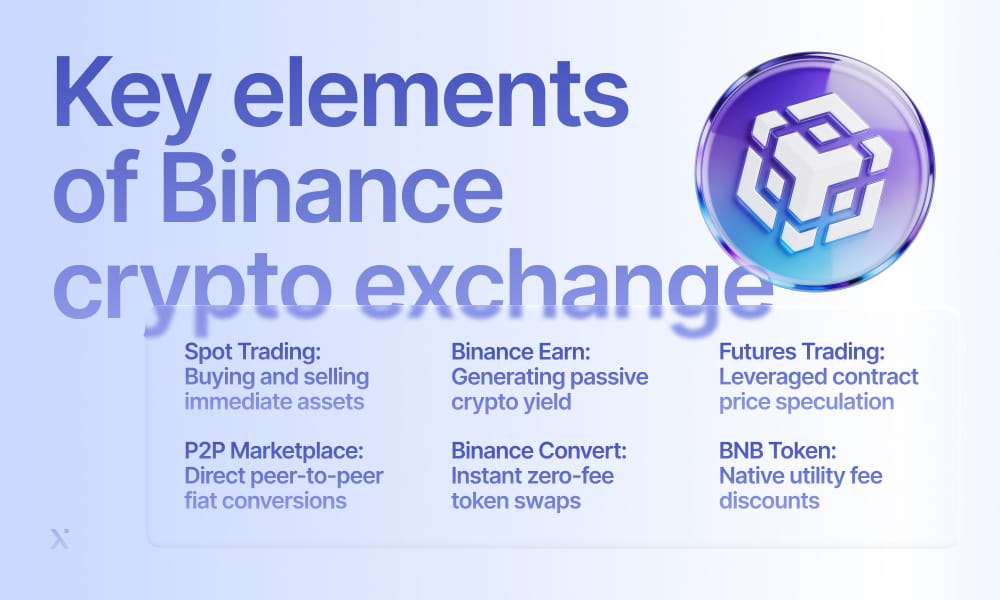
To understand the development process, you first need to examine what a Binance-style marketplace actually is. At its core, it is a high-volume trading ecosystem that supports multiple types of financial interactions. It combines spot trading, futures contracts, margin options, peer-to-peer transactions, and savings accounts inside a single dashboard. Millions of users log in simultaneously to buy, sell, or stake assets, which creates a huge demand for server stability. A platform like this does not just process simple trades, it manages an incredibly complex web of liquidity pools, user accounts, and real-time market data streams.
From an engineering perspective, this kind of platform depends heavily on a high-frequency matching engine. This engine matches buy and sell orders in microseconds, preventing price slippage and system lag during major market moves.
Additionally, the system must support multiple fiat gateways, internal asset ledgers, and institutional API connections. Managing all these moving parts requires a robust infrastructure that keeps user funds safe while providing instant visual updates on the screen. Anyone entering the field of cryptocurrency exchange development must realize that they are building a high-load financial institution rather than a basic web application.
The structural differences separating Binance from standard platforms
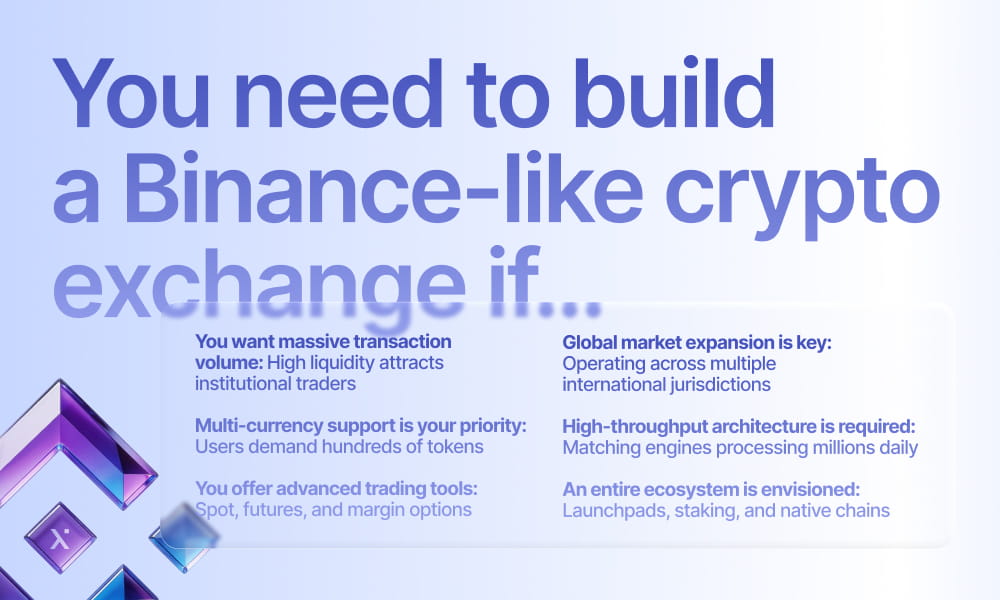
Not all trading platforms use the same basic architecture. A global giant operates differently than a simple regional broker or a basic swapping service. To build a competitive app, you must understand the structural differences that set top-tier ecosystems apart from standard ones.
High-frequency matching engine capacity
Standard platforms often rely on basic relational databases to match simple buy and sell orders. When trading volumes jump during market rallies, those systems quickly become sluggish. A Binance-style cryptocurrency exchange development platform uses custom-built memory-based matching engines that process millions of orders per second. These specialized engines use advanced data structures like binary heaps and ring buffers to execute trades with almost zero latency.
Multi-tiered account architecture
Basic apps usually offer one or two levels of user accounts with fixed limits. In contrast, a top-tier marketplace features an intricate, multi-tiered account framework. It handles retail accounts, corporate entities, VIP traders, and sub-accounts with independent balance structures. Each tier comes with dynamic trading fee schedules, custom API rate limits, and distinct security settings that adapt automatically based on monthly trading volume.
Hybrid liquidity sourcing
Smaller operations often depend on a single liquidity provider or a basic market-making script. A global platform uses a hybrid sourcing mechanism that pulls liquidity from multiple external order books simultaneously. By connecting directly to global market makers via FIX protocols, the system maintains tight spreads even during extreme market volatility. This complex network ensures that large institutional orders do not cause massive price swings on the platform.
Diversified financial product lines
Most entry-level applications limit their users to simple asset buying and selling. A comprehensive trading venue includes an array of financial products like perpetual futures, options, yield farming, and launchpads for new tokens. Implementing these options requires deep expertise in financial software development to ensure the underlying margin calculations remain accurate. The platform must continuously recalculate collateral values and trigger automated liquidations if a trader’s position drops below the safety margin.
Comprehensive compliance automation
While local platforms can sometimes handle compliance manually, a global cryptocurrency exchange development system requires fully automated verification setups. It integrates real-time risk assessment tools that scan every incoming and outgoing transaction for illicit patterns. This automated compliance setup checks user identities against global sanctions lists within seconds during onboarding. Without this advanced automated framework, managing compliance across hundreds of different countries would be completely impossible.
The underlying technology stack for a global trading ecosystem
Choosing the right technology stack determines whether your platform will thrive or crash under heavy traffic. The system needs a highly responsive frontend and a bulletproof backend that handles parallel processing flawlessly.
Tools for building the user interface
The user interface must display thousands of price updates every minute without draining the user’s device battery or freezing the browser.
| Tool | Primary Recommended Use | Main Alternative |
| React.js | Core web dashboards and live asset panels | Vue.js |
| React Native | Shared cross-platform mobile portfolios | Flutter |
| TypeScript | Type safety to prevent live code errors | Modern JavaScript |
| WebSockets | Continuous data stream for live prices | HTTP Long-polling |
| Tailwind CSS | Lightweight and responsive UI layouts | Styled Components |
React.js
- Recommended usage: This framework works well for building the main user dashboard, web trading panels, and account management screens. Its component-based nature allows developers to update individual asset prices on the screen without reloading the entire page.
- Alternative approach: Vue.js serves as a solid alternative for teams that want a lighter framework with faster initial rendering times for basic landing pages.
React Native
- Recommended usage: For cross-platform mobile development, this framework allows you to share up to eighty percent of the codebase between iOS and Android. It delivers smooth animations and quick interactions for standard mobile trading portfolios.
- Alternative approach: Flutter offers highly customized UI components and excellent performance, making it a great option if your mobile design requires unique visual elements.
TypeScript
- Recommended usage: Using this typed language across the entire frontend prevents common JavaScript errors before the code goes live. It ensures that data structures for order books and user profiles remain consistent across every UI component.
- Alternative approach: Pure modern JavaScript can work, but it increases the risk of runtime errors when handling complex data streams from the backend.
WebSockets
- Recommended usage: This protocol maintains a constant open connection between the user’s browser and the exchange servers. It streams live price updates, order book movements, and trade histories without interruption.
- Alternative approach: Long-polling via HTTP can serve as a backup, but it creates too much server overhead and noticeable data delays for active day traders.
Tailwind CSS
- Recommended usage: This utility-first framework lets developers build highly responsive, lightweight user interfaces that load quickly on mobile networks. It helps create clean layouts that adapt to various screen sizes easily.
- Alternative approach: Styled Components offer excellent style isolation inside React, but they can sometimes add unnecessary JavaScript processing overhead to the application.
Back-end engineering components
The backend handles the heavy lifting, including data storage, order execution, security protocols, and external wallet communications.
| Tool | Primary Recommended Use | Main Alternative |
| Go (Golang) | High-frequency matching engines and microservices | Rust |
| Node.js | User authentication, notifications, and API routing | Python |
| PostgreSQL | Relational data storage with ACID compliance | MySQL |
| Redis | In-memory storage for live order book states | Memcached |
| Apache Kafka | System event streaming and message brokering | RabbitMQ |
Go (Golang)
- Recommended usage: Go is ideal for building high-frequency matching engines and core microservices. Its built-in concurrency model handles thousands of background tasks simultaneously without consuming massive amounts of RAM.
- Alternative approach: Rust offers even greater memory safety and raw execution speed, though it typically requires longer development timelines due to its complex language rules.
Node.js
- Recommended usage: This runtime environment manages user authentication, notification systems, and general API routing efficiently. It works perfectly for non-blocking I/O operations that do not require heavy mathematical processing.
- Alternative approach: Python can manage these services, but it often requires more server resources to handle identical traffic levels.
PostgreSQL
- Recommended usage: This relational database stores critical user information, balance histories, and compliance records safely. It provides strong ACID compliance to guarantee that financial transactions are never partially written or lost.
- Alternative approach: MySQL can handle similar transactional data structures, but it lacks some of the advanced indexing options that make PostgreSQL ideal for deep financial reporting.
Redis
- Recommended usage: Operating as an in-memory data store, Redis holds the active order book data and user session states for instant retrieval. It reduces the read load on the main relational database by serving frequently requested data in milliseconds.
- Alternative approach: Memcached offers fast in-memory caching, but it lacks the advanced data structures and persistence options required for live order matching.
Apache Kafka
- Recommended usage: This message broker manages the massive stream of system events, passing data between the matching engine, the notification service, and the database recorders. It ensures that no transaction messages are dropped during sudden spikes in user activity.
- Alternative approach: RabbitMQ works well for simpler message routing tasks, but it can struggle to maintain ordering guarantees under extreme global transaction volumes.
Here is a summary of the core technology choices:
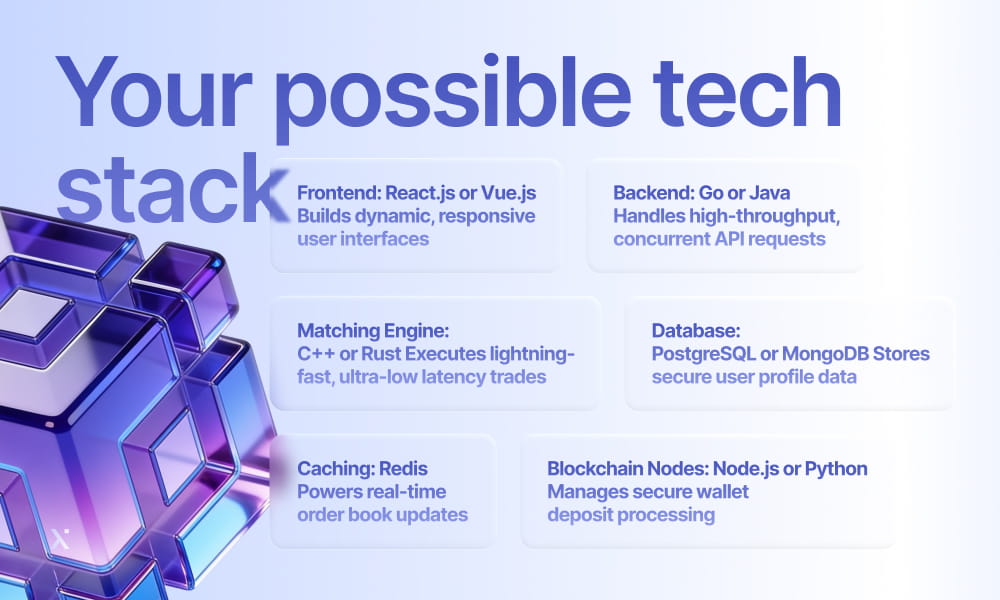
Never store live order book states directly in a traditional relational database during active trading sessions. Always use an in-memory data tool like Redis to handle the immediate matching process, then save the finalized transactions to your main database asynchronously.
Advanced features to consider for your platform
To attract professional traders and stand out from basic applications, your cryptocurrency exchange development roadmap should include several sophisticated features. These additions improve user retention and create extra revenue streams for your business.
Over-the-counter trading desk
Large institutional investors rarely execute multi-million dollar trades directly on public spot order books because doing so causes massive price shifts. An over-the-counter desk allows high-net-worth clients to execute massive transactions directly with the platform at a fixed price. The backend matches these large buyers and sellers privately, protecting the main public market from sudden artificial volatility.
Peer-to-peer escrow protocol
Many users prefer buying digital assets using local payment methods like domestic bank transfers or regional mobile wallets. A peer-to-peer system allows individuals to trade directly with each other while the platform acts as a neutral third-party escrow. When a trade begins, the platform locks the digital asset in an automated escrow contract and releases it to the buyer only after the seller confirms receipt of the fiat payment.
Integrated copy trading system
Novice users often want to participate in the markets but lack the technical knowledge to read charts or build advanced strategies. A copy trading module lets retail clients browse the performance histories of veteran traders and automatically replicate their positions. The system deducts a small percentage of the follower’s profits and sends it to the lead trader as a performance reward, creating an active community ecosystem.
Advanced charting libraries with technical indicators
Serious market analysts require professional charting tools to execute their daily trading strategies. Integrating advanced charting tools gives users access to real-time candlestick data, trend lines, and dozens of built-in technical indicators. This analytical frontend must pull clean data from the backend APIs instantly so traders can spot market patterns without dealing with lag.
Crypto-backed fiat lending programs
Users frequently want to access cash without selling their digital asset positions and triggering tax events. A lending module allows traders to deposit their coins as collateral to instantly borrow fiat currencies or stablecoins. This requires robust risk engine integration via custom DeFi development setups to monitor loan-to-value ratios around the clock and trigger liquidations if the collateral value drops too low.
Multi-chain staking pools
Providing a simple savings mechanism helps convert casual users into long-term platform members. A multi-chain staking framework aggregates yield opportunities from various proof-of-stake networks, such as the BNB Smart Chain ecosystem, directly into the user’s dashboard. This way, the cryptocurrency exchange development platform handles the technical validator configurations in the background, takes a small management fee, and distributes the remaining rewards to users daily.
AI-driven portfolio optimization
Modern traders appreciate intelligent tools that help them analyze their personal risk exposure and trading habits. Incorporating advanced analytics engines allows the platform to give users customized breakdowns of their historical win rates, average holding times, and diversification scores. Using dedicated data science development ensures that these analytical algorithms run efficiently without slowing down the primary trading databases.
Essential external integrations for smooth operation
Banking rails
Integrating dependable banking rails like ACH, SEPA, and international SWIFT connections allows users to fund their accounts using local fiat currency smoothly. You also need to connect to automated identity verification networks to satisfy global regulatory demands. These verification services scan user passports and run facial recognition tests instantly during onboarding to keep the platform compliant.
Real-time data feeds
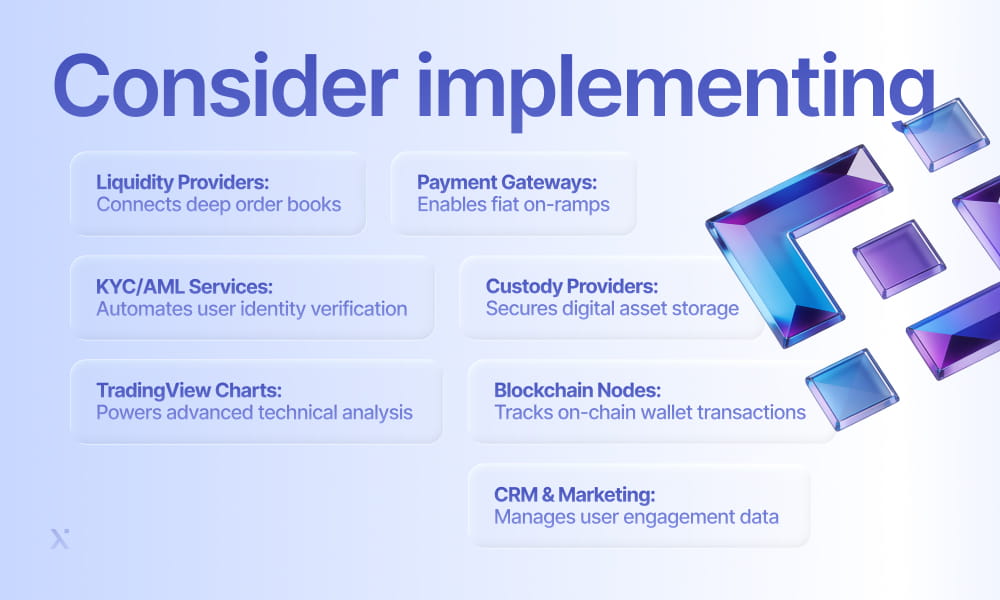
Furthermore, integrating real-time market data feeds from top global aggregators ensures your pricing remains accurate and protected from manipulation. Connecting to external liquidity providers keeps your order books deep from day one, preventing massive price spikes when users execute large trades. Finally, you must integrate specialized blockchain nodes or custody APIs to handle deposits, withdrawals, and asset transfers safely across dozens of distinct blockchain protocols.
Step-by-step development process for a Binance-style exchange
High-load cryptocurrency exchange development requires a structured process. Skipping foundational architectural steps can cause system-wide failures when you launch live trading.
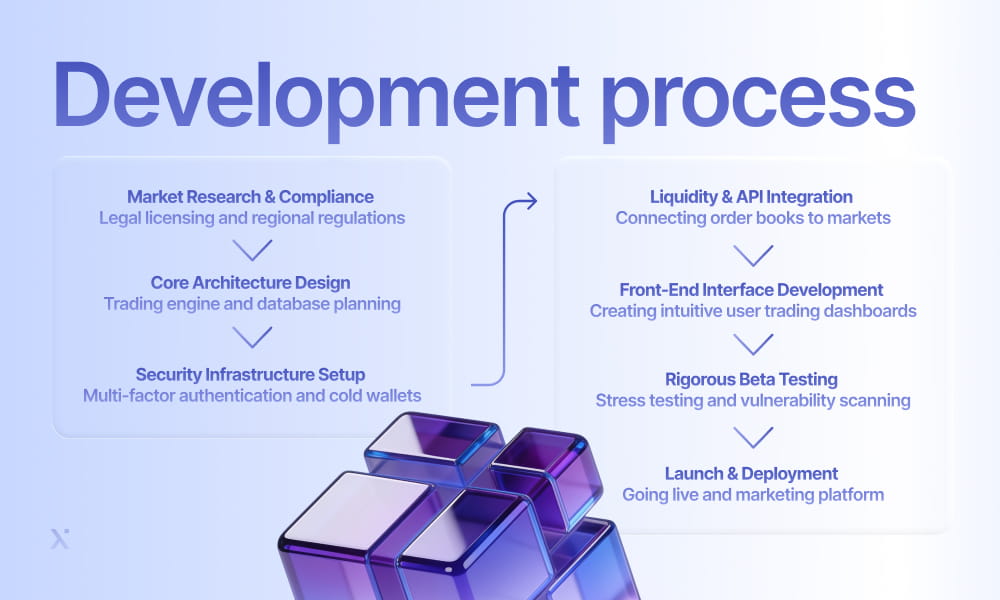
Comprehensive market analysis and legal structuring
Before writing any code, your team must define the regulatory framework for your target jurisdictions. You need to obtain financial licenses, register corporate entities, and establish clear terms of service for your users.
High-fidelity UX/UI prototyping
Designers create detailed interactive layouts for every screen, map out user journeys, and test the trading interface for usability.
- Visual wireframes map the user flow from registration to trade execution.
- Full-color mockups show the exact appearance of dark and light trading screens.
- Interactive prototypes let real users test the interface before backend engineering begins.
Scalable core architecture design
System architects define the microservices layout, set up the data models, and plan the server infrastructure. This stage determines how the matching engine interacts with the user ledgers and how the system isolates critical processes.
High-performance matching engine construction
Engineers write the core logic that processes and matches buy and sell orders. This module must be built for maximum speed, using low-latency languages to handle thousands of parallel operations without errors in a complex cryptocurrency exchange development.
Secure custodial wallet integration
The system needs separate hot and cold wallet infrastructures to store user funds safely. Developers build automated systems to handle retail deposits, track balances, and process customer withdrawal requests securely.
Implementation of advanced security barriers
Security teams install web application firewalls, set up multi-factor authentication systems, and deploy custom tracking tools. Integrating dedicated transaction monitoring software helps the platform detect and block suspicious account behavior before any funds can be moved.
Rigorous quality assurance testing
Testers run extensive automated checks, execute load testing to simulate high traffic, and run vulnerability scans. This phase uncovers hidden code glitches and ensures the platform can handle sudden market rallies smoothly.
Deployment and infrastructure expansion
The operations team deploys the finalized application across distributed cloud networks, sets up real-time monitoring tools, and launches the live platform.
- Automated deployment scripts push identical system updates to all global servers instantly.
- Real-time monitoring tools alert the engineering team the moment server usage spikes.
- Customer support dashboards open immediately to help users with onboarding issues.
Budget breakdown for building a cryptocurrency marketplace
The overall cost of cryptocurrency exchange development changes dramatically based on your project’s scope, feature set, and target launch timeline. Understanding these price differences helps management teams allocate their capital intelligently.
Minimum viable product tier
An MVP development service focuses purely on essential functionalities, allowing you to launch quickly and test your business idea with real users. It includes a basic matching engine, standard spot trading for a few major asset pairs, email-based registration, and simple hot wallets for user deposits. This approach minimizes your upfront financial risk while helping you gather early user feedback.
Intermediate feature tier
The intermediate tier expands the platform to support a much larger retail audience. It introduces margin trading, a peer-to-peer transaction board, automated identity verification integrations, and native mobile apps for iOS and Android. This tier provides a complete, modern trading experience that can compete effectively with established regional platforms.
Enterprise-grade ecosystem tier
An enterprise-grade platform is built for global operations and institutional clients. It features high-frequency matching engines, extensive futures and derivatives markets, over-the-counter desks, and institutional API access. The infrastructure uses advanced multi-signature cold storage setups and automated risk engines designed to process massive transaction volumes.
The following breakdown outlines typical cost structures and timelines:
| Development Tier | Estimated Cost Range | Average Development Timeline | Key Feature Inclusions |
| Minimum Viable Product | $60,000 to $100,000 | 3 to 5 Months | Spot trading, basic user accounts, standard security layers |
| Intermediate Tier | $120,000 to $220,000 | 6 to 9 Months | Native mobile apps, P2P board, automated compliance tools |
| Enterprise-Grade Tier | $250,000+ | 10+ Months | Derivatives markets, OTC desks, institutional API infrastructure |
Your initial development budget is only part of the puzzle. You must reserve at least twenty to thirty percent of your annual budget for ongoing server maintenance, security upgrades, and cloud infrastructure fees.
Designing a convenient and intuitive user experience
High transaction speeds mean very little if your users find your menus confusing or difficult to navigate. A successful trading platform must keep its user interface clean and accessible for both novice buyers and professional day traders.
Smooth switching
To provide an excellent experience, your application, especially the P2P crypto exchange software, should offer distinct interface modes that users can switch between with a single tap. A simplified view works best for casual investors who want to make quick purchases without looking at complex order books. Meanwhile, an advanced layout gives professional traders access to full order book depth, drawing tools, and diverse order configurations. Organizing your interface this way keeps your platform inviting for beginners while remaining powerful enough for advanced market players.
Fast onboarding
Additionally, simplify your registration and onboarding paths as much as possible. Long delays during identity verification frequently cause new signups to abandon the platform entirely. Using clean forms, clear progress indicators, and instant tooltips helps users complete verification quickly without feeling frustrated. Keeping your interface accessible and straightforward builds long-term user trust and improves retention rates.
Major technical challenges to manage during development
Building a large financial cryptocurrency exchange development project comes with significant engineering hurdles. Your development team must anticipate these issues during the early planning stages to prevent problems later on. Here is the short table summarizing the major technical challenges and their engineering solutions, following the same format:
| Challenge | Impact on Platform | Core Engineering Solution |
| Extreme Transaction Loads | Spikes overwhelm API gateways and slow database queries | Horizontally scalable microservices and distributed database shards |
| Protecting User Balances | Vulnerabilities lead to theft and destroyed reputation | In-depth security audits and comprehensive risk management reviews |
| Real-Time Data Sync | Discrepancies between web, mobile, and API interfaces | Distributed message brokers for immediate notification delivery |
| Continuous System Uptime | App downtime causes user losses and breaks trust | Redundant server nodes and automated failover systems |
| Fiat & Blockchain Sync | Timing gaps between slow bank transfers and fast crypto | Precise pending-state logic tracking to hold Uncleared funds |
| Changing Global Regulations | Evolving compliance rules risk sudden legal illegality | Flexible, modular compliance architecture for easy updates |
Managing extreme transaction loads
When major market movements occur, millions of users open their apps at the exact same moment to manage their positions. This sudden traffic spike can easily overwhelm poorly optimized API gateways and slow down database queries. To handle these load spikes, developers use horizontally scalable microservices and distributed database shards that distribute the data processing load across multiple servers.
Protecting user balances from theft
Digital asset platforms remain a prime target for international hacking groups looking for system vulnerabilities. Investing in secure multi currency crypto wallet development mitigates these risks, as a single security breach can drain millions of dollars from your user ledgers and instantly destroy your business reputation. To prevent this, you must run an in-depth security audit and risk management review before launching your platform. This deep audit uncovers potential security gaps in your code and ensures your core systems are safe from external attacks.
Synchronizing real-time data across devices
Maintaining identical balance records and order book prices across a user’s web browser, mobile application, and API connection requires excellent data synchronization. If an order executes on the web, the mobile interface must reflect that balance change immediately. Using distributed message brokers ensures that all internal microservices receive update notifications simultaneously without creating system lag.
Maintaining continuous system uptime
Financial markets run twenty-four hours a day, meaning your platform cannot afford long maintenance windows or unexpected downtime. If your app goes offline for even a few minutes during high market activity, your users can suffer severe losses and lose faith in your platform. Engineers resolve this by building redundant server nodes and automated failover systems that keep the platform running even if a main data center goes offline.
Connecting old financial systems with modern blockchains
Bridging traditional fiat banking APIs with modern distributed ledger networks often creates complex timing challenges. Traditional bank transfers can take days to finalize, whereas digital asset transactions execute in minutes or seconds. Your backend logic must track these pending states carefully, ensuring that users cannot trade or withdraw funds until their incoming fiat deposits are fully cleared.
Keeping pace with changing global regulations
Financial compliance rules for digital assets change constantly across different international jurisdictions. A compliance framework that works perfectly today might become illegal next month due to new local laws. Developing a flexible, modular compliance system allows you to update your geographic restrictions and verification rules easily without rewriting your entire application.
Implementing advanced architectural techniques helps ensure your cryptocurrency exchange development platform remains fast, scalable, and secure over years of operation.
- Database sharding: Split your primary user databases by geographic region or account ID to prevent any single database from becoming an execution bottleneck.
- Asynchronous ledgers: Process core order matching in your fast in-memory layer first, then write the transaction records to your main database in background queues.
- Isolated wallet management: Keep your main asset keys stored on offline hardware, and use automated systems to move small amounts of crypto to your live hot wallets as needed.
- Rate limiting policies: Protect your public API endpoints by limiting the number of requests an individual user account can submit every second.
- Component-based deployment: Deploy your application services inside isolated virtual containers so you can scale individual parts of the system independently when traffic grows.
Why PixelPlex is your ideal engineering partner
Launching a competitive cryptocurrency exchange development platform requires an engineering partner with real, hands-on experience in the blockchain space. Our team at PixelPlex has spent over a decade building robust decentralized products, and we have successfully delivered more than eight custom crypto wallet ecosystems and advanced trading platforms. We understand how to design scalable architectures that protect user funds while delivering high-speed order execution.
If you want to deploy a decentralized platform, our DEX development experts can build custom automated market maker systems that run entirely on-chain. Alternatively, for businesses targeting maximum transaction speed and high volumes, our CEX development specialists can create high-frequency matching engines capable of handling millions of orders smoothly.
Our portfolio across various trading styles proves our ability to handle complex financial software requirements.
Bitnetwork: A trading venue for professional market players
We engineered a high-capacity centralized exchange tailored specifically for institutional day traders who require extreme reliability and custom interfaces.
- The system includes over twenty modular widgets, letting traders arrange their order books, candle charts, and depth visualizations exactly how they want.
- Security layers use three distinct forms of multi-factor authentication, including email codes, SMS alerts, and hardware authenticator connections.
- The cryptocurrency exchange development platform supports 18 active trading pairs with advanced market and limit order options.
FunShape: Streamlined onboarding for casual investors
Our team designed a highly accessible trading application created for the Japanese market, focusing on clean user flows and fast mobile operations.
- The clean interface uses a simplified, fixed module layout that removes confusing configuration steps for new users.
- The platform features ten major trading pairs with clear market and limit order options, supporting both English and Japanese interfaces natively.
- The platform protects the network by requiring full identity verification and two-factor authentication before a user can execute their first trade.
Arbitrage Bot: Automated multi-venue market tracking
This cryptocurrency exchange development project features an intelligent arbitrage bot that connects directly to major venues like Binance, Kraken, Coinbase, and Bitfinex.
- The bot executes complex three-way and four-way arbitrage strategies across multiple platforms simultaneously, analyzing dozens of price anomalies every second.
- Users can customize their trading strategies by setting minimum profit percentages, maximum trade sizes, and custom account balance thresholds.
- The system uses fast WebSocket APIs to connect to each exchange, and it lets users export their entire trading history to CSV files for accounting.
Our teams also provide professional blockchain consulting to help you design token economics, plan regulatory compliance strategies, and map out your development phases. If you want to launch a custom community ecosystem, our Web3 app development teams can build tailored decentralized features directly into your core application. We focus on providing highly reliable technology solutions that protect your investments and scale naturally as your user base grows.
Using a pre-built foundation can shorten your development time significantly. Choosing white label crypto exchange development allows you to launch a pre-tested platform quickly, which lowers your upfront costs while giving you access to reliable core trading features. This approach works incredibly well for businesses that want to establish a market presence without waiting through long engineering cycles.
Final operational considerations for your project
Every layer of the platform, from the frontend interface to the backend order matching microservices, must be engineered to prevent bottlenecks and protect user assets. Working with an experienced engineering partner helps you navigate these technical challenges safely and avoid common development mistakes.
| Criteria | Proven Vendor | In-House Team |
| Speed | Immediate start with ready frameworks. | Months lost to hiring and onboarding. |
| Risk | Low; uses tested, secure architectures. | High; prone to rookie bugs and redesigns. |
| Cost | Predictable milestone-based pricing. | High overhead and ongoing salaries. |
| Compliance | Built-in KYC, AML, and audit readiness. | High risk of missing complex regulations. |
| Flexibility | Scales team size up or down instantly. | Rigid; bound by fixed full-time contracts. |
Our cryptocurrency exchange development team at PixelPlex creates these in-depth technical guides because we believe successful projects are built on strong architectural planning. Whether your business requires a high-frequency centralized matching engine or a custom decentralized swapping protocol, our specialists can design a solution tailored to your operational needs.
If you are ready to evaluate the technical requirements or estimate the development costs for your project, contact our team to build a secure, scalable, and highly reliable trading venue.
FAQ
A minimum viable product tier costs between $60,000 to $100,000 and takes roughly 3 to 5 months to develop. For a browser-based exchange, MVP web development focuses on essential functions like spot trading and basic user accounts, giving you a working product to test before expanding the feature set.
Instead of standard relational databases, top-tier cryptocurrency exchange development uses custom-built, memory-based matching engines that leverage advanced data structures to process millions of transactions per second with microsecond latency.
Our team recommends choosing the right language based on component criticalities: you can hire Golang developers or Rust engineers for the core matching engine to ensure sub-millisecond latency, while leveraging PostgreSQL for ACID-compliant relational data, Redis for active order books, and Apache Kafka for system event stream management.
Hybrid sourcing connects your platform directly to global market makers via FIX protocols, pulling liquidity from multiple external order books simultaneously to maintain tight spreads during extreme market volatility.
Startups can opt for white label crypto exchange development to achieve a faster time-to-market with lower upfront investments, or choose custom engineering from scratch for complete codebase ownership and unlimited feature growth.
Management teams must reserve at least twenty to thirty percent of their annual budget specifically to cover ongoing server maintenance, continuous security upgrades, and cloud infrastructure fees.