Decentralization means no single point of failure — just thousands of computers all agreeing you’re right. Or wrong. Either way, it’s transparent. That’s the promise behind dApps, and also why developing them properly is a lot more serious than it sounds.
The way we build and use the internet is starting to feel… up for debate. So why are so many suddenly obsessed with decentralization? Maybe it’s just people looking for systems they can trust a little more — ones that aren’t controlled by a single company, can’t go down all at once, and don’t quietly change the rules overnight.
At the center of all this are decentralized applications, or dApps. They run on distributed networks instead of a central authority. And it’s not just talk — the numbers are starting to back it up. The dApp market hit around $30.6 billion in 2024, is expected to reach about $43 billion in 2026, and nearly $87 billion by 2030.
At PixelPlex, we’ve been providing blockchain dApp development services for over a decade, so we know almost everything about doing it right. That’s exactly why we put together this guide: to help you navigate the world of decentralized applications without getting lost in this tech.
Let’s begin.
What are dApps and why is their development quality so critical?
It’s pretty simple — dApps are applications built on blockchain technology. While traditional apps rely on a central server or a specific company, dApps run on distributed networks where every transaction and action is recorded, verified, and permanent, making this infrastructure highly advantageous for transparent DeFi lending platform development.
This is what makes them a core part of Web3 — the next generation of the internet. In Web2, you trust the platform, and in Web3, you trust the protocol itself and the code behind it. This kind of shift is pretty exciting, but it also raises the stakes.
Since the blockchain is immutable, even a tiny mistake in smart contract development can bring huge consequences. Funds can be frozen, wallets drained, or functionality broken. There’s simply no “undo” button, and errors can be exploited immediately.
That’s why dApp development isn’t just about writing code, but about building it correctly from the very start. For complex systems utilizing NFT gaming platform development services, security and precision matter more than ever, because in a decentralized world, even a tiny slip can affect everyone involved.

(In)Famous Smart Contract Hacks: Why They Happened and How to Avoid Them
Top 5 Web3 Security Tools in 2026
What types of dApps are out there?
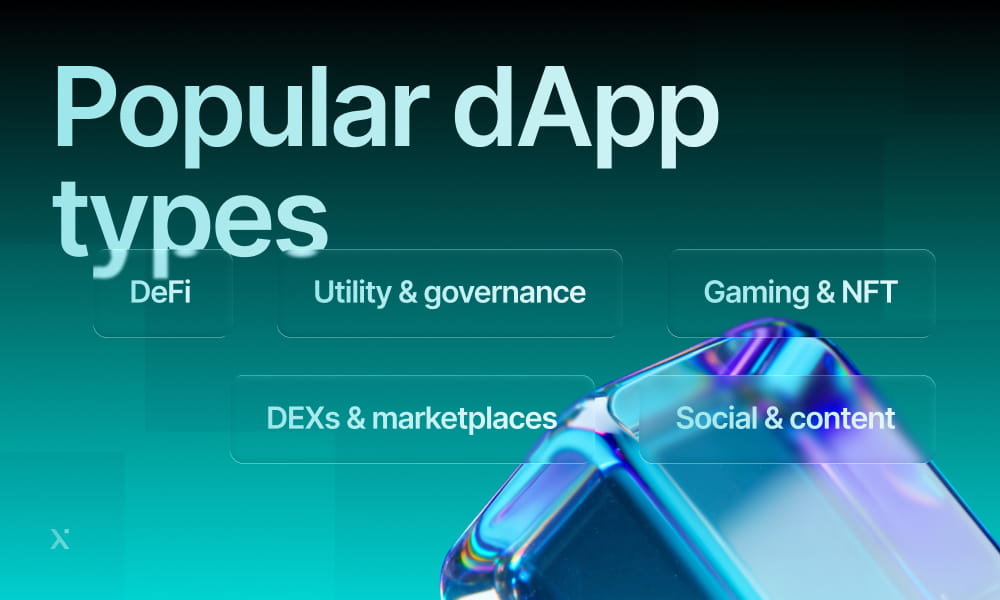
Today’s dApps cover numerous use cases. If your business is thinking about entering Web3, understanding the different types is a must. It can help you spot the best opportunities and, most importantly, avoid costly mistakes later.
Here are the main types of dApps you might consider:
- DeFi dApps. These apps let users lend, borrow, trade, or earn interest on digital assets without relying on traditional banks. DeFi (decentralized finance) applications use smart contracts to automate transactions securely. If you’re exploring financial solutions like lending platforms, exchanges, or yield farming protocols, working with a company specializing in DeFi dApp development services can keep your platform secure, reliable, and (dare we say?) stress-free.
- Utility and governance dApps. Utility dApps handle things like identity verification, secure data storage, or voting systems, while governance dApps enable communities to vote on decisions and manage resources together. Businesses that decide to launch these types of apps can create transparent, community-driven ecosystems — without having to babysit every move.
- Gaming and NFT dApps. Would you like the players in your games to really own what they earn or collect there? That’s exactly what these dApps do. Besides that, blockchain gaming and NFT platforms allow users to trade, sell, or showcase their collectibles across other games and platforms. If you’re in the creative space, this is a great way to engage users in new, immersive ways while keeping assets secure.
- Exchange and marketplace dApps. Through decentralized exchanges (DEXs) and marketplaces, users can trade tokens, cryptocurrencies, or digital goods directly with each other. For businesses, this builds trust, improves user satisfaction, and lets transactions happen transparently without intermediaries. To launch these platforms without a long custom development cycle, many companies choose to start with a customizable white label crypto exchange solution.
- Social and content dApps. People don’t really want platforms to hoard their data and decide what they can see or do there. Decentralized social networks and content platforms offer a way out: they give users ownership of their data and control over interactions. With this approach, companies can create stronger communities, reward active users, and build engagement models that are fair, transparent, and truly user-driven.

Social Media on Blockchain: Why It’s the Next Big Digital Revolution
Comparing DApps Across Protocols: Why Your Blockchain Choice Can Break Everything
| Type of dApp | What it does | Business opportunity |
| DeFi dApps | Lend, borrow, trade, or earn interest on digital assets using smart contracts | Financial solutions such as lending platforms, exchanges, yield farming protocols |
| Gaming & NFT dApps | True ownership of in-game assets and collectibles, the ability to trade or showcase them across different platforms | Increase player engagement, drive in-game economies, and monetize digital assets |
| Exchange & marketplace dApps | Peer-to-peer trading of tokens, cryptocurrencies, or digital goods | Build trust, remove intermediaries, give users control over transactions |
| Social & content dApps | Decentralized social networking and content sharing | Boost community loyalty, create subscription or reward models, and maintain data transparency |
| Utility & governance dApps | Services like identity verification, secure data storage, or voting systems | Implement secure authentication, enable transparent voting/governance, and strengthen regulatory compliance |
Which blockchains are dApps typically built on?
DApps can run on a variety of blockchains, but in practice, a handful of ecosystems do stand out. Whether you focus on Ethereum, Solana, or look into Polkadot development, these networks have become popular thanks to strong developer tools, active user communities, good scalability, and powerful smart contract features.
Here’s a closer look at the leading platforms, their strengths, limitations, and the types of dApps they’re best suited for.
Ethereum
What kind of blockchain list would this be without Ethereum? It’s practically a given because it is the original smart contract platform and still the most widely used blockchain for dApp development. It pioneered programmable blockchain infrastructure through its robust virtual machine and developer ecosystem.
Up to this day, Ethereum dApp development services remain in high demand thanks to its mature ecosystem and wide adoption.
Best features:
- Largest ecosystem of dApps, users, and developers
- Mature and secure smart contracts via Solidity
- Highly decentralized network
- Rich tooling: frameworks like Hardhat, Truffle, and extensive documentation
- Layer-2 solutions like Arbitrum and Optimism reduce costs
Limitations:
- High gas fees during congestion
- Slower transaction throughput compared to newer chains
- Possible complexity for new developers
Best suited for dApps like:
- DeFi apps, because they rely heavily on deep liquidity and strong security
- DEXs and other DeFi exchange development projects, thanks to Ethereum’s large user base and established infrastructure
- NFT platforms and marketplaces, which benefit from wide adoption and active communities
- DAOs, where well-developed governance frameworks and tooling make coordination so much easier
| Ethereum for dApp development | ||
| Feature | Details | What it means for dApp development |
| Consensus | Proof-of-Stake (PoS) | More energy-efficient and secure, suitable for large-scale applications |
| TPS | ~15-30 | Limited throughput means higher costs and the need for layer-2 solutions |
| Language | Solidity | Widely supported, easier to find developers and resources |
| Strength | Security & ecosystem | Ideal for complex dApps that require trust, liquidity, and integrations |
| Weakness | Fees & scalability | Developers must optimize code and often rely on scaling solutions |

Ethereum DApp Development: How It Works and What You’ll Pay
Solana
Solana dApp development focuses on building scalable, high-speed applications that can handle large volumes of users without significant costs. Engaging an experienced Solana project development company allows businesses to fully exploit this infrastructure. The network uses a unique combination of Proof-of-History (PoH) and Proof-of-Stake to achieve fast finality and high throughput.
Best features:
- High throughput
- Very low transaction costs
- Fast finality
- Great for scaling apps
Limitations:
- Several major outages have occurred
- More centralized compared to Ethereum
- Smaller ecosystem than Ethereum
Best suited for dApps like:
- Gaming dApps, because they require high speed and low latency
- NFT platforms as they need high-volume minting at low cost
- Social dApps that benefit from the ability to handle frequent micro-transactions efficiently
| Solana for dApp development | ||
| Feature | Details | What it means for dApp development |
| Consensus | PoH + PoS | Enables high-speed processing for real-time applications |
| TPS | 3,000-4,000 | Supports high-traffic apps like games and social platforms |
| Language | Rust, C/C++ | More complex but powerful for performance-focused development |
| Strength | Speed & cost efficiency | Great for user-heavy dApps with frequent transactions |
| Weakness | Stability concerns | Developers must plan for potential downtime or disruptions |
Blockchain for Business: Beyond Cryptocurrency to Real-World Value
A Comprehensive Guide to Blockchain Application Development
TRON
TRON dApp development is centered around building fast, cost-efficient applications that can handle a large number of users and transactions with minimal fees at the same time. Thanks to its Delegated Proof-of-Stake (DPoS) consensus mechanism, TRON offers quick confirmations and super low transaction costs, which makes it especially attractive for high-frequency cryptocurrency trading software development and decentralized finance applications like lending software development.
TRON is fully EVM-compatible, which means it can run Ethereum smart contracts. Developers can easily move their Ethereum-based dApps to TRON with minimal work, saving both time and effort.
Best features:
- Very low fees
- High throughput
- Strong stablecoin ecosystem (like USDT usage)
- Simple developer onboarding
Limitations:
- Centralization concerns
- Smaller developer ecosystem
- Less innovation compared to Ethereum
Best suited for dApps like:
- Payment apps because they require lower cost and fast transfers
- Gaming dApps since they need to handle high transaction volumes efficiently
- Content platforms that need timely creator monetization and fast payouts
| TRON for dApp development | ||
| Feature | Details | What it means for dApp development |
| Consensus | Delegated PoS | Faster and cheaper transactions, but with some centralization |
| TPS | ~2,000 | Handles high transaction volumes efficiently |
| Language | Solidity (EVM-compatible) | Easy migration from Ethereum-based dApps |
| Strength | Low fees | Great for apps with frequent or micro-transactions |
| Weakness | Centralization concerns | May not suit use cases requiring maximum decentralization |
Cardano
Cardano is a research-driven blockchain that focuses on security, scalability, and sustainability through peer-reviewed development.
Cardano dApp development is all about building reliable and secure applications. Its energy-efficient PoS consensus, Ouroboros, keeps the network safe, while the Plutus smart contract language helps developers write contracts that are accurate and robust.
Best features:
- Strong academic foundation
- Energy-efficient PoS model
- High security and formal verification
- Growing ecosystem
Limitations:
- Slower development cycles
- Smaller dApp ecosystem
- Less mature tooling
Best suited for dApps like:
- Identity solutions, because security is a top priority
- Government and enterprise systems that benefit from formal verification
- Financial infrastructure in emerging markets, due to reliability and security
| Cardano for dApp development | ||
| Feature | Details | What it means for dApp development |
| Consensus | Ouroboros PoS | Secure and energy-efficient foundation for long-term projects |
| TPS | ~250 | Moderate throughput, suitable for growing ecosystems |
| Language | Plutus (Haskell-based) | Quite safe, but requires specialized developer skills |
| Strength | Security & research | Best for applications where correctness and reliability are critical |
| Weakness | Adoption speed | Smaller ecosystem means fewer tools and integrations |
Polkadot
Polkadot’s specialty is its parachain system. It enables interoperability between blockchains and works especially well for cross-chain apps.
So, Polkadot dApp development lets you build scalable, multi-chain projects that can share data and security across networks. Its Relay Chain ensures safety, while parachains let you create custom blockchains for specific needs.
Best features:
- Interoperability, connects multiple blockchains
- Scalability via parachains
- Customizable blockchains
- Shared security model
Limitations:
- Complex architecture
- High barrier to entry for developers
- Relatively small user base
Best suited for dApps like:
- Cross-chain DeFi apps, where interoperability is key
- Multi-chain ecosystems that need to share data between chains
- Infrastructure-level projects that require custom blockchains
| Polkadot for dApp development | ||
| Feature | Details | What it means for dApp development |
| Consensus | Nominated PoS | Shared security across multiple chains simplifies deployment |
| TPS | ~1,000+ via parachains | Scales well for complex, multi-chain applications |
| Language | Rust | Powerful but requires experienced developers |
| Strength | Interoperability | Enables building dApps that interact across multiple blockchains |
| Weakness | Complexity | Higher development overhead and learning curve |
Work with blockchain professionals who can match your dApp type, user needs, and transaction requirements to the right chain.
What other technologies power dApps?
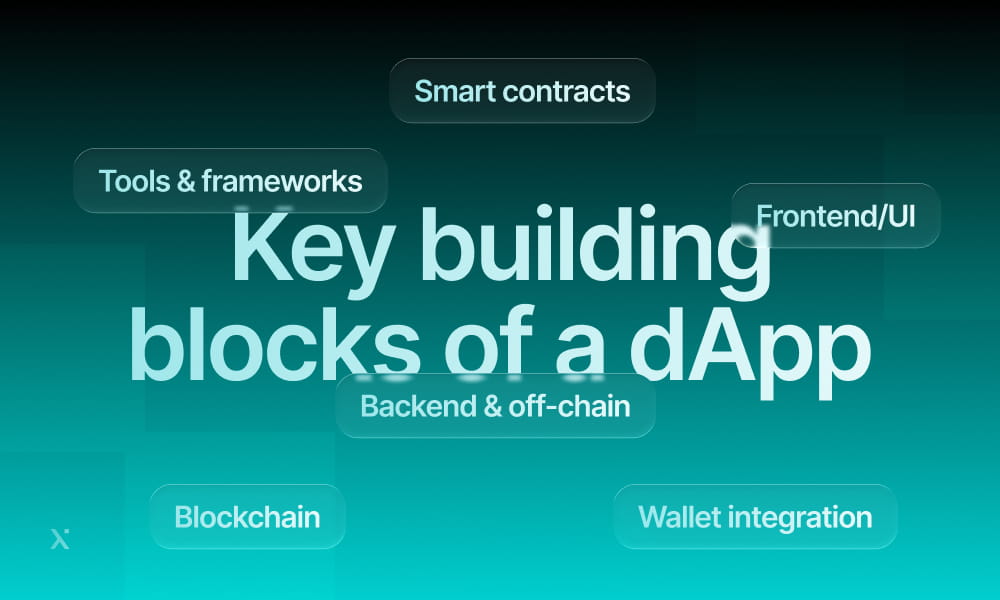
When it comes to dApp development, blockchain is essential, but other technologies play an important role too. Web3 dApp development services often use a mix of core components, tools, and frameworks to bring these apps to life.
Core parts of a dApp:
- Smart contracts — the backbone of any dApp, controlling logic and transactions on the blockchain.
- Frontend/UI — the interface users interact with, often built like a regular web app but connected to the blockchain.
- Backend and off-chain services — they handle data storage, computation, or APIs that don’t need to be on-chain.
- Wallet integration — lets users manage accounts, sign transactions, and interact securely with the dApp.
Main tools and frameworks:
- Web3.js, Ethers.js — JavaScript libraries to connect the frontend with blockchain networks.
- Truffle, Hardhat — development frameworks for compiling, testing, and deploying smart contracts.
- MetaMask, WalletConnect — popular wallet integrations for user authentication and transaction signing.
- IPFS, Arweave — decentralized storage solutions for hosting files and data off-chain.
- Ganache, Solana Testnet, Cardano Testnet — local or public test networks for development and debugging.
Blockchain Database vs Traditional Database: Choosing the Best For Your Project
DApp development: what does the process look like?
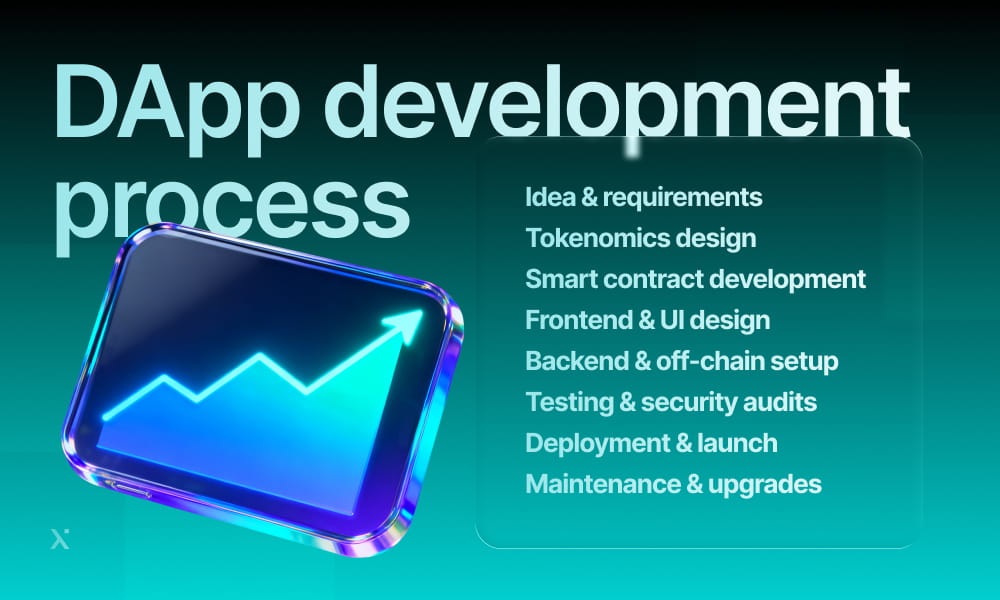
Building a decentralized application may seem complicated, but with the right guidance, it’s totally doable. Partnering with a nearshore software development team helps you at every stage and makes sure that your app is secure, user-friendly, and scalable.
Here’s how the process usually goes:
1. Idea and requirements
Here, you’ll define what your dApp is all about. Who is it for? What problem does it solve? You’ll also figure out what blockchain features you really need.
For example, if you’re building a gaming dApp, you might prioritize fast transactions and low fees, while a DeFi app would focus on security and compliance.
2. Tokenomics design
This is where you plan how your dApp’s token works. You’ll decide how tokens are distributed, what rewards users receive, and how the system stays balanced. Well-thought-out tokenomics design will keep your users engaged and your ecosystem healthy.
3. Smart contract development
Here, your team of developers will write the smart contract code that handles all the logic on the blockchain. You’ll also test them carefully, because once a contract is live, it can’t be changed easily.

Smart Contract Development Cost Demystified: What Every Business Should Know
Ethereum Smart Contracts: The Hard Parts Made Clear
4. Frontend and UI design
This is what your users actually see. You’ll need to design buttons, pages, and dashboards so everything is simple, clear, and enjoyable to use.
5. Backend & off-chain integration
Some things don’t need to live on the blockchain. Here, you’ll set up servers, APIs, and storage to handle extra data and computations efficiently.
6. DApp scaling across devices
Your users may be on phones, tablets, or desktops. At this stage, you’ll optimize your dApp so it looks good and works smoothly on all screen sizes and platforms.
7. Testing and security audits
Now it’s time to make sure everything works. You’ll test for bugs, check performance, and run smart contract security audits to keep users safe.
This step is extremely important because even small errors can lead to lost funds or damage your reputation. Thorough testing helps make your dApp reliable and builds trust with users from day one.
8. Deployment and launch
Here, you’ll put your dApp live on the blockchain and make it available to users. You’ll also monitor it closely to catch any early issues.
9. Maintenance and upgrades
After launch, your work isn’t done. You’ll update the app based on feedback, fix bugs, and improve features to keep your dApp running smoothly.
Upgrade smart contracts and add features as your audience grows
DApp development cost: what you should budget for
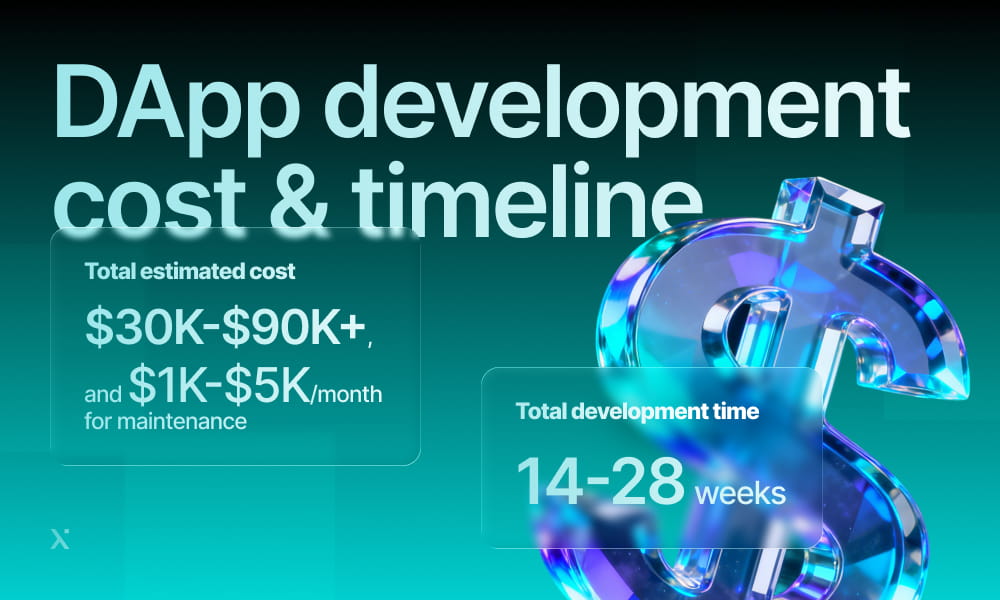
DApp development prices vary widely depending on complexity, underlying network choice, required features, and the hourly rates of your chosen BSC development company. Here’s a rough breakdown of what each stage might cost and how long it typically takes:
| Stage | Estimated cost | Timeline |
| Idea & requirements | $2K-$5K | 1-2 weeks |
| Tokenomics & planning | $3K-$7K | 1-3 weeks |
| Smart contract development | $10K-$30K | 4-6 weeks |
| Frontend & UI design | $5K-$15K | 3-5 weeks |
| Backend & off-chain setup | $5K-$12K | 3-5 weeks |
| Testing & security audits | $3K-$10K | 2-5 weeks |
| Deployment & launch | $2K-$5K | 1-2 weeks |
| Maintenance & upgrades | $1K-$5K/month | Ongoing |
Why PixelPlex is your best dApp development partner
If you’re looking for a partner who truly gets your vision and brings over 13 years of hands-on experience in blockchain development, PixelPlex is a dApp software development company that makes the whole journey feel smooth and collaborative.
Whether you’re starting from scratch or scaling an existing product, their team is there to guide you at every step, simplify complex processes, and turn your ideas into reliable, real-world applications that work for your business.
PixelPlex also takes security very seriously. Their team uses thorough audits and continuous testing to keep your project safe, while their clear planning helps you stay on budget without unexpected surprises. With ready-to-use modules that speed up development and reduce costs, you get both efficiency and quality without compromise.
Altogether, their dApp development services cover everything you need — from smart contract, NFT, and DAO development to building robust public and private blockchain solutions.
| PixelPlex experience in dApp development in numbers | |
| 13 years of experience in the blockchain space | 1 million+ audited smart contract calls |
| 3 unicorns launched | 50 million+ happy dApp users for their clients |
Top Blockchain Companies Revealed: How to Choose the Right Development Partner

Blockchain Development Cost in 2026: What Goes Into the Price Tag
Conclusion
Choosing the right approach to dApp development is all about matching your business goals with the right blockchain, development plan, and budget. Each blockchain has its own strengths, whether it’s scalability, security, ecosystem support, or cost, so the best choice really depends on your specific needs, not a one-size-fits-all solution. For projects where formal verification, reliability, and long-term security are priorities, Cardano dApp development may be worth considering early.
Getting clear on your requirements early, like expected users, transaction speed, and integration needs, can help you avoid unnecessary complexity and keep costs under control.
Also, having the right dApp development team on your side makes a big difference. Experienced engineers and advisors can guide you through technical decisions, steer you clear of common pitfalls, and make sure your dApp delivers real value for your business and your users.
FAQ
Not at all. DApps can serve finance, gaming, social media, marketplaces, governance, healthcare, and more — any sector that benefits from transparency, automation, and decentralized control.
Smart contracts are like little rulebooks on the blockchain — once they’re live, their rules can’t be changed. So if there’s a mistake in the code, it can freeze funds, let assets be stolen, or break key functionality. That’s why careful testing, code reviews, and security audits are absolutely essential before launching a dApp.
Yes, most decentralized apps require users to connect a crypto wallet, which stores their assets and allows secure interactions with smart contracts.
Scalability depends on your blockchain choice, smart contract design, and optimization. High-traffic dApps may need layer-2 solutions or sidechains to maintain speed and lower transaction costs.
Monetization strategies include transaction fees, subscription models, in-app purchases, NFT sales, or token-based economies. The approach depends on your dApp type and audience.
You will need to work with legal experts familiar with blockchain and crypto regulations in your target markets. Some dApps require KYC/AML procedures or other compliance measures.
Getting users on board is all about making your dApp easy to use, fun, and rewarding. Clear value, a smooth interface, and little incentives like tokens or NFTs can go a long way. Start engaging with your community even before the launch because people love being part of something great from day one.