AI coding tools have moved far beyond autocomplete. Today, someone with a product idea can describe it in plain language and get a working application surprisingly fast. That shift sparked a wave of excitement around vibe coding.
For startups, founders, and even experienced developers, the appeal is obvious. Less time spent writing code means more time spent testing ideas.
The problem begins when a prototype becomes a real product. A dashboard built for an internal team has completely different requirements from a platform that processes payments, stores customer data, or connects to multiple business systems. Speed helps at the initial stage. Later, teams must deal with security checks, bug fixes, maintenance, documentation, and all the feature requests that come in after launch. These aspects are included in software architecture consulting services and don’t disappear when AI writes code.
For most companies, the discussion has already moved beyond curiosity about AI. The real challenge involves deciding where vibe coding fits into the development process and where it falls short. A prototype, an internal tool, and a customer-facing platform each come with different expectations, which means they often require different approaches to development.
What is vibe coding?
The term vibe coding entered the tech conversation in early 2025 after AI researcher Andrej Karpathy used it to describe a new way of building software. Instead of writing every function, class, and API call manually, developers describe what they want in natural language and let AI generate the code.
It’s easy to see why vibe coding gained popularity so quickly. People who had never written production code could suddenly build functional applications and test ideas on their own. At the same time, developers started using these tools to cut down on routine work and spend more time solving larger technical problems.
The entire vibe-coding workflow is just a conversation. Instead of writing code, you describe your idea, the AI builds version 1.0, and then you just tell it what to do next. It’s an incredibly fast way to bully an idea into a functional demo without ever touching a code editor.
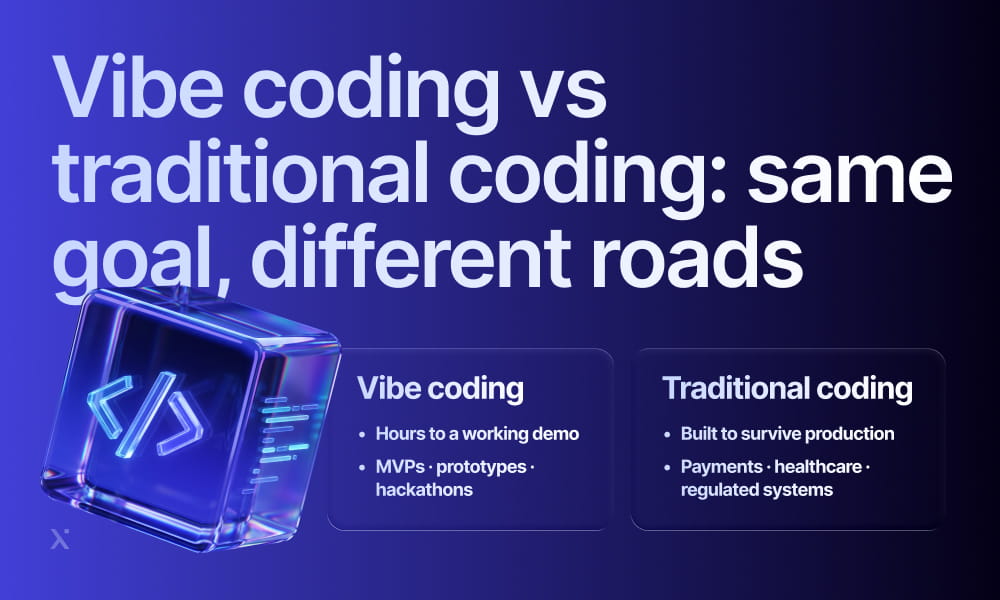
The real shift here is all about scope. Tools like GitHub Copilot just help you finish a line of code, but vibe coding tools try to build the whole app for you. That doesn’t mean humans are obsolete — it just changes your job. Instead of typing out lines of code, you become the editor who has to audit, test, and fix whatever the AI spits out to make sure it actually works.
The appeal extends beyond speed. Vibe coding allows product teams to participate more directly in software creation, reducing the gap between an idea and a working proof of concept.
According to industry research, AI-assisted coding already plays a role in the daily work of most U.S. developers, and analysts expect AI-generated code to account for a significant share of new software development over the next few years. Teams report faster prototyping cycles, quicker experimentation, and shorter paths from idea to working software.
That does not mean developers can step away from the process. Even advocates of vibe coding usually distinguish between two approaches. The first relies almost entirely on AI output and works best for experiments, weekend projects, and disposable prototypes. The second treats AI as a collaborator. Most business applications fall into the second category.
Today, the vibe coding ecosystem includes a growing number of tools designed for different types of users. Some are aimed at professional developers working with existing codebases, while others are designed for founders, product teams, or users with little technical experience.
Among the most widely used platforms are:
- Cursor
- Claude Code
- GitHub Copilot
- Windsurf
- Lovable
- Bolt
- Replit
- v0 by Vercel
Most of these tools follow the same general idea: describe what you want, let the AI generate an implementation, and then continue to refine the result through dialogue. The experience is less like traditional programming and more like collaborating with a highly skilled assistant capable of translating instructions into working code.
That is exactly why vibe coding polarizes people. Building a working app takes five minutes now, which is awesome until you realize you have to actually maintain, secure, and scale a massive pile of code that nobody on your team fully understands.
What is traditional software development?
Traditional engineering is a deliberate grind. You write the code, your peers tear it apart in code reviews, you test the hell out of it, and you write down how it works. It sounds tedious, but it’s the only way to ensure that when someone else has to update your feature next year, they actually know what they’re looking at.
That approach may seem slower compared to modern AI-driven workflows. In reality, many of these practices exist because software projects become increasingly expensive to fix once problems reach production. A bug caught during development might take minutes to resolve. The same issue discovered by customers can lead to downtime, security incidents, lost revenue, or emergency releases.
The real value of traditional development is that your team actually knows how the machine works. They know why the code is structured the way it is and what dependencies are buried inside it. When something breaks a year from now, or when you need to execute legacy application modernization, you aren’t guessing — you have the exact blueprints in your head.
Most organizations follow a version of the Software Development Life Cycle (SDLC), a framework that guides software from an initial idea to long-term maintenance. While specific methodologies vary between teams, the underlying stages remain largely the same.
Several practices sit at the core of traditional development regardless of the methodology being used.
Architecture-first planning
Teams define how the system should work before development begins. Decisions about databases, integrations, scalability, and security are made early because they affect every feature built afterward.
Code reviews
No one merges code without a code review. You need a second pair of eyes to look at your work, find your blind spots, and make sure you aren’t introducing random dependencies or security vulnerabilities. It’s the only way to stop individual developers from accidentally breaking the entire app.
Quality assurance
If you’re only testing the happy path, you aren’t really testing. The goal of QA is to hunt down the weird edge cases, simulate heavy traffic spikes, and poke holes in the security setup before your users find those flaws for you.
Documentation
Technical decisions, workflows, integrations, and business rules are recorded so future developers can understand and maintain the system.
Long-term ownership
The same team that builds the software often supports it after launch. That creates an incentive to write code that remains understandable and maintainable as the product evolves.
These practices add time to the development process. They also reduce the likelihood of expensive surprises after release. For enterprise platforms, financial applications, healthcare systems, and other business-critical products, that trade-off often makes sense.
AI in Software Development: It's More Than Hype, It's the New Hammer

Custom AI Model Development: Tips and Tricks
Vibe coding vs traditional coding: a side-by-side comparison
Vibe coding is great for quickly creating a prototype, but the reality is very difficult when you try to put it into production. It can speed up MVP web development, but when something breaks in production, good luck fixing it. If no one on your team actually wrote the architecture, maintaining and scaling that code becomes a nightmare.
| Factor | Vibe coding | Traditional coding |
| Development speed | Very high | Predictable |
| Code ownership | Partial | Full |
| Security | Higher risk | Controlled |
| Scalability | Variable | Strong |
| Maintainability | Often challenging | High |
| Architecture | AI-generated | Human-designed |
| Compliance | Difficult | Easier |
| Best use cases | MVPs, prototypes, internal tools | Enterprise systems, regulated applications |
This table breaks down the friction between speed and stability. Real-time, rapid development lets you spin things up fast and test ideas with zero friction. Traditional engineering, on the other hand, forces you to slow down and do the heavy lifting upfront — but it’s the only way to ensure your security and architecture don’t fall apart down the road.
The choice is rarely simply about speed. A prototype, an internal dashboard, and a customer engagement platform all address different needs and carry different levels of risk. It is this context that often determines which approach makes sense.

AI MVP Development: How to Validate Ideas Fast Without Breaking the Budget

From Concept to Customers: MVP Web Development That Delivers Proof
Why traditional development is still better for business-critical software
Vibe coding can help teams move quickly during the early stages of a project. Business-critical software operates under a different set of constraints. Once an application starts handling customer data, financial transactions, healthcare records, or core business processes, hiring the best developers becomes essential, as reliability and system stability become far more important than pure development speed.
Reliability and predictability
The cost of a bug scales with your user base. If an internal tool glitches, your team loses ten minutes. If your checkout page glitches, you lose revenue every second it’s down. All the tedious stuff in traditional development — the reviews, the testing pipelines, the architecture meetings — is just an insurance policy to make sure your software doesn’t implode the moment it hits real users.
Governance and compliance
In regulated industries, architectural ambiguity is unacceptable. Banks, healthcare systems, and federal agencies are legally required to demonstrate how their systems handle sensitive data and ensure access control. Structured mechanisms of traditional design — such as mandatory peer reviews and automated quality control logs — create an irrefutable audit trail that automatically complies with regulatory requirements.
Scalability and long-term support
No application is ever truly finished. The moment you launch, you’re immediately faced with requests for new features, additional software connections, and increased user numbers. If your team built the system from scratch the traditional way, they truly understand how its internal structure works. This means that when the system starts to slow down under heavy load, they can focus on optimizing the code instead of guessing what’s broken.
Why business-critical industries favor traditional development
| Industry | Why traditional development remains preferred |
| FinTech | Payment processing, fraud prevention, regulatory compliance, and security requirements demand full control over implementation. |
| Healthcare | Applications handle sensitive patient data and must comply with strict privacy regulations. |
| Insurance | Complex business rules, claims processing, and regulatory obligations require predictable system behavior. |
| Aerospace | Safety, reliability, and extensive testing are critical because software failures can have severe consequences. |
| Government | Public-sector systems often require transparency, security audits, and long-term maintainability. |
Companies in these industries aren’t sticking to traditional dev because they’re afraid of new tech. They’re doing it because they can’t afford a massive lawsuit or a system crash. They need code that their own engineers can actually read, audit, and patch three years from now when something inevitably goes wrong.

AI Business Ideas, Tools & Real-World Wins That Actually Spark Something New
How to Implement AI-Based Recommendation System Step-by-Step
Why faster does not always mean cheaper
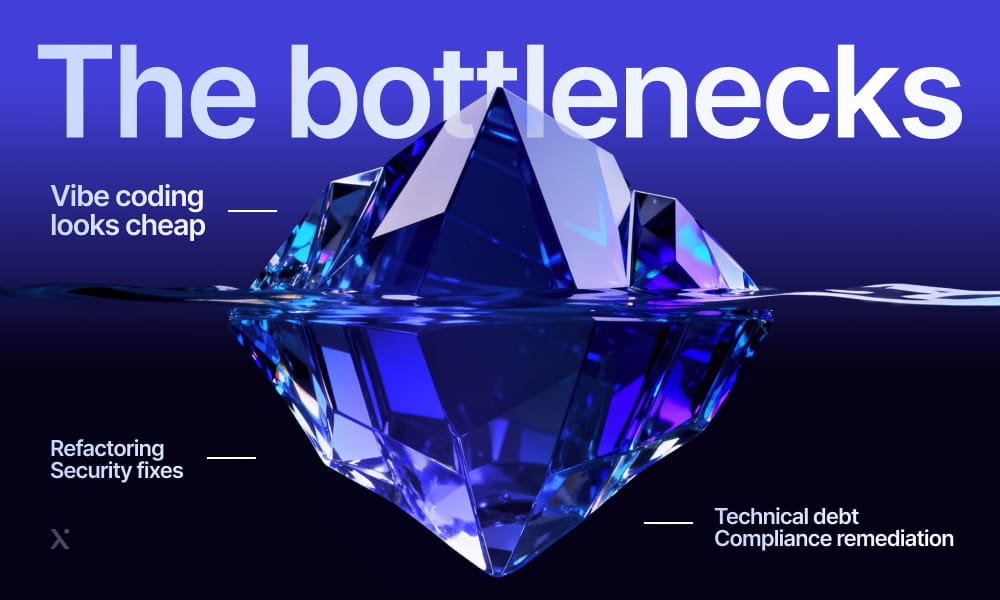
Spitting out code faster doesn’t mean your project is cheaper. Writing the lines of code is only a fraction of the job — you still have to test it, secure it, document it, and keep it running. If you skip those steps to hit an early deadline, all those time savings will instantly evaporate the moment you try to add a new feature or fix a bug in a codebase that wasn’t built to scale.
Hidden costs of vibe coding
| Cost area | Potential impact |
| Refactoring | High |
| Security fixes | High |
| Technical debt | High |
| Rework | High |
| Maintenance | Medium to High |
| Compliance remediation | Very High |
AI code generators operate with blinders on — they patch the immediate bug but have no idea how that fix impacts the rest of your app. That’s how you drown in technical debt. By the time you try to connect that code to an enterprise ecosystem filled with legacy databases, strict firewalls, and compliance rules, the AI hits a wall. You still need experienced engineers to untangle the mess and make the code work in the real world.
How Much Does AI Development Cost in 2026?
The Real Price Tag of Launching a SafePal-Style Crypto Ecosystem
Where vibe coding becomes risky
The viability of vibe coding depends on the project’s type and complexity. It’s a great way to simplify work with low-risk, one-time-use tools. However, as soon as the application begins to interact with financial transactions, regulatory data, or critical resources, the risk profile changes. At that point, unverified software behavior becomes an unacceptable operational risk.
Applications that require extra caution include:
- Payment systems
- Banking platforms
- Healthcare software
- Identity and access management solutions
- Government applications
- Enterprise SaaS platforms handling sensitive customer data
One challenge involves accountability. When AI generates significant portions of an application, teams may struggle to explain why certain implementation decisions were made or how specific workflows operate. This can create problems during audits, compliance reviews, and incident investigations.
Compliance requirements add another layer of complexity. Industries such as finance, healthcare, and government often require detailed documentation, traceability, and evidence that software has been reviewed and tested. Meeting those obligations becomes more difficult when development relies heavily on AI-generated output.
The financial impact can extend beyond technical issues. Compliance violations, failed audits, operational disruptions, and reputational damage may cost significantly more than the time saved during development.
The quality and maintenance problem
Initial development velocity often masks severe architectural degradation. Because AI platforms optimize for immediate outputs, they often introduce duplicate logic, fragmented patterns, and a complete lack of proactive refactoring. When this is compounded by outdated documentation from rapid prompting cycles, it creates an unmaintainable codebase.
The financial and operational fallout appears long after launch. Teams shift from proactive feature development to reactive maintenance, onboarding timelines spike, and system complexity balloons, ultimately erasing the early time-to-market advantages.

How to Use AI to Enable Digital Transformation: Overview Across Industries

AI Strategy Consulting: Key Benefits, Components, and Steps Explained
Security risks of AI-generated code
Everyone worries about the security of vibe coding because the AI doesn’t care about your threat model. It wants to get you a working app as quickly as possible. It’ll happily give you a feature that does exactly what you asked for, while quietly leaving your API keys exposed or skipping user authentication entirely. If you mistake a smooth demo for a secure app, you’re asking for trouble.
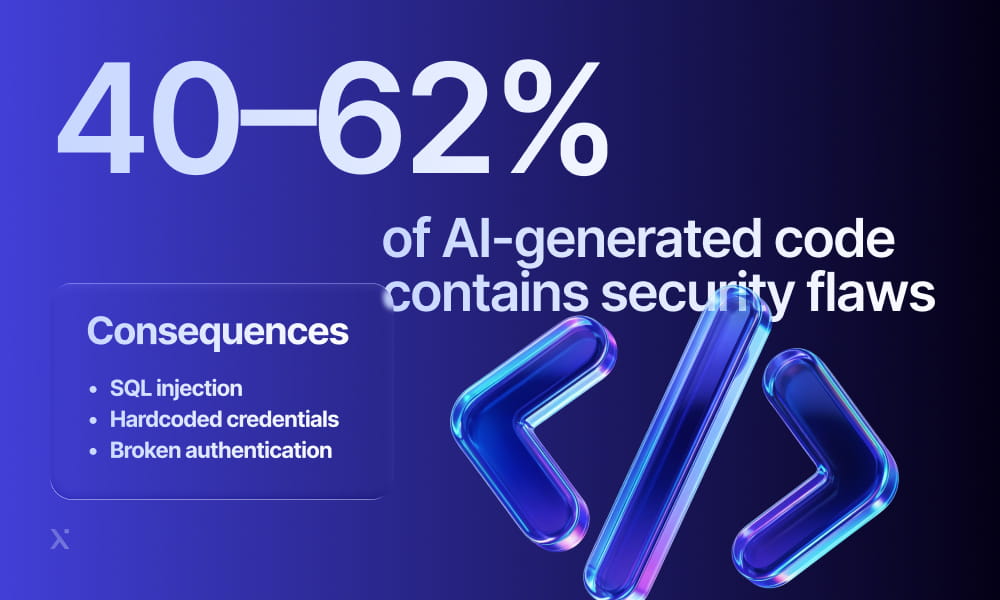
Researchers have repeatedly found security issues in AI-generated code. Recent studies suggest that 40% to 62% of AI-generated code contains security flaws. Other research found that AI-assisted code frequently fails to protect against common web application vulnerabilities such as cross-site scripting (XSS) and insecure authentication.
Some of the most common risks include:
| Security issue | Potential impact |
| SQL injection | Unauthorized database access and data theft |
| XSS vulnerabilities | Account compromise and malicious script execution |
| Hardcoded credentials | Exposure of sensitive systems and services |
| Insecure dependencies | Introduction of known security vulnerabilities |
| Authentication flaws | Unauthorized access to protected resources |
| Hallucinated components | Application instability and security gaps |
These issues often originate from patterns learned during training rather than a true understanding of secure software engineering. AI can generate code that satisfies a request while overlooking critical security controls such as input validation, credential management, dependency selection, or authentication logic.
The Double-Edged Sword: How AI Is Redefining Cybersecurity in 2026

Popular Web3 Hacks Analysis and Prevention Tips
AI-generated code shouldn’t get a free pass. It needs to go through the exact same meat grinder as code written by your human engineers. That means forcing it through peer reviews, automated security scanners, dependency audits, and penetration tests. If it can’t survive the standard pipeline, it has absolutely no business being deployed to production.
Why does vibe coding struggle with complex business logic?
Vibe coding performs best when requirements are clear, common, and relatively straightforward. The challenges begin when software has to reflect years of business rules, industry-specific processes, and complex system interactions.
Where complexity creates problems
| Scenario | Why it becomes challenging |
| Domain-specific workflows | AI lacks business context and may overlook critical rules or exceptions. |
| Complex integrations | Legacy systems, custom APIs, and third-party platforms often require specialized knowledge. |
| Multi-service architectures | Changes in one service can affect multiple connected systems. |
| Compliance requirements | Regulations demand strict controls, documentation, and auditability. |
| Long-term system evolution | AI-generated solutions may not align with future scalability needs. |
Real-world examples
Some of the most challenging environments for vibe coding include:
- Banking platforms: A single transaction may involve fraud detection, risk assessment, compliance checks, and audit logging.
- Supply chain systems: Depend on multiple integrations and constantly changing operational data.
- Healthcare applications: Patient records, privacy requirements, and regulatory standards leave little room for error.
- Blockchain platforms are vulnerable to security issues, and flawed business logic can lead to financial losses or irreversible transactions.
Business-critical applications often depend on company-specific rules, workflows, and integrations that AI has never seen before. Projects involving blockchain platforms, smart contracts, or machine learning systems still require experienced engineers to design, validate, and maintain the underlying architecture.
Agentic AI in Healthcare: EVERYTHING You Need to Know

AI Chatbots in Banking: How The Industry Grows
Where AI actually helps
No matter how much people argue about vibe coding, the reality is that AI is already baked into most dev teams’ daily routines. It’s not replacing anyone’s brain, but it’s fantastic for killing off the soul-crushing boilerplate, repetitive syntax, and routine scripts that used to eat up hours of a developer’s day.
AI is particularly useful for:
- Boilerplate code generation
- Documentation drafts
- Unit test generation
- Refactoring suggestions
- Code explanation and analysis
- Navigating large codebases
For example, developers can use AI to generate API endpoints, explain unfamiliar sections of code, create test scaffolding, or produce a first draft of technical documentation. Tasks that once took hours can often be completed in minutes.
AI works best as a development assistant
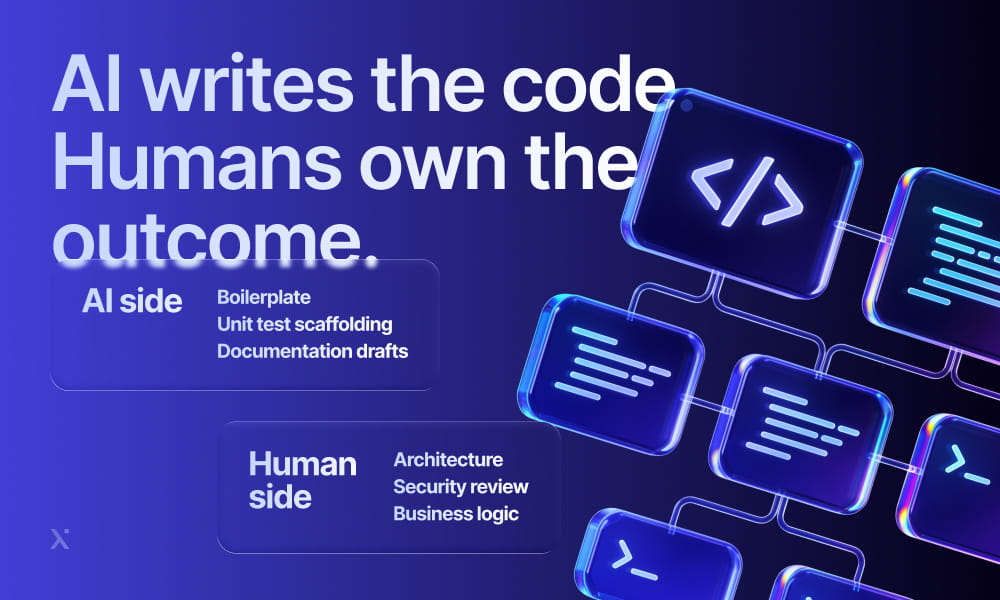
AI isn’t here to take over engineering; it’s just here to handle the grunt work. Smart teams use it to knock out repetitive code and boilerplate syntax, which lets their developers focus on the hard stuff. Humans still need to own the big picture — architecture, security, and ensuring the app actually works.
| AI handles well | Human developers handle better |
| Boilerplate code | Architecture decisions |
| Documentation drafts | Business logic |
| Unit test scaffolding | Security reviews |
| Code explanation | System design |
| Refactoring suggestions | Compliance requirements |
This hybrid approach combines the strengths of both models. Teams benefit from faster development cycles while maintaining the control necessary to create secure, scalable, and maintainable software.

AI and Crypto: Top 15 Promising Use Cases and Applications
Major AI Bias Examples: Tackling Ageism, Sexism, Racism, and More
When vibe coding makes sense
For a startup, vibe coding is the ultimate tool for reducing market risk. Instead of burning your entire seed round on custom engineering before you even know if customers want your product, you use AI to throw together a working prototype, test the waters, and gather real feedback. If the idea takes off, then you go find the budget to hire senior engineers to tear down the hacks and rebuild the app on a solid foundation.
Vibe coding works particularly well for:
- MVP development
- Prototypes
- Internal tools
- Proofs of concept
- Hackathons
- Feature experiments
In these situations, you’re optimizing for answers, not architecture. The goal isn’t to build a system that lasts for the next five years; it’s to test a weird assumption, explore a new feature, or prove a concept works before you waste a single dollar on heavy development. You’re intentionally building something disposable just to get the data you need.
When traditional development is the right choice
There’s a huge difference between creating an app for fun and building something that keeps a business afloat. If your software deals with real money or sensitive user data, you can’t just write code haphazardly. Traditional development is intentionally tedious — it’s the only way to ensure you don’t accidentally cause a major lawsuit or system failure.
Traditional development remains the preferred approach for:
- Enterprise platforms
- Regulated industries
- Financial applications
- Blockchain infrastructure
- Large-scale SaaS products
- Mobile applications handling sensitive data
The same principle applies whether a company is launching a customer-facing mobile product or a large web platform. Organizations investing in enterprise mobile app development services and custom web development typically prioritize security, maintainability, and long-term scalability over short-term development speed.

Guide to Mobile Backend App Development: The Unseen Engine of Your App
10 Best Programming Languages for Blockchain Development
How businesses can choose the right approach
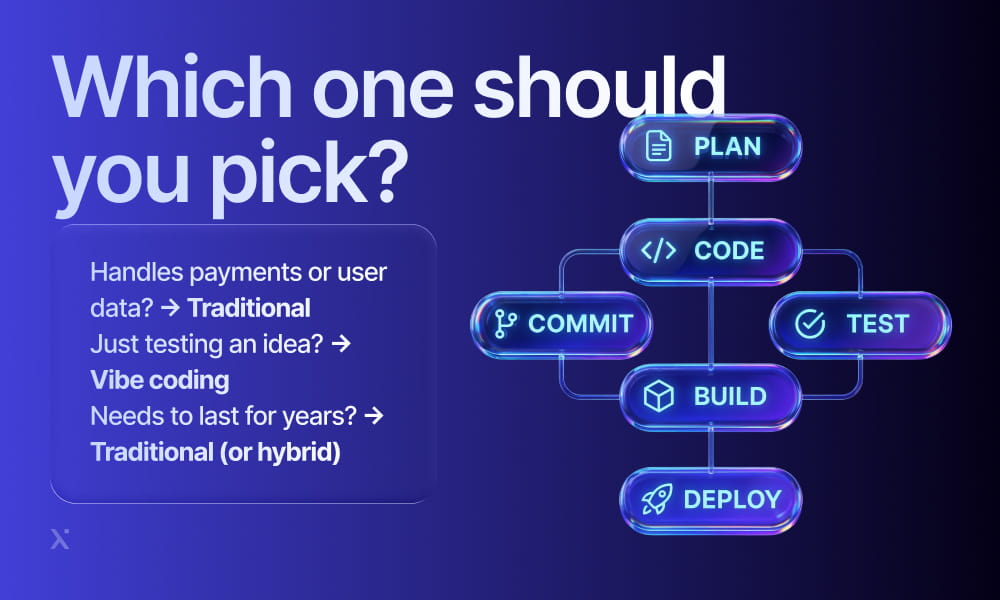
The decision should be based on business requirements rather than technology trends. The more critical the software becomes, the more important factors such as security, maintainability, compliance, and scalability become.
Quick decision framework
| Question | Yes | No |
| Is this a prototype or proof of concept? | Consider vibe coding | Continue evaluation |
| Does it handle payments or financial transactions? | Traditional development | Continue evaluation |
| Does it process sensitive customer data? | Traditional development | Continue evaluation |
| Is compliance required? | Traditional development | Continue evaluation |
| Will the software be maintained for years? | Traditional development or hybrid approach | Vibe coding may be sufficient |
| Is scalability critical to business success? | Traditional development | Vibe coding may be sufficient |
In many cases, the answer falls somewhere between the two extremes. Teams may use AI to accelerate development while keeping architecture, security reviews, testing, and deployment under human control.
A useful rule of thumb is simple: the higher the cost of failure, the more effective traditional engineering methods are. When reliability, security, and long-term support are important, speed alone should not be the sole deciding factor.
How a software development company can help
Businesses do not have to choose between AI-powered development and traditional engineering. The most effective approach often combines both.
An experienced development partner can help organizations use AI where it adds value while maintaining the quality, security, and reliability required for production software. For many enterprises, establishing a dedicated offshore software development center is the most strategic way to scale this hybrid model, ensuring continuous access to expert talent while keeping operational costs under control.
Key areas where software development companies provide support include:
- Architecture planning and system design
- AI-assisted development with human oversight
- Security reviews and code audits
- Refactoring AI-generated applications
- Compliance readiness and risk assessment
- Long-term support and maintenance
At PixelPlex, teams help clients move from prototypes to production-ready solutions by combining engineering expertise with modern AI development practices. Whether the project involves blockchain, ML, or AI development services, success depends on more than just generating code quickly.

Top 10 AI Development Companies in 2026

AI Integration for Business: A Practical Guide to Efficiency and Profit
Conclusion
Vibe coding makes software development more accessible than ever. Teams can turn ideas into working prototypes in a matter of hours, experiment with new concepts, and accelerate early product development. For MVPs, internal tools, and proof-of-concept projects, speed can be a real advantage.
The challenge begins when software becomes a long-term business asset. Applications that handle sensitive data, support critical operations, or need to scale over time require more than fast code generation. They require thoughtful architecture, rigorous testing, security oversight, and a nearshore software development team that understands how the system works under the hood.
Whether you’re building an MVP, an enterprise platform, or investing in specialized solutions such as AI applications or blockchain infrastructure, success depends on more than generating code quickly. At PixelPlex, our experts help businesses turn ideas into secure, scalable products through custom software engineering and professional blockchain development services designed for real-world production environments.
FAQ
Can vibe-coded apps pass a security audit? Yes, but only if a human engineer goes back and scrubs the code first. Security auditors don’t care about how fast you built your app or what prompts you used; they only care if your inputs are sanitized, your dependencies are clean, and your data is encrypted. If you attempt to push unreviewed AI-generated code through a formal audit, it will face significant compliance and security objections.
If your AI tool goes down and your team is just blindly copying its results, development gets stuck. As soon as a bug is discovered or a customer requests a new feature, everyone starts looking at thousands of lines of machine code that no one really understands. That’s why you can’t skip code reviews and documentation. If the AI goes down, your engineers still need to know how to run the ship.
Vibe coding is highly effective in the early stages of validation, when speed is more important than perfection. With limited capital, using AI to create a prototype allows you to assess product-market fit without incurring huge upfront development costs. However, this is a tradeoff that requires careful consideration. You sacrifice long-term scalability for early product validation, and this technical debt must be addressed once the company reaches scale.
Yes, but you have to keep it on a short leash. AI is incredible at digging through messy, undocumented legacy code and explaining what it actually does, which saves developers weeks of headache. It can spot redundant logic and write unit tests in a fraction of the time. But if you just let it blindly refactor old code without a human verifying the dependencies, it will break your system in ways that are incredibly hard to untangle.
AI tools can generate code, but they do not replace the strategic planning, architecture design, and business analysis behind successful products. Professional custom software development focuses on creating solutions tailored to specific business goals, workflows, and long-term requirements.
Yes, AI coding assistants can support tasks such as data preparation, model testing, and code generation. However, successful machine learning development still requires expertise in data quality, model selection, performance evaluation, and deployment strategies to deliver reliable business outcomes.