Online marketplaces have become one of the most powerful models in digital commerce. Instead of selling products directly, companies build platforms where buyers and sellers transact, and create value together. But how much would it cost to build one?
This approach scales quickly. Amazon grew into a global retail ecosystem by connecting millions of merchants with customers. Airbnb built a worldwide hospitality marketplace without owning hotels. OpenSea turned digital collectibles into a thriving NFT economy.
As these platforms expand, more and more companies are beginning to consider marketplace development, including P2P exchange development for financial and digital assets, as a growth strategy. A well-designed marketplace can open up new revenue streams, attract partners, and create a network effect, where each new user increases the platform’s value for others.
However, launching a marketplace isn’t as simple as creating a typical eCommerce website. Behind the interface lies a complex infrastructure that must support multiple user roles, payment flows, product management, moderation, analytics, and secure transactions. This complexity leads to a question that concerns almost every company during the planning stage:
So, how much does marketplace development cost?
The answer is rarely straightforward. The cost of building a marketplace depends on many factors, including feature complexity, platform architecture, security requirements, integration with external services, and long-term scalability. For platforms that involve digital assets or Web3 functionality, blockchain integration can add another layer of technical requirements. Testing, performance optimization, and ongoing maintenance also play a major role in the total investment.
Because of these variables, marketplace development projects can vary significantly in scope and budget. Businesses often struggle to estimate the real cost of building a marketplace platform and to understand which components influence the price the most.
In this article, we break down what actually shapes the cost of marketplace development. You’ll see which factors influence the budget most, what types of marketplaces exist, and what businesses should think through before starting a project. We’ll also look at how experienced teams providing marketplace development services, such as PixelPlex, help companies design marketplace platforms that are secure, scalable, and ready to grow.

Best NFT Marketplaces You Need to Know About

Metaverse NFT Marketplace Development: Benefits, Types, and Features
Why choosing the right development partner matters
At first glance, a marketplace may seem simple. Users browse listings, sellers post items, transactions occur, and reviews appear. But behind this interface lies a much more complex system. A true marketplace integrates multiple roles and processes simultaneously. Sellers manage inventory, buyers place orders, payment systems process transactions, logistics services track deliveries, and the platform itself must handle analytics, moderation, and security.
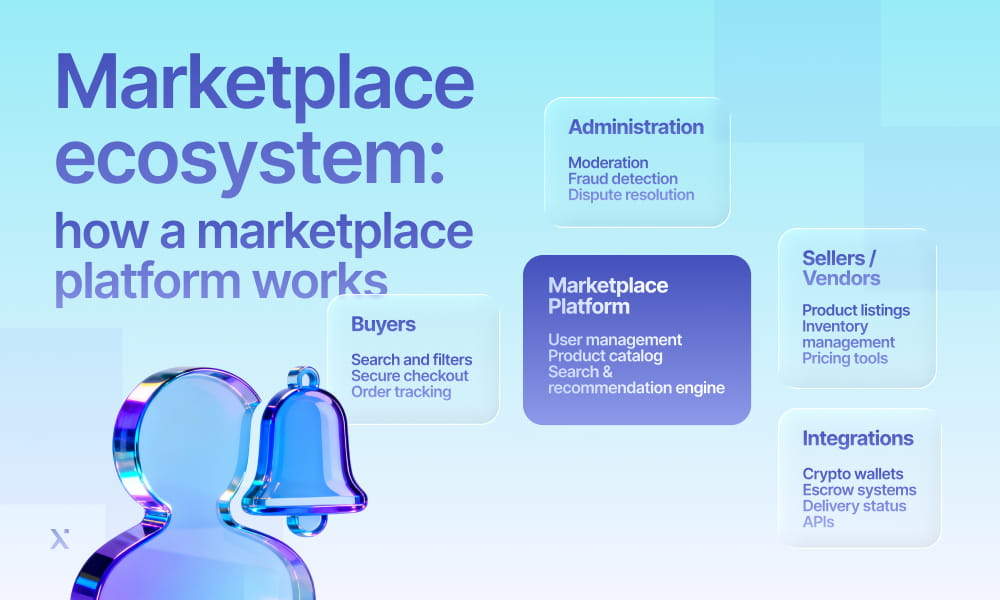
All these moving parts need to work together without friction. If the architecture is poorly designed, the platform quickly runs into trouble as traffic grows or new features are added.
This is where many marketplace projects fail. Companies often underestimate the technical complexity of marketplace development and choose a development partner based primarily on price or speed. In the short term, this may seem like a cost-saving solution. In practice, however, it often leads to increased costs down the road.
An inexperienced development team may build a system that works during the early launch stage but struggles as the marketplace grows. Vendors experience slow dashboards, buyers encounter payment errors, and administrators lack tools to moderate listings or resolve disputes. Fixing these issues later requires significant refactoring or even rebuilding the platform.
Several common problems appear when the development partner lacks marketplace experience:
- Scalability issues. The platform cannot handle traffic spikes or a growing vendor base.
- Security gaps. Weak protection exposes user data and payment flows to risks.
- Costly redevelopment. Core systems must be rebuilt once the platform grows.
- Poor vendor onboarding. Complicated seller workflows discourage merchants from joining the marketplace.
Reliable marketplace development services help avoid these risks from the beginning. Experienced teams approach marketplace platform development with long-term growth in mind. They design flexible architectures, implement secure payment systems, integrate third-party services correctly, and ensure the platform can scale without breaking core functionality.
At PixelPlex, marketplace development projects typically begin with a deep discovery phase. The goal is to understand the business model, transaction flows, and growth expectations before writing the first line of code. This approach allows the team to build a stable foundation that supports future expansion rather than limiting it.
Risks of choosing an inexperienced development team
| Risk | Impact on the marketplace | Long-term consequences |
| Weak architecture | Platform crashes under load | Expensive rebuild |
| Poor security | Data breaches | Loss of trust |
| Limited integrations | Payment and logistics issues | Reduced growth |
| Lack of scalability | Cannot handle growth | Infrastructure replacement |
Types of online marketplaces
Not all marketplaces work the same way. The structure of the platform, the transaction flow, and even the technical architecture depend heavily on the type of marketplace being built. A product marketplace that sells physical goods requires one set of tools. A service marketplace or an NFT platform may require something entirely different.
Because of this, choosing metaverse NFT marketplace development services over standard e-commerce directly affects the scope of platform engineering, the number of integrations required, and ultimately the development budget.
Some marketplaces focus on physical products. Others connect people who offer services. More recent platforms handle digital assets such as NFTs or operate in specialized B2B ecosystems. Each model introduces its own technical challenges, from inventory management to smart contract integration.
| Marketplace type | Example platforms | Complexity level |
| Product marketplace | Amazon | Medium |
| Service marketplace | Upwork | High |
| Hybrid marketplace | Etsy | High |
| NFT marketplace | OpenSea | High |
| B2B marketplace | Alibaba | Very high |
Product marketplaces typically focus on catalog management, logistics integrations, and payment processing. While technically complex, the core mechanics are well established and widely used.
Service marketplaces add another layer of functionality. Platforms like Upwork must manage freelancer profiles, project negotiations, contracts, milestone payments, and dispute resolution. This makes the architecture more complicated and increases development effort.
Hybrid marketplaces combine both models. Etsy, for example, connects independent creators with buyers, which requires tools for managing custom products, vendor storefronts, and personalized customer experiences.
NFT marketplaces operate under a different technological paradigm. Instead of managing physical goods, they handle digital assets stored on blockchain networks. Platforms in this category rely on smart contracts, crypto wallet integrations, token minting mechanisms, and on-chain transaction verification. Because of these requirements, projects involving NFT marketplace development services often include blockchain engineering in addition to traditional web development.
Some companies choose white label NFT marketplace development to launch platforms faster by leveraging pre-built frameworks. Others require more specialized solutions, such as NFT art marketplace development or NFT fashion marketplace development, where platforms must support unique asset formats, creator royalties, and marketplace governance models.
NFT Marketplace: How to Develop One?
B2B marketplaces bring a different level of complexity. Platforms like Alibaba deal with large transaction volumes, supplier verification, wholesale pricing structures, and cross-border trade processes. To keep everything running smoothly, these marketplaces usually rely on deep integrations with enterprise systems, logistics providers, and compliance tools.
The business model behind a marketplace directly shapes development costs. More complex transaction flows require additional features, security measures, and integrations. As a result, the architecture becomes larger, and the development timeline expands.
When you’re planning a marketplace, it’s worth taking a beat to really nail down which model you’re building. Getting a handle on the technical side early on is how you pick the right architecture, figure out what it’ll actually cost to build, and make sure you don’t get hit with any expensive surprises once the project is underway.
Marketplace revenue models
The way a marketplace earns revenue affects more than just pricing; it shapes how the entire platform is built. Payment flows, seller tools, analytics, and even moderation features all depend on the chosen model. Some marketplaces take a commission from each sale, while others rely on subscriptions, listing fees, or paid promotions. Picking the right approach early helps shape the technical setup and makes it easier to build a sustainable business.
| Model | Description | Example |
| Commission | The platform takes a percentage per transaction | Airbnb |
| Subscription | Sellers pay a monthly access fee | Shopify marketplace |
| Listing fees | Vendors pay to list items | Etsy |
| Advertising | Vendors promote products | Amazon |
Various marketplaces often combine several of these models. For example, a platform may charge a commission on sales while simultaneously offering advertising tools to help sellers promote their products. These monetization mechanisms must be carefully integrated into the payment system during the marketplace development stage, as they directly impact how transactions, fees, and payouts to sellers are processed.
Top 10 NFT Marketplace Development Companies

What You Should Know About the True Cost of Building a Crypto Wallet Like MetaMask
Key features that influence development cost
In any marketplace development project, functionality accounts for a significant portion of the budget. The more features a platform requires, the more time engineers spend designing, building, and testing each component. Some features are considered standard for most marketplaces, while others add advanced capabilities, increasing development complexity.
At its foundation, a marketplace must handle the basic interactions between buyers and sellers. Buyers need simple ways to sign up, explore listings, and complete purchases. Sellers, in turn, rely on dashboards to add products, track orders, and manage payments. Behind the scenes, the platform also runs search tools, recommendations, notifications, and analytics that keep the marketplace organized and easy to use for everyone involved.
These foundational components form the backbone of most marketplace platforms.
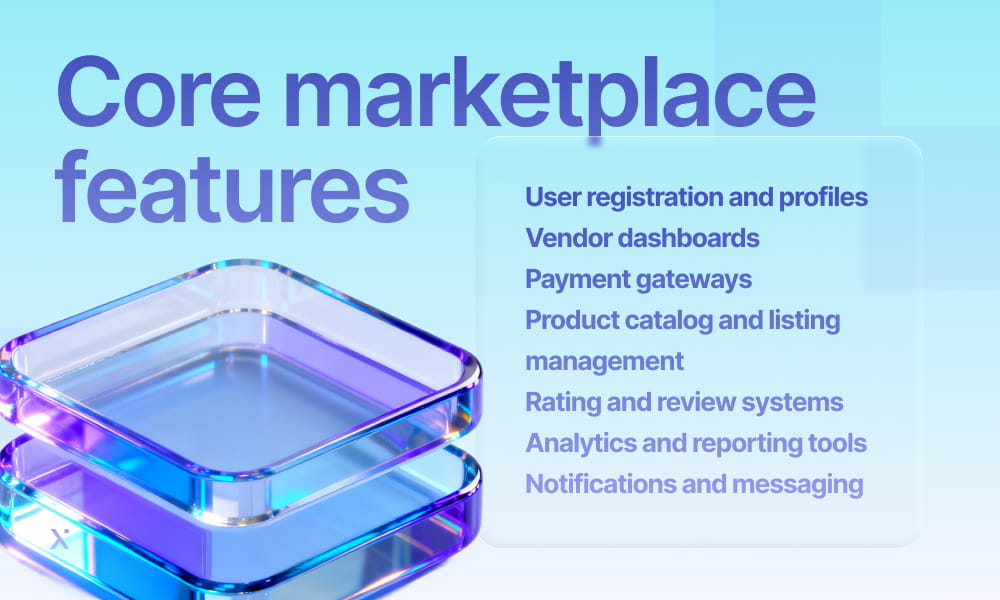
Core features
| Feature | Complexity | Importance |
| User authentication | Low | Essential |
| Vendor management | Medium | Essential |
| Payment processing | High | Critical |
| Search & filters | Medium | High |
| Reviews & ratings | Medium | High |
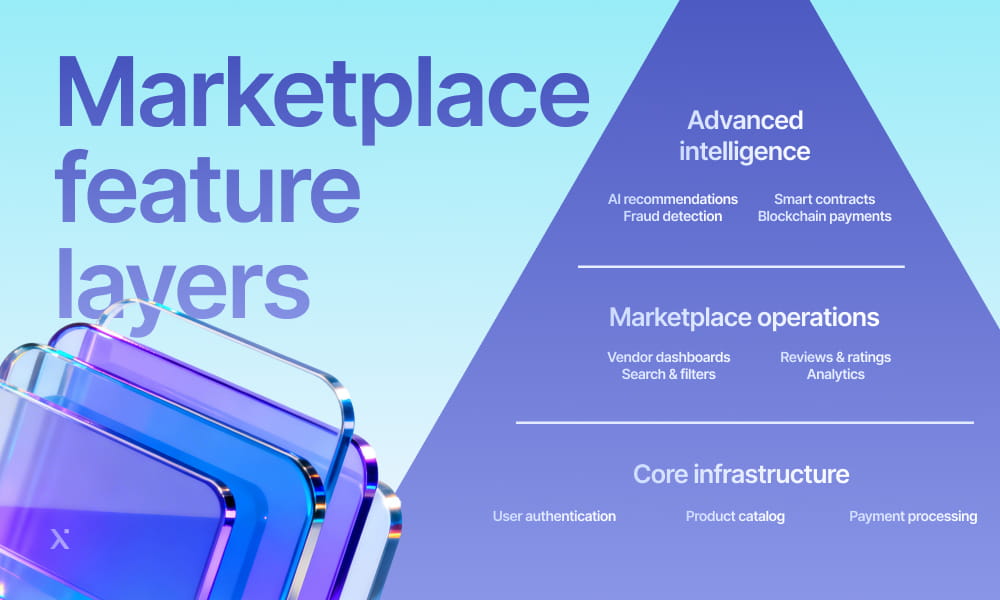
Most marketplaces begin with a standard set of core features, but many don’t stop there. As the platform grows, additional tools are added to improve user experience, automate everyday tasks, and strengthen security. While these features increase development costs, they often make the marketplace run more smoothly and make it more appealing for both buyers and sellers.

Web3 Development Cost: Breaking Down What Really Drives the Price

Smart Contract Development Cost Demystified: What Every Business Should Know
Advanced features
| Feature | Purpose | Cost impact |
| AI recommendations | Personalized experience | Medium |
| Blockchain payments | Transparency | High |
| Smart contracts | Automated transactions | High |
| Fraud detection | Security | Medium |
For example, AI-driven recommendation systems study user behavior and suggest relevant products, which helps increase engagement and conversions. Blockchain payments and smart contracts are often used in NFT and Web3 marketplaces to make transactions more transparent and automated. At the same time, fraud detection tools help protect users and keep the platform trustworthy.
When planning marketplace development services, it’s important to prioritize features wisely. Starting with the core functionality and adding more capabilities over time makes it easier to manage costs while letting the platform grow naturally.

Step-by Step Guide to P2P Crypto Exchange Development

Launching a Music NFT Marketplace: Concept Overview and Best Practices
Marketplace development process
Building a marketplace is not a single-step task. It is a structured process that moves from idea validation to a fully operational platform capable of handling real users and transactions. Each stage focuses on a different aspect of the product, from defining business requirements to testing system stability before launch.
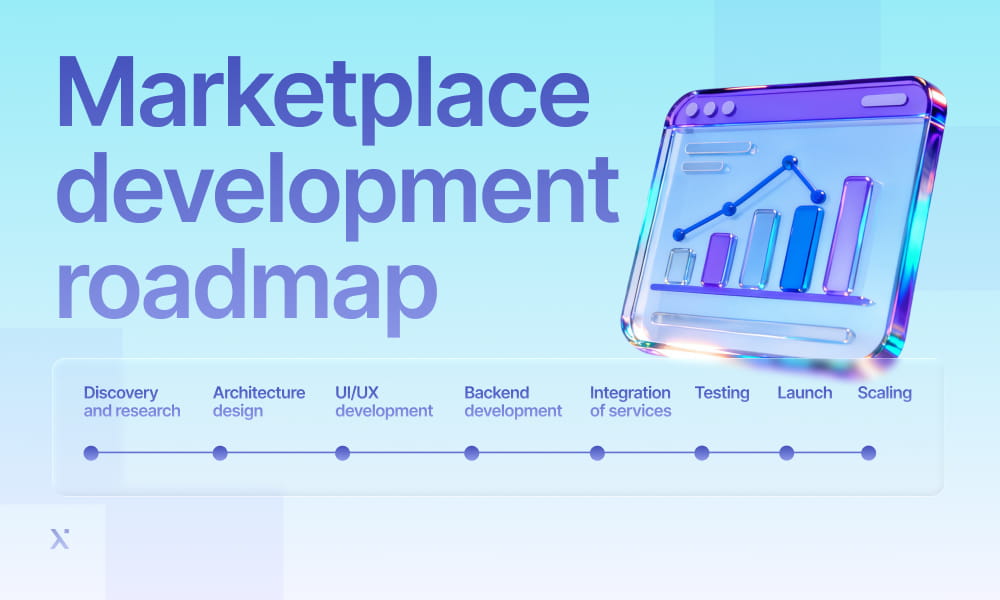
Professional marketplace development solutions usually follow a clear roadmap to reduce risks and keep the project predictable. This approach allows teams to design the platform architecture carefully, implement the right features, and ensure the system performs well under real-world conditions.
Although the exact workflow may vary depending on the project, most marketplace platforms are built through several core stages.
Marketplace development timeline
| Stage | Duration | Key deliverables |
| Discovery | 2–4 weeks | Requirements |
| Design | 3–5 weeks | UI/UX prototypes |
| Development | 3–6 months | Platform build |
| Testing | 4–6 weeks | QA reports |
| Deployment | 1–2 weeks | Launch |
Marketplace timelines can vary significantly depending on the platform’s complexity, the number of integrations required, and the number of planned features. Some companies choose to start with an MVP to test the idea in the market, then expand the platform step by step as the marketplace grows and gains traction.

Web3 Development: What It Takes to Build the Future

How to Integrate Blockchain Into Your Existing Business Infrastructure
Challenges in marketplace development
Marketplace platforms are more demanding than typical eCommerce sites because they have to keep both buyers and sellers working smoothly together. It’s not just about selling products; it’s about managing transactions, trust, and interactions among multiple parties. If something breaks in that flow, users feel it immediately, and it can slow down the platform’s growth.
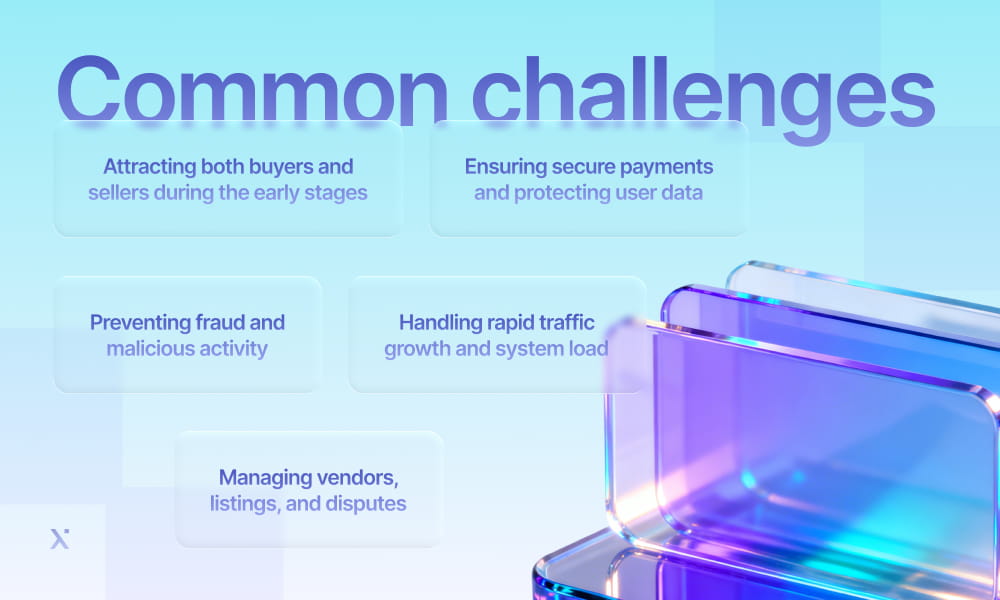
One of the biggest challenges appears at the early stage: attracting both buyers and sellers at the same time. Without enough vendors, the platform lacks product variety. Without buyers, sellers have no incentive to join. Many marketplaces address this problem with targeted onboarding campaigns, partnerships, or incentives for early participants.
Security is another major concern. Since marketplaces process payments and store user data, they are frequent targets for fraud attempts and cyberattacks. Platforms must implement strong security practices, including secure payment processing, data protection, and monitoring systems that detect suspicious behavior.
As a platform grows, technical scalability also becomes critical. Traffic surges during promotions or seasonal peaks can overwhelm systems not designed for rapid growth. To prevent downtime, marketplaces require a flexible infrastructure that can handle sudden increases in user traffic and transactions.
Operational management presents another layer of complexity. Marketplaces must vet sellers, moderate listings, and resolve disputes between buyers and sellers. Without proper management tools, platforms risk losing trust and damaging their reputation.
Technical challenges
| Challenge | Description | Solution |
| Liquidity problem | No sellers or buyers | Incentive programs |
| Security risks | Fraud & attacks | Security audits |
| Platform scalability | Rapid traffic growth | Cloud infrastructure |
| Payment disputes | Refund conflicts | Escrow systems |
10 Leading Blockchain Development Firms to Watch in 2026

Top 10 AI Development Companies in 2026
Why testing is critical
A marketplace cannot afford to fail once real users begin interacting with the platform. Buyers expect smooth transactions, sellers rely on stable dashboards, and every payment must be processed without errors. Even small technical issues can lead to failed orders, frustrated vendors, or lost revenue. This is why testing is a critical stage in marketplace development.
Marketplaces are more complex than typical web platforms because several roles and processes run simultaneously. A buyer places an order, the system processes the payment, the seller receives a notification, and the transaction is recorded in the platform. If any link in this chain fails, the user experience quickly breaks down.
Testing helps catch these problems before the platform reaches real users. Teams recreate typical user actions, check how the system behaves under heavy load, and make sure every feature works as intended. This step strengthens platform stability and helps prevent security issues or performance problems later.
For this reason, a few key types of testing are essential for any marketplace platform.
Important testing types
| Testing type | Goal | Importance |
| Functional | Verify features | High |
| Security | Prevent attacks | Critical | Performance | Handle traffic | High |
| Usability | Improve UX | Medium |
Thorough testing lowers the chance of problems after launch and helps keep the marketplace stable for both buyers and sellers. For companies investing in marketplace development services, this stage plays a key role in protecting the platform’s reputation and supporting long-term growth.

The Basics of a Software Testing Process and Tips on How to Set It Up
10 Best Programming Languages for Blockchain Development
Marketplace development cost breakdown
The cost of building a marketplace can vary widely depending on the platform’s scope and technical needs. Some companies start with a simple MVP to test their idea in the market, while others launch full-featured platforms with complex integrations and the ability to support large numbers of users from day one.
Several factors shape the final budget. The range of features, the underlying architecture, integrations with external services, and future scalability requirements all influence development costs. A marketplace that handles basic buying and selling will be much less expensive than one that includes advanced analytics, automated processes, and AI-driven recommendations.
| Marketplace type | Estimated cost |
| MVP marketplace | $40k – $80k |
| Medium marketplace | $80k – $200k |
| Enterprise marketplace | $200k – $500k+ |
| NFT marketplace | $100k – $350k |
An MVP marketplace usually focuses on the essentials: user accounts, product listings, payments, and simple tools for vendors to manage their offers. This type of platform helps businesses test the idea in the market and understand how users interact with the product before investing in more complex features.
Mid-level marketplaces expand on this foundation. They often include stronger search and filtering, analytics dashboards, tools for tracking vendor performance, and integrations with services such as payment providers or logistics platforms.
Enterprise marketplaces go much further. These platforms are built to support large numbers of users and transactions, handle complex workflows, and meet strict security requirements. They also tend to integrate deeply with enterprise systems such as ERP platforms, analytics tools, and supply chain software.
Adding mobile apps usually bumps up your budget since building for both iOS and Android means extra rounds of design, coding, and testing. Beyond the apps, your platform also needs to be “wired up” to essential services like payment gateways, shipping APIs, and identity verification. If you’re venturing into blockchain, the complexity grows even further with the need for smart contracts, crypto wallets, and heavy-duty security audits to keep everything safe.

Blockchain Development Cost in 2026: What Goes Into the Price Tag

Planning Web3 App Development Cost: Team, Timeline, And Hidden Expenses
Top companies that build marketplaces
Choosing the right development partner plays a huge role in how your marketplace performs over time. The team’s experience and technical skills affect everything from platform stability to its ability to scale and grow. Companies with strong expertise in platform engineering, cloud infrastructure, and complex integrations are usually better prepared to build reliable marketplace solutions.
There are many tech companies that focus on building digital platforms and marketplaces across different industries. The information about the companies listed here is based on publicly available sources, including platforms like Clutch, corporate websites, and social media profiles.
| Company | Clutch rating | Hourly rate | Expertise |
| PixelPlex | 4.9/5 | $50 – $99 / hr | Blockchain marketplaces |
| DBB Software | 5/5 | $25 – $49 / hr | Marketplaces, eCommerce, SaaS |
| Brainvire Infotech | 4.7/5 | $25 – $49 / hr | Magento/Shopify marketplace implementations |
| Codica | 4.7/5 | $25 – $49 / hr | Marketplaces (B2B/B2C/P2P) |
| Scopic | 4.9/5 | $50 – $99 / hr | Marketplace + mobile app development |
Among these companies, PixelPlex stands out for its deep expertise in blockchain and Web3 technologies. The company focuses on building advanced digital platforms, including NFT marketplaces, tokenized ecosystems, and decentralized trading environments.
PixelPlex provides comprehensive marketplace development services that cover the full lifecycle of a platform. Teams work on architecture design, UX/UI, backend infrastructure, smart contract development, and security audits. This approach helps businesses build marketplace platforms that remain stable as they scale.

Top Full-Service Web3 Development Companies 2026
Top 10 Blockchain Development Companies in 2026
Conclusion
Building a marketplace is a significant investment, but it can also become one of the most powerful drivers of business growth. As this article shows, the final cost depends on many factors, including the marketplace model, platform features, integrations, and long-term scalability requirements. A simple MVP can help validate an idea, while a full-scale platform requires a more in-depth architecture, security measures, and expanded functionality.
A thoughtful approach to marketplace development makes a big difference. When companies clearly define their business model, focus on the features that matter most, and plan the technical architecture early, it becomes much easier to manage costs and avoid problems later. With the right PHP development company and a clear roadmap, a marketplace can grow into a stable platform that connects buyers, sellers, and new business opportunities.
FAQ
The choice of technology depends on your business model, the number of users you expect, and the features you plan to offer. Most marketplaces rely on scalable backend systems, modern frontend frameworks, and cloud infrastructure that can handle growth. If the platform includes blockchain features, it also needs tools for smart contracts and crypto wallet integration.
It depends on your goals. Ready-made or white-label solutions help launch faster and reduce initial costs, while custom development gives more flexibility and better long-term scalability. Many companies start with a basic version and then move to a custom platform as the marketplace grows.
Early growth often requires a focused strategy. Companies usually attract one side of the marketplace first, either sellers or buyers, and then build momentum through partnerships, incentives, or targeted marketing campaigns.
Marketplaces need to follow data protection laws, payment regulations, and consumer protection rules. Depending on the region and industry, this can include GDPR compliance, tax requirements, and specific rules for handling transactions with digital or physical goods.
Yes, most marketplaces are designed to evolve over time. Teams often start with an MVP and gradually add features, integrations, and infrastructure improvements as the platform gains users and becomes more popular.
NFT marketplaces come with a different set of requirements compared to traditional platforms. They need to handle digital assets, which means working with smart contracts, crypto wallets, and token management. For example, platforms built through NFT music marketplace development must support audio formats, handle royalty distribution for creators, and track ownership directly on the blockchain