
KGeN turned a simple question, is this player real, into infrastructure that publishers pay for. Here is what it would take to build something in the same class.
KGeN, short for Kratos Gamer Network, has grown into a verified gaming audience of more than 53 million users across 60 countries, organized into tens of thousands of clans and profiled through billions of behavioral attributes. Founders look at that and ask the obvious question about budget. This guide breaks down the product, the stack, the honest cost ranges, and where a build like this quietly doubles in price.
There is no single number, because a dApp like KGeN means different things to different teams. One founder wants a quest app with a leaderboard and a reward token, while another wants the full apparatus of identity scoring, fraud defense, publisher campaigns, and on-chain settlement that took Kratos years to assemble.
What drives the number is rarely the part people budget for first. The quest screens are the cheaper half, while the scoring engine, the anti-fraud layer, and the data pipeline behind them are where the money goes.
Why KGeN is a distribution business wearing a gaming skin
KGeN looks like a gaming app from the outside. Underneath, it sells something game publishers have wanted for a decade, which is proof that the user they just paid for is a real, active, relevant player rather than an install farm.
That reframing changes the build. A quest app only has to be fun, while a verified distribution protocol has to be defensible under adversarial pressure, because the moment rewards become predictable, thousands of people will try to earn them without playing anything. KGeN reported annualized revenue of roughly $48 million in late 2025 and raised $43.5 million in total funding across a seed round, an ecosystem round led by Aptos Labs, and a $13.5 million strategic round with Jump Crypto, Accel, and Prosus Ventures. Money at that scale went into data infrastructure and verification, not into prettier screens.
None of this is meant to talk anyone out of the idea. It is meant to set the frame, because teams that approach a gamer network as serious dApp development from day one are the ones whose estimates survive contact with reality.
What Is the Cost to Develop a Cryptocurrency Exchange Like OKX?
From Zero to Order Book: What It Really Costs to Build a Bybit-Style Crypto Exchange This Year
What KGeN is under the hood
Before pricing anything, you need a clear picture of the parts. KGeN reads as four connected products rather than one app, and each carries its own engineering bill.
The first is the reputation engine, branded Proof of Gamer, which turns scattered signals into a single score. The second is the quest and campaign layer, where publishers post offers and players complete them. The third is the reward and token layer, built around rKGEN, a non-transferable pre-launch token that converts one to one into KGEN, which has a fixed supply of one billion. The fourth is the publisher side, a campaign console with targeting, budgets, and reporting.
Most founders underestimate the fourth one. The player app is what people see, but the publisher console is what gets paid for, and weak targeting or unclear reporting will lose you the customer no matter how polished the gamer experience is.
Module map of a KGeN-style platform
| Module | Job it does | Why it costs more than it looks |
| Reputation engine | Turns raw signals into a portable player score | Weighting, decay, and appeal logic need tuning against live abuse |
| Quest and campaign layer | Hosts publisher offers and validates completions | Every new offer type is a new verification path and a new exploit |
| Reward and token layer | Issues, locks, and converts reward tokens | Emission math has to stay solvent while payouts scale with users |
| Publisher console | Targeting, budgets, attribution, reporting | Advertisers expect ad-network reliability from day one |
| Identity and account linking | Connects social, game, and wallet accounts | Each integration has its own limits, outages, and policy changes |
How a player score gets built
The Proof of Gamer engine is the product. Everything else in the platform either feeds it or spends it, so it deserves the clearest explanation in the whole architecture.
KGeN evaluates players across five dimensions rather than one number. Proof of Human confirms there is a person behind the account, Proof of Play measures real engagement across quests and titles, Proof of Skill reads leaderboard standings, Proof of Commerce looks at genuine spending, and Proof of Social maps community presence on X, Discord, and Telegram. Those pillars sit on top of more than a hundred attributes per user, which is why the data layer rather than the contract layer is the heavy part of this build.
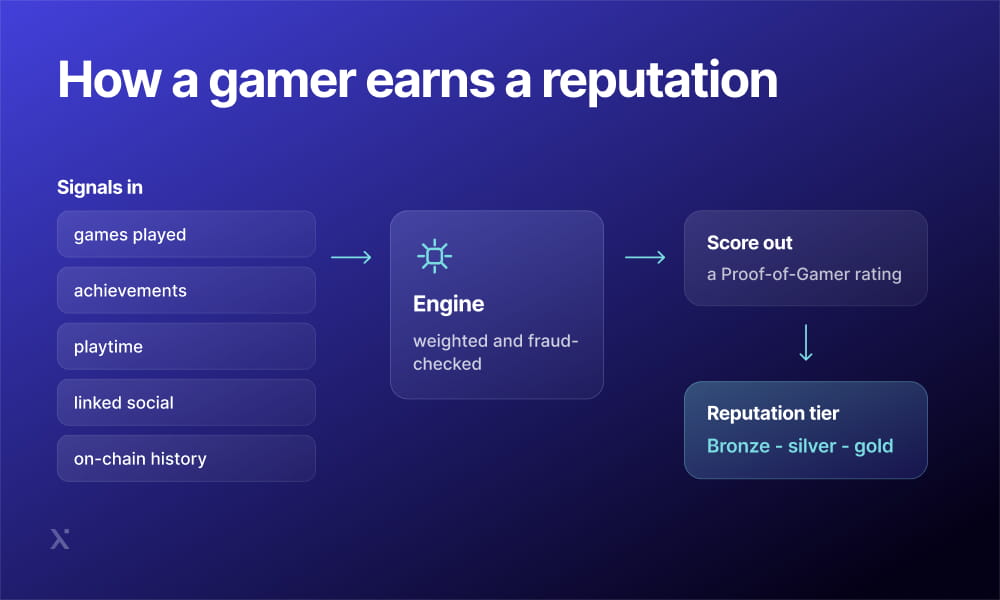
Scores also have to be portable and provable, which is where the on-chain side enters. KGeN issues Proof of Gamer credentials as soulbound tokens, and the project reported more than a million of them minted across 100 countries shortly after launch. Building that credential layer well is closer to NFT development than to anything in traditional gaming backends.
Reputation formulas change, and every change reprices every player retroactively. Teams that treat the score as a versioned artifact, with inputs and weights stored alongside each result, can explain to a publisher why an audience shifted last Tuesday. Teams that overwrite scores in place cannot, and that single choice turns a routine tuning pass into a week of forensic work and an awkward customer call.
The fraud problem that sets the price
Every reward system attracts people who want the reward without the work. In gaming, that population is large, technical, and highly organized, and defending against it is the single most expensive line nobody puts in the first budget.
The attack surface is wide. Device farms run hundreds of emulated handsets, script kits automate quest completions, account markets sell aged social profiles with real posting history, and wallet clusters split payouts across thousands of addresses so no single one looks unusual.
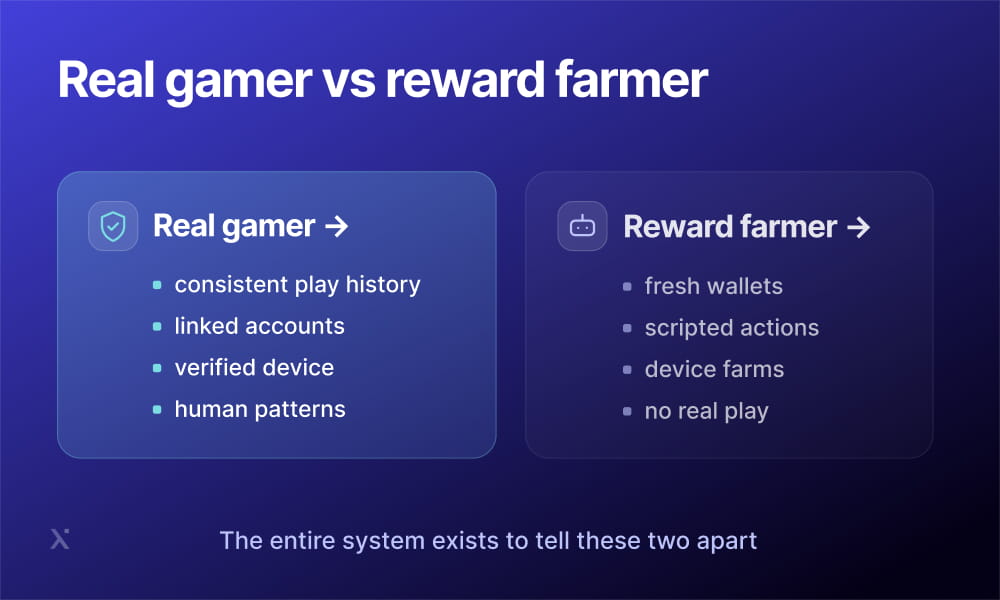
Defending that surface is a machine learning problem more than a blockchain one. You need behavioral baselines, device fingerprinting, graph analysis across accounts, and a model that keeps working when attackers adapt, which is the territory covered by machine learning for fraud detection work in fintech.
A habit worth borrowing from ad tech is to model fraud loss as a share of each campaign’s payout rather than as a fixed annual number. When you can tell a publisher that verified delivery ran at a measured fraud rate on their specific campaign, you are selling accountability. When you can only say the platform is generally secure, you are selling a promise, and promises get renegotiated at renewal.
The technology stack behind a KGeN-style dApp
A platform of this kind has three parts, which is one more than most founders plan for. There is a consumer app, a data and scoring backend, and a thin but critical on-chain layer.
The tooling is not exotic. What makes it demanding is the mix of consumer-scale traffic, always-on data processing, and money movement that has to be correct every time, so good Web3 development here means keeping those concerns separated cleanly.
The player app
KGeN reaches its audience mainly on phones in India, Southeast Asia, and Latin America, which shapes every front-end decision. The app has to work on mid-range Android devices and unreliable connections, which points toward Flutter or React Native, offline caching, and quest flows that survive a dropped connection mid-completion. Teams underestimate this constantly, and it is a large part of why mobile app development for emerging markets costs more than the same app for a Western audience.
Wallet handling is the other front-end trap. Most of your users are gamers first and crypto users second, so embedded wallets with social recovery usually beat a browser extension flow, and clear UI/UX design around rewards decides whether a first-time player ever collects anything.
The Real Price Tag Behind a Kraken-Style Exchange: A Builder's Field Guide
How to Build a P2P Crypto Exchange: Development Process, Tech Stack & Pricing Explained
The data and scoring backend
This is the layer that actually costs money to run. Signals arrive constantly from games, social APIs, quest completions, and chain activity, and they have to be cleaned, joined, scored, and made queryable fast enough for a publisher to build an audience segment in real time.
A realistic stack looks like an event pipeline, a warehouse, a feature store, and a model serving layer. That is conventional data analytics engineering rather than blockchain work, and it is usually the largest team on the project. Every game, launcher, and social platform you read from is also a separate connector with its own auth and rate limits, which is why serious blockchain integration planning pays for itself before the first release.
The on-chain layer
KGeN runs on Aptos with contracts written in Move, and the on-chain surface is deliberately small. Reward token issuance, staking locks, credential minting, and conversion logic live there, while scoring stays off-chain for cost and privacy reasons.
That restraint is worth copying. Putting a scoring model on-chain sounds principled and produces an unaffordable, unchangeable system, so production platforms publish attestations rather than the computation itself. Getting that boundary right is the core of smart contracts development on a project like this.
Typical stack for a KGeN-style platform
| Layer | Common technologies | What it carries |
| Mobile client | Flutter or React Native, embedded wallet SDKs | Quests, profile, rewards, onboarding |
| Publisher console | React or Next.js, TypeScript | Campaign setup, targeting, reporting |
| Data pipeline | Kafka, Spark or Flink, warehouse, feature store | Signal ingestion, cleaning, attribute storage |
| Scoring and anti-fraud | Python, model serving, graph analysis | Reputation scores, abuse detection |
| On-chain layer | Move on Aptos, or Solidity on EVM chains | Reward tokens, staking, credentials |
| Infrastructure | Cloud, RPC nodes, monitoring, CI/CD | Uptime, scale, observability |
How the money moves through the system
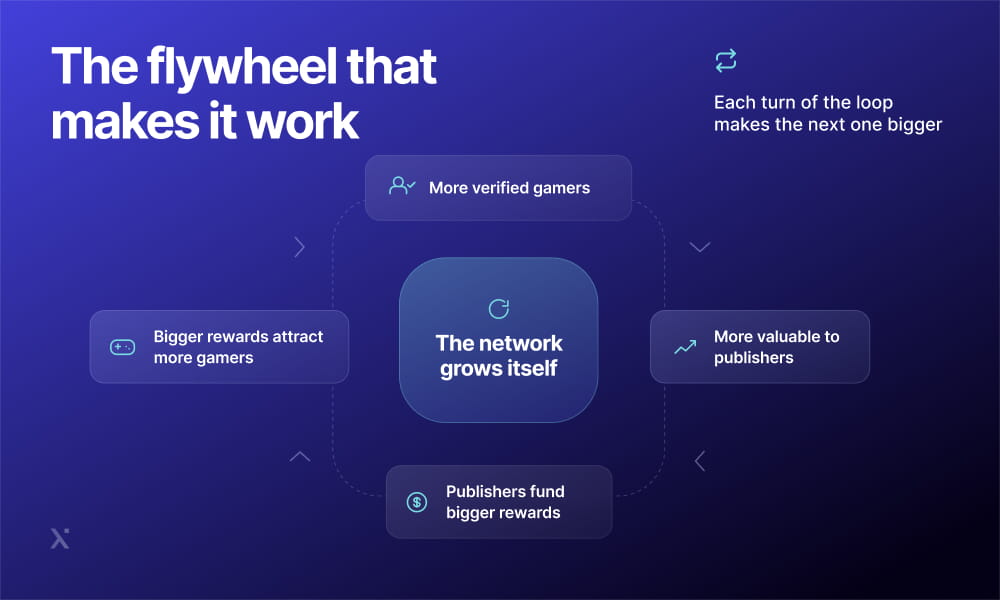
A reward platform is a two-sided market, and the cash flow shapes the architecture as much as the tech does. Publishers buy verified reach, the platform verifies and matches, players earn for real actions, and the resulting data makes the next campaign worth more.
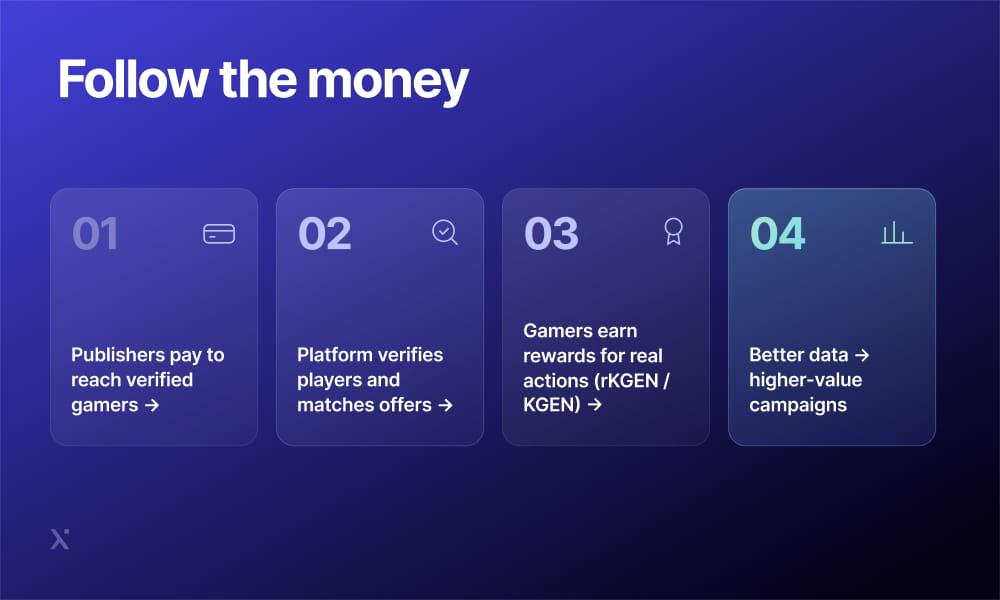
Designing that loop is an economics exercise before it is an engineering one. You need to know what a verified player is worth to a publisher, what share flows to the player, what the platform keeps, and how much of the payout is denominated in your own token.
KGeN handles the last question with rKGEN, which converts one to one into KGEN and offers staking commitments from 30 to 365 days, smoothing sell pressure without telling players their rewards are not real. The same tension sits at the heart of tokenomics for crypto games, and a weak model shows up as a collapsing reward token six months after launch.
Web3 Insurance App Development: Why It Matters and How It Works in Real Life

Counting the Crypto Millions: Development Costs of Binance-Like Crypto Exchange
The build process, step by step
A platform like this is built in stages, and skipping one usually resurfaces later as either a security hole or a rewrite. The sequence below is the one we follow on this class of engagement.
- Discovery and economic design, where the score, the reward model, and the publisher offer are defined.
- Architecture, where the module split and the on-chain boundary are drawn.
- Design, where the player journey and the publisher console are prototyped.
- Development, where the app, the data layer, and the contracts are built in parallel.
- Testing and auditing, including adversarial testing against fraud.
- Launch and operations, where the platform runs, gets attacked, and gets tuned.
Discovery and economic design
Discovery decides what the score rewards and what the platform can afford to pay for it. Reward rates, publisher pricing, and treasury runway get modeled here, usually in spreadsheets and simulations long before any code exists.
A weak model cannot be patched quietly later, because changing reward rates after launch reads to your community as a cut. Launching a focused first version through MVP development is far cheaper than launching a full network and discovering the unit economics do not close.
Design and prototyping
A player needs to understand in a few seconds what a quest asks, what it pays, when it pays, and why their score moved, because confusion here shows up directly as abandoned quests.
The publisher console has the opposite problem, which is density. Marketing managers want segment sizes, expected delivery, cost per verified action, and pacing on one screen, and they will compare it to tools they already use daily.
Development and integrations
Development runs on parallel tracks. Contract engineers build the on-chain logic, data engineers stand up the pipeline, and app developers work against a staging environment, and keeping those three in sync is a management problem as much as a technical one.
Integrations land during this phase and are rarely straightforward. Every external dependency is also a new attack path, so a social API that can be spoofed becomes a scoring exploit.
Testing and security
Testing here goes beyond checking that buttons work. The passes you cannot skip include unit and integration tests, load tests against realistic traffic, contract testing on a public testnet, and adversarial testing where a red team actively tries to farm your rewards.
Only after that does an external audit make sense, since a serious smart contract audit is worth far more when it starts from clean, self-tested code. Paying a small group to farm your own platform for two weeks before launch reliably finds exploits that no unit test describes.

What is the Cost to Develop a Crypto Wallet App Like Ledger?
What Happens to Your Budget When Building a Trust Wallet Alternative?
How much does it cost to develop a dApp like KGeN?
Here is the part everyone scrolls to. The honest answer is a range, because the total depends on how much of the KGeN stack you recreate and how large an audience you plan to handle in year one.
As a baseline, our Web3 app development cost breakdown puts a proof of concept at $25,000 to $60,000, an MVP at $80,000 to $180,000, and a full product at $200,000 to $500,000 and up. A KGeN-style network sits at the upper end of that scale, because the data and anti-fraud layers push it past a typical Web3 app.
For a comparison from the gaming side, our analysis of the cost to develop a dApp like World of Dypians lands at $100,000 to $500,000 or more for a production-grade Web3 game, and a gamer network costs less on art and more on data.
Design and development cost
Design usually takes a modest share of the total and is a poor place to economize. For a platform with a consumer app and a publisher console, expect roughly $20,000 to $50,000, with localization and dashboard-grade reporting pushing the figure up.
Development is the largest line by a wide margin, and app, data pipeline, scoring, anti-fraud, publisher tools, contracts, and integrations together typically land between $180,000 and $600,000. The data layer is what separates this from an ordinary app budget, which is why the comparison to blockchain game development cost only holds for the client side.
Token work is its own line. Designing, deploying, and operating a two-token reward system with locks and conversion is a focused piece of cryptocurrency development that carries audit costs of its own.
Estimated budget by workstream
| Workstream | Typical range (USD) | Notes |
| Discovery and economic design | $15,000 to $40,000 | Score model, reward math, publisher pricing |
| UI and UX design | $20,000 to $50,000 | Player app plus publisher console |
| Mobile app development | $50,000 to $150,000 | Android-first, offline tolerant, wallet flows |
| Data pipeline and scoring | $70,000 to $250,000 | Ingestion, warehouse, features, model serving |
| Anti-fraud and verification | $40,000 to $150,000 | Device signals, graph analysis, appeals |
| Smart contracts and token layer | $30,000 to $90,000 | Rewards, staking, credentials, conversion |
| Publisher console and reporting | $30,000 to $80,000 | Targeting, budgets, attribution |
| Security audits | $5,000 to $60,000 | Usually more than one round |
Security and audit cost
This architecture needs two kinds of audit. Contract audits start around $5,000 for a small scope and rise with complexity, while an application and infrastructure review covers the larger off-chain surface where most of your value actually sits.
A platform holding reward balances for millions of accounts is a target regardless of how little code runs on-chain, so both reviews plus a re-audit after any major change belong in the plan.
Most reward platform losses are not contract bugs. They are economic flaws, where the system does exactly what it was told and what it was told is exploitable, such as a quest that pays more than it costs to fake. Before any external audit, our engineers run payout simulations that model farm behavior, collusion between accounts, and worst-case campaign spend. Code that passes every unit test can still be drained by someone who read your reward table more carefully than you did.
Reputation tiers and why progression costs more than it looks
Tiered reputation keeps players engaged after the novelty of the first quest fades. It is also deceptively expensive, because every tier multiplies the states your system has to handle.
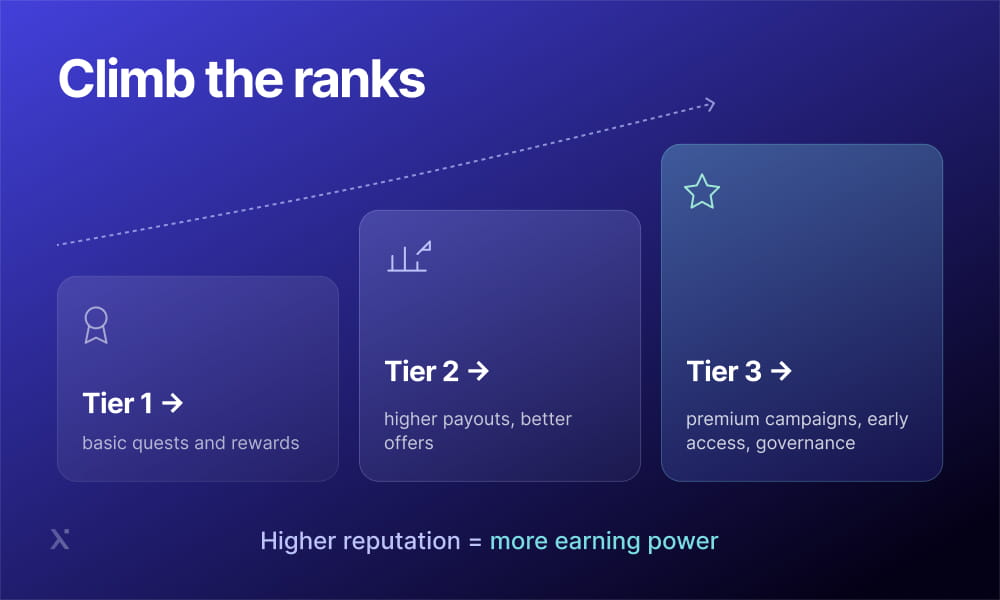
Each tier needs its own eligibility logic, reward table, targeting rules, and a defensible path for moving up and down. Demotion is the hard part, since taking a tier away from a player who has done nothing wrong is a support problem and a trust problem at once.
Tiers also interact with fraud defense in ways that are easy to miss. The higher the tier, the higher the reward, so verification requirements have to scale with the payout rather than staying flat across the ladder.
Chain choice and what it does to the bill
The chain you pick is a cost decision as much as a technical one. It sets your fees per reward transaction, your contract language, your available talent pool, and how easily you hire a second engineer when the first one leaves.
KGeN chose Aptos, and the logic follows the product. When you are paying out micro-rewards to millions of accounts, transaction cost and throughput dominate everything else, and Move gives strong safety guarantees for asset handling. The trade is a smaller developer pool and less mature tooling than the EVM world.
Chain trade-offs for a rewards and reputation platform
| Factor | Aptos | Solana | EVM Layer 2 |
| Contract language | Move | Rust with Anchor | Solidity |
| Cost per micro-reward | Very low | Very low | Low |
| Developer availability | Limited | Moderate | Widest |
| Tooling maturity | Growing | Strong | Strongest |
| Best fit | Asset-safety-first rewards | High-frequency consumer apps | Teams that need hiring depth |
Foundations compete hard for consumer apps with real audiences, and a gamer network is exactly that. Grants, co-marketing, integration engineering, and early publisher introductions frequently exceed the technical differences between two comparable chains. Negotiating those terms before you commit, rather than after you have deployed, is one of the highest-return conversations in the entire project.
A realistic timeline
Timelines slip on this kind of build for a predictable reason, which is that the data layer has to exist before the score means anything, and the score has to mean something before a publisher will pay.
A focused MVP with one region, a handful of quest types, and a simple score usually takes four to six months. A full platform with tiered reputation, a publisher console, anti-fraud, and a live token layer runs nine to fifteen months, with the second half dominated by tuning.
What you keep paying after launch
| Item | Estimated annual range (USD) | Purpose |
| Infrastructure and data processing | $40,000 to $200,000 | Pipelines, storage, RPC, monitoring |
| Model retraining and tuning | $30,000 to $120,000 | Keeping scoring and fraud detection current |
| Maintenance and new features | $80,000 to $250,000 | Integrations, releases, platform changes |
| Security monitoring and re-audits | $20,000 to $90,000 | Ongoing review after each major change |
| Support, appeals, and moderation | $30,000 to $150,000 | Human review of disputed scores and bans |
| Reward funding | Highly variable | Payouts to players, ideally funded by campaigns |
Those lines scale with users rather than staying flat, which is why the operating budget deserves the same modeling attention as the build budget.
Where budgets quietly break
Most overruns on platforms like this trace back to four decisions made early, not to anything that happened in the final sprint.
- Treating fraud defense as a feature to add later rather than a system to design around.
- Building for sixty countries at once instead of proving the model in one.
- Underestimating integration work with games, social platforms, and partner ecosystems.
- Launching a reward token before the reward economics have been tested with real payouts.
The token trap is the most expensive of the four. A reward token launched before the platform has demonstrable demand puts you in the position of defending a price while still building the product, and reviewing what GameFi got wrong in its first cycle, where emissions outran genuine usage, is a cheap way to avoid repeating it.
Sell one campaign before you build the console
Run your first publisher campaign manually, with spreadsheets and a shared document, before writing a line of console code. You will learn what a publisher actually asks for, which is usually two or three reports rather than the twelve you planned, and you will have real revenue and a reference customer before the expensive part of the build begins.
What is the Cost to Develop a Crypto Wallet App Like Coinbase?
NFT Wallet Development Explained: Features, Process, and Pricing
Why this category exists now
User acquisition in gaming keeps getting more expensive and less measurable, while attribution signals have weakened across mobile platforms. Web3 offered an answer that mostly failed commercially in its first attempt, when projects paid for wallets rather than players and got exactly what they paid for.
What changed is the emphasis on verification, since a platform that can prove the person on the other end plays games, spends money, and behaves like a human is selling something measurable.
Why PixelPlex is the right team to build it
A platform that holds reward balances and sells verified audiences is not the place to learn on the job. It calls for a team that has shipped consumer scale, data engineering, and on-chain logic together, because the hard parts sit exactly where those three meet.
What clients rely on us for includes:
- More than 17 years in software and over a decade in blockchain, with 450+ delivered projects.
- More than a million on-chain smart contract executions across live systems, with no exploits to date.
- In-house machine learning and data engineering teams, so scoring and fraud defense are built rather than outsourced.
- Coverage of Aptos, Solana, Ethereum, Polygon, and newer networks under one roof.
Our clients have collectively raised over $1.2 billion, and more than 50 million users have been onboarded across products we built. We stay on after launch to tune the score and the fraud defenses once real campaigns put pressure on both.
FAQ
A focused first version with a working score, a quest app, and a basic reward token usually starts around $120,000. A full platform with tiered reputation, anti-fraud, a publisher console, and multiple audits typically runs $300,000 to $700,000 or more.
A focused MVP generally takes four to six months. A complete network with tiers, a publisher console, and a live token layer usually runs nine to fifteen months, with tuning continuing well past launch.
Pick the chain by transaction economics and ecosystem support rather than by reputation. Reward platforms move enormous numbers of tiny transactions, so low fees and high throughput matter more than anything else.
It is a portable reputation score built from play history, skill, spending, social presence, and human verification. It turns an anonymous user into an audience a publisher can price.
No, and launching without one is often smarter. You can pay rewards in stable value or points first, prove the unit economics, and introduce a token once real demand exists.
Because your product is verification. If farmed accounts pass as real players, publishers stop paying, so detection work is the product rather than a safeguard around it.
Expect recurring spend on infrastructure, data processing, model retraining, support and appeals, security monitoring, and reward funding. For an active network these run well into six figures a year.
Start with a narrow niche where you can prove quality rather than scale, such as one game genre in one country. A small verified audience with clean reporting is easier to sell than a large unverified one.