
People don't download a crypto wallet just because they love wallets — they download one because they want easy and simple access to digital assets. A white label solution helps you deliver exactly that without a lengthy development cycle.
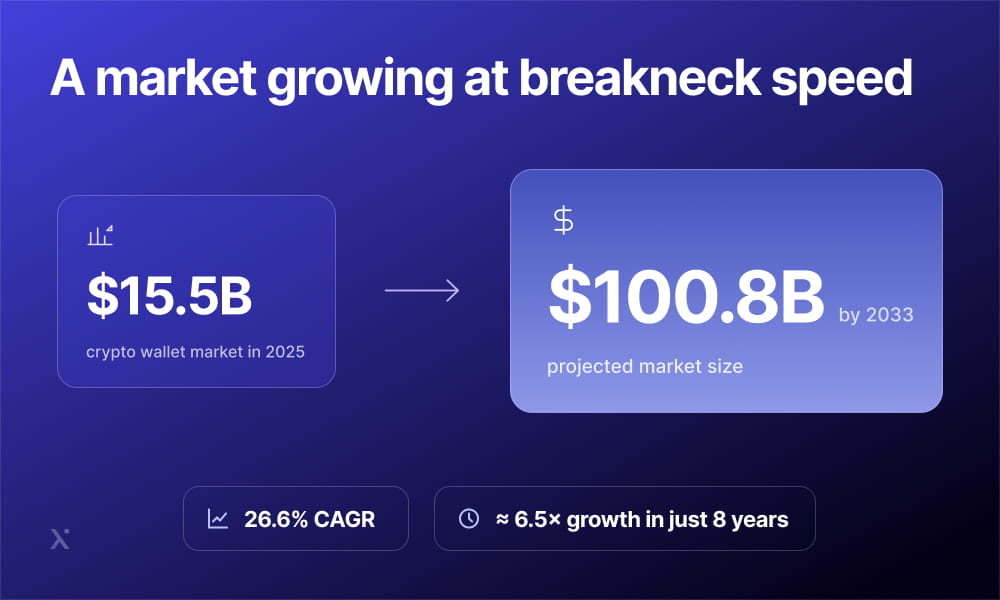
The crypto wallet market is growing just as fast as the digital asset economy itself. Valued at $15.5 billion in 2025, it’s expected to surpass $100.8 billion by 2033, expanding at a 26.6% CAGR.
As crypto adoption accelerates, companies are launching branded wallets to engage users, unlock new revenue streams, and offer services like trading, staking, and Web3 access. While many use white label solutions to speed up their own launch, others build customizable wallet platforms they can license to multiple clients and generate recurring revenue.
PixelPlex — a white label crypto wallet development company — has helped businesses build secure, scalable wallet solutions for both use cases. In this guide, we’ll walk you through the development process, essential features, common risks, costs, and everything you need to know before launching a white label crypto wallet.
What is a white label crypto wallet?
A white label crypto wallet is a ready-made wallet solution that businesses can customize, brand, and launch under their own name. They don’t need to develop every component from scratch — they simply use an existing wallet infrastructure and adapt it to their specific needs, including design, features, supported assets, integrations, and security requirements.
But what is the difference between a white label solution and custom crypto wallet development? Let’s compare the two approaches in the table below.
White label crypto wallet development vs. custom crypto wallets
| Category | White label crypto wallets | Custom crypto wallet development |
| Development approach | Uses a pre-built wallet solution that is customized to match business requirements | Built entirely from the ground up based on unique business needs |
| Time to market | Faster launch due to existing infrastructure and tested components | Longer development timeline because every element must be designed and built |
| Cost | Lower initial investment with fewer development resources required | Higher cost due to extensive design, development, and testing |
| Customization | High level of customization for branding, features, and integrations | Maximum flexibility with complete control over every component |
| Scalability | Can be scaled depending on the provider’s architecture and capabilities | Designed specifically around the company’s long-term growth plans |
| Security | Uses established security frameworks and proven wallet infrastructure | Requires building and testing security mechanisms |
| Maintenance | Updates, improvements, and technical support are often handled by the development provider | Requires an internal team or dedicated partner for ongoing maintenance |
| Best suited for | Businesses that want to launch quickly and validate their crypto product | Companies with highly specific requirements or unique wallet concepts |
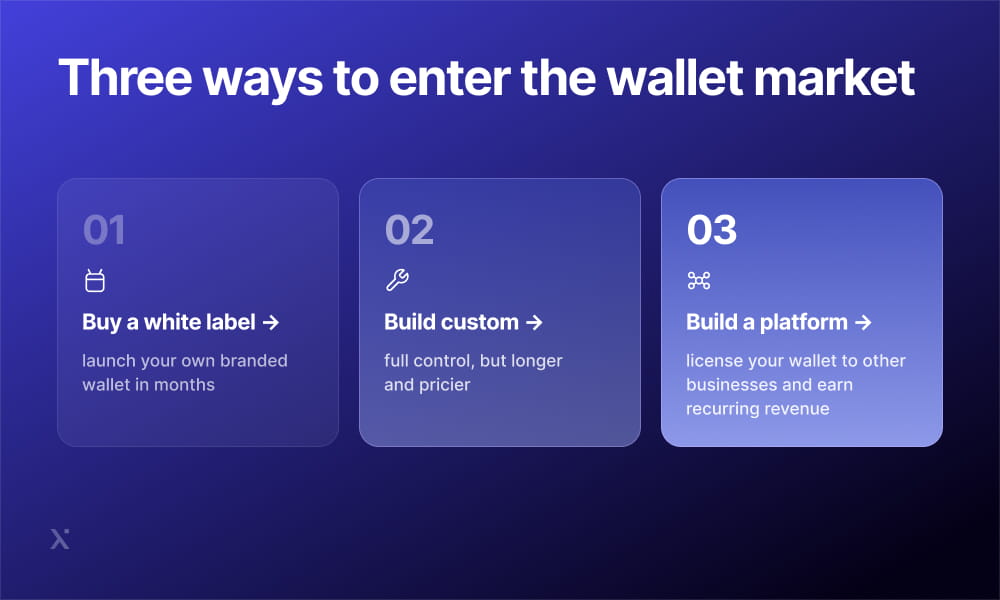
Now that we understand the difference between buying a ready-made solution and building a custom wallet for your own needs, there is another option for you to consider. Businesses can create their own white label crypto wallet platforms and offer them to other companies as a product or service.
With dedicated payment software development expertise from providers like PixelPlex, businesses can build customizable wallet platforms tailored to the needs of multiple clients.
Who exactly needs white label crypto wallet software?
White label crypto wallets are a practical solution for companies that want to offer secure crypto storage, payments, and Web3 features under their own brand. White label wallet software is commonly used by:
- Crypto exchanges
- Fintech companies
- Banks
- Payment providers
- Web3 startups
- Enterprises
Exchanges need secure wallets to help users store, deposit, withdraw, and manage their digital assets. Partnering with a specialized non-custodial wallet development company for a white label solution allows them to offer a reliable wallet experience while focusing on growing their trading platform.
Fintech businesses can use white label wallets to add crypto services to their existing products. This helps them support digital asset payments, transfers, and other blockchain-based features without extensive development efforts.
Banks are exploring ways to support the growing demand for digital assets. White label crypto wallet development can help them introduce crypto-related services and, at the same time, maintain security, compliance, and a familiar branded experience.
Payment companies can expand their services by adding crypto transactions, digital asset management, or crypto payment solutions. A white label wallet provides the infrastructure needed to support these new capabilities.
For Web3 startups, launching quickly can be critical. A white label wallet helps them enter the market faster and focus on building their ecosystem, community, and unique features.
Large companies can use white label wallets to explore blockchain-based payments, loyalty programs, tokenized assets, or other digital initiatives. Meanwhile, they will keep full control over their brand experience.

Building Strategic Value with Blockchain FinTech App Development

What is the Cost to Develop a Crypto Wallet App Like Ledger?
Whether they want to launch a new crypto product or expand existing services, businesses can benefit from white label crypto wallet development in several ways:
- Launch faster by using ready-made infrastructure
- Reduce development costs by avoiding the need to build every component internally
- Customize the user experience with branded designs, features, and integrations
- Add new revenue streams through crypto services, transaction fees, or licensing models
- Scale more easily with a solution designed to support growing user demand
- Improve security by relying on proven wallet architecture and industry best practices
- Focus on business growth while technical complexities are handled by experienced development teams
Offer a wallet solution that enables users across regions to securely access your digital asset services.
Main types of crypto wallets and their differences
Crypto wallets generally fall into two categories: cold wallets and hot wallets. The key difference lies in whether the wallet is connected to the internet.
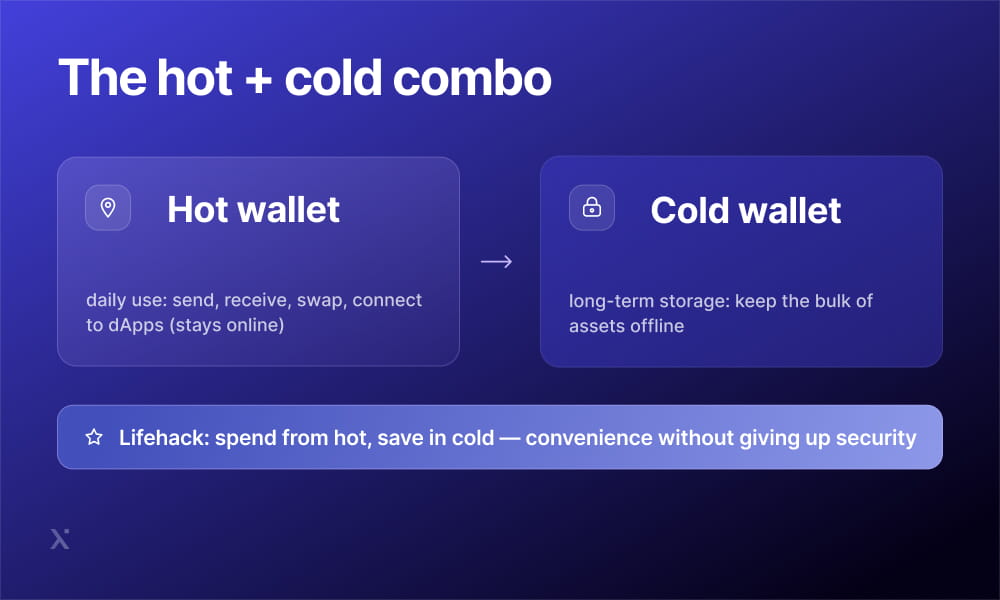
Cold wallets prioritize asset protection by storing private keys offline, while hot wallets focus on convenience and seamless access to crypto services. Each category includes several wallet types designed for different user needs. Let’s take a look at them.
Cold wallets
Cold wallets store private keys offline, so they are much harder for hackers to access. Since they are not connected to the internet, they are protected from common online threats like phishing, malware, and remote attacks.
They are a popular choice for long-term investors, businesses, and institutions that want to keep large amounts of crypto secure.
The downside is that they are less convenient for everyday use because accessing funds usually requires connecting a hardware wallet or completing extra verification steps.
Types of cold wallets and how they work
| Cold wallet type | How it works | Security | Best for |
| Hardware wallet | Stores private keys on a dedicated physical device that connects only when transactions are signed | Very high | Long-term investors, businesses, and institutions |
| Paper wallet | Private and public keys are printed or written on paper and stored offline | Moderate (vulnerable to physical damage and insecure printing methods) | Offline backups and archival storage (rarely used today) |
| Air-gapped wallet | Runs on a device that never connects to the internet, with transactions transferred via QR codes or removable media | Very high | High-value portfolios and enterprise-grade security |
Hot wallets
Hot wallets remain connected to the internet. They allow users to quickly send, receive, swap, and manage cryptocurrencies. They offer a smooth user experience and often integrate with exchanges, dApps, NFT marketplaces, and DeFi platforms.
Because they are online, hot wallets face greater cybersecurity risks than cold wallets. However, today’s security measures such as biometric authentication, encryption, multi-factor authentication (MFA), and secure key storage help greatly reduce these risks.
Types of hot wallets and how they work
| Hot wallet type | How it works | Security | Best for |
| Mobile wallet | Smartphone application for managing crypto anywhere | Moderate | Everyday payments and personal use |
| Desktop wallet | Installed on a desktop or laptop computer | Moderate to high | Personal portfolio management and active trading |
| Web wallet | Accessed through a web browser without installing software | Moderate | Quick access across multiple devices |
| Browser extension wallet | Browser plugin that connects directly to Web3 applications | Moderate | DeFi, NFTs, DAOs, and dApps |
| Exchange wallet (custodial) | Assets are managed by a cryptocurrency exchange on behalf of the user | Moderate (depends on the provider) | Beginners and frequent traders |
If we talk about popularity, hot wallets are the most widely used today. Their convenience makes them the preferred choice for retail users and businesses offering customer-facing crypto services.
Cold wallets, however, remain the most secure option. They are often used to safeguard large crypto holdings by institutional investors, custodians, and security-conscious users.
Rather than choosing one over the other, many individuals and businesses combine both approaches. They use hot wallets for day-to-day transactions and cold wallets to securely store the majority of their digital assets.
This hybrid strategy offers a practical balance between accessibility and security and has become a common approach in financial software development, where applications must deliver both a seamless user experience and strong asset protection.
Key features of a white label crypto wallet solution
A successful white label crypto wallet should offer more than basic crypto storage. The exact feature set depends on your business model, but the capabilities below are considered essential for building a competitive crypto wallet.
Essential features of a crypto wallet and why they matter
| Feature | What it does | Why it matters |
| Multi-currency support | Supports multiple cryptocurrencies in one wallet | Lets users manage different assets from a single app |
| Multi-chain compatibility | Works with multiple blockchain networks | Gives users access to assets across different ecosystems |
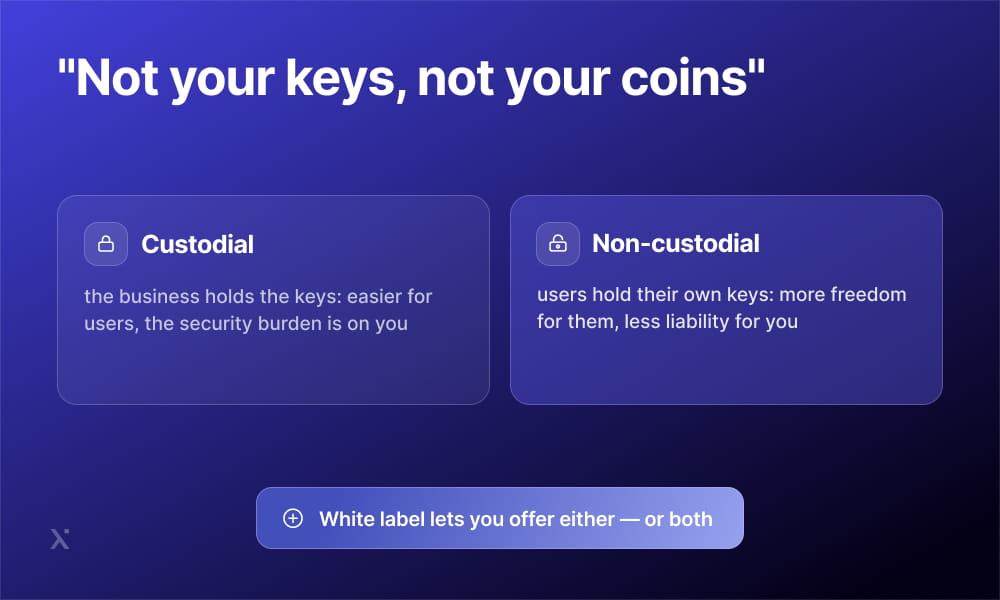
| Custodial and non-custodial options | Offers wallets where either the business or the user controls the private keys | Meets different security, compliance, and user needs |
| Advanced security features | Includes encryption, secure key storage, MFA, biometrics, multisig, transaction signing, fraud detection, and anti-phishing protection | Protects user accounts and digital assets |
| KYC/AML integration | Verifies users and monitors transactions | Supports regulatory compliance and fraud prevention |
| Fiat on- and off-ramps | Enables users to buy and sell crypto with traditional currencies | Makes crypto easier to access and use |
| NFT support | Allows users to store and manage NFTs | Supports digital collectibles and Web3 applications |
| Staking and DeFi integration | Lets users stake assets and access DeFi services | Creates more ways to use and earn from crypto |
Depending on your business goals and target audience, you can expand your wallet with additional features such as P2P crypto exchange integration, push notifications, portfolio analytics, QR code payments, address books, recurring transactions, and Web3 connectivity to create a more convenient user experience.
How to Build a P2P Crypto Exchange: Development Process, Tech Stack & Pricing Explained

From Chaos to Compliance: How Cryptocurrency Regulation Is Shaping Up
Main risks of white label crypto wallet development and how to avoid them
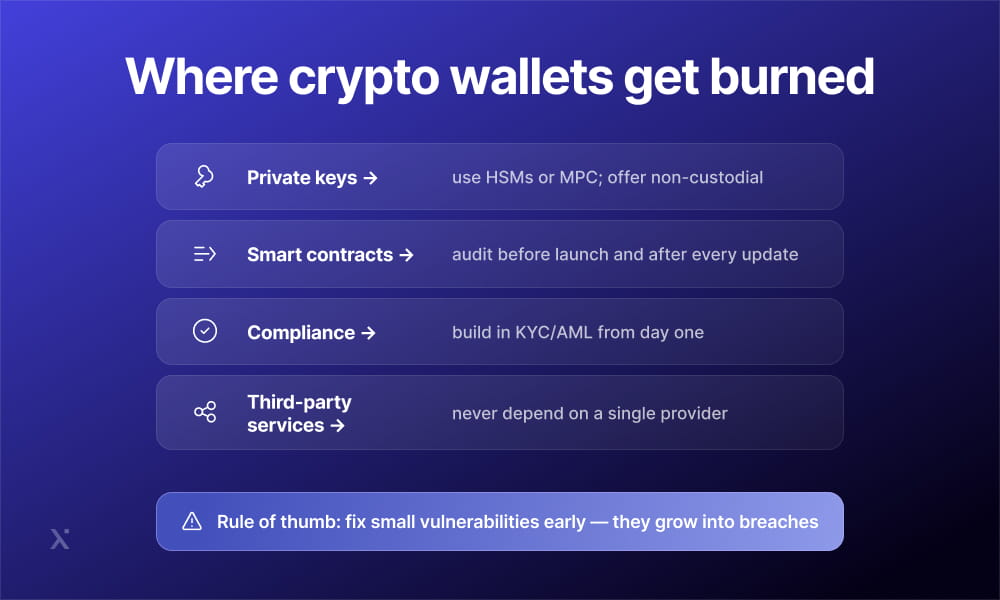
White label crypto wallet development requires careful planning and strong security measures. Since these wallets handle valuable financial data and digital assets, even small vulnerabilities can lead to security breaches, compliance issues, stolen funds, loss of user trust, and reputational damage. No one wants that, right?
So, below are the main risks that businesses should consider when developing a white label crypto wallet and the measures they can take to reduce them.
Private key management risks
Private keys are the foundation of crypto wallet security. If private keys are exposed, lost, or poorly managed, users can permanently lose access to their funds. This makes secure key generation, storage, and recovery one of the most important parts of wallet development.
How to avoid it:
- Use secure key management solutions such as hardware security modules (HSMs) or trusted key management systems
- Apply encryption and MFA to protect access
- Consider non-custodial models where users maintain control over their private keys
- Regularly test backup and recovery processes
Smart contract vulnerabilities
Smart contract-based wallets provide advanced functionality but can introduce additional security risks. Vulnerabilities in contract logic, third-party modules, or dApp integrations may allow attackers to access funds or execute unauthorized transactions.
How to avoid it:
- Conduct regular smart contract audits before deployment and after major updates
- Review all third-party modules and integrations carefully
- Verify transaction details before users approve them
- Monitor wallet activity to detect suspicious transactions
- Educate users about phishing attacks and malicious dApps
- Use trusted sources and official platforms when connecting wallets to Web3 services

Web3 Smart Contract Development: Building the ‘Brain’ of Your Web3 Project

Ethereum Smart Contracts: The Hard Parts Made Clear
Compliance risks
Crypto regulations vary across countries and continue to evolve. A wallet that does not meet regulatory requirements may face legal issues, restrictions, or reputational damage.
How to avoid it:
- Integrate KYC and AML verification tools
- Follow local and international crypto regulations
- Work with compliance specialists during development
- Keep transaction monitoring and reporting systems up to date
Third-party dependency risks
White label crypto wallets often rely on external providers for services such as blockchain infrastructure, payment processing, analytics, or security tools. Problems with third-party services can affect the wallet’s overall performance and reliability.
How to avoid it:
- Choose trusted technology providers with proven security practices
- Review third-party APIs and integrations regularly
- Avoid relying on a single provider for critical services
- Have backup solutions in place for essential wallet functions
Data privacy risks
Crypto wallets handle sensitive information like user identity data, transaction history, and account details. Poor data protection can lead to privacy breaches and compliance problems.
How to avoid it:
- Use encryption for stored and transferred data
- Follow privacy regulations such as GDPR where applicable
- Collect only the data required for wallet operations
- Apply strict access controls for sensitive information
Operational risks
Poor maintenance, outdated software, or weak internal processes can affect wallet security and user experience over time. Even a well-built wallet requires ongoing monitoring and updates.
How to avoid it:
- Perform regular security testing and software updates
- Monitor transactions and system activity
- Create clear incident response procedures
- Train employees on security best practices
- Continuously improve the wallet based on user feedback and emerging threats
The sooner risks are identified and resolved, the safer your wallet will be. Don’t overlook small issues — even minor vulnerabilities can grow into serious security threats over time.
Technologies behind white label crypto wallet applications
Several technologies work hand in hand behind the scenes to make white label crypto wallets secure, scalable, and easy to use. The table below summarizes the core components.
Key tech behind white label crypto wallet development
| Tech | What it does | Examples |
| Blockchain networks | Process transactions and store digital assets. The wallet connects to one or more blockchains so users can send, receive, and manage crypto | Ethereum, Bitcoin, Solana, Polygon, BNB Smart Chain, Tron |
| Wallet infrastructure | Powers the wallet’s backend, manages wallet addresses, private keys, transaction processing, and communication with blockchain networks | Node.js, Go, Rust, WalletConnect, Bitcoin Core |
| APIs and third-party integrations | Connect the wallet to services such as fiat on/off ramps, identity verification, price feeds, blockchain data providers, and payment solutions | Fireblocks, MoonPay, Transak, CoinGecko API, Chainlink, Sumsub |
| Cloud infrastructure | Provides scalable hosting, storage, networking, and deployment tools that keep the wallet fast, reliable, and highly available | Amazon Web Services (AWS), Google Cloud Platform (GCP), Microsoft Azure, Docker, Kubernetes |
| Security technologies | Protect user funds and sensitive data through encryption, secure key storage, authentication, and transaction verification | AES-256 encryption, TLS, MFA, multi-signature wallets, HSMs, Secure Enclave |
If you’re unsure which technologies best fit your business goals, experienced providers of blockchain development services can help evaluate your requirements, recommend the right blockchain network and technology stack, and build a wallet that balances security, performance, and scalability.

Top 10 Blockchain Development Companies in 2026
Comparing DApps Across Protocols: Why Your Blockchain Choice Can Break Everything
How to develop a white label crypto wallet step by step
White label crypto wallet development is about more than putting your logo on an existing product. You need to create a solution that aligns with your business model, supports the right technologies, and delivers the experience your future customers expect.
Here’s what the development process typically looks like when you work with a blockchain development company.
Step 1. Discuss your goals and requirements
The process starts with understanding your business. Together, you’ll define your target audience, required features, supported cryptocurrencies, compliance requirements, and long-term objectives. This helps shape the right development strategy from day one.
Step 2. Choose the right white label platform
Based on your requirements, your development partner will help you select the most suitable white label solution (or even build one for you). Factors such as blockchain support, customization options, scalability, security, and licensing are carefully evaluated to ensure the platform fits your needs.
Step 3. Customize the wallet
Next, the wallet is tailored to your brand and business requirements. This includes designing the user interface, adding your branding, configuring supported crypto and blockchain networks, and implementing the features your customers will need.
Step 4. Integrate additional services
To expand the wallet’s functionality, the development team integrates third-party services such as payment gateways, fiat on- and off-ramps, crypto exchanges, KYC and AML providers, staking platforms, analytics tools, and price feeds.
Step 5. Strengthen security
Security is built into every stage of development. Your wallet can include encryption, multi-factor authentication, biometric login, secure key management, transaction monitoring, fraud detection, and other protections based on your security requirements.
Step 6. Test and optimize the solution
Before delivery, the wallet undergoes comprehensive testing to verify its functionality, performance, security, and compatibility across devices. Any issues are resolved to ensure the final product is stable and ready for deployment.
Step 7. Deploy and maintain the solution
Once development is complete, the wallet is deployed to your infrastructure or cloud environment. Your development partner can also provide ongoing maintenance, security updates, feature enhancements, and technical support as your business grows.
Complete Guide to Web3 Wallet Development and Its Costs

More Than Just Storage: How Crypto Wallet Rewards Programs Build Loyalty and Drive Growth
How much does white label crypto wallet development cost?
It’s quite clear that a simple wallet costs less, while a more advanced solution requires a larger investment. But what else makes the prices different? Well, several factors influence the overall development cost:
- Feature complexity
- Supported blockchains
- Integrations
- Security requirements
- Custom branding
The final cost depends on your business goals and the type of wallet you want to create. Below are typical estimates for different solution levels.
White label crypto wallet development cost
| Wallet type | Estimated cost | Timeline | Typical features |
| MVP wallet | $35,000-$75,000 | 2-4 months | Basic wallet functionality, support for one or a few blockchains, sending and receiving crypto, transaction history, user accounts, basic security features, and simple branding |
| Mid-level wallet | $75,000-$200,000 | 4-8 months | Multiple blockchain support, advanced security features, third-party integrations, KYC/AML verification, fiat on/off ramps, improved customization, and additional user features |
| Enterprise wallet | $200,000-$500,000+ | 8-12+ months | Multi-chain architecture, MPC or institutional-grade security, advanced compliance tools, custom infrastructure, extensive integrations, admin dashboards, analytics, and enterprise-level scalability |
Since a lot of crypto businesses handle large amounts of digital assets, advanced security solutions become increasingly important. MPC wallet development is becoming a popular approach for building secure wallets by distributing key management across multiple parties instead of relying on a single private key.

MPC Wallet Development Cost: Pay Now or Pay After a Breach

NFT Wallet Development Explained: Features, Process, and Pricing
How and when does a white label crypto wallet pay off?
The investment usually pays off when the crypto wallet starts generating revenue through services such as transaction fees, exchange integrations, subscriptions, or premium features. The exact timeline depends on factors such as:
- User base growth: more active users usually mean higher transaction volumes and greater revenue potential
- Business model: wallets with trading, payment, staking, or other services can create more income streams
- Development and operational costs: lower upfront costs and efficient maintenance improve the return on investment
- Market demand: a wallet that solves a real user need has a higher chance of gaining traction
In many cases, businesses can launch a white label crypto wallet within a few months instead of spending a year or more on custom development. Depending on the features, user adoption, and revenue model, the initial investment can potentially be recovered within 12-24 months. However, success largely depends on the quality of the product, marketing strategy, and ability to attract and retain users.
Why choose PixelPlex for white label crypto wallet development?
PixelPlex brings 13+ years of blockchain experience and a proven track record in white label crypto wallet development services. The team has delivered multiple wallet solutions, including custodial, non-custodial, multi-chain, and enterprise-grade platforms.
With expertise across different blockchain ecosystems, PixelPlex can build solutions tailored to your goals — from MVP wallets for testing your idea to advanced platforms with complex features. The team also specializes in multi-currency crypto wallet development. This allows businesses to support multiple digital assets while giving users a convenient way to manage their crypto portfolios.
Beyond wallet development, PixelPlex helps companies build complete Web3 solutions with features such as DeFi integrations, NFT support, staking, fiat on/off ramps, and advanced security mechanisms.
FAQ
A wallet can support different cryptocurrencies depending on the blockchain networks integrated, including Bitcoin, Ethereum, Solana, Polygon, and others.
Yes. Wallets can be connected with exchanges, payment providers, fiat gateways, and other third-party services.
MPC (Multi-Party Computation) wallet development uses advanced key management technology to improve security by splitting private key control across multiple parties. It is suitable for white label wallets, especially for businesses that need enterprise-level security, better access control, and protection for large volumes of digital assets.
Yes. White label solutions can be developed with either custodial models, where assets are managed by a service provider, or non-custodial models, where users control their private keys.
Yes. Startups often choose white label solutions to test their ideas, launch faster, and reduce initial development costs.
Look for a partner with blockchain experience, proven projects, strong security practices, customization options, and ongoing technical support.