
How much does it really cost to build the next Revolut or Wise — and why can two apps that look almost identical to a user end up worlds apart in price?
Few fintech products have changed the way people move money as dramatically as P2P payment apps. What started as a convenient way to split a dinner bill has evolved into a multi-billion-dollar market, with platforms like Cash App, Revolut, and Wise handling everything from everyday transfers to cross-border payments. As digital payments become the norm, more banks, fintech startups, and non-financial businesses are exploring whether building their own payment app makes business sense.
The cost can vary widely. An MVP built around basic transfers is one thing. Another is a product designed for a large user base, multiple payment methods, and more complex workflows. The budget also depends on what has to happen behind the interface, including compliance checks, fraud controls, banking connections, security, and the infrastructure needed to process transactions without delays.
This guide breaks down what goes into P2P payment app development, the factors that have the biggest impact on cost, the risks businesses should prepare for, and how long it typically takes to recover the investment. You’ll also find practical cost ranges, development timelines, and recommendations for planning a payment product that grows with your business.
Step-by Step Guide to P2P Crypto Exchange Development
How to Develop a Peer-to-Peer Lending Application: PixelPlex’s Detailed Guide
What is a P2P payment app?
A peer-to-peer (P2P) payment app allows people to send and receive money directly from one another using a mobile device or web application. Instead of relying on cash or bank transfers initiated through traditional online banking, users can complete transactions in just a few taps. Depending on the platform, funds may be transferred between digital wallets, linked bank accounts, or payment cards.
The first P2P payment apps focused on one thing: making it easy to send money between friends and family. That’s no longer the whole story. Modern platforms are used for everything from paying merchants and freelancers to moving money across borders, with many offering digital wallets and other financial services alongside payments.
Popular P2P payment apps and their business models
| P2P app | Primary use | Revenue model | Target audience |
| Venmo | Personal payments and bill splitting | Instant transfer fees, merchant payments | Individual consumers |
| Cash App | Money transfers, banking, investing | Transaction fees, interchange, and financial services | Consumers and small businesses |
| Wise | International money transfers | Transfer fees and currency conversion | Individuals and businesses sending money abroad |
| Revolut | Everyday payments and digital banking | Subscription plans, exchange fees, and premium services | Consumers, travelers, freelancers |
| Zelle | Domestic bank-to-bank transfers | No user fees — bank consortium ownership | Retail banking customers |
Although these applications share the same core function, sending money from one user to another, the products themselves often differ significantly. The choice of business model, target audience, and feature set affects everything from the underlying architecture to compliance requirements, which ultimately has a direct impact on development costs.

Centralized Crypto Exchange Development Explained: From Architecture to Launch

Building Strategic Value with Blockchain FinTech App Development
How P2P payment solutions are developed
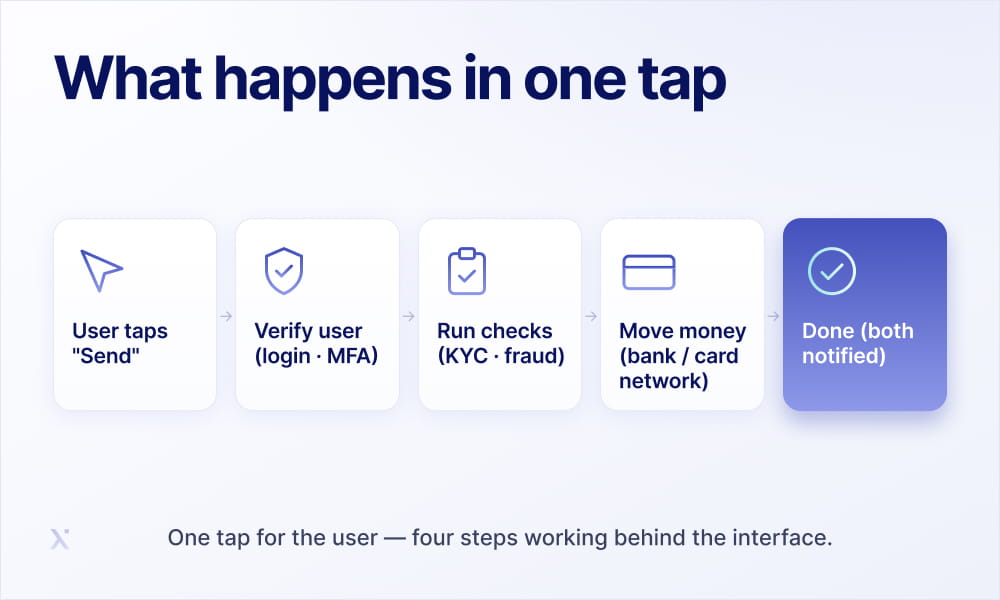
The majority of commercial payment platforms require substantially more than UI design and payment gateway integration. A lot of the work happens behind the scenes, from planning the system architecture to integrating financial services and meeting regulatory requirements. Decisions made early in the project tend to affect everything that follows, including the budget.
While individual workflows vary from project to project, most payment P2P app development follows a similar lifecycle.
Discovery
The project starts with defining business goals and product requirements. During discovery, the development team analyzes the target audience, identifies the core functionality, evaluates regulatory requirements, and selects the technology stack. The outcome of this stage typically includes business requirements, a prioritized feature list, technical specifications, a project roadmap, and initial budget and timeline estimates.
UI/UX design
Once the product requirements are clear, designers create the user experience. The goal is to make payments feel simple while keeping essential security features easy to understand. At the end of this phase, the team usually delivers user journeys, wireframes, interactive prototypes, visual designs, and a design system that developers often use during implementation.
Architecture
Before developers start writing code, they need a clear blueprint for the platform. During this stage, the team decides how the mobile apps, backend, databases, and external services will work together. The result is a technical architecture that guides the rest of the project and helps avoid costly changes later.
Backend development
Typically, transaction processing and integrations are handled by the backend. It receives requests from the mobile application, verifies users, processes transactions, exchanges data with external services, and stores payment records. By the end of this stage, the team has a working server-side platform with the APIs and integrations needed to support the mobile app.
Mobile development
Developers build the Android and iOS applications, connect them to the backend, and optimize each platform for performance and security. Depending on the project, Android app development and iOS app development may be handled by dedicated native teams or delivered with a cross-platform framework.
Testing
A payment app doesn’t get a second chance after a failed transfer. Before launch, the team checks every critical scenario, from successful payments to failed transactions and third-party service interruptions. P2P transfers add their own testing demands: idempotency checks to prevent duplicate transfers from a retried request, reconciliation between sender and recipient balances, and safeguards against double-spending when transactions happen concurrently. Once testing is complete, the project moves forward with a release-ready build and the documentation required to deploy and support it.
Deployment
Deployment marks the point where the product becomes available to real users. Along with releasing the applications and configuring the production environment, the team prepares everything needed for day-to-day operations, including deployment documentation, monitoring, support procedures, and plans for future releases.
Support and further development
Launching the app is the beginning of its operational life. The team monitors the platform, resolves production issues, supports users, and releases new features as business needs evolve.
Support may also cover performance improvements, compliance updates, and new features based on user behavior and business priorities.
Custom development projects generally follow similar high-level phases, although implementation approaches differ. Projects focused on domestic peer-to-peer transfers typically move much faster than platforms designed for cross-border payments, multiple currencies, and complex regulatory requirements.
No. Security is generally incorporated from the earliest planning stages. Building secure authentication, encrypted data storage, and fraud protection into the architecture is significantly easier than adding them after core functionality has already been implemented.
Feature scope, compliance requirements, integrations, and team size have the greatest influence on the project timeline.
| Phase | Typical duration | Main output |
| Discovery | 2–4 weeks | Requirements, roadmap, estimates |
| Design | 4–8 weeks | UI/UX, prototype, design system |
| Development | 3–8 months | Mobile apps, backend, integrations |
| Testing | 4–10 weeks | Verified payment flows, bug fixes |
| Launch | 1–3 weeks | Production deployment |
| Ongoing support | Continuous | Updates, maintenance, new features |
Real projects don’t move from one phase to the next like a checklist. As soon as part of the application is ready, QA starts testing it, while designers and developers continue working on the remaining functionality. In most cases, finding issues earlier is faster and less expensive than fixing them after everything has been built.
Each stage of the development process contributes to the overall project budget. The sections below look at the technical and business factors that have the greatest influence on development costs.
Features that affect P2P payment app development cost
The number of features is only part of the equation. Two payment apps may offer similar functionality, yet require very different levels of effort to build. Some features can be implemented with relatively little complexity, while others involve integrations with external providers, compliance requirements, or additional security measures that increase both development time and cost.
The table below highlights some of the features that have the greatest impact on a project’s budget.
How key features influence development cost
| Feature | Complexity | Cost impact |
| User registration and login | Low | Low |
| KYC identity verification | High | High |
| Digital wallet | Medium | Medium |
| Money transfers | High | High |
| QR code payments | Medium | Medium |
| Push notifications | Low | Low |
| Analytics and reporting | Medium | Medium |
| Admin panel | Medium | Medium |
| Transaction history | Medium | Medium |
| Card linking | High | High |

Blockchain Development Cost in 2026: What Goes Into the Price Tag
Crypto Payment Gateway: Costs, Benefits, Implementation
Core features for an MVP
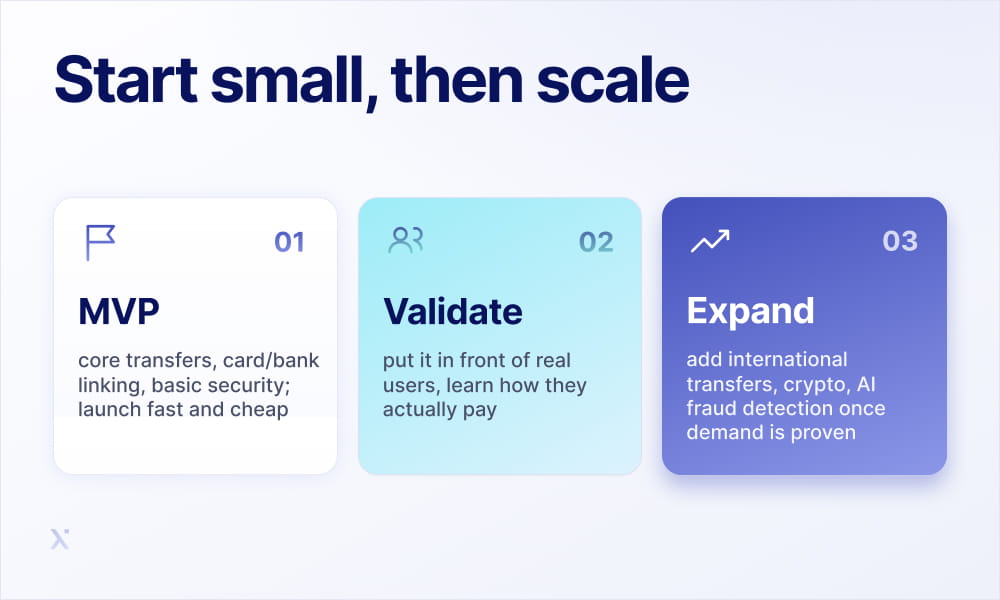
Launching with a focused feature set is often the fastest way to validate a payment product. An MVP doesn’t need every capability found in established platforms. Launching with a smaller, well-tested feature set allows businesses to validate demand, collect user feedback, and reduce the initial investment.
A typical P2P payment app MVP includes:
- User registration and authentication
- Profile management
- Card or bank account linking
- Basic KYC/AML checks (identity verification required to legally move funds)
- Basic money transfers
- Transaction history
- Push notifications
- Simple admin dashboard
- Basic security features, including encryption and multi-factor authentication
Additional features, such as international transfers, loyalty programs, recurring payments, cryptocurrency support, or AI-powered fraud detection, can always be added later. Initially, the most important thing is to guarantee a secure and reliable payment process that addresses users’ primary concerns.

AI MVP Development: How to Validate Ideas Fast Without Breaking the Budget

What Is MVP in Software Development?
Technology stack for a P2P payment app
There isn’t a standard technology stack for P2P payment apps. Technology choices reflect the product’s functionality, expected scale, and long-term business goals. An MVP for one market won’t require the same infrastructure as a platform handling international payments or digital assets.
The table below shows how the technology choices for each layer typically shift between an MVP and a platform built for scale.
| Layer | MVP | At scale |
| Backend | Node.js, NestJS | Java, Go, .NET, Spring Boot (for high-throughput, low-latency services) |
| Frontend | React Native or Flutter (single cross-platform codebase) | Native Swift/Kotlin (when performance or platform-specific features matter) |
| Database | PostgreSQL | PostgreSQL + Redis (caching) + read replicas or sharding as volume grows |
| Cloud and DevOps | Single-region AWS/GCP setup, basic CI/CD | Multi-region deployment, Kubernetes, Docker orchestration |
| Payment processing | Stripe or PayPal (fastest to integrate) | Adyen, Braintree, Visa Direct, Mastercard Send (multi-provider redundancy, lower fees at volume) |
| Authentication and security | OAuth 2.0, JWT, basic MFA | Adds OIDC, Face ID/Touch ID, and hardware-backed key storage |
Cloud services tie the stack together, providing the environment where the platform runs, scales, and stays available.
Supporting domestic payments is relatively straightforward. Expanding into crypto introduces blockchain infrastructure, wallet management, and additional security considerations. AI has become another common addition, particularly for fraud detection, transaction monitoring, and customer support, although these capabilities are often introduced after the initial release.
Your Practical Guide to Creating a Decentralized Cryptocurrency Exchange

Blockchain in Payment Services: Trends, Technologies, and Development Best Practices
Factors that influence P2P payment app development cost
It’s difficult to estimate the cost of a P2P payment app based on the feature list alone. Two products with similar functionality may require very different budgets depending on their technical architecture, regulatory requirements, and long-term business goals. Below are the factors that typically have the biggest impact on development costs.
Cost drivers for P2P payment app development services
| Cost driver | Low | Medium | High |
| Target markets | Single country | Multiple countries within one region | Global rollout with multiple regulatory frameworks |
| Project scope | MVP | Production-ready platform | Enterprise-grade ecosystem with multiple products |
| Integrations | One or two external services | Several banking and payment APIs | Large ecosystem of banks, fintech providers, and enterprise systems |
| Transaction volume | Low user base | Growing user base | High-volume, always-on payment processing |
| Deployment architecture | Monolithic | Modular services | Distributed microservices architecture |
| Scalability requirements | Moderate growth | Regional expansion | Global scaling with high availability |
| Delivery approach | Cross-platform application | Hybrid delivery model | Separate native Android and iOS applications |
| Compliance scope | Single regulatory framework | Multiple compliance standards | Multi-country regulatory compliance and audits |
| Development team | Small team | Dedicated cross-functional team | Large distributed fintech program |
No two payment platforms are built under the same conditions. Defining the target market, business model, and technical requirements early in the project helps improve the accuracy of budget and timeline estimates.

Ethereum DApp Development: How It Works and What You’ll Pay
Comparing DApps Across Protocols: Why Your Blockchain Choice Can Break Everything
Hidden costs companies often miss
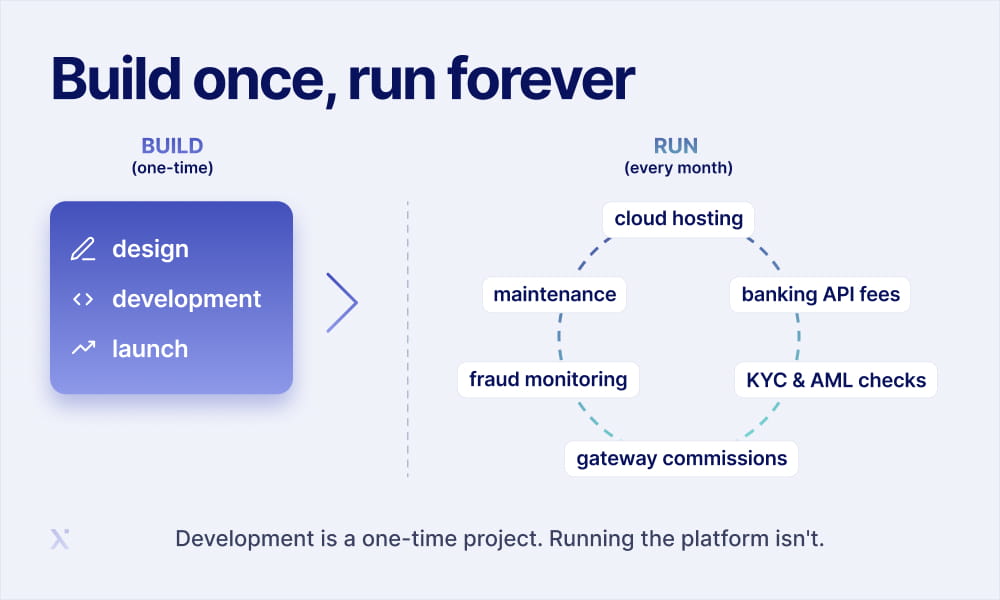
Development is a one-time project. Operating a payment platform isn’t. After launch, the business starts paying for the services that make every transaction possible, and those costs continue month after month.
Cloud hosting
Payment platforms rely on cloud infrastructure to run backend services, databases, file storage, backups, and monitoring tools. As the user base and transaction volume grow, hosting costs usually grow as well.
Banking API fees
Organizations investing in banking software development services should look beyond the initial integration cost. Banks and financial providers often continue charging for API usage after the connection is in place, making ongoing fees an important part of the overall budget.
Payment gateway commissions
Typically, payment gateways charge a fee for every successful transaction. These charges are among the largest operating expenses for applications that process high payment volumes.
App store fees
Publishing the application is only one step. Keeping it available through the Apple App Store and Google Play also means maintaining developer accounts — Apple charges $99/year, Google a one-time $25 fee — meeting each marketplace’s requirements, and accounting for commissions on in-app purchases: 15% for developers earning under $1M annually, 30% above that threshold. These commissions typically apply to premium subscriptions or paid features sold through the app, not to the underlying money transfers themselves, which fall outside app store commission structures.
KYC verification services
Identity verification is commonly handled by specialized providers rather than being built from scratch. Pricing is usually based on the number of identity checks, supported document types, countries covered, and verification methods.
AML screening
Financial products often rely on external services to screen users against sanctions lists, politically exposed persons (PEPs) databases, and other compliance sources. These checks often generate recurring subscription or usage-based costs.
Fraud detection services
Early-stage products often start with basic fraud controls. Transaction monitoring software development can add real-time checks that flag unusual payment activity, although building and maintaining these capabilities increases both the initial budget and ongoing costs.
Monitoring and observability
Payment platforms need constant visibility into what’s happening behind the scenes. Teams monitor server health, application performance, third-party integrations, and security events to spot problems before they affect users. The tools used for monitoring and alerting usually become part of the platform’s monthly operating costs.
Maintenance and support
Ongoing maintenance keeps the platform secure, compatible, and compliant over time. This includes applying operating system updates, addressing security vulnerabilities, adapting to regulatory changes, and introducing enhancements as business requirements evolve.
Unexpected expenses to plan for
Even well-planned projects encounter additional costs after development begins. Common examples include:
- Additional regulatory compliance requirements introduced during the project
- Changes in API pricing from banks or payment systems
- Infrastructure upgrades as transaction volumes increase
- Use of third-party services required during development
- Security audits and penetration testing prior to launch
- Performance optimization after live user adoption
- Bug fixes following operating system or API updates
- Customer support tools and help desk software
These costs often don’t become apparent until development is underway or the product goes live. Factoring them into the budget from the beginning makes financial planning much easier later on.
Common risks during payment app development
Payment app projects rarely follow a straight path from planning to launch. Integrations, regulatory changes, security requirements, and other technical challenges may affect both the delivery timeline and the overall budget.
| Risk | Business impact | Mitigation |
| Security vulnerabilities | Financial losses, data breaches | Secure architecture, encryption, penetration testing |
| Regulatory compliance | Delayed launch, legal exposure | Compliance review from the discovery phase |
| Scalability limitations | Poor performance during growth | Cloud-native architecture, load testing |
| Fraud | Chargebacks, financial losses | Fraud prevention and transaction monitoring |
| Low user adoption | Reduced ROI | User research, MVP validation, UX testing |
| API failures | Payment disruptions | Redundant integrations, monitoring, and fallback mechanisms |
| Regulatory changes | Additional development costs | Regular compliance reviews and system updates |
It’s common for the first release to be much smaller than the final product. Once the platform is in use and real customer behavior is understood, adding new capabilities becomes a far less expensive decision than building everything up front.

Top Blockchain Companies Revealed: How to Choose the Right Development Partner
A Comprehensive Guide to Blockchain Application Development
How much does P2P payment app development cost?
Development budgets can differ significantly even between apps with similar feature sets. The final budget is shaped by the number of platforms, required integrations, compliance obligations, security requirements, and the complexity of the payment flows, rather than the feature list alone.
| Solution | Estimated cost (USD) |
| Simple MVP | $50,000–$120,000 |
| Standard product | $120,000–$250,000 |
| Enterprise platform | $250,000–$500,000+ |
| Cross-border platform | $300,000–$700,000+ |
| Crypto-enabled platform | $350,000–$800,000+ |
The same feature can involve very different amounts of work from one project to another. For example, money transfers within one country are typically much simpler to implement than payments involving multiple currencies, banking partners, or regional compliance requirements. Likewise, integrating identity verification or fraud prevention services is very different from developing these capabilities as part of the platform itself. As the number of integrations, supported markets, and transaction volumes grows, both development effort and infrastructure costs increase.

Cryptocurrency Exchange Development Cost: Key Factors & Estimates
How to Build a P2P Crypto Exchange: Development Process, Tech Stack & Pricing Explained
When does a P2P payment app pay for itself?
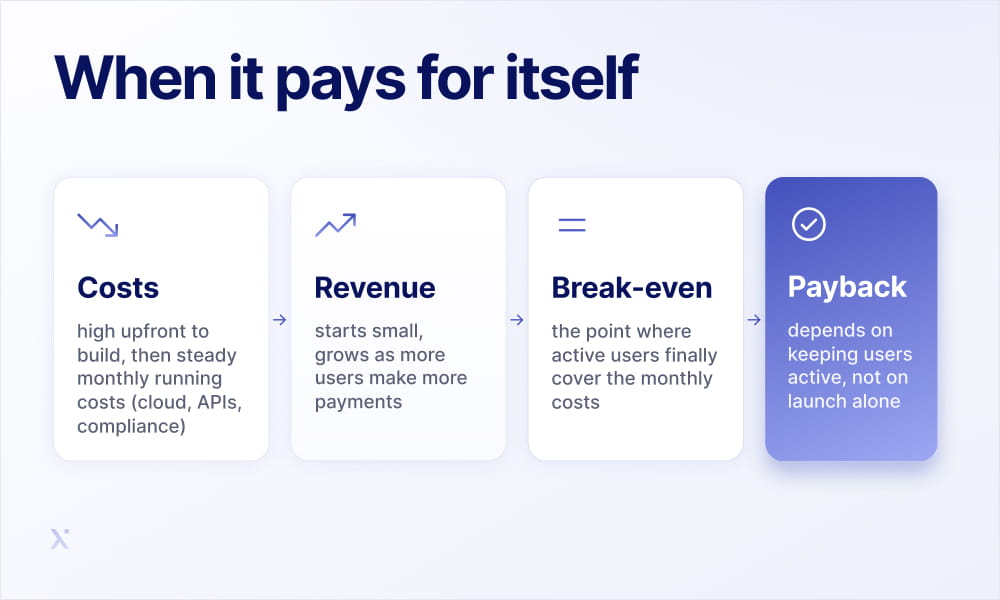
There is no set timeframe for the return on investment in P2P payment apps. Some products begin generating revenue soon after launch, while others require time to build a user base before transaction volumes become large enough to cover operating expenses. Business model, customer acquisition costs, monetization strategy, and ongoing infrastructure costs determine the payback period.
Common revenue sources
Payment apps rarely rely on a single source of income. Instead, they combine different revenue streams depending on the product, target audience, and stage of growth.
- Transaction fees charged for transfers or merchant payments
- Subscription plans with premium features and higher account limits
- Instant transfer fees for expedited withdrawals
- Interchange revenue generated from linked debit or prepaid cards
- Business accounts with paid financial tools and payment services
- Foreign exchange (FX) margins on international transfers
- Lending and credit products, where permitted by local regulations
- Partner services, such as insurance, investments, or rewards programs
Factors that affect ROI
Several factors influence how quickly a payment platform begins generating a return on investment:
- Customer acquisition costs
- User activity and transaction frequency
- Transaction volume and average payment value
- The way the platform generates revenue
- Ongoing operating and infrastructure costs
- Compliance and fraud prevention requirements
- Future expansion plans and new financial services
Recovering the initial investment usually comes down to one question: can the platform attract active users and keep them making payments? Products that continue expanding their customer base and introduce new ways to generate revenue are generally in a much stronger position than those that rely on launch alone.

Web3 Development Cost: Breaking Down What Really Drives the Price

Blockchain Game Development: Budgeting for Success in 2026
Why choose PixelPlex
Payment software combines financial infrastructure, security, compliance, and high-availability engineering in ways few digital products do. The right payment app development company should understand how financial systems work, how compliance affects development, and what it takes to build software that handles growing transaction volumes.
Financial software development expertise
Our financial software development services help banks, fintech companies, payment providers, and startups build payment products for real-world use. Whether the goal is to launch a new platform or expand an existing one, we focus on software that supports everyday financial operations, integrations, and regulatory requirements.
Blockchain and digital asset solutions
Beyond traditional payment systems, we develop blockchain-powered financial products, including crypto wallet development services, digital asset platforms, tokenization solutions, and cryptocurrency payment infrastructure.
Secure, scalable engineering
Building a payment platform is often a long-term investment. The architecture should support future integrations, larger transaction volumes, and changing business requirements without forcing the team to redesign the entire system every few years.
Long-term technology partner
Launching an application is just one stage in its lifecycle. We continue to support our clients with cloud resource optimization, infrastructure management, platform updates, security enhancements, DevOps, and the development of new features as their business needs evolve.

Top 10 AI Software Development Companies 2026

Top Full-Service Web3 Development Companies 2026
Conclusion
The foundation of a successful P2P payment application is laid long before development begins. Early decisions about product scope, architecture, compliance, and integrations shape everything that follows. While an MVP allows validation of a business idea with a smaller initial investment, expanding into new markets, supporting additional payment methods, or processing high transaction volumes introduces new technical and operational requirements that should be considered early on.
As the platform grows, maintaining it becomes more demanding. Integrations need to be kept up to date, regulations evolve, infrastructure must scale, and performance requires continuous attention.
Working with a team that provides payment software development services gives you access to the technical expertise needed to build a platform that handles real transaction volumes, integrates with the financial ecosystem, and continues growing without constant rework.
FAQ
Yes. A separate app isn’t always necessary. Banks and fintech companies often introduce P2P payments as a new feature within an existing mobile application, giving customers another way to transfer money without asking them to download a new product. The amount of development work is largely determined by the current platform and the systems already connected to it.
The choice starts with the product’s priorities. Organizations that need maximum performance or deep integration with platform-specific features often choose native development. Those looking to reduce development time and maintain a single codebase may find a cross-platform approach more practical. Experienced teams providing mobile app development services help evaluate these tradeoffs and recommend the approach that best fits the project’s technical and business requirements.
No. P2P payment apps typically rely on banks, card networks, and payment providers to move money, so blockchain isn’t part of the architecture. It becomes relevant only when the product is expected to support digital assets, crypto wallets, or cryptocurrency payments. In those cases, crypto payment solutions development provides the blockchain infrastructure needed to support these capabilities.
Most payment platforms aren’t built for today’s transaction volume alone. They’re designed with future growth in mind, whether that’s a seasonal increase in activity or a much larger user base a few years later. The underlying architecture makes it possible to expand processing capacity as demand grows while keeping the payment experience consistent.
Yes, but many organizations prefer a phased implementation. Launching in one market first allows teams to validate integrations, operational processes, and compliance before expanding to other countries. Target markets, regulatory requirements, and business goals shape the rollout strategy.
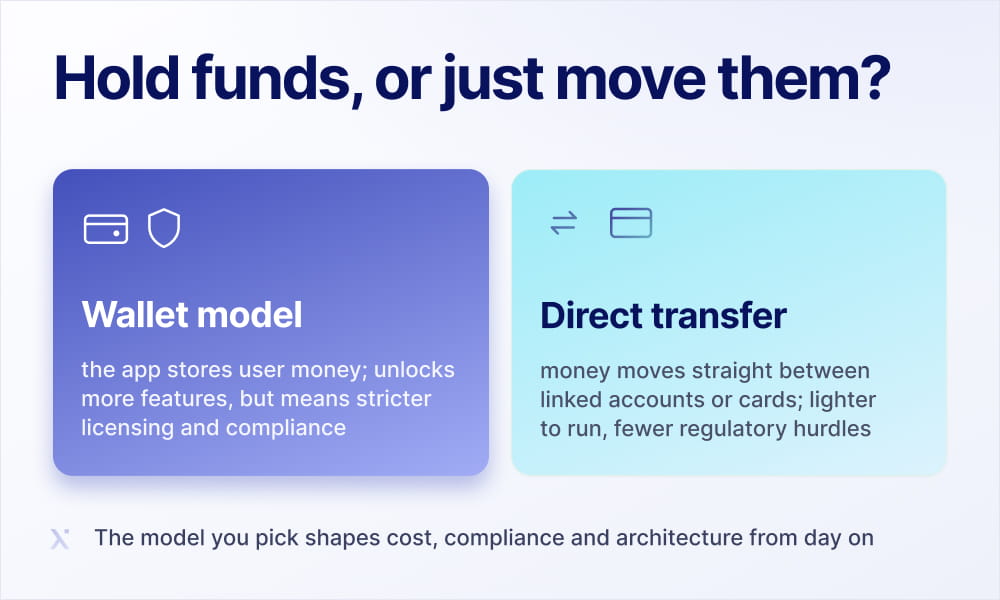
Yes. Digital wallets are only one way to build a payment product. Some applications transfer money directly between linked accounts or payment cards, while others let users hold funds inside the platform. The choice comes down to the services the platform will offer and the regulatory framework it must follow.