
From chatbots that actually understand you to apps that create content in seconds, generative AI is changing the way we build digital products. Behind every great AI app are powerful technology, highly skilled developers, and yes — probably a lot of coffee.
Software developers around the world work hard, but AI and generative AI development teams work even harder. The results of their efforts can already be seen across numerous industries.
Today, generative AI and support from a business process optimization consulting company are making a difference across marketing, sales, customer service, finance, and product development to automate tasks. Other industries like healthcare, manufacturing, and logistics are adopting it more gradually: they’re still exploring how generative AI can help solve challenges and improve their work.
But building a great generative AI solution takes more than just adding an AI model to an app. It requires the right technology, a clear strategy, and a deep understanding of how to turn AI capabilities into a truly helpful tool.
At PixelPlex, we help businesses bring their AI ideas to life through custom generative AI development services. With hands-on experience in building AI-powered solutions, our team is ready to share our insights on the entire development process.
Technical challenges of building generative AI applications
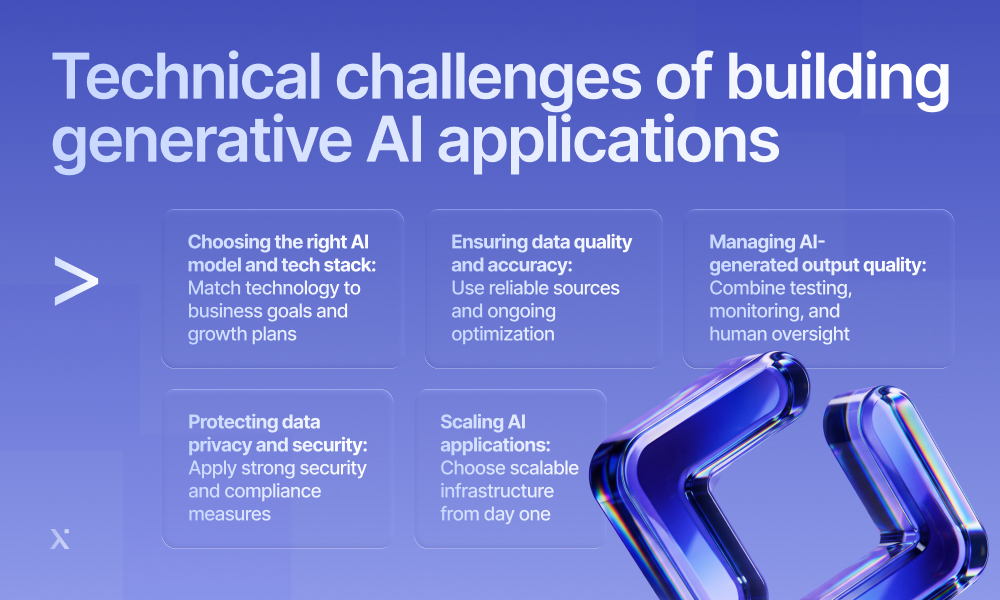
There is no doubt that generative AI development brings endless opportunities for businesses, but building an effective AI solution also requires overcoming challenges related to technology, data, security, and scalability.
Let’s take a closer look at the most common problems companies face during the generative AI software development process and see how to deal with them:
| Challenge | How to overcome it |
| Choosing the right AI model and tech stack | Select technologies based on your business goals, use case, performance requirements, and future growth plans |
| Ensuring data quality and accuracy | Use reliable data sources, proper data preparation, and ongoing optimization to improve AI performance |
| Managing AI-generated output quality | Use testing, monitoring, and human oversight to ensure responses are accurate, relevant, and useful |
| Protecting data privacy and security | Apply strong security practices, access controls, and compliance measures to keep data safe |
| Integrating AI with existing systems | Build flexible solutions that connect smoothly with current platforms and workflows |
| Scaling AI applications | Plan for growth by choosing scalable infrastructure and optimizing system performance |
| Controlling development costs | Start with clear goals and a focused MVP to validate ideas before expanding the solution |
With the right strategy and expertise, businesses can overcome these challenges and turn generative AI development opportunities into convenient solutions.

Introduction to Generative AI and the Innovative Solutions It Offers
![Generative AI Market Map: From History and State to Trends and Applications [With Infographic]](https://pixelplex.io/wp-content/uploads/2023/07/generative-ai-market-map-main-1600.jpg)
Generative AI Market Map: From History and State to Trends and Applications [With Infographic]
Technologies required for generative AI development
Depending on the project goals, developers use a combination of AI models, machine learning app development frameworks, and cloud platforms to create reliable AI applications.
Let’s explore the main technologies behind most generative AI development solutions:
| Technology | What it does | Examples of tools |
| Large language models (LLMs) | Generate and understand human-like text, power AI assistants, chatbots, and content-generation applications | GPT-4, GPT-5, Claude, Gemini, Llama |
| Machine learning frameworks | Help developers build, train, test, and optimize AI models | TensorFlow, PyTorch, Keras |
| Natural language processing (NLP) | Enables AI systems to understand, analyze, and generate human language | spaCy, NLTK, Hugging Face, OpenAI API |
| Deep learning technologies | Support advanced AI models that learn from large amounts of data and recognize complex patterns | PyTorch, TensorFlow, CUDA, DeepSpeed |
| Vector databases | Store and search AI-generated data efficiently to help models deliver more relevant and accurate responses | Pinecone, Weaviate, Milvus, ChromaDB |
| Cloud computing platforms | Provide the infrastructure, computing power, and storage needed to build and scale AI applications | AWS, Microsoft Azure, Google Cloud |
| AI APIs and integration tools | Allow businesses to connect AI models with existing applications and workflows | OpenAI API, Azure OpenAI Service, LangChain |
| Data processing and management | Collect, clean, organize, and prepare data for AI training and performance improvement | Apache Spark, Databricks, Snowflake |
| Security and monitoring tools | Help protect AI systems, monitor performance, and ensure reliable operation | Azure AI Content Safety, AWS Guardrails, LangSmith, Weights & Biases |
With so many AI technologies, platforms, and tools available, it can be easy to feel overwhelmed when choosing the right solution for your project. This is where AI consulting can help — experts can evaluate your goals, recommend the right technology stack, and guide you toward building an effective generative AI application.
What defines a winning generative AI application? Key factors
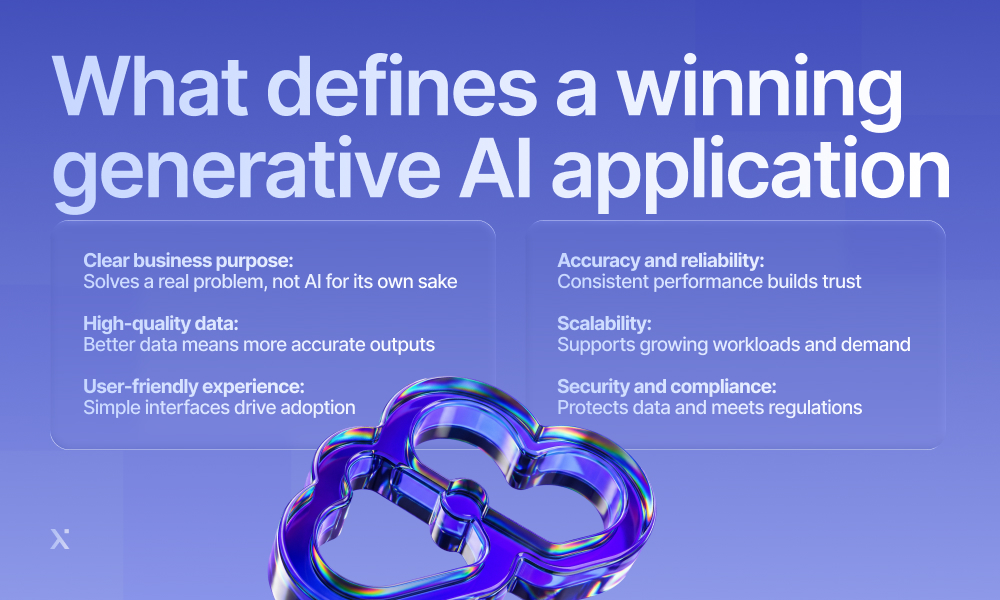
Successful generative AI applications deliver real value to users while remaining reliable, secure, and easy to use. The most effective generative AI development solutions focus on solving specific business challenges rather than using AI for its own sake.
Key factors include:
- Clear business purpose: the application should address a real problem or improve an existing process.
- High-quality data: better data leads to more accurate and relevant AI-generated outputs.
- User-friendly experience: simple, intuitive interfaces encourage adoption and maximize the productivity benefits of generative AI for software development.
- Accuracy and reliability: consistent performance helps build user trust.
- Scalability: the solution should be able to support growing workloads and user demands.
- Security and compliance: sensitive information must be protected, and regulatory requirements should be met.
- Continuous improvement: regular monitoring and optimization help maintain performance over time.
To maximize the benefits of generative AI development, organizations often rely on generative AI integration services that connect AI capabilities with existing systems, applications, and workflows. Effective integration helps businesses automate tasks, improve customer experiences, and optimize operations while ensuring security, scalability, and long-term performance.
By embedding generative AI into your current platforms, you can unlock hidden value in business data, streamline complex processes, and create better user experiences.
Successful generative AI use cases
Today, organizations and individuals use AI to generate a wide range of content and creative assets like text, software code, images, videos, music, and even 3D models. We all know ChatGPT, for example. This AI platform has become one of the most popular generative AI tools for creating content, answering questions, assisting with research, and improving productivity.
However, it is only one example of how generative AI is being used — many other platforms are transforming the way people create, design, develop, and communicate. Let’s take a look at them.
| Generative AI platform | What it generates |
| ChatGPT | Text, code, research, and conversational responses |
| GitHub Copilot | Code suggestions and programming assistance |
| Midjourney | High-quality images from text prompts |
| Kling AI | Realistic AI videos from text and image prompts |
| Suno | Original music and songs from text descriptions |
| ElevenLabs | Realistic AI voices and speech |
ChatGPT
ChatGPT is one of the most widely adopted AI applications in the world and is often the first experience people have with generative AI. OpenAI reports more than 900 million weekly active users and over 50 million paying subscribers, so it is one of the fastest-growing consumer technology products ever.
This generative AI platform uses large language models trained on vast amounts of text and code to generate human-like responses, assist with research, create content, analyze information, and support business workflows.

ChatGPT Integration: How Companies Turn AI Into Real Operational Advantage
GitHub Copilot
GitHub Copilot is another successful example of generative AI in software development. Often described as an AI pair programmer, it helps developers write code faster by generating suggestions directly within their development environment.
Its popularity shows how quickly AI coding tools are being adopted, with over 20 million all-time users.
Copilot is trained on large collections of publicly available code and uses advanced language models to predict functions, complete code blocks, explain logic, and assist with debugging. By supporting developers throughout the coding process, it helps improve productivity, reduce repetitive tasks, and make software development more efficient.
Midjourney
Midjourney became one of the most popular AI image generators, but its beginning was far from a typical tech launch. Instead of launching as an app or a website, Midjourney started as a simple Discord bot. Users could join a Discord server, create a text prompt, and receive AI-generated images within several seconds.
This unusual approach helped the platform grow quickly through online communities, where people shared their creations and experimented with AI art.
Today, Midjourney has nearly 20 million users and has expanded beyond Discord with a dedicated web platform. It allows users to create illustrations, concept art, marketing visuals, and realistic images using simple text descriptions.
Kling AI
Kling AI is a generative AI video platform developed by Kuaishou, a Chinese technology company known for its short-video platform. It gained attention after launching in 2024 with the ability to create realistic videos from text and image prompts.
The platform uses advanced AI video models that understand text descriptions, objects, motion, and scene relationships to create dynamic videos. It is designed to produce more natural movement and longer, more consistent scenes compared with many early AI video generators.
Kling AI quickly gained popularity among creators, marketers, and filmmakers, attracting millions of users within its first months after launch. Today, the platform has reached over 12 million monthly active users and expanded its global reach to more than 100 million users across 224 countries and regions.
Suno
Suno demonstrates how generative AI development can transform music creation. The platform allows users to generate complete songs with vocals, lyrics, and instrumentals from simple text prompts. The platform combines language models with audio-generation technology to create original music across different genres and styles.
Since its launch, Suno has been used by more than 100 million people worldwide, including music enthusiasts and professional creators.
ElevenLabs
ElevenLabs is a leading platform for AI voice generation. It can create realistic speech from text, clone voices with permission, and support content localization across multiple languages. The platform uses advanced speech synthesis models to capture natural intonation, emotion, and pronunciation. Users rely on this AI tool for applications such as audiobooks, podcasts, customer service, and digital media.
Together, these examples show that generative AI is no longer limited to a single type of content. From text and code to images, videos, music, and speech, successful platforms are transforming how people create, communicate, and work.
Beyond creative content, generative AI is also opening new possibilities in areas like AI game development, where it helps create game assets, generate environments, improve storytelling, and streamline the development process.

Top 10 AI Development Companies in 2026

AI Integration for Business: A Practical Guide to Efficiency and Profit
How to build a generative AI solution: a step-by-step guide
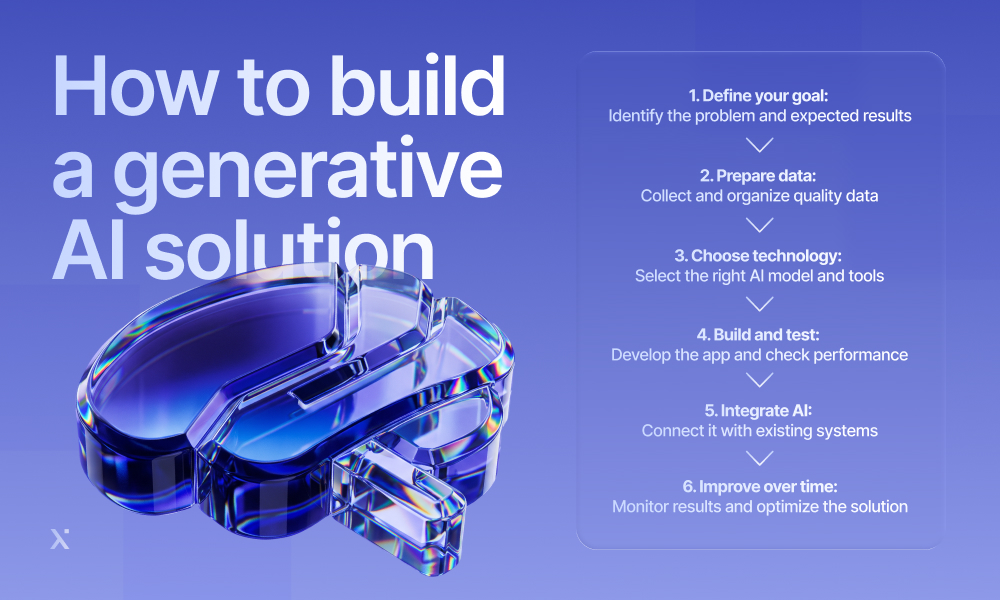
The generative AI development process involves several important stages, from defining an idea to launching and improving a complete AI-powered solution. Whether you want to build a customer support assistant, a content generation tool, or a custom AI application for your business, each step ensures that the final product is useful, reliable, and aligned with your goals.
Below are the main steps to follow when building a generative AI solution.
Step 1. Define your business goal
You can start the generative AI development process by identifying the problem your application should solve. Your team should define the main goal, target users, and expected results. A clear purpose helps you choose the right AI approach and avoid developing a solution that does not provide real value.
Step 2. Prepare and analyze your data
You will need high-quality data to train, customize, or improve your AI solution. Your team will collect, organize, and review the data to make sure it is accurate, relevant, and secure. This stage is a key part of the machine learning development process because better data leads to better AI performance.

Inside Machine Learning Development: What Businesses Should Know
Step 3. Choose the right AI model and technology
You can select an existing AI model or develop a customized solution based on your business needs. Your developers will evaluate different models, tools, and technologies to find the best option for your application’s goals, budget, and expected scale.
Rely on professional generative AI development services to make the right technology choices, build a solution that fits your goals, and open up the full potential of AI.
Step 4. Develop and test the application
Your team will build the AI application, connect it with your existing systems, and test how it performs in real-world situations. You will need to check the quality of AI outputs, user experience, speed, and reliability before launching.
Step 5. Integrate AI into your business workflow
You can start integrating your AI solution into daily operations once the application is ready. Your team will connect it with existing software, platforms, or databases to make sure it works smoothly and supports your business processes.
Step 6: Launch, monitor, and improve
After launch, you will need to track performance and collect user feedback. Your team will continue improving the AI application, updating data, fixing issues, and adding new features to keep the solution effective over time.
| Step | What to do |
| Define your goal | Identify the problem and expected results |
| Prepare data | Collect and organize quality data |
| Choose technology | Select the right AI model and tools |
| Build and test | Develop the app and check performance |
| Integrate AI | Connect it with existing systems |
| Improve over time | Monitor results and optimize the solution |
All in all, we highly recommend following a structured approach and partnering with experienced generative AI developers to create reliable AI solutions that scale, adapt, and deliver long-term business value.

The Complete Guide to AI Agents Development in 2026

Custom AI Model Development: Tips and Tricks
How much does generative AI development cost?
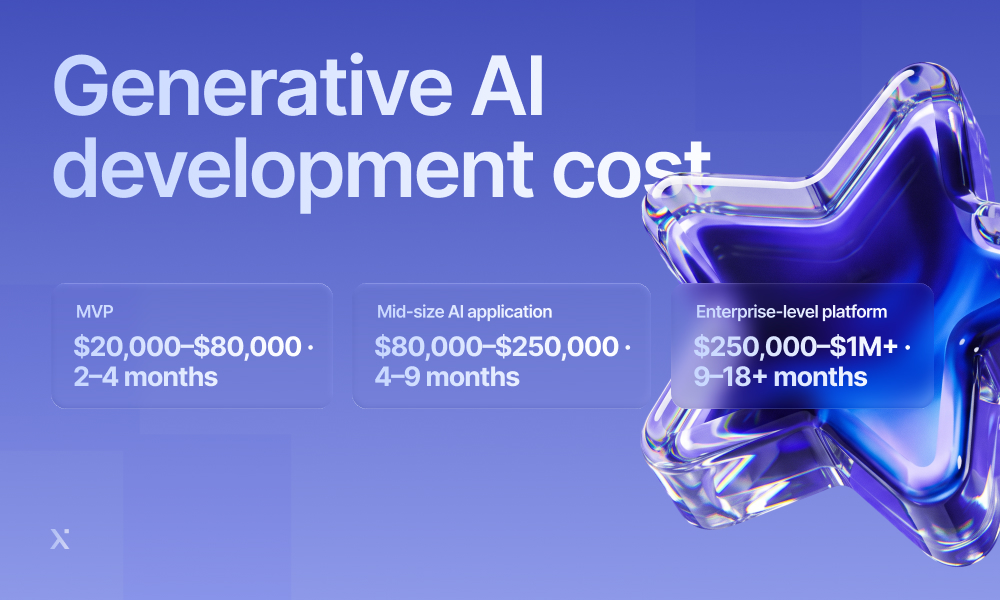
The cost of generative AI development varies a lot and depends on the complexity, features, data requirements, and level of customization. A simple MVP will require fewer resources, while enterprise-level platforms need more advanced technology, integrations, and ongoing support. Here is exactly what you can expect.
MVP
An MVP is a basic version of your AI application designed to test the idea, validate user demand, and collect feedback before investing in a full-scale product. Partnering with an experienced AI MVP development company can help you navigate early technical challenges and bring this initial version to market faster.
The scope usually includes:
- Basic AI functionality and core features
- Integration with an existing AI model or API
- Simple user interface
- Basic testing and performance checks
- Initial deployment setup
| Estimated cost | Timeline | Main factors affecting price |
| $20,000-$80,000 | 2-4 months | Features, AI model choice, integrations |

AI MVP Development: How to Validate Ideas Fast Without Breaking the Budget
Mid-size AI application
A mid-size AI application includes more advanced features, better customization, and deeper integration with business workflows. It is suitable for companies that need a reliable AI solution for regular use.
The scope usually includes:
- Custom AI features and workflows
- Integration with business systems
- Improved user experience and interface design
- Data processing and AI model customization
- Security and performance optimization
| Estimated cost | Timeline | Main factors affecting price |
| $80,000-$250,000 | 4-9 months | Customization, data needs, system integrations |
Enterprise-level platform
Enterprise AI platforms are built for large-scale business operations and usually require advanced architecture, high security, and complex integrations.
The scope usually includes:
- Custom AI models and advanced features
- Integration with multiple internal systems
- Large-scale data processing
- Enterprise security and compliance
- Ongoing maintenance and AI improvement
| Estimated cost | Timeline | Main factors affecting price |
| $250,000-$1M+ | 9-18+ months | Scale, security, advanced AI capabilities |
The final cost of a generative AI project depends on your specific goals, technical requirements, and business needs. Professional AI app development services can help you evaluate the full scope, choose the right approach, estimate costs accurately, and avoid unnecessary expenses during development.
Why choose PixelPlex for generative AI development
PixelPlex is a trusted generative AI development company that helps businesses turn AI potential into results. From deep learning and computer vision to natural language processing and custom generative AI solutions, we develop intelligent systems that solve complex business challenges, improve efficiency, and support long-term growth.
With experience across multiple industries, we understand that every sector faces unique challenges and opportunities. The table below highlights how we apply generative AI and related technologies in different domains.
| Industry | How we help |
| FinTech & banking | Build AI-powered assistants, automate financial reporting and document processing, enhance fraud detection, generate insights from large datasets, and improve customer support |
| Retail & eCommerce | Create personalized shopping experiences, power virtual shopping assistants, generate product descriptions, optimize marketing content, and improve demand forecasting |
| Supply chain & logistics | Automate document processing, generate operational insights, optimize inventory management, improve demand forecasting, and support route and logistics planning |
| Healthcare | Develop AI assistants for patients and clinicians, automate medical documentation, analyze healthcare data, support research activities, and enhance patient engagement |
| Real estate | Generate property descriptions and marketing materials, automate document review, power virtual property assistants, analyze market trends, and streamline client interactions |
| Oil & gas | Automate technical documentation, support knowledge management, analyze operational data, improve maintenance planning, and assist with risk assessment and compliance processes |

Exploring Key Generative AI Applications and Use Cases across Industries
To help organizations grab these opportunities, we offer a comprehensive suite of generative AI services covering every stage of the development lifecycle:
- AI development services
- Custom generative AI development services
- Generative AI consulting
- AI model training and fine-tuning
- NLP solutions
- Computer vision development
- AI integration and deployment
- Ongoing AI support and maintenance
Whether you’re launching a new AI initiative or enhancing existing processes, our developers can build a solution tailored to your goals.
The future of generative AI: trends and predictions
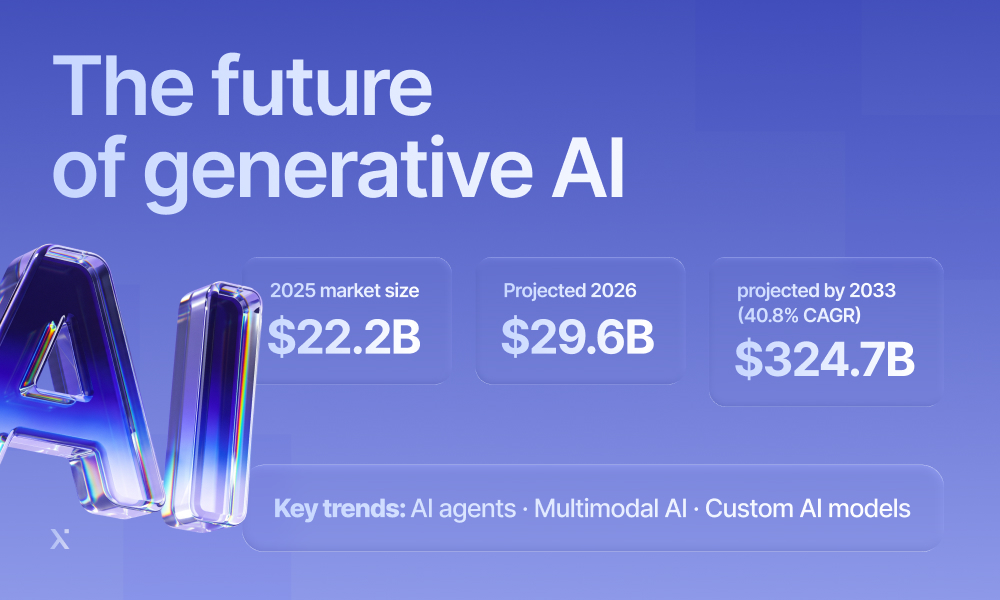
According to Grand View Research, the global generative AI market size was valued at $22.2 billion in 2025 and is expected to reach $29.6 billion in 2026. The market is then projected to grow significantly, reaching $324.7 billion by 2033 at a CAGR of 40.8% from 2026 to 2033.
This growth shows that generative AI is quickly becoming a key technology for businesses around the world. In the coming years, AI will be more accessible and widely adopted across industries. Companies will use it to automate everyday tasks, improve customer experiences, and make smarter decisions.
Several trends will shape the next stage of generative AI development:
- AI agents: AI agents will become more common and help businesses handle complex tasks with less human involvement.
- Multimodal AI: AI systems that can understand and generate text, images, audio, and video will improve how people interact with technology.
- Custom AI models: Companies will invest more in AI models trained on their own data to create more accurate and industry-specific solutions.
As generative AI adoption grows, businesses will also need expert guidance to identify the right use cases, choose the best technologies, and build effective AI strategies. Generative AI consulting will become an important part of successful AI adoption, as it will enable companies to move from ideas to practical solutions and maximize the benefits of these technologies.
In addition, AI will play a bigger role in areas such as content creation, software development, healthcare, finance, and business automation.
FAQ
Yes, it is possible to build your own generative AI app from the ground up. However, you will need a skilled development team with expertise in AI, machine learning, data engineering, and software development to handle the process.
You will need relevant, high-quality data related to your business use case. This may include documents, customer data, product information, internal knowledge bases, or industry-specific content that helps the AI generate more accurate results.
Of course. Many businesses use existing models from platforms like OpenAI, Google, or Anthropic and customize them for their specific needs. This approach can reduce development time and costs compared with building an AI model from scratch.
Generative AI can be applied across many industries, including healthcare, finance, retail, education, manufacturing, and entertainment. Businesses use it for tasks like customer support automation, content creation, data analysis, personalized recommendations, and internal process optimization.
How do you make sure a generative AI app provides accurate results?
Developers improve accuracy through quality data preparation, model customization, testing, monitoring, and techniques like retrieval-augmented generation (RAG). Regular updates and performance checks help maintain reliable AI outputs.
Security depends on how the application is designed. Professional AI development includes data protection, access controls, secure integrations, and compliance measures to reduce risks and protect sensitive information.