
AI isn't going to replace your workforce, but a competitor using AI absolutely will. The businesses dominating the next decade will be the ones that stop hesitating and start building. It’s time for companies to allocate resources for AI agent development to forge ahead of the competition.
The AI agents market is growing steadily. According to Grand View Research, the market reached $7.63B in 2025. This figure is expected to grow to $182.97B by 2033. The triggers that cause such a considerable increase are the necessity for automation and personalized customer service, as well as technical advancements. Other reliable sources also analyze the AI agent’s domain and make predictions. For example, Statista predicts the growing number of operational AI agents. McKinsey mentions that agentic AI will account for over 60% of the total new value that AI is projected to add to marketing and sales functions.
In this overview, we have consulted our AI experts and asked them questions about AI agents development trends, how to build AI agents, and how much the process costs. Dive deep into reading to find the answers to these questions and more.
Is this already the future?
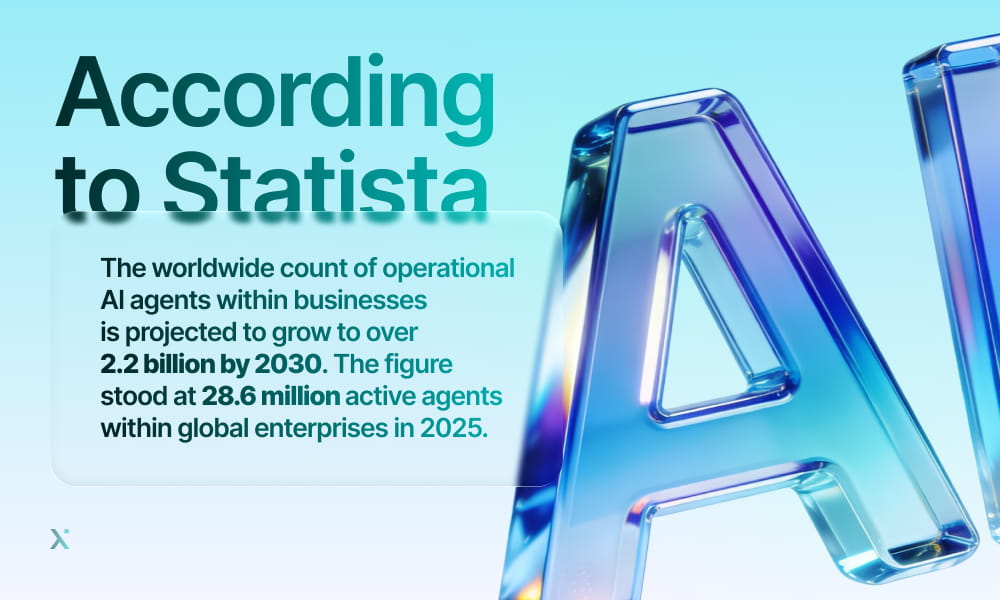
Various research agencies examine AI agents and provide data that emphasize the same idea. Agentic AI will penetrate deeper into business operations as it becomes more customizable and stimulates better performance and advanced productivity. Microsoft mentions 6 key AI trends expected in 2025. They all demonstrate that AI is shifting from simply being a productivity tool to acting autonomously to execute tasks and streamline workflows.
- AI models will be tailored to certain industry needs. Agents will no longer be universal (i.e., superficial), but more specific and deep.
- AI agents will handle complex and repetitive tasks. Technical and non-technical experts will be able to build their own customized agents.
- Everyday AI companions like Microsoft Copilot will help with summarizing information, making lists, and providing other assistance in daily life.
- Green AI will work on sustainable energy resources, such as solar, wind, nuclear, and geothermal power. Therefore, AI technologies will produce zero waste by 2030.
- Responsible AI will ensure AI apps are safe and all risks of data leakage or AI “hallucinations” are minimized.
- Scientific breakthroughs will be driven by AI. It will change and accelerate advancements in such areas as weather forecasting, pharmacy, public health, and tackling climate change.
The Double-Edged Sword: How AI Is Redefining Cybersecurity in 2026

AI for Drug Development: How to Turn Scientific Data into Better Decisions
What are AI agents?
In the current reality, it seems that even a kid can easily answer this question. AI agents help with analyzing information, making decisions, taking actions depending on the situation and bringing certain outcomes. Microsoft cites more than 1,000 examples of how its AI solutions have been implemented by companies across various industries.
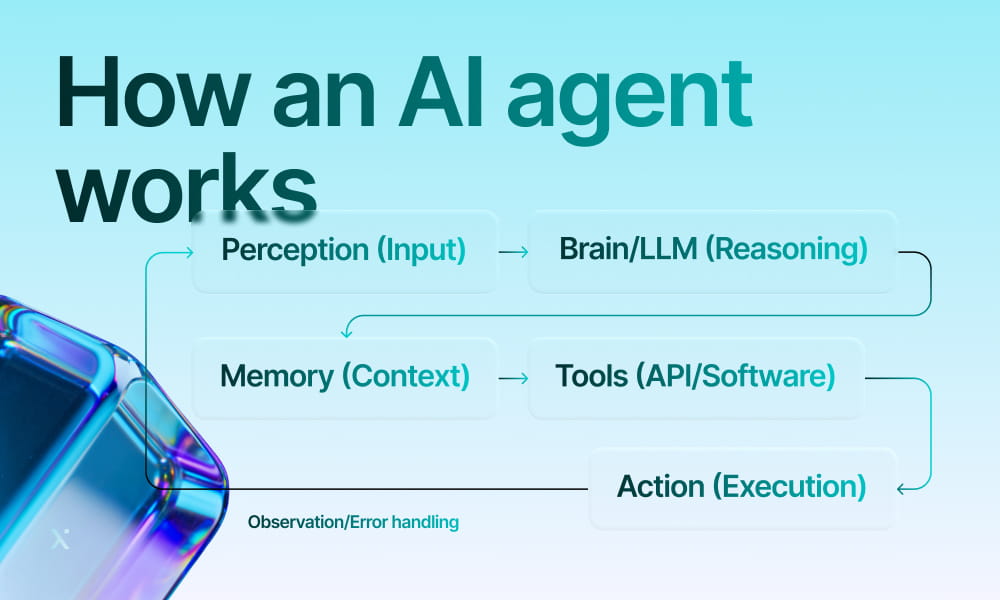
The scheme above illustrates the principle of AI agent functioning. It is an autonomous system that solves complex problems through a continuous loop. And here are the components:
- Perception: The cycle begins when the agent receives data (input). This could be a user’s prompt, an event trigger from a system, or the result of a previous step.
- Brain / LLM: This is the core cognitive engine. The Large Language Model analyzes the input, breaks the final goal down into smaller steps, and decides on the best strategy to solve the problem. An LLM development company helps to fine-tune and clean the proprietary data.
- Memory: Before finalizing its plan, the brain accesses its memory. It retrieves short-term memory (what has happened so far in the current task) and long-term memory (rules, past experiences, or specific user data). This ensures the agent doesn’t lose track of the main goal and uses past context to make better decisions.
- Tools: Because the LLM’s native ability is mostly just text generation, it needs “hands” to interact with the real world. The agent selects specific tools, such as web browsers, code interpreters, calculators, or external software APIs, to execute its current plan. Software integration services help connect these external tools with the systems an agent needs to use safely and reliably.
- Action: The agent actively uses the chosen tool. This could be running a Python script, querying a database, or sending an HTTP request to an external service.
- Observation: The cycle doesn’t end at execution. The output of the action, whether it is a successful data retrieval or an error message, is routed directly back to the first step (Perception). If the action is successful, the agent observes the new data and reasons about what the next step should be. If the action fails, the agent observes the error, processes why it happened, and tries a different tool or approach on the next loop until the goal is achieved.

What are AI agents? Key Types, Examples, and Benefits

AI Integration for Business: A Practical Guide to Efficiency and Profit
Types of AI agents
There are various approaches to AI agent categorization. They can be classified according to the system behind (single-agent, multi-agent), application area (customer service, supply chain assistant), roles (virtual colleague, code generator), type of technology (deep learning, machine learning), etc.
Single-agent systems are more popular as they are easier to develop and implement. The architecture and debugging process are vastly simpler than coordinating multiple AI models, so businesses are able to enhance efficiency rapidly. However, the trend is likely to shift to multi-agents and even so-called “AI-teams”. Such software allows for having a separate agent for each task: one is gathering the data, the second analyzes it, and the other generates a strategy. It’s exactly where the foreman AI development companies are. Frameworks like Microsoft’s AutoGen are already being used to create specialized agent swarms where a researcher agent, a writer agent, and a QA agent collaborate on a single prompt. Dividing labor among specialized agents heavily reduces errors and hallucinations. Seems like there’s no space for a human? Well, that might be true for the distant future. Today, AI systems still need a person to control the process and improve the outcome, which is known as the Human-in-the-Loop concept.
Among the diverse spheres of AI agent applications, we can distinguish the most popular use cases. What makes them so easily adaptable? Clearly, the fact that they address employees’ biggest pain points, such as:
- Lack of context: Modern agents provide context-aware retrieval and handle specific tools with high accuracy. They examine internal Q&A, legal queries, and CRM entries to provide tailored outcomes.
- Fragmented workflows: AI agents are able to handle multi-step, rules-based pipelines. Whether it is automated approvals or data syncs, these agents ensure smooth and interconnected operations.
- Time-consuming tasks: Integrating AI agents in software development, such as coding agents and UI interaction bots, saves time and money. These systems can accelerate software development by 10x.
- Insufficient scalability: Voice agents and specialized support bots provide natural, fast, and continuous communication, remaining highly functional even when business models scale rapidly.
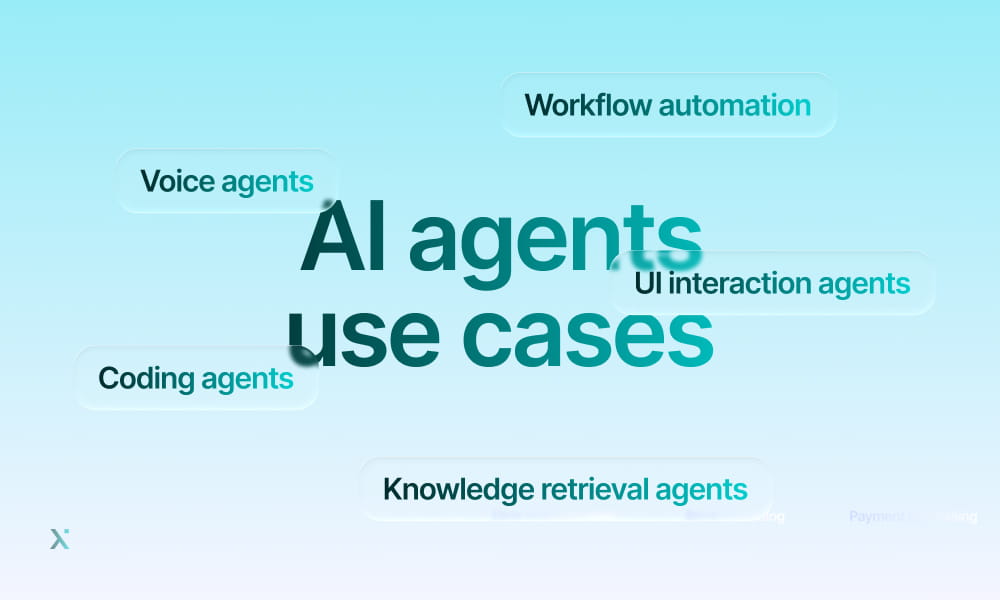
Therefore, there are five most popular AI agent use cases:
1. Voice agents
Voice agents are successfully used in customer service, sales calls, and healthcare triage. They deliver natural communication and are available 24/7. An AI voice agent development company creates assistants that handle routine tasks like answering support tickets, qualifying leads, or conducting interviews, therefore, providing scalability for growing businesses.
2. Knowledge retrieval agents
AI copilot development services enable agentic RAG that transforms basic search into context-aware assistants. These agents surface relevant information, live documentation, and dynamic internal Q&A. Enterprise AI development applies agentic RAG because it focuses strongly on providing exact, hallucination-free answers directly from company data. These agents are best for sales enablement, policy lookups, and legal queries.
3. Workflow automation
Workflow automation agents handle multi-step, rules-based tasks without manual effort. Think of them as smart orchestrators that automate approvals, onboarding, and data synchronization. Supported by a business process optimization consulting company, they help build seamless connections between operational software across departments like HR, procurement, or marketing. The best AI agents for research and development are able to speed up the initial step of the development process.
4. UI interaction agents
UI interaction agents operate like supercharged Robotic Process Automation. They use web browsers exactly like a human would: clicking, typing, and navigating user interfaces intelligently. They help businesses automate manual digital operations like form-filling, report downloading, and web scraping.
5. Coding agents
Coding agents are AI agents for software development. They act as your peer programmer. They can review, debug, generate, and test code autonomously. They accelerate software development and are perfect for dev teams dealing with high scaling demands and tight deadlines. Coding AI agents for software development perform frontend scaffolding, backend debugging, and testing suites.
Here are the agent types and their real-world examples:
| Type of AI agent | Real-world examples of tools |
| Multi-agent swarms (AI-teams) | Microsoft AutoGen, CrewAI, LangGraph (Frameworks for coordinating specialized agent roles) |
| Voice agents | Vapi, Bland AI, Retell AI, Sierra (Platforms for building conversational, low-latency phone agents) |
| Agentic RAG | Glean, Dust, Mendable (Enterprise knowledge assistants that securely search and cite internal documents) |
| Workflow automation | Zapier Central, n8n, Make (Smart orchestrators that connect APIs and automate multi-step business pipelines) |
| UI interaction agents | MultiOn, Skyvern, Anthropic Computer Use (Agents that navigate web browsers, click, and fill out forms autonomously) |
| Coding agents | Cursor, Devin, GitHub Copilot Agent Mode, Sweep AI (Autonomous pair programmers that edit files, run tests, and debug) |
How to create AI agents?
Today, the barrier to start gaining agentic AI benefits is lower than ever due to various agentic AI development platforms, frameworks, and tools, some of which are even open-source. Here is the core strategy to get your autonomous system off the ground rapidly, without draining your budget:
1. Define a goal
Do not try to create a “do-it-all” virtual colleague. Define a specific employee pain point, such as routing customer support tickets or parsing incoming invoices.
Expert hint: Narrow scopes reduce hallucination risks, require vastly simpler architecture, and prove ROI much faster.
2. Choose the foundational brain
You can avoid training an LLM. Leverage existing models via APIs.
Expert hint: Heavyweight commercial models are great for complex reasoning, but smaller, open-source models work great for simpler, repetitive tasks. This reduces long-term API costs.
3. Adding enough tools
Connect your agent to the tools it needs to execute its specific plan, like an email client, a web scraper, or a complex API built via custom CRM development services.
Expert hint: Use low-code or no-code orchestration frameworks (like LangChain or Zapier Central) to visually connect these tools. This saves developers time and money.
4. Build the context engine
Use RAG development to feed an agent with your company’s specific data and give it access to relevant internal knowledge.
Expert hint: Start by dropping your standard operating procedure PDFs into a simple, open-source vector store to give your agent hallucination-free knowledge.
5. Design a Human-in-the-Loop workflow
Design the pipeline so the agent does the heavy lifting (drafting the response, querying the data, or generating the code) but flags the final step for a human to review and approve.
Expert hint: This approach helps to cope with and minimize errors and provides the feedback loop that your agent needs to improve its reasoning over time.
Here is a quick breakdown of the most popular frameworks and tools used in AI agents development:
| Framework / Tool | Pricing model | Key benefit & best use case |
| OpenAI Assistants API | Pay-per-token (Variable) | Zero infrastructure. The fastest way to launch a single, highly capable agent. Best for straightforward chatbots and basic document retrieval. |
| LangChain / LangGraph | Free (Open Source) + API costs | Ultimate flexibility. The industry standard for connecting LLMs to external tools and databases. Best for complex, custom workflow automation. |
| CrewAI / Microsoft AutoGen | Free (Open Source) + API costs | Collaborative power. Designed specifically for building “AI teams.” Best for multi-agent swarms where specialized roles (e.g., researcher, writer, QA) collaborate on a single task. |
| Flowise / Zapier Central | Subscription / Usage-based | Rapid prototyping. Visual, drag-and-drop interfaces that require little to no coding. Best for non-developers and teams looking to automate UI interactions and basic workflows quickly. |
Don’t build the entire tool on day one. MVP development services allow for building just enough of the agent to solve the core problem and testing its value in the real world before committing massive resources. Tools like LangChain or OpenAI Assistants may bring you to the market faster. If users access the agent through a browser, MVP web development services can help you build a simple interface for submitting tasks and reviewing results. You can release the agent into a controlled environment (like a single department’s workflow) and gather real data on how it handles edge cases and user interactions before investing in complex, multi-agent swarms. An MVP approach means your AI agent starts generating ROI almost immediately. You can then use those savings to fund its future iterations.

Fintech’s New Brain: Why Machine Learning is the Real Reason Your Bank Suddenly Understands You
From Data to Decisions: Machine Learning Development for Supply Chain
Industries transformed by AI agents
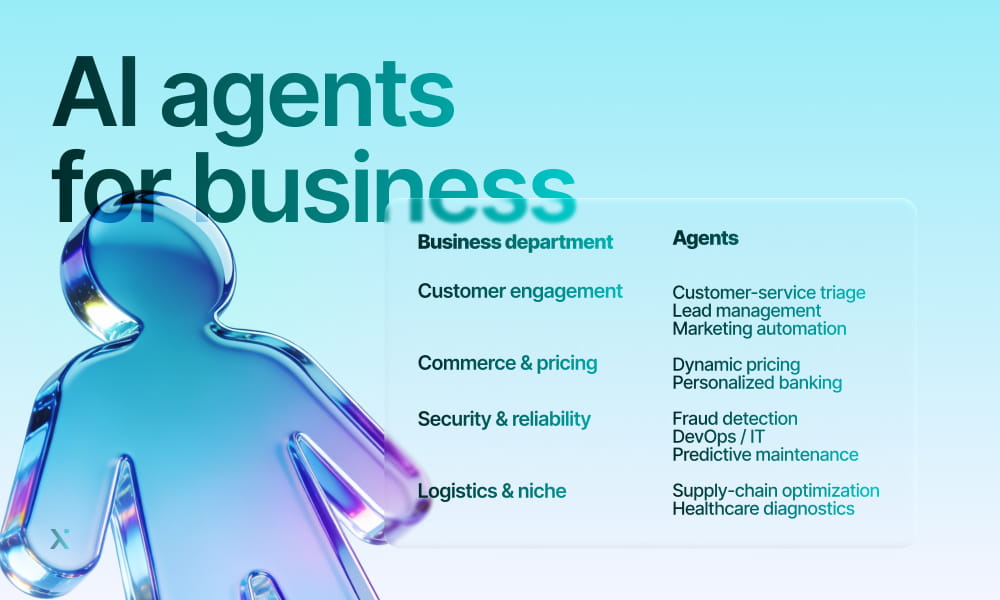
Here are the key industries that are successfully applying AI agents development today, and the use cases driving their growth:
Customer service & sales
Companies that offer custom AI chatbot development create triage agents that can read incoming emails or chats, tag intents, and automatically route complex cases to the right human rep. Similarly, lead-management agents analyze CRM records and schedule demos 24/7. Platforms in various domains (e.g., real estate) and call centers use these agents to shorten first-response times by up to 60% and boost conversion rates.
Finance & banking
Dealing with clients’ money and assets requires robust security measures. ML for fraud detection helps screen transactions the moment they hit the gateway. Algorithms assess dynamic behavioral patterns and self-retrain to outpace hazardous tactics. On the consumer side, personalized banking agents assist in examining trends, predicting cash-flow crunches, and automating savings. Furthermore, the integration of agent-driven payment standards, such as the Agent Payments Protocol (AP2), ensures that when these personalized banking agents execute transactions on behalf of users, the actions are secure.
Supply chain & logistics
Supply-chain optimization agents facilitate the routine of the employees by tracking real-time demand, automatically reallocating warehouse stock, and rerouting shipments on the fly when disruptions occur. Industry leaders like DHL have partnered with AI startup HappyRobot to integrate autonomous AI agents into its global operations. Agents help to arrange appointment scheduling and driver follow-up calls. It reduces manual effort and improves response times.
Manufacturing & industrial
Predictive analytics solutions include the creation of predictive-maintenance agents to watch factory machines by ingesting vibration and temperature data every second. When they spot early component wear, they autonomously forecast failure dates, book work orders, and order spare parts. Siemens plans to achieve a 50% increase in productivity due to AI agents development for industrial automation.
Healthcare
Agents aggregate disparate medical data, such as EHR notes, MRI images, and live vitals, into a unified database. They flag odd lab spikes, prioritize high-risk patients on clinician dashboards, and suggest evidence-based treatment options. The Mayo Clinic mentions such results of AI-powered triage as shortened “door-to-balloon” time from 64.5 minutes under conventional triage down to 53.2 minutes. Besides, for higher-risk patients (indicated by an ASAP clinical risk score of 3 or higher), the median wait time from the door to receiving an electrocardiogram decreased from 30 minutes to just 6 minutes.
Have a look at the key applications of AI agents in various domains and their business value:
| Industry / domain | Key agent applications | Quantifiable business value |
| Healthcare & Wellness | Diagnostic detection, telehealth triage, and advanced data analytics | Up to 95% accuracy in disease detection, actively outperforming traditional diagnostic methods |
| Finance | Automated trading execution and real-time anomaly screening | 75% improvement in fraud detection rates and 65% of all daily trades executed autonomously |
| Enterprise & retail | Routine task automation, dynamic pricing, and document processing | 70% increase in routine task productivity and a 55% reduction in document processing times |
| Manufacturing & autonomous systems | Supply chain optimization, predictive maintenance, and autonomous driving | 92% accuracy in safely handling unexpected, real-world scenarios within autonomous systems |
The business value in the table above is taken from the internal PixelPlex research. The data highlights exactly where the autonomous systems are delivering the most profound business value today. It is easy to see why healthcare, finance, retail, and manufacturing are experiencing the largest adoption rates. The ROI is irrefutable. Integrating AI agents is rapidly shifting from a competitive advantage to a baseline industry standard.

Top 10 AI Development Companies in 2026

ChatGPT Integration: How Companies Turn AI Into Real Operational Advantage
Top AI agents software development companies
Microsoft
Microsoft is the primary provider of platforms that help create, deploy, and manage autonomous agents. Many businesses already use their tools. Microsoft Copilot has 33 million active users. Teams that adopted Microsoft 365 Copilot report 9.4% higher revenue per seller, 20% more closed deals, and a 12% faster resolution time for customer cases. Beyond Copilot, Microsoft has rolled out 10 new autonomous agents for Dynamics 365. These include the Sales Qualification Agent (which prioritizes inbound leads and drafts emails) and Reconciliation Agents that automate the most labor-intensive parts of the financial close process.
Salesforce
Salesforce is democratizing agent creation with Agentforce and its AI-powered Agent Builder. It allows businesses to create custom agents using simple natural language descriptions (low-code) while retaining pro-code tools for complex scaling. Salesforce recently partnered with IBM. This integration combines Agentforce with IBM’s WatsonX, allowing enterprises to deploy AI agents deep within their own IT infrastructures. It results in maintaining rigorous oversight over proprietary data.
GitHub
In February 2025, GitHub introduced Agent Mode for GitHub Copilot. It took coding assistants to the next level. It turned an autocomplete assistant into an autonomous worker. Agent Mode can independently interpret high-level requests, generate code across multiple files, and actively debug its own output with minimal human intervention.
PixelPlex
There’s no doubt that tech giants provide excellent generalized platforms. However, out-of-the-box solutions often fall short when a business requires highly specialized, secure, or niche workflows. At PixelPlex, our experts combine deep knowledge in machine learning, data science, and blockchain technology to engineer tailored AI agents from the ground up. We know how to fit agents to complex financial transactions or highly customized workflows.
Therefore, it depends on the situation whether to choose a ready-made solution or address an expert partner like PixelPlex. Developing a custom AI agent might be rather costly, however, it provides a perfect match with business requirements and full control.
Here is a succinct breakdown of the core trade-offs between purchasing a tool and collaborating with an expert development partner:
| Decision factor | Partner / agency | Ready-made solution |
| Time to market | Moderate. Weeks or months to scope, design, and deploy a custom functional MVP | Immediate. Instant deployment out-of-the-box |
| Cost structure | High initial CapEx. Significant upfront investment for development and project milestones | Recurring OpEx. Low barrier to entry with predictable subscription pricing (per user/month) |
| Customization & fit | Bespoke. Built exactly to your specifications | Standardized. Highly powerful within its native ecosystem. Offers limited flexibility for specialized workflows |
| Control & IP | Full ownership. You own the final Intellectual Property, custom algorithms, and maintain absolute control over where and how your data is processed and hosted | Vendor-controlled. You retain rights to your data, but rely entirely on the vendor’s “black box” models, infrastructure, data governance, and broader privacy policies |
| Maintenance | SLA-dependent. Requires ongoing retainers or internal resources to patch, update, host, and scale the custom architecture over time | Vendor-managed. Continuous maintenance, bug fixes, security patches, and new feature rollouts are handled by the provider and included in the subscription |

Machine Learning Development for eCommerce: Building Smart Stores that Learn
Enterprise Machine Learning for Real Estate: Build or Integrate?
How much does it cost?
The development lifecycle usually includes five phases: requirements planning, data preparation, model training, testing, and deployment. Because of this phased approach, the true cost varies wildly depending on your goals. A basic, rule-based assistant might cost around $10,000 to get off the ground, while a fully autonomous enterprise solution requiring custom machine learning can scale over $300,000.
Here is what you can expect to spend based on the agent’s complexity and target capabilities:
| Complexity level | Estimated cost range | Key capabilities & best use cases |
| Simple AI agent | $10,000 – $30,000 | Relies on rule-based automation and pre-trained models with minimal customization.Best for: FAQ chatbots, basic data entry automation, and highly specific, repetitive tasks. |
| Advanced AI agent | $30,000 – $45,000 | Features NLP, basic machine learning, and the ability to handle dynamic responses and structured data. Best for: E-commerce recommendations, intelligent customer support triage, and multi-step business workflows. |
| Enterprise- level agent | $45,000 – $300,000+ | Deep learning, complex autonomous decision-making, predictive analytics, and enterprise-grade system integrations.Best for: Finance, healthcare diagnostics, and large-scale supply chain orchestration. |
What are the risks?
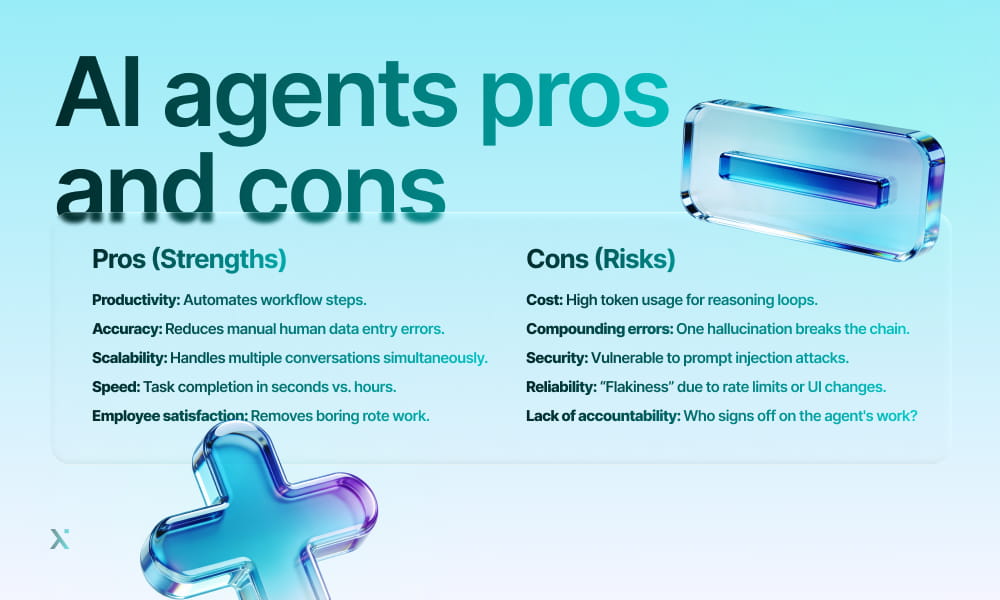
Perfect configuration of AI agents, as well as the ability of the development team to foresee hurdles, are essential for a business to quickly experience the workflow improvements and receive ROI. Here is how successful engineering teams (like PixelPlex) address the most common AI agent challenges:
Controlling runaway costs
Because agents think and learn in loops, a complex task can quickly burn API tokens.
Solution: Do not use massive, expensive models like GPT-4 or Claude 3.5 Sonnet for every single step. Use smaller, cheaper open-source models for basic routing and logic, reserving the heavyweight models only for the final reasoning or generation phase. Besides that, implement strict limits on tokens to prevent infinite processing cycles.
Stopping compounding errors
In a multi-step workflow, if the agent hallucinates on step one, steps two through five are guaranteed to fail.
Solution: When implementing custom ChatGPT integration services, it is critical to build validation checkpoints into your architecture. Before the agent executes an action (like sending an email or updating a database), force it to cross-reference its proposed action against a strict set of predefined rules or ground-truth company data.
Hardening security
AI agents are susceptible to prompt injection. Malicious users might trick the agent into ignoring its instructions and revealing sensitive data.
Solution: Never give an agent unrestricted access to your entire database. Use the principle of least privilege. If an agent only needs to read inventory levels, do not grant it write or delete permissions.
Ensuring system reliability
Agents that rely on scraping web UIs will inevitably break when a website updates its layout. Similarly, relying on third-party tools means dealing with API rate limits.
Solution: Build robust fallback mechanisms. If an API times out, the agent should be programmed to pause and retry, rather than throwing a fatal error and crashing the entire workflow.
Establishing accountability
If an agent approves a fraudulent refund or sends an incorrect quote, who is responsible?
Solution: The Human-in-the-Loop concept. Require human authorization for irreversible actions (like moving money or deleting records) and maintain comprehensive audit logs so every decision the agent makes can be traced and reviewed.
Final thoughts
Gartner predicts that the number of artificial intelligence agents could exceed 150,000 per global Fortune 500 enterprise by 2028. That’s why the firm finds it essential that businesses should learn how to cooperate with agents and manage “agent sprawl”. To mitigate risks such as data loss, misinformation, and the dangerous rise of unmonitored “shadow AI,” Gartner advises IT leaders to establish clear agent governance policies, build a centralized inventory to track all AI tools, and strictly define agent identities, permissions, and life cycles.
AI app development companies like PixelPlex know how to implement robust information governance to control what data AI tools can access, continuously monitor and correct anomalous agent behavior, and foster a culture of responsible AI usage through comprehensive workforce training programs. Contact us, and we will discuss your vision.
FAQ
In simple words, the first talks, the second acts. Generative AI development services include creating tools that produce an output, such as drafting an email, writing code, or generating an image based on a specific prompt. Agentic AI, on the other hand, is a proactive system. It breaks the goals into consequent steps and utilizes external tools like web browsers or databases.
The efficiency of AI agents for business is measured through certain quantifiable key performance indicators. AI agents’ business impact examples might include a high task completion rate, zero errors, and manual intervention. A well-optimized system will also manage token usage effectively, avoiding additional API costs. Success is also defined by the reduction in average handling time for customer support tickets or accelerated code deployment cycles. However, all these benefits are likely to appear in the long run.
This depends on the complexity of your workflow. Building a simple agent, such as an automated lead qualifier or an internal document retriever using off-the-shelf frameworks, can generally be done in two to four weeks. If you are developing an advanced agent that requires integration into core software like a CRM and involves custom tool-calling, you should expect a timeline of one to three months. Highly sophisticated enterprise systems may take more than six months if heavy data labeling, custom model training, and strict security compliance measures are required.
It is crucial to maintain comprehensive audit logs that record every API call, database query, and executed action. This ensures that if a logic failure occurs, it can be traced back to the exact source. For high-stakes operations like financial transactions or legal evaluations, implementing a Human-in-the-Loop safeguard is highly recommended.