Glossary · Blockchain basics
Block time
Published 27 Apr 2025 · Updated 21 Oct 2026 · 12 min read
Block time is the average interval between consecutive blocks on a blockchain. Bitcoin targets ten minutes through proof of work, with random gaps. Scheduled chains follow fixed intervals, with Ethereum at 12 seconds and Solana at 200 milliseconds since October 2026. Finality is a separate, later step that protects blocks against reversal.
- Bitcoin targets a 10-minute average, but proof-of-work block times are random.
- Ethereum has 12-second slots, and Solana's target has been 200 milliseconds since 9 October 2026.
- Block time describes cadence, not finality or transaction capacity per second.
 Bitcoin600-second target, random gaps
 Ethereum12-second slots
 Solana200-millisecond slots since 9 October 2026
How block time is set
A target is a protocol's intended interval. A measured average describes the blocks that actually appeared during a stated period. Scheduled slots can remain empty. A block exists only when one is produced. Network rules therefore need different readings, even when explorers present every value in seconds. A published average also depends on the measurement window and timestamp source.
Proof of work
Bitcoin targets 600 seconds. Its mining difficulty changes every 2,016 blocks to keep the long-run average near that target. Before 15 September 2022, Ethereum's proof-of-work target was about 13.3 seconds per block.
Proof of stake
Since the Merge on 15 September 2022, Ethereum has 12-second slots, with 32 per epoch. An offline proposer can leave one empty.
BFT rounds and leaders
Byzantine fault-tolerant rounds use named producers and votes. Solana assigns four consecutive slots per leader, BNB Smart Chain uses turns and Monad votes for finalization.
Rollup sequencers
OP Mainnet and Base have 2-second blocks. Base streams ten 200-millisecond Flashblocks as preconfirmations. Arbitrum's sequencer produces blocks only when transactions need sequencing, at most every 250 milliseconds.
Not every distributed ledger has a single shared chain. The Canton Network explainer describes ordering within each synchronizer. Its sequencer orders transactions for that synchronizer, and nodes store only their parties' data. Without one global chain replicated by every node, Canton has no network-wide block time.
Block times across blockchains
Inclusion puts a transaction into a block. Transaction confirmations count that block and each one above it, while finality describes protection against reversal. The three proof-of-work markers use six blocks deep for comparison, not a shared deposit rule. Their assurance remains probabilistic. Targets and measured averages appear separately, since an observed interval is not a guaranteed schedule. The "Final" label indicates that a network has passed its marker.
Across several minutes, more networks pass their markers. Bitcoin reaches six blocks deep in about an hour.
Targets follow network documentation. Page team averages date to 21 October 2026. Proof-of-work markers show six blocks deep.
| Network | Block or slot time | Finality | How it is set |
|---|---|---|---|
| Bitcoin | Block or slot time600 s target, 596.2 s measured from 4 June to 21 October 2026 | FinalitySix blocks, about an hour, probabilistic assurance | How it is setDifficulty retarget every 2,016 blocks |
| Litecoin | Block or slot time150 s target, 148.3 s measured over 5,760 blocks to 21 October 2026 | FinalitySix blocks, about 15 minutes, probabilistic assurance | How it is setDifficulty retarget every 2,016 blocks, about 3.5 days |
| Dogecoin | Block or slot time60 s target, 63.3 s measured over 24 hours on 21 October 2026 | FinalitySix blocks, about six minutes, probabilistic assurance | How it is setDigiShield difficulty adjustment after every block |
| Ethereum | Block or slot time12 s slots, 12.035 s measured over 7,200 blocks to 21 October 2026 | FinalityTwo to three epochs, about 13 to 19 minutes | How it is setFixed 12 s slots, 32 slots per epoch |
| BNB Smart Chain | Block or slot time0.45 s since 14 January 2026, 0.4502 s measured on 21 October 2026 | FinalityAbout 1.125 s to finality, BEP-619 estimate | How it is set16 consecutive blocks per validator turn since June 2025 |
| Polygon PoS | Block or slot time1.5 s measured over 20,000 blocks on 21 October 2026 | FinalityDeterministic finality in 2 to 5 seconds with Heimdall v2 | How it is setOne producer per span, from a small eligible set |
| OP Mainnet | Block or slot time2 s blocks, per the Optimism docs | FinalitySafe after a few minutes, finalized after about 15 to 30 minutes | How it is setThe sequencer builds a block every two seconds |
| Monad | Block or slot time300 ms blocks since MIP-12 on 23 July 2026 | Finality600 ms finality since 23 July 2026 | How it is setMonadBFT vote pace, cut to 300 ms by MIP-12 |
| Solana | Block or slot time200 ms target, 212 ms per slot measured over one hour on 21 October 2026 | FinalityAbout 150 ms target with Alpenglow, live since 21 October 2026 | How it is setStake-weighted leader schedule, four consecutive slots per producer |
Why Bitcoin block times vary
Mining is a random search, not a countdown. With constant hashrate, Bitcoin's gaps follow an exponential distribution around a 10-minute mean. The model puts 36.8% beyond 10 minutes, 13.5% beyond 20 and 5.0% beyond 30. Only 0.25% exceed an hour, while 9.5% finish within a minute. The median is 6.9 minutes. Starting at a random moment still gives a 10-minute average wait, because long gaps occupy more of the clock.
Across 20,160 blocks from 4 June to 21 October 2026, the median gap was 7.0 minutes. Of those gaps, 36.8% lasted at least 10 minutes, and 61 lasted an hour or more. The longest reached 112 minutes. Results fit a memoryless process, with past waiting not making the next block due. Miners set timestamps, and 585 blocks were stamped earlier than their parents. Each timestamp must exceed the median of the previous 11 blocks, not necessarily the parent's time.
The 140-day histogram follows the exponential curve, with many short gaps and a long tail.
Data cover 20,160 blocks from 4 June to 21 October 2026, sourced from mempool.space. Miners set timestamps.
How Bitcoin keeps ten-minute blocks
Every 2,016 blocks, Bitcoin compares elapsed time with 1,209,600 seconds, or two weeks. It scales difficulty to bring the average back toward ten minutes. Each adjustment is capped at four times up or down. The code measures 2,015 intervals instead of 2,016, an off-by-one that enables the timewarp attack. In October 2026, BIP-54 proposes timestamp rules to close this gap, but has no activation date. The 20 complete periods that began in 2026 average 602.5 seconds.
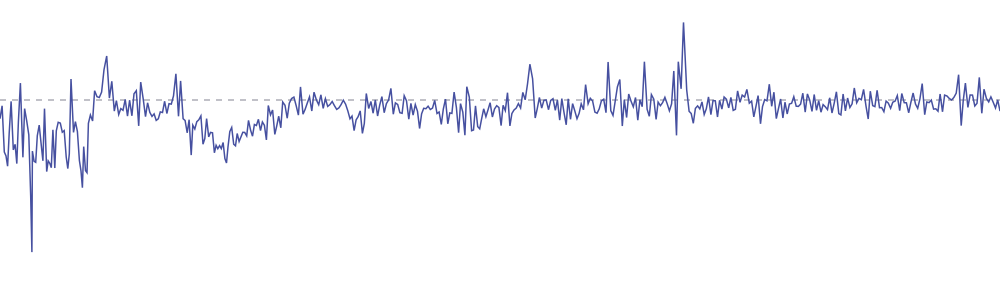
When hashrate falls, blocks slow until difficulty falls. The opening June 2021 period illustrates a historical slowdown.
Historical periods come from mempool.space on 21 October 2026. The simulator uses a simplified model.
The period starting at block 971,712 on 16 October 2026 averages 9.4 minutes through 21 October 2026. The next retarget, at block 973,728, is estimated around 29 October 2026, with difficulty rising about 6%. Bitcoin halvings occur every 210,000 blocks. Block 840,000 arrived on 20 April 2024. The 21 October 2026 estimate puts block 1,050,000 in spring 2028.
When block times changed
Intervals change for different reasons. A mining adjustment reacts to completed work, while an upgrade can change the production schedule itself. These examples separate automatic corrections from deliberate protocol changes, including changes to how quickly blocks become irreversible.
- October 2017
The bomb and Byzantium
Ethereum's difficulty bomb raised mining requirements on a schedule. Around Byzantium on 16 October 2017, 10,000-block samples averaged 29.70 seconds before the upgrade and 15.41 seconds afterward. Delays in February 2019, January 2020 and June 2022 repeated that pattern.
- July 2021
Bitcoin's largest downward retarget
After China's mining ban, the period beginning 13 June 2021 averaged 13.9 minutes per block. The 3 July 2021 retarget at block 689,472 cut difficulty by 27.94%, the largest downward adjustment on record.
- September 2022
Ethereum changes consensus
Ethereum replaced proof of work with proof of stake through the Merge on 15 September 2022. The final 10,000 mining blocks averaged 14.51 seconds, compared with 12.19 seconds for the first 10,000 under the new schedule.
- November 2025
Avalanche adopts dynamic delays
Granite on 19 November 2025 replaced Avalanche C-Chain's old 2-second target with a dynamic minimum delay set by validators. Blocks average 0.90 seconds over 20,000 blocks on 21 October 2026.
- January 2026
BNB Smart Chain cuts again
Fermi on 14 January 2026 set a 0.45-second interval. It followed Lorentz's 1.5 seconds on 29 April 2025 and Maxwell's 0.75 seconds on 30 June 2025. The sequence began with a 3-second interval.
- July 2026
Monad shortens both waits
The 23 July 2026 MIP-12 upgrade cut the interval from 400 to 300 milliseconds. Finalization now takes 600 milliseconds rather than 800.
- October 2026
Solana changes cadence and consensus
Solana reached 200-millisecond slots on 9 October 2026, the last of four reductions. On 21 October 2026 Alpenglow replaced TowerBFT, targeting finality of about 150 milliseconds. This is an expectation, not a constant delay.
What shorter block times cost
Faster cadence leaves less room for information to travel. The engineering question is how production, propagation and voting fit within the available interval. Capacity is a separate parameter, so a lower waiting time does not establish a higher transaction rate.
Propagation and stale blocks
Stale block risk is roughly t/(T+t), using transit time t and interval T. Bitcoin's measured fork rate in 2012 was 1.69%. Ethereum's first 280,000 blocks in 2015 had a 7.41% uncle block rate.
Less time for votes
Fast chains name producers ahead and finalize through votes. BEP-619 warns that reducing intervals also reduces the time available for vote propagation.
Timing games
Ethereum proposers can delay publication to earn more MEV within their allotted slot. Researchers warn of missed slots, reorgs and incorrect attestations.
Throughput remains separate
BNB Smart Chain's 2025 cuts shortened the interval more than they lowered gas limits, so capacity per second rose. Solana's SIMD-0525 halved slot time but scaled per-slot limits down, keeping throughput about the same.
Block time in contracts and apps
Ethereum's block.timestamp follows genesis time plus 12 seconds per slot. block.number counts produced blocks, so it falls behind the slot count after missed slots. Neither timestamps nor blockhash provide dependable randomness. Compound's Governor Bravo assumes 15-second blocks for its 5,760-block minimum voting period. At 12 seconds, that becomes 19.2 hours rather than 24. A block-based governance window can therefore drift after a network upgrade. OpenZeppelin supports timestamp clocks through ERC-6372 from version 4.9, avoiding dependence on changing block intervals.
Arbitrum's block.number returns the block of its first non-Arbitrum ancestor chain. ArbSys(100).arbBlockNumber() gives the Arbitrum count. BNB Smart Chain's January 2026 cut also moved block-based timing. Since Solana's 9 October 2026 change, fixed slot-to-time conversions drift, and a blockhash expires after 150 blocks, about 30 seconds. Solana suggests getBlockTime. Bitcoin's time-based locks use the median of the last 11 blocks, about an hour behind wall-clock time. Relative time locks count blocks or 512-second units. New coins need 100 blocks, about 16.7 hours.
Designing around block time
A timing assumption can reach from a contract into deposit handling, indexing and monitoring. For blockchain development projects, PixelPlex considers five connected areas. The goal is to make the product's behavior explicit when blocks arrive early, arrive late or stop matching assumptions made during development.

PixelPlex has worked on both sides of block time. It built the Echo protocol, where a new committee is chosen at random for each block. It worked on the Qtum platform, whose governance can change block time. For the mining client PEGA Pool, it built the PegaPool mining pool and modified Antminer S19 firmware for the miners who produce blocks.
Contract clocks
We identify whether each timelock and deadline depends on elapsed time or block counts, including governance windows and transaction expiry.Deposit assurance
We separate inclusion, confirmation counts and finality in deposit rules, so an interface does not present them as interchangeable states.Indexing and reorgs
We account for reorgs and missed slots when describing indexer behavior, rather than assuming uninterrupted block production.Chain parameters
For a chain with its own rules, we connect the production interval to capacity, voting time and parameter governance.Production monitoring
We distinguish a target from observed intervals in monitoring, including changes in hashrate and production gaps that need interpretation.
Discuss the timing assumptions in your product
We can discuss your network assumptions and where waiting, block counts or irreversible settlement affect the product's behavior.
Discuss your projectBlock time FAQ
What is Bitcoin's target block time?
What is Ethereum's block time after the Merge?
What is Solana's block time in October 2026?
Why do Bitcoin blocks arrive at irregular intervals?
How does block time differ from finality?
How many confirmations does a transaction need?
Do shorter block times make a blockchain faster?
Related terms
All definitionsSources (46)
- Bitcoin Core on GitHub: src/kernel/chainparams.cpp, mainnet consensus parameters
- Bitcoin Core on GitHub: src/pow.cpp, difficulty adjustment
- Bitcoin BIPs: BIP-54, Consensus Cleanup, Apr 2025
- Bitcoin BIPs: BIP-113, Median time-past as endpoint for lock-time calculations, Aug 2015
- Bitcoin Optech: Time warp
- Bitcoin Wiki: Confirmation, Aug 2026
- mempool.space API: Difficulty adjustment
- mempool.space API: Difficulty adjustments since 2009
- CoinWarz: Bitcoin Halving Countdown
- Decker and Wattenhofer, IEEE P2P: Information Propagation in the Bitcoin Network, 2013
- Ethereum Foundation Blog: Toward a 12-second Block Time, Jul 2014
- Ethereum Foundation Blog: More uncle statistics, Sep 2015
- ethereum.org: Blocks, Jul 2026
- ethereum.org: The Merge, May 2026
- Ethereum Foundation Protocol Consensus: Fast Confirmation Rule
- Ethereum EIPs: EIP-2, Homestead Hard-fork Changes, Nov 2015
- Ethereum EIPs: EIP-7782, Reduce Block Latency, Oct 2024
- Ethereum EIPs: EIP-8198, Quick Slots, Mar 2026
- Ethereum EIPs: EIP-8081, Hardfork Meta for Hegotá, Nov 2025
- Ethereum Foundation Blog: Glamsterdam Hoodi Testnet Announcement, Oct 2026
- Ethereum Research: Timing Games, Implications and Possible Mitigations, Dec 2023
- Compound on GitHub: GovernorBravoDelegate.sol
- OpenZeppelin Docs: How to set up on-chain governance
- Solana: Reduced Slot Times, Oct 2026
- Solana: Alpenglow, Oct 2026
- Solana Improvement Documents: SIMD-0525, Reduce Slot Times, May 2026
- Solana Compass: Solana Alpenglow Is Live on Mainnet as Anza Retires TowerBFT at Slot 459,653,000, Oct 2026
- Litecoin Core on GitHub: src/chainparams.cpp
- Dogecoin Core on GitHub: src/chainparams.cpp
- BNB Chain BEPs: BEP-524, Short Block Interval Phase Two, 0.75 seconds, Feb 2025
- BNB Chain Docs: Maxwell Hardfork (BSC)
- BNB Chain BEPs: BEP-619, Short Block Interval Phase Three, 0.45 seconds, Sep 2025
- BNB Chain Docs: Fermi Hardfork (BSC)
- Polygon Docs: Polygon Chain overview
- Optimism Docs: Transaction finality
- Base Docs: Transaction Ordering, Flashblocks
- Arbitrum Docs: Block numbers and time
- Arbitrum Research: The power of faster blocks, May 2024
- Monad Blog: Monad Mainnet now has 300ms block times and 600ms finality, Jul 2026
- Avalanche Builder Hub: Avalanche Granite Upgrade, Enabling Dynamic Block Times, Nov 2025
- Canton Network Docs: Architecture Overview
- Kraken Support: Cryptocurrency deposit processing times, Oct 2026
- PixelPlex: Echo, smart contract layer 2 blockchain protocol
- PixelPlex: Qtum, UTXO-based blockchain and dApp development platform
- PixelPlex: PegaPool, Bitcoin mining pool with a sustainable approach, 2020
- PixelPlex: Antminer S19 firmware modification, 2024
Get updates about blockchain, technologies and our company
We will process the personal data you provide in accordance with our Privacy policy. You can unsubscribe or change your preferences at any time by clicking the link in any email.Follow us on social networks and don't miss the latest tech news


Services
Blockchain
Blockchain consultingStrategy, architecture, feasibility
Crypto wallet developmentSelf-custody, MPC, cards on top
Cryptocurrency exchange developmentTrading venues, liquidity and protocols
Tokenization servicesRWA, funds, collateral
Crypto payments developmentAccept, settle and pay out in crypto
Smart contracts developmentDesign, build, audit
Blockchain integration dApp development DeFi development NFTs Tokens Web3 development All blockchain services All servicesNetworks
Canton developmentDaml apps, wallets, settlement, validators
Official Partner
Ethereum developmentSmart contracts, L2s and dApps
Solana developmentHigh-throughput programs and dApps
TON developmentMini apps, wallets, Telegram ecosystem
Official Partner
Hedera developmentHashgraph apps and token services
Exclusive Partner
Hyperledger developmentPermissioned networks for enterprises
Certified Partner
Cardano Algorand Stellar Avalanche Bitcoin Polygon All networks All servicesAI & ML
AI agents developmentConnect tools and automate multi-step workflows
RAG developmentFind answers across your company’s documents and systems
AI copilot developmentAdd useful assistance to your product or internal tools
LLM developmentCustom and fine-tuned models for your domain
Private AI deploymentRun models in your own environment
AI consultingUse cases, feasibility and a roadmap
Generative AI development Machine learning development Computer vision Chatbot development ChatGPT integration Deep learning development All AI services All servicesData & analytics
Data engineeringPipelines that keep your data reliable
Data platform developmentOne source of truth for analytics
Analytics & dashboards developmentBI your teams actually use
Predictive analyticsForecasts built on your own history
Data strategyWhere data can pay off first
Data visualizationDashboards and visual stories from your data
Data science development Development of data marts All data services All servicesSoftware
Product discoveryValidate scope and cost before you build
MVP developmentA launch-ready first release
Web application developmentPlatforms, portals and internal tools
Mobile app developmentiOS, Android and cross-platform
SaaS developmentMulti-tenant products that scale
Software integrationConnect the systems you already run
Infrastructure & cloud cost UI/UX design IT consulting QA & software testing R&D Serverless development All software services All servicesSecurity & compliance
Smart contract auditsFind vulnerabilities before launch
Transaction monitoring developmentIntercepta inside your systems and processes
Security assessmentsTest apps, infrastructure and processes
Data security servicesProtect sensitive data across its lifecycle
Cloud security servicesSecure cloud workloads and configurations
DAML smart contract auditReview DAML contracts before they go live
All security services All servicesSolutions
Products, APIs and platforms
CC SuiteNew
Products and engineering to build and operate on Canton.
In production 55M API requests served in 8 months
Crypto APIBlockchain data for your applications.
Power in numbers 6 TB Data storage. 500K Tokens indexed
RWA platformA foundation for your asset tokenization platform.
Time to launch 2–4 weeks Branding & setup. 90% more cost-efficient
DocFlowBlockchain-based document management.
Use case & value 100% Secure workflows. Zero third-party risks.
OTC Hawk Arbitrage Bot Book a solution consultWork
450+ projects. 250+ clients. 3 unicorns in portfolio
Console walletThe first non-custodial wallet built natively for Canton
TON ecosystemA series of improvements for The Open Network
Mining platformEnvironmentally friendly web platform for Bitcoin pool mining
Mantra DAOCommunity-governed DeFi: 60+ staking pools, $23M TVL
Canton TON Web3 & DeFi Digital Assets & Tokenization AI & Data Intelligence IoT & Edge Computing Consulting See all projectsIndustries
Trusted by startups, small businesses, and enterprises
Financial services software developmentBanking, payments, lending, insurance, capital markets
Real estate software developmentInvestment, property operations, tokenization
Retail & commerce software developmentCommerce, loyalty and fulfillment
Supply chain software developmentTraceability and connected operations
Healthcare software developmentPatient services, data and connected systems
Banking software developmentCore banking, digital channels, payments
Fitness Education Oil & Gas Insurance Construction TravelCompany
From R&D to launch, we bring any of your ideas to life
About PixelPlexEngineering partner. Product builder. Since 2007.
Technical experience 19+ years All competencies on board. Scalable team.
AchievementsIndustry recognition & awards.
Delivering real value 4.9 Clutch ratings. 150+ awards
Contact usDiscuss your project.
Quick response 30 min Average reply time. Offices in 6 countries
BlogDive into the latest software trends.
Fresh insights 500+ Articles in blockchain, AI, big data, AR/VR
Team Careers Social responsibility Glossary