
AI has moved well beyond simple enemy behavior and scripted interactions. Developers now use it to create smarter characters, generate content, personalize gameplay, and make virtual worlds feel more dynamic. As a result, AI is becoming a core part of many modern game development projects.
At the same time, building a game with AI capabilities is very different from building a traditional one. New mechanics, additional technical requirements, and evolving player interactions can significantly affect both development effort and budget. This raises a question that many studios, startups, and investors are asking: how much does AI game development services actually cost?
The answer depends on several factors, from the type of game being developed to the AI capabilities it requires. In this guide, we’ll take a detailed look at the key factors affecting cost, development timelines, and technology selection, and provide real-world examples to help you estimate the budget for your next AI-powered game project.
What makes AI game development more complex than traditional game development?
The cost of a game with AI capabilities has a lot to do with what happens behind the scenes. Features such as AI-controlled characters, real-time decision-making, and AI-generated content add layers of complexity that are not found in most traditional game projects.
Different logic behind the gameplay
Traditional games follow rules that developers define in advance. Characters behave in specific ways, events trigger under specific conditions, and players move through experiences that have been carefully planned from start to finish.
AI changes that dynamic. Instead of reacting according to a fixed script, game systems can respond to player actions, adapt to what’s happening in the game world, and produce outcomes that weren’t explicitly programmed.
Smarter NPCs require more work
NPC behavior is often where the complexity becomes most visible.
In a traditional game, non-player characters typically follow a limited set of scripted actions. AI-powered NPCs can react to player behavior, change their strategies, and behave differently depending on the situation. Building these systems requires additional design work, model training, testing, and ongoing refinement to ensure interactions remain believable.
Balancing becomes an ongoing process
Balancing a game gets trickier when AI enters the picture. A scripted enemy will always behave within the limits set by developers. An AI opponent may react differently depending on how people play. Sometimes that’s exactly what makes the experience memorable. Sometimes it creates headaches for the team trying to keep the difficulty curve under control.
Data and infrastructure matter more
Many AI systems use large datasets for training and optimization. Teams require processes for collecting, managing, and refining data throughout the development process.
AI comes with its own set of infrastructure costs. Training models require additional computing resources, and many systems continue to evolve after launch as developers refine them based on how real players interact with the game.
Traditional and AI-driven games compared
| Aspect | Traditional game | AI-driven game |
| NPC behavior | Scripted actions, fixed paths, and predefined reactions | Adaptive behavior based on player actions, context, and game state |
| Content generation | Manually created levels, assets, quests, and scenarios | AI-assisted generation of environments, missions, assets, dialogue, and gameplay variations |
| Testing | Standard QA focused on bugs and gameplay logic | Continuous testing, model evaluation, behavior analysis, and AI tuning |
| Infrastructure | Moderate backend and hosting requirements | Higher demand for cloud resources, GPUs, data pipelines, and monitoring tools |
| Data requirements | Limited gameplay data needed for core mechanics | Large datasets for model training, personalization, analytics, and optimization |
How Much Does AI Development Cost in 2026?

The Economics of Generative AI Development: Cost and Value
What types of AI games are being developed today?
Not every AI-powered game looks the same. A strategy title might use AI to create more adaptive opponents, while a mobile game could rely on it to personalize the player experience. RPGs often use AI for NPC behavior, and simulation games use it to make virtual worlds feel more alive.
As a result, AI game development is no longer tied to a single genre or game format. The technology is showing up in more places, and developers are experimenting with new applications well beyond the NPC systems that first made AI popular in gaming.
Popular AI game categories
| Game type | AI use cases | Complexity |
| RPG | Smart NPCs | High |
| Strategy | Adaptive enemies | High |
| Shooters | AI opponents | Medium |
| Simulation | Dynamic worlds | High |
| Mobile games | Personalization | Medium |
| Educational games | Adaptive learning | Medium |
Here are some of the most common ways developers use AI in games today:
- Intelligent NPCs that adapt to player behavior and make decisions in real time
- Procedural content generation for levels, quests, environments, and game assets
- Dynamic storytelling that changes based on player choices and in-game actions
- Personalized gameplay experiences tailored to individual preferences and skill levels
- Predictive analytics used to improve retention, engagement, and monetization
- Voice interaction systems that enable natural conversations with game characters

How to Use AI to Enable Digital Transformation: Overview Across Industries

5 Steps to Develop an Efficient Token Economy for Crypto Games
AI game development process
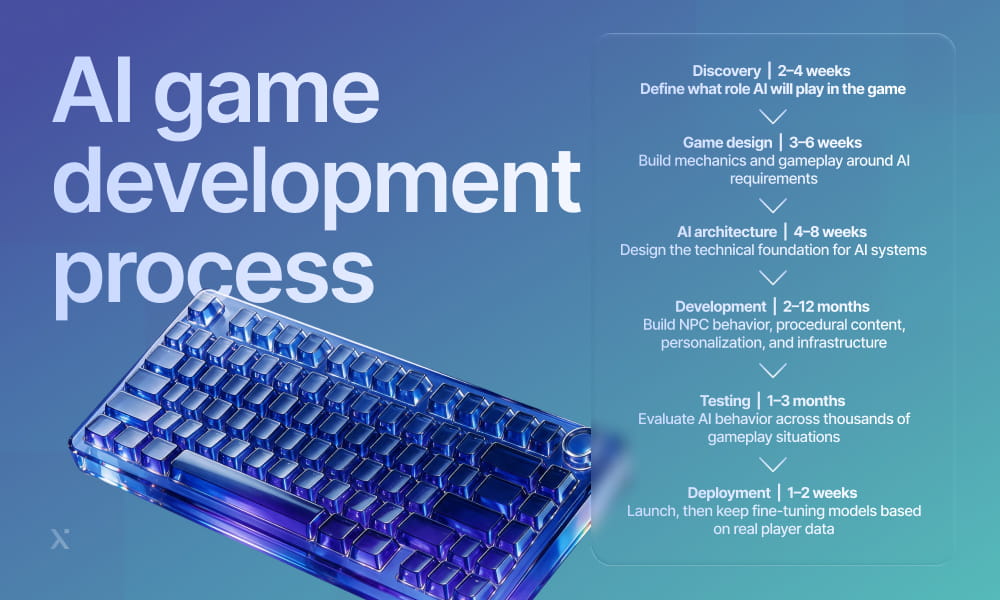
The development process for an AI-powered game follows many of the same stages as a traditional game project, but several additional steps come into play once artificial intelligence is involved. Teams need to define AI requirements early, design the underlying architecture, prepare training data, and spend more time testing how intelligent systems behave under real gameplay conditions.
The timeline is shaped by the role AI plays in the game. The more central AI becomes to the gameplay experience, the more time teams typically need for development, testing, and refinement.
Typical AI game development stages
The Double-Edged Sword: How AI Is Redefining Cybersecurity in 2026

AI Business Ideas, Tools & Real-World Wins That Actually Spark Something New
Good planning saves time later. Teams first define the role AI will play in the game, then build the mechanics and technical foundation around those requirements. Making these decisions early helps avoid expensive changes during development.
Most of the budget is typically spent during development. This is where ideas become working systems, whether that’s adaptive NPC behavior, procedural content generation, personalization features, or the backend infrastructure that supports them. It’s also where unexpected challenges tend to surface, especially when AI models are involved.
Testing often takes longer than teams anticipate. Finding bugs is only part of the job. Developers also need to understand how AI behaves across thousands of gameplay situations and ensure the experience remains engaging, balanced, and consistent.
Releasing the game is only part of the journey. AI systems continue to evolve once they meet real players, often uncovering areas for improvement. Fine-tuning models, adjusting gameplay mechanics, and optimizing performance become part of the ongoing development process.
AI game development is a collaborative effort. From gameplay design to machine learning and infrastructure, every stage relies on specialists working together to turn an idea into a production-ready game.
In most cases, complexity is one of the primary factors affecting both timelines and budgets. A recommendation engine is relatively straightforward. A living game world filled with adaptive characters and AI-driven mechanics is a much bigger undertaking.

AI in Software Development: It's More Than Hype, It's the New Hammer

AI MVP Development: How to Validate Ideas Fast Without Breaking the Budget
Technologies used in AI game development
The technology stack behind an AI-driven game depends on what the game is designed to do. Mobile game development focused on personalization may require a very different set of tools than an RPG built around dynamic storytelling or a simulation game with evolving virtual worlds. Even so, there are several technologies that appear in many modern AI game development projects.
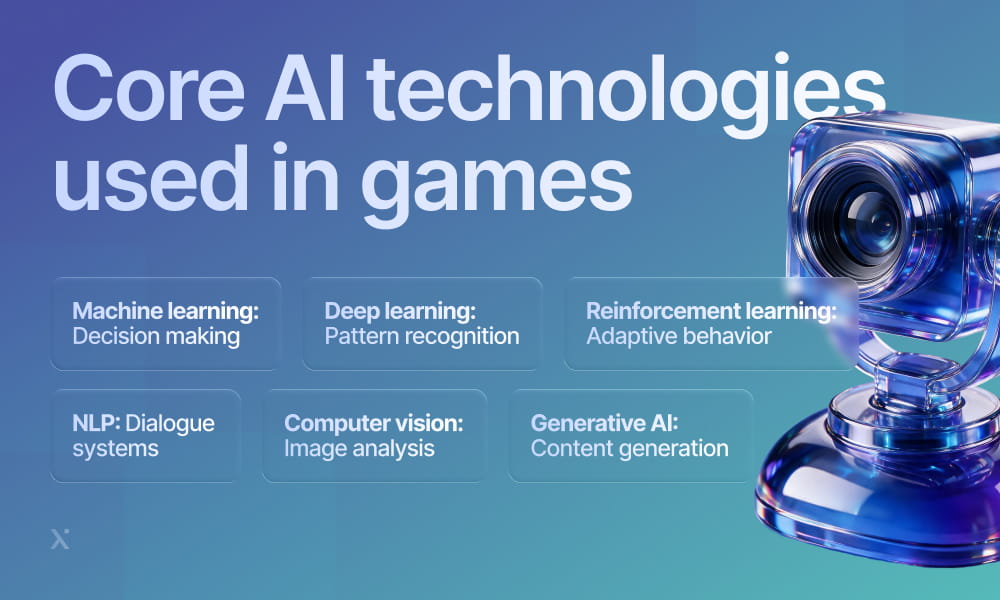
Machine learning remains the foundation of many AI systems in gaming. It helps games recognize patterns, respond to player behavior, and make decisions based on data rather than predefined rules. More advanced applications often rely on deep learning and reinforcement learning, particularly when developers want AI characters to adapt, learn, or improve over time.
Other technologies address more specialized tasks. Natural language processing makes conversations with NPCs feel more natural, computer vision enables image analysis and recognition, while generative AI helps create assets, dialogue, quests, and other forms of content. Together, these technologies are expanding what’s possible with AI in game development and allowing teams to create experiences that would have been difficult to build just a few years ago.
Core AI technologies used in games
Choosing the right tools is just as important as choosing the right technologies. Game engines, machine learning frameworks, and AI development platforms all impact the speed at which teams can build, train, and deploy intelligent systems. The choice often depends on the project requirements, the team’s experience, and the complexity of the AI functions being implemented.
The following tools are commonly used for such projects:
| Tool | Usage |
| Unity ML-Agents | NPC training |
| Unreal Engine AI | AI systems |
| TensorFlow | ML models |
| PyTorch | Deep learning |
| OpenAI APIs | Generative AI |
| NVIDIA ACE | AI-powered NPCs and digital characters |

ChatGPT Integration: How Companies Turn AI Into Real Operational Advantage
AI game development cost breakdown
There is no fixed price for AI in game development. Two projects may both be labeled “AI-powered games” while requiring completely different budgets. A mobile game with basic personalization features can be built for a fraction of the cost of a large-scale RPG with adaptive NPCs, AI-generated content, and multiplayer functionality.
In most cases, the final budget reflects one simple reality: the more intelligence you add to a game, the more effort it requires to develop, test, and maintain it. AI systems require additional engineering, data preparation, infrastructure, and quality assurance, all of which contribute to the overall cost.
AI game development costs by project size
The figures below reflect typical market ranges. Actual development costs depend on project scope, AI complexity, technology choices, and team structure.
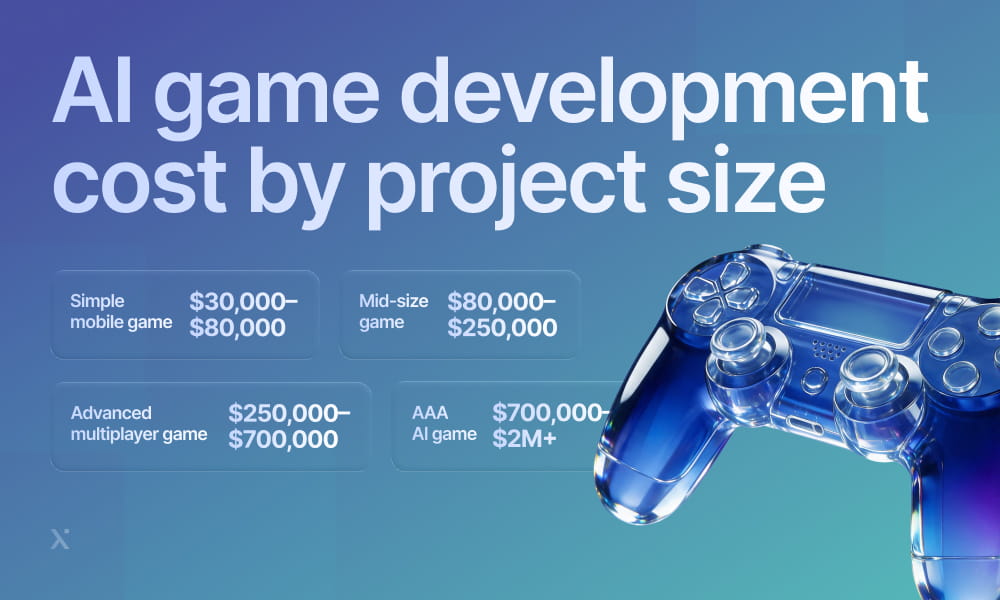
Project size is only part of the equation. AI capabilities themselves can significantly impact the budget. Some features can be integrated relatively quickly, while others require extensive model training, testing, and ongoing optimization.
Blockchain Game Development: Budgeting for Success in 2026

The Price of a Marketplace: What It Really Costs to Build One Today
h3>Estimated cost by AI feature
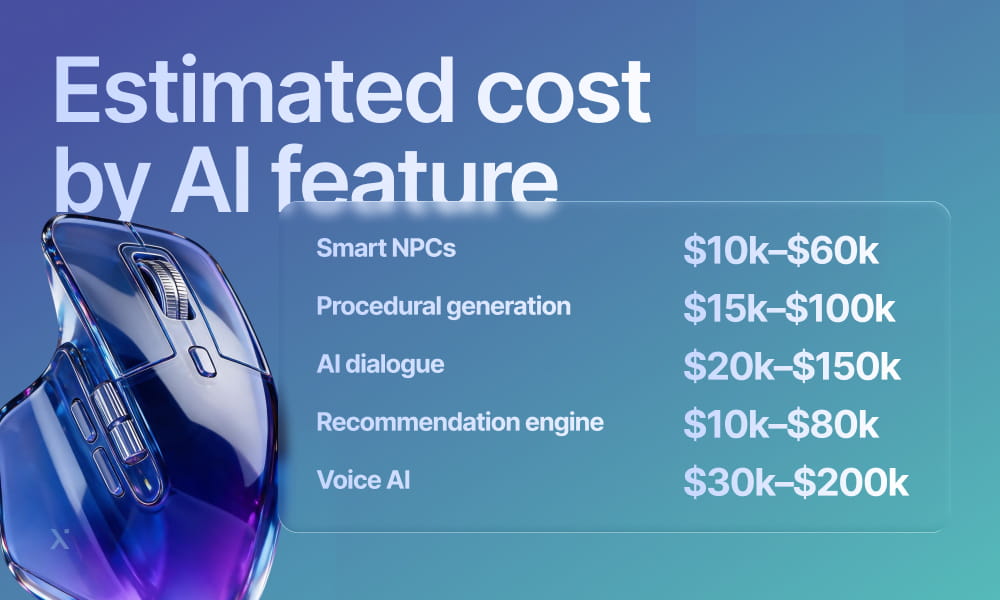
Several factors typically have the biggest influence on development costs.
A recommendation engine for a mobile game, for example, requires a very different investment than a fully voiced NPC system capable of generating contextual responses in real time. The same principle applies to procedural world generation, adaptive enemy behavior, and personalized gameplay systems. While AI can improve player engagement and create more dynamic experiences, each additional capability adds its own development and maintenance costs.
That’s why successful projects typically begin with identifying the AI features that provide the greatest benefit to players. Focusing on the right features early on helps control costs while ensuring that AI remains a meaningful part of the gameplay rather than an expensive add-on.
One of the simplest ways to control costs is to avoid doing everything at once. Many teams begin with a limited set of AI features, launch an MVP, and expand the game based on player feedback and business results. This reduces risk and helps ensure development resources are spent where they matter most.

Blockchain Development Cost in 2026: What Goes Into the Price Tag

Web3 Development Cost: Breaking Down What Really Drives the Price
How long does AI game development take?
Two AI game projects can have completely different timelines. One might only use AI to personalize the player experience. Another may rely on AI to shape gameplay from the ground up through adaptive mechanics, procedural content, or real-time decision-making. Those projects rarely require the same level of effort.
Typical timelines
| Project type | Average duration |
| Mobile AI game | 3–6 months |
| Indie PC game | 6–10 months |
| Multiplayer game | 10–18 months |
| AAA AI game | 18–36 months |
Several factors can influence the final timeline:
- The number and complexity of AI features
- Custom vs. pre-trained AI models
- Multiplayer and cross-platform requirements
- Data preparation and model training
- Testing and balancing efforts
- Team size and available resources
Not every AI feature affects the timeline in the same way. Adding personalized recommendations is usually much faster than building adaptive NPCs, AI-generated worlds, or voice-driven interactions. The more the gameplay depends on AI, the more time teams spend testing, balancing, and refining the experience.
Successful examples of AI in video game development
AI can mean very different things depending on the game. In one title, it powers an enemy that learns from the player’s actions. In another, it generates entire worlds or influences how stories unfold.
The following games show how different approaches to AI can shape the player experience and turn a good idea into a defining feature.
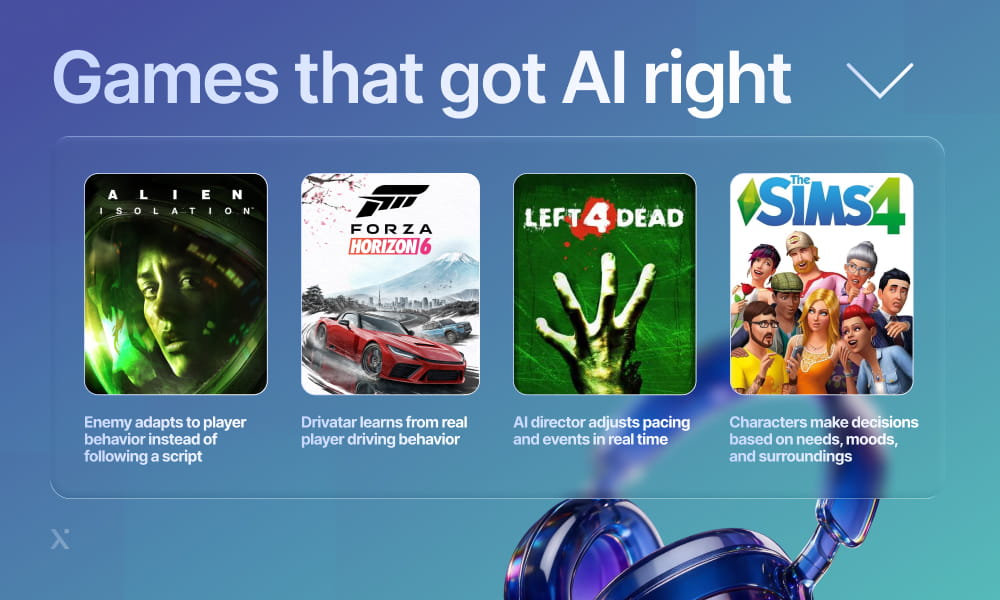
Alien: Isolation
One of the most frequently cited examples of AI in gaming, Alien: Isolation features an enemy that adapts to player behavior instead of following a fixed set of scripted actions. This creates a sense of unpredictability that keeps players under constant pressure throughout the game.
Left 4 Dead
Left 4 Dead took a different approach to AI. Instead of relying on fixed enemy placements and scripted events, the game constantly adapts to what’s happening in a match. The result is a pacing system that keeps players on their toes and makes each playthrough feel a little different.
Forza Horizon
Rather than relying on traditional racing AI, the Forza series introduced Drivatar, a system that learns from real player driving behavior. By analyzing how people brake, accelerate, and navigate tracks, it creates opponents that behave more like human drivers, making races feel less predictable and more competitive.
The Sims
The AI in The Sims isn’t always obvious, but it’s everywhere. Characters constantly make decisions based on their needs, moods, relationships, and surroundings. That’s what creates the unexpected situations, strange interactions, and memorable moments that have defined the series for decades.
These games take very different approaches to artificial intelligence, but they all use it to make gameplay less predictable. Whether it’s enemies adapting to player behavior, a world generated on the fly, or characters developing their own scenarios, AI helps create experiences that would be impossible with scripted systems alone.

How to Capitalize on a Play to Earn Game Concept: Real Examples and Pro Tips
![Metaverse Gaming: How to Build an Interactive Metaverse Ecosystem [PixelPlex Guide]](https://pixelplex.io/wp-content/uploads/2023/09/metaverse-gaming-main-1600.jpg)
Metaverse Gaming: How to Build an Interactive Metaverse Ecosystem [PixelPlex Guide]
Why is it worth investing in AI game development?
For many studios, AI is no longer viewed as an experimental technology. When implemented thoughtfully, it can improve both the player experience and the commercial performance of a game. From increasing engagement to reducing production overhead, AI offers advantages across multiple stages of the game lifecycle.
Some of the most significant business benefits include:
- Higher player retention through adaptive gameplay and personalized experiences
- Stronger engagement driven by dynamic content, responsive NPCs, and evolving game worlds
- More distinctive gameplay mechanics that help games stand out in a crowded market
- Lower content creation costs through procedural generation and AI-assisted asset production
- Faster scalability when expanding content, game environments, or player interactions
- Improved monetization opportunities through personalization, player behavior analysis, and targeted in-game offers
Complete Guide to Web3 Wallet Development and Its Costs

Planning Web3 App Development Cost: Team, Timeline, And Hidden Expenses
Why choose PixelPlex for AI game development?
Building an AI-powered game requires more than game development expertise. Teams need experience with machine learning, data pipelines, cloud infrastructure, AI integration, and post-launch optimization. Bringing these disciplines together can be challenging, especially when AI plays a central role in the gameplay experience.
As an experienced AI game development company, PixelPlex helps businesses turn AI concepts into production-ready gaming products. Our teams combine expertise in game development, AI, ML, and scalable cloud architectures to deliver solutions that are built for long-term success.
No two AI game projects are exactly alike. Whether the goal is to create smarter characters, more dynamic worlds, or entirely new gameplay experiences, we help teams build solutions that are both technically sound and commercially viable.
Why businesses choose PixelPlex
Our capabilities extend beyond AI game development services. Depending on project requirements, clients can leverage our expertise in:
- AI development services for intelligent game systems, automation, and player personalization
- Experience building scalable cloud infrastructures capable of supporting AI-powered gaming environments
- Expertise in integrating generative AI into existing game ecosystems and production pipelines
- Machine learning development for custom AI models, adaptive NPCs, and predictive gameplay mechanics
- Deep experience in data engineering, model optimization, and AI performance monitoring
- Work in cross-functional teams that include game developers, AI engineers, data scientists, and solution architects
- Support for both MVP development and large-scale commercial gaming products
- Post-launch optimization, model retraining, and continuous AI improvement

Top 10 AI Development Companies in 2026
Top 10 Machine Learning Development Companies
Conclusion
AI is changing how games are built, played, and monetized. As the technology becomes more accessible, the challenge is no longer whether AI can be used in a game, but how to use it effectively. Teams that focus on meaningful gameplay improvements, realistic budgets, and scalable architectures are far more likely to succeed than those chasing technology for its own sake.
The same applies across the broader AI ecosystem. Many of the technologies used in modern games also power products delivered through AI app development services, from personalization engines and recommendation systems to conversational AI and predictive analytics.
FAQ
Yes. AI can be integrated into an existing game without rebuilding it from scratch. Developers often introduce features such as smarter NPCs, personalized recommendations, or AI-powered analytics through updates, allowing them to improve gameplay while minimizing disruption to the core experience.
Not anymore. Cloud infrastructure, pre-trained models, and modern development frameworks have made AI much more accessible. Indie studios and startups can now integrate selected AI features without the budget of a large publisher, provided they choose the right implementation strategy.
The best time is before development begins. AI consulting helps define realistic project goals, evaluate technical feasibility, select appropriate AI models, and estimate infrastructure requirements. Addressing these questions early reduces development risks and helps avoid unnecessary costs later.
Yes. AI gives developers a better understanding of how people play. That information can be used to personalize in-game offers, recommend relevant content, and spot players who are losing interest. The result is a game that feels more relevant to each player while creating new opportunities to increase revenue.
Many modern games are supported by companion applications for player communities, analytics, progression tracking, or live events. Machine learning app development makes these applications smarter by enabling personalized recommendations, predictive analytics, and intelligent player engagement outside the game itself.
Right now, generative AI, autonomous NPCs, and real-time voice chat are among the biggest trends in development. The real payoff as these tools mature is that developers won’t have to waste hours on boring, repetitive asset creation — they can focus on making games that actually feel alive and fun to play.