
Just a few years ago, adding AI to a web product was something only the largest tech companies could justify. Today, it's becoming an expectation among customers and employees.
Businesses across industries are using AI to automate support, personalize customer experiences, assess user behavior, generate content, and streamline internal workflows. As users grow accustomed to these capabilities, companies that depend on static web experiences risk falling behind.
At the same time, AI for web development is far from a one-size-fits-all investment. A website with an AI chatbot requires a very different level of effort than a SaaS platform powered by large language models (LLMs), recommendation engines, or predictive analytics. The technology and infrastructure required to implement these solutions can influence the overall project scope.
So, how much does AI in web development cost? There isn’t a single answer. The final budget depends on what you want to build, which AI capabilities you plan to include, how many third-party systems need to be integrated, the underlying infrastructure, the amount of data involved, and the overall scope of the project. In this guide, we’ll look at the main cost drivers, typical pricing ranges, expected timelines, and the factors you should consider when planning AI web application development.

Custom AI Model Development: Tips and Tricks

AI Business Ideas, Tools & Real-World Wins That Actually Spark Something New
What makes AI web development different?
Most traditional websites behave exactly as they’re programmed to. Every action follows a fixed set of rules, so users receive the same experience regardless of context. AI web development introduces more flexibility by enabling applications to learn from data, understand user intent, and generate responses that evolve over time.
Different AI technologies solve different problems. Machine learning development helps identify patterns in large datasets; natural language processing (NLP) enables applications to understand and generate text; and computer vision processes images and video. Recommender systems suggest relevant products or content, predictive analytics helps forecast future outcomes, and generative AI creates text, images, code, or other content. Taken together, these technologies enable web applications to respond more intelligently rather than relying on fixed rules alone.
| Traditional web development | AI web development |
| Static logic | Adaptive, data-driven logic |
| Manual workflows | Intelligent automation and decision-making |
| Basic keyword search | Semantic search with NLP |
| Standard forms and interactions | AI assistants and conversational interfaces |
| Fixed recommendations | Personalized recommendations powered by ML |

How to Use AI to Enable Digital Transformation: Overview Across Industries

Future of AI: Unveiling Its Impact on Industries and Society
Why AI web development is more complex
Traditional web applications usually consist of familiar building blocks: a user interface, backend services, a database, and business logic. Adding AI changes that picture. Language models, vector databases, data pipelines, cloud AI services, and monitoring tools all become part of the architecture, and every new component brings additional work around integration, security, testing, and maintenance. As a result, AI-powered web applications generally take more time and effort to build than traditional web projects.
How AI changes the development process
| Area | Traditional web development | AI web development |
| Application logic | Business rules and predefined workflows | Business logic combined with AI inference and decision-making |
| Data | Structured application data | Structured data, training datasets, embeddings, and vector databases |
| Infrastructure | Standard cloud hosting | Cloud infrastructure with AI services, GPUs, or managed AI platforms |
| Integrations | Payment gateways, CRMs, CMSs | Business systems plus LLMs, ML models, and AI APIs |
| Performance | Page load speed and server response time | Inference latency, model accuracy, and response quality |
| Maintenance | Software updates and bug fixes | Application updates, model monitoring, prompt optimization, and AI service management |
| Security | User authentication and data protection | Traditional security plus AI governance, privacy controls, and model access management |
Main complexity drivers
- Choosing the right AI model involves balancing accuracy, response speed, and operating costs.
- Preparing reliable data, since model quality depends heavily on the data it receives.
- Connecting AI with existing systems, including CRMs, ERPs, payment platforms, and other business tools.
- Reducing inference latency, so AI features remain responsive as traffic grows.
- Protecting sensitive information, especially when processing customer or business data.
- Monitoring AI behavior after launch, because models, APIs, and user expectations change over time.
Types of AI web solutions businesses build
AI in web development isn’t limited to chatbots or virtual assistants. Today, businesses build AI into ecommerce platforms, SaaS products, customer portals, marketplaces, and corporate websites to solve specific problems, whether that’s helping customers find information faster, automating routine work, or delivering more relevant recommendations. What those solutions look like depends on the business itself, its industry, and the project’s goals.
While some projects introduce a single AI capability, others combine multiple technologies, such as generative AI, predictive analytics, and recommendation engines, within the same platform.
Common types of AI web solutions
| Solution type | Typical AI features | Complexity |
| Business website | Chatbots, semantic search, and personalization | Low |
| eCommerce platform | Recommendations, AI search, dynamic pricing | Medium |
| Marketplace | Recommendations, fraud detection, buyer-seller matching | High |
| Customer portal | AI assistants, knowledge search, workflow automation | High |
| SaaS platform | AI copilots, document generation, analytics | High |
| Industry-specific platform | Predictive analytics, computer vision, fraud detection, decision support | Very high |
Business websites
For many companies, the first step into AI for web development is improving an existing website. AI-powered chatbots, semantic search, automated lead qualification, and personalized content recommendations help visitors find information faster while reducing the workload for customer support and sales teams.
eCommerce platforms
Shopping online has become much more personalized over the past few years, and AI is a big reason why. Retailers use it to recommend products, improve search results, tailor promotions to individual customers, forecast demand, and even create product descriptions. Many also rely on AI to fine-tune pricing and inventory as buying patterns change.
AI SaaS products
AI has become a core feature of many SaaS platforms rather than an optional add-on. Businesses use it to automate repetitive tasks, generate content, summarize documents, analyze large datasets, and provide intelligent recommendations directly within the application. Depending on the product, these capabilities may rely on LLMs, custom machine learning models, or a combination of both.
Marketplaces
Large marketplaces often generate substantial behavioral data. Every customer interaction reveals what people search for, what they ignore, and what they eventually buy. That information can improve search results, generate more relevant product recommendations, match buyers with the right sellers, and help detect suspicious activity.
Customer portals
AI allows customer portals to handle far more than basic account management. Users can find answers, submit requests, retrieve information, and complete routine tasks without waiting for a support agent. Many platforms also use AI to search internal documentation and generate responses based on company knowledge.
Industry-specific platforms
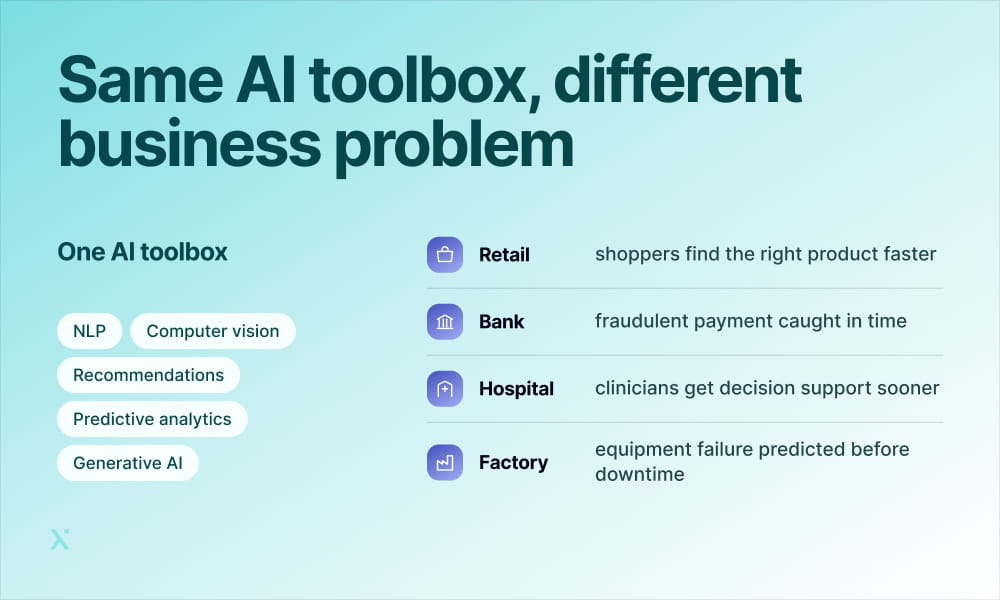
There isn’t a universal AI solution that works across every industry. A hospital has very different priorities than a bank or a manufacturer. One organization may focus on organizing medical documentation, another on preventing fraudulent payments, and another on detecting equipment problems before they disrupt production. The technology changes because the business problem changes.
AI in web development has found its way into almost every industry, but no two projects look exactly alike. A retailer, a bank, and a healthcare provider all have different priorities, so the AI features they build are designed to solve very different business challenges.

AI Integration for Business: A Practical Guide to Efficiency and Profit
The Double-Edged Sword: How AI Is Redefining Cybersecurity in 2026
AI web development process
While AI web development mirrors traditional software projects, it requires critical upfront decisions. Teams must choose between prebuilt and custom models, structure high-performance data pipelines, and design a scalable architecture capable of supporting intensive compute workloads as the application grows.
Because AI influences almost every layer of the application, decisions made during discovery and solution design often have a greater impact on the final outcome than the implementation itself. A well-defined roadmap helps reduce technical risks, avoid unnecessary infrastructure costs, and keep development focused on measurable business goals.
AI web development stages
| Stage | Primary deliverable |
| Discovery | Business requirements and project scope |
| Solution design | System architecture and technology stack |
| UI/UX design | Wireframes and interactive prototypes |
| AI development | AI models, prompts, and inference workflows |
| Backend development | APIs, business logic, and integrations |
| Frontend development | Responsive user interface |
| Quality assurance | Functional, security, and AI validation |
| Deployment | Production release and monitoring |
Technologies used in AI web development
The technology stack plays a much bigger role in AI and web development than it does in a traditional web project. It’s not simply a matter of choosing React instead of Vue or Python instead of Node.js. Every technology affects development effort, infrastructure requirements, licensing costs, and future scalability.
Architecture generally has a greater impact on project cost than the choice of programming language. While some projects can easily run on prebuilt models and managed services, those requiring custom machine learning app development, dedicated retrieval systems, or specialized infrastructure to meet strict compliance and performance requirements will incur significantly higher costs.
Typical AI web development stack
| Layer | Common technologies |
| Frontend | React, Next.js, Vue |
| Backend | Python, Node.js |
| AI Frameworks | TensorFlow, PyTorch |
| Large Language Models | OpenAI, Claude, Gemini, Llama |
| Databases | PostgreSQL, MongoDB |
| Vector Databases | Pinecone, Weaviate |
| Cloud Platforms | AWS, Microsoft Azure, Google Cloud |

How to Ensure Security for Your Web Application Technology Stack

Top 12 AI Tools for Data Analytics to Look out for in 2026
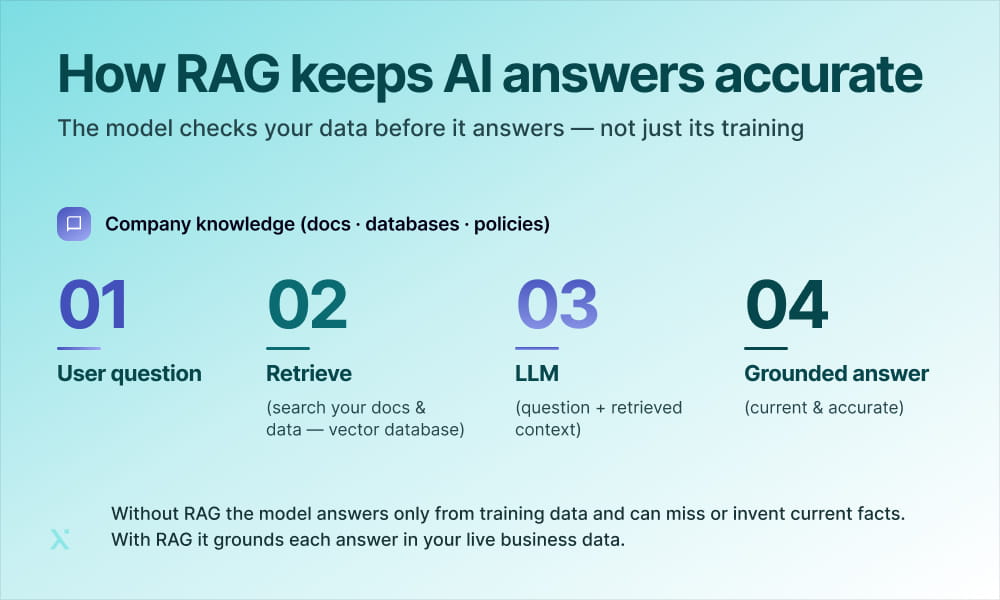
Most modern AI applications don’t rely solely on the knowledge already built into a language model. Many use Retrieval-Augmented Generation (RAG), which allows AI to retrieve relevant information from company documents and databases before generating a response. This helps improve accuracy and keeps answers aligned with current business data.
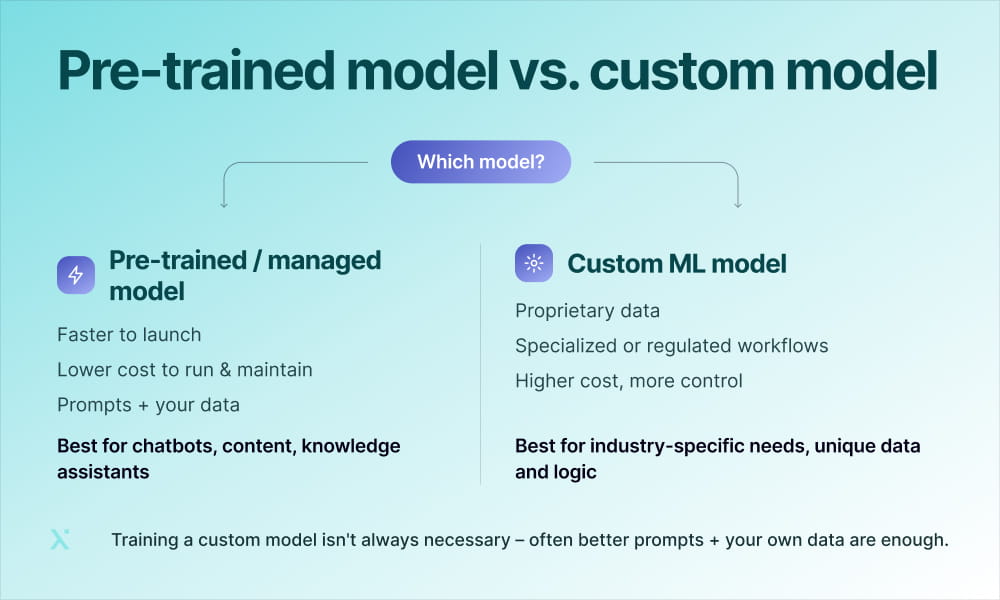
Training a custom model isn’t always necessary. In many projects, teams get the results they need by improving prompts, connecting AI to company data, and testing different ways the model interacts with the application. That approach can reduce both development effort and ongoing operating costs.
AI is also moving beyond traditional chatbots. Modern AI agents can handle multi-step tasks, gather information from multiple sources, use external tools, and make decisions as they work toward a specific goal, rather than responding to a single prompt at a time. That added capability comes with additional engineering challenges. Teams need to control how agents interact with business systems, define clear rules for when they can take action, and thoroughly test their behavior to ensure reliable and predictable results.
The best technology mix is determined by the project requirements, not its novelty. Choosing overly complex tools for simple tasks increases development and maintenance costs without corresponding business value.

The Complete Guide to AI Agents Development in 2026

The Economics of Generative AI Development: Cost and Value
What affects AI web development cost?
There isn’t a standard price for AI web development because every project has different business goals, technical requirements, and implementation approaches. The final budget depends not only on the AI capabilities themselves, but also on the surrounding application, infrastructure, integrations, and long-term operating requirements.
Factors that influence AI web development cost
| Factor | Cost impact |
| Features | High |
| AI complexity | Very High |
| UI/UX design | Medium |
| Third-party integrations | High |
| Infrastructure | High |
| Security | Medium |
| Compliance | High |
| Maintenance | Medium |
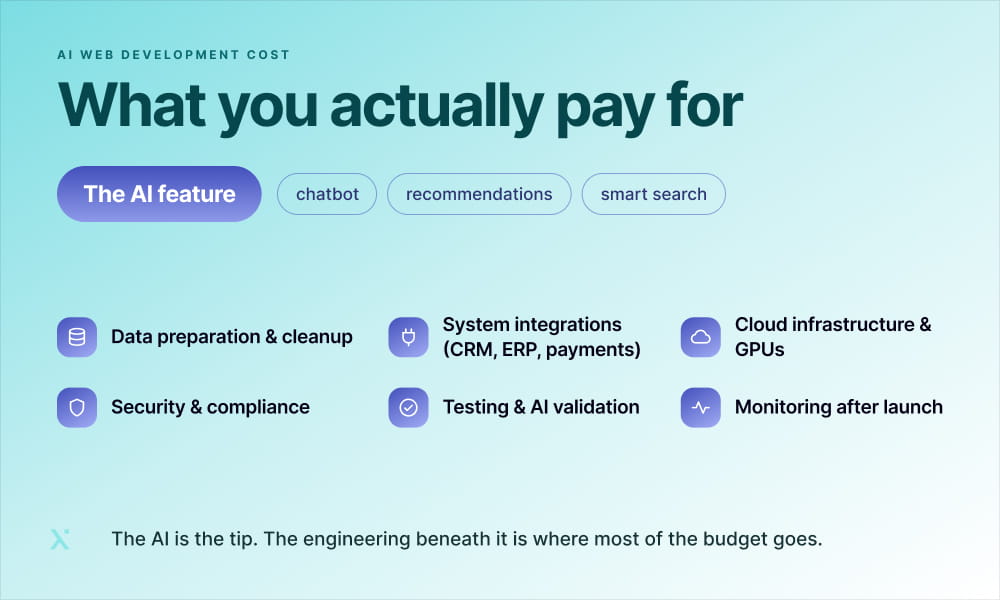
The heavy lifting on these projects is almost always the non-AI engineering — building connections to our current databases, scrubbing and organizing our data, laying down a solid infrastructure, and meeting security or regulatory audits. If we don’t budget equal time and resources for these structural pieces, they will quickly become the primary bottlenecks holding up our launch.
Typical cost drivers
- AI models. The choice between managed AI services, open-source models, or custom machine learning models affects both development costs and ongoing operating expenses.
- Cloud infrastructure. AI workloads often require more computing power than conventional web applications, particularly when processing large volumes of requests.
- Third-party APIs. External AI services, payment gateways, CRMs, ERPs, and other integrations all contribute to the overall project scope.
- DevOps. Cloud environments, deployment pipelines, monitoring, and scaling strategies add engineering effort throughout the project lifecycle.
- Testing. AI-powered features require more than functional testing. Teams also validate response quality, performance, security, and behavior across different scenarios.
- System integrations. Connecting AI with existing business applications often becomes one of the largest development tasks, especially in enterprise environments.
AI itself is only one part of the overall investment. Enterprise projects often require significant effort to prepare data, integrate existing business systems, secure sensitive information, and build infrastructure that can support production workloads. These activities frequently account for a large share of the total project budget.
The biggest cost drivers are usually AI agents, recommendation engines, semantic search, computer vision, and predictive analytics because they require more data, integrations, and supporting infrastructure than basic AI features. The more sophisticated the functionality and the more business systems it needs to interact with, the higher the overall development cost.
Top 10 Real-Life Applications of Large Language Models

Inside Machine Learning Development: What Businesses Should Know
The price behind AI web development
One of the first questions businesses ask is, “How much will it cost?” Unfortunately, there isn’t a universal answer. Two projects may look similar on paper, yet require completely different budgets once AI capabilities, integrations, security requirements, and infrastructure are taken into account.
The prices below are meant to give you a general idea of what businesses typically invest in AI web development. The final budget comes down to the project’s scope, the AI capabilities you want to include, the systems that need to be connected, and the complexity of the overall solution.
| Project | Estimated cost |
| AI web application (basic) | $20,000–50,000 |
| AI business web application | $40,000–90,000 |
| AI ecommerce web application | $60,000–150,000 |
| AI marketplace | $120,000–300,000 |
| Enterprise AI web application | Starting at $250,000 |
These ranges are intended as planning estimates. The final budget depends on application scope, AI capabilities, integration requirements, security expectations, and implementation complexity.
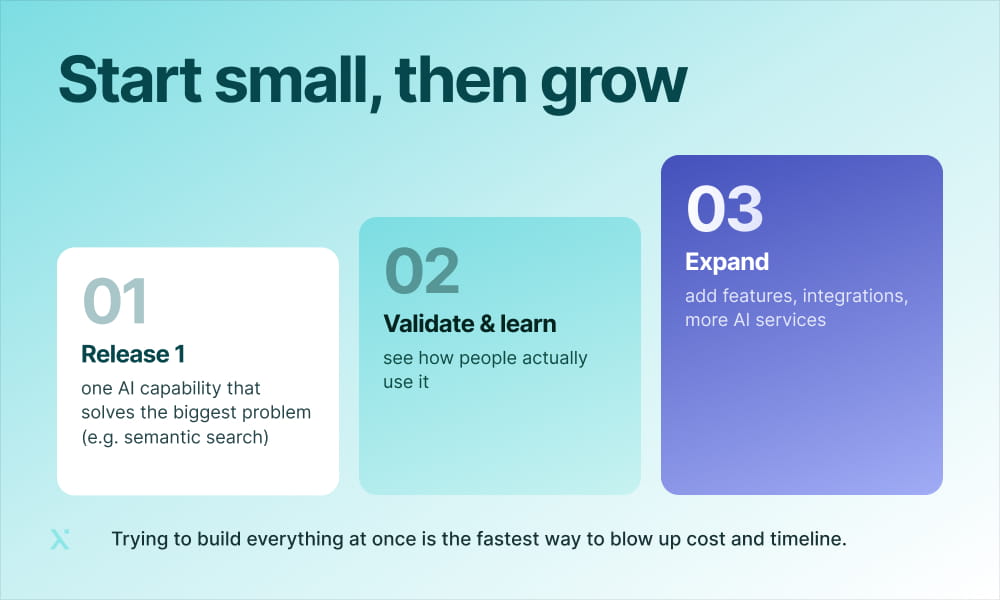
For that reason, it’s often more practical to think in terms of project scope rather than price alone. An MVP with one AI capability can be delivered quickly, while an enterprise platform may involve dozens of integrations, multiple AI services, and several development teams working in parallel.

How Much Does AI Development Cost in 2026?

Blockchain Game Development: Budgeting for Success in 2026
Typical development timeline
The timeline follows a similar pattern. The more AI features, integrations, and business processes involved, the longer the project takes. An intelligent search feature added to an existing website is very different from building a customer portal where AI is responsible for document processing, workflow automation, and decision support.
| Project | Timeline |
| MVP | 2–3 months |
| Mid-size solution | 4–6 months |
| Enterprise platform | 6–12 months |
| Large AI ecosystem | 12+ months |
Project timelines are rarely extended because of coding alone. More often, delays come from activities that happen around development, such as preparing data, integrating legacy systems, validating AI responses, or meeting security and regulatory requirements. These stages are difficult to compress because they directly influence the quality and reliability of the final product.
Trying to build everything at once is one of the fastest ways to increase both costs and delivery time. Many companies start with a smaller release, see how customers use it, and then add new AI features as the product evolves.

AI MVP Development: How to Validate Ideas Fast Without Breaking the Budget

AI in Software Development: It's More Than Hype, It's the New Hammer
AI web development in action
The easiest way to understand why AI web development costs vary is to look at how different businesses use the technology. While every project has its own requirements, the examples below show how AI solves different problems across industries, from increasing sales to reducing operational risk.
| Industry | Example | Primary AI function |
| eCommerce | Amazon | Product recommendations and personalized search |
| Healthcare | Mayo Clinic | AI-assisted diagnostics and clinical decision support |
| Financial Services | PayPal | Fraud detection and transaction monitoring |
| Education | Duolingo Max | Personalized learning powered by generative AI |
| Customer Service | Zendesk AI | AI assistants and intelligent customer support |
These examples show why AI projects are difficult to compare by price alone. A recommendation engine for an online store has very different technical requirements than a fraud detection platform or an AI assistant, even if all three are built as web applications. That’s why project budgets can differ so widely.
How to reduce AI web development costs
Budget overruns often have less to do with AI itself than with early planning. Defining the project scope, choosing the right technologies, and deciding what belongs in the first release can make a noticeable difference to both development costs and future operating expenses.
Practical ways to optimize your budget
- Start with an MVP. Focus on one or two AI capabilities that solve the biggest business problem first. Additional features can be introduced once the initial release has been validated.
- Take advantage of pre-trained models. Many applications don’t require a custom machine learning model. Existing foundation models are often faster to implement and considerably less expensive to maintain.
- Use managed AI services where they add value. Many organizations combine managed AI infrastructure with custom models or proprietary AI components. This approach reduces operational overhead while allowing teams to customize the parts of the solution that create the most business value.
- Prioritize features based on business value. Not every AI idea belongs in the first release. Ranking features by expected impact helps avoid unnecessary development work.
- Automate testing wherever possible. Automated testing shortens release cycles, improves software quality, and reduces the time spent on repetitive manual validation.
- Plan the architecture before development begins. Decisions about integrations, infrastructure, and AI models are much easier and far less expensive to make at the beginning of a project than after development is already underway.
Cutting the budget and reducing costs aren’t always the same thing. A well-planned AI project focuses investment where it matters most and avoids features or technologies that add complexity without solving a real business problem.

80 AI Statistics and Trends Across Multiple Categories: 2026 and Beyond

How to Build an AI Strategy for Your Business
Why choose PixelPlex for AI web development services?
Launching an AI-powered web application is about much more than integrating an LLM or adding a chatbot. The success of the project depends on choosing the right architecture, selecting technologies that fit the business case, and building a solution that remains reliable as usage grows. That’s where experience makes a difference.
PixelPlex develops custom AI web solutions for businesses that need more than off-the-shelf functionality. Whether you’re building a customer portal, an ecommerce platform, a marketplace, or an enterprise application, our team helps define the right implementation approach, estimate the project realistically, and deliver a solution designed to support long-term growth.
What can we help with?
- AI consulting. Evaluate business opportunities, identify practical AI use cases, and define a realistic implementation roadmap.
- AI strategy. Select the right technologies, architecture, and deployment approach before development begins.
- Custom AI web development. Build AI-powered websites, SaaS products, marketplaces, customer portals, and enterprise platforms from the ground up.
- Machine learning engineering. Develop and integrate machine learning models where pre-trained solutions aren’t the right fit.
- System integration. Connect AI capabilities with CRMs, ERPs, payment platforms, internal business systems, and third-party services.
- Cloud deployment. Deploy and scale AI applications on AWS, Microsoft Azure, or Google Cloud.
- Security and compliance. Design applications with data protection, secure access, and industry-specific compliance requirements in mind.
- Long-term support. Continue improving the solution after launch with maintenance, performance optimization, and new AI capabilities as business needs evolve.
Every project starts with a different idea, but the expectation is always the same: build something that solves a real business problem and continues to support the business as it grows.

Top 10 AI Development Companies in 2026
Top 10 Machine Learning Development Companies
Conclusion
AI web development isn’t a fixed-cost investment. The budget depends on what you’re building, how the solution fits into your existing technology landscape, and the business outcomes you want to achieve. Taking the time to define the right scope, architecture, and implementation approach from the beginning can save both time and money as the project grows.
If you’re planning an AI-powered website, customer portal, marketplace, or enterprise platform, experienced AI development services can help you make informed technical decisions, estimate costs realistically, and build a solution that delivers lasting business value.
FAQ
A good place to start is by looking at everyday work. If employees spend hours answering the same questions, searching for information, reviewing documents, or completing repetitive tasks, AI may help simplify those processes. An AI consulting engagement can help determine which opportunities are worth pursuing and which aren’t.
Yes, in many cases it can. The implementation approach depends on how the application is built, where the necessary data resides, and whether the existing architecture can support AI services and additional integrations. An initial technical assessment usually helps identify the most practical implementation strategy.
It depends on your goals. Pre-trained models are often the fastest and most cost-effective option for chatbots, content generation, and knowledge assistants. Custom machine learning models make more sense when your business relies on proprietary data, highly specialized workflows, or industry-specific requirements.
The underlying technologies are often the same, but the user experience and architecture differ. Web applications run in a browser, while mobile solutions must also account for device capabilities, offline access, and platform-specific requirements. If you’re planning a mobile product, our AI app development services can help you build AI-powered applications for iOS, Android, and cross-platform environments.
Yes. That’s how many AI projects begin. Companies often roll out one capability first, such as semantic search or an AI assistant, see how people use it, and then decide what to add next. Planning for future growth early makes those additions much easier.
Absolutely. Technologies such as generative AI, computer vision, natural language processing, and machine learning are used across many types of digital products. If you’re developing interactive entertainment or gaming experiences, our AI game development services help integrate AI into gameplay, NPC behavior, procedural content generation, and player personalization.