
Social applications seem deceptively simple from the outside. A news feed, profiles, likes, comments, maybe a chat function. Nothing seems particularly difficult to develop. But as soon as you start building, reality quickly sets in.
A social product only comes alive when other users are active on it. Without consistent user activity, even a polished app can feel empty.
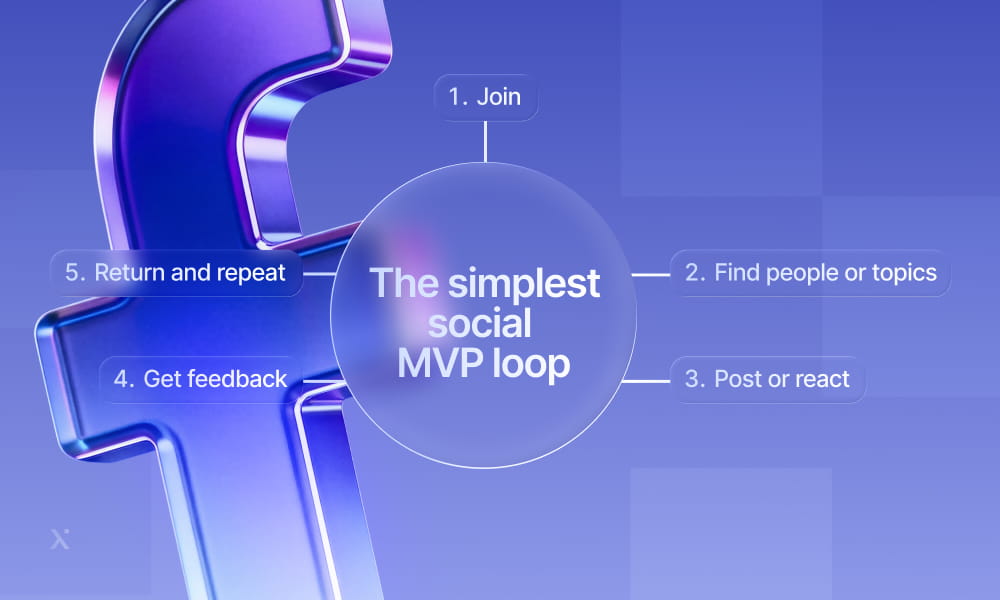
That is why MVP development for social apps is a unique challenge. It is not enough for the app to work. It has to pull users back in and spark real interaction, because that momentum is the whole product. And no, the goal is not to build a tiny version of a massive social platform but to launch the minimum feature set that creates a real loop, users join, do something meaningful, get feedback, and come back.
Next, we will take a detailed look at what an MVP for a social application truly entails, what features should be included in the first release, what this process typically looks like in practice, what factors influence the budget, and what technological solutions will help scale the application without requiring a complete overhaul in the future. We will also discuss what results are considered acceptable at the MVP stage so that you can move forward based on data, not assumptions.

AI MVP Development: How to Validate Ideas Fast Without Breaking the Budget

What Is MVP in Software Development?
What counts as an MVP (and what doesn’t)
Teams throw the term MVP around, but they often mean different things. One group calls a clickable prototype an MVP. Another calls a limited beta an MVP. Sometimes it is simply the first version that went live because the deadline hit and the backlog kept piling up. The label is not the issue. The problem is what happens after launch: you track the wrong numbers and end up learning the wrong lessons. MVP development for social apps is even easier to misread, because activity is the product.
An MVP is the smallest release you can deliver to real users, and its behavior should communicate something useful. You want action, not praise. Will they come back tomorrow? Will they complete the cycle again? If you can’t answer this question, you’ve probably released a demo, not an MVP.
With social apps, the bar is higher. A clean interface helps, but it does not create activity. Your MVP needs to prove one thing: the loop works. Someone joins, does something, gets a response, and has a reason to return. If that is not happening, you do not have an MVP yet. You have a working demo that’s live.
Release types compared
| Format | Main goal | What you ship | What you measure | Typical timeframe |
| Prototype | Test the concept and UX direction fast | Clickable screens, basic flows, sometimes no backend | Clarity of flows, usability, and user understanding | 3–10 days |
| Demo | Pitch the idea to stakeholders or early partners | Polished visuals, scripted scenarios, limited functionality | Interest level, feedback quality, investor or team alignment | 1–3 weeks |
| MVP | Validate real user behavior with minimum viable functionality | Working product with a core loop, basic analytics, and a stable build | Activation, retention, engagement depth, repeat actions | 4–10 weeks |
| Beta | Test stability and improve the product before scaling | Near-complete version, expanded features, stronger infrastructure | Bugs, performance, churn reasons, and feature adoption | 4–12+ weeks |
An MVP needs to move beyond the lab. With MVP development for social apps, production usage is the only thing that counts. If you can’t get it in front of real users and track what they actually do, you haven’t reached the MVP stage yet. You might still be doing the right thing — for example, it’s a prototype for testing scenarios or a demonstration to get all stakeholders on board — but it’s serving a different purpose.

From Idea to Launch: The Essentials of eCommerce MVP Development

Inside Crypto Wallet MVP Development: Process, Costs, and Real-World Lessons
What makes social MVPs different
Building a social MVP is not about making a smaller Facebook. It’s about shipping something that still feels real with a tiny audience. Most products can prove value with one user and one flow. A social app can’t. It only works once people start interacting. That’s why your MVP shouldn’t be a list of features, it should be the simplest engine that gets users to show up, respond, and come back.
Network effects and cold start
If there is no activity, there is no reason to stay. A tight niche and some seeded content can make the first sessions feel real.
UGC pipeline
Once users can post, you are dealing with uploads, storage, delivery, and feed speed. If this is slow or flaky, people bounce.
Real-time feel
Social products benefit when reactions feel immediate. Live updates, refreshable comments, chat, and even a simple online indicator can change how active the app feels.
Moderation basics
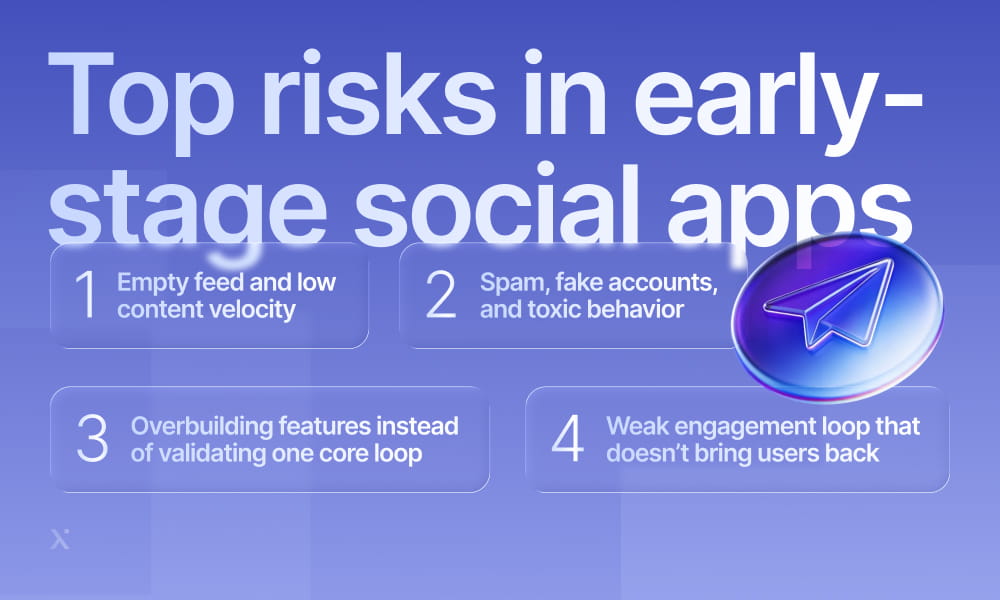
Spam and fake accounts show up early, not later. Reporting, blocking, rate limits, and a basic admin review flow are MVP-level needs.
Privacy and visibility controls
Users want control over who sees their content and who can reach them. Even simple settings reduce friction and churn.
Growth loops
Invites and sharing are not add-ons; they are part of how social products grow. You want at least one loop that users actually use.
In short, you’re not trying to release everything. You’re trying to release the smallest version that delivers real interaction and clear signals.
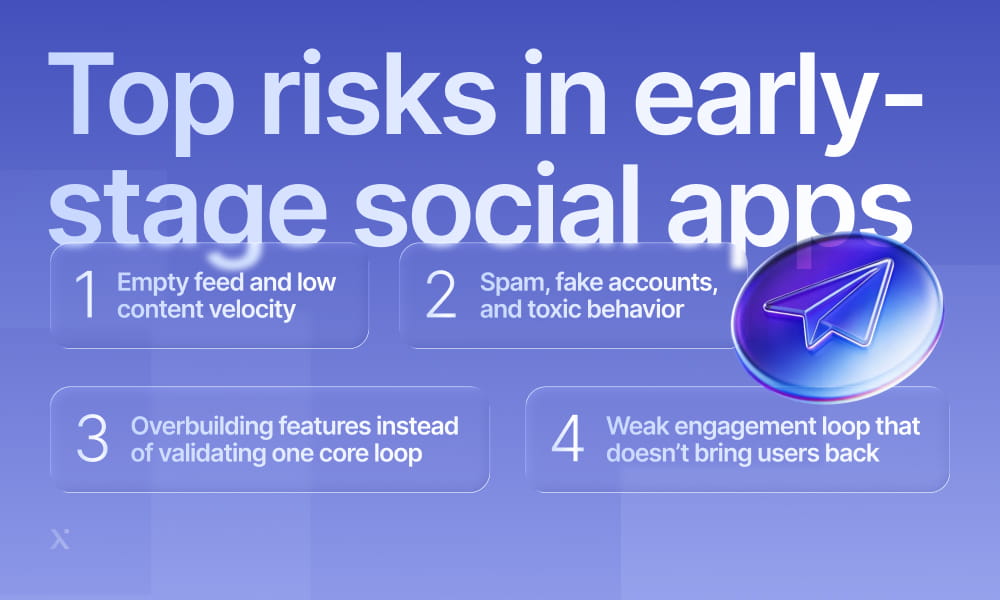
Early social apps don’t usually lose users because of bugs. They lose them because the app feels empty. When the feed is blank, people assume the place is dead and leave. In MVP development for social apps, seeding content and guiding the first actions is not a nice extra; it’s what keeps the first users around long enough for the product to come alive.

Social Media on Blockchain: Why It’s the Next Big Digital Revolution

Inside Machine Learning Development: What Businesses Should Know
What to build first and what to skip
This is where most social media MVPs get stuck. Social apps are essentially a magnet for feature requests, messaging, groups, stories, recommendations, videos, filters — you name it. The problem is, you can spend months developing an app and still fail to find out the only thing that really matters: will people come back and interact? A good plan for MVP development for social apps focuses on one core loop and eliminates everything that doesn’t support it yet.
The easiest way to maintain sanity is to build the core features that make the app easy to use, and put off everything else until you have active users. Your first release should help users quickly join, understand what to do, and start interacting quickly. Everything else can wait until you see real engagement.
Feature prioritization
| Feature | MVP (Yes/No) | Why it matters |
| Signup + onboarding | Yes | Gets users in fast and shows them what to do first |
| Profiles | Yes | Gives identity and context for social interaction |
| Feed (simple timeline) | Yes | Creates a place where activity is visible |
| Ranked feed | No (later) | Needs enough data and volume to be meaningful |
| Posting (text) | Yes | Fastest way to create content and kick-start activity |
| Posting (photo/video) | Optional | Boosts engagement but adds media complexity early |
| Likes + comments | Yes | Core interaction, instant feedback for users |
| Follow/friends | Yes | Builds the social graph and improves relevance |
| Notifications | Yes (basic) | Brings users back when something happens |
| Basic moderation | Yes | Protects the early community from spam and abuse |
| Search | Optional | Helpful for discovery, not always required on day one |
| Messaging | Optional | Strong for retention, but adds real-time complexity |
The process of MVP development for social apps
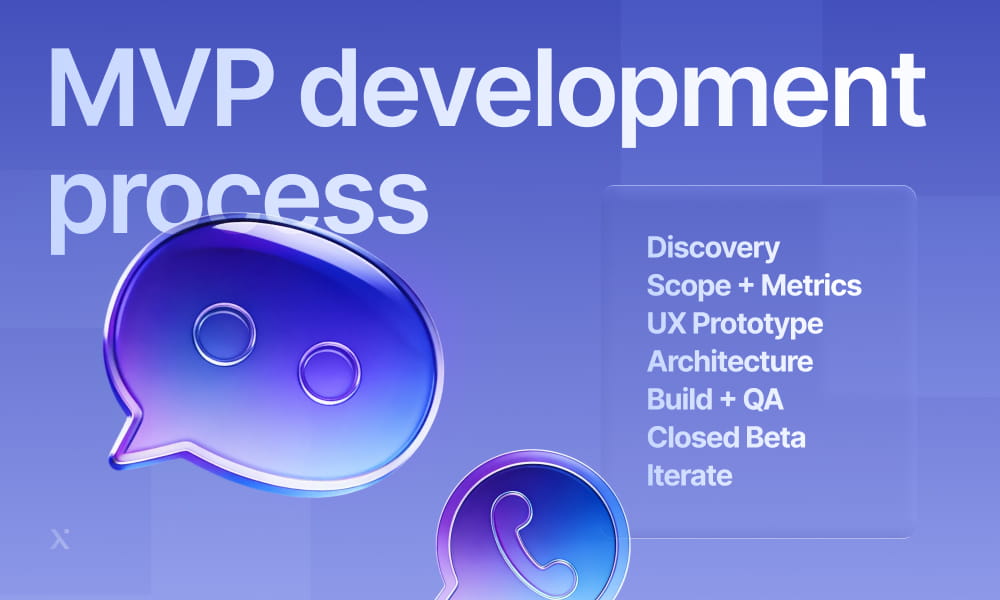
When creating an MVP for social apps, the process is as important as the development itself. You can launch a product quickly, but waste time if you launch without clear hypotheses, without tracking progress, and without a plan for action after the first users. MVP development for social apps is most effective when you treat the MVP as an experiment: set a goal, release the smallest version that can prove it, and then make changes based on real-world usage.
Timeline by phase
| Phase | Deliverables | Who’s involved | Typical duration |
| Discovery | Core idea framing, user segment, hypothesis list | Product lead, BA, tech lead | 3–7 days |
| Scope + metrics | MVP feature set, success metrics, release plan | Product lead, stakeholders, tech lead | 2–5 days |
| UX + prototype | UX flows, wireframes, and a clickable prototype | UX/UI designer, product lead | 1–2 weeks |
| Architecture + backlog | System outline, backlog, sprint plan | Tech lead, backend/mobile leads | 3–7 days |
| MVP build + QA | Working on MVP, QA coverage, bug fixes | Dev team, QA, product lead | 3–6 weeks |
| Closed beta | Beta release, feedback intake, quick fixes | Product, QA, devs | 1–2 weeks |
| Review + roadmap | Analytics insights, iteration backlog, next milestones | Product lead, tech lead | 3–5 days |

Web3 Development: What It Takes to Build the Future

Guide to Mobile Backend App Development: The Unseen Engine of Your App

How to Create a Mobile App Startup: a Step-by-Step Guide
Best tech stack for a social MVP
MVP development for social apps doesn’t require a complex tech stack. What’s needed is a stack that will allow you to quickly release the app, ensure its smooth operation, and avoid getting bogged down when users start posting more content, reacting to messages, and generating more information than expected. The right choice also depends on what you’re building. A text-focused community app has different needs than a video-focused social product with chat and real-time updates.
Here’s a common configuration that works well for most MVPs, and you can customize it to suit your product and budget.
- Mobile: Flutter or React Native, or native Swift + Kotlin if you need maximum performance
- Backend: Node.js, Python, or Go
- Database: PostgreSQL for core data, Redis for caching and rate limits
- Real-time: WebSockets, Firebase, or Socket.io, depending on your feature set
- Media: S3-compatible storage + CDN for fast content delivery
- Analytics: Mixpanel or Amplitude, plus BI tooling if you need deeper reporting
- CI/CD: GitHub Actions + Docker, Terraform, when infrastructure starts growing

App Development for Startups: Expert Strategies for Technology Decision Makers

Top 8 Cross-Platform App Development Frameworks in 2026
MVP cost: what you pay for (and why)
When asked about the cost of an MVP, people usually expect a precise figure. Social apps rarely work that way. The price isn’t determined by how beautiful the interface is or how many screens you have in Figma. The budget is influenced by everything that happens behind the scenes:
- Platforms: one platform vs cross-platform vs fully native iOS + Android
- Real-time: chat, live updates, presence, sync, push complexity
- Media: photo/video uploads, compression/transcoding, CDN delivery, feed performance
- Feed complexity: chronological vs ranked/personalized feed
- Safety: reporting, blocking, rate limits, admin tools, anti-spam/anti-bot
- Analytics: event plan, funnels, retention tracking, experiments/feature flags
- Non-negotiables: QA depth, release pipeline, monitoring/alerts

Blockchain Development Cost in 2026: What Goes Into the Price Tag
How Much Does AI Development Cost in 2026?
Typical MVP cost ranges for social apps
| MVP type | What’s included | Rough range |
| Lean MVP (1 platform) | Signup/onboarding, profiles, simple feed, text posting, likes/comments, basic notifications, basic moderation, basic analytics | $25k–$60k |
| Standard MVP (cross-platform) | Everything above + stronger UX, more polished onboarding, better notification logic, more complete admin tools, more analytics events | $60k–$120k |
| MVP with real-time chat | Standard MVP + 1:1 chat, typing/seen states (basic), realtime infra, extra QA for edge cases | $90k–$180k |
| Media-heavy MVP (photo/video) | Standard MVP + media upload pipeline, compression/transcoding, storage + CDN tuning, feed performance work | $120k–$250k |
| Advanced MVP (ranking + safety) | Media or chat MVP + ranked feed v1, anti-abuse hardening, stronger privacy controls, observability/monitoring | $180k–$350k+ |

Cryptocurrency Exchange Development Cost: Key Factors & Estimates
Crypto Payment Gateway: Costs, Benefits, Implementation
Security, privacy, and moderation
Popular social platforms attract real people, but at the same time, they also attract spammers. If you postpone security issues, you risk losing the one thing you can’t get back — user trust in the early stages. The goal is not to create a perfect trust and security system. The goal is to create a comfortable space where ordinary users feel comfortable posting content and returning to the platform.
MVP safety baseline for social apps
| Area | What to include in MVP | Why it matters | Keep it lean |
| Verification | Email verification; phone verification if you expect bots or public posting; optional device checks/CAPTCHA on suspicious signups | Cuts bot signups and reduces low-effort abuse early | Start with email, add phone only if the risk is high |
| Rate limits + anti-bot | Limits on signups and repeated actions; throttling for follows/likes/comments/messages; flag suspicious patterns | Prevents spam floods and makes abuse more expensive | Use simple rules first, then tighten based on abuse patterns |
| User controls | Report content/profiles; block users; optional mute/restrict | Gives users a way to protect themselves, and reduces churn | Keep report reasons short and clear |
| Privacy settings | Public/followers/private visibility; who can message; search visibility toggle | Helps users feel safe enough to post and engage | Two or three clear options beat a complex matrix |
| Admin panel (minimum) | Report queue; view user history; remove content; suspend/ban accounts; basic export | Let the team act fast when something goes wrong | Simple dashboard beats manual database work |

Popular Web3 Hacks Analysis and Prevention Tips

A Developer’s Guide to Mobile App Security
Designing the MVP for scaling later
When you’re designing for the future, the trick is to keep it lean without building a throwaway product. The worst-case scenario happens all the time: you launch, people love it, and then the first major update forces you into a total rewrite. Scaling isn’t just about traffic spikes — it’s about adding new features without breaking the stuff your users already like.
Keep your boundaries clean
You don’t need a complex microservices architecture on day one. Just make sure there’s a clear split between the basics — things like auth, profiles, the feed, and notifications. If your moderation tools or analytics need to grow later, they should be able to expand without dragging the entire codebase down.
Give your data model some breathing room
Most social apps eventually move in the same directions: groups, DMs, or better recommendation engines. If your initial database schema is too rigid, you’ll end up hacking new features on top of it. Small wins that save you later:
- Set up follower relationships so they can easily evolve into groups.
- Treat visibility and privacy as dedicated fields from the start.
- Keep the structure for posts, comments, and media consistent.
Plan for constant tweaking
Expect to mess with your onboarding and feed logic way more than you think. Using feature flags makes this a lot safer — you can test a change, see if it works, and roll it back instantly if it doesn’t. Even if you aren’t charging users yet, keep your roles and analytics clean. It makes adding subscriptions or boost features feel like a natural addition later on, rather than a clunky afterthought.

Future of AI: Unveiling Its Impact on Industries and Society

Top 10 Digital Transformation Trends for 2026 and Beyond
PixelPlex as your MVP partner
We don’t view an MVP as a scaled-down version of a full-fledged social platform. We view it as a test to learn from. The goal is to release the smallest version that will prove the core functionality of the platform, including user acquisition, interaction, feedback, and retention. That’s why we set up analytics early on so that post-launch decisions are based on user behavior, not guesswork.
Social products quickly become complex once real users arrive. Content uploads, feed performance, real-time updates, notifications, moderation, and privacy are all factors that seamlessly impact user retention. Our team has extensive experience working with user-generated content-rich feeds, real-time mechanisms, and a backend architecture that can scale without redesigning as popularity begins to grow.
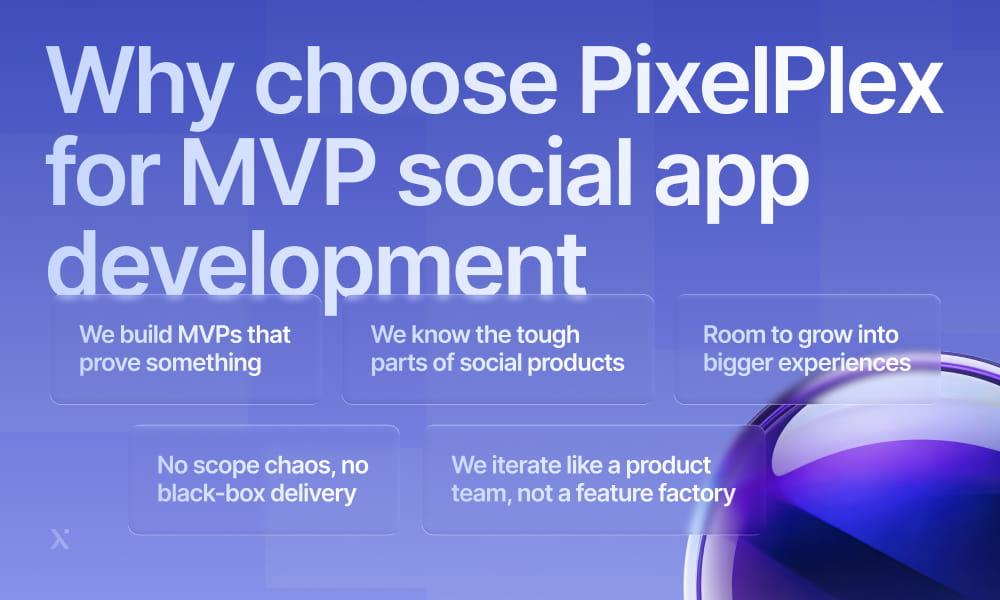
We also focus on the practical aspects of MVP development for social apps. Scope management is important because social applications are prone to feature growth. We help you clearly prioritize, release products iteratively, and remain transparent about what’s being built and why. After launch, we continue to work in the same way as product teams: measuring results, learning, improving, and then releasing the next release with a clearer roadmap.

Top 10 AI Development Companies in 2026

Top Full-Service Web3 Development Companies 2026
Conclusion
A social app can look ready on the surface and still fail the moment it meets real users. The feed loads, profiles work, posting is smooth, but the app feels quiet. People scroll, don’t see much happening, and leave. That is why MVP development for social apps should be built around one simple check: will users interact with each other and return, or will they disappear after the first session?
Therefore, consider the first release as live testing, not a demonstration of capabilities. Limit the functionality and focus on the core workflow. Add basic moderation tools before opening access to a wider audience, because spam and fake accounts appear very quickly. Then observe what users are doing: are they posting content, reacting to it, returning to the platform, and inviting other users without being forced to? If these actions are observed, you can confidently develop the next version. If not, you will get feedback while the product is still small enough to be modified.
FAQ
Don’t let things go quiet. Fill the feed with content, attract a few users who will post and respond to messages, and encourage newcomers to participate with prompts. Your goal is to solve the problem of an empty feed, not just create the illusion of activity.
Usually not. A simple chronological news feed combined with a quality user onboarding process can work perfectly well in the initial stages. Recommendations become important later, when you have accumulated enough activity and data for them to be useful, rather than random.
Using real names discourages some people from breaking the rules, but it also silences others. Pseudonyms encourage communication, but you’ll have to spend more time dealing with dishonest users. Starting with pseudonyms and then adding verification is often the easiest approach.
Suppose the experience depends on presence and identity, not just content. That’s usually the point where metaverse consulting & development services become relevant, because you’re building more than a feed, you’re building an environment.
Pick the platform where your first users already are. If your niche leans toward Web3 iOS app development, start there. If you need both for adoption, go cross-platform, but keep the MVP scope tight. This is also where mobile app development strategy matters, because the wrong platform choice can slow down the whole launch.
Begin with session one. If users cannot complete the loop, the product is creating friction. If they complete it once but do not return, the issue is usually around community and content; the feed feels quiet, the social graph is weak, and there is no clear reason to come back. You need early analytics to know which problem you have.