Glossary · Data and DeFi
Oracle
Published 22 May 2025 · Updated 9 Nov 2026 · 16 min read
A blockchain oracle is a service or mechanism that brings outside data onto a blockchain so smart contracts can use it. That data can include prices, reserves or event results. A contract cannot fetch outside data itself. The mechanism makes an input available, but cannot establish that an off-chain fact is true.
- An oracle cannot prove an off-chain fact, so contracts check signatures, agreement and freshness.
- Push feeds publish timed or price-triggered updates, while users pull signed prices into transactions.
- Many oracle failures involved prices one trader could move, rather than broken signatures.
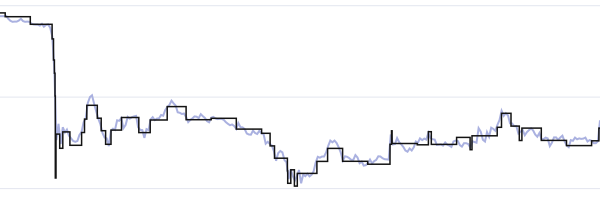
 19:4301:4307:4313:4319:43Uniswap v3 pool price, five-minute samplesPrice stored by the feedUpdate after a deviationUpdate after the heartbeat
 Read from a public Ethereum node with no API key: the feed's rounds through its proxy and 8,587 swaps in the pool.
What a blockchain oracle does
Every node processing a transaction must reach the same result. Smart contracts therefore use data already recorded on the chain, rather than fetching changing answers from websites. A blockchain oracle makes outside information available in that shared record. The definitions below describe this connection from technical and regulatory perspectives. They do not make the source automatically trustworthy.
| Source | Date | Definition, in its own words | What it adds |
|---|---|---|---|
| NIST IR 8301, Blockchain Networks: Token Design and Management Overview | DateFebruary 2021 | Definition, in its own words“A source of data from outside a blockchain that serves as input for a smart contract.” | What it addsThe shortest neutral wording, with no design built in |
| ethereum.org, Oracles | DatePage updated 26 June 2026 | Definition, in its own words“Oracles are applications that produce data feeds that make offchain data sources available to the blockchain for smart contracts.” | What it addsThe developer view, tied to data feeds |
| IOSCO, Decentralized Finance Report | DateMarch 2022 | Definition, in its own words“An oracle connects a smart contract to off-chain data that may be an input for that smart contract's functionality.” | What it addsSecurities regulators frame it as an input to a contract |
| FSB, The Financial Stability Risks of Decentralised Finance | Date16 February 2023 | Definition, in its own words“Oracles are services typically enabling blockchain smart contracts to access external (or “offchain”), real-world data.” | What it addsA financial stability view that names oracle risk |
| BIS Bulletin No 76, The oracle problem and the future of DeFi | Date7 September 2023 | Definition, in its own words“Oracles are third parties that collect and disseminate data on real-world events.” | What it addsCentral banks point to where the trust sits |
| Chainlink white paper v1.0 | Date4 September 2017 | Definition, in its own words“Today, the solution to this problem is to introduce a new functionality, called an oracle, that provides connectivity to the outside world.” | What it addsWhy the need exists: consensus cannot call outside systems |
On Ethereum, every node must execute the same transaction consistently. Determinism means identical starting conditions and inputs produce identical results. An external request could return 3 to one node and 7 to another. Those different answers would break blockchain consensus. An oracle writes one input into the shared record instead. Every node can then calculate the same state change from that on-chain input, even if the outside source later changes.
The oracle problem is that correct execution still depends on correct inputs. Trusting an operator reintroduces trust that smart contracts were meant to remove. The ethereum.org guide names correctness, availability and incentive compatibility as tests. In September 2023, BIS called complete decentralization of oracles "debatable". An on-chain check can establish who signed, how many agreed, the value's age and whether it meets application limits. It cannot establish the truth of an off-chain fact, including a price used in DeFi applications.
Beyond prices, proof of reserve supports stablecoin reserve checks and tokenized assets, often using one issuer or custodian. Verifiable randomness (VRF) generates values with a proof that a smart contract checks. It does not fetch existing randomness. An optimistic oracle can report event outcomes. Output oracles send on-chain information to external systems. Cross-chain messaging carries messages between chains, where cross-chain bridges also operate. These functions have different verification rules, so a data feed for reserves is not interchangeable with a price feed.
How prices reach a smart contract
A price travels through sources, operators and verification before a DeFi smart contract uses it. These steps follow a decentralized oracle network rather than a pool average. Different designs change who supplies an observation and who checks the final input.

Source
Chainlink crypto price feeds draw on three or more aggregators or market data vendors using exchange data. Several nodes reading one source still share its errors.

Observe
Each node operator queries several sources and combines their estimates into its own observation. Independent operators do not necessarily mean independent information when their sources overlap.

Aggregate and sign
In Off-Chain Reporting, nodes exchange signed observations and a quorum signs one median report. The on-chain contract verifies digital signatures. Transmission and consumption create oracle extractable value, a subset of maximal extractable value.

Deliver
A push oracle publishes when a deviation threshold or heartbeat triggers an update. A pull oracle lets users include a signed report in the transaction needing it.

Verify
The receiving contract checks the required signatures, not the market itself. Since 26 August 2026, Pyth Core on Ethereum accepts updates with three of five router signatures.

Read and check
The consuming smart contract compares the timestamp with its own maximum age. On a layer 2, it also checks sequencer status before accepting a price.
An optimistic oracle instead accepts an answer backed by a bond unless someone disputes it during a challenge period. UMA disputes involve 24-hour commit and 24-hour reveal votes. Polymarket's January 2026 guidance specifies a two-hour challenge period and a $750 bond. DEX oracles work differently again. A TWAP reads a pool's own price accumulators, not signed observations from off-chain reporters. Its verification depends on on-chain trading history and the averaging window, rather than agreement among data vendors.
How push and pull feeds update
Delivery determines when an off-chain price becomes an on-chain input and who pays. Chainlink describes each push feed as funded by its community of users. With pull delivery, the caller brings an update and pays transaction gas. Neither approach removes the need for freshness checks.
- Who pays
- The feed, about 181,000 gas per update. In this model, about 0.0118 ETH ($25.27) for the day
- The live feed, same 24 hours
- 55 updates (44 after a deviation, 11 after the heartbeat), 0.0088 ETH of gas
- Who pays
- The feed, about 181,000 gas per update. In this model, about 0.0109 ETH ($23.22) for the day
- The live feed, same 24 hours
- 55 updates (44 after a deviation, 11 after the heartbeat), 0.0088 ETH of gas
- Who pays
- The feed, about 181,000 gas per update. In this model, about 0.0069 ETH ($14.68) for the day
- The live feed, same 24 hours
- 55 updates (44 after a deviation, 11 after the heartbeat), 0.0088 ETH of gas
- Who pays
- The feed, about 181,000 gas per update. In this model, about 0.0056 ETH ($11.95) for the day
- The live feed, same 24 hours
- 55 updates (44 after a deviation, 11 after the heartbeat), 0.0088 ETH of gas
- Who pays
- The feed, about 181,000 gas per update. In this model, about 0.0043 ETH ($9.22) for the day
- The live feed, same 24 hours
- 55 updates (44 after a deviation, 11 after the heartbeat), 0.0088 ETH of gas
- Who pays
- The feed, about 181,000 gas per update. In this model, about 0.0013 ETH ($2.73) for the day
- The live feed, same 24 hours
- 55 updates (44 after a deviation, 11 after the heartbeat), 0.0088 ETH of gas
- Who pays
- The feed, about 181,000 gas per update. In this model, about 0.0038 ETH ($8.20) for the day
- The live feed, same 24 hours
- 55 updates (44 after a deviation, 11 after the heartbeat), 0.0088 ETH of gas
- Who pays
- The feed, about 181,000 gas per update. In this model, about 0.0003 ETH ($0.68) for the day
- The live feed, same 24 hours
- 55 updates (44 after a deviation, 11 after the heartbeat), 0.0088 ETH of gas
- Who pays
- Each user, as gas in the transaction that needs the price
- Price at the moment of use
- Signed off-chain moments before, checked on chain in the same transaction
- Who pays
- Each user, as gas in the transaction that needs the price
- Price at the moment of use
- Signed off-chain moments before, checked on chain in the same transaction
- Who pays
- Each user, as gas in the transaction that needs the price
- Price at the moment of use
- Signed off-chain moments before, checked on chain in the same transaction
Between uses, the stored price ages. Without an age check, the gap reaches 4.58% with hourly use and 5.10% with use every six hours.
At 1% or 2% with an hourly heartbeat, time triggers most updates while price gaps grow between them.
At 0.25% deviation, the model sends 68 to 74 updates with a smaller average gap, while the feed pays more gas.
Each user transaction carries its own signed price and pays gas, making the price fresh when that transaction uses it.
A 24-hour heartbeat lets the stored value wait for hours. At 2%, the model's longest wait reaches 21.7 hours.
At 0.5% and one hour, the model sends 43 updates. The live feed sent 55, with nodes watching continuously and querying several sources.
This page team model uses five-minute Uniswap v3 USDC/WETH pool samples from 8 to 9 November 2026.
During the 24 hours ending 19:43 UTC on 9 November 2026, Chainlink's Ethereum ETH / USD feed recorded 55 updates. Of these, 44 followed moves of at least 0.5%, and 11 followed the heartbeat. A 3.3% step occurred at 21:56 UTC on 8 November 2026 during a fall. The feed paid about 181,000 gas per update, 0.0088 ETH in total (page team calc). Thresholds and heartbeats differ by asset and by chain.
Check updatedAt against the heartbeat or an application limit. A zero timestamp marks an incomplete round. The answeredInRound field is deprecated, and most feeds no longer use minAnswer or maxAnswer. Pyth's getPriceNoOlderThan rejects stale data, while getPriceUnsafe can return arbitrarily old prices. Pyth suggests pausing new activity when the confidence interval is too wide relative to the price. On layer 2 networks with a sequencer uptime feed, check it and apply a grace period after outages. These checks belong in the consuming smart contract, not just its user interface.
How aggregation contains bad reports
Aggregation limits the effect of individual errors without certifying the underlying market. A median selects the middle observation rather than averaging every value. The interactive example separates a few faulty reporters from a shared source failure, which agreement cannot repair.
One wrong value moves the average about 4.8% downward or 57% upward, while the median barely changes.
A shared source defeats agreement. A 30% DAI spike reached Compound in November 2020 despite signed price reporting.
Ten wrong observations among 21 reach the OCR limit for 31 nodes. The median remains between honest values.
Eleven wrong observations on the same side control the median, exceeding the fault bound in this example.
With no wrong values, the median and plain average agree around the illustrative honest price.
These observations are illustrative, not node measurements. Off-Chain Reporting requires fewer than one third of nodes to be faulty.
With fewer than a third of nodes faulty and at least 2f + 1 observations, the OCR median stays between honest values. Feed contracts allow at most 31 oracles. On 26 November 2020, a 30% DAI spike on one exchange reached Compound, and $88.4 million of collateral was liquidated. On 20 September 2021, two publishers' errors caused sharp dips in Pyth's BTC/USD price over about two minutes, reaching $5,402. On 12 May 2022, a paused feed left Venus pricing LUNA at about $0.107 while the market price was $0.01.
How oracle prices get manipulated
Valid signatures can carry a price from a market someone has moved. Reading a decentralized exchange pool does not establish an independent market value. The figure separates trade capital from attacker loss. Capital funds the trade, while the loss is what arbitrage takes back when prices return.
- Capital for one trade
- $3.89 million of USDC, including the 0.3% fee. The attacker gets ETH back, and loses what arbitrage takes when the price returns
- Spot price after the trade
- $4,267 per ETH, from $2,133
- TWAP window
- 150 slots of 12 seconds. The moved price counts for 12 of 1,800 seconds
The pool held 9.37 million USDC on 9 November 2026. Doubling takes about 3.9 million, trade capital potentially available through a flash loan.A pool with $100 million per side needs about $41.5 million to double. Depth raises trade capital requirements but cannot validate spot prices.With $100,000 per side, 13-fold pricing needs about $261,000. Thin pools featured in Rodeo Finance's July 2023 and Polter Finance's November 2024 cases. One 12-second block occupies 1/150 of the window. Doubling moves the v2 TWAP 0.67% and the v3 TWAP 0.46%.Ten doubled-price blocks move v2 by 6.67% and v3 by 4.73%. Longer holds increase exposure to arbitrage, while averaging delays real changes.Holding the move for three blocks means losing value to arbitrage each block, unless one proposer controls them all.
This page team calculation uses pool reserves from 9 November 2026 and Uniswap formulas, not observed attack costs.
A spot price can move within one transaction, often through a flash loan. Thin markets can make such manipulation cheaper. At bZx on 18 February 2020, moved exchange prices enabled borrowing against inflated collateral. The CFTC reported that Mango Markets' oracle price rose over 13-fold in 30 minutes on 11 October 2022 and that more than $110 million was withdrawn. Following the April 2024 jury verdict, a judge vacated two commodities convictions on 23 May 2025 and granted acquittal on the wire fraud count.
A TWAP dilutes brief moves but lags. Uniswap Labs' October 2022 analysis found two-block attacks on top pairs prohibitively expensive. Longer attacks were feasible but unlikely for smaller validators. It identified wide-range liquidity as the best mitigation. Since the Merge, validators know in advance when they will propose. One controlling two blocks in a row can hold a moved price without arbitrage. UwU Lend's June 2024 case showed one attacker moving several median inputs. IOSCO cited an estimate of over $400 million lost in 41 oracle manipulation attacks in 2022.
How blockchain oracle designs compare
The table compares reporting, verification, update timing, payment and failure modes rather than ranking products. Chainlink illustrates decentralized push reporting, while Pyth and Chainlink Data Streams illustrate pull delivery. Api3 illustrates a first-party oracle, where the data provider signs directly. A validator-run oracle places reporting inside chain consensus.
| Design | Who reports | How a contract checks it | When it updates | Who pays | Main risk | Examples |
|---|---|---|---|---|---|---|
| Single source | Who reportsOne operator or data provider | How a contract checks itOne key's signature or an allowed sender | When it updatesOn the operator's schedule or on request | Who paysThe operator or the requester | Main riskSource error, outage or a stolen key | ExamplesCompound's Open Oracle reporters (2020), single-source proof of reserve feeds |
| Decentralized push feed | Who reportsA committee of node operators | How a contract checks itQuorum signatures on one report, median exposed | When it updatesDeviation threshold or heartbeat, whichever comes first | Who paysNode operators send it, users fund the feed | Main riskStaleness between updates, operator concentration | ExamplesChainlink Data Feeds, Sky (Maker) Median with a one-hour delay, Chronicle Scribe |
| Pull feed | Who reportsPublishers, aggregated off-chain and signed | How a contract checks itSignatures checked inside the user's transaction | When it updatesWhen a user posts an update | Who paysThe user who needs the price | Main riskA consumer that skips the age check | ExamplesPyth Core and Pyth Pro, Chainlink Data Streams |
| First-party oracle | Who reportsThe data provider runs its own node | How a contract checks itThe provider's key signatures | When it updatesDeviation threshold, 24-hour heartbeat on Api3 Market | Who paysUsers buy plans to keep a feed active | Main riskEach provider is a single source for its data | ExamplesApi3 (Airnode deprecated, now AirnodeHub and signed-api) |
| Optimistic oracle | Who reportsAnyone who posts a bond | How a contract checks itNo proof. The claim stands unless disputed in time | When it updatesWhen a claim is asserted | Who paysAsserters and disputers pay their own transactions and bonds | Main riskA false claim stands if nobody disputes it in time | ExamplesUMA Optimistic Oracle V3, Polymarket resolution (2-hour window) |
| DEX TWAP | Who reportsThe pool itself, through trades | How a contract checks itRead from the pool's own accumulators | When it updatesAt most once per block | Who paysTraders who touch the pool | Main riskThin pools and proposers with consecutive blocks | ExamplesUniswap v2 cumulative prices, Uniswap v3 tick accumulators |
| Validator-run oracle | Who reportsThe chain's validators | How a contract checks itSet by consensus as a stake-weighted median | When it updatesEach vote period or each block | Who paysValidators, as part of consensus work | Main riskCollusion above the stake threshold | ExamplesTerra Classic x/oracle, dYdX Chain |
Each row assigns trust differently: a provider's key, operator quorum, freshness check, bonded challenge, pool liquidity or chain validators. Combining a main data feed with a fallback or delay changes those dependencies rather than removing them. Maker's Oracle Security Module holds new prices for one hour so governance can react. For a DeFi smart contract on Ethereum, the relevant comparison is the failure behavior it can tolerate, including what happens when two inputs disagree.
How blockchain oracles developed
The timeline tracks changes in data delivery and the failures that exposed design assumptions. Early work focused on authenticated off-chain inputs. Later designs added price accumulators and shared reports, while public data publication expanded beyond market prices.
- October 2016
Authenticated outside data
The Town Crier paper on authenticated data feeds for smart contracts was presented at ACM CCS in October 2016, after first appearing in February 2016.
- September 2017
A network of reporters
The Chainlink white paper described a decentralized oracle network. It connected the need for outside data to blockchains' consensus protocols, which could not natively communicate with external systems.
- February 2020
Borrowing against moved prices
A flash loan moved Uniswap and Kyber prices used by bZx as an oracle. The attacker borrowed against inflated collateral, demonstrating manipulation of the input market.
- March 2020
Updates fall behind prices
During Black Thursday, rising gas prices delayed Maker oracle updates while ETH fell. Glassnode reported that more than $8 million in ETH was liquidated for zero DAI.
- May 2020
Price history becomes readable
Uniswap v2 launched on 18 May 2020 with price accumulators for TWAP oracles. Contracts could compare checkpoints over time instead of relying only on a pool's current price.
- February 2021
One report per round
Chainlink Off-Chain Reporting went live on 24 February 2021. Nodes exchanged signed observations off-chain, then submitted one report per round instead of a separate transaction from every node.
- October 2022
Market moves reach lending
According to the CFTC, Mango Markets' oracle price rose over 13-fold within 30 minutes after buying on three exchanges, and more than $110 million was withdrawn.
- August 2025
Public statistics reach blockchains
The US Department of Commerce published GDP data on public blockchains on 28 August 2025. Pyth and Chainlink helped disseminate this first federal publication of economic statistics through that route.
Where blockchain oracles still fail
A data feed can pass every signature check and still be unusable. Operational limits include source errors, delayed transactions and dependencies outside the application. These cards separate the conditions a protocol must monitor from the guarantees its oracle actually provides.
Sources can be wrong
Chainlink warns that reserve feeds often depend on one provider. Compound's November 2020 spike and Pyth's September 2021 errors exposed different source failures.
Updates can lag
Congestion delays publication, and a paused feed preserves an old value. Maker's March 2020 experience showed why an update schedule cannot guarantee timely delivery.
Thin markets move
Chainlink identifies low-liquidity assets as especially vulnerable to market manipulation. The FSB's February 2023 report also identified manipulation risk for oracles themselves.
Operators can concentrate
Chainlink's Ethereum ETH/USD feed lists 31 node operators (9 November 2026). Since 26 August 2026, Pyth Core requires three of five router signatures. FSB warned in February 2023 that shared oracles can propagate shocks.
Outages interrupt access
Base's 5 August 2025 disruption halted block production for 33 minutes. Sequencer checks detect downtime, and a grace period delays price use after recovery.
Integrators carry responsibility
Chainlink assigns developers responsibility for market integrity and application code risks (checked 9 November 2026). No court ruling on an oracle provider's liability for bad data was found when this page was checked.
Building and reviewing oracle integrations
We choose and integrate price feeds, write the surrounding checks, and test how a DeFi protocol responds when data is late, wrong or moved. PixelPlex is a software engineering company founded in 2007 and building in blockchain since 2013. Our oracle work focuses on contract behavior and failure handling, not treating a signed input as automatically safe.

In Echo's protocol design, the oracle role belongs to a committee of trusted accounts selected by ECHO holders. That committee reports market rates for coins such as MKR, DAI and BTC to the contract system. This design makes the reporting authority explicit rather than removing it.
Source selection and safeguards
In smart contract development, we select oracle sources early, code safeguards for delayed or unusual updates, and test them before deployment.DeFi checks and simulations
Our DeFi contract development includes TWAP oracles, localized slippage limits, flash-loan simulations and property-based fuzzing to test application behavior.Exchange failure testing
Our decentralized exchange development tests oracle manipulation, flash-loan attacks and extreme market volatility, going beyond checks for ordinary implementation bugs.Reserve and price planning
For stablecoin development work, we prepare an oracle and price feed integration plan and provide on-chain proof of reserve.Insurance source validation
Our blockchain insurance development includes source validation and fallback logic for oracle integrations, including rule-based flight delay cover.
Discuss the checks around your oracle integration
We can discuss a planned integration or review how an existing protocol handles delayed, unusual or disputed inputs.
Discuss oracle integrationOracle FAQ
What is a blockchain oracle in simple terms?
Why can't smart contracts fetch outside data themselves?
What does the oracle problem actually mean?
How do push and pull oracles differ?
How can a contract identify a stale price?
How do protocols reduce oracle manipulation risk?
Is a blockchain oracle related to Oracle software?
Related terms
- Smart contracts
- Relayer
- DeFi
- Decentralized exchange
- Maximal Extractable Value (MEV)
- Stablecoin
- Layer 2
- Attestation
- Trustless
Sources (35)
- NIST: IR 8301, Blockchain Networks: Token Design and Management Overview, Feb 2021
- ethereum.org: Oracles, Jun 2026
- IOSCO: IOSCO Decentralized Finance Report, Mar 2022
- IOSCO: Final Report with Policy Recommendations for Decentralized Finance (DeFi), Dec 2023
- FSB: The Financial Stability Risks of Decentralised Finance, Feb 2023
- BIS: BIS Bulletin No 76, The oracle problem and the future of DeFi, Sep 2023
- EBA and ESMA: Recent developments in crypto-assets (Article 142 of MiCAR), Jan 2025
- CFTC: Release 8647-23 on the Mango Markets oracle manipulation charges, Jan 2023
- US District Court for the Southern District of New York: Opinion and Order, case 23-cr-10, May 2025
- US Department of Commerce: Department of Commerce Posts 2nd Quarter Gross Domestic Product to the Blockchain, Aug 2025
- Chainlink: ChainLink: A Decentralized Oracle Network, white paper v1.0, Sep 2017
- Chainlink: Chainlink 2.0: Next Steps in the Evolution of Decentralized Oracle Networks, Apr 2021
- libocr on GitHub: contract2/OCR2Aggregator.sol
- Chainlink docs: What are Chainlink Data Feeds?
- Chainlink docs: Getting Historical Data
- Chainlink docs: Selecting Quality Data Feeds
- Chainlink docs: L2 Sequencer Uptime Feeds
- Chainlink docs: Developer Responsibilities: Market Integrity and Application Code Risks
- Chainlink Data: ETH / USD, Ethereum Mainnet, Nov 2026
- Chainlink blog: Chainlink Achieves Major Scalability Upgrade With Mainnet Launch of Off-Chain Reporting (OCR), Feb 2021
- Pyth Developer Hub: How Pyth Pro Works
- Pyth Developer Hub: Contract Addresses (EVM)
- pyth-crosschain on GitHub: target_chains/ethereum/sdk/solidity/IPyth.sol
- Pyth Network: Root Cause Analysis Report, Sep 2021
- UMA docs: How does UMA work?
- Polymarket Help Center: How Are Prediction Markets Resolved?, Jan 2026
- Uniswap: Uniswap v2 Core, Mar 2020
- Uniswap Labs blog: Uniswap v3 TWAP Oracles in Proof of Stake, Oct 2022
- IACR ePrint: Town Crier: An Authenticated Data Feed for Smart Contracts, Feb 2016
- arXiv: Attacking the DeFi Ecosystem with Flash Loans for Fun and Profit, Mar 2021
- Venus Protocol: Venus Protocol Official Statement regarding LUNA, May 2022
- Base Status: Base Mainnet, Unsafe head delay, Aug 2025
- Glassnode: What Really Happened To MakerDAO?, Mar 2020
- The Block: DAI price increase led to a massive $88 million worth of liquidations at DeFi protocol Compound, Nov 2020
- SlowMist: Analysis of the UwU Lend Hack, Jun 2024
Get updates about blockchain, technologies and our company
We will process the personal data you provide in accordance with our Privacy policy. You can unsubscribe or change your preferences at any time by clicking the link in any email.Follow us on social networks and don't miss the latest tech news


Services
Blockchain
Blockchain consultingStrategy, architecture, feasibility
Crypto wallet developmentSelf-custody, MPC, cards on top
Cryptocurrency exchange developmentTrading venues, liquidity and protocols
Tokenization servicesRWA, funds, collateral
Crypto payments developmentAccept, settle and pay out in crypto
Smart contracts developmentDesign, build, audit
Blockchain integration dApp development DeFi development NFTs Tokens Web3 development All blockchain services All servicesNetworks
Canton developmentDaml apps, wallets, settlement, validators
Official Partner
Ethereum developmentSmart contracts, L2s and dApps
Solana developmentHigh-throughput programs and dApps
TON developmentMini apps, wallets, Telegram ecosystem
Official Partner
Hedera developmentHashgraph apps and token services
Exclusive Partner
Hyperledger developmentPermissioned networks for enterprises
Certified Partner
Cardano Algorand Stellar Avalanche Bitcoin Polygon All networks All servicesAI & ML
AI agents developmentConnect tools and automate multi-step workflows
RAG developmentFind answers across your company’s documents and systems
AI copilot developmentAdd useful assistance to your product or internal tools
LLM developmentCustom and fine-tuned models for your domain
Private AI deploymentRun models in your own environment
AI consultingUse cases, feasibility and a roadmap
Generative AI development Machine learning development Computer vision Chatbot development ChatGPT integration Deep learning development All AI services All servicesData & analytics
Data engineeringPipelines that keep your data reliable
Data platform developmentOne source of truth for analytics
Analytics & dashboards developmentBI your teams actually use
Predictive analyticsForecasts built on your own history
Data strategyWhere data can pay off first
Data visualizationDashboards and visual stories from your data
Data science development Development of data marts All data services All servicesSoftware
Product discoveryValidate scope and cost before you build
MVP developmentA launch-ready first release
Web application developmentPlatforms, portals and internal tools
Mobile app developmentiOS, Android and cross-platform
SaaS developmentMulti-tenant products that scale
Software integrationConnect the systems you already run
Infrastructure & cloud cost UI/UX design IT consulting QA & software testing R&D Serverless development All software services All servicesSecurity & compliance
Smart contract auditsFind vulnerabilities before launch
Transaction monitoring developmentIntercepta inside your systems and processes
Security assessmentsTest apps, infrastructure and processes
Data security servicesProtect sensitive data across its lifecycle
Cloud security servicesSecure cloud workloads and configurations
DAML smart contract auditReview DAML contracts before they go live
All security services All servicesSolutions
Products, APIs and platforms
CC SuiteNew
Products and engineering to build and operate on Canton.
In production 55M API requests served in 8 months
Crypto APIBlockchain data for your applications.
Power in numbers 6 TB Data storage. 500K Tokens indexed
RWA platformA foundation for your asset tokenization platform.
Time to launch 2–4 weeks Branding & setup. 90% more cost-efficient
DocFlowBlockchain-based document management.
Use case & value 100% Secure workflows. Zero third-party risks.
OTC Hawk Arbitrage Bot Book a solution consultWork
450+ projects. 250+ clients. 3 unicorns in portfolio
Console walletThe first non-custodial wallet built natively for Canton
TON ecosystemA series of improvements for The Open Network
Mining platformEnvironmentally friendly web platform for Bitcoin pool mining
Mantra DAOCommunity-governed DeFi: 60+ staking pools, $23M TVL
Canton TON Web3 & DeFi Digital Assets & Tokenization AI & Data Intelligence IoT & Edge Computing Consulting See all projectsIndustries
Trusted by startups, small businesses, and enterprises
Financial services software developmentBanking, payments, lending, insurance, capital markets
Real estate software developmentInvestment, property operations, tokenization
Retail & commerce software developmentCommerce, loyalty and fulfillment
Supply chain software developmentTraceability and connected operations
Healthcare software developmentPatient services, data and connected systems
Banking software developmentCore banking, digital channels, payments
Fitness Education Oil & Gas Insurance Construction TravelCompany
From R&D to launch, we bring any of your ideas to life
About PixelPlexEngineering partner. Product builder. Since 2007.
Technical experience 19+ years All competencies on board. Scalable team.
AchievementsIndustry recognition & awards.
Delivering real value 4.9 Clutch ratings. 150+ awards
Contact usDiscuss your project.
Quick response 30 min Average reply time. Offices in 6 countries
BlogDive into the latest software trends.
Fresh insights 500+ Articles in blockchain, AI, big data, AR/VR
Team Careers Social responsibility Glossary