A shipment can survive the road, the port, and the warehouse just fine. The real question is whether the data around it makes it through the same trip.
Most supply chain problems are, at their core, information problems.
In a traditional setup, every company maintains its own record of what happened. A supplier records one set of events, a logistics partner records another, and the buyer often sees only a small, incomplete piece of the picture. As long as the shipment moves without disruption, that may seem manageable. But one delay, and the chain slows down into disputes over whose data can actually be trusted.
Blockchain supply chain app development approaches this differently.
What is blockchain supply chain application development?
In simple terms, blockchain supply chain application development is the process of building software that gives supply chain participants a shared record of key events. Instead of each company keeping its own data, a blockchain-based supply chain app makes it easier to track key movements and confirm related data across the chain. That is one of the main reasons blockchain continues to draw attention in supply chain management.
Take a temperature-sensitive pharmaceutical shipment. On paper, everything may look fine until the cargo arrives outside the allowed range. At that point, the real question is what happened between departure and delivery, when the conditions changed, and which record can actually be trusted. A blockchain-based system helps reduce that uncertainty by giving participants one traceable history to work from.
That gives independent parties a more reliable way to work with the same information as goods move from one stage to the next.
A Comprehensive Guide to Blockchain Application Development

Blockchain for Business: Beyond Cryptocurrency to Real-World Value
How are blockchain apps used in supply chain management?
Blockchain apps are most useful in the parts of the supply chain where information starts changing hands along with the goods. That is where blockchain supply chain application development tends to focus most clearly, especially in use cases where product history has to remain consistent across multiple participants.
For traceability
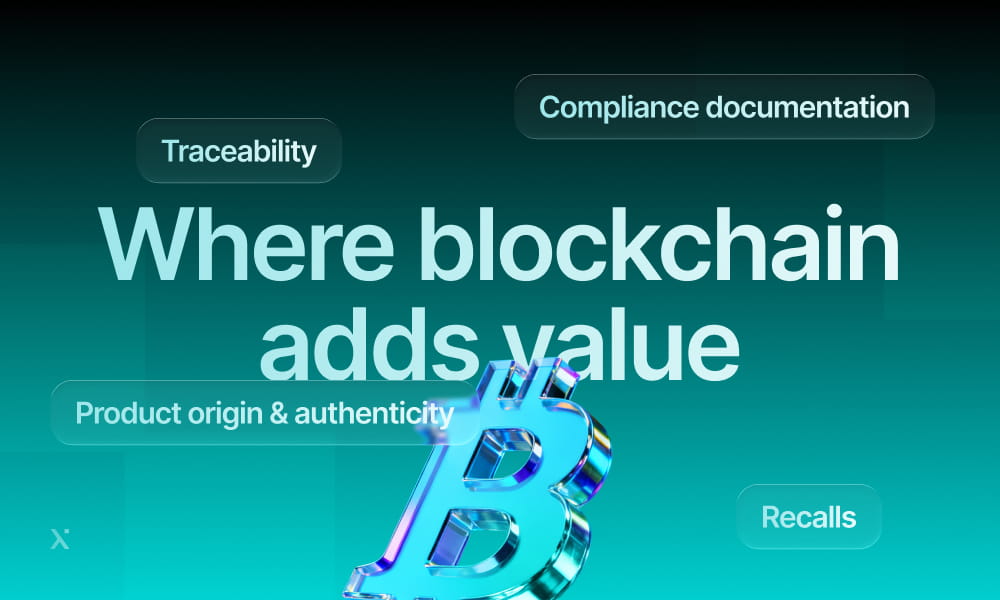
Traceability is one of the main reasons companies use blockchain in supply chains. It helps them follow a product from its source to its final destination and keep a clearer record of what happened along the way. That becomes especially important once a shipment passes through several hands and each participant sees only part of the journey.
For product origin and authenticity
If the origin can’t be confirmed, confidence in the product starts to weaken as well. In some supply chains, that creates real risk, especially where counterfeiting or sourcing disputes are hard to ignore. Blockchain apps help preserve a clearer record of where goods came from and how they moved through the chain, making authenticity easier to verify later.
For compliance and documentation
Supply chains also depend on documents such as certificates, declarations, inspection results, and other records that prove a product meets certain requirements. Blockchain apps help keep those records tied to the product journey, so they are easier to retrieve and review when needed.
For recalls and issue resolution
When something goes wrong, companies need to see where the issue entered the chain quickly. By making product history easier to trace, blockchain apps support faster recalls and a more focused response instead of forcing teams to work through the problem batch by batch.
Top 10 Blockchain Use Cases In 2026: How Your Business Can Ride the Wave

Blockchain in Procurement: A Guide to Transparency, Efficiency, and Trust
Blockchain vs traditional supply chain apps
So why not just use a standard cloud database? In many cases, that is the better option. If one company owns the process and keeps all the records in one place, a traditional system is usually simpler to build and run.
Blockchain becomes more relevant when the process extends beyond one organization. Once several independent participants are involved, the challenge shifts from storing data to deciding who controls the record and how others can rely on it. That is often the point where companies start looking at blockchain app development services instead of treating the problem as a standard internal software build.
So the real comparison is less about technology on its own and more about what kind of supply chain model the system needs to support.
| Aspect | Blockchain-based supply chain app | Traditional database-based app |
| Control | Shared between multiple participants | Controlled by one organization |
| Trust model | Built for cross-company collaboration | Best for one-company workflows |
| Data consistency | Keeps key records aligned across participants | Data is often stored separately across systems |
| Complexity | More complex to design and govern | Simpler to build and maintain |

Private Blockchain Development in 2026: A Step-by-Step Guide
Blockchain Database vs Traditional Database: Choosing the Best For Your Project
Advantages of blockchain-based apps over traditional
The main point here is that blockchain-based apps are not a replacement for traditional systems in every case. The advantages of blockchain supply chain application development become easier to see when the same shipment data has to be held across several independent participants. In that context, three strengths stand out most clearly:
- A shared record across multiple companies. In many supply chains, the slowdown starts when partners compare records and find gaps between them. Keeping key events aligned across participants helps reduce that back-and-forth and cuts down on manual checking. In some cases, that can lower administrative costs by up to 30%.
- Less manual reconciliation. Even after the shipment moves, teams still have to match invoices, shipping documents, and purchase orders. Blockchain-based apps can automate part of that process through smart contract development, and some market analyses estimate that this can reduce manual reconciliation work by roughly 40%.
- Better visibility into product history. Tracking a product is much easier while it is still inside your own operation than after it changes hands. A blockchain layer helps preserve a clearer view across the chain, and in recent surveys, 48% of companies reported better risk visibility from using it.
Blockchain Analysis Explained: Use Cases & Data Insights
![Blockchain Statistics And Trends Across Industries in 2026 [With Infographic]](https://pixelplex.io/wp-content/uploads/2023/04/blockchain-statistics-and-trends-main-1600.jpg)
Blockchain Statistics And Trends Across Industries in 2026 [With Infographic]
The limitations of blockchain-based apps
Blockchain-based apps can solve real supply chain problems, but they don’t remove the operational work around them. In most cases, three limitations matter most.
- Bad data doesn’t become good just because it’s on blockchain. This is one of the most important limitations to understand early. Blockchain can make a record harder to change later, but it can’t guarantee that the original input was correct.
- Interoperability still takes work. Blockchain doesn’t automatically make different companies, systems, and formats work together. Supply chains still need shared standards and a consistent way to exchange information, which means strong integration still matters underneath.
- Setup and governance are more demanding. A traditional app is easier to launch because one company owns it and sets the rules. With a blockchain-based app, several participants are involved, so roles, responsibilities, and supply chain management have to be agreed from the start.
Choosing your development path
As mentioned above, blockchain and traditional databases solve different kinds of problems. The choice depends less on technology itself and more on where trust starts to break down in the supply chain. In many cases, companies start with supply chain software development in a more traditional form, then move toward blockchain when the process has to work across several independent participants.
The table below gives a simple way to see which model may suit your case better.
| Situations | Blockchain app | Traditional app |
| You want total control over all records and user permissions | ✓ | |
| You spend too much time fixing data mismatches with external partners | ✓ | |
| You need to process massive amounts of data in real-time | ✓ | |
| You want to trigger payments based on data from several companies | ✓ | |
| You must provide a permanent history for regulators or ESG audits | ✓ |
A hybrid approach means using both a traditional database and blockchain, each for the job it handles best. The traditional system manages fast internal operations, while blockchain is used at the moments when trust has to extend across several participants.
So instead of putting every data point on-chain, companies keep most operational data inside systems like an ERP or WMS. Only the events that really need shared proof, or the assets that need a clear digital representation, are written to the blockchain, which is also where tokenization services can become relevant. This makes it easier to keep daily operations fast without losing the audit trail that external partners or regulators may need later.
Examples of successful blockchain supply chain apps
Blockchain in supply chains becomes easier to evaluate when you look at real cases where companies had a specific problem to solve. The strongest examples of blockchain supply chain application development usually come from industries where product history has to stay reliable and easy to check under pressure.
Walmart: Making food traceability faster and clearer
| Industry | Food retail |
| Primary goal | Instant recall capability and regulatory compliance (FSMA 204) |
| What blockchain helped with | Traceability time reduced from 7 days to 2.2 seconds. |
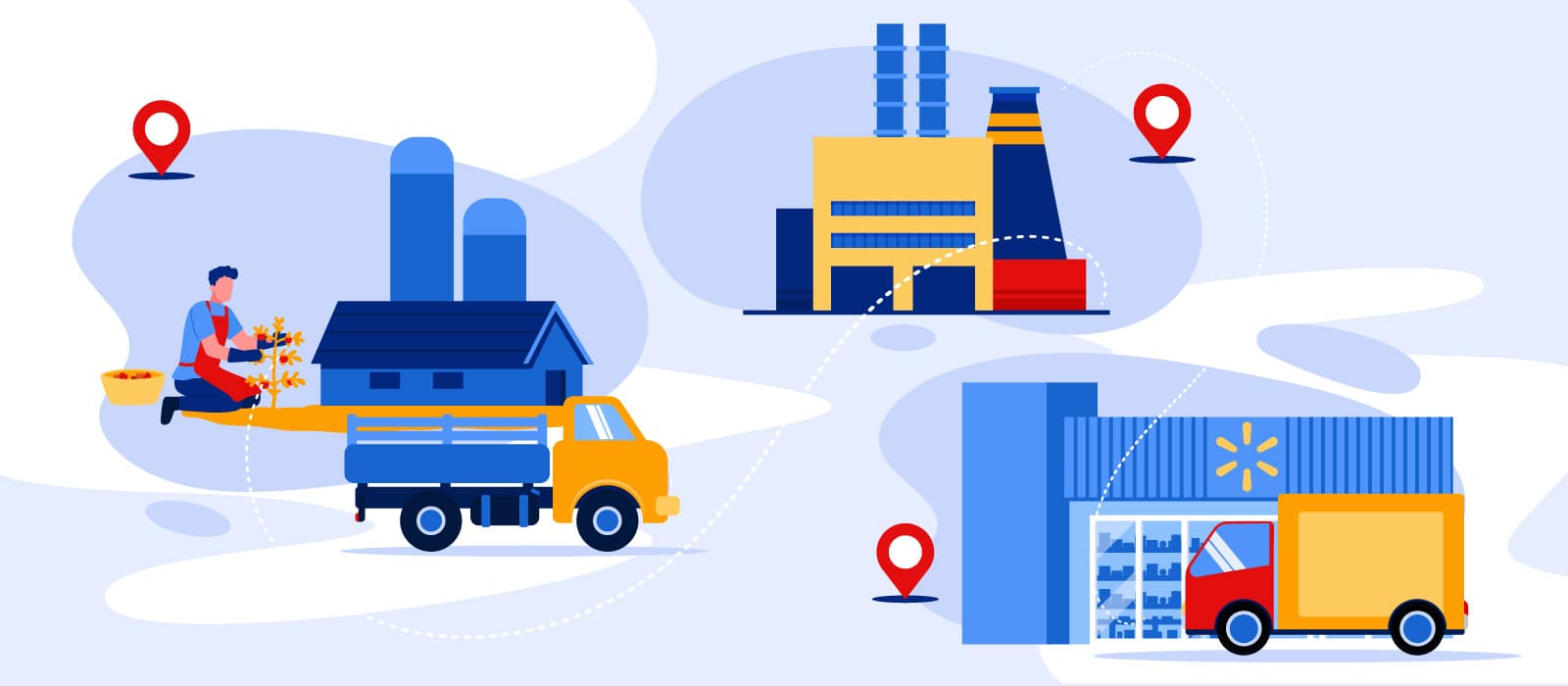
Walmart remains one of the clearest examples of blockchain being used for supply chain traceability at scale. Built on Hyperledger Fabric, its food traceability system was designed to make product origin easier to track across suppliers. That matters in food retail, where even a short delay in traceability can make recalls slower and more expensive.
MediLedger: Applying blockchain to pharmaceutical compliance
| Industry | Pharmaceuticals |
| Primary goal | DSCSA compliance and package-level drug tracing |
| What blockchain helped with | FDA pilot found blockchain-based package-level tracing feasible |
MediLedger is one of the strongest examples from a highly regulated supply chain. Its FDA pilot explored whether a blockchain-based system could support DSCSA requirements for package-level tracing of prescription drugs. The final report found the approach feasible and highlighted its value for record-keeping and coordination across participants.
MECA by PixelPlex: Managing a specialized high-risk supply chain
| Industry | Hazardous materials |
| Primary goal | Improving traceability and reporting for hazardous materials |
| What blockchain helped with | More reliable tracking across participants |
MECA shows what blockchain looks like in a supply chain where the margin for error is extremely small. Built by PixelPlex on Hyperledger Fabric, the platform was designed to manage the movement of radioactive and hazardous materials between organizations. This makes it a useful example of how blockchain can support traceability and reporting in supply chains where every transfer has to be handled with a high degree of control.
How Walmart Strives for Food Quality And Safety Using Blockchain Technology Solutions
How Supply Chain Makes Use of TradeLens – Maersk and IBM Blockchain Solution
Where to start: Mapping your ecosystem
Before building anything, it helps to understand what could shape the project from the start. In blockchain supply chains, some of the biggest obstacles appear early, long before development begins. That is especially true in blockchain supply chain application development, where the success of the system depends on how well the ecosystem is prepared before the product itself is built. This is often the stage where blockchain consulting becomes most valuable.
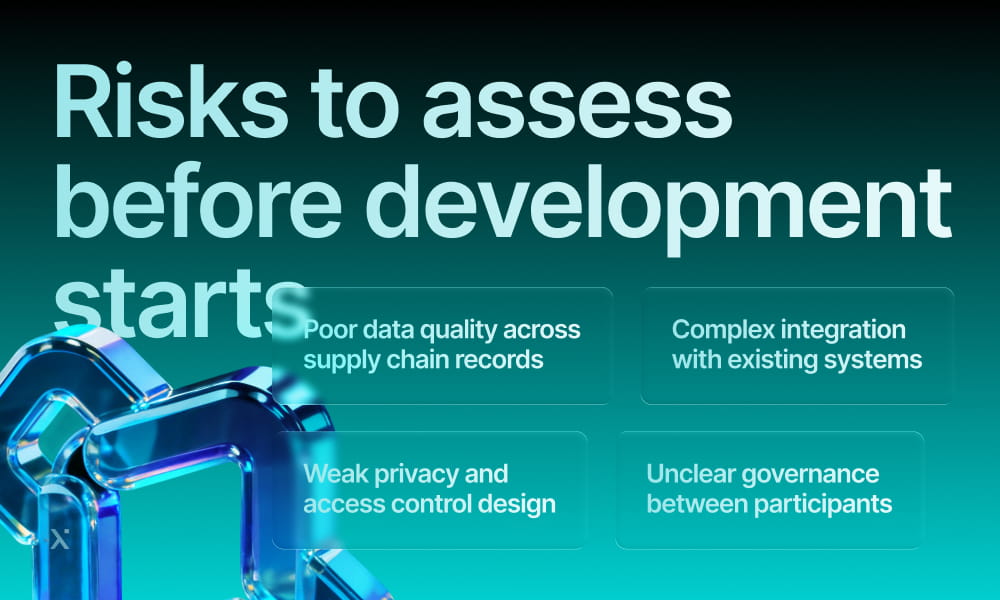
Once those risks are visible, the focus shifts. The question is no longer whether blockchain could fit the supply chain, but what has to be in place for the project to work.
Define the supply chain problem first
A blockchain app only delivers value when it targets a specific bottleneck. Instead of trying to move the entire operation onto a ledger from day one, it’s better to focus on the point that’s already costing the most time or money, whether that’s a customs delay or a dispute caused by mismatched records.
Move from MVP to MVE (Minimum Viable Ecosystem)
Unlike a regular product with a private database, a blockchain supply chain app depends on a small but real network of participants from the start. That’s why the first version is often less of an MVP and more of an MVE, a Minimum Viable Ecosystem.
An MVE, or Minimum Viable Ecosystem, is the smallest real group of supply chain participants needed to make a blockchain app useful from the beginning. Unlike a standard MVP, which can be tested inside one company, an MVE usually includes at least a few independent parties, such as a supplier, a carrier, and a buyer, all working with the same shared process from the start.
Choose the right infrastructure
The next step is deciding what kind of setup can support that model. This is a business choice as much as a technical one. The goal is to choose infrastructure that fits the privacy needs of the participants and connects cleanly to existing ERP, WMS, or logistics systems without adding unnecessary friction.
Align on data standards
If one company labels a shipment one way, another uses a different identifier, and a third records the same event in its own format, the system quickly becomes harder to scale. To avoid that, it helps to align with global standards like GS1 and EPCIS 2.0 from the beginning.
How to Select The Best Blockchain Platform for Your Project

15 Best Big Data Analytics Tools and Platforms to Look out for in 2026
Key features behind a real blockchain supply chain app
The difference between a pilot and a production-ready app usually comes down to what sits around the blockchain itself. In supply chains, a few features tend to matter again and again because they make the system usable in real conditions.
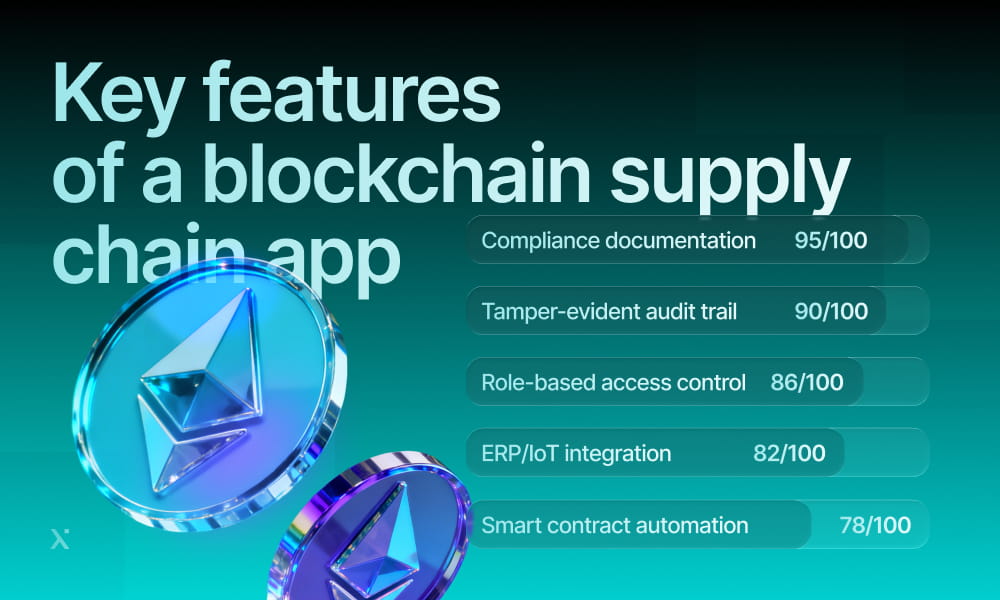
- Shared product event ledger. Keeps key product events in one shared history, so participants can follow the same chain of movements and handoffs.
- Tamper-evident audit trail. Makes important records harder to alter later, which helps with audits, investigations, and regulatory reporting.
- Role-based access control (RBAC). Gives each participant access to the information they need without exposing data that should stay private.
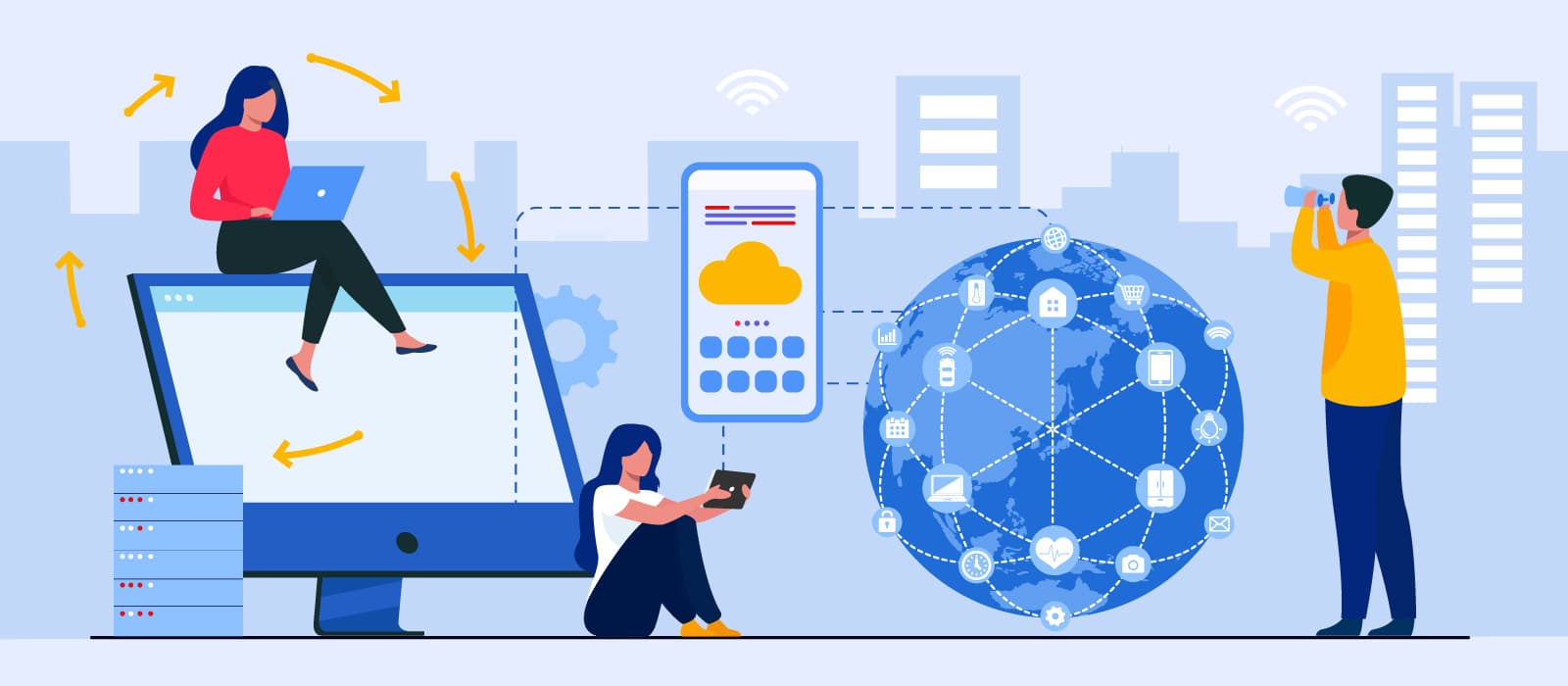
- ERP and IoT integration. Connects the blockchain layer to internal systems and sensor data, so the record reflects real operational events with less reliance on manual updates.
- Smart contract automation. Uses predefined rules to trigger actions automatically when certain conditions are met, such as releasing a payment after a verified delivery.
What Is the IoT? Our Comprehensive Guide

Blockchain in IoT: Data Everywhere, Trust Nowhere?
The 6 stages of blockchain supply chain app development
As mentioned above, blockchain supply chain application development tends to make the most sense when a specific process starts breaking down across several participants. Once that point is clear, the work shifts from evaluating the idea to building something that can operate beyond the concept stage. In most cases, that process moves through six stages.
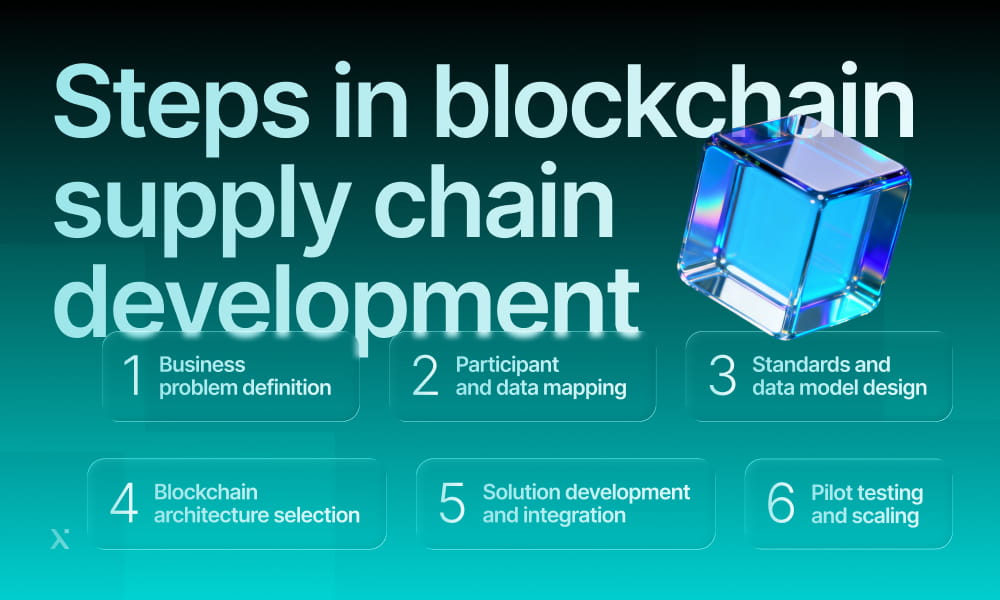
1. Business problem definition
As discussed earlier, blockchain works best when it addresses a clear bottleneck. Take a food retailer struggling with slow recalls because product records from suppliers, carriers, and warehouses don’t always line up. In a case like that, the project starts with one clear issue: traceability takes too long when time matters most.
What you get at this stage:
- A clearly defined supply chain problem
- A realistic project goal
- Early success metrics to measure value
2. Participant and data mapping
In the food traceability example, mapping the ecosystem means identifying the supplier, the carrier, the warehouse, and the retailer, along with the records that move between them. As mentioned earlier in the MVE section, even an early version of a blockchain app depends on a small but real group of participants from the start.
What you get at this stage:
- A map of the first participants in the ecosystem
- A list of the key data flows and handoffs
- A clearer view of what should be shared
3. Standards and data model design
Now you need to make sure the same events are described in the same way across the chain. Here, a shipment update or handoff has to carry the same meaning for everyone involved. As mentioned earlier, if each participant records it differently, the system quickly becomes harder to scale.
What you get at this stage:
- A shared data analytics model for products, locations, and events
- Agreed naming and identification rules
- A stronger foundation for interoperability
4. Blockchain architecture selection
Only then does the technical setup start to make sense. In a food traceability network with many participants and strict access rules, Hyperledger Fabric may be a good fit. A more flexible private setup may suit a project that needs custom smart contract logic or easier integration with existing tools.
What you get at this stage:
- The right blockchain framework for the use case
- A clear access and permission model
- An architecture that fits existing systems
5. Solution development and integration
After the setup is defined, the focus shifts to building a system that works in practice. At this stage, blockchain integration services often play a key role, as data from warehouse scans, retailer records, and carrier updates must move into the app with minimal manual work.
What you get at this stage:
- A working product with the core features in place
- Integrations with the main operational systems
- A usable flow for real participants
6. Pilot testing and scaling
Once the system is working, it’s time to test it on a smaller scale before expanding it further. That usually means running controlled shipments through the app to see how it handles delays, scan errors, and partner interactions before a wider rollout begins.
What you get at this stage:
- Proof that the model works in a real setting
- Feedback on gaps, friction, and needed changes
- A clearer path to wider rollout

How to Integrate Blockchain Into Your Existing Business Infrastructure
How much does blockchain supply chain app development cost?
There is no single price tag for a blockchain supply chain application development. The budget depends on how complex the system becomes once it starts working across real participants, integrations, and business rules.
In most projects, cost is shaped by four things:
- The number of participants involved in the network
- The depth of integrations with external systems
- The amount of custom logic
- The level of security and operational readiness needed
The ranges below give a practical view of what companies can expect at different stages of blockchain supply chain app development.
| Project scope | Typical cost range | Timeline |
| PoC/pilot | $25,000–$60,000 | 1–3 months |
| MVP | $80,000–$150,000 | 2–6 months |
| Full production system | $400,000–$1M+ | 4–12+ months |
Hidden costs to plan for
The first estimate rarely tells the whole story. A blockchain supply chain app may seem affordable at the start, but the cost often rises once the system has to connect to real partners and operational tools.
That is especially common in supply chains. Take the food traceability app we mentioned earlier. It may begin as a simple MVP between a supplier and a retailer, then grow more expensive once it has to pull data from an ERP, connect to warehouse scans, support supplier onboarding, and manage separate access rules.
Most of those costs become visible step by step as the app moves from planning to launch and then into ongoing operation.
| Development step | Hidden cost | Cost range |
| Pre-development | – Ecosystem legal frameworks – Consortium governance drafting – Data standard alignment |
$15,000–$45,000 |
| Smart contract build | – Third-party security audits – Penetration testing – Formal verification |
$10,000–$60,000 |
| System integration | – Custom API middleware – Legacy ERP data cleansing – IoT edge gateway security |
$20,000–$55,000 |
| Network launch | – Node infrastructure hosting – Cloud management fees (AWS/Azure) – Private key management (HSM) |
$1,500–$6,000/mo |
| Post-launch support | – Protocol/version upgrades – Smart contract remediation – Partner onboarding support |
15%–25% of initial dev/yr |

Blockchain Development Cost in 2026: What Goes Into the Price Tag

Smart Contract Development Cost Demystified: What Every Business Should Know
Why PixelPlex is a strong partner for blockchain development
For companies considering blockchain supply chain app development, delivery experience matters as much as technical knowledge. With 13+ years of blockchain experience and 500+ delivered projects, PixelPlex presents itself as a partner with a strong background in enterprise blockchain, private-network solutions, and Web3 development services for systems built to work across multiple organizations.
That background becomes easier to assess through real cases.
- Blockverify: A blockchain-based supply chain and anti-counterfeit solution designed to track products from production to distribution. It helps companies check product authenticity, trace origin, and follow the product path before it reaches the end customer. NFC-based package tracking adds another layer of visibility.
- DDrive: A blockchain-powered automotive supply chain system focused on parts verification and lifecycle tracking. By combining blockchain with IoT, it helps companies confirm component origin and maintain a clearer lifecycle record as parts move through the chain.
Taken together, these examples show a combination of blockchain specialization and delivery experience in traceability-focused systems. In supply chain projects, where the challenge usually extends well beyond the ledger itself, that kind of background can make a meaningful difference. If you’re evaluating a blockchain supply chain solution for your own operations, contact PixelPlex to discuss the use case.
Top 10 Blockchain Development Companies in 2026

Top Blockchain Companies Revealed: How to Choose the Right Development Partner
Conclusion
Administrative delays that companies once accepted as routine are becoming harder to justify. Supply chains now operate under tighter rules and greater customer pressure, which puts much more weight on accurate and accessible records. Shifting from siloed systems to a shared and reliable record helps companies react more quickly to problems and make better decisions at every stage.
At the same time, blockchain is only part of the picture. Long-term results depend just as much on how the system is handled in everyday work. Companies that can manage both the technology and the process well will stand in a stronger position as supply chains grow more connected and more demanding.
FAQ
Traditional database development gives one company control over the system and the data inside it. Blockchain is built for situations where several participants need to record and review the same chain of events. Basically, it changes who controls the record and how easily others can rely on it.
No. If the process stays mostly inside one organization, a traditional system is usually easier to launch and maintain. DApp development becomes more relevant when the process crosses company boundaries and record-keeping starts slowing the operation down.
Yes. In most cases, blockchain is not there to replace your ERP or warehouse system, but to work alongside them. The goal is usually to connect the app to the tools you already use, then record the events that need to be shared more reliably across the chain.
It helps by making traceability records easier to follow, retrieve, and review. When a company needs to show where a product came from and who handled it along the way, a shared record can make that process much faster. That doesn’t remove the need for standards and good input data, but it does make crypto compliance work less fragmented.
Blockchain supply chain app development usually takes from 1 month to 12 months or more, based on the scope of the project. A small pilot often takes less time. A production-ready system needs longer for integrations, partner onboarding, and governance.
There is no fixed ROI timeline for every project. A common range for custom blockchain solutions is 12 to 18 months. The fastest returns often come from fixing one costly problem first, such as poor traceability, manual verification, or recurring disputes.