
When you create a new product, you make bets. On the problem, the target audience, the price, and the timeframe. The only question is whether you can validate these bets with real user behavior or internal evaluations and a few positive comments. That's why developing an MVP (minimum viable product) is such a practical approach: it turns assumptions into data, while keeping the cost of error low.
A web MVP isn’t a half-built app you apologize for. It’s a lean, working version of your product that does one job well enough for people to actually use it. You launch a product, observe where users are having problems, understand what’s important to them, and then confidently build the next version, rather than haphazardly.
Up next: what qualifies as an MVP, what doesn’t, how the build typically unfolds, what affects the price, and which tech decisions save you from a painful rebuild once the product starts gaining traction.

What Is MVP in Software Development?

https://pixelplex.io/blog/ai-mvp-development/
MVP vs. everything else
The term “MVP” is quickly becoming misused. Some teams refer to an MVP as an interactive prototype. Others release a full-fledged product with all the features requested by stakeholders, then use “minimal” as a polite excuse for mistakes. Neither approach adequately tests the viability of an idea.
A real MVP is a usable product with one clear value. Not a concept, not a promise, not a roadmap. It’s something people can actually interact with, even if it’s simple. The goal is to prove a core assumption: that users have the problem, care enough to try your solution, and are willing to take a meaningful action (sign up, request a demo, complete a flow, pay, come back).
Just as important, an MVP has limits. It’s intentionally narrow. You pick one main scenario and make it work end to end, without stuffing the release with “nice-to-haves” that slow you down and blur the results.
Validation formats compared
| Format | Purpose | Real users | Typical timeline | Outcome |
| Prototype | Visualize the idea, test UX flows, and align stakeholders | No (or very limited) | 2–10 days | Feedback on screens, flows, and assumptions |
| PoC (Proof of Concept) | Prove something is technically possible | No | 1–3 weeks | Technical validation, no real product value yet |
| Pilot | Test in a controlled environment (often with one client/team) | Yes, but a limited group | 4–10 weeks | Real-world feedback, early operational insights |
| MVP | Deliver one core value and validate product-market fit signals | Yes | 4–12 weeks | Measurable traction, learnings, and a clear roadmap for growth |
If you’re still unsure, here’s a quick rule: if users can’t use it to solve a real problem, it’s not an MVP. It might still be useful, but it serves a different purpose. Next, let’s talk about why MVP web development has its own rules, and why the web is often the fastest way to get proof.

From Idea to Launch: The Essentials of eCommerce MVP Development

Inside Crypto Wallet MVP Development: Process, Costs, and Real-World Lessons
Why web MVPs move faster
In web development, MVPs are typically the fastest to develop. You can release apps without waiting for reviews in the App Store, learn from real users, and release updates as soon as you spot a problem. This pace changes your entire approach. Instead of betting everything on one big release, you work within tight deadlines, validate assumptions, and adjust your actions before bad decisions become costly. This is the practical advantage of MVP development: you seek validation of your effectiveness, not praise.
Analytics is another reason why web app MVPs work so well. You can track user actions, not just what they say they’ll do. You can also track where they hesitate, where they stop using, what they ignore, and what they repeat. This also simplifies experimentation: A/B testing, adjusting the onboarding process, experimenting with pricing, and new scenarios — all without rebuilding the product from scratch.
Real users don’t live in your dev environment. They show up on older phones, weird browsers, and shaky internet. Something that looks flawless on a MacBook can fall apart on a mid-range Android. So yes, UX and speed matter early. If the MVP feels clunky or untrustworthy, people bounce, and you’re left with zero signal.

How to Ensure Security for Your Web Application Technology Stack

Web3 Development: What It Takes to Build the Future
Signals that your MVP works
Launching is just the starting line. What matters is what happens next: do people get to the value, do they finish the key action, do they come back, do they move one step deeper? That’s the kind of proof you can build on.
This is also where teams get distracted. A spike in traffic, a bunch of sign-ups, good reactions from colleagues, all of that can feel like progress. But those signals are easy to fake. If users don’t activate, don’t return, and don’t convert, the product isn’t sticking, no matter how good the numbers look in a report.
The same logic applies to quality. An MVP can be small, but it can’t feel careless. Keep the scope tight and ship the core flow first, but make sure it’s clear, stable, and safe enough to trust. Otherwise, people drop off because the experience is confusing or shaky, and you end up “validating” problems you created yourself.
MVP-ready signals and metrics
| Metric | Acceptable baseline | How to measure | What to improve next |
| Activation rate (users who reach the “aha” moment) | 20–40% for targeted traffic | Funnel tracking (signup → key action) | Reduce friction, simplify onboarding, improve first-run UX |
| Time-to-value (how fast users get the outcome) | Under 5 minutes for simple products | Session analytics and event timestamps | Remove steps, add guidance, optimize performance |
| Retention (users returning) | 15–30% weekly for early-stage B2C / 20–40% monthly for B2B | Cohort analysis | Improve core loop, notifications, and content cadence |
| Conversion to next step (demo request, trial, payment) | 1–5% early, depends on price and audience | Goal tracking and CRM events | Refine offer, tighten positioning, test pricing/packaging |
| Drop-off points (where users quit) | No single step bleeding >40% | Funnel and heatmaps/session replays | Fix confusing screens, shorten forms, improve copy |
| Stability (crashes, critical bugs) | Zero blocker issues in the main flow | Error logging and QA reports | Fix top errors first, add tests, improve monitoring |
| Performance (page speed) | Core pages load in 2–3 seconds on average | Lighthouse and real user monitoring | Optimize assets, caching, and database queries |
| Trust signals (support tickets, complaints, refunds) | Low and explainable volume | Support tags and NPS/CSAT feedback | Clarify UX, improve messaging, tighten security and privacy flows |

App Development for Startups: Expert Strategies for Technology Decision Makers

Top 10 Blockchain Use Cases Across Different Industries and Domains to Explore in 2026 and Beyond
The MVP build path (no guesswork)
There’s no single “perfect” way for MVP web application development, but teams that ship quickly and learn quickly tend to follow a similar logic. They don’t jump straight into coding. They first gain clarity, define the scope of work, and then move in short, predictable cycles. This is the essence of MVP development for web apps: the goal is to prove functionality, not to prolong a long release cycle.
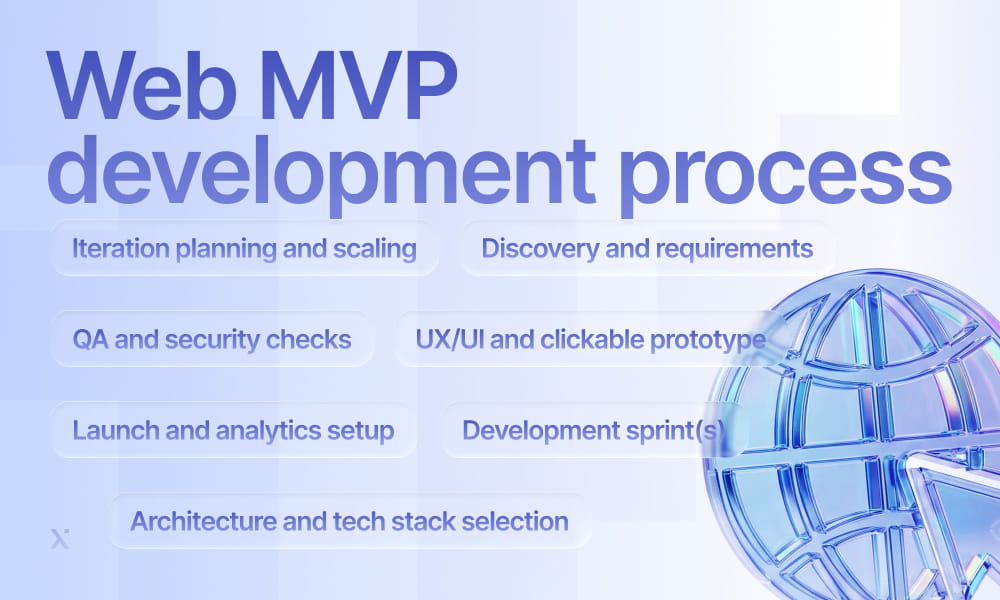
- Start with clarity. Who’s the user, what’s the pain, and what exactly do we need to learn from the first release?
- Sketch the path. A quick clickable prototype is enough to see where people will get stuck.
- Make a few tech decisions early. Nothing fancy, just enough structure so you won’t regret it after launch.
- Build the one thing that matters. The core flow, end-to-end. Everything else waits.
- Try to break it. Test the main сценарий, fix the obvious cracks, and cover basic security so it doesn’t feel risky.
- Launch with tracking on. If you can’t see the funnel and errors, you’re flying blind.
- Then iterate. Look at what users actually did, not what the team hoped they’d do, and plan the next slice.
If a page can be empty, assume it will be. And don’t leave users staring at a blank screen. Add a quick hint that guides them: what they’re looking at and what step comes next. MVPs often lose people not on the big concept, but on tiny moments of confusion.
Overview of Top 15 UI/UX Trends in 2026 and Beyond
Top 8 Cross-Platform App Development Frameworks in 2026

How to Create a Mobile App Startup: a Step-by-Step Guide
What features usually belong in a Web MVP
Building an MVP for a web app doesn’t require a long feature list. It requires a working core and enough supporting components to make the user experience feel complete. The goal is simple: enable users to benefit without encountering obvious obstacles, and give your team the ability to gather objective feedback without guesswork.
Here’s the “starter kit” that shows up in most web MVPs:
- Signup/login (or passwordless auth)
- User profile basics
- Lightweight admin panel
- Notifications (email and/or in-app)
- Payments (if monetization starts early)
MVP modules by priority and risk
| Module | Priority | Risk if skipped | Notes |
| Core user flow | High | MVP won’t prove anything | Build end-to-end first |
| Auth | High | No personalization, weak retention | Consider passwordless |
| Admin panel | Medium | Ops becomes slow/manual | Keep it lightweight |
| Payments | Medium–High | Can’t validate monetization | Skip if not needed yet |
| Notifications | Medium | Users drop mid-flow | Email is enough early |
| Analytics | High | No real learning | Track funnels and drop-offs |
| Security basics | High | Trust issues, legal risk | OWASP-level baseline |

How to Build a Crypto Wallet: a Complete Guide

A Comprehensive Guide to Blockchain Application Development
Tech Stack for MVP Web Application Development
Choosing technologies for MVP development services rarely boils down to the best overall stack. It’s about what will help you ship quickly, maintain flexibility, and avoid painful rework if the product becomes popular. The right stack is one your team can work with while providing decent performance, clean data, and room for growth.
| Product type | Recommended stack | Why does it fit MVP |
| B2C web app (marketplaces, booking, content) | Frontend: React or Next.js; Backend: Node.js; Data: PostgreSQL; Cloud: AWS; Analytics: GA4 | Fast to ship, easy to iterate, solid performance, and SEO options |
| B2B SaaS (dashboards, workflows, internal tools) | Frontend: React or Next.js; Backend: .NET or Node.js; Data: PostgreSQL; Cloud: Azure; Analytics: Mixpanel or Amplitude | Works well for structured business logic, scales predictably, and supports deeper product analytics |
| Data-heavy product (reports, analytics, ops tools) | Frontend: Next.js; Backend: Python; Data: PostgreSQL; Cloud: AWS or GCP; Analytics: Amplitude | Python fits data workflows, Postgres handles complex queries, and analytics supports cohort insights |
| MVP with fast-changing requirements | Frontend: React; Backend: Node.js; Data: MongoDB; Cloud: AWS; Analytics: Mixpanel | Flexible data model, quick iterations, strong visibility into user behavior |
| Enterprise-facing MVP (SSO, compliance, integrations) | Frontend: Next.js; Backend: .NET; Data: PostgreSQL; Cloud: Azure; Analytics: Amplitude | Better fit for enterprise ecosystems, smoother integration path, stronger governance options |
| SEO-driven product (landing-heavy, content-first) | Frontend: Next.js; Backend: Node.js; Data: PostgreSQL; Cloud: AWS; Analytics: GA4 | Strong SEO foundation, fast pages, clean tracking, and easier content scaling |
10 Best Programming Languages for Blockchain Development

How to Integrate Blockchain Into Your Existing Business Infrastructure
What impacts MVP web development pricing
MVP budgets almost never fall apart because the team coded too slowly. They fall apart because the scope quietly grows, integrations turn out to be more involved than expected, and the MVP starts getting treated like an enterprise product while everyone still calls it minimal. If you want a realistic estimate, you need to be clear on what actually drives the cost.
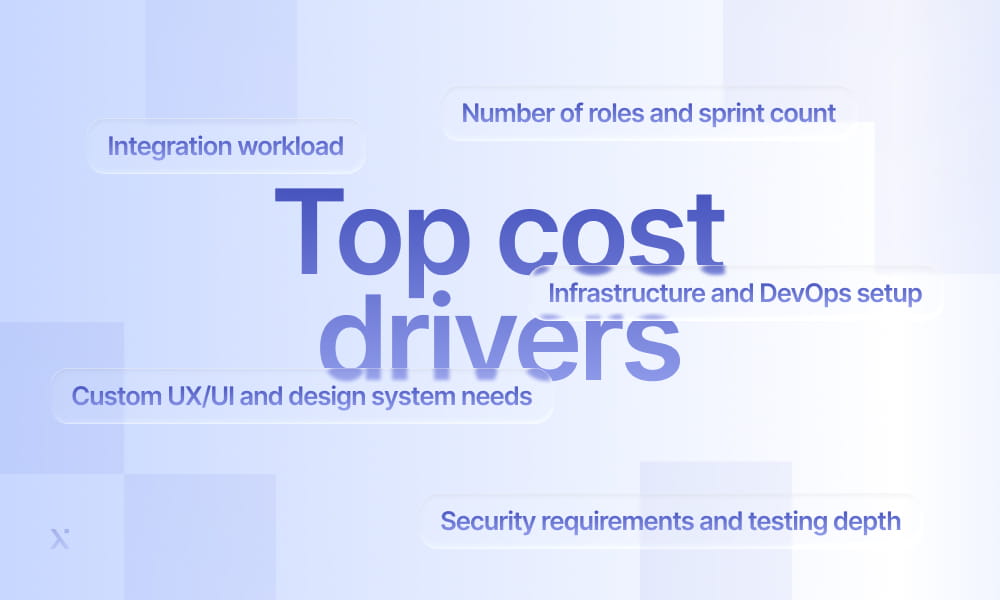
Scope size and complexity are the obvious ones. A focused MVP with one clean user flow is a different project from a product with multiple roles, dashboards, permissions, and edge cases. The more states your app can be in, the more time it takes to build, test, and keep stable.
Integrations can change everything. Payments are one thing. CRM, ERP, identity providers, external APIs, and data sync are other examples. Even simple integrations come with authentication, error handling, retries, rate limits, and support work. That’s the time you don’t see in the UI, but you absolutely feel in the timeline.
UX/UI depth also matters more than people expect. Using a template and a basic component library is fast. Building a custom design system, polishing micro-interactions, and designing multiple responsive layouts takes real effort. The trick is choosing the right level of design for what you’re trying to prove.
Next comes security, compliance, and data privacy. If you work with personal data, payments, or anything regulated, security can’t be an afterthought. Even for a minimum viable product (MVP), you’ll need basic security, secure storage, access control, and a careful approach to what data you collect.
And then there’s the team and the schedule. A small, consistent team moving in a steady sprint rhythm is usually the most efficient way to build. When the timeline gets squeezed, and you start adding people to go faster, it often has the opposite effect: more handoffs, more meetings, more chances to miss things. You can absolutely buy speed, but you’ll feel it in the budget.
| MVP type | Typical budget range | What’s usually included | What often pushes costs up |
| Lean MVP (single core flow) | $20,000–$45,000 | Basic UX/UI, core user journey, simple backend, database setup, basic admin tools, analytics events, QA for main flow | Custom design, complex logic, extra user roles, rushed timeline |
| Standard MVP (product-ready foundation) | $45,000–$90,000 | Polished core flow, role-based access basics, stable backend, integrations (1–2), CI/CD, monitoring, stronger QA, scalable structure | Payments, external APIs, multiple dashboards, and more advanced analytics |
| Complex MVP (B2B / regulated / integration-heavy) | $90,000–$180,000+ | Multiple user roles, advanced permissions, enterprise-grade integrations, security hardening, audit logs, performance tuning, production-ready DevOps | SSO, compliance requirements, heavy data logic, high-load expectations |

Blockchain Development Cost in 2026: What Goes Into the Price Tag

Cryptocurrency Exchange Development Cost: Key Factors & Estimates
What must be in place to scale after MVP?
When your MVP is gaining traction, the most frustrating feeling is the realization that you can’t safely move forward without destroying half the project. The good news: you don’t need an “enterprise architecture” to avoid this. You just need a few basic elements that will ensure the product’s measurability, stability, and scalability.
Here’s what should be in place if you want to scale without tearing things down later:
- Event tracking and funnels so you can tell what’s working and where users fall off
- Security basics like roles/permissions, rate limiting, and standard OWASP hygiene
- A reliable core codebase with enough tests to ship changes without breaking the main flow
- Logs, monitoring, and alerts so problems surface in your tools, not through support tickets
- Modular structure and clean APIs so new features plug in, instead of breaking what’s already there
- Docs and handover notes so the product isn’t dependent on one or two people who “just know it”
A big mistake is treating an MVP as a disposable product. Teams often tell themselves they’ll just rewrite everything once the idea works, but this rewrite almost never actually happens. The MVP usually becomes the product. The feature list should be short, but don’t build it like a chaotic hackathon project; maintain order and avoid “quick fixes” that turn future changes into a nightmare. Building it right the first time pays off as soon as real users start coming in.

Top 10 AI Development Companies in 2026
Top 10 NFT Marketplace Development Companies
Why choose PixelPlex
PixelPlex is a good fit when you want the MVP to answer a real question, not just exist. We build the smallest version that can deliver value, then we make sure you can actually measure what happens next.
We’re careful with scope because MVPs die from just one more feature. We focus on one core flow, ship it end-to-end, and keep the extras out of the first release. If a new request pops up, we call it what it is: either it replaces something, or it goes to the next round.
We keep you close to the work. You’ll know what’s going into the current sprint, what’s ready for review, and what’s waiting on a decision. And if there’s a risk, we raise it when it first shows up, not after it becomes a problem.
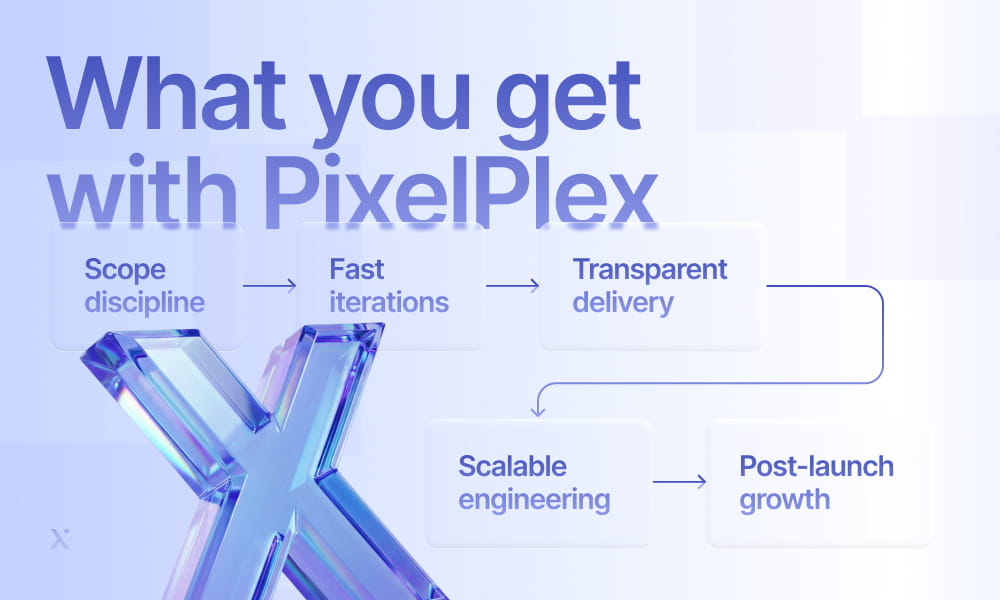
Engineering-wise, we don’t treat the MVP like a throwaway. We keep the code clean enough to extend, add basic security and permissions where needed, wire up analytics and error monitoring, and ensure the main flow survives real-world usage on real devices. That’s why teams come to us as their MVP web development company when they need speed without sacrificing what happens after launch.
If your product involves blockchain, Web3 identity, or tokenization, we can also help you avoid early mistakes that could waste time later. And once the MVP is launched, we won’t disappear; we’ll help you analyze the data, prioritize the next iteration, and transition from the MVP to growth without losing momentum.
Choosing the right Web3 app development company means finding a partner who understands the technology and the discipline of shipping something real, measurable, and secure. That is exactly how we approach every blockchain project, be it mobile, desktop, or otherwise.

Top Blockchain Companies Revealed: How to Choose the Right Development Partner
The Power of Blockchain for Startups: Advantages and Use Cases
Conclusion
MVP web development is your quickest way to stop guessing. Keep it small on purpose, make the main flow work from start to finish, and put it in front of real users. That’s how you learn what to build next, without burning budget on features nobody asked for.
Lean doesn’t mean careless. The MVP still has to feel clear and trustworthy. People should understand what to do, it should run smoothly on everyday devices, and security basics need to be in place. And you need tracking from day one, otherwise you’re arguing from gut feelings instead of seeing what actually happens.
If you treat the MVP like the first brick of the real product, the next steps get easier. You improve what users are already trying to do, fix what slows them down, and grow the feature set only when there’s a reason.
If you want a partner providing web development services with that mindset, PixelPlex is ready to help you ship, learn, and move forward with confidence.
FAQ
Yes, as long as the core flow is clear. You don’t need a full design system for an MVP web development project, but you do need enough UX work to avoid confusion. Even a simple layout with clean copy and predictable navigation can outperform a “pretty” product that users don’t understand.
Not always, but it’s often worth it. A lightweight admin panel saves time when you need to manage users, content, pricing, or moderation without involving developers. If the product relies on manual operations early, skipping admin tools can slow you down more than you expect.
It can be, especially if your goal is to validate demand fast. The trade-off is flexibility. No-code tools work well for simple flows, but they can limit custom logic, integrations, and performance once traction grows. A common approach is to validate early with no-code, then rebuild only after you see real pull from users.
Trying to build for every user type at once. The MVP scope should be built around a single primary user and a single core scenario. If you start with multiple roles, permissions, dashboards, and edge cases, you lose speed, and the MVP stops being minimal.
Keep it lightweight and well-timed. Use short prompts after key actions, optional feedback buttons, and support chat for real issues. Avoid long surveys inside the product. Behavioral data, plus a few targeted questions, usually beats a page of opinions.
Once the core numbers stop swinging every time you tweak a button or rewrite a line of copy, you’re past the MVP stage. At that point, you’re not fixing the MVP anymore; you’re building on top of something that works. The roadmap gets a lot simpler too, because you’re scaling what users already respond to, not guessing what might land.