
Real estate has always relied on data, including comparable sales, neighborhood characteristics, tax records, and credit histories. Today, the difference lies in the volume of information arriving simultaneously and how confusing it can be.
Listings change minute by minute across multiple platforms. Satellite imagery helps teams see what is being built and where growth is heading. Smart building sensors send nonstop signals about how assets are performing. CRM systems log every conversation and every showing. Transaction data grows daily across markets and asset classes. Eventually, spreadsheets and dashboards hit their limits.
The pressure on business stakeholders is also higher than before. Margins have shrunk, and competition has intensified in virtually every segment. Investors want faster risk assessment and fewer surprises. Buyers and renters instantly compare options and expect a smoother process from first click to closing. Property managers’ performance is measured by customer retention and operating expense control. At many companies, analytics remains backward-looking, meaning executives make decisions based on market performance just weeks ago.
Machine learning supports a different approach, helping teams look forward rather than constantly playing catch-up. Models can predict price movements, identify prospects most likely to convert, detect patterns associated with fraud or credit risk, and predict maintenance issues before they become emergencies. This is important because real estate data is no longer simply rows and columns. It includes behavioral signals, imagery, geospatial layers, and sensor data streams. When organizations embrace real estate machine learning as an infrastructure, they create systems that learn from their portfolio and improve over time, creating a sustainable competitive advantage.
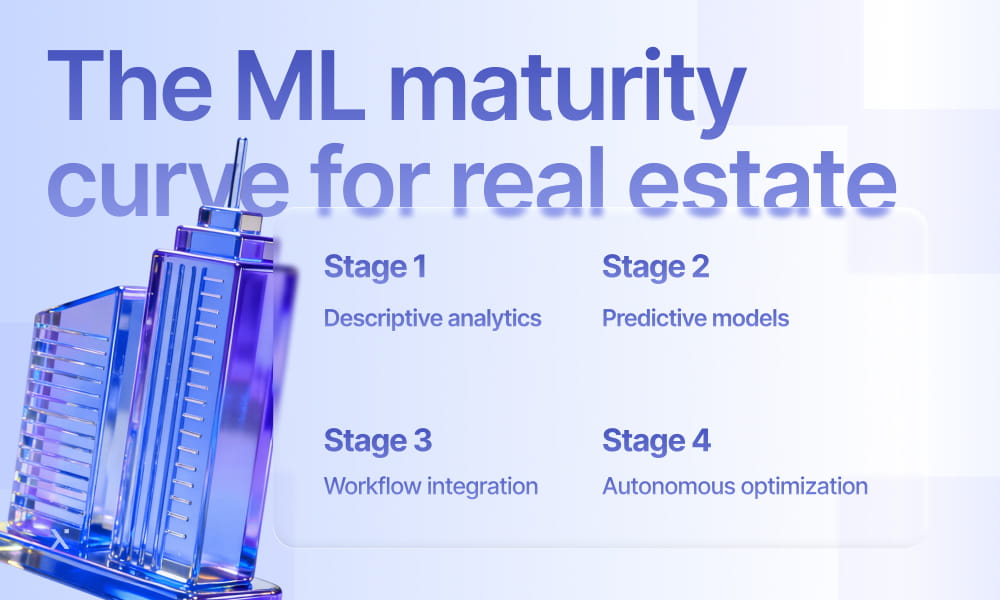
How machine learning is used in real estate
Machine learning in real estate delivers value when applied to specific business functions. The strongest results appear in areas where decisions depend on large volumes of variables, fast market shifts, and historical patterns that are difficult to model manually. Property valuation and price forecasting remain the most mature and commercially impactful applications.
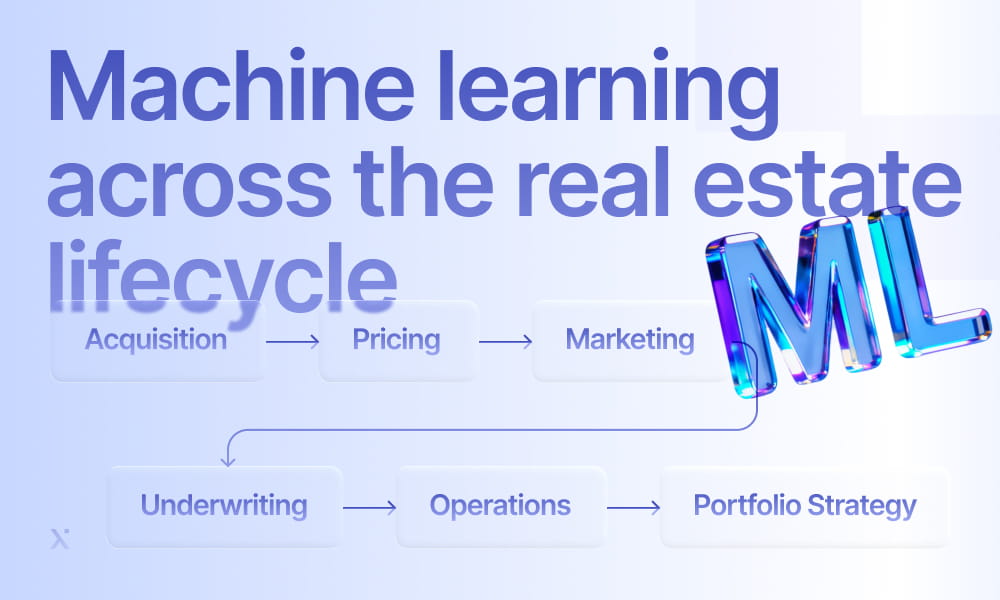
Property valuation and price forecasting
Pricing accuracy affects almost everything downstream, including how fast underwriting moves, how many deals you can process, how a portfolio performs, and how confident investors feel in the numbers. A small pricing miss might look harmless on one property, but across a portfolio, it can translate into serious write-ups, write-downs, or deals that never happen. Machine learning helps by building pricing models that adjust as new transactions come in and as buyer behavior and broader economic conditions shift.
Automated valuation models (AVMs)
Modern AVMs use regression, gradient boosting, and ensemble models to process thousands of data points per property. These models go beyond surface-level comparables. They account for micro-location dynamics, renovation history, proximity to infrastructure, liquidity patterns, and seasonal demand. Unlike traditional appraisal methods, AVMs update automatically as new transactions enter the system. This reduces manual effort and shortens underwriting cycles.
Comparable analysis using ML
Traditional comps depend heavily on manual selection, and that usually means relying on distance and a handful of obvious attributes. Machine learning makes comps more precise by looking for properties that are genuinely similar across many factors, not just nearby on a map.
Two homes in the same neighborhood may exhibit different price dynamics due to school districts, a new transit line, or the type of buyers competing in the area. Machine learning can identify these patterns and select suitable properties for comparison, resulting in reduced subjective valuations and a more stable valuation of the entire portfolio.
Dynamic pricing engines
Dynamic pricing helps teams stop guessing. It watches demand signals, competing listings, and how fast inquiries come in, then suggests price changes based on what is happening right now. The goal is simple: move faster, avoid stale listings, and protect revenue.
Rental yield forecasting
For large investors, yield is often the primary metric. They analyze occupancy rates, rent stability, and local demand factors such as employment and migration to estimate future rental income. This approach guides the selection of acquisition targets and the allocation of assets within the portfolio.
Machine learning applications in property valuation
| Use case | Data inputs | ML model type | Business outcome |
| Automated valuation model | Sales history, geospatial data, property attributes | Regression, Gradient Boosting | Faster and more consistent valuations |
| ML-based comparable analysis | Transaction clusters, location features, and amenity data | Clustering, Similarity Models | Reduced valuation bias |
| Dynamic pricing engine | Demand signals, inquiry volume, competitor pricing | Reinforcement Learning, Time-Series | Optimized listing price |
| Rental yield forecasting | Occupancy data, demographics, macroeconomic indicators | Time-Series, Ensemble Models | Improved investment planning |

Leveraging MLaaS: Why It's Crucial for Your Business Growth

What is Automated Machine Learning and Why and When to Use It?
Lead scoring and buyer behavior prediction
In a busy market, speed matters, but accuracy matters more. Sales teams get a flood of inquiries, and most of them never go anywhere. The real challenge is figuring out who is serious before your competitors do.
Machine learning looks at what people do and how they behave, then predicts how likely they are to buy. Rather than treating every lead the same, it sorts them by intent and potential value, reducing the guesswork in prioritization.
Predicting purchase intent
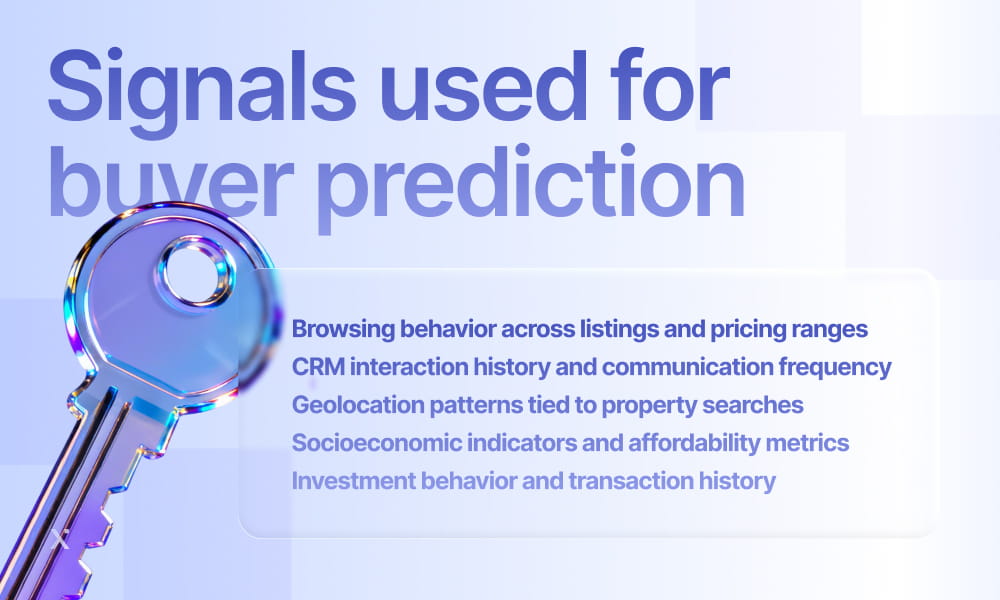
Intent scoring helps teams focus on prospects who are actually moving toward a deal. A single click may mean nothing. Repeated, consistent actions usually do.
High-intent signals include:
- Repeat visits to the same property type or neighborhood
- Consistent browsing within a defined price range
- Use of mortgage or affordability tools
- Scheduling a viewing or requesting a call
- Downloading disclosures or floor plans
- Fast response to emails or messages
The output is a clear probability score that helps prioritize outreach, reduce time spent on low-quality leads, and increase close rates.
Identifying high-value investors
Not all buyers have the same long-term value. Institutional investors, repeat buyers, and portfolio builders behave differently from one-time purchasers. Machine learning can segment prospects based on transaction history, asset preferences, deal size, and capital deployment patterns.
By recognizing high-value investors early, firms can assign experienced brokers, tailor communication, and structure offers strategically.
Churn prediction for rental tenants
Keeping a tenant is usually cheaper than replacing one. ML can surface early signs that someone may not renew, like late payments, repeat maintenance issues, less engagement, or better competing options nearby. That gives property teams time to respond with a specific fix or offer, instead of throwing out a discount at the end.
ROI comparison: manual qualification vs. ML-driven scoring
| Criteria | Manual qualification | ML-driven scoring |
| Lead processing speed | Limited by team capacity | Automated and scalable |
| Conversion rate | Dependent on individual judgment | Optimized through pattern recognition |
| Consistency | Variable | Standardized scoring logic |
| Cost per acquisition | Higher due to inefficiencies | Reduced through prioritization |
| Revenue impact | Moderate | Higher through better targeting |
Think of it as a scoring system that sharpens with experience. The more interactions it watches, the clearer the pattern becomes. That helps teams respond faster to the right people and stop burning hours on leads that were never going to convert.
Fraud detection and risk assessment
Real estate transactions involve large sums, multiple intermediaries, and tight timelines. That combination attracts fraud. Traditional controls rely on checklists and static rules. They work until someone finds a way around them.
ML adds another layer by looking for patterns that do not match normal behavior.
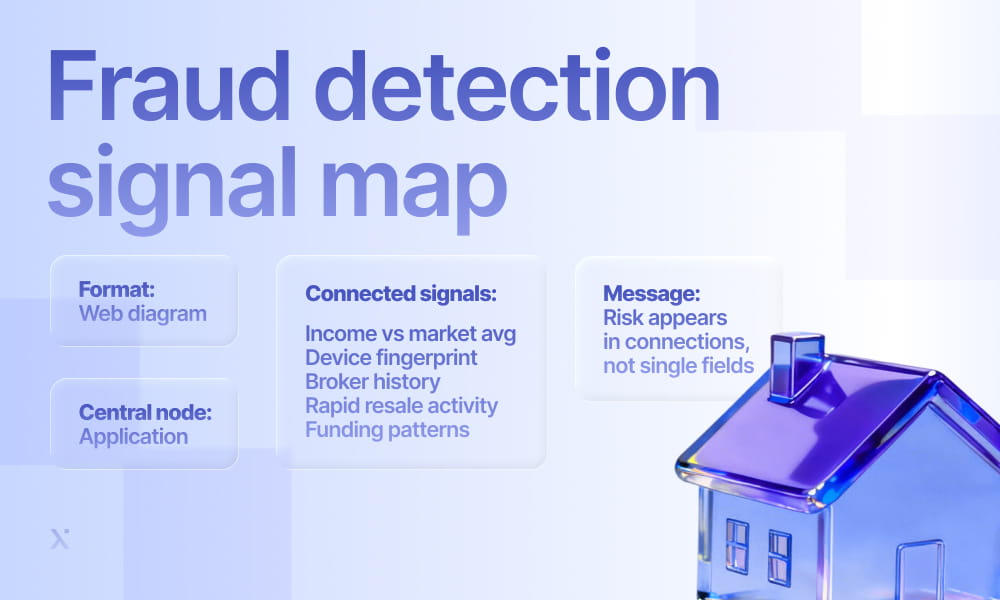
Mortgage fraud detection
Fraud often hides in inconsistencies across documents, income statements, property details, and transaction history. Instead of reviewing each field in isolation, ML can compare applications against thousands of past cases and flag unusual combinations. That may include inflated income relative to market averages, repeated use of similar documentation across applications, or valuation anomalies tied to specific brokers.
Identity verification
Identity fraud is no longer limited to obvious mismatches. It can involve synthetic identities or the subtle manipulation of personal data. ML-based verification looks at behavioral signals, device fingerprints, and cross-database inconsistencies. The goal is to confirm that the person behind the application behaves like a real borrower, not just that the documents look valid.
Suspicious transaction patterns
Money laundering and coordinated fraud schemes often appear as patterns across multiple transactions. These patterns may include rapid property flips, unusual fund transfers, or repeated involvement of the same parties in high-risk structures. ML can connect these dots faster than manual review.
Risk-based underwriting
Underwriting traditionally depends on credit scores, income ratios, and predefined risk brackets. ML can incorporate a broader set of variables, including behavioral data and localized market trends. That allows lenders to price risk more accurately and reduce blanket rejections.

An All-Encompassing Guide To Real Estate Tokenization

IoT in Real Estate: The Smart Home Revolution Leading the Way
Traditional risk modeling vs. ML-based risk modeling
| Criteria | Traditional modeling | ML-based modeling |
| Data scope | Limited structured inputs | Structured and unstructured data |
| Adaptability | Rule updates required | Adjusts as new patterns emerge |
| Fraud detection | Based on known scenarios | Detects new anomaly patterns |
| Risk pricing | Standardized brackets | More granular segmentation |
| False positives | Higher | Typically lower |
Smart property and predictive maintenance
Modern buildings generate a constant stream of operational data. Elevators, HVAC systems, lighting, access control systems, and energy meters report on their activities every minute. Many organizations store these signals but don’t use them to make day-to-day decisions. Machine learning helps teams turn this “noise” into actionable insights, such as what needs attention and when.
IoT sensor analytics
Sensors monitor key metrics, including temperature, vibration, runtime, and load. Individually, these readings appear normal. However, taken together, they often reveal subtle changes that lead to failure, such as motor overheating, increased vibration, or increased cycle rate. These early warning systems enable scheduled maintenance before equipment failure occurs, preventing downtime.
Energy optimization
Electricity is one of those costs that quietly eats margin. Buildings rarely use power evenly. Demand jumps in the morning, dips, then spikes again, shifting with the weather. When you line that up with how tenants actually use the space, you can run systems closer to real need, not a fixed schedule, and cut waste without making anyone uncomfortable.
Maintenance forecasting
Historical data on completed work reveals not only individual incidents but also patterns. For example, certain equipment may fail predictably after reaching a certain usage threshold. Machine learning can predict these events and help teams plan budgets and schedule technician work.
Tenant behavior analysis
Usage data also reveals how tenants interact with the space. High-traffic areas, peak hours, and service request trends help property managers adjust staffing levels and service levels.
Benefits for property managers:
- Lower maintenance costs
- Fewer emergency repairs
- Longer equipment lifespan
- Stronger tenant satisfaction and retention
Predictive maintenance impact metrics
| Metric | Reactive approach | Predictive approach |
| Emergency repairs | Frequent | Reduced |
| Maintenance cost volatility | High | More stable |
| Equipment downtime | Longer | Shorter |
| Asset lifespan | Standard | Extended |
| Tenant complaints | Higher | Lower |

Machine Learning Pattern Recognition: Explanations and Examples
![Machine Learning Application Development: Business Insights [With Infographic]](https://pixelplex.io/wp-content/uploads/2023/03/machine-learning-app-development-main-1600.jpg)
Machine Learning Application Development: Business Insights [With Infographic]
How real estate teams use ML to win
The impact of machine learning in real estate becomes clearer when tied to operational outcomes. Below are condensed examples based on common implementation patterns across the market.
PropTech startup building an AVM platform
A PropTech company rolled out a residential valuation platform across several major cities. They wanted to cut down on manual appraisals and give buyers and lenders a price estimate right away, not days later.
They developed their own appraisal system using sales history, location data, redevelopment permits, and local demand signals. Instead of relying on fixed comparative data, the model took into account the behavior of specific neighborhoods, even within a single zip code. In the first year, the number of manual appraisals was reduced by approximately a third, and processing time was reduced from days to minutes. This consistency also helped the company attract lender partners who needed appraisals they could explain and verify.
Investment fund using predictive acquisition models
A mid-sized REIT wanted a standard yardstick for deal selection across multiple regions. The old approach relied on who sourced the deal and how the internal review framed it, leading to uneven decision-making across markets.
They put in place a forecasting model based on rent trends, local labor conditions, migration, and trade activity. That let the team sort opportunities by expected stability and downside risk, without rebuilding the logic from scratch for every deal.
The impact became evident in where funds were being channeled. Capital flowed from submarkets that initially appeared strong but had weaker forecasts to regions with clearer demand dynamics. Over time, the portfolio demonstrated higher returns with fewer sharp fluctuations.
Brokerage automating lead scoring
A national brokerage was getting plenty of inquiries, but the follow-up was uneven. Some offices called back fast; others did not. Agents also had no reliable way to tell who was serious and who was just window-shopping, so strong prospects sometimes got the same treatment as low-intent leads.
They started ranking new inquiries based on the signals people leave behind, like what they viewed, how often they came back, whether they requested a showing, and how they responded after the first contact. They also used their own past deal data to see which behaviors usually showed up right before a buyer moved forward.
After the rollout, the change was simple and noticeable. The right leads reached the right people sooner. Conversion improved in the priority segments, and agents spent less time on conversations that never had a chance to turn into a deal.
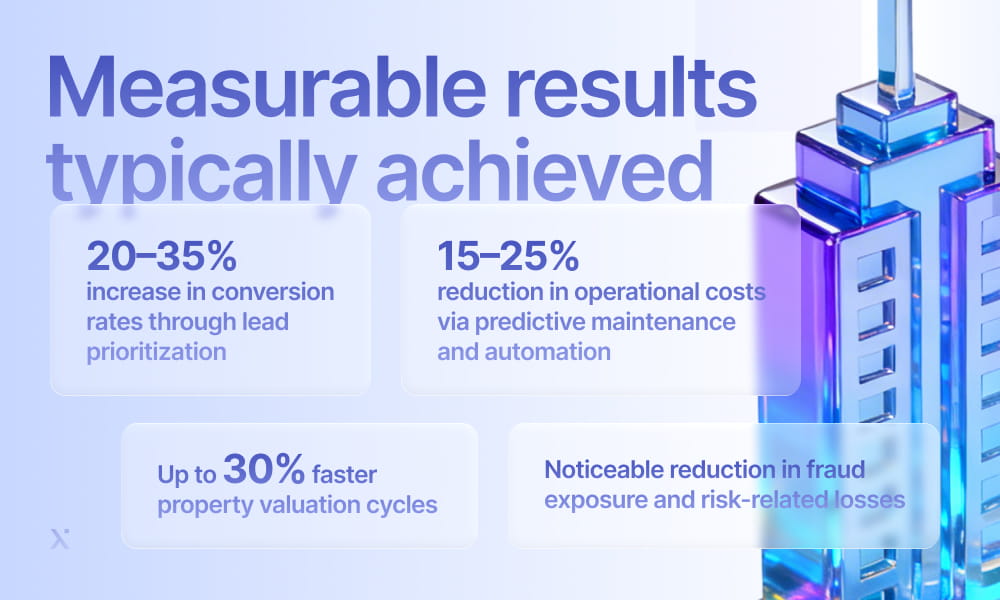
Selected implementation outcomes
The examples above show a pattern. When machine learning is tied to a clear business objective, such as pricing accuracy, acquisition discipline, lead prioritization, or maintenance planning, the impact shows up in measurable metrics. It affects speed, cost, risk exposure, and capital allocation.
The table below summarizes how different types of real estate organizations applied ML and what changed as a result.
| Company type | ML solution | Implementation scope | Result |
| PropTech startup | Automated Valuation Model | Multi-city residential pricing engine | Faster valuations, reduced manual appraisal load |
| Investment fund | Predictive acquisition model | Portfolio-wide market ranking | Improved yield allocation, lower volatility |
| Brokerage | Automated lead scoring | CRM and web behavior integration | Higher conversion, better resource focus |
| Large developer | Predictive maintenance | IoT-enabled asset monitoring | Fewer breakdowns, stabilized maintenance costs |
They start with clean historical data and clearly defined accountabilities so the team knows what can be trusted and who is responsible for maintaining it. Business KPIs are defined before training begins, allowing work to be tied to results, not experiments. Models are integrated into CRM, ERP, and asset management tools where decisions are made, and are monitored and refined over time to ensure performance remains consistent with market changes.

Machine Learning Development for eCommerce: Building Smart Stores that Learn

From Data to Decisions: Machine Learning Development for Supply Chain
The cost of machine learning development for real estate
Often, the first serious question executives ask is cost. The answer depends not so much on the algorithm itself as on the scale of the project, the maturity of the data, and the long-term goals. Developing enterprise machine learning systems for the real estate market can range from a targeted pilot project to a multi-tier platform integrated with underwriting, CRM, and asset management systems. The cost difference reflects the difference in ambition.
What influences the cost
Cost is driven by a handful of practical factors, and most of them have nothing to do with fancy algorithms.
- Data availability and quality
If your data is scattered across systems, labeled differently from region to region, or full of gaps that need cleanup, most of the time goes into getting it into shape. When the data is already in one place and uses consistent definitions, work moves faster, and costs are easier to keep under control. - Model complexity
A simple rental pricing model is one thing. Another valuation engine combines location layers, buyer behavior, and economic signals. More inputs and more edge cases mean more development, more testing, and more time before the output is stable enough to rely on. - Custom vs pretrained models
Pre-trained models can help you get started quickly, but they’re designed for a broad, “average” use case. Real-world portfolios rarely look average. Building your own model requires more effort initially, but over time, it typically performs better because it’s built on your assets, markets, and how your trades actually perform. - Infrastructure choice
Where you run the solution affects both the initial build and what it costs to operate later. Cloud, on-prem, and hybrid setups each come with their own tradeoffs around security, performance, and scaling. Once you add enterprise basics like access control and audit logging, the scope grows quickly. - Compliance requirements
In a regulated environment, it’s usually impossible to implement a working model without being able to explain why certain decisions were made. Reliable documentation and clear assignment of accountability are also essential. Confidentiality rules and audit requirements add additional work during the testing and implementation stages, and continue to create additional challenges after launch related to monitoring and reporting, so it’s best to plan for these from the outset.
Estimated cost breakdown for a custom ML solution
| Project stage | Estimated cost range (USD) | Timeline |
| Discovery and scoping | $20,000 – $50,000 | 4–6 weeks |
| Data engineering | $50,000 – $150,000 | 6–12 weeks |
| Model development and training | $60,000 – $180,000 | 8–14 weeks |
| Testing and validation | $20,000 – $60,000 | 4–6 weeks |
| Deployment and integration | $40,000 – $120,000 | 6–10 weeks |
| Monitoring and optimization (annual) | $30,000 – $100,000 | Ongoing |

How Much Does AI Development Cost in 2026?

How to Build an AI Strategy for Your Business
For full-scale development of enterprise machine learning solutions in real estate, the total investment typically ranges from $200,000 to $600,000 or more, depending on the scale and depth of integration.
When companies compare in-house development and integration, the discussion typically begins with speed and initial budget. Integration seems simpler at first glance, with a subscription, faster deployment, and fewer in-house resources. Custom development requires more planning, deeper data mining, and a higher initial investment. However, the long-term outlook is different.
The cost of third-party ML solutions is typically calculated per API call, per property, or per monthly volume. For medium-sized portfolios, annual licensing can range from $50,000 to $250,000 or more, depending on usage and the depth of functionality. Enterprise contracts often exceed this range, especially when multiple modules are combined into a single package. In addition to licensing, there are integration costs, typically between $20,000 and $100,000, depending on the system’s complexity, data mapping, and security.
Over three to five years, subscription fees, usage growth, and contract renewals can equal or even exceed the cost of building a custom solution.
Developing a custom machine learning solution for the real estate market requires a significant initial investment, but the model becomes an internal asset rather than a recurring expense. Infrastructure and monitoring still incur ongoing costs, but pricing remains under your control. There are no per-call fees, no vendor-imposed functionality limitations, and no unexpected contract changes.
The comparison below highlights the structural differences between the two approaches.
| Criteria | Custom development | Third-party integration |
| Upfront cost | Higher | Lower |
| Long-term cost control | Strong | Vendor-dependent |
| Customization depth | Full control | Limited |
| Competitive differentiation | High | Moderate |
| Deployment speed | Slower | Faster |
| Data ownership | Full | Shared or restricted |

Machine Learning in the Automotive Industry: Benefits, Limitations, and Best Applications

Exploring Key Generative AI Applications and Use Cases across Industries
Custom vs. ready-made ML: what to choose?
This choice becomes simple when you stop thinking in terms of “technology” and start thinking in terms of control. A ready-made tool can be fine when the use case is narrow, and the model is not central to revenue or risk. Custom machine learning development for Real Estate makes more sense when ML decisions shape pricing, underwriting, acquisition, or tenant retention.
Choose custom if:
- You own proprietary data that competitors cannot access.
- You need a competitive advantage, not a generic benchmark.
- You require deep integration into CRM, ERP, underwriting, or asset workflows.
- Compliance requirements are strict, and decisions must be explainable.
When ready-made tools fit better
Ready-made tools tend to work when you need a fast start, the scope is limited, or the use case sits on the edge of the business. Examples include a quick pricing sanity check, an early pilot for lead scoring, or a narrow fraud-screening module.
Decision matrix
| Decision factor | Ready-made integration is a good fit when… | Custom development is the better fit when… |
| Data | You have a limited internal history or inconsistent datasets | You have rich proprietary data and want to use it fully |
| Business criticality | The output is “nice to have” or supports small workflows | The output drives pricing, underwriting, or investment decisions |
| Differentiation | Similar outcomes to competitors are acceptable | You need unique logic tied to your portfolio and markets |
| Integration depth | Light integration is enough, mainly API calls | The model must sit inside workflows and automate actions |
| Compliance | Basic reporting is fine | You need auditability, transparency, and strict governance |
| Time-to-value | You need results fast for a pilot | You can invest upfront for long-term control and ROI |
| Cost over time | You accept recurring fees and vendor pricing changes | You want cost control and ownership of the asset |
Leveraging MLaaS: Why It's Crucial for Your Business Growth

Inside Machine Learning Development: What Businesses Should Know
Future of machine learning in real estate
ML in real estate is moving from single features to connected systems that influence how assets are run, marketed, financed, and traded.
AI-powered digital twins
Digital twins are virtual copies of buildings linked to real operational data, such as sensor readings, maintenance logs, and energy usage. They let teams test upgrades, predict failures, and plan lifecycle spend with fewer surprises.
Generative AI for property marketing
Generative tools help quickly create and tailor announcements, brochures, and investor materials. A key advantage is personalization based on the target audience, such as buyer-focused messaging versus investor-ready summaries, with human review to ensure accuracy.
Autonomous investment agents
They monitor the market, identify significant changes early on, and identify deals that merit closer attention based on demand, liquidity, rent dynamics, and overall economic signals. They don’t make the final decisions, but they do reduce the time spent analyzing unnecessary information.
ESG scoring via ML
ML can unify messy ESG inputs, including energy performance, emissions estimates, tenant churn, and building upgrades, into a consistent score used for reporting and capital allocation.
Blockchain and asset tokenization
As tokenized real estate grows, ML can support pricing, liquidity forecasting, and risk evaluation by leveraging transparent ownership and transaction histories from blockchain records.

Fintech’s New Brain: Why Machine Learning is the Real Reason Your Bank Suddenly Understands You

How to Apply Machine Learning in Banking: Top Use Cases
Why choose PixelPlex for machine learning development for real estate
Machine learning projects fail when they are treated as experiments instead of infrastructure. They also fail when the technical team understands algorithms but not the business logic behind underwriting, pricing, risk, or portfolio management.
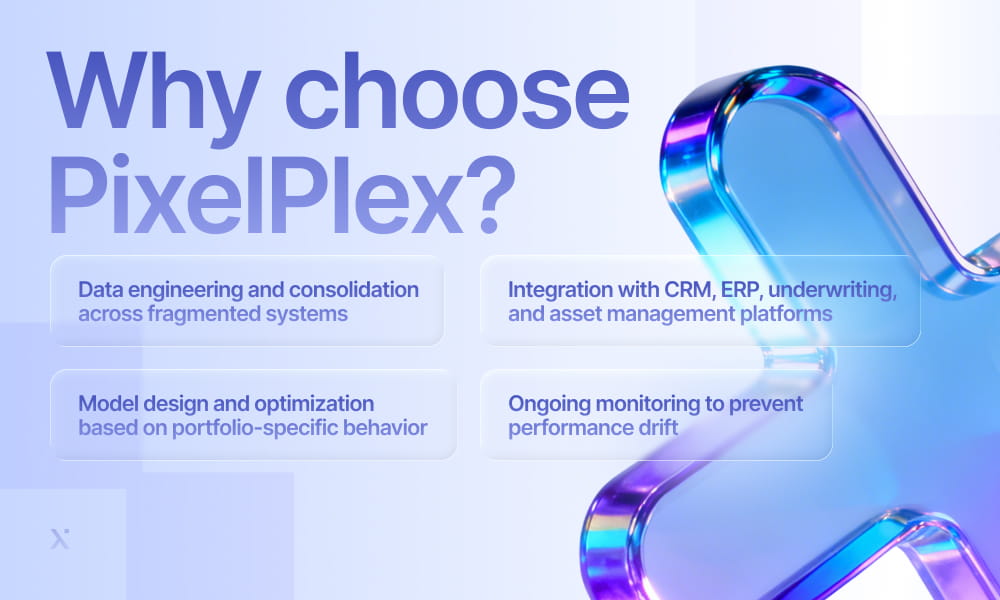
PixelPlex has over 10 years of experience providing machine learning and blockchain solutions to companies operating in data-intensive and highly regulated environments. This experience is essential in the real estate industry, where decisions often impact capital allocation, regulatory compliance, and long-term asset performance.
We provide a full range of machine learning solution development services for the real estate market, from initial analysis and data preparation to model deployment and monitoring.
In addition to full-scale builds, we provide focused machine learning development services for targeted use cases, as well as advisory support through consulting engagements. When the goal includes a user-facing product, our machine learning app development practice supports the design and launch of production-ready platforms.
PixelPlex supports the full lifecycle, from early scoping and data preparation to deployment and ongoing support. The work stays tied to real workflows such as underwriting, pricing, risk, and portfolio decisions, so the solution fits how teams actually operate. We also handle the engineering required to run models reliably, including integration, security, and scaling. The end product is built for daily use, not for a one-time demo.

Top 10 Machine Learning Development Companies

Top 10 AI Development Companies in 2026
Conclusion
Real estate teams have a wealth of data, but turning it into decisions remains challenging. Machine learning helps by extracting signals from transactions, customer behavior, and location context, and by shaping the data, allowing teams to act faster and miss fewer risks and opportunities.
The right choice depends on where machine learning is used in your business. For a small pilot project or simple use case, integrating a third-party tool may be appropriate. When machine learning begins to impact key decisions, you need to control the logic, data flow, and costs. This is when developing in-house solutions becomes more feasible than using an external product.
The best results are achieved when machine learning is integrated into the business, not added on top. Data quality is taken seriously, predictions are embedded where decisions are made, and models are updated as the market changes. Over time, accuracy improves, and this advantage becomes increasingly difficult to surpass.
FAQ
There isn’t a single magic number, but most teams need about 12–24 months of clean transaction or operating data to get a first model they can trust. If the market swings a lot, you usually want a longer history so the model has seen different conditions. When internal data is thin, you can fill some gaps with external market data to get an early version off the ground.
Yes, but it takes more work upfront. Many real estate companies run on a patchwork of systems, such as CRM, ERP, accounting, and property management tools that do not share the same data definitions. Before you can train anything, you have to connect those sources and make sure “the same” field means the same thing everywhere. If you skip that step, the model might look fine in a demo, but results will vary across teams and workflows.
If ML lives in a report, it usually gets ignored. People work in listing systems, underwriting screens, asset tools, and tenant portals. Real estate software development services help put ML outputs right there, so the next step happens naturally, whether that’s adjusting a price, routing a lead, or planning maintenance.
Machine learning consulting is a good first step when management wants answers before funding full-scale development. A brief consultation phase can reveal whether the data is truly usable, what success metrics are meaningful, what ROI to expect, and how the solution should fit into existing systems. This initial clarity reduces risk and prevents teams from investing heavily in attractive use cases that don’t yield tangible results.
ROI should be directly linked to business metrics, such as increased conversion rates, shorter assessment cycles, reduced fraud losses, lower maintenance costs, or increased portfolio profitability. The key is to establish a baseline of performance before implementation and track changes over time, rather than relying solely on model accuracy.
The usual risks are not exotic. Data can be messy, nobody clearly owns it, and teams underestimate how much work it takes to connect models to real systems and workflows. Another common pitfall is getting locked into a vendor without thinking through what renewals, usage growth, and switching costs will look like later. Strong data governance, clear KPIs, and visible leadership support help prevent many of these problems before they snowball.