
In a world where every AI prompt you type is being watched and stored, Pavel Durov is building a platform that turns the lights out on corporate surveillance. Are you ready to take back your privacy and let your data live in the shadows of a secure cocoon?
Privacy feels like a myth these days. Every time you type a prompt into a popular AI chatbot, you are basically handing over your thoughts to a massive corporation. They store it, they study it, and sometimes, they even use it to train the next version of their model. It is a bit like having a conversation in a room where the walls have ears and the ears are connected to a giant database in Silicon Valley. This is exactly what Pavel Durov wants to change with his latest project.
At PixelPlex, our blockchain development team has been following these shifts closely. We have seen how centralized power can stifle innovation, and that is why we put together this article. We want to help you understand why Cocoon might be the most important thing to happen to Telegram since the launch of the TON blockchain itself. If you are looking to understand this new landscape, our experts are always here to help you build or integrate these systems.
What is Cocoon?
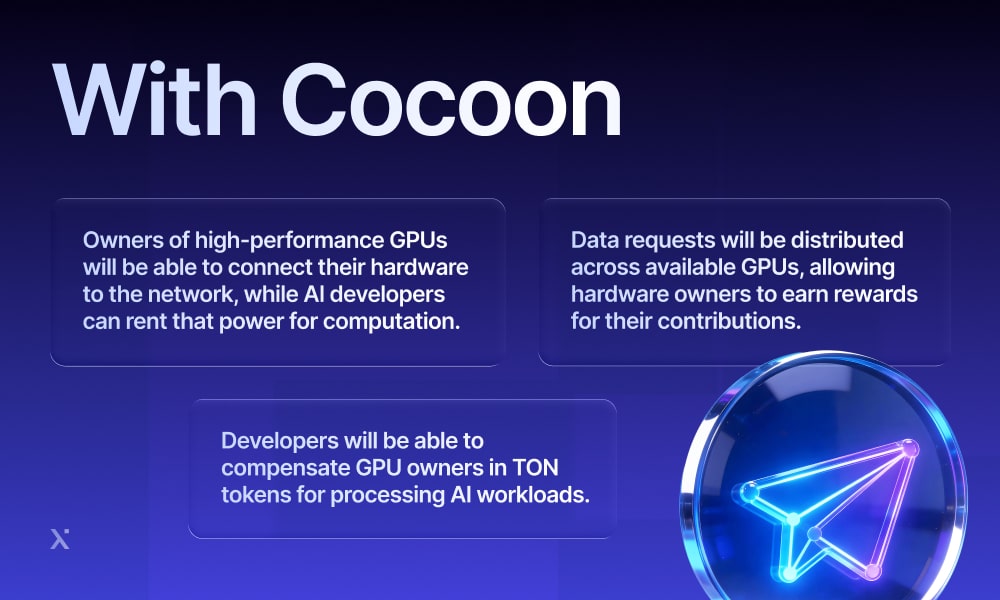
Actually, the name tells you a lot. A cocoon is a protective shell. In this case, Cocoon (or the Confidential Compute Open Network) is a decentralized system where AI models can run without anyone peeking at the data. It is built on top of The Open Network (TON), and it aims to turn Telegram into a platform for private computation.
The idea is pretty simple. On one side, you have people with powerful graphics cards (GPUs) sitting idle. On the other, you have developers who need that power to run AI apps but do not want to sell their souls to big cloud providers. Cocoon acts as the middleman that keeps everything anonymous and secure.
During a talk in Dubai, Durov shared a funny bit of history about the name.

One of the first ideas was to call it PAIN – Private Artificial Intelligence Network. But then I thought, it would be weird to come here and say: welcome to the world of PAIN. So we came up with a better name – Cocoon.

Pavel Durov
Founder of Telegram
It is a good thing they changed it. Nobody wants to sign up for a network that sounds like a dental appointment.

Canton Network Reward System: How Canton Coin Pays Developers to Build Real Value
ChatGPT Integration: How Companies Turn AI Into Real Operational Advantage
The three layers of Cocoon
To understand how it works, you have to look at the three main players. It is like a digital marketplace with very high security.
| Player | Role | Reward/Cost |
| GPU owners | Provide the raw horsepower (hardware) | Earn TON tokens for every task finished |
| AI developers | Build the bots and apps | Pay for compute power without buying servers |
| End users | Use the bots within Telegram | Get AI answers with 100% privacy |
If you are thinking about building your own app in this space, you might need dApp development services to ensure your interface connects smoothly with the underlying blockchain.
Why do we need this?
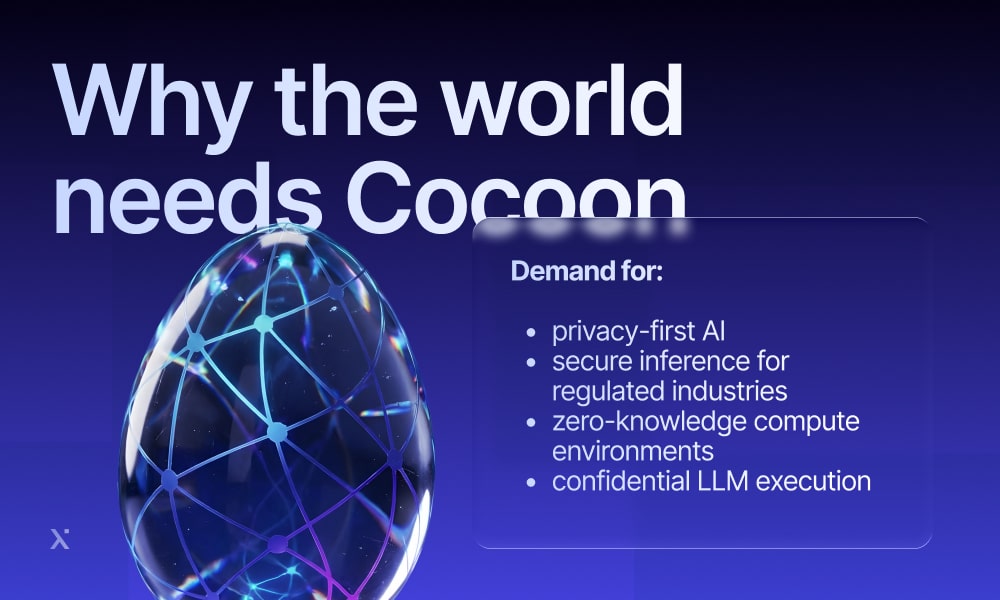
The world is currently addicted to centralized AI. When you use the big names in the industry, your data goes to a single server. In 2023, there was a significant leak in Google Cloud that exposed some confidential AI prompts from corporate clients. Then in 2024, it came out that some ChatGPT prompts were being used in test datasets without people really knowing. By 2025, media reports suggested that large platforms were even filtering responses based on politics.
Cocoon wants to break this cycle. By using decentralized hardware, there is no single point of failure and no single “Big Brother” watching the logs. This is why many founders are looking into why you should launch your web3 project on TON because the ecosystem is already set up to support this kind of independence.
Current estimates suggest that about 65% of the world’s cloud computing power is controlled by just three companies. Cocoon is basically an attempt to take a slice of that pie back for the people.
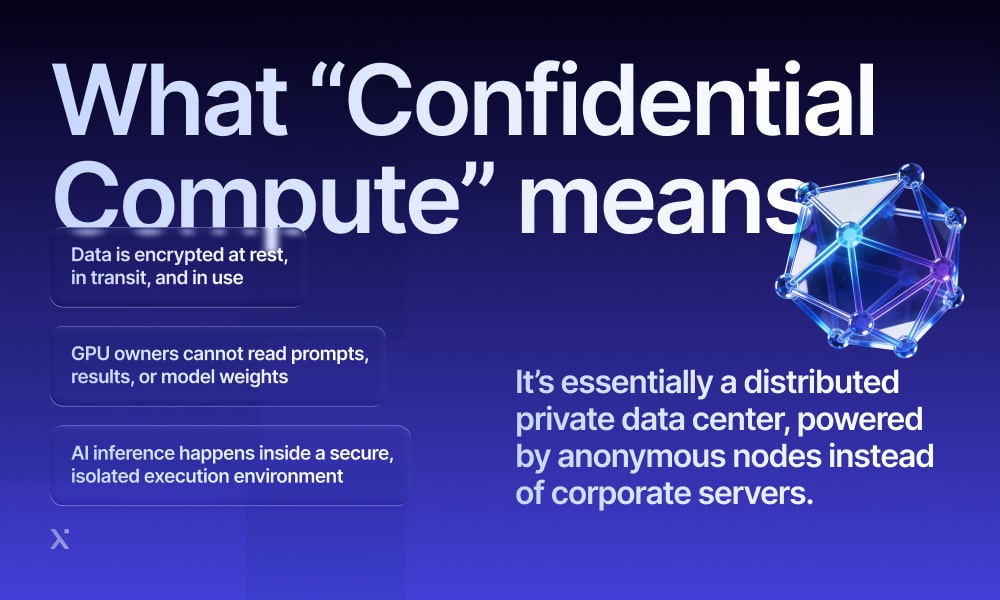
The Cocoon’s confidential computing
You might wonder how you can trust a stranger’s computer with your private data. Cocoon uses something called “secure enclaves.”
We can compare it to a digital safe inside the GPU. The data goes in encrypted, the GPU does the math inside the safe, and the result comes out encrypted. Even the person who owns the computer cannot see what is happening inside that safe. Your prompt and the AI’s response remain a secret. This is a massive jump from traditional cloud computing where the server owner can basically read everything if they want to.
For companies that handle sensitive info, this is a game changer. We often suggest a security audit and risk management strategy for our clients to make sure their data handling is up to these new standards.
How the workflow looks
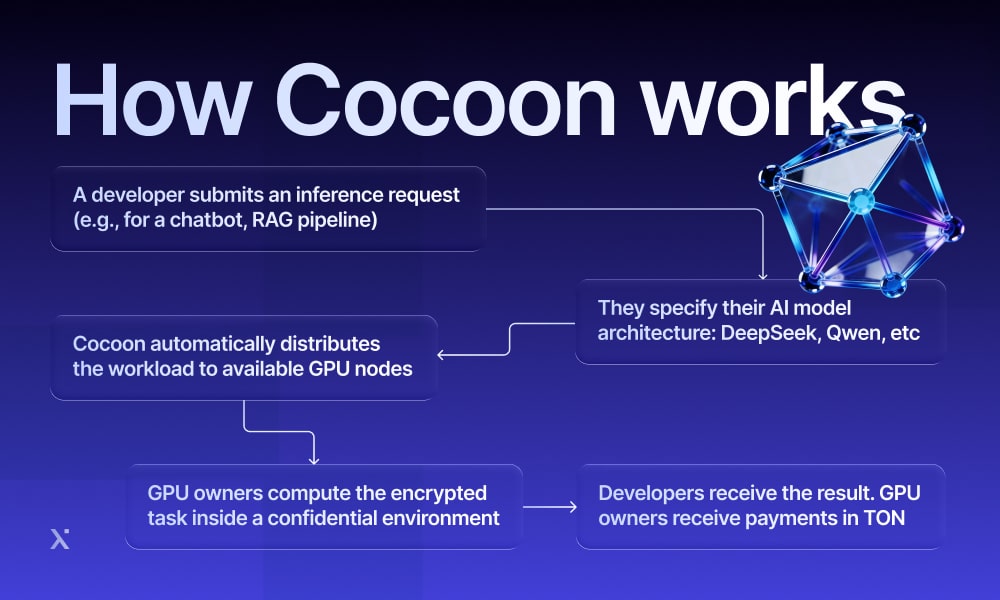
- The ask: A developer sends a request for a chatbot or a voice model.
- The choice: They pick a model architecture like DeepSeek or Qwen.
- The distribution: Cocoon finds an available GPU in the network.
- The work: The task is finished inside a secure, isolated environment.
- The payday: The developer gets the result, and the GPU owner gets TON.
This setup is perfect for those who want to know how to create Telegram apps that offer high-end AI features without the high-end server costs.

AI Integration for Business: A Practical Guide to Efficiency and Profit

Crypto Wallets Get Brain: How AI Crypto Wallet Development is Creating a Smarter and Safer Financial Future
Business opportunities
If you are running a startup, Cocoon is like finding a shortcut. Normally, if you want to run a heavy AI model, you have two choices. You either buy incredibly expensive H200 GPUs (which are hard to find) or you pay a king’s ransom to Amazon or Google.
Cocoon levels the playing field. It gives smaller teams access to massive compute power on a “pay-as-you-go” basis. Because there is no corporate overhead, the prices are expected to be much more competitive. For a founder, this means you can spend your budget on improving your product rather than just keeping the lights on in a data center.
Many businesses are already integrating these tools via AI development to stay ahead of the competition. It is about being agile.
Where Cocoon wins against the giants
| Feature | Traditional cloud AI | Cocoon (decentralized) |
| Privacy | They can see your data | Encrypted at all times |
| Cost | High, fixed margins | Market-driven, competitive |
| Control | Vendor lock-in | Open network |
| Accessibility | Restricted by geography | Available to anyone with a wallet |
If you are looking to test the waters, starting with MVP development services can help you build a lean version of your AI app on Cocoon without blowing your whole investment.

Code, Capital, and Compliance: A Deep Dive into Canton Network Smart Contract Development

Are Corporate Crypto Stashes The Future? A No-Nonsense Guide to DATs
TON: the fuel in the Cocoon’s engine
Everything in Cocoon runs on the TON token. It is the currency that makes the whole machine turn. Developers use it to buy time, and miners earn it for their work. This gives the token actual economic utility. It is basically a ticket for computation.
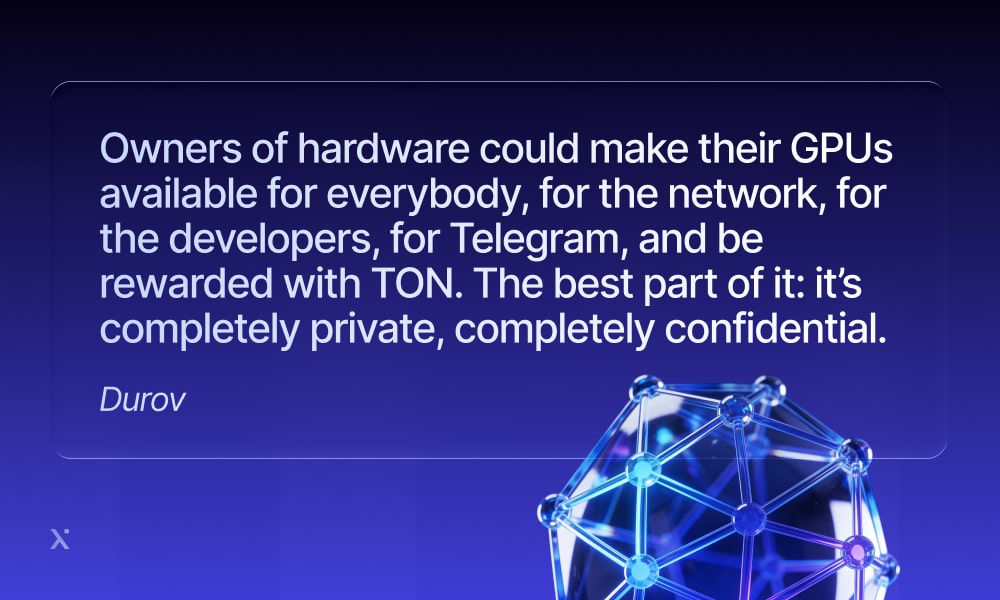
Durov has been very clear about this. He noted that hardware owners can make their GPUs available to everyone and be rewarded with TON. This is a huge incentive for people who previously used their rigs for traditional crypto mining. Now, they are actually solving real-world AI problems.
If you are new to the ecosystem, checking out a Telegram Open Network guide is a great way to get up to speed on how the underlying tech works.
Real-world use cases for different industries
Cocoon is not just for making funny cat pictures. Its focus on privacy makes it useful for serious industries where data leaks are not an option.
If you are a developer looking to join Cocoon, keep an eye on your “input and output token size.” This will be a major factor in how much you pay for compute power. Smaller, optimized prompts will save you a lot of TON in the long run.
Legal & compliance
A lawyer could use an AI bot to summarize a sensitive contract or look for loopholes in a deposition. Because of Cocoon, the law firm doesn’t have to worry about the document leaking to a third-party AI provider or being used to train a public model. Everything stays within the encrypted enclave.
Healthcare & biotech
Doctors can analyze patient data or research papers using AI models without violating privacy laws. Since the data never exists in a readable format on a central server, it becomes much easier to follow strict rules like HIPAA. This is a massive win for personalized medicine.
Finance & banking
Analyzing market trends or private portfolios becomes much safer. Using DeFi development alongside Cocoon could lead to some truly private financial advisors that help you manage your wealth without ever actually “seeing” your bank balance in plain text.
Human resources
Imagine an HR bot screening thousands of resumes for a high-security role. These documents contain addresses, phone numbers, and salary history. By using a private network, a company can rank candidates based on skills without exposing their personal details to a cloud giant.
Logistics & supply chain
Large shipping firms often have a secret way of how they move goods. If they use a central AI to optimize routes, they are essentially giving away their trade secrets. Cocoon allows them to run heavy optimization math while keeping their logistics data completely dark to outsiders.
Cybersecurity
Security teams need AI to hunt for bugs in their own code. However, uploading your proprietary code to a public AI is like giving a map to a burglar. Cocoon lets teams run vulnerability scanners in a private environment, making it a much safer way to keep the digital gates locked.
For bigger firms, enterprise AI development is the logical next step. It allows them to scale these private solutions across thousands of employees while maintaining a “trustless” architecture.
A typical enterprise-level AI request can pass through as many as seven different third-party servers before it reaches the end user. Cocoon cuts that chain down to a single, encrypted path between the developer and the GPU.

Web3 Development: What It Takes to Build the Future

Protecting Ideas: How Blockchain Is Becoming the Guardian for Your Creations
Making money with your graphics card
If you have a powerful PC gathering dust while you are at work, Cocoon wants to pay you. The network is looking for high-performance GPUs like the H200 or even high-end consumer cards with plenty of VRAM.
It is a bit like renting out a spare room on Airbnb, but for your computer. You provide the space and the electricity, and the network handles the “guests” (the AI tasks). The more “uptime” you have, the more you can earn. This creates a global, distributed data center that nobody truly owns, but everyone profits from.
For those curious about the specifics of the network’s home, exploring TON development services can give you a better idea of how these rewards are distributed through smart contracts.
| GPU type (Example) | Expected role | Potential value |
| Nvidia H200 | Heavy LLM inference | High reward per task |
| Nvidia RTX 4090 | Mid-range bot processing | Steady, consistent income |
| Older Workstation GPUs | Simple data processing | Lower, but still profitable |
To manage your earnings, you will need to know how to build a crypto wallet or at least how to use one that is compatible with the TON ecosystem.
Telegram’s adoption powers Cocoon
The biggest problem for most blockchain projects is getting people to actually use them. Cocoon doesn’t have that problem. It is launching inside an app that reached a massive milestone of 1 billion monthly active users in 2025. While other web3 projects are begging users to download clunky browser extensions, Cocoon is already sitting in their pocket.
Telegram is already home to over 10 million active bots and a rapidly growing ecosystem of Mini Apps. Cocoon just gives these bots a brain that is private and cheap to run. Instead of being an abstract tech project, Cocoon is a feature that will likely be invisible to the average user. They will just notice that their favorite bots are suddenly smarter, faster, and more secure.
From a business perspective, the integration with Telegram Stars (the in-app currency) and the new ad revenue-sharing models creates a closed-loop economy. A developer can build a bot, use Cocoon for low-cost private AI inference, and get paid in Stars, which they then convert back into TON. This friction-free environment is exactly why should your startup choose TON over other platforms. You are building in a crowded marketplace where users are already spending money.
Why the Telegram integration changes the game
| Factor | Most AI/Web3 projects | Cocoon + Telegram |
| Onboarding | High friction (new apps/wallets) | Zero friction (already installed) |
| Distribution | Needs heavy marketing spend | Native access to 1B users |
| User Flow | Switches between apps | All-in-one chat interface |
| Payment | Complex crypto swaps | Integrated Telegram Stars |

AI in Software Development: It's More Than Hype, It's the New Hammer

Custom AI Model Development: Tips and Tricks
Solving the “Cloud Crisis”
The way we use the internet is changing. People are becoming more aware of how their data is being harvested. Cocoon offers an alternative to the “free” services that actually cost you your privacy. By moving the processing away from Amazon AWS or Google Cloud, we get a more democratic version of AI.
At PixelPlex, we often help clients with blockchain integration services to bridge the gap between their current systems and these new decentralized networks. It is about giving you the best of both worlds.
The problem with the current AI giants
- Usage quotas: They decide how much you can use their AI.
- Vendor lock-in: Moving your data to a different provider is a nightmare.
- Surveillance: Your data is a product for them.
- Censorship: Models are often tuned to follow specific corporate or political guidelines.
By using private blockchain development, companies can create their own internal versions of these networks to keep their data even more secure.
The economics of TON and Cocoon
The price of compute power in Cocoon will likely be dynamic. If many people are asking questions at once, the cost might go up. If there are thousands of GPUs waiting for work, the cost goes down. This “supply and demand” model is much more efficient than the flat monthly fees charged by big tech companies.
For those looking to build tools that manage these assets, tokenization platform development is an area that is growing quickly. You could even tokenize “compute credits” to trade them on the open market.

AI Chatbots in Banking: How The Industry Grows

AI Business Ideas, Tools & Real-World Wins That Actually Spark Something New
TON vs. the others
When people talk about decentralized AI, names like Solana or Ethereum often come up. However, TON has a unique advantage because it is deeply integrated with a social platform.
| Feature | TON (Cocoon) | Ethereum | Solana |
| User base | 1B+ (Telegram) | Large, but fragmented | Growing, tech-heavy |
| Transaction speed | Ultra-fast | Slower/Expensive | Very fast |
| AI focus | Built-in via Cocoon | Third-party only | Early-stage projects |
| Social integration | Native | None | None |
You can find a more detailed breakdown in our article on TON vs. Ethereum vs. Solana to see which one fits your specific needs.
What happens after the Cocoon’s launch?
The launch of Cocoon is just the beginning. The team is already accepting applications from GPU owners and developers. They are specifically looking for people working with architectures like DeepSeek and Qwen.
Telegram itself will be the first big customer. It will use Cocoon to power its own AI features, which will immediately provide the network with a huge volume of work. This “lead by example” approach is exactly how you jumpstart a new economy.
If you want to automate these interactions, smart contract development will be key. You can set up contracts that automatically pay for compute power when your bot receives a message from a user.
Potential challenges
It is not all sunshine and rainbows. Cocoon will face hurdles.
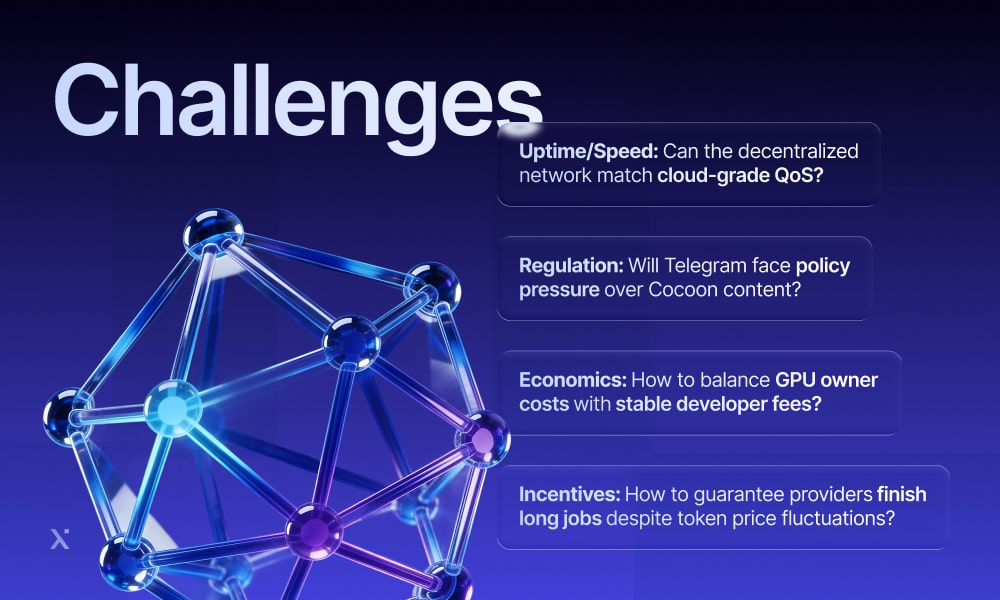
- Regulations: Governments might not like a network they cannot watch.
- Quality of service: Can a thousand home PCs really be as fast as a Google data center?
- Price volatility: If the price of TON swings wildly, it might be hard for developers to budget.
Even with these risks, the demand for privacy is only growing. Many are turning to machine learning development company expertise to build models that are efficient enough to run on these distributed nodes.
How to get involved right now
If you are a developer, start looking at the model architectures that Cocoon will support. If you are a hardware owner, check your VRAM and your electricity costs. For businesses that want to get a head start, business intelligence solutions can help you analyze where AI would actually save you money.
For developers
If you are writing code, your first move should be model optimization. The truth is, the network loves efficiency. You should start experimenting with quantizing your favorite models like DeepSeek or Qwen down to 4-bit or 8-bit precision. This makes them lean enough to run on consumer-grade hardware without losing much of their “intelligence.”
Getting comfortable with the TON SDK is another smart move. Since every single trigger and payment happens on-chain, you need to know how the network handles high-frequency micropayments. This way, when the gates open, your bot will be ready to process queries while others are still reading the documentation.
For the hardware owners
For the people who love the smell of thermal paste in the morning, it is time to audit your setup. Cocoon isn’t a “set and forget” situation. You need to think about the longevity of your fans and the stability of your power supply.
Check if your VRAM can handle the weights of popular LLMs. The juiciest rewards will likely go to those who can host larger models, which usually require cards with at least 24GB of memory. Also, do the math on your local electricity rates. If you are paying a fortune for power, you might just end up breaking even.
For startups
For companies, the smartest move is a feasibility study. Do not just throw AI at every problem because it is trendy. Our team can help you figure out exactly which parts of your workflow would benefit from private, decentralized compute. Maybe it is a customer support bot that needs to handle sensitive user IDs or an analytics tool that is currently eating up your cloud budget.
If you are planning to rent out your GPU, focus on “uptime.” The network will likely prioritize nodes that are online 24/7. A less powerful card that is always on might earn more than a monster card that is only on for two hours a day. Consistency is the secret to a steady flow of TON.

Smart Contract Development Cost Demystified: What Every Business Should Know

Enterprise Blockchain: Prom Promise to Profit
Wrapping it up
Pavel Durov has a habit of disrupting industries. He did it with social media, he did it with messaging globally, and now he is taking on the AI cloud giants. Cocoon is more than just a new way to run a chatbot, it is a promise of independence for our data.
At PixelPlex, we believe that the combination of TON and AI is one of the most exciting developments in the blockchain world. Our team is ready to help you navigate this transition, whether you are building a new dApp, auditing your security, or integrating AI into your existing workflow. We wrote this because we know that the future belongs to those who value privacy and decentralization.
Cocoon is ready to launch, and the only question is whether you will be inside the shell or watching from the outside.
Drop us a line – let’s start your project together.
FAQ
Cocoon is a decentralized network built on the TON blockchain that allows AI models to run privately using a global marketplace of distributed GPUs. Our team offers specialized AI app development to help you build software that taps into this secure computing layer directly within the Telegram ecosystem.
You don’t need to be a developer to benefit, as you can start by identifying which of your processes could be automated or secured through decentralized AI. We provide AI consulting to guide companies through the technical shift from centralized cloud providers to the Cocoon network.
Yes, Cocoon is designed to be accessible via APIs, allowing you to route sensitive data through its encrypted enclaves while keeping your front-end intact. If you want to enhance your current platform, we can assist with generative AI integration that prioritizes user confidentiality.
Absolutely, as it allows your bots to handle much more complex reasoning and data analysis without the risk of leaking user prompts to a central server. Our experts in chatbot development can help you migrate your existing bots to Cocoon for a faster, smarter, and more private user experience.
Yes, the network creates a marketplace where hardware owners are paid in TON for every AI task they process inside their secure enclaves.
Unlike the big cloud giants, Cocoon uses “confidential computing” to ensure that your data is encrypted even while it is being actively processed by a GPU.
At launch, the network is prioritizing popular open-source architectures like DeepSeek and Qwen, though more are being added as the developer community grows.
Since Cocoon removes the massive corporate markups of traditional providers, it actually lowers the barrier to entry for smaller teams needing high-end compute power.