The gaming world is leveling up with blockchain, giving players more control, rewards, and opportunities than ever before. And it’s not just blockchain — NFTs, AR/VR, and the metaverse are also stepping in to enhance the player experience.
People are stressed, and everyone has their own way to unwind. For many, it’s as simple as playing computer games. Out of the 3.32 billion people around the world who actively play video games, roughly 2.04 billion do it for this exact reason: just to relax.
It’s no secret that the gaming industry is always growing. Global revenue in this market is projected to reach $564.27 billion in 2026, and with an expected CAGR of 6.77% from 2026 to 2030, it is set to hit approximately $733.22 billion by 2030.
Within this booming industry, demand for blockchain game development services is also skyrocketing, as blockchain technology gives players real ownership of in-game assets, decentralized economies, and play-to-earn (P2E) opportunities.
This phenomena is drawing in developers and investors alike, and our team at PixelPlex is leading the way. As a company specializing in blockchain, we’ve delivered our own blockchain-powered games and built deep expertise in this space. So we’re ready to guide you through it using our firsthand experience.
Why use blockchain in game development?
First of all, what is blockchain? It is a decentralized digital ledger that securely records transactions across a network of computers. Instead of depending on a single authority, it shares data directly among participants, without any intermediaries. As a result, records are transparent, tamper-resistant, and easily verifiable by anyone.
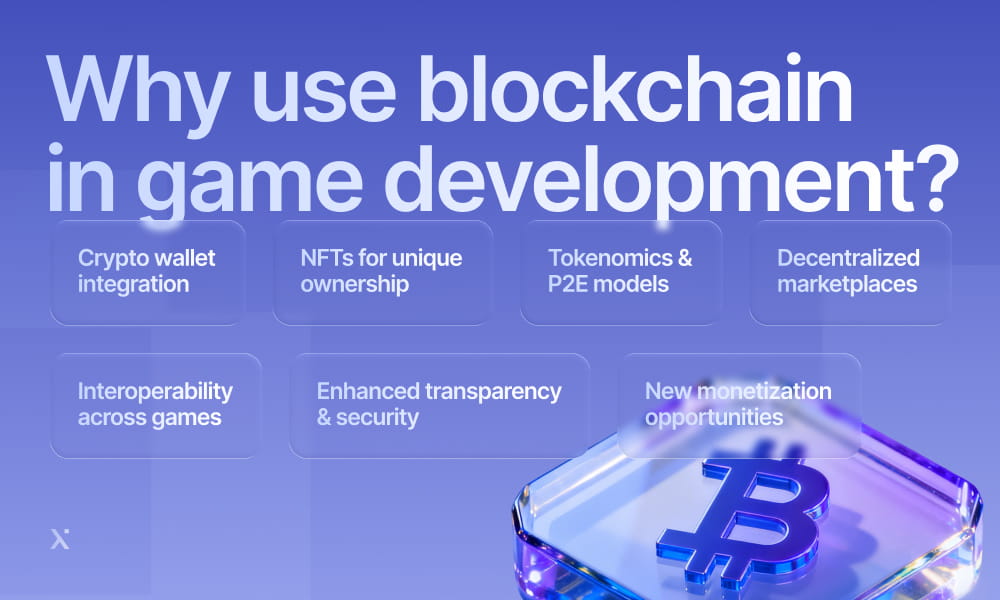
As far as gaming is concerned, blockchain opens the door to innovative in-game economies and true digital ownership. From crypto wallets to NFTs, blockchain brings about new ways to monetize, trade, and engage within computer games. Here is how it happens:
- Crypto wallet integration: Players can securely store and manage digital assets using crypto wallets. They are used for in-game purchases, trading, and transfers across platforms, which gives gamers full control over their assets.
- NFTs for unique ownership: Non-fungible tokens (NFTs) ensure players have verifiable ownership of characters, skins, and collectibles. Each token is unique and cannot be duplicated, which generates real value and scarcity in the digital world.
- Tokenomics and P2E models: Blockchain introduces new economic systems through tokens and crypto. Thanks to play-to-earn game development models, players can earn rewards by completing quests, competing in tournaments, or contributing to the game ecosystem. In this way, they convert their time in-game into real money.
- Decentralized marketplaces: Blockchain enables direct trading of assets without any central authorities. This means that no single entity controls the economy. As a result, in-game transactions are fairer, more transparent, and resistant to manipulation.
- Interoperability across games: With blockchain or metaverse game development services, assets can move freely between different games. Players can bring NFTs, characters, and rewards from one game to another, and thus form a connected and persistent ecosystem.
- Enhanced transparency and security: Every transaction is recorded on the blockchain, a ledger that simply cannot be deleted or altered. This makes it tamper-proof and fully transparent.
- New monetization opportunities: Blockchain + NFTs + tokenomics + crypto wallets = multiple revenue streams, such as selling limited-edition digital items, introducing subscription or staking models, and creating in-game economies that reward engagement.
Blockchain-based games vs traditional technologies
Traditional games have always captured players’ hearts with immersive worlds, great storytelling, and competitive excitement — and without any doubt, they will continue to do so. But like any field, gaming is changing with new technologies and ideas. Blockchain-based games are part of this change as well.
Let’s compare them to see how they differ from traditional games and what each brings to its players.
| Aspect | Blockchain games | Conventional games |
| Asset ownership | Players have true ownership of in-game items and tokens, which they can trade or sell | Items belong to the game — players enjoy them while playing but cannot transfer ownership outside the game |
| Economy & rewards | Players can earn real-world value through tokens or NFTs | Rewards are mainly in-game achievements, points, or items |
| Asset trading | Assets can be traded peer-to-peer on decentralized marketplaces | Trading is limited or controlled by the game developer |
| Interoperability | Some assets can be used across multiple games or platforms | Assets usually stay within a single game |
| Transparency | Game rules and transactions are recorded on a public ledger | Game economy and rules are set and managed by developers |
| Entry requirements | Players may need a crypto wallet and basic knowledge of cryptocurrency | Players simply download a game and register there |
| Community | Players can participate in governance through tokens or voting | Decisions are made by developers |
| Gameplay focus | Often includes P2E mechanics and token-driven systems | Focuses on narrative, challenges, and entertainment experience |
For game development companies, these differences highlight both opportunities and considerations when introducing blockchain. Offering ownership, tradable assets, and P2E models can attract players who want to invest time and money in a game. Decentralized marketplaces and cross-game interoperability can create long-term engagement and new revenue streams.
At the same time, developers need to consider additional complexity, such as integrating crypto wallets, ensuring secure transactions, and educating players about blockchain. Choosing to adopt blockchain in game development is not about completely replacing traditional gaming but about expanding possibilities and creating complementary experiences for players.
What is the best blockchain for game development?
Blockchain technology has been around since the early 2010s. Over the years, a wide range of games and ecosystems have grown up around it. For developers, this means that there is plenty of proven infrastructure, tools, and player interest to build on, and they don’t need to start from scratch.
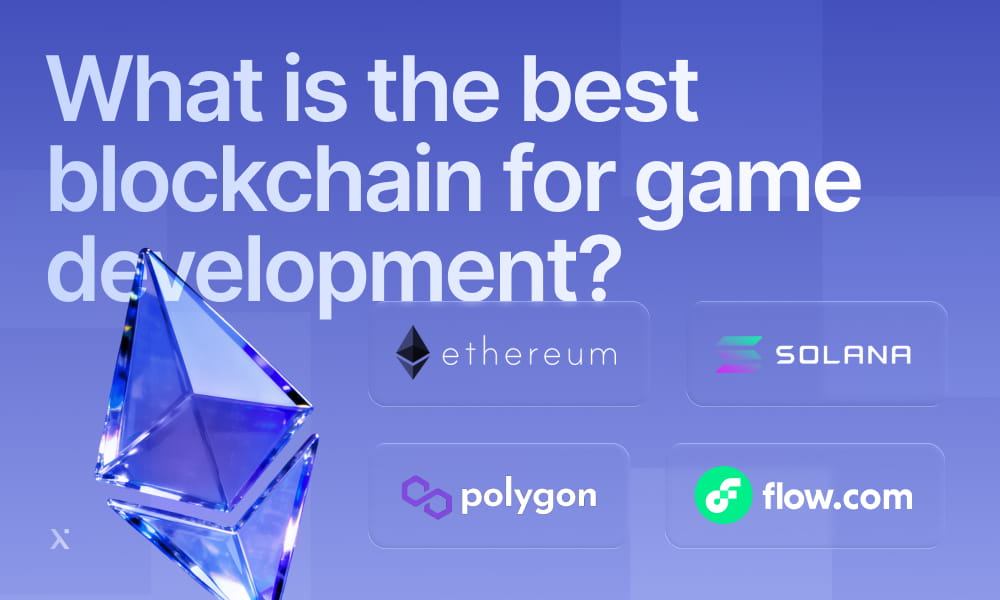
Below are the examples of popular chains used in blockchain game development today.
Ethereum
First launched in 2015, Ethereum originally used a Proof‑of‑Work (PoW) consensus mechanism but transitioned to Proof‑of‑Stake (PoS) in 2022 — a move known as “The Merge.” This major upgrade reduced energy usage and positioned Ethereum as a more secure, sustainable network.
- Strengths: Ethereum’s PoS network is one of the most secure and decentralized public blockchains with the biggest developer community and robust tooling. It also offers broad compatibility with other apps, a well-established NFT ecosystem, and access to deep liquidity, making it easier for developers to build, scale, and connect their games.
- Drawbacks to consider: Ethereum can be slower and more expensive than newer blockchains, so developers often add layer‑2 solutions to speed up transactions and lower costs.
- For game development: Many early blockchain games like CryptoKitties and Axie Infinity were built on Ethereum or linked to it, demonstrating how game economies and NFTs can operate in a decentralized environment.
What Are Layer 2 Blockchain Scaling Solutions and What Benefits Do They Offer?
Ethereum Smart Contracts: The Hard Parts Made Clear
Solana
Solana was launched in March 2020 with a hybrid consensus that combines Proof‑of‑History (PoH) for transaction ordering and Proof‑of‑Stake for validation.
- Strengths: Extremely high throughput and low fees. With a practical capacity of 3,000-4,000 transactions per second (TPS) and a maximum of over 65,000 TPS, this blockchain can support fast-paced gameplay and large player activity without slowing down or becoming super costly.
- Drawbacks to consider: Solana’s design focuses on speed and low fees, but this can sometimes cause network outages during very high activity. For example, the network went down for 17 hours in September 2021 during a bot-driven launch and nearly five hours in February 2024 when validators struggled to process heavy transaction loads. These incidents show that developers need to balance throughput and stability based on their game’s needs.
- For game development: Solana hosts games such as Star Atlas and Aurory, which benefit from high speed and fast transaction finality, especially where frequent actions and asset transfers are key to gameplay.
Polygon
Polygon was also launched in 2020 as an Ethereum‑compatible PoS sidechain. It was designed to handle transactions quickly and cheaply while still benefiting from Ethereum’s ecosystem.
- Strengths: Lower transaction costs and faster confirmations than on Ethereum, with strong compatibility for Ethereum tools and assets.
- Drawbacks to consider: Because Polygon is a sidechain, it is less decentralized than Ethereum’s mainnet, and developers must rely on the network’s validator set and checkpointing to Ethereum for ultimate security. This can mean slightly lower security guarantees compared with building directly on Ethereum.
- For game development: Games like The Sandbox, Aavegotchi, and Crazy Defense Heroes are built on Polygon to offer smoother, cost‑effective gameplay. At the same time, it still leverages Ethereum’s security bootstrapped via checkpoints.
Flow
Flow’s mainnet was launched in 2020. It was created by the team behind NBA Top Shot to support high‑performance apps and games at scale. It uses a multi‑role consensus architecture optimized for speed, efficiency, and consumer use cases. Its smart contracts are written in the resource‑oriented Cadence language designed specifically for digital assets.
Strengths: Flow was built with mainstream consumers in mind, so it prioritizes performance, low fees, and developer experience. Its architecture allows games and apps to scale without sharding, while offering built‑in tools like upgradeable contracts and easier onboarding for new users.
Drawbacks to consider: Flow is less decentralized than some older blockchains and its ecosystem is still smaller compared with giants like Ethereum or Solana. This means fewer tooling options and community resources in some areas.
For game development: Flow supports a growing range of blockchain games and interactive experiences, such as NBA Top Shot — a breakthrough collectible platform where fans trade licensed NBA “Moments.” Other examples include aiSports, MFL (Metaverse Football League), Pin Quest, and more.
How to Select The Best Blockchain Platform for Your Project
How to Capitalize on a Play to Earn Game Concept: Real Examples and Pro Tips
| Aspect | Ethereum | Solana | Polygon | Flow |
| Consensus mechanism | PoS (earlier PoW) | PoH + PoS | PoS, EVM-compatible L2 scaling | PoS with multi-role architecture |
| Factual & potential TPS | 15-250 TPS on base, higher via L2s | 3,000-4,000 factual; up to 65,000 TPS potential | 30-100+ real-time TPS; up to 65,000 TPS theoretical | 1,000 TPS and targeting 10,000+ TPS |
| Programming languages | Solidity, Vyper, others via EVM | Rust, C/C++, others via Solana toolchains | Solidity, EVM compatible | Cadence + EVM compatibility |
| Developer ecosystem & tools | Largest smart contract community & tooling | Growing but smaller ecosystem; different stack | Strong EVM-based development ecosystem | Gaming & NFT-oriented SDKs and tools |
| Use-case strengths | High security, a broad range of dApps and DeFi | Super high throughput, low cost | EVM toolchain, cost-effective dApps | Consumer and game-centric |
As a result, each technology delivers distinct advantages for blockchain game development.
Ethereum, especially when combined with its Layer-2 solutions, provides unmatched security and a mature development ecosystem, though its base layer can be too slow and costly for high-frequency gaming transactions.
Solana stands out with its exceptional throughput and minimal fees. This makes it ideal for real-time or large-scale games. What developers need to keep in mind is that its development standards differ from EVM-based platforms and may require a learning curve.
Polygon, on the other hand, does deliver EVM compatibility, plus, it has higher throughput and cost efficiency. It is a practical option for developers who want Ethereum’s ecosystem but don’t really want to face its scalability limits.
Finally, Flow was just built specifically for gaming, NFTs, and consumer Web3 experiences. It offers fast finality and robust scalability — exactly what’s needed to power interactive, user-centric gaming experiences.
These games are successfully running on blockchain
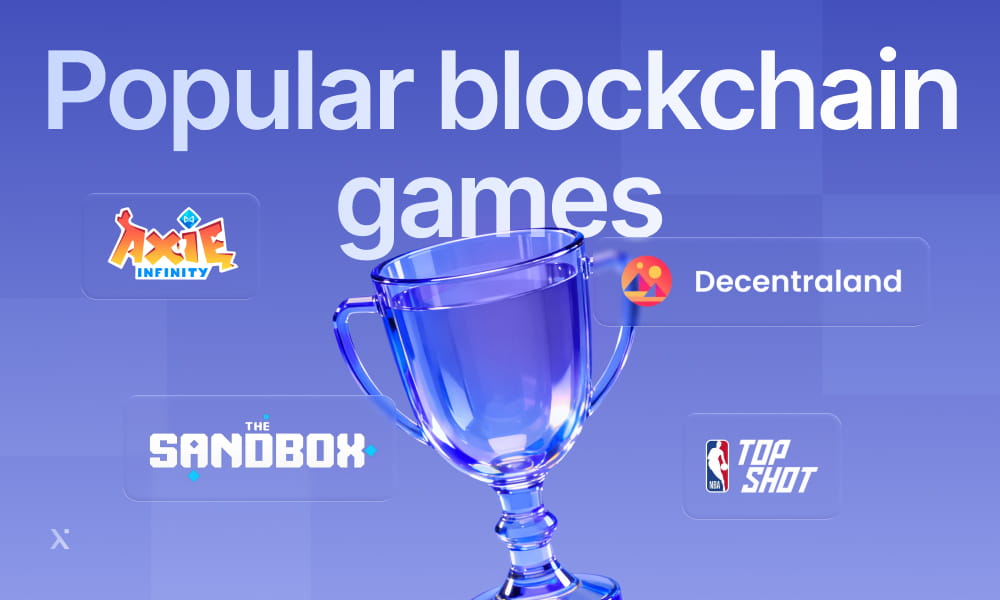
Let’s take a closer look at several well-known games built on top of blockchain technology.
| Game | Launched | Blockchain | Facts |
| Axie Infinity | March 2018 | Initially on Ethereum; now runs on its own sidechain, Ronin |
|
| NBA Top Shot | October 2020 | Flow |
|
| The Sandbox | November 2021 | Ethereum |
|
| Decentraland | February 2020 | Ethereum |
|
Axie Infinity
Axie Infinity is a pioneer in play-to-earn games. Here, players collect, breed, and battle cute creatures called Axies. Each Axie is an NFT, so players become true owners of their in-game pets and items.
The game runs on the Ethereum-based Ronin sidechain, keeping transactions fast and cheap at the same time. By battling, completing quests, and breeding Axies, players can earn two types of tokens — AXS and SLP. AXS is for governance and investment, while SLP is for gameplay and breeding.
NBA Top Shot
NBA Top Shot offers basketball fans to buy, sell, and trade Moments — officially licensed NBA highlight clips presented in the form of NFTs. Each Moment is a unique digital collectible of a real NBA play.
NBA Top Shot became wildly popular in 2021 as collectors and basketball fans rushed to own iconic moments with their favorite athletes. This led to massive trading volume and media attention.
With its mix of sports fandom, digital collecting, and NFT development, it created a new way for fans to engage with basketball and the growing digital collectibles ecosystem.
The Sandbox
The Sandbox is a virtual world where people can unleash their creativity by building and customizing their own spaces, games, and experiences. Whether designing a personal hangout, a virtual art gallery, or an adventure game, players have the tools to bring their imagination to life.
Built on the Ethereum network, it uses SAND as its main currency and NFTs to represent land, items, and avatars.
The project was originally developed by Pixowl and later acquired by Animoca Brands in 2018, which marked its shift toward a decentralized, blockchain-based metaverse.
Decentraland
Similar to The Sandbox, Decentraland is a virtual world built on the Ethereum blockchain, where users can buy, build, and explore digital land and experiences. Every piece of land and item in the game is an NFT. The platform uses two main tokens — MANA for transactions and LAND to represent property ownership.
People love Decentraland because it’s a space where creativity and community come together: users host concerts, build galleries, run virtual businesses, or just simply socialize. As one of the pioneers in metaverse development, it gives anyone the chance to shape their own corner of the digital world and become a part of an open, player-driven economy.
![Metaverse Gaming: How to Build an Interactive Metaverse Ecosystem [PixelPlex Guide]](https://pixelplex.io/wp-content/uploads/2023/09/metaverse-gaming-main-1600.jpg)
Metaverse Gaming: How to Build an Interactive Metaverse Ecosystem [PixelPlex Guide]
Blockchain game development: the process
When opting for blockchain in game development, keep in mind that it adds new layers of technology, design, and user experience to consider. Let’s break down the entire process.
1. Define the concept and game design
This is where you define the game’s genre, story, and core mechanics. At this stage, developers also decide how blockchain features — such as NFTs, tokens, or decentralized ownership — will fit into gameplay and how it will impact the overall player experience.
2. Choose the blockchain platform
Selecting the right blockchain is crucial. The choice depends on factors such as transaction speed, fees, scalability, and developer tools that suit your game’s specific needs.
Partnering with professional blockchain development services can make this process much easier, as experienced teams can help analyze your project requirements and recommend the most suitable blockchain platform for your goals.
3. Develop smart contracts
Smart contracts handle the game’s blockchain logic, such as NFT minting, token rewards, or marketplace transactions. They automate processes and ensure fairness, transparency, and trust between players and developers.
Smart contracts also form the foundation for the P2E blockchain game development model that enables players to earn real value through gameplay and participate in a sustainable in-game economy.
4. Integrate NFTs and tokens
Here is where you will implement the developed tokenomics. You will create and connect NFTs for assets like characters, items, or land and tokens — for currency or governance. Use token standards such as ERC-20, ERC-721, or ERC-1155 depending on your blockchain of choice.
At this stage, specialized services, such as blockchain casino software development, set up secure and fair gaming mechanics while integrating tokens and rewards correctly.
How to Create, Sell, and Buy NFTs: Our Detailed Guide
5 Steps to Develop an Efficient Token Economy for Crypto Games
5. Build the backend and frontend
At this stage, your development team will verify that the blockchain components integrate seamlessly with your game’s traditional systems and interface. They will need to develop APIs, wallets, and dashboards to make blockchain features easy for players to access.
6. Ensure security and conduct audits
All smart contracts and blockchain components must go through thorough security checks and third-party audits. This step should not be skipped under any circumstances.
Audits will identify vulnerabilities, prevent hacks, and protect users’ assets and data. They also safeguard your company from costly breaches, reputational damage, and potential legal issues. Once completed, you can be confident that your game launches on a solid and truly trustworthy foundation.
7. Test and optimize the game
You will need to conduct comprehensive testing to make sure smooth gameplay, reliable blockchain interactions, and a balanced in-game economy. Testing on a testnet first allows you to safely validate everything before launching your game on the main network.
8. Deploy and launch the game
The long-awaited launch of your blockchain game is finally here. Once testing and audits are complete, you can move your game to the mainnet, release tokens, NFTs, and marketplace features, and excite your community with events or airdrops to celebrate the launch.
9. Maintain and update regularly
Launching your blockchain game is just the beginning. Keep an eye on network performance, transaction speed, and security, while adding new content and refining gameplay.
Regular updates help your game stay stable, secure, and fun for players while keeping the blockchain economy running safely and smoothly.
| Step | Key action |
| Concept & design | Define game mechanics, story, and blockchain features |
| Blockchain selection | Choose a blockchain platform with expert guidance |
| Smart contracts development | Set up NFT minting, tokens, marketplace logic, and P2E |
| NFTs & tokens | Connect assets and tokens; add secure, fair mechanics |
| Backend & frontend | Integrate blockchain with game systems, build APIs and wallets |
| Security & audits | Test contracts, prevent hacks, and protect users and your company |
| Test & optimize | Verify gameplay, blockchain interactions, and economy; use testnets |
| Deploy & launch | Launch on mainnet, release tokens/NFTs, and engage the community |
| Maintain & update | Monitor performance and security, keep the blockchain economy stable |
How do you integrate blockchain into an existing game
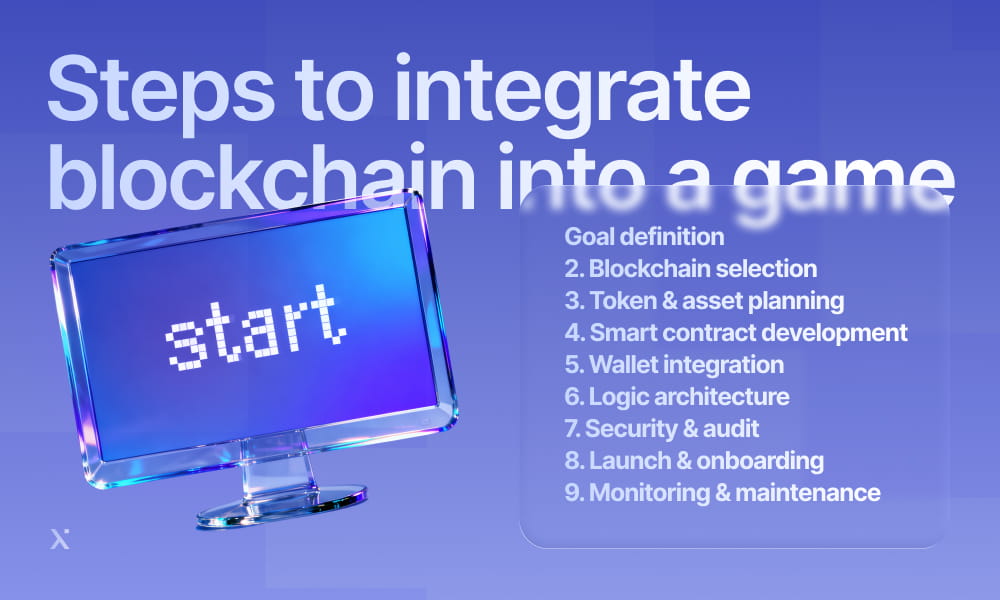
Let’s say you already have a game up and running, and you’ve decided to introduce blockchain into it. What do you need to do and where do you start? Here is how blockchain integration goes.
| Step | What needs to be done | Details |
| 1. Define blockchain goals | Decide why you want blockchain in your game | NFTs for in-game items, tokenized economy, cross-game asset ownership |
| 2. Choose blockchain | Pick a blockchain that fits your game’s needs | Options include Ethereum, Solana, Polygon, Flow. Consider transaction fees, speed, and wallet support |
| 3. Decide token & asset type | Define what exactly will be tokenized | ERC-20 for currencies, ERC-721/1155 — for NFTs. Decide on supply limits and tokenomics |
| 4. Smart contract development | Write smart contracts for tokens, assets, and game mechanics | Include minting, burning, transfers, marketplace logic. Test extensively on testnets. |
| 5. Wallet integration | Integrate crypto wallets into your game | MetaMask, WalletConnect, or platform-specific wallets. Define how users manage their assets |
| 6. On-chain vs off-chain logic | Decide what game logic is on-chain vs off-chain | Expensive or high-frequency actions usually stay off-chain. Only scarce assets or ownership proofs go on-chain |
| 7. Security & audits | Audit smart contracts and integration | Vulnerabilities can lead to asset theft. Consider professional third-party audits |
| 8. Launch & user onboarding | Deploy smart contracts and onboard players | Educate users on wallets, transactions, gas fees, and how assets are owned |
| 9. Monitoring & maintenance | Monitor transactions and smart contract health | Watch for failed transactions, gas spikes, hacks, and upgrade contracts if possible and asap |

How to Integrate Blockchain Into Your Existing Business Infrastructure
Zero-Leakage Vaults: Building High-Stakes Canton Network Wallets
What kind of team do you need to develop a blockchain-based game?
First of all, you need a team with extensive experience in providing blockchain game development services and a proven record of successfully launching this kind of games.
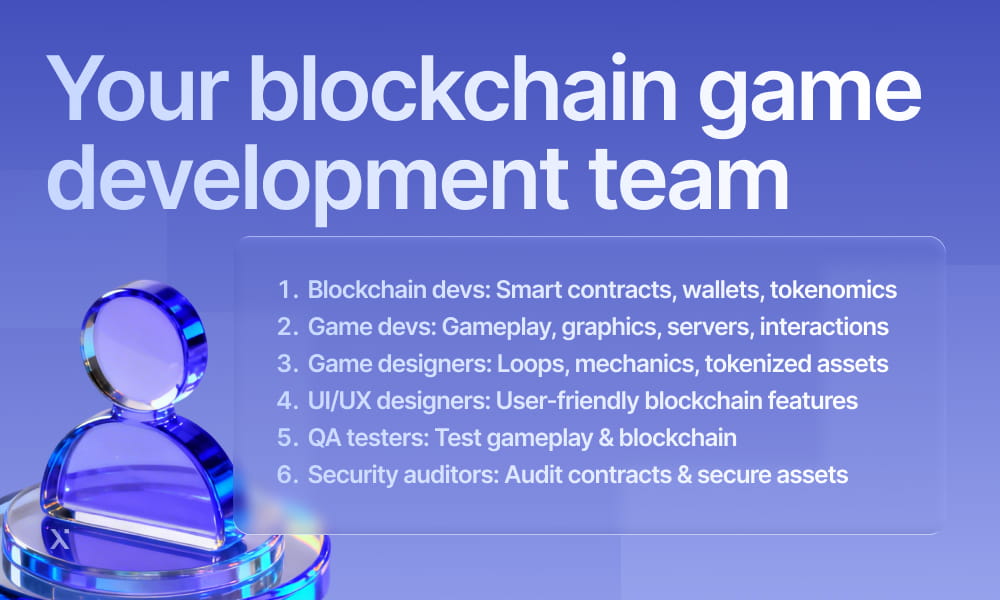
Developing a blockchain game requires a multidisciplinary team with both game and blockchain expertise. Key roles include:
- Blockchain developers: experts in writing and deploying smart contracts under the standards like ERC-20, ERC-721/1155, integrating wallets, designing and handling tokenomics development, and connecting the game to blockchain networks such as Ethereum, Polygon, Solana, etc.
- Game developers: front-end and back-end developers who build gameplay mechanics, graphics rendering, server logic, and provide perfect in-game interactions.
- Game designers: responsible for creating engaging gameplay loops, balancing mechanics, and designing in-game assets for tokenization.
- UI/UX designers: ensure players can easily interact with blockchain features like wallets, marketplaces, and tokenized assets through user-friendly interfaces and intuitive workflows.
- QA testers: they test both game mechanics and blockchain features on testnets to catch bugs and transaction errors.
- Security auditors: perform smart contract audits, penetration testing, and implement security best practices to protect player assets. They are usually hired externally as third-party specialists.
On the blockchain side of the process, these are the professionals and their responsibilities that you will rely on.
| Specialist | Main skills |
| Blockchain developer | Solidity, Rust, Cadence, C++ programming languages; Ethereum, Polygon, Solana, smart contract testing frameworks |
| Blockchain architect or consultant | Blockchain protocols, blockchain platform selection, scalability solutions, architecture design, and consensus mechanisms. |
| Wallet & payment integration specialist | Wallet SDKs, API integration, token standards, user authentication |
| Security specialist | Smart contract auditing, security frameworks, code analysis, blockchain security protocols |
Blockchain game development cost: what to expect
And now, let’s talk numbers: how do you budget for introducing blockchain into game development?
The blockchain game development cost can vary widely depending on several factors. First, the type of game matters a lot. For instance, digital collectible games are usually cheaper because the gameplay mechanics are simpler and most of the work revolves around smart contracts, tokenization, and a marketplace for trading assets. You might expect to spend anywhere from $50,000 to $150,000.
Action games and digital world games, on the other hand, often require high-quality graphics, multiplayer functionality, real-time interactions, and more complex blockchain integration. For these projects, budgets can easily climb into the hundreds of thousands or even over a million dollars.
Other factors include the blockchain platform you choose, the complexity of smart contracts, NFT minting and marketplace integration, and security audits. Even seemingly small choices, like whether transactions are free to the player or require gas fees, can affect development time and overall blockchain in game development budget.
Let’s take a look at each stage of the development process, money-wise.
| Development stage | Estimated costs | Development timeline |
| Concept & design | $5K-$20K | 2-4 weeks |
| Smart contracts | $10K-$50K | 3-6 weeks |
| Game development | $50K-$500K+ | 2-6+ months |
| UI/UX & blockchain integration | $10K-$50K+ | 3-6 weeks |
| Marketplace & NFT features | $5K-$30K | 2-4 weeks |
| QA & launch | $10K-$50K | 2-6 weeks |
To make sense of all these numbers and plan your budget effectively, it’s worth turning to blockchain consulting. From estimating development costs to selecting the right blockchain platform and optimizing tokenomics, the consulting team will help you approach blockchain game development with a clear financial roadmap and reduce the risk of unexpected expenses.

Blockchain Development Cost in 2026: What Goes Into the Price Tag
From Code to Confidence: Inside Smart Contract Audit Pricing
Why PixelPlex is your number one choice for blockchain game development
When it comes to blockchain game development, experience matters — and PixelPlex delivers. With nearly two decades in blockchain and a history of building Web3 games for real players, we create engaging and rewarding on-chain games.
Our blockchain game development company has expertise across multiple blockchain platforms, including Ethereum, Solana, Polygon, Flow, and TON, and have developed our own Layer-2 solution called Echo. This allows us to choose the right technology for each game, develop smart contracts, integrate wallets, and implement P2E mechanics and other vital blockchain features.
Here are the games we have delivered:
| Game/solution | Blockchain involved | Key accomplishments |
| Proleague | Ethereum, Solana | – Defined core platform features, structure, and tokenomics for the esports P2E platform – Provided recommendations for the best tech stack and a blockchain implementation plan |
| PlayPoint | Echo, Ethereum | – Developed a gaming ecosystem where players compete in tournaments with transparent, tamper‑proof payouts and in‑game rewards – Implemented a native in‑game wallet and SDK for developers |
| Duels | Echo | – Developed the entire game logic on the Echo protocol – Integrated a native coin, NFT assets, and mechanisms for players to earn, trade, and own in‑game collectibles |
Conclusion
Although blockchain game development is not an entirely new phenomena, it continues to be highly relevant. Technology evolves and player demand for immersive, rewarding experiences only grows.
It’s not too late to join the blockchain gaming wave, and PixelPlex can be your go-to partner for making it happen. With our blockchain game development services, we turn your ideas into secure, engaging, and scalable games where players enjoy true ownership and real rewards, while you see your game achieve long-term success.
FAQ
Blockchain game developers use secure smart contracts, decentralized storage, and third-party audits to prevent hacks and ensure code reliability. They also implement layer-2 solutions or sidechains to handle high transaction volumes without slowing gameplay.
Developers face technical hurdles like network latency, high gas fees, and complex smart contract coding. Plus, balancing engaging gameplay with blockchain mechanics and regulatory compliance can be quite difficult.
You can monetize through NFTs, in-game tokens, and P2E mechanics that reward players with tradeable digital assets. Developers may also charge transaction fees, premium content, or launch limited-edition collectibles.
High transaction fees can slow down in-game actions and reduce player engagement. Developers often use layer-2 solutions or alternative blockchains to minimize fees and maintain smooth gameplay.
Look for a team with proven experience in smart contract development, NFT integration, and gaming mechanics. Check their portfolio and client reviews, and make sure they have worked with the specific blockchain you plan to use.
Blockchain games are likely to become more mainstream as they combine traditional gaming with NFT economies and metaverse integration. Advances in scalability, cross-chain compatibility, and user-friendly wallets will drive broader adoption.