
The internet has changed. Welcome to 2026, where Web3 is the foundational layer of the new digital economy. And we’ve prepared a list of companies to turn to for expert Web3 support.
Remember the days of dial-up static noises and waiting five minutes for a pixelated image to load? We’ve come a long way. Today, we are standing on the precipice of a new digital era, one about owning the content, not just writing it.
If you are reading this, you are likely looking for a partner to help you explore this new world. You need more than a team that codes well, you need full-perspective vision. Finding the right team to build your decentralized dream is arguably the most critical decision you will make this year. That’s exactly why our blockchain development services team at PixelPlex put together this massive, no-nonsense guide. We’ve been here since the inception of blockchain, we’ve seen the ups and downs of the industry, and we know who the real players are.
We’ll cover everything from the philosophy of Web3 to the details of choosing a partner, and finally, reveal the definitive list of the top full-service Web3 development companies 2026.
What is Web3?
Imagine a world where you don’t have to trust a giant corporation to keep your money safe, your data private, or your game items in your inventory – that is the core promise and advantage of Web3.
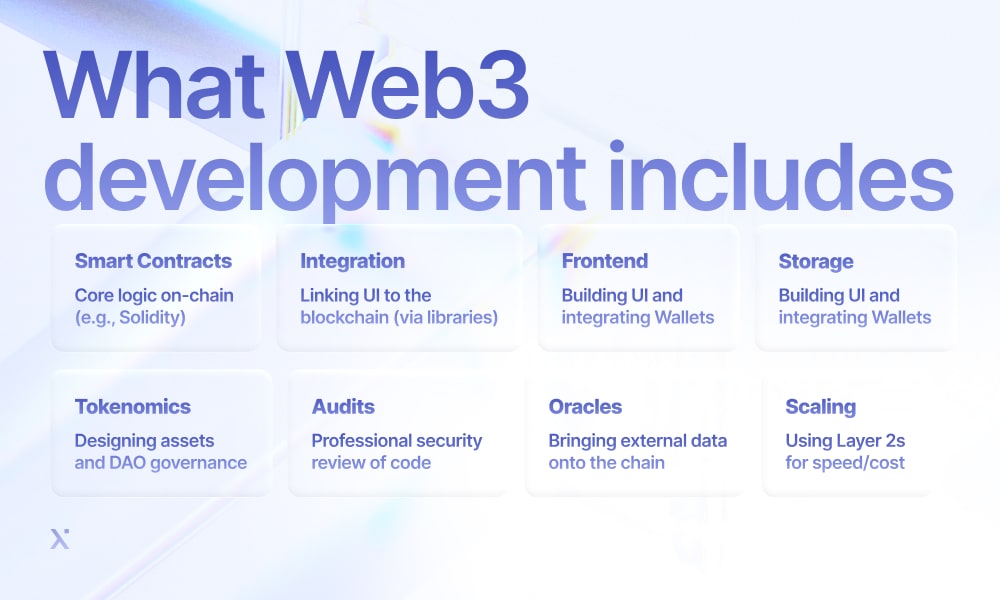
To understand Web3, we have to look at the family tree.
- Web1 (1990s – early 2000s): The “Read-Only” web. Static pages. You could look at information, but you couldn’t really touch it. It was like a digital library.
- Web2 (mid 2000s – present): The “Read-Write” web. Social media, blogs, user-generated content. You could create, but you didn’t own the platform. You were renting space on Zuckerberg’s or Musk’s servers.
- Web3 (present – the future): The “Read-Write-Own” web. Through decentralization, users retain control.
Web3 is an umbrella term for a new iteration of the World Wide Web which incorporates concepts such as decentralization, blockchain technologies, and token-based economics. It is not hosted on a single server farm in arguably the middle of nowhere, it runs on a network of computers owned by no one and everyone simultaneously.
Don’t confuse “decentralized” with “unregulated.” As we moved into 2026, the best Web3 projects are those that find the sweet spot between code-is-law autonomy and real-world compliance.
Why is Web3 exploding in popularity now?
You might be asking, “Why now?” Why is everyone from a local coffee shop owner to major banks talking about Web3 development services?
The answer lies in a symbiosis of technological maturity and social shift.
- Trust issues: People are tired of data breaches. When centralized servers get hacked, millions of passwords leak so Web3 architecture inherently mitigates single points of failure.
- Creator economy: Artists, musicians, and developers want to be paid directly. Smart contracts allow for royalties to be programmed into the asset itself.
- Financial inclusion: Billions of people lack access to traditional banking. DeFi opens global markets to anyone with a smartphone.
Let’s look at the numbers: According to recent market analysis, the global Web3 market size is projected to reach staggering heights, with a Compound Annual Growth Rate (CAGR) of nearly 50% leading up to 2034. By 2026, we are seeing enterprise adoption hit critical mass, moving beyond experimental “sandbox” projects into full-scale production systems.

Inside Cocoon: How Durov is Rebuilding the AI Internet on the TON Blockchain
DeFi Vaults Explained: How to Turn Lazy Crypto Into an Automated Yield Machine

What Is POAP and How to Use It Effectively?
Web3 vs. Blockchain
Are they the same thing? No, not really.
We can describe it like this: Blockchain is the engine, Web3 is the car. You can’t have the car without the engine, but the engine alone isn’t going to drive you to the grocery store.
- Blockchain is the underlying technology – the distributed ledger that records transactions immutably. It is the database layer. If you are looking for blockchain integration services, you are looking to connect this secure ledger to your existing systems.
- Web3 is the ecosystem of applications (dApps), wallets, and interfaces that run on top of that blockchain. It includes the user experience, the frontend, and the community dynamics.
So, when we talk about Web3 development companies, we are talking about teams that understand the full stack of blockchain development, how to build a usable, beautiful application on top of it.
How to choose the right Web3 development company
Picking a vendor in this space is tricky because the market is flooded with overnight experts who learned Solidity from a YouTube tutorial last week.
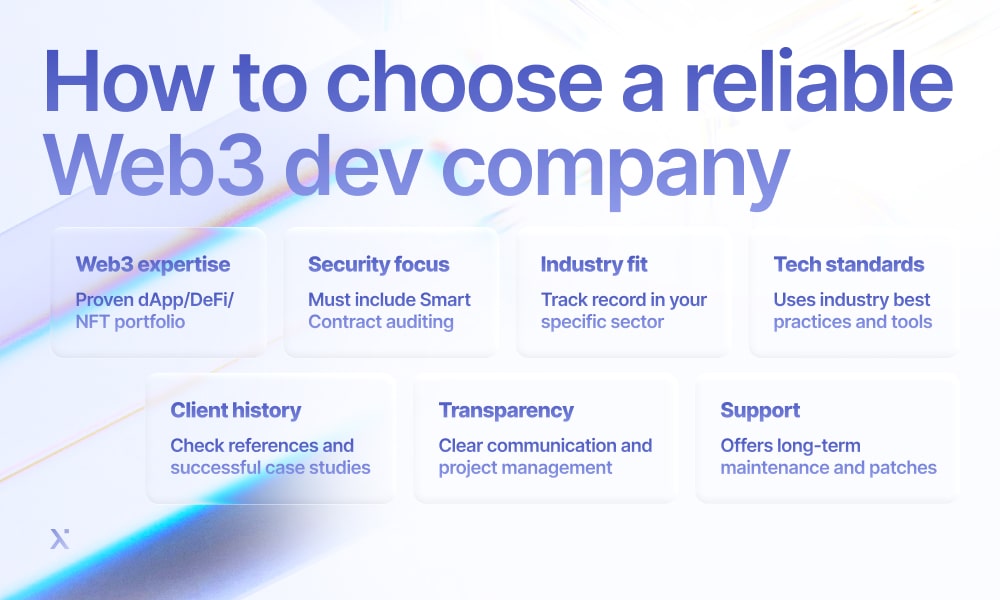
Here is your checklist for vetting potential partners:
Look at the portfolio, not the promises
Talk is cheap. Code is expensive. Does the company have a track record of live, functioning products? Have they built a Web3 wallet development project that actually handles real funds securely?
Security culture is non-negotiable
In Web3, a bug is a bank robbery. If a developer tells you they “move fast and break things,” run away. In this industry, you move deliberately and audit everything. Ask them about their approach to security audit and risk management. Do they use external auditors? Do they have internal red teams?
Niche expertise
Web3 is too big to be good at everything. Some companies specialize in Web3 game development, creating immersive metaverse experiences. Others focus strictly on high-security DeFi protocols. Make sure their strength aligns with your needs.
Post-launch support
Blockchains never sleep. If your dApp goes down at 3 AM on a Sunday, who are you going to call? A true partner offers lifecycle support, not just a code dump.
Check their activity on GitHub. A team that actively contributes to open-source protocols is usually a team that stays on the bleeding edge of technology.

Social Media on Blockchain: Why It’s the Next Big Digital Revolution

DAML Development for Business: A Practical Guide to Building Multi-Party Applications

How Permissioned Blockchains Transform Business: A Detailed Overview
Top Web3 development companies 2026
After rigorous analysis, factoring in technical capability, market presence, client satisfaction, other companies’ ratings, price/quality and innovation, here are the leaders of the pack. We’ve included giants of the market, foundational platforms’ providers and just worthy expert development teams, so you can choose whatever your project specifics and budget require.
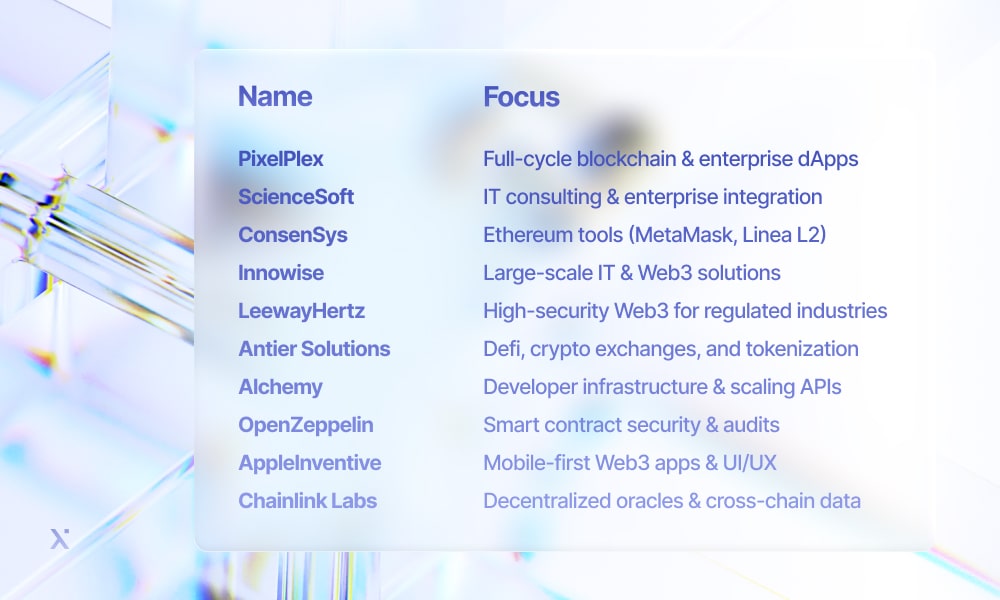
PixelPlex
At the top of our list is PixelPlex. Yes, this is our list, but the data backs it up. With nearly 20 years of experience and a client roster that includes unicorns and Fortune 500s, PixelPlex has mastered the art of turning complex blockchain concepts into seamless user experiences.
What sets PixelPlex apart is the “consultative engineering” approach. We not only perform the requested project development, we challenge assumptions to build better products. Whether you need complex blockchain consulting to map out your tokenomics or a robust DeFi development strategy, our team handles the heavy lifting.
We specialize in everything from building custom L1 blockchains to intricate smart contract ecosystems. Our developers are polyglots, fluent in programming languages, latest AI and blockchain tech, ensuring we pick the right tool for the job.
| Feature | Details |
| Price range | $50 – $150 / hr (entry project ~$25k) |
| Projects done | 600+ |
| Specialization | Enterprise blockchain, DeFi, custom dApps, AI, metaverse integration |
ScienceSoft
ScienceSoft is a giant in the software world. While they are broader than just crypto, their entry into the Web3 development companies space has been impactful. They bring a level of corporate rigor and process maturity that is often missing in younger “crypto-native” agencies.
They are particularly strong when you need to integrate Web3 components into massive legacy enterprise systems. If you are a healthcare giant trying to figure out patient data on-chain, these are the people to call.
| Feature | Details |
| Price range | $30k – $1M+ (high-end enterprise) |
| Projects done | 3,000+ |
| Specialization | Healthcare, banking, supply chain Web3 integrations |
ConsenSys
You can’t talk about top Web3 development companies without bowing to ConsenSys. They are the team behind MetaMask, Infura, and Truffle – tools that literally built the Ethereum ecosystem.
Working with ConsenSys is less about hiring a dev team and more about partnering with the infrastructure builders of the internet. They focus heavily on institutional finance and massive infrastructure plays – expensive, but very high quality.
| Feature | Details |
| Price range | $50k – $1M+ (high-end enterprise) |
| Projects done | 1000+ |
| Specialization | Ethereum infrastructure, institutional DeFi, wallets |

Canton Network Reward System: How Canton Coin Pays Developers to Build Real Value

The Agent Payments Protocol (AP2): A New Standard for Autonomous Commerce
Innowise
Based in Europe, Innowise has gained a reputation for scaling teams rapidly. If you needed 50 developers yesterday, Innowise has the bench depth to make it happen. They cover a wide array of services, including Web3 app development for startups that need to move fast.
| Feature | Details |
| Price range | $50 – $100 / hr |
| Projects done | 600+ |
| Specialization | Staff augmentation, full-cycle Web3 development |
LeewayHertz
LeewayHertz has carved out a cool niche at the intersection of AI and blockchain. As we move through 2026, these two technologies are merging, and LeewayHertz is ahead of the curve. They are a fantastic choice for metaverse development where AI-driven NPCs meet blockchain-backed assets.
| Feature | Details |
| Price range | $50 – $150 / hr |
| Projects done | 120+ |
| Specialization | AI/Web3 hybrid, metaverse, gaming |
Antier Solutions
Antier is known for speed. They have a massive library of white-label solutions. If you need a Web3 marketplace development platform and you need it live in 6 weeks, Antier is a strong contender. They specialize in exchange and wallet solutions that can be deployed rapidly.
| Feature | Details |
| Price range | $25 – $49 / hr |
| Projects done | 500+ |
| Specialization | White-label exchanges, wallets, token launchpads |

Web3 Development Cost: Breaking Down What Really Drives the Price
Code, Capital, and Compliance: A Deep Dive into Canton Network Smart Contract Development
Alchemy
Alchemy is technically a platform, but their developer services arm is critical. They power the infrastructure for the biggest NFT marketplaces and dApps in the world. While they might not build your custom UI, their stack is likely what your Web3 website development will rely on.
| Feature | Details |
| Price range | Free tier to enterprise custom |
| Projects done | Powers millions of apps |
| Specialization | Node infrastructure, NFT APIs, account abstraction |
OpenZeppelin
OpenZeppelin is the gold standard for security. They wrote the libraries that 99% of smart contracts are based on (ERC-20, ERC-721). While they are famous for audits, they also do high-level development consulting. If security is your #1, #2, and #3 priority, you go here.
| Feature | Details |
| Price range | $10k+ for simple audits |
| Projects done | 1000+ |
| Specialization | Security audits, smart contract standards |
AppInventiv
In the mobile-first world of 2026, AppInventiv shines. They are experts at taking complex Web3 logic and wrapping it in a buttery smooth mobile interface. They are a go-to for consumer-facing apps where UX is paramount, often handling private blockchain development for startups looking to disrupt the market.
| Feature | Details |
| Price range | $30 – $70 / hr |
| Projects done | 1,000+ |
| Specialization | Mobile dApps, consumer wallets, lifestyle apps |
Chainlink Labs
Chainlink connects the real world to the blockchain. If your project relies on real-world data – like stock prices, weather data, or sports scores – you need Chainlink. They are the leaders in Oracle networks, making them essential for complex business intelligence solutions on-chain.
| Feature | Details |
| Price range | $20k+ entry |
| Projects done | Thousands of integrations |
| Specialization | Oracles, CCIP (Cross-Chain), real-world assets |
SoluLab
SoluLab has made a massive name for itself by providing enterprise-class blockchain solutions at a speed that start-ups admire. They have worked with some impressive names (including Fortune 500 entities) and have a massive talent pool. They are excellent if you have a clear idea and need a large team to execute it fast and smoothly.
| Feature | Details |
| Price range | $25 – $49 / hr |
| Projects gone | 1,500+ |
| Specialization | Enterprise blockchain, staff augmentation, mobile solutions |
Blockchain App Factory
If speed is your absolute number one priority, Blockchain App Factory is a strong contender. They have built a reputation on having a massive library of pre-built, white-label solutions. Need an NFT marketplace development platform similar to OpenSea, but you need it launched next month? They likely have a script ready to customize.
| Feature | Details |
| Price range | $50 – $150 / hr |
| Projects done | 600+ |
| Specialization | White-label exchanges, NFT marketplaces, marketing services |

Are Corporate Crypto Stashes The Future? A No-Nonsense Guide to DATs

Protecting Ideas: How Blockchain Is Becoming the Guardian for Your Creations
Webisoft
Webisoft is a slightly newer entrant compared to the giants, but they pack a punch. They are known for being incredibly agile and “crypto-native.” They understand the culture of Web3 deeply. If you are building a project that relies heavily on community engagement and needs a slick, modern feel, Webisoft is a great choice. They are excellent at dApp development that converts into ROI.
| Feature | Details |
| Price range | $50 – $99 / hr |
| Projects done | 400+ |
| Specialization | DeFi, Rust/Solana development, startup MVPs |
Building your MVP – start small, think big
One common mistake we see clients make is trying to build “Google on Blockchain” as their first release. Don’t do that.
The smartest path is MVP development (Minimum Viable Product). You want to test your core hypothesis with the least amount of code possible. In Web3, this usually means a simple set of smart contracts and a basic frontend.
The hidden costs of Web3 development
Clients often come to us with a budget for development but forget the ecosystem costs.
- Audits: You cannot skip this. A good audit from a firm like OpenZeppelin or a boutique firm can cost anywhere from $10k to $100k depending on code complexity.
- Gas optimization: Bad code is expensive to run. Investing more in a senior developer who knows Assembly (Yul) can save your users thousands of dollars in fees later.
- Liquidity: If you are launching a token, you need to provide liquidity. This is capital, not code, but it’s a massive line item.
Some of the biggest DeFi protocols started with less than 500 lines of code. Uniswap v1 was incredibly simple. Complexity is the enemy of security.
What’s the future of Web3? Trends 2026-2030
If 2021 was the “Casino Era” of Web3 (speculation, monkey JPEGs), then 2026 marks the beginning of the “Utility Era.” But what comes next? We consulted with industry experts and analyzed market data to forecast the landscape leading up to 2030. Here is what you need to prepare for.
The “invisible” blockchain
By 2028, we predict that 80% of Web3 users won’t even know they are using Web3. Currently, using a dApp requires a certain level of technical masochism – managing seed phrases, bridging tokens, and understanding gas fees.
The trend: The technology will fade into the background. Passkeys (biometrics) will replace private keys. “Gas stations” (paymasters) will allow apps to pay transaction fees for their users. It will just look like a regular app, but with the superpower of true ownership underneath.
The agentic economy (AI + crypto)
This is the most explosive trend for the 2026-2030 cycle. We are moving from “humans using tools” to “agents using agents.”
- The concept: Imagine an AI personal assistant that doesn’t just find you a flight, but books it and pays for it using a digital wallet.
- The tech: Traditional banks won’t let a robot open a checking account. But a blockchain doesn’t care if you are a human or a script. We will see billions of micro-transactions happening between AI agents without human intervention, just with white-label crypto exchange software development solutions.
RWA: the $16 trillion opportunity
Boston Consulting Group (BCG) estimates that the tokenization of global illiquid assets could reach $16 trillion by 2030.
- What it means: We aren’t just talking about digital art. We are talking about tokenizing commercial real estate, US Treasury bonds, carbon credits, and even intellectual property.
- The impact: RWA platforms unlock liquidity for assets that were previously frozen. You could own $50 worth of a Manhattan skyscraper or trade a fraction of a solar farm in the Sahara.
DePIN (Decentralized Physical Infrastructure Networks)
This is the “blue collar” side of Web3. DePIN projects use tokens to incentivize people to build real physical infrastructure.
- Example: Instead of a telecom company spending billions to build cell towers, a DePIN project pays individuals to put small 5G hotspots in their windows.
- Forecast: By 2030, we expect DePIN networks to seriously challenge centralized providers in areas like WiFi, data storage, and EV charging stations. The edge computing market alone, driven by DePIN, is expected to surge to over $100 billion.
Post-quantum preparedness
While it sounds like science fiction, the threat of quantum computers cracking current encryption is real. By 2030, top Web3 development companies will be mandated to transition to “Quantum-Resistant” cryptographic standards. Smart contracts written today need to be upgradeable to survive the 2030s.
Web3 Development Cost: Breaking Down What Really Drives the Price

Web3 Development: What It Takes to Build the Future
Conclusion
The landscape of top full-service Web3 development companies 2026 is diverse and exciting. Whether you are looking for the security focus of OpenZeppelin, the infrastructure might of ConsenSys, or the comprehensive, client-focused innovation of PixelPlex, there is a partner out there for you.
We believe that the future of the internet is decentralized, and we are building it one block at a time. If you are ready to stop watching from the sidelines and start building, our team is ready to chat.
Choosing among Web3 development companies means engaging in a strategic alliance. Choose wisely, audit often, and WAGMI (We All Are Gonna Make It).
Or just contact us – we’ll be happy to assist with your any endeavor.
FAQ
Honest answer? It depends. A simple MVP with basic smart contracts usually starts around $25,000 – $40,000. If you need a fully custom ecosystem with a complex token economy, an audited DeFi protocol, and a cross-platform mobile app, you are looking at $150,000+. Remember, cheap code is expensive later (because hacks happen).
No. In fact, for many business models in 2026, launching a token is a distraction. If you are building a loyalty program or a supply chain tool, you might not need a volatile asset attached to it. We often recommend starting without a token and introducing one later only if it adds real utility (governance, staking, etc.).
For a standard dApp, plan for 3 to 5 months.
- Month 1: discovery & architecture (the blueprint).
- Month 2-3: development (the building).
- Month 4: audits & testing (the safety check).
- Month 5: mainnet launch.
Technically, yes, but it’s tricky. Blockchains are immutable (unchangeable) by design. However, we use “Proxy Patterns” – essentially a pointer contract that directs users to the latest version of your logic. It’s like changing the engine of a car while it’s driving. It requires skilled architects to do this safely without creating security loopholes.
Think of it like this:
- Coin: Has its own house (Blockchain). Bitcoin (BTC) and Ethereum (ETH) are coins because they run on their own networks.
- Token: Lives in someone else’s house. USDT or Uniswap (UNI) are tokens because they live on top of Ethereum. Most businesses build tokens first because it’s faster and cheaper than building a whole new blockchain.
Gas is the transaction fee you pay to the network miners/validators to process your request. In 2026, good UX means you (the app owner) should probably pay these for your users. This is called “Gas Sponsorship” or “Paymaster” integration. It stops your users from getting confused by weird fees.
Yes, if built correctly. In 2026, we have “Permissioned Pools” and “Zero-Knowledge” tech that allows businesses to use public blockchains without revealing trade secrets. Major banks and logistics firms are already doing this. The risk usually is human error in the smart contract code – which is why you hire top-tier pros (like us!).