Where there’s a pursuit of decentralization, there are Web3 wallets. Why do people want that specifically? They’re tired of central authorities always having control over their data, assets, and online identities. Web3 wallets offer a way to take that control back.
The market for decentralized applications (dApps) is booming as more and more people seek stronger data security, better transparency, and greater autonomy. The rise of Web3 and metaverse projects is also accelerating their adoption.
It’s quite clear that, like any other new technology, decentralized applications come with their own challenges such as complex implementation and regulatory uncertainty. Despite this, the future still looks rather bright: the market is expected to surpass $100 billion by 2033, growing at an impressive 68.2% CAGR from 2020 to 2034.
In this context, Web3 wallets are a vital piece of the puzzle. As a leading provider of Web3 wallet development services, PixelPlex knows all the ins and outs of this space, which is why we created this article to guide you through everything you need to know.
What is a Web3 wallet?
A Web3 wallet is a digital tool that allows users to securely store and manage crypto and different kinds of tokens. Web3 wallets connect directly to blockchain networks, so you can send, receive, and manage your digital assets without relying on any intermediaries.
The wallet keeps everything safe using private keys and seed phrases. This means that only the user has access to it and can enjoy true ownership of their assets, smooth interaction with dApps, and greater privacy and control over their digital identity.
There are two types of Web3 wallets — software and hardware. Software wallets, also known as hot wallets, are digital apps that store your crypto keys online or on your device. They provide easy access through browsers, mobile apps, or desktop clients, so they are very convenient when it comes to frequent transactions. MetaMask, Trust Wallet, and Coinbase Wallet are among the most popular ones.
Meanwhile, hardware wallets, or cold wallets, are physical devices that store your private keys offline. They offer stronger protection against hacking and malware. They are perfect for long-term investors who prioritize security over convenience. Some examples include Ledger Nano X and Trezor Safe 5.
Web2 vs Web3 wallets: what’s the difference?
First of all, what are Web2 wallets? Those are the wallets tied to traditional platforms or services, like PayPal, Venmo, or your local banking app. Users store, send, and receive money or digital assets there, but the platform controls the account, stores the data, and manages security. In other words, the service acts as the intermediary.
Web3 wallets, on the other hand, are designed specifically for interacting with various blockchain networks. They allow users to sign transactions, participate in DeFi blockchain protocols, trade NFTs, and connect directly to dApps without any central authority. Examples include MetaMask, Coinbase Wallet, and Trust Wallet.
| Aspect | Web2 wallets | Web3 wallets |
| Ownership | Custodial: platform owns the account and can freeze or limit access | Non-custodial: Users own private keys and entirely control their funds |
| Access | Limited to platform services, like PayPal or banks | Directly connects to blockchain networks and dApps |
| Security | Platform manages passwords and security. You must contact the provider for access issues | Users manage their own private keys and seed phrases. No third-party intervention is possible or available |
| Privacy | Platform collects and may share personal data | User controls data and identity, transactions are pseudonymous |
| Functionality | Transactions visible only to the platform | Transactions recorded on blockchain, fully transparent |
| Examples | PayPal, Venmo | MetaMask, Coinbase Wallet, Trust Wallet |
It’s important to point out that with Web3 wallet development, users are fully responsible for their private keys and seed phrases. If these are lost, access to funds is gone forever, and there’s no way for any third party to recover them — because, simply put, there is no third party at all.
That’s why it’s essential to store your keys and seed phrases carefully, as even a small mistake can lead to irreversible loss.
Benefits of Web3 wallets
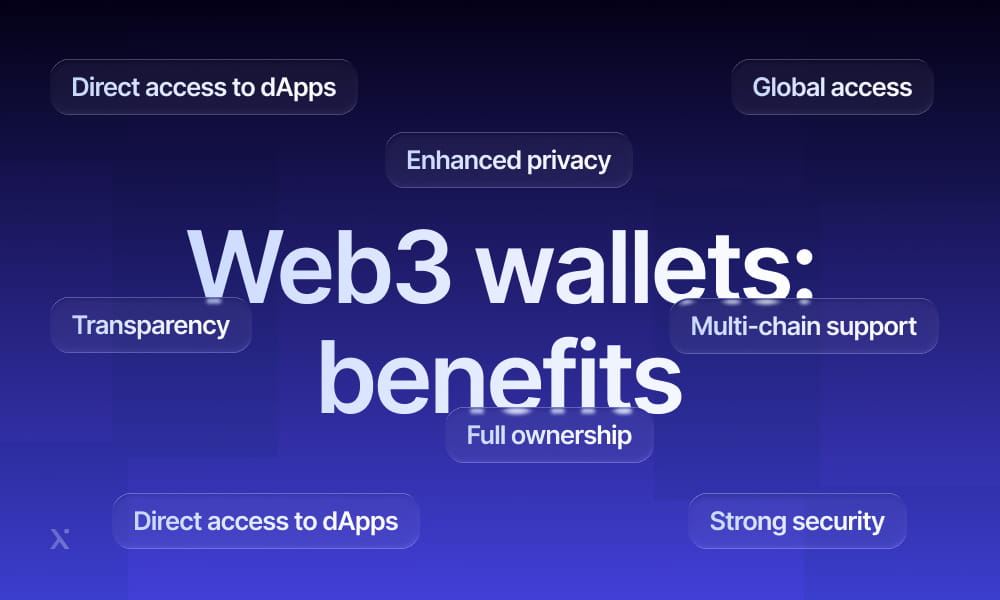
Web3 wallets do more than just storing crypto. Their benefits include:
- Full ownership: Only you control your private keys and funds.
- Direct access to dApps: You can connect to DeFi platforms, NFT marketplaces, and more all by yourself, without intermediaries.
- Enhanced privacy: You get to keep your data under your control and enjoy pseudonymous transactions.
- Transparency: All transactions are recorded on the blockchain for full visibility.
- Global access: You can use your wallet anywhere, anytime, without relying on banks.
- Strong security: You come up with passwords and seed phrases that later protect your assets.
- Multi-chain support: You will be able to manage multiple tokens of different types and blockchains in one wallet.
Successfully delivered Web3 wallet solutions
For some, it may sound like something completely new, but in fact, Web3 wallets have been around for over a decade. MetaMask, for instance, was launched in 2016 as a browser extension for Ethereum-based dApps and is widely recognized as a pioneer in the Web3 ecosystem.
Let’s dive into this popular wallet and explore several others that have also made their mark in this area.
MetaMask
MetaMask is one of the most widely used software Web3 wallets. It lets you store, send, and receive Ether and ERC-20 tokens. You can also easily connect it to various decentralized applications.
Over time, MetaMask added a mobile app, multi-chain support, and in-app token swaps. These features make it a key player in the Web3 world. Its usability and security has positioned it as a go-to wallet for both beginners and experienced crypto users. The numbers back this up — over 100 million people have downloaded MetaMask to buy, sell, and swap digital assets.

What You Should Know About the True Cost of Building a Crypto Wallet Like MetaMask
Trust Wallet
Launched in 2017 and acquired by Binance in 2018, Trust Wallet is a mobile-first wallet that supports a wide range of cryptocurrencies across multiple blockchains, including Ethereum, Binance Smart Chain, and Polygon.
This Web3 wallet emphasizes simplicity and security: it allows users to store private keys locally on their devices. Trust Wallet also features a built-in dApp browser, staking capabilities, and NFT management.
It supports over 10 million crypto assets across more than 100 blockchains and, as of February 2026, has over 200 million users.
Phantom
Phantom was launched in 2021. This Web3 wallet is tailored for the Solana blockchain, so it offers fast and low-cost transactions for Solana-based tokens and NFTs.
Available as both a browser extension and mobile app, Phantom focuses on user experience with a clean interface and integrated dApp support. Features like token swaps, staking, and NFT management have made it the leading wallet for Solana users. The wallet has seen strong adoption, with more than 22 million active users as of early 2026.
Coinbase Wallet
Coinbase Wallet was released in 2019 as a self-custody wallet developed by the team behind the Coinbase exchange. Unlike a custodial wallet tied to an exchange account, it gives users full control of their private keys.
The wallet supports multiple blockchains, cryptocurrencies, and NFTs, and includes a built-in dApp browser for interacting with DeFi platforms. As of 2025, the Coinbase platform has 120 million users, with 8.7 million active users making at least one transaction per month.
In July 2025, Coinbase revealed the Base App, set to replace Coinbase Wallet. The new platform will integrate wallet, trading, and payment features with social media, messaging, and mini app support. It will be operating on Coinbase’s own public blockchain, Base, which is built on top of Ethereum.
| Feature | MetaMask | Trust Wallet | Phantom | Coinbase Wallet |
| Primary blockchain support | Ethereum, EVM-compatible chains (Polygon, BSC, Avalanche, etc.) | Ethereum, BSC, Tron, and many others (multi-chain) | Solana, Ethereum (limited) | Ethereum, EVM chains, Bitcoin, Litecoin, Dogecoin, and more |
| NFT support | Yes | Yes | Yes (mainly Solana-based NFTs) | Yes |
| Staking opportunities | Directly through its app and web portfolio, primarily for Ethereum | 25+ in-wallet staking options, including ETH, SOL, TRON, DOT, and others | Native and liquid staking of SOL directly in-app; liquid staking of ETH via third-party services | Staking for ETH, SOL, ADA, ATOM, DOT, and many other coins |
| Swap/Exchange feature | Built-in token swap that works on Ethereum Mainnet, BNB Smart Chain, Polygon, Optimism, and more | On-chain and cross-chain swaps for thousands of assets across Ethereum, BNB Chain, Solana, and more. | In-app swap of ETH, MATIC, and SOL | Token swaps on Ethereum, Base, OPMainnet, Polygon, BNB Chain, Arbitrum, and Avalanche C-Chain. |
| Multi-chain support | Strong (Ethereum + EVM chains) | Very strong (many chains) | Limited (Solana primary) | Moderate (EVM chains + major crypto) |
Here is a breakdown of what these characteristics mean for end users and how each wallet performs in terms of usability:
- MetaMask
- Strengths: Widely supported in DeFi, strong ecosystem integration
- Target users: Ethereum users, DeFi enthusiasts
- Trust Wallet
- Strengths: Broad compatibility, simple interface
- Target users: Multi-chain users, beginners, DeFi users
- Phantom
- Strengths: Smooth NFT management, user-friendly experience
- Target users: Solana users, NFT collectors
- Coinbase Wallet
- Strengths: Easy link to Coinbase exchange, simple onboarding
- Target users: Beginners, Coinbase ecosystem users
What team and resources do you need to develop your own Web3 wallet?
Web3 wallet development is not just about writing code. It’s about creating a secure, user-friendly bridge between the traditional web and the decentralized world. To make your wallet competitive, you’ll need a team specializing in blockchain development services, cybersecurity, product design, and compliance.
1. Core blockchain development team
At the heart of any Web3 wallet development project is a strong technical team. You’ll need blockchain developers familiar with Ethereum, Solana, or other chains, as well as frontend and backend engineers who can ensure seamless interaction between users and smart contracts.
Smart contract audits and secure transaction signing mechanisms are also essential to prevent exploits. Don’t ever skip this stage of the development process.
Smart contracts are immutable once deployed, so any overlooked vulnerability can lead to irreversible losses and reputational damage. Always verify, test, and audit before going live.
2. Security and compliance specialists
Since Web3 wallets handle sensitive private keys and user funds, security experts must be involved from day one. They’ll implement encryption, key-management systems, and penetration testing. If you plan to operate in regulated markets, legal advisors and compliance officers should also be there to navigate KYC/AML requirements and regional regulations.
Ethereum Smart Contracts: The Hard Parts Made Clear

From Code to Confidence: Inside Smart Contract Audit Pricing
3. Product and wallet design
Even if you have come up with the best functionality, it won’t guarantee you success without great usability. That’s why you need experienced UI/UX designers and product managers who will work to deliver an intuitive interface, easy onboarding, and clear transaction flows.
4. Marketing and community
It’s no secret that great products need more than just solid tech — they need people who believe in them. That’s where marketing and community teams come in. They help share your story, grow awareness, and build a community of loyal users who truly care about your brand.
In the Web3 space, genuine word-of-mouth and trust within online communities can be some of your most powerful growth drivers.
5. Operations and support
Finally, you will need an operations and support team to keep things running smoothly and make sure users always get quick, reliable help when they need it. They’re also the ones who listen to feedback and bring those insights back to the team. This will help make the product better and safer with every update.
To be even more specific, these are the key roles and required skills for implementing your future Web3 wallet development solution.
| Role | Key skills and experience |
| Product manager | Market analysis, project management, communication, blockchain awareness |
| Blockchain developer | Blockchain frameworks, smart contracts, cryptography, interoperability |
| Frontend developer | Web/mobile development, responsive design, wallet integration |
| Security specialist | Risk management, encryption standards, auditing |
| Compliance officer | KYC/AML knowledge, crypto compliance, legal coordination |
| UI/UX designer | User research, prototyping, brand consistency |
| Marketing lead | Branding, digital campaigns, community engagement |
| Community manager | Social media management, content creation, public relations |
| Operations & support lead | CRM systems, issue resolution, feedback management |
Web3 wallet development: the process
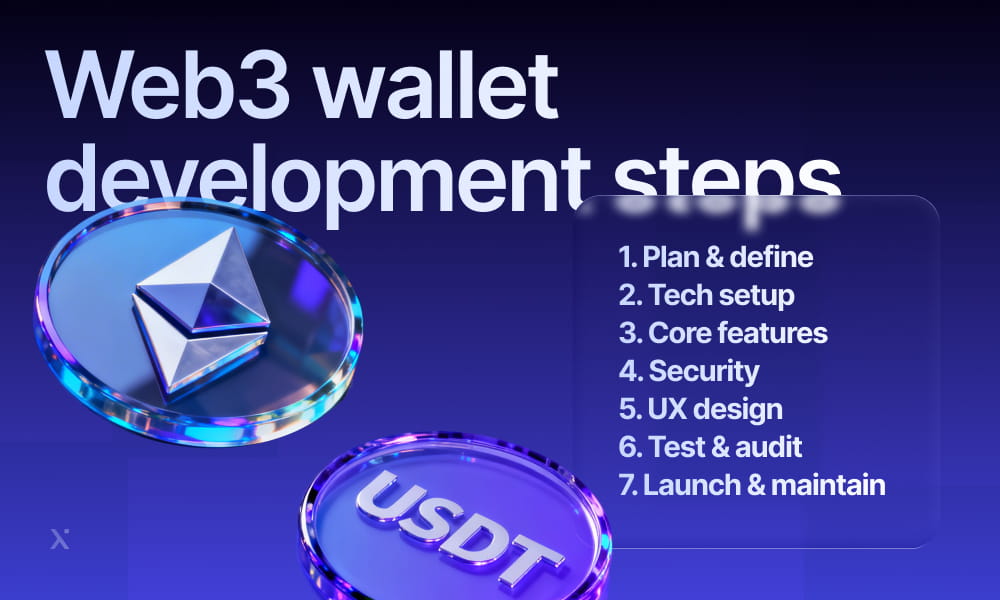
The Web3 crypto wallet development journey requires careful planning, the right technology stack, robust core functions, and strong security measures. Below is our step-by-step guide to help you navigate the entire process more easily:
Step 1. Define wallet type, purpose, and blockchain networks
Before developing a Web3 wallet, clarify its main purpose and the type of control over private keys:
- Custodial vs non-custodial: Decide if the wallet will manage users’ private keys (custodial) or allow users to fully control them (non-custodial). Here, you will also need to determine whether the wallet focuses on general crypto storage, NFTs, DeFi interactions, or multi-chain support.
- Blockchain networks: Identify which blockchains your wallet will support. For example, Ethereum, Binance Smart Chain, Solana, or others. This choice affects the tech stack, libraries, and smart contract compatibility.
Custodial vs. Non-Custodial Wallet: Everything You Need To Know

Blockchain Development Cost in 2026: What Goes Into the Price Tag
Step 2. Choose the technology stack
At this step, your tech team will select tools and frameworks that align with your wallet’s features and target platforms:
- Frontend: React.js, Vue.js, or React Native for web and mobile apps.
- Backend: Node.js, Go, or Python for server-side operations.
- Blockchain integration: Libraries like Web3.js, Ethers.js, or Solana Web3.js for connecting to different chains.
- Database: PostgreSQL or MongoDB for storing non-sensitive data such as transaction history or user preferences.
- Smart contract coding: Solidity for Ethereum/EVM chains, Rust for Solana or NEAR, depending on supported networks.
Step 3. Implement main Web3 wallet functions
The core functions are what make a Web3 wallet truly useful. First, the wallet should allow users to easily create accounts by generating private keys, public keys, and wallet addresses. It also needs to handle transactions smoothly.
A clear and real-time display of token balances, NFTs, and transaction history is essential, so users always know where they stand.
Finally, supporting multiple blockchain networks ensures that users can interact with different ecosystems without any hassle.
How to Select The Best Blockchain Platform for Your Project
Step 4. Integrate security features
Security is the backbone of any Web3 wallet as well as your safety net: it keeps users’ assets safe and helps your company avoid trouble or losses. Key measures include:
- Private key encryption: Use strong standards like AES-256.
- Secure storage: Store keys in device keystore, Secure Enclave, or hardware wallets.
- Authentication: Implement biometrics, PINs, or two-factor authentication (2FA).
- Transaction signing: Make sure that all transactions are signed locally. Private keys should never leave the device.
- Backup and recovery: Provide secure seed phrases and recovery options to restore wallets if devices are lost.
Step 5. Enhance user experience
Every company that develops a Web3 wallet should take this step seriously because a wallet that’s easy and enjoyable to use keeps people coming back and builds trust in the product.
A well-designed interface is key to this — simple navigation, responsive layouts, and clear workflows make it easy for users to find what they need. Real-time notifications for transactions keep users informed and confident that their assets are secure.
You can also enhance the experience by offering optional features like portfolio tracking, price updates, and analytics. This would give users a clear overview of their holdings without feeling overwhelmed.
Step 6. Testing and auditing
Testing and auditing your entire Web3 wallet solution will reduce risks and guarantee its reliability:
- Unit and integration tests: Verify all wallet functions across supported blockchains.
- Security audits: Conduct smart contract audits and vulnerability assessments.
- Beta testing: Collect feedback to improve UX and identify bugs before full release.
Step 7. Deployment and maintenance
Once Web3 wallet development is done, it’s time to launch the wallet and keep it running smoothly. Start by making the app available on the iOS App Store and Google Play so that users can easily download it.
After launch, keep an eye on things by monitoring network changes, bug reports, and user feedback. Regular updates to libraries, APIs, and smart contracts are also important to maintain security, performance, and compatibility with new blockchain networks. Ongoing maintenance like this helps ensure the wallet stays secure, works well, and keeps users happy (as well as you as a developer).
| Step | What to do | Main points |
| 1. Plan | Define wallet type, purpose, and blockchains | Custodial vs non-custodial; crypto, NFTs, DeFi; Ethereum, Solana, BSC, etc. |
| 2. Tech setup | Choose frontend, backend, blockchain tools, database, and smart contracts | Frontend: React/Vue/React Native; Backend: Node.js/Go/Python; Libraries: Web3.js, Ethers.js; Database: PostgreSQL/MongoDB; Smart contracts: Solidity/Rust |
| 3. Core features | Build main Web3 wallet functions | Account creation, transactions, balance & assets, multi-chain support |
| 4. Security | Protect users and your company | Key encryption, secure storage, authentication via PIN/biometrics/2FA, local signing, backup & ecovery |
| 5. UX | Make the wallet easy and fun to use | Simple navigation, responsive layouts, notifications, optional portfolio tracking |
| 6. Test | Check reliability and safety | Unit & integration tests, security audits, beta testing |
| 7. Launch & Maintenance | Deploy and keep the wallet running smoothly | App Store & Google Play, monitor feedback, update libraries, APIs, smart contracts |
Web3 wallet development cost: what to expect?
Now let’s take a look at the financial side of building a Web3 wallet. How much it will cost you depends on things like the type of wallet, which blockchain networks it supports, the security measures you include, and how complex the features are.
To give you a clearer picture, here’s a breakdown of the typical costs at each stage of Web3 wallet development:
| Stage | Estimated cost | Timeline |
| Planning & research | $2K-$5K | 1-2 weeks |
| Technology setup | $5K-$15K | 2-4 weeks |
| Core features development | $10K-$30K+ | 4-10 weeks |
| Security implementation | $5K-$15K+ | 2-4 weeks |
| UX/UI | $3K-$10K | 2-4 weeks |
| Testing & auditing | $5K-$15K | 3-5 weeks |
| Launch & maintenance | $2K-$8K+ (initial) and ongoing monthly costs $500-$2K | 1-2 weeks for launch, ongoing maintenance |
MVP vs enterprise-grade Web3 wallets: how costly will they be?
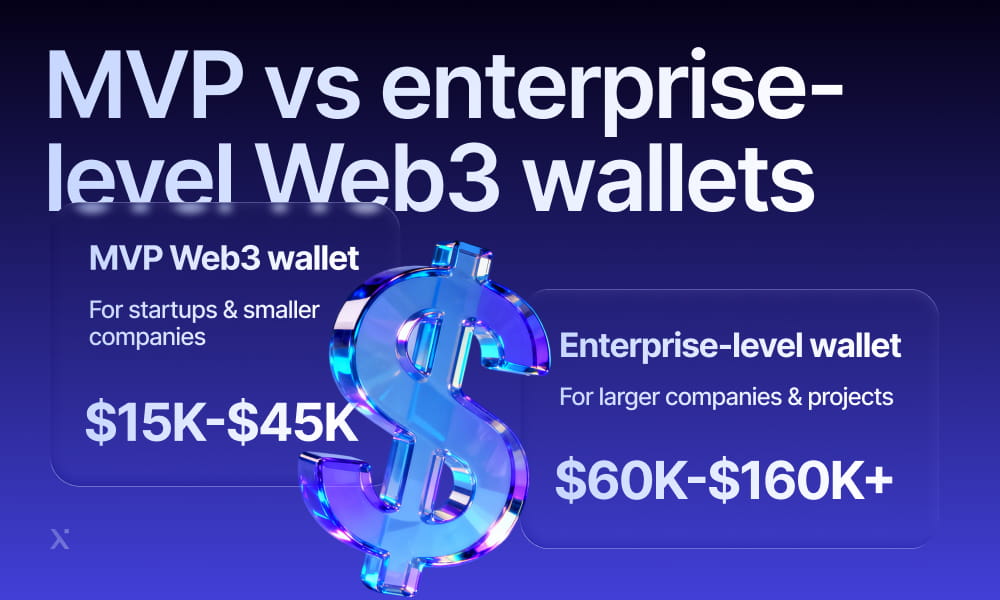
When it comes to Web3 wallets, not every company needs a full-featured, enterprise-grade solution right away. An MVP (Minimum Viable Product) wallet includes only the essential features needed to get started, test the market, and gather user feedback. Startups and smaller companies often choose an MVP because it’s faster to build and less expensive.
On the other hand, enterprise-grade wallets are designed for larger companies or projects that need advanced security, multi-chain support, high scalability, and ongoing maintenance. These wallets are more expensive and take longer to develop, but they’re built to handle larger user bases and complex operations.
When it comes to cost, an MVP wallet is more budget-friendly since it focuses on the core features. The development here typically ranges from $15,000 to $45,000 and takes a few weeks to a few months to develop.
Enterprise-grade wallets, with advanced security, multi-chain support, and the ability to handle large user bases, are much more expensive. They usually cost between $60,000 and $160,000 or more, and require several months to build.
The choice between the two depends on your company’s size, goals, and how quickly you want to launch your wallet.
Inside Crypto Wallet MVP Development: Process, Costs, and Real-World Lessons

Web3 Development Cost: Breaking Down What Really Drives the Price
| Type of wallet | Who it’s for | Key features | Estimated cost | Development time |
| MVP Web3 wallet | Startups & smaller companies | Core features only to test the market | $15K-$45K | 6-12 weeks |
| Enterprise-level wallet | Larger companies & projects | Advanced security, multi-chain support, high scalability, ongoing maintenance | $60K-$160K+ | 4-6 months+ |
Then the MVP approach is a way to go. Get in touch with us for expert consulting and a detailed pricing plan.
How to choose the right partner for Web3 wallet development?
This question is about finding a team that truly understands your vision, both technically and strategically. Look for a company that offers Web3 app development services with solid, long-term experience in building real-world blockchain products. They should have deep knowledge of multiple blockchain networks, smart contracts, secure key management, and multi-chain integration — not just in theory, but in actual delivery.
Don’t hesitate to ask for past projects or client success stories. That’s the best way to see if they can create a wallet that’s really secure, fast, and user-friendly.
A good provider of web3 wallet development services will feel more like a collaborator than a contractor. They’ll guide you through every step of the process, from idea validation and UI design to deployment and post-launch support, and will make sure that your wallet not only works well but stands out.
Pick a team that communicates openly, offers practical advice, and helps you make smart trade-offs between speed, cost, and scalability. That’s how good Web3 projects are built.
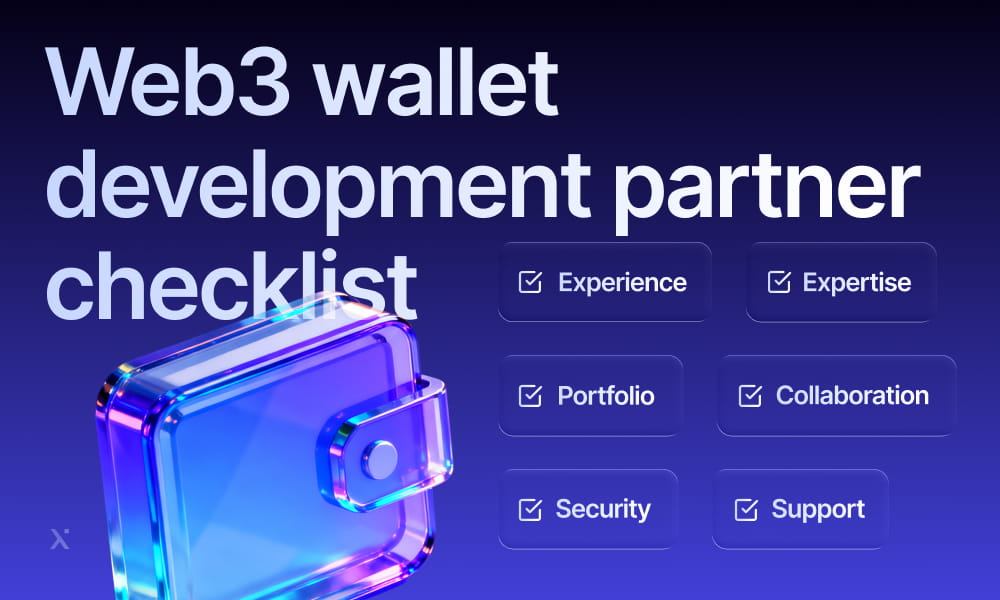
| Criteria | What to look for |
| Experience | A team with proven experience in building real blockchain products |
| Expertise | Strong skills in smart contracts, security, and multi-chain integration |
| Portfolio | Examples of past wallets or blockchain projects with measurable success |
| Collaboration | Open communication and guidance throughout the entire process |
| Security | Thorough testing, auditing, and best practices to protect user assets |
| Support | Ongoing updates, maintenance, and improvements after launch |
We highly recommend checking off each of these points and asking your potential partner about them before making a final decision.
Top-3 Web3 wallet development companies you can rely on
Based on a careful analysis of portfolios, areas of focus, and technical expertise, we’ve selected three leading companies that can deliver secure, reliable, and fully functional Web3 wallets.
These companies combine proven experience, innovative solutions, and strong development practices to help bring your blockchain project to life. Take a look at them.
PixelPlex
PixelPlex is a Web3 wallet development company that has been delivering blockchain solutions for almost two decades. What sets PixelPlex apart is their strong focus on practical, scalable blockchain development across multiple networks, including Ethereum, Solana, Bitcoin, Polkadot, and more.
Their Web3 development services cover full blockchain stacks — from tokenization and dApps to wallets and decentralized marketplaces. They have contributed to projects serving over 50 million end users and have helped clients raise significant funding.
ConsenSys
No discussion of Web3 wallets would be complete without this giant: ConsenSys. Founded by one of Ethereum’s co‑creators, they’re best known for MetaMask, the world’s most popular self‑custodial wallet. Today, over 100 million people use this solution to access DeFi, NFTs, and other Web3 apps.
Beyond wallets, they build essential blockchain infrastructure like Infura and Layer‑2 solutions, giving them a full view of the Ethereum ecosystem.
AppInventiv
Last but not least — Appinventiv. This blockchain development company has extensive experience in building secure and user-friendly Web3 wallets and far beyond. They handle everything from smart contract development to wallet platforms.
As for Web3 wallets, Appinventiv focuses on scalable solutions with multi-currency support, smart contract integration, and strong security layers. Their hands-on approach also includes thorough testing and auditing.
| Company | Blockchain experience | Notable projects | Typical pricing | Project focus |
| PixelPlex | 450+ delivered blockchain projects including custom wallets, DeFi, dApps and smart contracts; 17+ years in the space | Solutions used by millions, developers of custom wallet tech for clients, 1M+ smart contracts deployed | $50-$150+/hr; $15K-$50K for blockchain consulting;$50K-$2,5M — enterprise-level blockchain development | Custom Web3 wallets, dApps, DeFi, NFTs, smart contracts, integrations, security & scalability |
| ConsenSys | Founded by an Ethereum co‑founder; long history building Ethereum ecosystem tools & wallets | Creator of MetaMask (100M+ users globally) and 17K dApps | $50K-$1M+ (enterprise-level solutions) | Ethereum‑centric solutions, wallets, DeFi, DAO, NFT platforms |
| AppInventiv | 500+ blockchain experts, 3000+ blockchain-related projects delivered | Builds custom blockchain solutions, Web3 wallets, crypto exchanges; broad tech stack expertise | Projects range from $10K to $1M+ depending on scope and complexity | Full-stack blockchain applications, DAO, DeFi, NFT platforms, secure crypto wallets, integration & consulting |

Top Full-Service Web3 Development Companies 2026

Planning Web3 App Development Cost: Team, Timeline, And Hidden Expenses
Conclusion
Web3 wallets have become a cornerstone of the decentralized digital world. As the demand for privacy, security, and transparency grows, companies are investing in Web3 wallet development to meet the needs of a rapidly expanding user base.
For businesses looking to launch their own wallet, exploring web3 wallet development services by PixelPlex is a solid choice. We prioritize robust security, seamless usability, and scalable design so that you and your users enjoy full control, smooth interactions, and confidence in every transaction.
FAQ
Web3 wallets create a digital message with your transaction details, sign it with your private key, and send it to the blockchain. Network validators confirm it, and once approved, it’s permanently recorded. Transactions usually take seconds or a few minutes.
These wallets connect directly to smart contracts and let you trade tokens, stake crypto, or use DeFi services. All of this happens automatically, without any intermediaries.
At a minimum, your wallet should provide secure key management, multi-chain support, smooth transaction handling, a clear interface, and the ability to connect to dApps and NFTs. Optional extras can be token swaps, staking, and analytics.
Keep your private keys and seed phrases safe, use strong passwords, enable two-factor authentication, and choose wallets with built-in encryption and local signing. Regular updates and audits also help keep your wallet secure.
Only if they saved their seed phrase or backup keys. Without them, there’s no way to recover the wallet, so keeping them safe is crucial.
The next generation of Web3 wallets is expected to focus on improved user experience, enhanced security, and interoperability. Innovations like account abstraction, biometric authentication, and social recovery will make wallets safer and easier to use.