
Writing code for the blockchain is different from building a standard mobile app. In the old world, if you made a mistake, you just pushed a quick update. In the Web3 world, your code is often permanent. You need to get it right the first time.
Digital ownership and decentralized finance are moving fast. The global Web3 market was worth about 2.25 billion dollars back in 2022, but experts think it will climb to over 81 billion by 2030. That is a lot of growth.
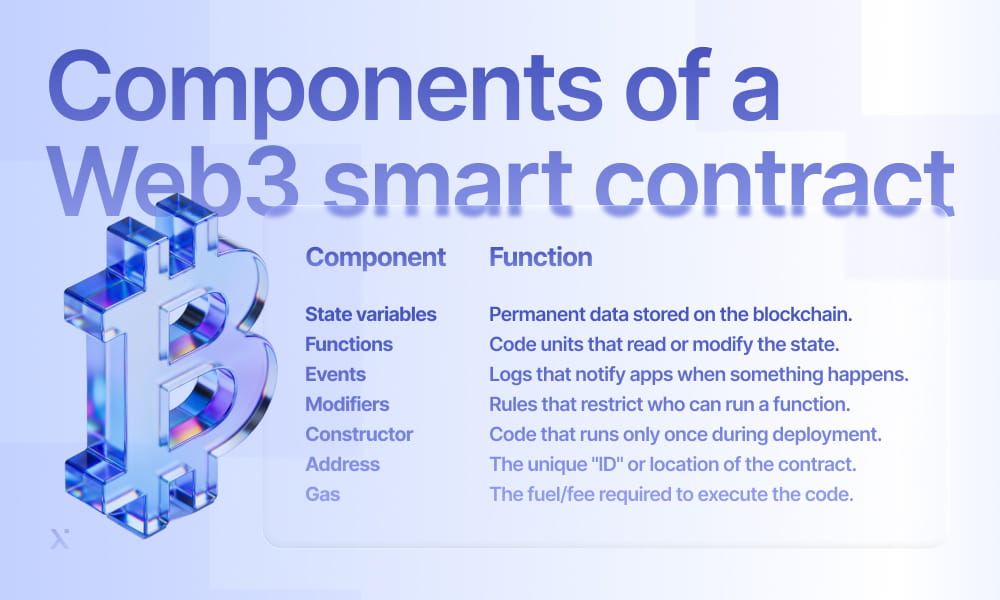
People are realizing that traditional middleman-heavy systems are slow and expensive. This is why our Web3 development services team stays busy – we see the shift every day. Our experts helped write this guide to help you understand how to build smart contracts without getting lost in the technical complexities. This article dives into the costs, the tech stacks, and the value these contracts bring to a modern business.
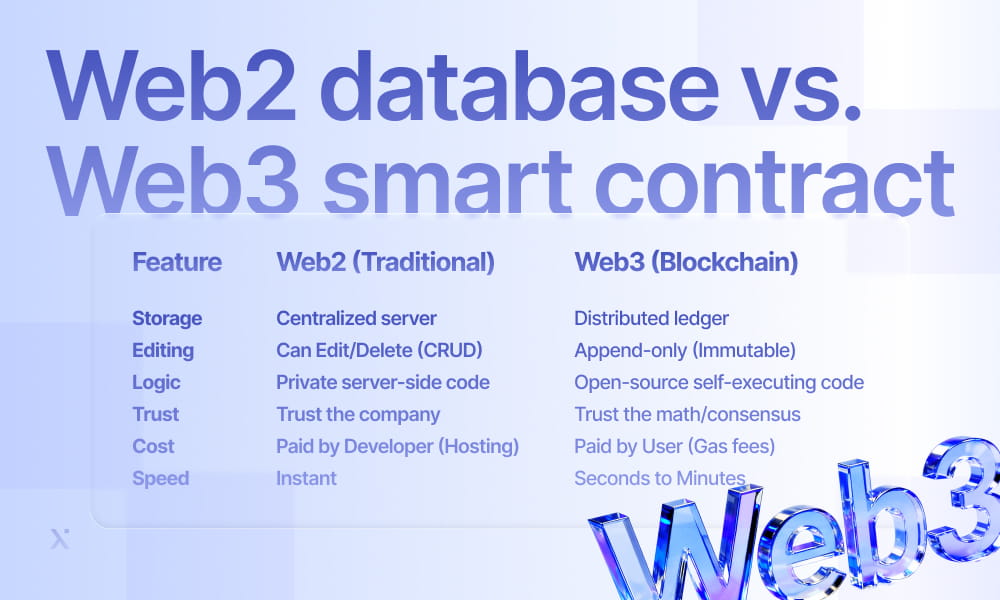
How Web3 smart contract are different from other smart contracts
Truly decentralized identity integration
Standard smart contracts usually just look at wallet addresses, they see a string of numbers and letters and move on. A Web3 smart contract goes further: it often interacts with decentralized identifiers or DIDs. This means the contract can verify who you are or what permissions you have without a central server ever getting involved, it is a more mature way of handling users. If you are curious about how this fits into a broader business plan, blockchain consulting can help map out these identity flows. Instead of relying on a Google login, the contract itself checks your digital signature and grants access based on cryptographic proof.
Native cross-chain communication
Older contracts were often stuck on one single chain. If you built on Ethereum, you stayed on Ethereum. Web3 smart contract development now focuses on interoperability. Modern contracts use protocols to talk to other blockchains. This allows a contract on one chain to trigger an action on another. It is like having a bank account in New York that can automatically trigger a payment in a bank in Tokyo without any manual intervention. This connectivity is a huge leap forward. It makes the entire ecosystem feel like one giant, unified computer rather than a bunch of isolated databases.
Integrated decentralized storage links
A typical contract is tiny, it can only hold a small amount of data because storing things on a blockchain is pricey. Web3 contracts solve this by linking directly to decentralized storage like IPFS or Filecoin. The contract holds the “fingerprint” of the data, while the actual heavy files sit on a distributed network. This allows for complex Web3 app development where the logic remains on the chain but the content stays accessible and censorship-resistant. You get the security of the ledger without the massive storage fees.
Governance and DAO readiness
Web3 contracts are rarely solo acts, they are often built to be controlled by a community. This is what we call DAO development. The code includes “voting” logic from the very beginning. Instead of one CEO making a choice, the contract waits for a majority of token holders to sign off on a change. This is a fundamental shift in how organizations run, because the rules are in the code, and the code is public. It creates a level of transparency that traditional corporate structures simply cannot match.
Comparing Web3 contracts with legacy smart contracts
| Feature | Legacy smart contracts | Web3 smart contracts |
| Connectivity | Isolated to one chain | Cross-chain compatible |
| Identity | Simple wallet addresses | Decentralized Identifiers (DIDs) |
| Data | On-chain only (expensive) | Integrated with decentralized storage |
| Control | Usually centralized admin | Community-led (DAO) logic |
Zero-Leakage Vaults: Building High-Stakes Canton Network Wallets

Ethereum Smart Contracts: The Hard Parts Made Clear
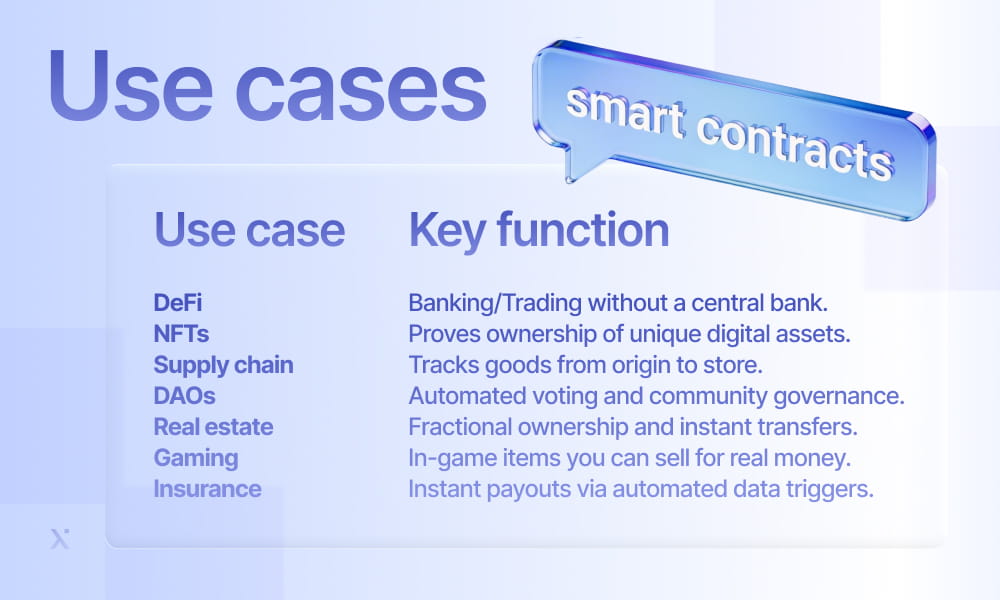
Where Web3 smart contracts are used
DeFi
DeFi removes the banker from the equation. Smart contracts handle lending, borrowing, and trading. You lock up some tokens, and the contract automatically gives you a loan. No credit checks, no waiting in line, and no paperwork. If you don’t pay back, the contract simply sells your collateral. This is why DeFi development has become a cornerstone of the industry. It is finance that never sleeps and never judges you.
Real world asset tokenization
Now, we use real world asset tokenization platform development to turn physical property into digital tokens. The smart contract manages the ownership records and even distributes rental income to everyone who holds a token. It makes expensive assets accessible to regular people, it also makes selling your share as easy as sending an email.
Web3 gaming and digital property
Gamers spend billions on items they don’t actually own. If the game shuts down, the items vanish. Through Web3 game development, items are tied to smart contracts. They exist in your wallet, not on the game company’s server. You can take your sword from one game and sell it on an open market or even use it in another game. The contract acts as the ultimate proof of ownership that no developer can take away.
Supply chain monitoring
Knowing exactly where your coffee came from is getting easier. Smart contracts can track a product from the farm to the store shelf. Every time the crate moves, a sensor or a person updates the contract. This creates a record that nobody can erase or fake. If a batch of food is found to be bad, the company can use transaction monitoring software logic to trace it back to the exact source in seconds. This saves lives and reduces waste.
Automated insurance claims
Insurance is usually a slow process of proving you deserve a payout. Web3 smart contracts in insurance software development can automate this. Imagine flight insurance that is tied to a flight database. If the flight is delayed by more than two hours, the contract sees the data and sends you the money immediately. You don’t even have to file a claim – the contract just does what it was told to do. It removes the human bias and the long wait times.
Intellectual property and royalties
Musicians and artists often get the short end of the stick when it comes to pay. A smart contract can change the deal: when someone buys a song or a piece of digital art, the contract can automatically send a percentage of the sale directly to the creator. This works for secondary sales too. If you sell a painting to a friend, the original artist can still get a cut. This ensures that creators are supported as their work grows in value over time.
Decentralized social media
Current social platforms own your data and your audience. If they ban you, you lose everything. Web3 social contracts give you control. Your “graph” of followers is stored on the blockchain. You can move from one app to another and take your friends with you. The contracts handle the likes, shares, and tips without a central company taking a massive 50% cut of your earnings.
Keep in mind that smart contracts are like residents of a windowless room. They cannot see the outside world on their own. They rely on “oracles” to feed them data like weather reports or stock prices. Choosing a reliable oracle is just as important as writing good code. If the data is wrong, the contract will execute the wrong action perfectly.

Planning Web3 App Development Cost: Team, Timeline, And Hidden Expenses

More Than Just Storage: How Crypto Wallet Rewards Programs Build Loyalty and Drive Growth
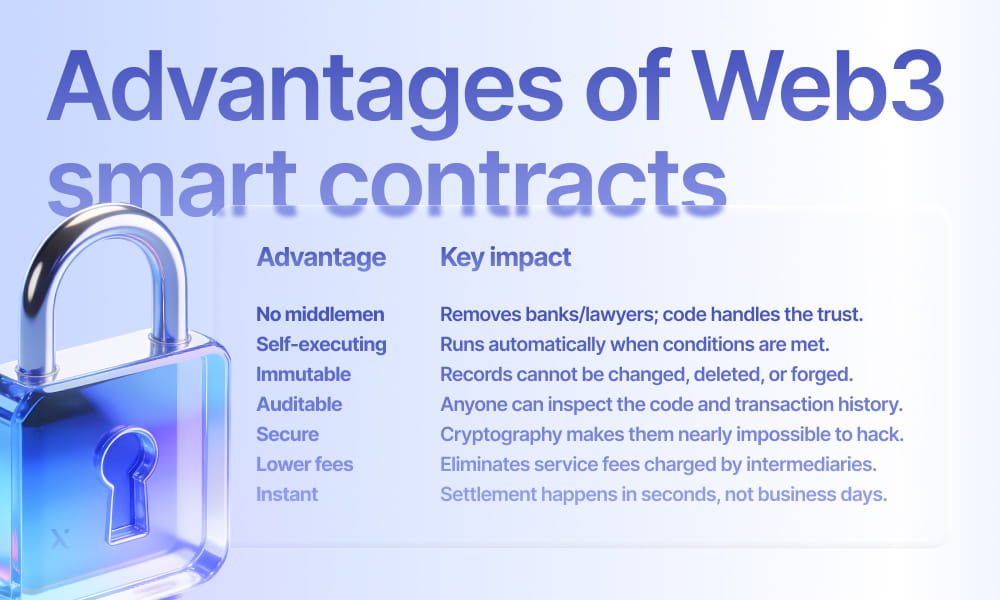
Web3 smart contract advantages
Absolute transparency
Everyone can see the code. In a world where “trust us” is the standard corporate motto, Web3 says “verify us.” You can look at the contract and see exactly where the money goes. This builds a massive amount of trust with users. They know that no human can jump in and change the rules of the game halfway through.
Lower operational costs
Banks and legal firms have huge buildings and thousands of employees. Smart contracts are just lines of code. By using blockchain integration services, businesses can automate tasks that used to take teams of people weeks to finish. You save on salaries, office space, and human error. It is a much leaner way to run a global operation.
High-level security
Blockchains are very hard to hack. While a central server can be taken down by a single breach, a decentralized ledger is spread across thousands of computers. As long as the logic in your smart contract development is solid, the execution is virtually guaranteed. It provides a level of uptime that most traditional IT departments can only dream of.
Permissionless innovation
You don’t need to ask for permission to build on Web3. There is no “App Store” gatekeeper telling you that your idea isn’t good enough. If you have the code and a little bit of gas money, you can deploy your project. This leads to a frantic pace of innovation. People are constantly combining different contracts like “money legos” to create entirely new financial products.

Top Full-Service Web3 Development Companies 2026

Inside Cocoon: How Durov is Rebuilding the AI Internet on the TON Blockchain
24/7 availability
The traditional financial system closes on weekends and holidays – smart contracts do not, they are always on. A user in Australia can take out a loan from a protocol built in Poland at 3 AM on a Sunday. The contract doesn’t need a coffee break or a vacation. This constant availability is essential for a truly globalized economy.
Instant settlement
In the traditional world, “sending” money is just an entry in a database, the actual settlement can take days. With Web3, the transfer of the asset and the payment happen at the same time. There is no “pending” state that lasts for a week. Once the block is confirmed, the deal is done. This reduces risk for everyone involved because nobody is left waiting for a check to clear.
Best blockchains for Web3 smart contract development
Ethereum
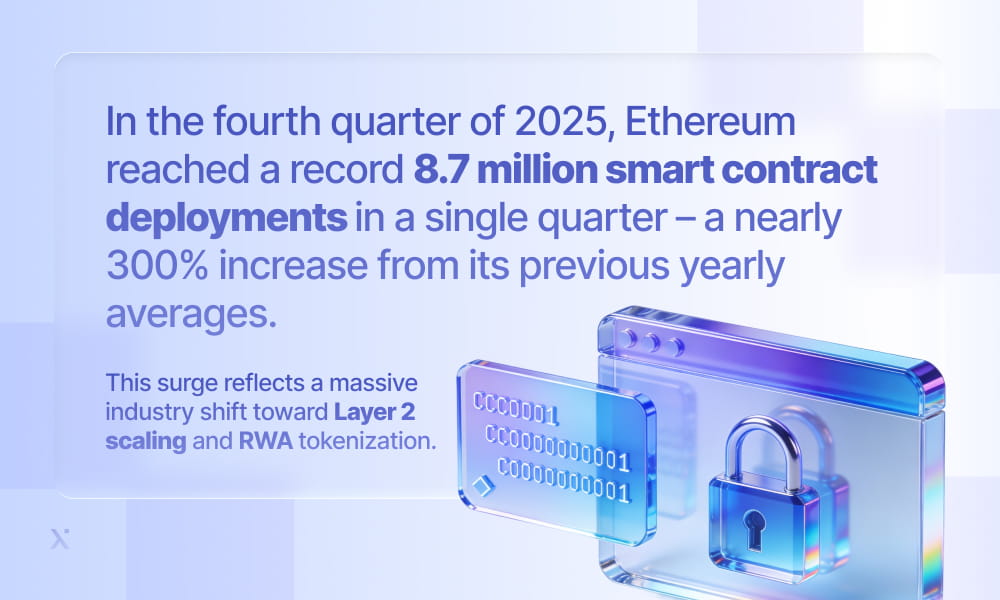
Ethereum has the most developers, the most tools, and the most liquidity. If you want to be where the people are, you start here. However, it can be expensive when the network gets busy. To handle this, many developers now look at Layer 2 solutions that sit on top of Ethereum to keep costs down. It remains the gold standard for security and decentralization.
Polygon
It is very popular for Web3 wallet development and gaming. It uses a different way to reach consensus, which makes it much speedier. Many big brands choose Polygon when they want to launch NFTs or loyalty programs because they don’t want their customers paying 50 dollars in fees for a 10 dollar item.
Solana
Solana can handle thousands of transactions per second. This makes it a favorite for high-frequency trading and complex games. The code is written in a language called Rust, which is known for being very fast and safe. While it has had some growing pains with network stability in the past, it remains a top contender for anyone who needs extreme performance.
Canton Network
For businesses that need privacy and control, this is a very interesting choice. It is designed specifically for institutional use. Unlike public chains where everyone can see everything, Canton allows for more “private” interactions while still being decentralized. We even have a Canton Network smart contract development guide for those who want to dive deeper into this specific ecosystem. It is perfect for banks or healthcare companies that have strict data laws to follow.

Canton Network Reward System: How Canton Coin Pays Developers to Build Real Value

From Code to Confidence: Inside Smart Contract Audit Pricing
Avalanche
Avalanche is known for its “subnets.” This allows a company to create its own mini-blockchain that is still connected to the main network. You get to set your own rules and your own token for fees. It is a great middle ground for projects that need their own space but still want to be able to talk to the rest of the crypto world easily.
Cardano
Cardano takes a very academic approach. They use peer-reviewed research to build their features. This makes the development process a bit slower, but the results are very stable. They use a language called Haskell, which is great for preventing bugs in financial code. It is a solid choice for long-term projects where “slow and steady” is the preferred mantra.
Blockchain selection matrix
| Blockchain | Primary language | Best for | Speed |
| Ethereum | Solidity | High security / DeFi | Moderate |
| Solana | Rust | Gaming / High frequency | Very high |
| Polygon | Solidity | Mass market / NFTs | High |
| Canton | Daml | Privacy / Enterprise | High |
| Avalanche | Solidity/Go | Custom subnets | High |
Cost of Web3 smart contract development
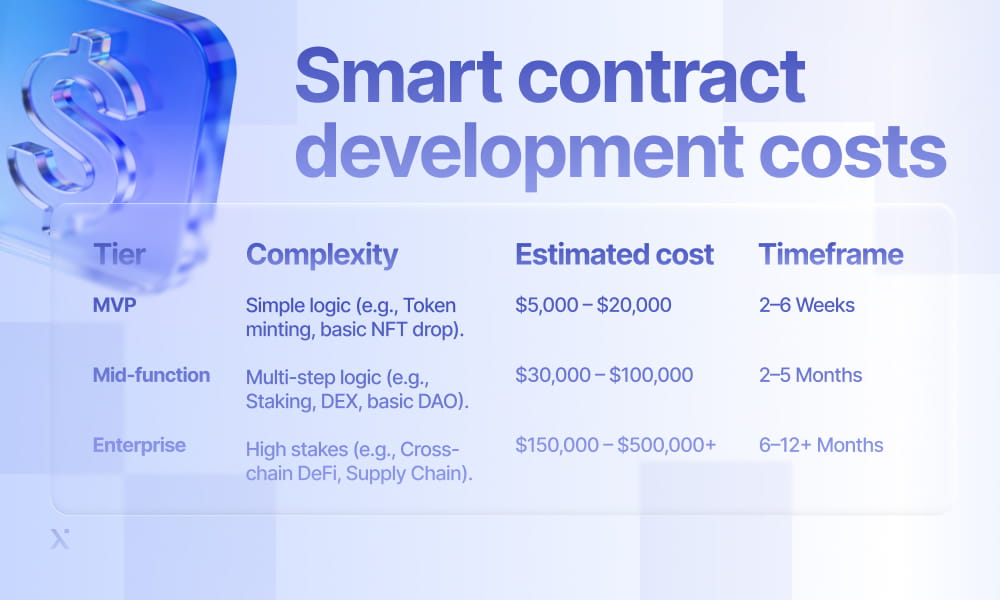
Talking about price is always tricky because every project has individual metrics. However, we can look at some general buckets to give you an idea of the budget you might need. Remember that Web3 smart contract development services involve more than just typing code. You have to account for design, testing, and the dreaded security audits.
Simple MVP contract
If you are just launching a basic token or a simple NFT collection, you are looking at the entry-level tier. This usually involves standard code that has been tested many times before. You aren’t reinventing the wheel, you just need a reliable set of wheels to get moving.
- Price range: $5,000 – $20,000
- Timeline: 2–4 weeks
Mid-level Web3 contract
You might be building a decentralized marketplace or a custom staking platform. This requires custom logic that handles user funds carefully. It also needs a more robust front-end so users can actually interact with the contract without being a computer scientist.
- Price range: $30,000 – $100,000
- Timeline: 2–4 months
Enterprise level contract
We are talking about complex DeFi protocols, cross-chain bridges, or large-scale private blockchain development for a corporation. The security requirements here are intense. You might need multiple audits from different firms to ensure there are zero vulnerabilities. One small bug could mean losing millions of dollars, so the investment in quality is mandatory.
- Price range: $150,000+
- Timeline: 6 months+
Estimated cost breakdown
| Project phase | Percentage of budget | Why it costs this much |
| Discovery & architecture | 15% | Mapping out the logic to avoid future rewrites |
| Smart contract coding | 35% | The actual heavy lifting in Solidity or Rust |
| Frontend/UI development | 20% | Making it pretty and easy for humans to use |
| Security audit | 20% | Getting experts to try and break the code |
| Deployment & support | 10% | Putting it on the mainnet and fixing early hiccups |
A “cheap” developer might write messy code that works but costs your users a fortune in gas fees. A high-quality Web3 smart contract development company focuses on gas optimization. By writing more efficient code, you can save your users thousands of dollars in the long run. Sometimes spending more on development actually saves you money overall.

Web3 Development Cost: Breaking Down What Really Drives the Price

Web3 Development: What It Takes to Build the Future
Logic complexity
This is the most obvious factor. A contract that says “if A happens, do B” is cheap. A contract that says “if A happens, check C, talk to an oracle, wait for three signatures, and then calculate a variable interest rate based on market volume” is expensive. The more “if-then” statements you have, the more time it takes to write and test. Every new branch of logic is a potential place for a bug to hide.
Security and audit requirements
In the Web3 world, your code is your bank vault. You wouldn’t hire a cheap locksmith for a vault holding a billion dollars. A security audit and risk management review is non-negotiable for serious projects. The more complex the contract, the more the auditors will charge. They have to go through every line of code with a magnifying glass to make sure no hacker can find a way in.
Integration with external systems
Does your contract need to talk to a traditional bank? Does it need to pull data from a business intelligence solutions dashboard? Building bridges between the old world of Web2 and the new world of Web3 is hard work. You have to handle APIs, data formatting, and different security standards. These integrations can easily double the development time.
Choice of blockchain
Some blockchains are harder to code for than others. Ethereum is relatively straightforward because there are so many templates. Coding for something newer or more niche might require specialized developers who charge a premium. Also, some chains have different testing requirements. If you choose a chain with high gas fees, even the process of testing the contract on the main network can add up.

Smart Contract Development Cost Demystified: What Every Business Should Know

Enterprise Blockchain: Prom Promise to Profit
Upgradability features
By default, smart contracts cannot be changed. If you want the ability to update your code later, you have to use a “proxy” pattern. This adds a layer of complexity to the architecture. You have to be very careful how you set this up, or you might accidentally create a security hole. Deciding whether to be “immutable” or “upgradable” is a big choice that affects the initial build cost.
Compliance and legal logic
If you are doing tokenization services, you might need to build in KYC checks. This means the contract has to check a whitelist before it allows someone to buy a token. Adding these regulatory features takes more time. You have to ensure the contract follows the laws of the countries where you operate, which often requires a mix of legal and technical expertise.
Complexity vs cost impact
| Complexity factor | Impact on cost | Why? |
| Basic token | Low | Well-known standards exist |
| Custom DAO | Medium | Requires complex voting logic |
| Cross-chain bridge | Very high | Massive security risks and tech hurdles |
| Oracle integration | Medium | Needs careful data validation |
Don’t forget that deploying a contract is not the end. You need to monitor it. Blockchains change, new vulnerabilities are discovered, and user needs evolve. Budgeting for a long-term relationship with a Web3 smart contract development partner is much smarter than looking for a one-time “gig” worker. Stability is the most valuable asset in Web3.
Advanced features you can add
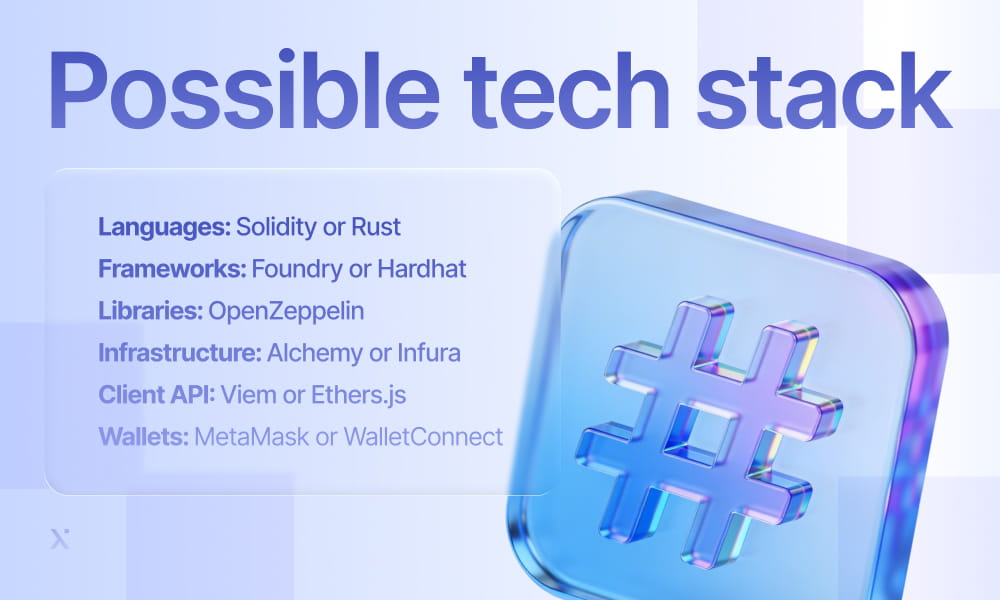
Once you have the basics down, you might want to spice things up. Advanced Web3 smart contract development often includes features that make the user experience much smoother.
Meta-transactions
For example, meta-transactions allow you to pay the gas fees for your users. This is a game-changer because it means a regular person can use your app without having to buy crypto first. It makes the blockchain feel invisible, which is the goal.
Multi-signature control
This means the contract won’t do anything unless several different people sign off on it. This is great for managing a company’s treasury. It prevents one rogue employee from running off with the funds. You can also add “time-locks,” which prevent funds from being moved for a certain period. This is often used by founders to show they are committed to a project for the long haul.
Crypto payments integration
You might also consider crypto payment solutions integration directly into the contract. This allows for automated splits. If a customer pays for a service, the contract can immediately send 80% to the service provider, 10% to the platform, and 10% to a referral partner. No manual accounting is required. Everything happens in the same transaction.
Advanced feature value add
| Feature | User benefit | Business benefit |
| Gasless transactions | No need to own ETH/SOL | Much higher user conversion |
| Auto-compounding | Higher yields with no effort | Increased “stickiness” of the platform |
| Dynamic NFTs | Art that changes over time | Higher engagement and utility |
| Social recovery | Can’t lose access to the wallet | Much safer for non-technical users |

Top 10 Blockchain Use Cases In 2026: How Your Business Can Ride the Wave

DeFi Vaults Explained: How to Turn Lazy Crypto Into an Automated Yield Machine
Why work with the PixelPlex team
We have built everything from small NFT drops to massive enterprise systems. When you choose a Web3 smart contract development company, you want someone who has seen it all. We know where the hidden traps are. We have a deep understanding of blockchain app development and how to make code that is both secure and efficient.
- Battle-tested since 2007. We have over 13 years of deep blockchain focus, seeing the tech evolve from a niche experiment into a global powerhouse.
- 450+ successful launches. From fintech to healthcare, our team has delivered diverse solutions across almost every major industry.
- We build unicorns. Three of the startups we partnered with from their early days have reached billion-dollar valuations.
- Investors trust our tech. The projects we have engineered helped our clients raise more than $1.2 billion in capital.
- 1 million+ secure executions. Our smart contracts have handled over a million real-world transactions without a hitch.
- Rapid MVP delivery. We can take you from an idea to a live, working product in as little as one month.
- Scale that matters. The solutions we’ve built are currently used by over 50 million happy end-users worldwide.
Quick start checklist
| Step | Action | Priority |
| 1 | Define the core “If/Then” logic | High |
| 2 | Choose the right blockchain | High |
| 3 | Hire a proven Web3 smart contract development team | High |
| 4 | Conduct a thorough security audit | Mandatory |
| 5 | Plan your “Gas” strategy | Medium |
| 6 | Build a simple, friendly user interface | High |
While professional audits are vital, an open-source approach can also help. When you make your code public, thousands of eyes can look at it. The Web3 community is often very helpful in pointing out flaws before they become problems.
Conclusion
Web3 smart contract development is about rethinking how we trust each other and how we move value across the globe. By removing the friction of middlemen and replacing them with transparent code, we are opening up a world of new possibilities. From banking the unbanked to giving gamers true ownership of their digital lives, the impact is real. It is an exciting time to be building, even if the learning curve feels a bit steep at first.
We hope this guide has made the world of digital contracts feel a bit more accessible. There is a lot to learn, but you don’t have to do it alone. The PixelPlex Web3 development team will be glad to assist you in bringing your vision to life. Whether you are a startup with a bold new idea or an enterprise looking to modernize your systems, we are here to help. The future is being written in code right now, and we would love to help you write your chapter – you just need to share your idea.
FAQ
A Web3 smart contract development company specializes in creating permanent, decentralized code that manages digital ownership and value without relying on central authorities.
Utilizing Web3 smart contract development services ensures your code is gas-optimized, secure against hacks, and capable of interacting with decentralized storage and identity systems.
Canton Network smart contract development is ideal for enterprises because it offers a unique balance of decentralization and data privacy for highly regulated industries.
Yes, we integrate crypto compliance solutions like KYC whitelisting and transaction monitoring directly into the smart contract logic to meet global regulatory standards.
Professional NFT marketplace development includes creating secure minting logic, secondary sale royalty enforcement, and seamless integration with decentralized file storage.
Instead of storing heavy files on-chain, these contracts use links to decentralized networks like IPFS to maintain security while keeping storage costs low.
Modern Web3 development focuses on cross-chain interoperability, allowing a contract on one network to trigger actions or payments on another automatically.
Since contracts cannot “see” the real world, they rely on oracles to provide external data like stock prices or weather, making oracle reliability critical for accuracy.
Enterprise projects typically start at $100,000 due to the intensive security audits and complex logic required to manage large-scale financial protocols safely.
While code on the blockchain is generally immutable, developers can use “proxy patterns” to allow for secure patches and feature rollouts when needed.