
Most blockchain reward systems are kind of a mess. Usually, it’s the same old story: a few early insiders buy up half the supply before the public even knows the project exists, and then the "rewards" are just them dumping tokens on retail investors.
We’ve seen it with ICOs, we’ve seen it with “fair” launches that weren’t actually fair, and we’ve seen it with yield farming schemes that collapse in a week. But every once in a while, a network comes along and flips the script.
In the Canton Network, they aren’t just throwing digital coins at people for staking and doing nothing. They are building what they call a Global Synchronizer, and they’ve designed a reward system that pays people for actually doing stuff. Useful stuff.
If you are a developer, a bank, or just a crypto enthusiast trying to figure out where the industry is heading next, you need to understand this model. It’s about building a circular economy that actually makes sense.
At PixelPlex Canton.Network development company, our development team has been digging deep into the Canton architecture. We are fascinated by how they’ve structured their incentives, and we thought, “Why not write the ultimate guide on it?” Grab a coffee (or a tea, we don’t judge), and let’s break down exactly how rewards work on the Canton Network.
The big picture: Why Canton is different
Before we get into the math of who gets paid what, we need to talk about the philosophy here.
Most blockchains operate on a “pay-to-play” model where the network creates value for the token holders, often at the expense of the users. Canton Network decided to go with a “Proof of Utility” approach.
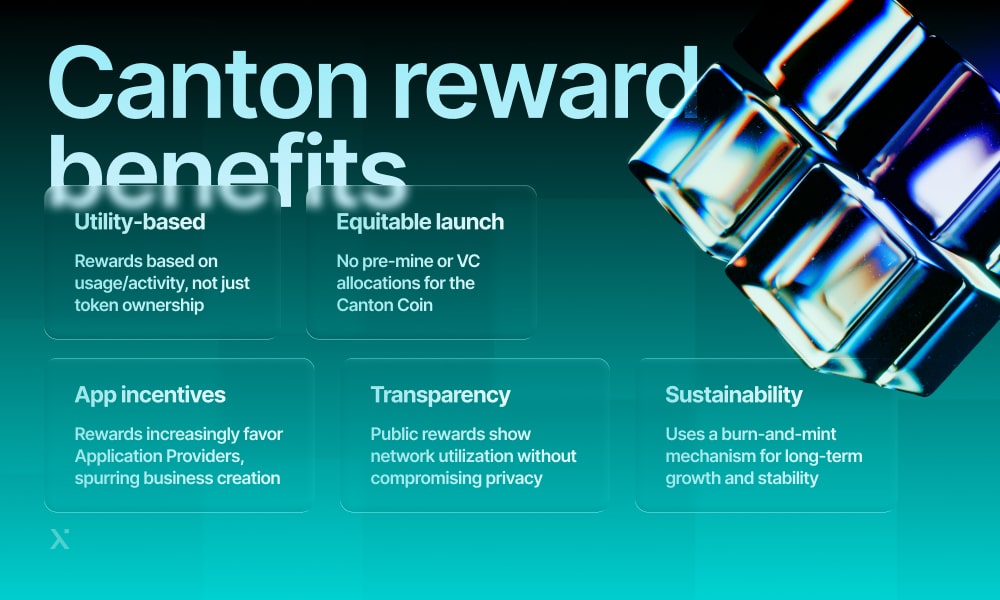
Here is the kicker: Canton Coin had no pre-mine. No pre-sale. No VC allocation.
Read that again. In an industry where “Allocation to Team” is usually a huge slice of the pie, Canton launched with zero tokens reserved for the founders or the foundation. Every single coin in circulation has been earned by someone participating in the network. This is what a true fair launch looks like.
Fair launch vs. the “Industry standard”
To really appreciate how weird (in a good way) this is, look at how Canton stacks up against the typical crypto project launch you usually see on Twitter.
| Feature | Typical “Hype” launch | Canton Network launch |
| Founder allocation | 15% – 25% kept by team | 0% (Zero) |
| VC pricing | Bought early at huge discount | No VC Presale |
| Public access | Often dumped on by insiders | Equal footing for everyone |
| Token source | Printed out of thin air | Earned via network work |
The problem with “gas”
On networks like Ethereum, when the network gets busy, gas fees increase immensely. The rewards go to the validators (or miners, back in the day). The users lose money and the app developers don’t see a dime of that gas fee.
Canton changes this dynamic. The network is designed to reward the people who bring value – and that includes the application builders and the actual users, not just the people running the servers.
When analyzing a new blockchain, always look at the “Token Distribution” chart. If the “Insider” slice is bigger than 20%, you are likely the exit liquidity. Canton’s slice for insiders was 0%. That’s a green flag.

The Agent Payments Protocol (AP2): A New Standard for Autonomous Commerce

From Code to Confidence: Inside Smart Contract Audit Pricing
The “Global Synchronizer” – engine behind the rewards
To understand the rewards, you have to understand the machine. The Canton Network isn’t just a blockchain but a “network of networks.” It connects private blockchains (like those used by banks for privacy) with a public synchronization layer.
This layer is called the Global Synchronizer.
When you transact on Canton, you aren’t just moving a token from Wallet A to Wallet B. You might be synchronizing a private asset (like a tokenized bond) with a public cash payment. This requires infrastructure, and that infrastructure needs to be paid for.
How the money moves
The economic model uses a Burn-and-Mint Equilibrium. It sounds fancy, but it’s actually pretty simple:
- Usage: People pay fees to use the Global Synchronizer.
- Burning: Those fees are burned (destroyed). They are taken out of circulation.
- Minting: Every 10 minutes, the network creates (mints) new Canton Coins.
- Distribution: These new coins are handed out to the people who made the network run during those 10 minutes.
The goal is to issue and burn about 2.5 billion coins annually. If usage is high, more fees are burned, making the coin scarcer. If usage is low, the minting continues to incentivize people to stick around. It’s a self-regulating system that keeps the lights on without needing a central bank manager.
The three kings: Who actually gets rewarded?
Okay, let’s get to the part you are here for. Who gets the money?
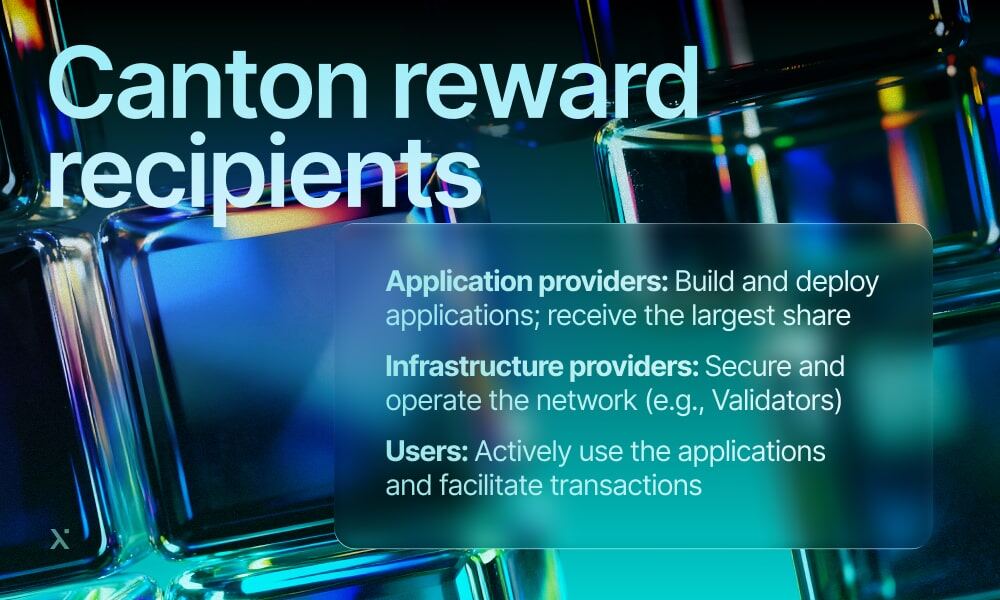
The Canton ecosystem divides the world into three main buckets. Depending on which bucket you fall into, your rewards come from different sources and require different work.
1. Super Validators (the heavy lifters)
These are the big institutional players. We can compare them to the miners in Bitcoin, they run the heavy infrastructure that secures the Global Synchronizer.
- Role: They ensure the network is live, secure, and processing transactions correctly.
- Reward source: They get a slice of the minted coins.
- The trend: Initially, they got the lion’s share (about 80%) because the network needed to establish security first. But here is the twist: their share is programmed to decrease over time. By 2029, they will only get about 20% of the rewards.

Building the Unbreakable Exchange: A Developer's Guide to Canton Network
Your Practical Guide to Creating a Decentralized Cryptocurrency Exchange
2. Application Providers (the innovators)
On most chains, if you build a popular dApp, you only make money if you charge your own fees. The blockchain itself doesn’t pay you.
Canton says, “Wait, without apps, our network is a ghost town. We should pay the devs.”
- Role: Building smart contracts and applications (usually in Daml) that people actually use.
- Reward source: A massive chunk of the minting pool. The reward structure acts like an ongoing, perpetual grant.
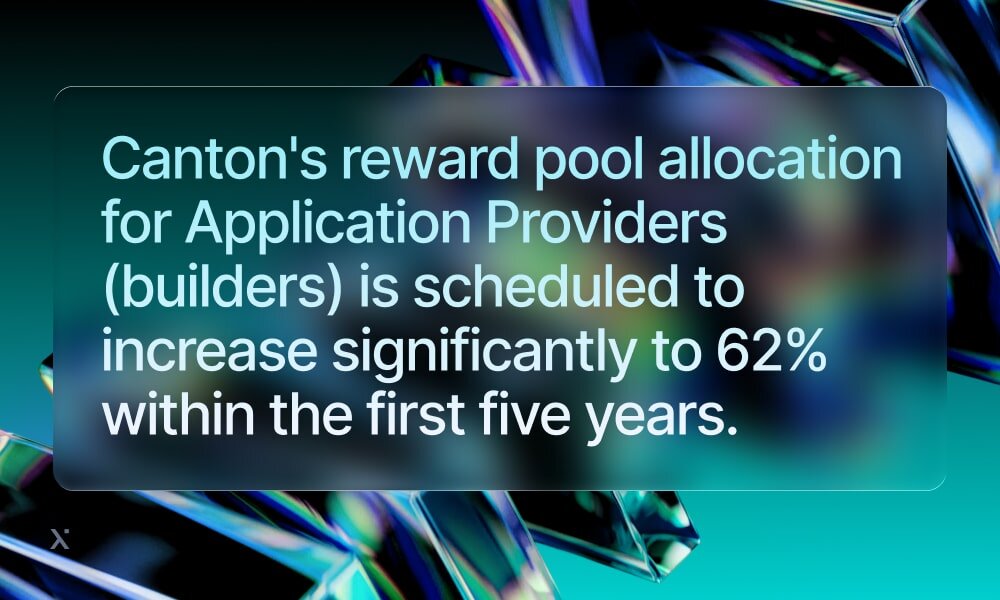
- The trend: As Super Validator rewards go down, Application Provider rewards go up. Until mid-2029, apps are eligible for up to 62% of the reward pool.
This is huge for businesses. If you are looking into Daml development services, you aren’t just building a product, you are building a revenue stream that comes directly from the protocol.
3. Validators (the users)
In Canton terminology, a “Validator” isn’t necessarily a massive server farm. It can be an entity participating in a dApp, like a company running a node to verify their own trades.
- Role: Generating traffic, using apps, and maintaining a “live” connection to the network.
- Reward source:
- Proof-of-Life: Just for staying connected and demonstrating you are active.
- Transaction rebates: You actually get a portion of fees returned when you transact. It’s like credit card cashback, but on-chain.
| Participant type | Primary role | Reward share trend | Income source |
| Super validator | Infrastructure security | Decreasing (to ~20%) | Minted rewards |
| App provider | Creating utility/traffic | Increasing (to ~62%) | Protocol “Grants” |
| User | Generating volume | Stable/variable | Rebates & Proof-of-Life |
The “Proof of Utility” mechanism
How does the network know who to pay? It can’t just trust you when you say, “Hey, I’m a cool app, pay me.”
It uses on-chain metrics.
For developers: The traffic game
If you build an app using Canton.Network explained principles, the network tracks the traffic flowing through your smart contracts. The more traffic your app generates for the Global Synchronizer, the bigger your slice of the pie.
This aligns incentives perfectly. In the Web2 world, apps try to trap users to monetize them (ads, data selling). In the Canton world, apps just need to be useful. If people use the app because it solves a problem, the protocol pays the developer.
Code, Capital, and Compliance: A Deep Dive into Canton Network Smart Contract Development

A Network of Networks: How Canton Is Redesigning Financial Infrastructure
For users: The cashback loop
Imagine sending money to a friend and getting paid for doing it. That’s the “Transaction Reward.”
When a validator (user node) sends Canton Coin or interacts with a smart contract, a portion of the fee they paid is calculated and returned to them. This lowers the barrier to entry. It effectively makes the network cheaper to use for power users than for casual tourists.
Most blockchains have a “Fee Market” where users bid against each other to get processed, driving prices up. Canton’s model is designed to keep fees predictable in Dollar terms, even if the coin price fluctuates.
Why this matters for business
If you are running a company, you might be thinking, “This sounds nice, but why do I care?”
Here is why: Subsidized Infrastructure.
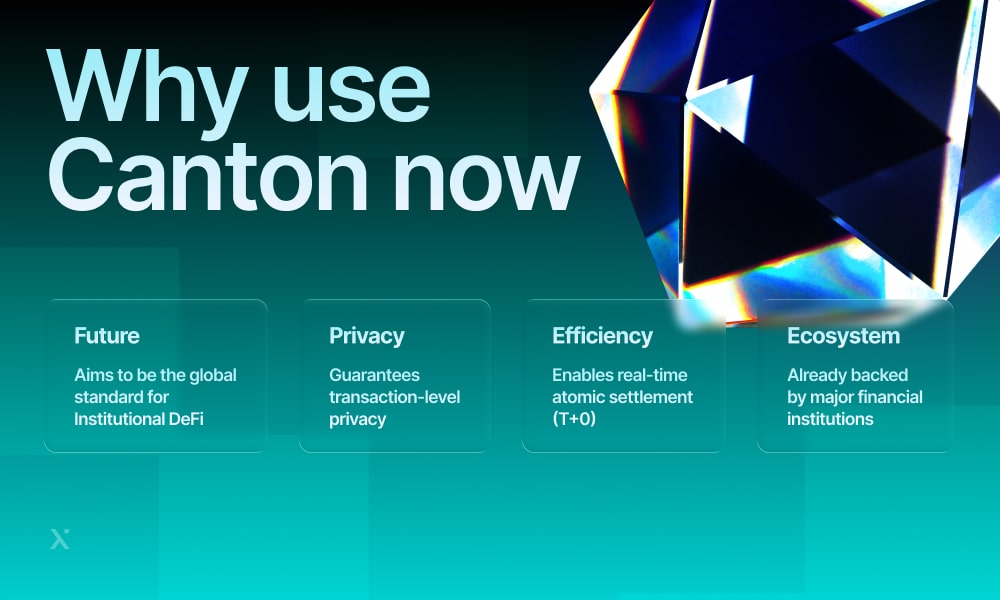
If you build a private blockchain solution for your supply chain or finance operations, you usually have to pay for all the servers and maintenance yourself. If you build on Canton, and your application becomes active, the protocol rewards might offset your hosting costs.
We have seen this shift the conversation when we talk to clients about private blockchain development. Suddenly, IT infrastructure isn’t just a cost center but it has a revenue line attached to it.
Integration with real-world assets (RWA)
Canton is heavily focused on RWA – things like tokenized bonds, real estate, and stablecoins.
- Hashnote USYC: A tokenized money market fund.
- Brale: Regulated stablecoins.
- QCP: Crypto derivatives.
These aren’t just JPGs of monkeys but financial instruments. The rewards system incentivizes financial institutions to bring these assets on-chain because the more volume these assets move, the more rewards the issuers can earn.

Are Corporate Crypto Stashes The Future? A No-Nonsense Guide to DATs

Protecting Ideas: How Blockchain Is Becoming the Guardian for Your Creations
Technical implementation: How to get your slice
So, you want in. How do you actually start earning these rewards? It’s not as simple as buying a token on an exchange and hitting “Stake.”
Step 1: Build the app (Daml)
Canton runs on a smart contract language called Daml. It’s strictly typed, privacy-preserving, and designed for financial workflows. You can’t just copy-paste Solidity code here.
You need to architect your application to take advantage of the Global Synchronizer. This is where expert guidance comes in. Check out our Daml development services guide to see how the syntax differs from what you might be used to.
Step 2: Set up the wallet infrastructure
You can’t earn rewards if you can’t receive them. Wallet integration on Canton is slightly more complex than Ethereum because of the privacy layers.
A Canton wallet needs to handle:
- Identity management: managing the keys that prove who you are without revealing your data to the world.
- Interoperability: Moving assets between the private layer and the public layer.
If you are looking to build a custom solution, you’ll need to look into Canton Network wallet development. It’s not just a UI wrapper but a serious cryptographic tool.
Canton Loop
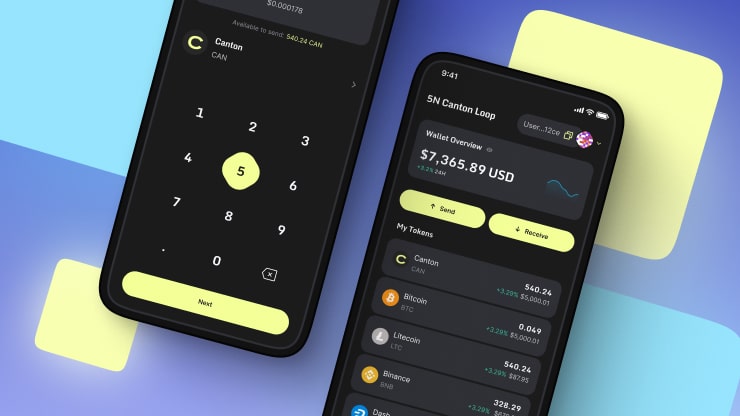
The Canton Network’s first self-custodial wallet
First non-custodial wallet on Canton
Generated $3M revenue in 2 months since launch
Ranked in Top 10 Canton Coin Validator Leaderboard
Explore the case studyStep 3: Connect and validate
Once your app is live, you (or your users) need to run a participant node. This node connects to the Global Synchronizer. The “Proof-of-Life” rewards require high uptime. If your node goes offline, you stop earning.
Don’t scrimp on your node infrastructure. “Proof-of-Life” rewards are binary – you are either alive or you aren’t. A cheap server that disconnects every hour will cost you more in lost rewards than you save in hosting fees.
Complexity check: What does it take?
Before you jump in, you should know the level of effort required for each role. We broke it down so you don’t bite off more than you can chew.
| Role | Technical complexity | Main requirement | Maintenance level |
| Running a validator | Moderate | Docker/Kubernetes knowledge | Medium (updates/monitoring) |
| Building an app | High | Daml proficiency & architecture | High (dev & security) |
| Wallet integration | High | Cryptography & privacy flow | High (security audits) |
| Holding Coin | Low | Compatible wallet software | Low |
Statistics: The numbers don’t lie
Let’s sprinkle in some data to show why this is heating up.
- Reward pool: Monthly rewards for top apps have ranged from 100 Million to 500 Million Canton Coins. That is a massive amount of liquidity flowing to developers.
- Split ratio: The shift is aggressive. We are moving from an 80/20 split (favoring infra) to a 62% allocation for apps by 2029.
- Coin supply: The target issuance is 2.5 Billion per year. This provides a predictable inflation schedule, unlike some chains where issuance varies wildly based on unknown factors.
Future outlook: The 2029 vision
Why is Canton shifting rewards from Super Validators to Apps?
It’s the standard “Bootstrapping” curve.
- Phase 1 (2024): Pay the security guards (Super Validators) to keep the vault safe.
- Phase 2 (2025-2029): Pay the shopkeepers (App Developers) to open stores in the vault.
- Phase 3 (2029+): The economy is self-sustaining.
This long-term thinking is rare. Most projects plan for the next bull run. Canton is planning for the next decade.
The role of security
As the network grows and the rewards become more lucrative, the target on Canton’s back grows larger. Hackers follow the money.
This is why security audit and risk management are non-negotiable. If you are building an app to capture that 62% reward pool, your smart contracts need to be bulletproof. A hack destroys your “Proof of Utility” metrics and shuts off your reward tap.
Comparison: Canton vs. the world
Let’s look at how this compares to the big dogs.
| Feature | Ethereum (L1) | Solana | Canton Network |
| Who gets fees? | Validators (mostly) | Validators | Burned (mostly) |
| Dev rewards? | None (protocol level) | None | Yes (perpetual grant) |
| User rebates? | No | No | Yes |
| Privacy? | Public by default | Public by default | Private by default |
It’s clear that Canton is optimizing for a different game. They are trying to be the global settlement layer for regulated assets.
Integration strategies for enterprises
If you are a CTO or a Product Manager, how do you pitch this to your board?
- The “Free” MVP: Use the reward potential to justify the R&D cost. You can explain that successful MVP development services might pay for themselves via protocol rewards.
- Data-driven decisions: Use business intelligence solutions to track on-chain metrics. Show your stakeholders exactly how much traffic you are generating and how that translates to Canton Coin income.
- Tokenization: If you have assets (real estate, loyalty points, debt), tokenization platform development on Canton offers a liquid market that connects to other private chains.
A note on wallets and custody
We briefly touched on this, but it’s vital. The user experience of collecting rewards depends entirely on the wallet.
If you are building a consumer-facing app, you can’t expect users to run command-line scripts to claim their rewards. You need a slick mobile or web interface.
If you are looking for Canton.Network wallet development services, you need to focus on “Transaction Signing.” Since Canton transactions can involve multiple parties (a “atomic swap” between three banks, for instance), the wallet needs to handle multi-party approvals smoothly. This is a prime example of where MPC wallet development services are indispensable. They provide the cryptographic protocols to securely distribute the signing authority, enabling seamless, policy-controlled multi-party transactions that appear simple to the end-user.
Also, for those interested in the broader scope of holding these assets, knowing how to build a crypto wallet that is compatible with both public and private states is a niche skill. It’s not your average MetaMask clone.

Inside Crypto Wallet MVP Development: Process, Costs, and Real-World Lessons
Crypto Payment Gateway: Costs, Benefits, Implementation
Challenges and risks
We promised to be balanced, so let’s talk about the risks.
- Complexity: Daml is powerful, but the learning curve is steeper than Solidity.
- Adoption: Canton is newer than Ethereum. The liquidity is growing, but it’s not yet at the trillion-dollar mark.
- Dependency: If your business model relies 100% on protocol rewards, you are vulnerable to governance changes. The reward split is programmed to change. You need to be aware of that schedule.
However, for established businesses, these risks are managed through proper blockchain integration services. You don’t just dump code on the mainnet – you test, you simulate, and you audit.
Wrapping up
The Canton Network is doing something brave. It’s trying to realign the incentives of the crypto world away from speculation and toward utility.
By rewarding the developers who build useful apps and the users who actually transact, they are creating a system that mimics a healthy national economy rather than a casino.
- Validators keep the lights on.
- Developers build the shops.
- Users bring the commerce.
- Everyone gets paid based on their contribution.
It sounds simple, but in the blockchain space, it’s revolutionary.
If you are thinking about building on Canton, or if you just want to figure out how to integrate these reward streams into your existing business model, you don’t have to figure it out alone.
At PixelPlex, we specialize in this stuff. Whether it’s dApp development services or full-scale infrastructure setup, we’ve got the team to help you navigate the Global Synchronizer.
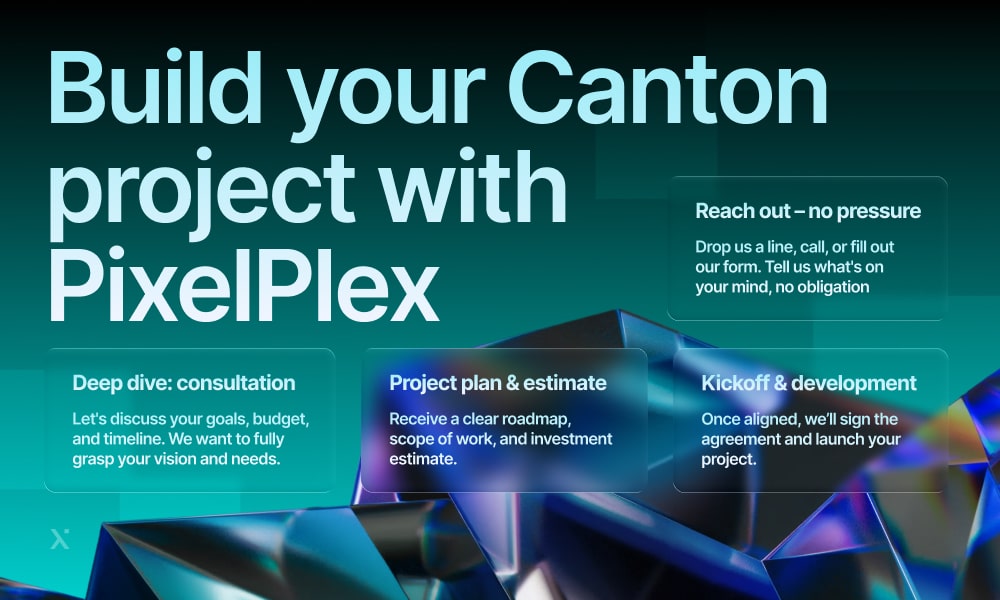
The rewards are there. The infrastructure is ready. The only question is: are you ready to claim your slice of the pie?
FAQ
Not really, it is designed strictly for utility to pay for network synchronization. While the price floats, the system is built to reward people who actively use and secure the network, not just passive holders.
Nope, they got absolutely zero. There was no pre-mine, no pre-sale, and no special allocation – every coin in circulation was earned by someone participating in the network.
Because unlike other chains, Canton treats you like a partner and pays you directly from the protocol rewards just for generating traffic on your app.
It’s basically a participation trophy that actually pays! You get rewarded just for keeping your node online and connected to the Global Synchronizer, ensuring the network stays robust.
No, Canton uses a language called Daml, which is specifically designed for complex financial workflows and strict data privacy.
Fees are designed to be predictable in dollar terms, and the cool part is that users often get a “cashback” rebate on the fees they pay.
The reward schedule is programmed into the network, gradually shifting from paying infrastructure providers (now) to paying app developers more heavily (by 2029).
No, and that’s a feature, not a bug. Canton is private by default, so you only see the transaction data that you are directly involved in.
They are burned (destroyed), which reduces the total supply of Canton Coin and helps balance out the new coins being minted.
It requires some specialized knowledge of Daml and node infrastructure, which is exactly why teams like PixelPlex exist to help you handle the heavy lifting.