
How do you execute high-volume crypto trades without triggering market slippage or drowning in manual spreadsheets? The answer lies in building a robust OTC platform that seamlessly bridges the gap between a Request for Quote and final settlement.
Big OTC crypto trades tend to run into the same problems: on public order books, size gets punished with slippage; “just split the order” works only up to a point and adds timing risk; and once you’re done trading, the real work begins — settlement, counterparty exposure, and compliance. When teams attempt to handle all of this with brokers, chat threads, and spreadsheets, quoting slows down, controls become shaky, and post-trade becomes a cleanup process.
That’s the point of OTC development. A solid OTC platform keeps big trades off the public order book and runs them through a straightforward RFQ flow. It defines who can request a quote, how the price is set, what gets checked before approval, and how the trade ultimately settles. When it’s built well, the process doesn’t depend on constant manual coordination — it carries the trade from request to settlement and continues to function as volume grows.
If you’re planning to outsource OTC crypto exchange development services, it’s a good idea to read this guide before choosing a contractor. Use it as a checklist for vendors: you’ll quickly understand who’s truly capable of putting together a functioning platform from start to finish, and who’s just showing off a pretty interface that requires manual work from an administrator.

Step-by Step Guide to P2P Crypto Exchange Development
What to Know About Decentralized Exchanges?
What is an OTC crypto exchange?
An OTC crypto exchange is built for trades that should stay off the public order book. You do not post size into the market and hope it fills cleanly. You request a quote, get a price, accept it, and then settle the deal on controlled rails.
That is the whole point of OTC — control over execution, control over who can trade, control over settlement, and records when a compliance team asks questions later.
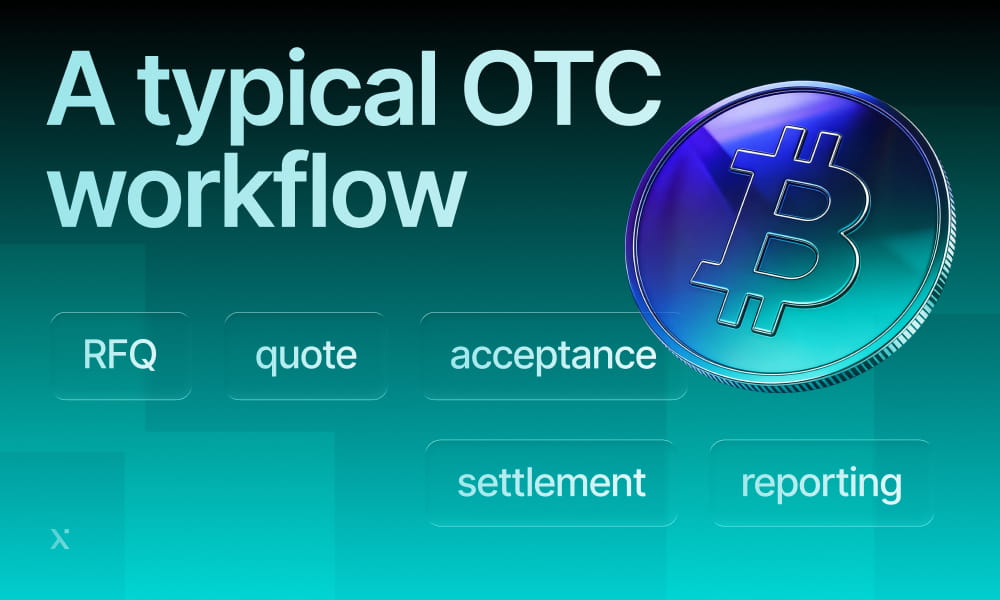
In a real build, the simple flow needs rules at every step. RFQs require TTLs and access rules, while quotes require pricing logic, spreads, and inventory checks. Acceptance needs limits and approvals. Settlement needs custody rails and reconciliation. Reporting needs trade tickets and audit logs that stay consistent.
How OTC differs from other models (in practice)
| Parameter | OTC platform | CEX | P2P marketplace | Broker |
| Price discovery | RFQ / negotiated quotes | Order book | Direct negotiation | Dealer quotes via chat/calls |
| Market impact | Low | Medium–high | Low–medium | Low (depends on execution path) |
| Ideal trade size | Large blocks | Any | Small–mid | Large blocks |
| Privacy | High | Medium | Medium | High |
| Settlement | Custom workflows | Instant matching | Varies | Manual coordination, often bespoke |
| Compliance load | High (B2B-ready) | High | Medium | High (but enforcement varies) |
| Control model | Permissioned clients, limits, approvals | Broad access, standardized rules | Reputation + escrow patterns | Relationship-based, operator-driven |
| Dispute handling | Trade tickets and audit trails | Standardized execution logs | High-touch disputes are common | Depends on records kept, often fragmented |
| What usually breaks first | Post-trade operations, if they are not sufficiently developed | Quality of execution for this size | Fraud and payment friction | Consistency: controls, logging, settlement ops |
In 2026, desks are moving from chat-based OTC to platforms because liquidity is fragmented and reporting expectations are tighter. Institutional OTC trading volumes are growing thanks to dedicated channels. As a result, many desks are moving from chat-based operations to full-fledged OTC platforms.

Centralized Сrypto Exchange Development Explained: From Architecture to Launch

Your Practical Guide to Creating a Decentralized Cryptocurrency Exchange

How Permissioned Blockchains Transform Business: A Detailed Overview
Benefits of OTC crypto exchange development
Public order books do not hide size. Once an order is large enough, it affects the price and attracts attention. Execution becomes harder to control.
OTC trading operations are processed within a closed workflow. Quotes are processed through requests for quotes or negotiations, after which the trade is concluded under specific terms and conditions. This structure is what makes OTC trading platforms valuable for live trading.
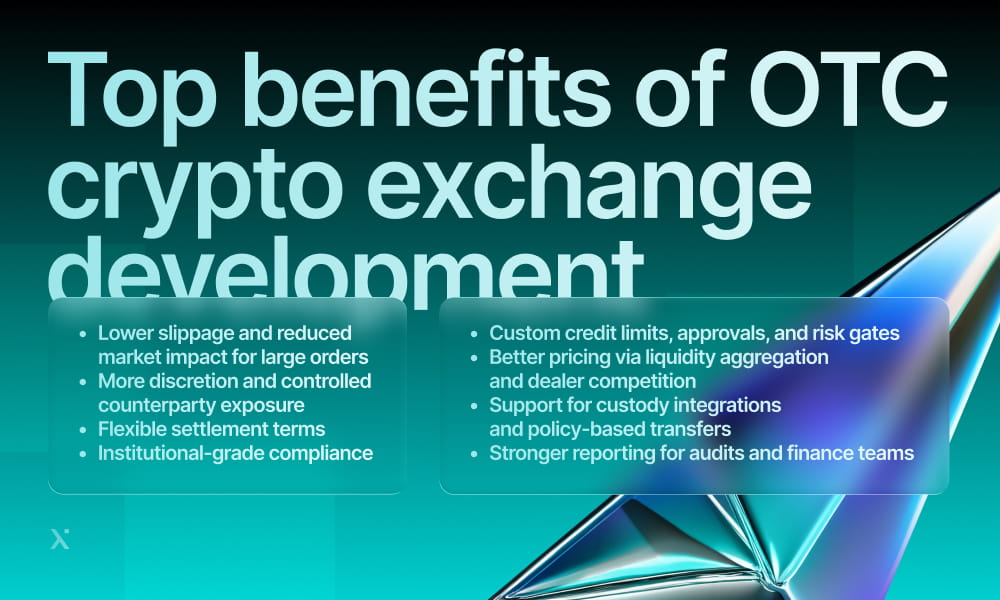
In 2025, desks are being pushed toward this model because liquidity is spread across multiple venues, and reporting expectations are becoming tighter.
Why OTC helps, and what you ship
| Benefit | What you implement | What it enables |
| Lower market impact | RFQ + quote engine | Off-order-book execution |
| Discretion | Private deal tickets | Controlled visibility |
| Risk control | Limits + approvals | Reduced exposure |
| Compliance | KYB + screening | Safer onboarding |
| Better pricing | Multi-LP integrations | Competitive quotes |
| Audit readiness | Immutable logs | Faster audits |

Top Blockchain Projects, Platforms, and Companies in 2026

The Synergy of Blockchain and Artificial Intelligence: Unlocking New Business Opportunities
OTC platform models (what you’re actually building)
When discussing the development of an OTC trading platform, most people overlook the specific type of platform. The architecture of OTC trading platforms varies. They fall into two categories: who bears the risk and where the liquidity will come from. These decisions determine the overall cryptocurrency exchange development cost, legal structure, and level of inventory management complexity.
Axis 1: Principal vs. agency
This determines your relationship to the trade and your risk exposure.
- Principal model (dealer/market maker): Your firm acts as the counterparty. You hold inventory, quote buy and sell prices, and take market risk if prices move between the quote and execution. This requires highly sophisticated, real-time inventory management, hedging, and enough capital to run the desk. High risk, high reward.
- Agency model (broker): Your firm acts as a middleman, serving as an intermediary between buyers and sellers. You source pricing from external liquidity providers (LPs) and route the client’s order without holding the asset. Risk is typically lower, usually limited to execution and counterparty failure, but your margin is derived from fees or a small spread on the sourced quote.
Axis 2: Liquidity Sourcing
This decision is critical because it dictates the complexity of your entire connection layer and, ultimately, the quality of your execution.
- Bilateral (Single-Dealer) Model: The simpler approach. The platform sources all pricing either from its own inventory (principal model) or from a single prime broker (agency model). The architecture is easy to maintain, but you are entirely dependent on that one source for execution quality and competitiveness.
- Aggregated (Multi-Dealer) Model: This significantly increases the complexity. The platform connects to multiple Liquidity Providers (LPs), centralized exchanges, and often internal trading desks to dynamically find the best available price. The trade-off is substantial: you now need sophisticated routing, normalized APIs, and robust fallback logic. The definite upside, however, is superior liquidity and highly competitive client pricing. Similar complexity can also be seen in multi-exchange trading infrastructure, where execution depends on stable integrations across several venues at once.
When evaluating a project, what matters is not its market potential but rather the model within which we accept market and product risks.
| Platform model | Risk profile | Liquidity source | Technical consequence |
| Principal (Bilateral) | High (Inventory Risk) | Single internal desk | Inventory management is core. The connection layer is simpler. |
| Agency (Aggregated) | Low (Execution/Counterparty Risk) | Multiple LPs/Venues | Routing + normalization become core modules. |
| B2C retail OTC | N/A (Often Agency) | Aggregated or single prime broker | UX, KYC/AML scale, and fraud controls drive scope. |
| Institutional B2B | Principal or Agency | Bilateral / negotiated RFQ | Credit lines, API speed, audit logging, reporting. |

Blockchain for Business: Beyond Cryptocurrency to Real-World Value

Building the Unbreakable Exchange: A Developer's Guide to Canton Network
Core features of an OTC crypto exchange
Before you estimate cost, decide which version you’re building. An MVP gets you live and processes real RFQs. An enterprise build is what you need when volume grows, and you can’t rely on manual work to keep things running.
| What it covers | MVP (get live) | Enterprise (run at scale) |
| Who can trade | Basic KYC/KYB + accounts | More rules by region/entity + stricter access |
| How quotes work | RFQ, one pricing source/desk | Multiple dealers/sources, sometimes streaming quotes |
| Approvals & limits | Simple limits | Fine-grained permissions + two-person approval on risky steps |
| Settlement | Track status, some steps manual | More automation + policy checks before funds move |
| Compliance handling | Basic screening + audit log | Alerts turn into cases with owners and outcomes |
| Reporting | Simple exports for finance/risk | Reconciliation + audit-ready packs + accounting exports |
| Integrations | 1–2 vendors | Multiple vendors + backups if one goes down |

What Is MVP in Software Development?

Inside Crypto Wallet MVP Development: Process, Costs, and Real-World Lessons
From discovery to pilot: OTC build stages
OTC projects fail when teams focus on the trading screen and forget everything around it. The real product is the full process: quotes, approvals, settlement, reporting, and the rules behind them. If those pieces don’t work together, you end up with a nice UI and the same manual work behind the scenes.
This is what an end-to-end build typically looks like when planned as a platform, rather than a patch.
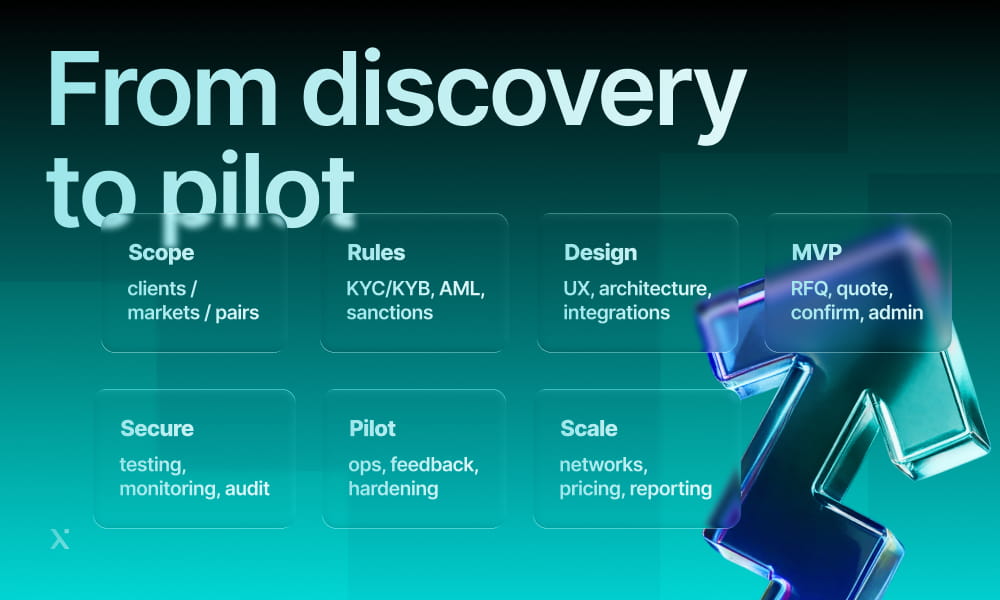
Step 1: Understand what we’re building (product framework)
Start by writing down the basics: who your clients are, where you’ll operate, which currencies and pairs you’ll support, and what limits you want in place. Then describe how a trade will happen day to day, whether it goes through a dealer in chat or through a self-serve account. Finally, map the steps from RFQ to confirmation, settlement, and close.
Result: a short document with requirements and a list of mandatory features (must-haves).
Step 2: Set up the “rules” in advance (legal and compliance)
Decide in advance how you check clients and companies (KYC/KYB), how you filter risks (AML), how you check sanctions, the limits you impose, and what you consider suspicious. Decide what data you store and what reports you download.
Result: agreed-upon policies (KYC/AML/sanctions/limits) and a clear flowchart of the transaction process “as it should be.”
Step 3: Designing how it will work (design and architecture)
Design the key screens (client dashboard, admin panel) and think through how the system processes the transaction step by step. Consider the quotes and integration module separately: liquidity, blockchain providers/nodes, banks/payments. Don’t forget about logs and access rights.
Result: Screen prototypes + technical diagram + task list (backlog).
Step 4: Building an MVP (minimum viable product)
MVP development has a basic start: registration and verification, application, quote, confirmation, statuses and notifications, admin panel, basic wallets/payments. Don’t try to do everything at once.
Result: An MVP capable of conducting a real transaction in a controlled manner.

From Idea to Launch: The Essentials of eCommerce MVP Development

AI MVP Development: How to Validate Ideas Fast Without Breaking the Budget
Step 5: Checking reliability and security (tests and audits)
Test the load, verify calculations, secure the API, configure secrets and access permissions, enable monitoring, and conduct a pen test/audit. Run “what to do if something goes wrong” scenarios.
Result: a stable and secure version, ready for pilot.
Step 6: Launching the pilot and moving into production
Start with a small group of clients, set up support and compliance procedures, learn how to quickly resolve incidents, improve the UX and integrations based on live feedback.
Result: the first production release and clear work procedures for the team.
Step 7: Scaling and improving
Add new networks and currencies, automate risk control, enhance pricing, expand reporting capabilities, increase fault tolerance, and expedite ticket processing.
Result: a mature OTC service that can handle growing volumes and requirements.
Typically, the project needs: a product or business analyst (gathers requirements and describes the transaction process), a tech lead/architect, backend developers, a frontend developer, DevOps/SRE (infrastructure, monitoring, releases), a QA engineer, a security specialist, and a compliance/legal specialist (KYC/AML/sanctions and regulatory). Often, separate roles are assigned to the OTC operator/dealer (handles transactions) and the financial operations specialist (reconciliations, settlements, and closing).
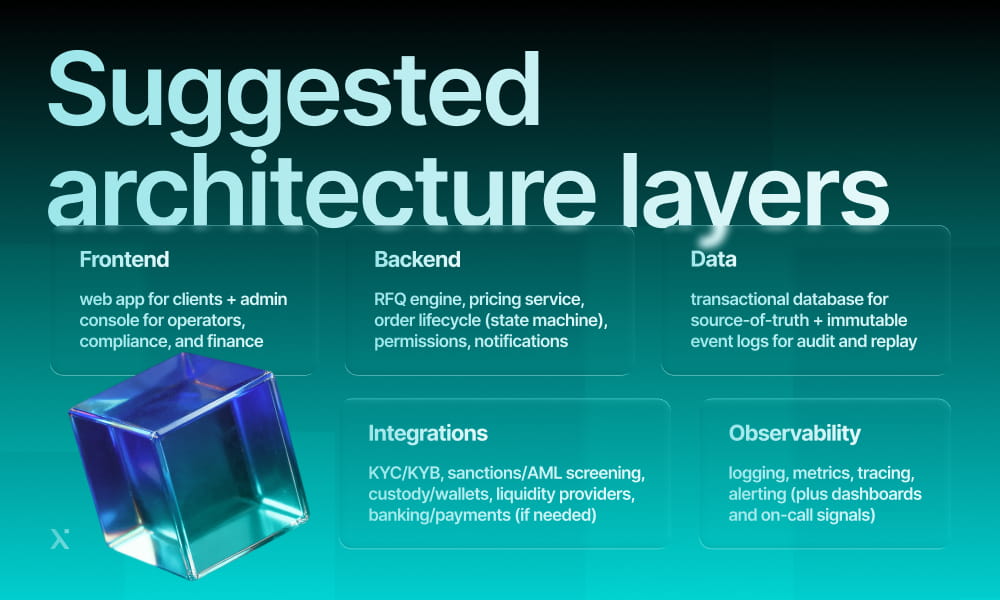
Tech stack options
| Layer | Options | Notes |
| Frontend | React / Next.js | Fast, admin-friendly UI and component ecosystem |
| Backend | Node.js / NestJS, Java, Go | Choose based on throughput needs + team expertise + ecosystem |
| Storage | Postgres | Strong transactional consistency for order and settlement records |
| Cache/Queue | Redis, Kafka / RabbitMQ | RFQ speed, async workflows, event-driven processing |
| Custody | Fireblocks / BitGo / in-house HSM | Depends on the custody model and risk appetite |
| KYC/KYB | Sumsub / Sardine / Onfido | Often region-dependent; pick based on coverage + conversion |
| Screening | Chainalysis / TRM Labs | Policy enforcement + ongoing monitoring and alerts |
| Cloud | AWS / GCP / Azure | Balance compliance requirements, scaling, and internal standards |
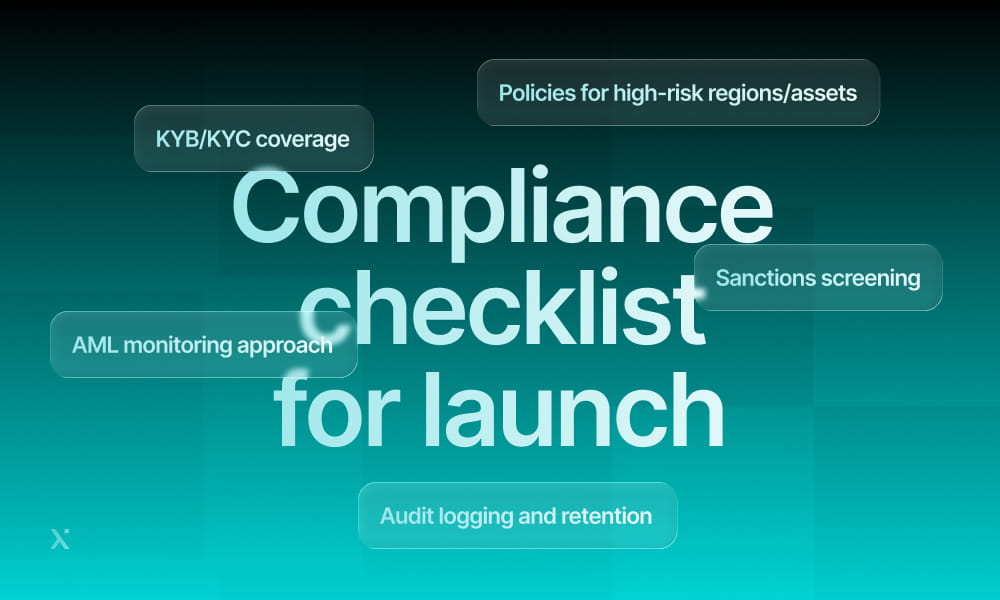
Security and compliance (non-negotiable for OTC)
It’s best to ensure security and compliance from the start. Post-launch rework is almost always painful: you have to rebuild everything on the fly, and every “minor” change entails new checks, new access permissions, and new exceptions.
Start with access and responsibility. Different roles should have different rights, and actions that change risk or move funds require re-approval. This applies to limits, whitelists, and invoicing. The larger the volume, the more often these parameters are checked retroactively, so it’s best to ensure from the start that the system doesn’t allow for “just click-and-drag.”
Encryption shouldn’t be a “deferred” step, but a constantly running background process. Encrypt traffic between the client and services, encrypt databases and storage, encrypt backups. And don’t turn the intermediate stage into a place where “it could have been easier.” This is when problems usually migrate to the production environment.
Monitoring isn’t just a question of “is the service running?” In the OTC market, it’s important to notice unusual behavior: sudden spikes in bid requests, repeated quote requests, unusual logins, changes in payout settings, and settlement rollback chains. All of this often seems insignificant until it becomes a serious incident.
Finally, you need a log that allows for quick recovery. Logs should be designed so that they cannot be undetected retroactively. Record key events: bid requests, quotes, approvals, cancellations, limit changes, and payouts.

From Code to Confidence: Inside Smart Contract Audit Pricing

How Much Does AI Development Cost in 2026?
MVP vs. enterprise: OTC build cost in practice
People always want one number. With OTC platforms, that’s rarely possible, because the cost depends on what you’re building. The biggest drivers are the scope of features, the number of integrations, the level of control required, and the degree to which you want to automate versus having operations handle it.
So it’s usually easier to talk in ranges.
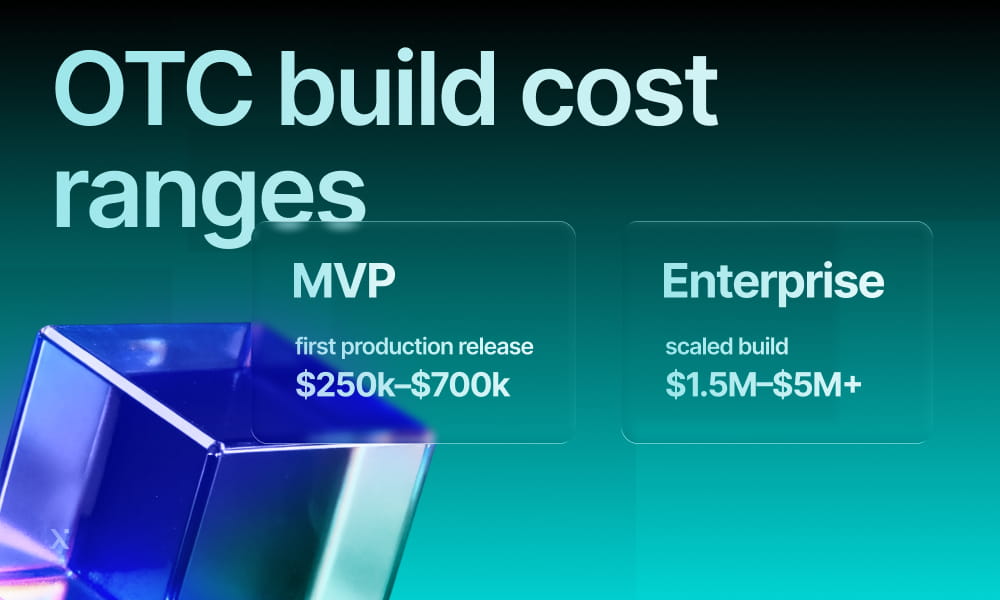
MVP range
Ballpark: $250k–$700k for a first production MVP.
Assumptions behind this range:
- One OTC desk, one legal entity, limited geography
- 1–2 vendors for custody and KYC/KYB (and a basic screening provider)
- Web client portal + admin console (dealer/compliance/ops)
- RFQ flow + quote + confirm + basic order lifecycle
- Semi-manual settlement (ops-driven checks, manual bank steps if fiat is involved)
- Basic audit trail, basic reporting exports
- Sensible security baseline (MFA, RBAC, maker-checker on critical actions)
What MVPs typically spend time (and money) on are integration, permissions/approvals, and the “last mile” around transaction logs and audit trails. The user interface rarely takes center stage.
Enterprise range
Ballpark: $1.5M–$5M+ depending on how far “enterprise” goes.
What typically pushes it into this bracket:
- Multiple legal entities/desks, shared or segregated liquidity
- Multi-jurisdiction compliance requirements and different onboarding rules
- Streaming quotes, smarter pricing, tighter latency targets
- Heavier compliance automation (risk scoring, case management, ongoing monitoring)
- More robust reporting (regulatory-style exports, reconciliation packs, audit-ready data)
- Redundancy, disaster recovery, and higher uptime targets
This is also where platform work is evident: event-driven architecture, replayable audit trails, operational tooling, and the ability for “everything keeps working even when a vendor is down.”

Web3 Development Cost: Breaking Down What Really Drives the Price

Smart Contract Development Cost Demystified: What Every Business Should Know
What a reliable OTC looks like
Most OTC platforms don’t fail because pricing is off. They fail in the daily grind: a request gets missed, an approval stalls, someone changes a detail in the wrong system, and later nobody can untangle what happened. The platforms that hold up keep the process simple and minimize the risk of errors. They reduce the number of handoffs, establish clear rules within the process, and ensure that finance and compliance departments can obtain reliable data without having to track down people.
Hybrid OTC + liquidity aggregation
If quotes depend on who’s online, prices will fluctuate. It’s simpler and more reliable when quotes are collected automatically: you retrieve prices from multiple sources, format them accordingly, apply your own spread and limit rules, and then display them to the client. As a result, quotes arrive faster and appear more stable.
Multi-asset OTC for treasury teams
A deal can be “closed” in trading, but in finance, it’s not considered closed until all accounts are reconciled. Therefore, working platforms immediately provide what treasury needs: roles and limits, clear trade logs, daily summaries, and reconciliation files. This means less manual cleanup and less chaos at the period close.
Institutional desk modernization
Many workstations start with chat and Excel. Someone agrees on terms in a discussion, someone else copies the details into a spreadsheet, and then operators are left to figure out what actually happened. This is feasible with small volumes, but quickly becomes unbearable as activity ramps up. The solution is quite simple and not at all aesthetically pleasing: give each trade a clear lifecycle, require a second approval for important steps, and log every key action. This won’t earn you any demo rewards, but it will make daily trading easier.

How to Create A White Label Crypto Exchange in 7 steps

Your RWA Platform in a Month? We Made It Happen
Top OTC crypto exchange development companies
We reviewed each OTC crypto exchange development company using open-source signals and publicly available materials, then compared them side by side so it’s easier to shortlist vendors. The focus is on what matters for bringing OTC products into production — security, compliance readiness, depth of integration, proven end-to-end execution, and the ability to support the platform post-launch.
| Company | What they emphasize | Clutch min. project | Clutch hourly rate | Why consider |
| PixelPlex | Full-cycle crypto exchange development, wallet support | $25,000+ | $50–$99/hr | Stronger “enterprise build” vibe: exchange modules + wallet plumbing + monitoring/compliance-type capabilities. |
| Antier Solutions | White-label exchange positioning | $10,000+ | $25–$49/hr | Good fit when you want a white-label/bespoke exchange build with strong compliance-forward framing. |
| HashCash Consultants | Pushes white-label exchange | $5,000+ | $50–$99/hr | If you want a vendor that pairs services with a packaged exchange product line and can customize around it. |
| SoluLab | Explicit OTC crypto exchange development | $25,000+ | $25–$49/hr | Good if you want a vendor that clearly markets OTC as a standalone service (not just “exchange dev”) |
| Rapid Innovation | Strong speed positioning | $25,000+ | $100–$149/hr | Good if you want a time-boxed MVP push and a team that markets fast delivery as the core differentiator. |
We looked at security, compliance, integrations, and whether the team has shipped and supported similar systems in production. That includes access controls and approvals, audit logs, KYC/KYB and sanctions checks, custody and liquidity connections, and post-launch support.

Top 10 AI Software Development Companies 2026

Top 10 Machine Learning Development Companies
Crypto Payment Gateway: Costs, Benefits, Implementation
Conclusion
Creating an OTC cryptocurrency exchange isn’t so much about “adding a request for quote screen” as it is about streamlining the entire trading process — from pricing and approvals to settlements, reconciliations, and audit reporting. Problems typically arise in the same places: manual data transfer, inconsistent control mechanisms, and post-trade work that occurs in chat rooms, spreadsheets, and people’s heads.
If you’re planning an OTC cryptocurrency exchange, start by choosing a platform model (principal or agency, bilateral or aggregated), as this determines your risk profile, compliance burden, and depth of integration. Then, build an MVP as a closed-loop solution — onboarding new clients, requesting quotes, settlement tracking, and logs — that won’t break down in the future. When volume starts to show up, “enterprise” mostly means two things: more automation and more resilience. That’s where multi-source pricing, heavier compliance workflows, tighter approvals, proper reconciliation, and real ops tooling come in, so the desk can keep running even when one of your vendors goes down.
When evaluating a vendor for outsourcing OTC cryptocurrency exchange development services, ignore the glossy demos. Instead, demand proof of effective security controls, compliance, deep integration experience, and reliable post-launch support. This specific due diligence determines whether the platform can handle real trading volume, or if it will simply devolve into a modern interface hiding the same manual work you started with.
FAQ
A crypto-only settlement is relatively focused, running primarily on custody and wallet flows. The moment you introduce fiat, you are adding serious layers of complexity. This includes integrating banking and payment rails, significant additional reconciliation effort, and tighter operational controls around funding windows, cutoffs, and critical settlement reversals.
Many platforms begin with a strong web portal and an internal administrative console. They then quickly move to add robust client APIs, which are non-negotiable for institutional clients. These APIs allow clients to submit RFQs and pull trade data programmatically — a core requirement for serious traders.
It depends on the scope, but most teams don’t aim for a “big bang” launch. They roll out a pilot first to prove the RFQ-to-settlement flow with real trades, then layer in more automation and integrations once the process is running smoothly.
Some teams keep conversations in Slack or Telegram and treat the platform as the system of record. Others prefer to chat inside the product, so the discussion and the trade details stay together instead of being scattered across threads.
White-label can work when speed-to-launch matters and requirements stay close to a standard model. For deeper controls, unique approvals, or multi-entity setups, custom usually avoids painful retrofits. In some cases, teams start with white label crypto exchange development services and then budget for hardening and customization after the pilot.
Skip the demo polish and ask what they’ve actually shipped. Which custody and KYC/KYB tools they integrated, how approvals and access are handled, what the audit trail looks like, and what support looks like after launch.