
If arbitrage were only about price differences, it would be solved already. Turning it into a system that survives real market conditions is where most attempts fall apart.
Crypto markets are fast, but they’re not perfectly synchronized.
One venue reacts instantly to new demand. Another white label cryptocurrency exchange development company takes a moment to adjust. Somewhere else, liquidity shifts quietly, leaving a brief imbalance behind. These moments are short, often invisible, and constantly replaced by new ones. Taken together, they form the underlying rhythm of the market.
This rhythm is what arbitrage bots are built to follow. They don’t predict markets or chase trends. They watch for moments when prices fall out of alignment and act before those gaps close again.
The article focuses on how arbitrage works in practice today, where it actually happens, and what it takes to build systems that can keep up as crypto markets continue to evolve as part of modern cryptocurrency development efforts.
Crypto arbitrage bots in a nutshell
A crypto arbitrage bot is an automated system that compares prices across different trading venues and executes trades when the same asset is priced differently. It doesn’t predict trends or take directional bets. Instead, it reacts when prices drift out of alignment and steps aside when they don’t.
In simple terms, imagine the same asset trading at slightly different prices at the same time. For a brief moment, one exchange might show Bitcoin priced slightly lower than another. An arbitrage bot notices that gap, buys on the cheaper venue, sells on the more expensive one, and exits before the prices converge again.
At first glance, this may sound similar to other types of trading bots. The difference becomes clearer when you compare how arbitrage bots operate versus systems that rely on market predictions, such as directional trading bots.
| Feature | Arbitrage bot | Directional trading bot |
| Main goal | Capture temporary price differences | Profit from price moving up or down |
| What it relies on | Mispricing + reliable execution | Correct market prediction |
| Behavior in flat markets | Can still trade if gaps appear | Often inactive without a trend |
| What matters most | Execution quality and controls | Signal accuracy and timing |
In short, arbitrage is less about anticipating where prices will go and more about acting precisely when they briefly fall out of sync.
That role sounds simple. The execution rarely is.
In practice, every decision an arbitrage bot makes happens at the level of a single trade. Before acting, the system has to evaluate whether a visible price difference is still viable once real-world constraints are applied. Each potential trade is filtered through a set of practical checks:
- Trading fees that immediately narrow margins;
- Available liquidity that determines how much can actually be traded;
- Execution speed, which decides whether both sides of the trade complete as planned;
- Funding and borrowing costs that can turn a small gain into a loss;
- Exchange rules and limits that restrict how and when orders can be placed.
Only when a price difference survives these filters does it become a real opportunity.
What arbitrage bots are used for
As we discussed earlier, arbitrage bots are typically designed to watch a specific part of the market and act when price gaps appear there. In practice, this means focusing on one clear task rather than trying to trade everywhere at once.
For example, a bot might only compare Bitcoin prices on two centralized exchanges and trade when the difference becomes large enough. Another bot may focus on a single decentralized exchange, correcting price differences between two liquidity pools. Others compare spot prices with derivatives to capture funding or basis gaps.
Each of these setups solves a different problem and operates under different conditions. That’s why arbitrage bots are usually grouped by where they operate and what kind of price gap they are designed to capture.
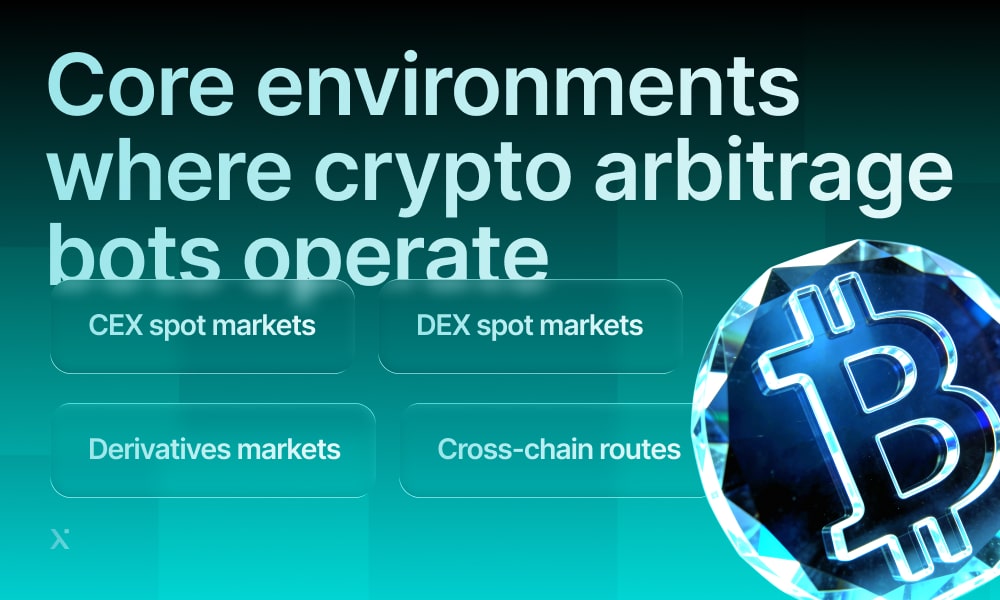
The most common uses of arbitrage bots fall into four categories.
CEX arbitrage
CEX arbitrage happens when the same asset trades at slightly different prices on different centralized exchanges at the same time. These differences appear because each exchange has its own users, order flow, and liquidity, so prices don’t always update in perfect sync. Building and maintaining reliable trading infrastructure for such strategies often requires solid CEX development, including exchange integrations and order-execution logic.
For example, Bitcoin might be trading at a slightly lower price on one exchange while another exchange still shows a higher price. A CEX arbitrage bot buys on the cheaper exchange and sells on the more expensive one before the prices align. In some cases, the opportunity exists within a single exchange as well, where a bot cycles through multiple trading pairs (often called a triangular loop) to end up with more of the starting asset.
What bots are used for here:
- Detecting price differences across exchanges in real time;
- Executing orders quickly while respecting rate limits;
- Managing inventory across venues to avoid relying on withdrawals.

Centralized Сrypto Exchange Development Explained: From Architecture to Launch

How to Build a Decentralized Exchange Like Uniswap
DEX arbitrage
In decentralized exchange development, the main bot’s challenge is executing the trade safely once you see one. Unlike centralized exchanges, DEX prices are determined by liquidity pools, which means every swap changes the price along a curve. Because arbitrage bots interact directly with on-chain logic, a smart contract audit is essential to ensure swap execution and edge-case handling behave.
Because of this, price gaps often appear after large trades. A pool can drift away from the broader market while other pools, DEXs, or centralized exchanges still show a different price. DEX arbitrage bots trade against these mispriced pools to bring prices back toward market levels, whether the gap exists entirely on-chain or between a DEX and a CEX.
What bots are used for here:
- Estimating swap outcomes before execution, including slippage;
- Choosing the right pool or route as liquidity shifts;
- Controlling transaction delivery to reduce failed trades.
Derivatives arbitrage
Derivatives arbitrage focuses on price differences between spot markets and derivatives, most commonly perpetual futures. These gaps show up as funding-rate differences or price mismatches between where an asset trades now (spot) and where it’s priced in perpetual contracts. And this isn’t a small corner of the market anymore: Kaiko notes that derivatives make up over 75% of all crypto trading activity.
What makes derivatives arbitrage different is that speed alone isn’t enough. The real challenge is staying hedged while prices move and funding rates change. If a hedge drifts or margin isn’t managed carefully, a strategy that looks market-neutral can quickly turn into directional exposure, especially when markets gap.
What bots are used for here:
- Keeping spot and derivatives positions tightly hedged;
- Tracking funding rates and basis changes in real time;
- Managing margin usage to avoid liquidation during volatility.
At the institutional level, one of the most common forms of derivatives arbitrage is the cash-and-carry (basis) trade on CME Group. The structure is simple in principle: buy Bitcoin exposure in the spot market and simultaneously short Bitcoin futures to capture the premium futures often trade at relative to spot. This setup is widely used by hedge funds and market makers during periods of strong demand and is commonly referenced as a market-neutral strategy rather than a directional bet.
Cross-chain arbitrage
Cross-chain arbitrage looks for price differences between the same asset on different blockchains or Layer-2 networks. These gaps exist because each chain has its own liquidity and transaction finality, so prices don’t always move together.
What sets cross-chain arbitrage apart is settlement timing. Even when a price gap is clear, both sides of the trade cannot usually be completed at the same moment. One transaction may finalize on one chain, while the other is delayed by bridges, confirmations, or finality rules. During this gap in time, prices can move, turning an intended arbitrage into temporary exposure. In practice, managing these settlement flows often overlaps with crypto payment gateway development.
What bots are used for here:
- Coordinating trades across chains with different settlement speeds;
- Managing bridge delays and partial execution scenarios;
- Applying fail-safe logic when one leg completes and the other doesn’t.
Benefits of arbitrage bots for business
1. Ability to operate continuously
Crypto markets don’t slow down at night, on weekends, or during holidays. Price gaps can appear at any hour, and many of them close within seconds. An arbitrage bot allows a business to stay active without needing a team watching screens around the clock.
While a trading desk is offline, a bot can continue monitoring dozens of exchanges and execute trades the moment conditions align. This becomes especially important at scale. According to CoinGecko, the top centralized exchanges processed about $17.4 trillion in spot trading volume in 2024, while decentralized exchanges handled over $1.7 trillion. In markets that busy, manual reaction is neither fast nor consistent enough. Bots give businesses a way to participate continuously, using the same rules every time.
2. More efficient use of capital across venues and chains
Many arbitrage strategies fail not because the idea is wrong, but because capital isn’t in the right place at the right time. Bots help businesses manage inventory automatically, keeping funds where they’re most likely to be used and rebalancing when conditions change.
A simple example: instead of discovering too late that one exchange is short on stablecoins while another has excess balance, a bot can track this in real time and rebalance before it becomes a problem. This allows businesses to reduce idle funds and avoid missing opportunities caused by poor timing or manual processes.
3. Access to market-neutral strategies with built-in risk control
Many businesses prefer strategies that don’t rely on predicting whether prices will rise or fall. Arbitrage bots make this possible by supporting market-neutral setups, where returns come from price relationships or funding differences rather than outright market direction.
A common example is spot–perpetual arbitrage. A bot buys an asset on the spot market and simultaneously opens a corresponding position in perpetual futures, keeping the exposure hedged as prices move. The system then adjusts the hedge and reacts to funding rate changes automatically, allowing businesses to maintain market-neutral exposure even as conditions shift.
4. More predictable operations
As trading activity grows, even small operational mistakes can escalate quickly. For businesses, arbitrage bots serve as control systems. They operate within predefined rules, apply the same logic consistently, and react automatically when conditions move outside expected ranges.
Instead of relying on manual decisions under pressure, a bot can slow down execution, reduce position sizes, or pause trading entirely when predefined thresholds are reached. This allows businesses to stay operational while limiting risk during volatile periods.

AI and Crypto: Top 15 Promising Use Cases and Applications

AI Integration for Business: A Practical Guide to Efficiency and Profit
Why proper development matters: What to expect in 2026
As markets evolve, the requirements for arbitrage systems change with them. In 2026, crypto arbitrage bot development is no longer just about implementing strategy logic, but about meeting a new set of operating conditions shaped by how exchanges and protocols now behave. This shift closely mirrors the standards seen in enterprise blockchain development, where reliability and operational discipline matter as much as functionality.
In practice, teams should expect the following shifts:
- API limits as a hard operational constraint. If a bot sends too many requests or retries too aggressively, exchanges completely block it. Binance already enforces this behavior: repeated rate-limit violations can escalate from temporary throttling (HTTP 429) to short-term IP bans (HTTP 418) that last minutes or even days. This means bots must be built to respect limits and slow themselves down when needed.
- Execution failures as a normal operating condition. Arbitrage systems must assume that not every trade will execute cleanly. This shift means bots can no longer be built around the assumption of perfect execution. Instead, they must be designed to handle failure by default, with the ability to reconcile incomplete trades and pause activity automatically rather than improvising under pressure.
- Competition moving off public price signals. A growing share of on-chain trading no longer happens through simple public swaps where price gaps are easy to observe. Instead, more flow is routed through auctions and intent-based execution. Systems like UniswapX already operate this way, shifting the edge away from “spotting a gap” and toward pricing accuracy.
- Faster and more extreme stress regimes on-chain. On-chain markets can shift from stable to highly adversarial conditions in a matter of hours. Regulatory analysis from the European Securities and Markets Authority shows that MEV is widespread and can change execution dynamics sharply. In this environment, arbitrage systems that aren’t designed to handle stress predictably tend to fail.
Risks if development goes wrong (and what it can cost you)
Arbitrage is only as strong as the system behind it. What looks straightforward on paper depends on many moving parts working together, and when any of them fail, arbitrage stops being a controlled strategy and turns into exposure.
The four risks below are the ones that most often turn solid ideas into costly outcomes under real 2026 market conditions.
| Risk area | Direct consequences |
| Execution risk | – Unintended inventory exposure – Slippage erases expected margin – Small losses compound over time |
| Infrastructure risk | – API throttling or temporary bans – Missed or delayed executions – Downtime during volatile periods |
| On-chain execution risk | – Reverted transactions – High fees for failed attempts – Losing trades to better-connected bots |
| Security and compliance risk | – API key leakage or misuse – Frozen accounts or investigations – Losses exceeding trading profits |
Execution risk
Execution risk occurs when an arbitrage trade can’t be completed as planned. In practice, this usually means one part of the trade succeeds while the other fails. For example, a bot buys an asset on one exchange, but before it can sell on the second exchange, the price moves or available liquidity disappears.
What makes execution risk costly is repetition: a system that frequently enters trades where the second leg is fragile may lose small amounts over and over again. Over time, these “almost successful” trades quietly turn arbitrage from a controlled strategy into a steady source of losses.
Infrastructure risk
Infrastructure risk appears when an arbitrage bot loses access to the market itself. This usually happens when the system sends too many requests or doesn’t slow down when an exchange expects it to.
A common case is rapid order placement and cancellation during volatile periods, which can trigger exchange limits. Instead of getting slower responses, the exchange blocks the connection altogether. While the bot is disconnected, it can’t complete trades or manage open positions, turning arbitrage into missed fills and unmanaged exposure.
On-chain execution risk
On decentralized networks, an arbitrage bot can see a price gap and still fail to execute it on favorable terms. Transactions are ordered and routed competitively, often behind the scenes. When smart contract development doesn’t fully account for execution ordering and gas dynamics, even correctly identified arbitrage opportunities can fail at the point of execution.
As a result, a bot may send a transaction to take advantage of a price gap, but another participant gets there first. By the time the bot’s trade goes through, the price has changed, the trade fails, or fees are paid without any profit. In practice, this means a bot can spot the right opportunity and still lose money again and again.
Security and compliance risk
These are often the most expensive failures. Security and compliance risk arises when problems outside the trading logic lead to losses far greater than any single failed arbitrage. In practice, it often starts with something simple: an API key stored insecurely or sensitive data leaking through logs or internal tools. To reduce custody-related exposure, teams increasingly rely on MPC wallet development, which replaces single private keys with distributed signing schemes and minimizes single points of failure.
Compliance is becoming part of day-to-day operation. Under the EU’s DAC8 framework, businesses will be required to collect and report certain crypto-asset transaction data for EU residents starting January 2026, with reporting obligations following in 2027. When security and compliance are postponed or treated as secondary, arbitrage risk shifts from missed opportunities to frozen accounts or direct asset loss.

A Complete Guide to Crypto-Asset Reporting Framework and DAC8

Crypto Compliance: Key Regulations and Consequences of Non-Compliance
Crypto arbitrage bot development process
With the basics defined and the trade-offs understood, the following section breaks down how to develop a crypto arbitrage bot for real market conditions.
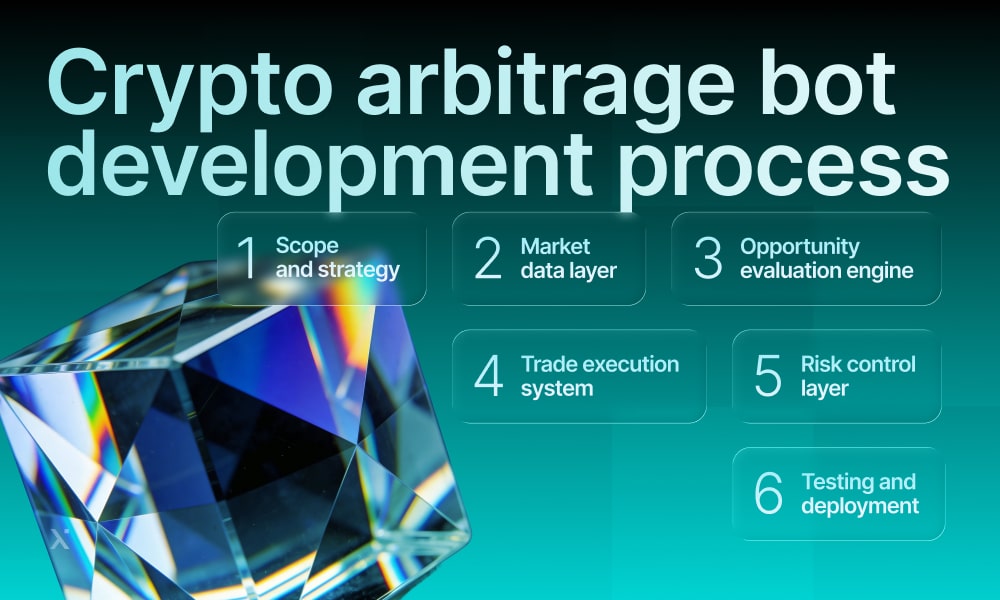
Step 1: Define scope and constraints
Every serious build starts by narrowing the problem to avoid a common trap: building a “universal” arbitrage bot in theory that never works in practice. A focused approach to MVP development helps surface those issues early, before complexity and capital exposure grow.
Imagine you’re starting to design a bot from scratch. Before any trading logic is written, you need to decide where this bot will live and what it’s allowed to touch. Maybe it only compares prices on two centralized exchanges. Maybe it focuses on one DEX route, or a single spot-perpetual setup. Along with that comes a clear view of how much capital it can use and when it should stay out of the market entirely.
Just as important are the constraints that don’t come from the strategy itself. Exchanges impose API security and its limits. Networks introduce latency. Businesses may have internal rules or regulatory obligations. All of these shape what the bot can realistically handle.
Step 2: Build the market data and normalization layer
This step is about building the data foundation the bot will later rely on, not the trading logic itself.
At this point, the bot doesn’t make decisions or place trades yet. Instead, you’re creating the part that collects market information and prepares it for future use. This includes pulling live data from exchanges and protocols (prices, order books, trades, funding rates, or pool states) and organizing it into a consistent format. If this data isn’t aligned, later steps will be based on incorrect assumptions.
Step 3: Implement opportunity detection and cost modeling
Here, the bot moves from simply observing the market to judging which opportunities make sense after costs. Using the aligned market data from the previous step, the bot now asks a practical question: if we tried to take this price gap, would it actually make sense after all real costs are applied?
To answer that question, the bot looks beyond the visible price difference and factors in:
- Fees and rebates;
- Available liquidity and expected slippage;
- Latency and the chance that both sides of the trade fill;
- Funding or borrowing costs (for derivatives);
- Gas and transaction costs (on-chain).
Instead of producing a simple “trade/don’t trade” signal, the bot builds a ranked list of opportunities based on how attractive they remain after these costs.
Step 4: Design the execution and order management system (OMS)
This is the point where the bot starts acting on the opportunities it has identified.
The order management system (OMS) handles how trades are placed and tracked once the bot decides to move. It manages the lifecycle of each order, making sure trades are executed as intended and that the bot remains aware of what has actually happened on each exchange. In arbitrage, this also includes knowing which side of a trade to execute first and how to exit safely if things don’t go as planned.

Guide to Crypto Arbitrage: Tricks, Tips & Insights

Canton Network Reward System: How Canton Coin Pays Developers to Build Real Value
Step 5: Add risk controls, safeguards, and monitoring
Once a bot is able to execute trades, the next priority is making sure it knows when to slow down or stop.
At this stage, you add the rules that protect the system when markets behave unexpectedly. These controls define how much risk the bot is allowed to take, how it should react when losses grow, and what happens when conditions move outside normal ranges. In regulated environments, they also help support crypto compliance through enforced limits and monitoring, forming the basis for ongoing security audit and risk management. This layer keeps an arbitrage bot from blindly pushing forward when assumptions break.
Step 6: Test, deploy, and iterate under real conditions
The final step isn’t about flipping a switch and calling the bot “live.” It’s about moving to real market behavior.
Teams typically progress through a few controlled phases:
- Historical replay or backtesting;
- Paper trading or sandbox environments;
- Limited live deployment with small position sizes.
The focus here is to observe how the bot behaves when exposed to real conditions. Only after the system proves stable in these conditions does it begin to scale. From there, development becomes iterative, with improvements added gradually.
Many arbitrage bots appear to work well in testing, but live markets behave differently. Prices move unevenly, liquidity shifts without warning, and trades don’t always complete as expected. Small execution issues can accumulate over time if the system isn’t designed to notice and respond to them, and even basic infrastructure mistakes can cut a bot off from venues entirely.
Core components of a crypto arbitrage bot
A crypto arbitrage bot is built from several core modules, each responsible for how the system observes the market and acts safely. In practice, this often requires blockchain integration services to connect exchanges and execution layers into one system.
The modules below outline the key components most teams actually build.
| Module | Primary responsibility |
| Market visibility | Collect and normalize live market data |
| Opportunity filtering | Decide which price gaps are worth trading |
| Trade execution | Place, track, and unwind orders safely |
| Capital positioning | Ensure funds are available where needed |
| Safety controls | Limit losses and stop trading when risk rises |
| System observability | Monitor behavior and explain decisions |

Blockchain for Business: Beyond Cryptocurrency to Real-World Value

DAML Development for Business: A Practical Guide to Building Multi-Party Applications
Market visibility
Market visibility defines how accurately the bot understands current market conditions. By consolidating price and liquidity data from multiple venues into a consistent view, this module ensures that decisions are based on accurate inputs.
What it does:
- Collects live prices and liquidity from exchanges and protocols;
- Normalizes data so values can be compared across venues;
- Detects when data is delayed or no longer trustworthy.
Opportunity filtering
Opportunity filtering determines which price gaps are worth considering once real trading costs are taken into account. Not every visible discrepancy leads to a profitable trade, and this module prevents the bot from reacting to noise. In more advanced setups, teams may incorporate AI development services to improve how opportunities are ranked.
What it does:
- Checks whether a price gap still makes sense after fees and slippage;
- Estimates how much volume can realistically be traded;
- Filters out opportunities that are too small or risky.
Trade execution
Trade execution turns evaluated opportunities into real trades on the market. In live trading, orders may fill partially, get rejected, or execute at worse prices than expected. This module ensures those situations don’t turn a neutral arbitrage trade into unintended exposure.
What it does:
- Places buy and sell orders on selected venues;
- Tracks order status in real time, including partial fills;
- Handles cancellations and safe exits when execution breaks down.
Capital positioning
Capital positioning determines whether the bot can act when an opportunity appears. This module keeps track of balances across venues and prevents situations where a trade looks profitable but can’t be executed because capital is stuck elsewhere.
What it does:
- Monitors balances across exchanges and chains;
- Keeps funds distributed according to strategy needs;
- Triggers rebalancing when inventories drift too far.
Safety controls
Safety controls determine how the bot behaves when market conditions move outside expectations. Their purpose is to limit damage. Instead of continuing to trade blindly, these controls ensure the bot slows down or stops entirely when volatility rises or assumptions no longer hold, preventing small issues from turning into large losses.
What it does:
- Enforces limits on position size and potential losses;
- Reduces activity during unstable or abnormal conditions;
- Automatically shuts down trading when risk thresholds are crossed.
System observability
System observability provides visibility into how the bot behaves over time and why it makes certain decisions. It helps teams spot problems early, explain unexpected outcomes, and improve behavior based on evidence rather than guesswork. Because observability involves sensitive operational data, teams often rely on data security services to protect logs.
What it does:
- Logs decisions, trades, and errors for later review;
- Tracks performance and unusual behavior;
- Sends alerts when human attention is required.
Who you need to build a crypto arbitrage bot
Once a crypto arbitrage bot runs in real markets, it behaves like a small trading system: it processes live data, makes decisions under time pressure, and executes trades. Because of that, building one is rarely a one-person task. Even small teams need clear ownership across strategy, engineering, and operations for the bot to work reliably.
Here are the core roles most teams rely on when building and running a crypto arbitrage bot:
-
- Strategy/Quant researcher for defining the arbitrage approach, validating opportunities after costs, and choosing which market niches to pursue first.
- Backend/Trading systems engineer for turning trading ideas into a working system that connects to exchanges, processes market data, and executes trades reliably.
- Risk and controls owner for setting exposure limits, defining loss thresholds, and deciding when the bot should slow down or stop.
- DevOps/Infrastructure engineer for keeping the bot available and responsive under real market load and strict API constraints.
- Security-focused engineer for protecting API keys, credentials, and infrastructure access.
If the arbitrage strategy includes on-chain or DEX execution, teams usually add:
- On-chain/protocol engineer for handling smart contract interactions, swap simulation, and transaction execution in adversarial on-chain environments.

Top Blockchain Companies Revealed: How to Choose the Right Development Partner

The Agent Payments Protocol (AP2): A New Standard for Autonomous Commerce
How long does it take to develop a crypto arbitrage bot?
The time required to build a crypto arbitrage bot depends on how far the system needs to go beyond a prototype. A simple build can demonstrate logic quickly, but a bot designed to run in real markets requires more time to mature.
In practice, development timelines usually fall into a few broad stages:
| Development stage | Timelines |
| Prototype/Proof of concept | 2–6 weeks |
| MVP | 2–5 months |
| Production-grade system | 6–12+ months |
The key takeaway is that development time scales with reliability, not ambition. Testing an idea can be fast, but most of the effort goes into making the bot behave predictably when conditions aren’t ideal. Building safeguards and handling edge cases often takes longer than writing the initial trading logic.
How much does a crypto arbitrage bot development cost?
There’s no single price tag for a crypto arbitrage bot. As with timelines, the cost of crypto arbitrage bot development depends less on the trading idea itself and more on how reliable and production-ready the system needs to be. A basic build that demonstrates logic can be relatively inexpensive, while a bot designed to trade live under real market conditions requires significantly more investment.
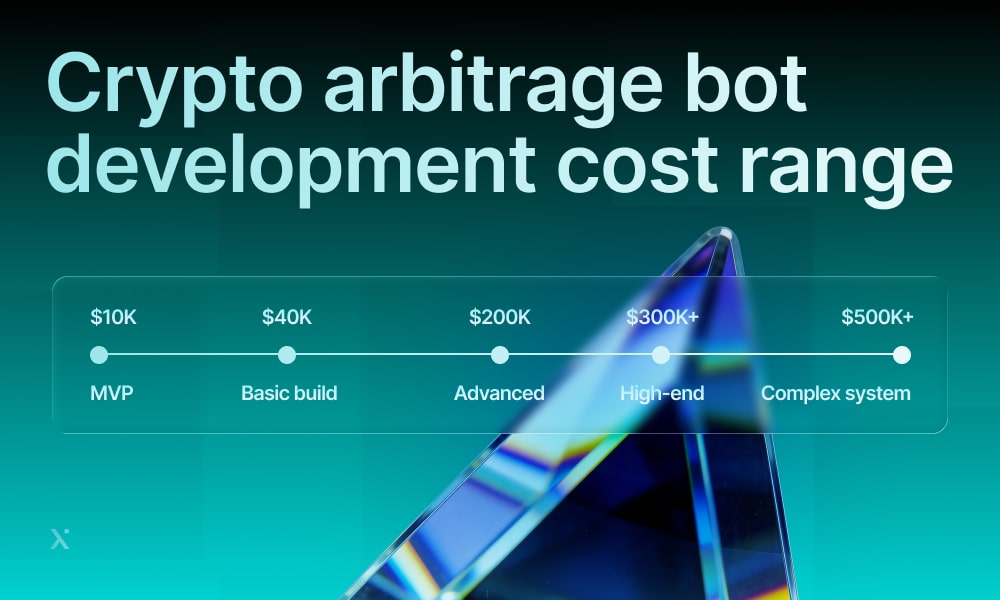
A practical way to frame 2026 budgets looks like this:
- Prototype/proof-of-concept (single niche, paper trading/sandbox): $15k–$60k;
- MVP (limited live trading, strong risk controls, 1–3 venues): $60k–$200k;
- Production system (multi-venue, 24/7 ops, monitoring, hardened security): $200k–$500k+.
It’s also important to keep in mind that costs don’t end at launch. For arbitrage systems, where external dependencies change frequently, ongoing upkeep is a normal part of operating a stable bot.
Successful case studies of crypto arbitrage bots
Hummingbot’s AMM arbitrage strategies
Hummingbot is one of the clearest real-world examples of arbitrage automation in practice, largely because it’s an open-source framework that traders actually run. According to the project, Hummingbot supports 50+ exchanges, and users have generated $34B+ in aggregate trading volume across 140+ trading venues using the framework.
In late 2020, Hummingbot shipped a concrete AMM arbitrage setup: a Balancer connector bundled into the v0.33 release, alongside a new amm-arb strategy. The logic reflects the on-chain reality described earlier in this article: AMM pools drift after large swaps, and the edge lies in execution rather than prediction. The bot continuously compares AMM pricing with external venues and only acts when the price gap survives real costs such as fees and slippage.
PixelPlex’s multi-exchange arbitrage bot and platform
PixelPlex built a custom crypto arbitrage trading platform with an integrated bot designed for a single operator trading across multiple centralized exchanges. The goal was to move beyond a standalone script and deliver a full system: reliable connectivity to major venues, support for core assets like Bitcoin and Ether, and real-time execution tied to a dedicated control interface rather than manual oversight.
To achieve this, the bot was integrated with five major exchanges: Kraken, Binance, Bittrex, Bitfinex, and Coinbase, and supports simultaneous 3- and 4-way arbitrage across multiple trading pairs. While the system scans order books at high frequency, execution is gated by predefined conditions, ensuring trades only happen when expected returns survive real-world costs. This setup reinforces a theme seen throughout this article: long-term arbitrage performance depends more on execution discipline and system design than on detecting every visible price gap.
Check out one more multi-user crypto arbitrage bot by PixelPlex: a Binance ↔ VALR arbitrage platform with BTC/USD/ZAR support and compliance considerations.
Cases like these highlight why arbitrage success depends on system design rather than strategy alone. This is where a crypto arbitrage trading bot development company with hands-on experience becomes essential.
Bonus: What successful arbitrage systems tend to get right in 2026
When you look at real arbitrage systems that continue operating over time, they often share the same traits. The exact strategy may differ, but the way these systems are built and run looks surprisingly similar.
These patterns don’t guarantee profit, but they strongly increase the chances that a bot keeps working under real conditions.

- Execution matters more than finding many opportunities. Many bots see the same price gaps. Only a few manage to act on them reliably. Systems that focus on clean execution usually perform better than those that try to trade every visible signal.
- Starting narrow before expanding. Successful bots usually begin with one clear use case. They prove it works first, then grow carefully. Trying to cover too many venues or strategies early often creates more problems than gains.
- Risk controls built in from the start, not added later. Bots that survive volatile periods don’t rely on manual intervention. They slow down or stop automatically when conditions change. Systems without this behavior tend to fail at the worst possible time.
- Clear visibility into what the bot is doing. Teams that understand their bot’s behavior can react faster when something goes wrong. Bots that run without monitoring often fail quietly, leaving problems unnoticed until losses appear.
How PixelPlex handles such a development
As shown in the case above, PixelPlex has already worked on building crypto arbitrage bots for live, multi-exchange trading. That hands-on experience shapes how the team operates as a crypto arbitrage bot development company: not by delivering isolated trading logic, but by designing full systems that behave predictably under real market conditions.
This approach defines PixelPlex’s crypto arbitrage bot development services and shows up across the way the team delivers arbitrage solutions:
- Proven custom arbitrage solutions. PixelPlex has implemented multi-exchange arbitrage systems with 3- and 4-way mechanisms, allowing simultaneous trades across multiple pairs and platforms based on client needs.
- Scalable architecture and exchange integration. Arbitrage back ends are built so new exchanges, assets, or strategies can be added without reworking the core system.
- Risk management built in. Clients can define profitability thresholds and risk parameters; the bot enforces them so trades only execute when they meet criteria, reducing unintended exposure.
- Rapid yet disciplined rollout. Development follows a structured process, with staged testing and controlled deployment. For many projects, this results in a stable first release within roughly 3 months, depending on scope.
- End-to-end support and future extension. Post-launch maintenance, integrations, and strategy refinements are part of the engagement, helping businesses evolve their bot over time.
If you’re looking to move from an arbitrage idea to a system that can operate under real market pressure, PixelPlex can help plan and build that path. Contact PixelPlex to discuss your goals and explore what a production-ready arbitrage bot could look like for your use case.
Conclusion: What “good” looks like in 2026
In 2026, a “good” crypto arbitrage bot is defined by reliability. It needs to keep working when markets become noisy or unpredictable. As liquidity spreads across more venues, the advantage shifts away from clever signals – execution quality becomes the deciding factor. Bots that start with a clear focus and handle imperfect execution tend to last longer than those that chase every visible gap.
Success now comes from consistency. Teams that succeed treat arbitrage as an ongoing capability rather than a one-off build, often investing in a crypto arbitrage bot development platform that can evolve over time. That’s what turns arbitrage from a short-term tactic into something that can be sustained as market conditions, venues, and execution dynamics continue to change.
FAQ
The main risk is that trades don’t go as planned. One side of the trade may execute while the other fails, prices can move suddenly, or an exchange may become unavailable at the wrong moment. When a bot isn’t built to handle these situations, small issues can turn into repeated losses.
While you can technically start small, many professional operators suggest starting with higher capital (e.g., $100,000–$250,000+) to overcome fees, slippage, and execution costs effectively and to make the economics meaningful.
Crypto arbitrage still exists, but competition has increased sharply. Price gaps tend to be smaller and close faster, especially on high-volume assets. Profitability now depends on execution speed, fee management, and how reliably trades complete under live conditions.
You start with the visible price difference, then subtract everything that reduces it. That includes trading fees, slippage, network or withdrawal costs, and the risk that one side doesn’t fill as expected. If there’s still a margin left after all of that, the trade may be worth considering.
Pre-built bots can be useful for learning or experimentation, but they’re often limited once you move into real markets. They usually can’t be adjusted deeply for specific exchanges, risk limits, or execution conditions. Over time, teams that rely on arbitrage often move toward crypto arbitrage trading bot development to build systems that better match how they trade and operate under real conditions.
Extremely important. Delayed or inconsistent data makes the bot trade gaps that no longer exist. That leads to partial fills, failed orders, or direct losses. Accurate, current data keeps decisions tied to real prices and live liquidity.