
Keeping your money under a mattress was a bad idea in 1920, and keeping your crypto simply in a wallet is a bad idea today. But here is the problem: trying to maximize your returns in the DeFi space often feels like a full-time job.
You have to wake up at odd hours, calculate gas fees that cost more than your actual dinner, and constantly move tokens between protocols like a nervous squirrel moving nuts before winter. What can help? Probably the DeFi Vault.
It is a piece of automated architecture that takes the headache out of yield farming. If you have ever wondered how some investors seem to compound their wealth while sleeping, the answer usually lies in a vault.
At PixelPlex, our blockchain development team has spent years building, auditing, and refining financial protocols. We have seen the good, the bad, and the code that makes it all happen. That is why we compiled this massive guide, basically to strip away the complexity and show you exactly what is happening under the hood of these digital asset treasuries.
Why do we need Vaults?
To understand the solution, we have to look at the problem. In the early days of DeFi (we are talking ancient history, like 2020), “yield farming” was a manual sport.
If you wanted to earn a return on your USDC or ETH, you had to:
- Deposit assets into a lending protocol.
- Wait for some interest to accumulate.
- Claim that interest (pay a gas fee).
- Sell the reward token for the base asset (pay a gas fee).
- Deposit that new principal back into the pile (pay a gas fee).
Unless you were moving millions, the network fees often ate up all the profit. At that point, you were just recycling it into gas fees for Ethereum miners, which is why infrastructure-focused builds like crypto mining pool development put so much emphasis on monitoring from day one.
A Vault solves this by pooling resources. It is a smart contract or a cluster of them that accepts funds from thousands of users and executes these strategies as a single entity. It effectively socializes the gas costs and automates the compounding process.
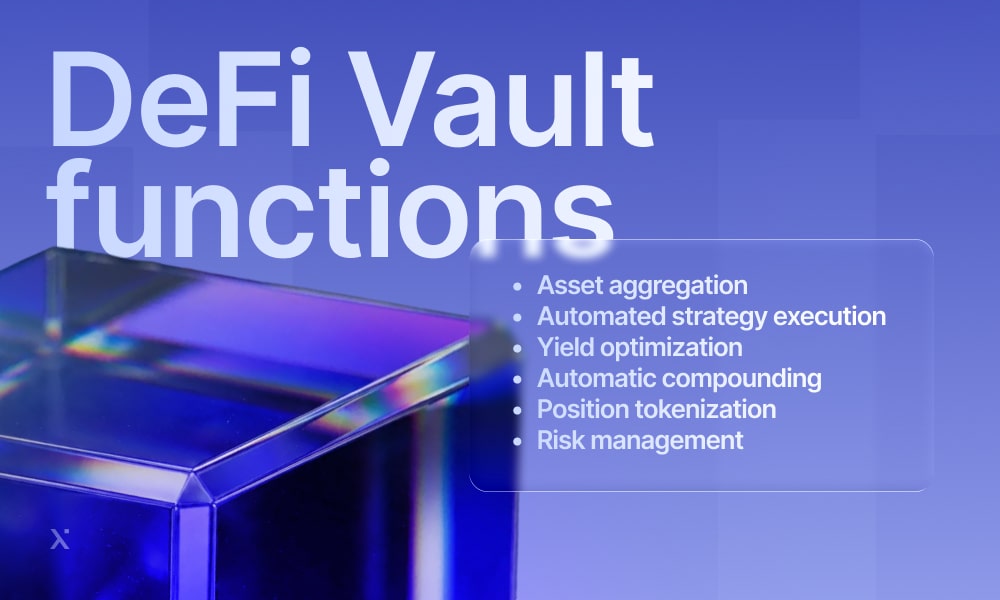
Think of it less like a bank account and more like a cooperative investment robot. You put tokens in, the robot goes to work, and when you come back, you (hopefully) have more tokens than you started with.
The term “Vault” was popularized by Yearn Finance. Andre Cronje, the founder, built the first iterations because he was simply tired of manually moving his own stablecoins around to find the best lending rates every day. Laziness, as it turns out, is the mother of innovation.

Canton Network Reward System: How Canton Coin Pays Developers to Build Real Value

The Agent Payments Protocol (AP2): A New Standard for Autonomous Commerce
The anatomy of a Vault: architecture and logic
Research into the technical structure of these instruments reveals a clever separation of duties. A robust DeFi vault system isn’t just one big pile of code but usually split into two distinct components: the Vault and the Strategy.
This modularity is crucial for security and upgradeability. If you need to change how the money is invested, you shouldn’t have to rebuild the whole bank. You just change the investment manager.
The Vault (the accountant)
The Vault acts as the face of the operation, it is the gatekeeper. Its job is boring but essential: it keeps the books.
When you interact with the protocol, you are talking to the Vault contract.
- It accepts your deposit (e.g., USDC, DAI, or ETH).
- It issues you a “receipt” token, often called a share or an LP token (like USDC).
- It sits on the funds until the Strategy calls for them.
- It handles withdrawals, burning your receipt tokens and sending you back your share of the pool.
For businesses looking to build their own financial instruments, our DeFi development services focus heavily on ensuring this specific contract is bulletproof, as it is the primary entry point for user funds.
The Strategy (the worker)
While the Vault is the accountant, the Strategy is the trader. This is a separate smart contract that tells the Vault what to do with the money.
A Strategy is programmed with a specific set of instructions:
- Where to go: “Take this USDC and put it into Aave.”
- What to do: “Supply it as collateral, borrow DAI against it, and deposit that DAI into Curve.”
- When to harvest: “Check for rewards every 6 hours.”
- How to reinvest: “Sell the reward tokens and buy more of the underlying asset.”
The beauty here is isolation. The Vault knows how much the Strategy has earned, but it doesn’t need to know the complex logic of how it earned it. This keeps the main storage contract clean and simple, reducing the attack surface.
The Vault vs. the Strategy
| Feature | The Vault contract | The Strategy contract |
| Primary role | Custody & accounting | Execution & yield generation |
| User interaction | Direct (deposit/withdraw) | Indirect (invisible to user) |
| Risk level | Low (passive storage) | High (interacts with external apps) |
| Upgradeability | Rarely upgraded (immutable) | Frequently swapped for better yields |
| Analogy | The bank teller | The hedge fund manager |
How it works: the lifecycle of a deposit
Let’s break down the journey of a user’s funds. This process relies on a concept called “pooling.”
Imagine you have $1,000. On your own, executing a complex 5-step compounding strategy on Ethereum might cost $50 in gas. That is a 5% loss instantly. But if 1,000 people put $1,000 into a Vault, the pot is now $1,000,000. The Vault executes that same strategy, paying the same $50 gas fee. The cost per user is now a fraction of a penny.
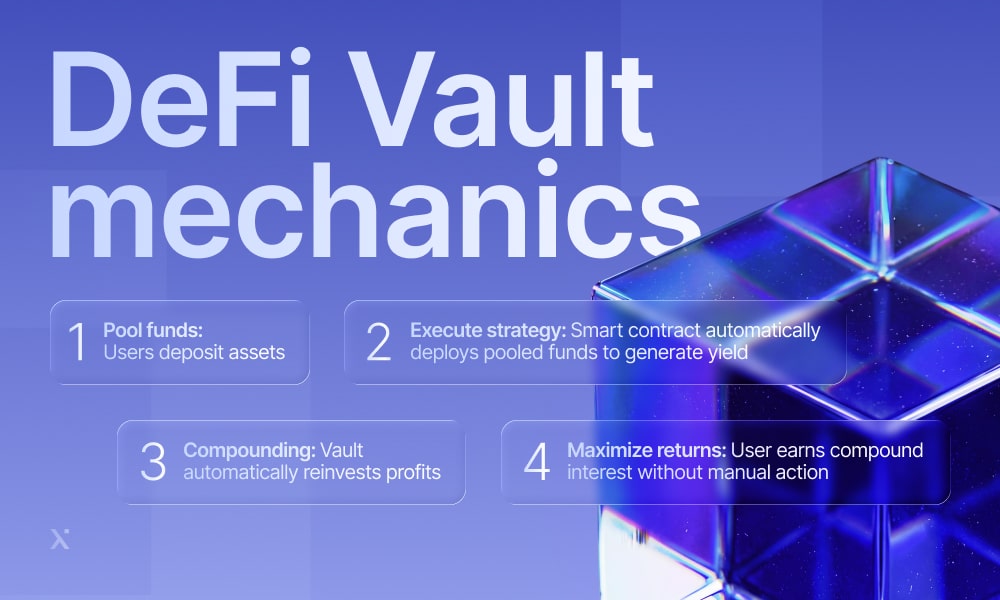
Step 1: The deposit and “Shares”
When you send funds to a Vault, you aren’t just giving it money but buying equity in the pool. The Vault mints Shares for you.
This is a critical concept. You don’t own specific USDC tokens inside the vault. You own a percentage of the total liquidity.
User share = (Amount deposited * Total supply of shares) / Total value locked
If the Vault makes a profit, the number of shares you hold stays the same, but the value of each share increases. This is why these are often called “interest-bearing tokens.”
Step 2: Allocation
The Vault pushes the idle assets to the Strategy. The Strategy might split the funds. For example, a risk-managed vault might send 70% to a low-risk lending protocol and 30% to a high-risk liquidity pool.
Integrating these complex logic flows requires specialized engineering, involving smart contract development to ensure the allocation weights (the percentages) can be adjusted dynamically without pausing the whole system.
Step 3: The harvest
This is the magic moment. Periodically, the Strategy function harvest() is called. This can be triggered by a bot, a keeper, or a user.
During a harvest:
- The Strategy claims rewards (like CRV, COMP, or AAVE tokens) from the external protocols.
- It swaps those reward tokens on a decentralized exchange (DEX) back into the base asset (e.g., selling CRV to buy more USDC).
- It adds this new USDC back into the principal pile.
Now, the total pool of money has grown, but the total number of shares has not. The price per share just went up.
Step 4: Withdrawal
When you are ready to leave, you send your shares back to the Vault. The Vault calculates the current value:
Withdrawal amount = Your shares * Current price per share
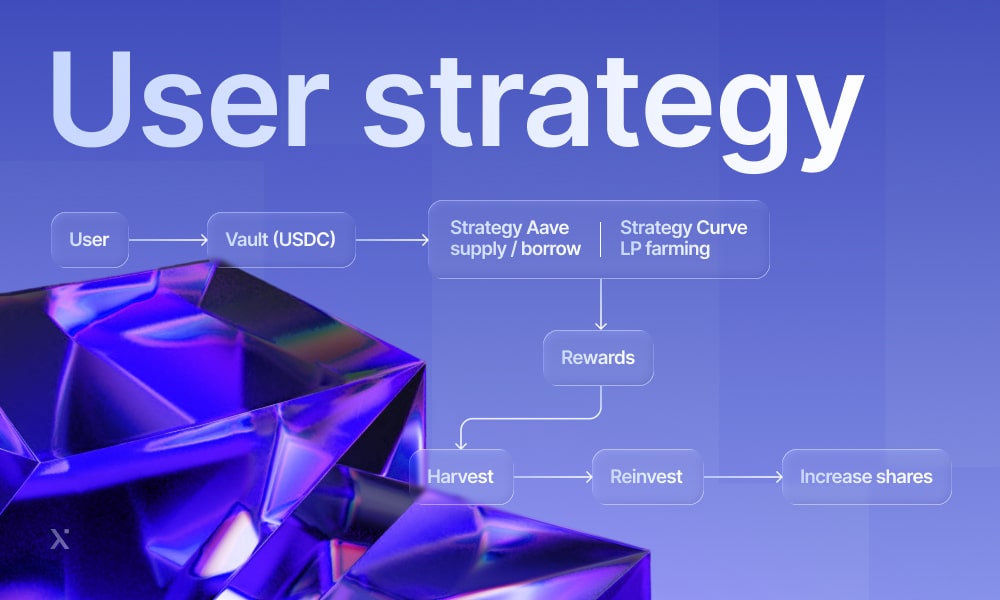
Because of the auto-compounding in Step 3, you get back your original deposit plus the accumulated profit.

Code, Capital, and Compliance: A Deep Dive into Canton Network Smart Contract Development

Are Corporate Crypto Stashes The Future? A No-Nonsense Guide to DATs
A practical example: The USDC strategy
Let’s visualize a specific scenario based on our research data. Imagine a “Balanced USDC Vault.”
The Setup:
- User deposits 1,000 USDC.
- Vault splits the capital based on a weighted allocation.
The Split:
- 70% (700 USDC) goes to Aave. This is the safe play. It earns interest from borrowers.
- 30% (300 USDC) goes to Curve. This is the yield play. It provides liquidity to stablecoin swaps and earns trading fees plus CRV incentives.
The Automation:
Every 24 hours, the harvest function triggers.
- The Strategy collects the lending interest from Aave.
- It collects the CRV tokens earned from the Curve pool.
- It sells the CRV for more USDC.
- It puts all that new USDC back into the Vault.
The user never touched Aave or Curve. They never paid for a swap. They just held the Vault token.
On top of that, many vaults issue so-called “vault tokens” – receipt tokens that represent your share of the strategy. These tokens can often be traded or used in other DeFi protocols, which means your position is not strictly locked inside the vault. As long as there is a liquid market for the vault token, you can exit or rebalance by selling it instead of withdrawing the underlying assets directly.
Strategy complexity
In the beginning, vaults were simple. They just lent money out. Today, strategies are incredibly sophisticated.
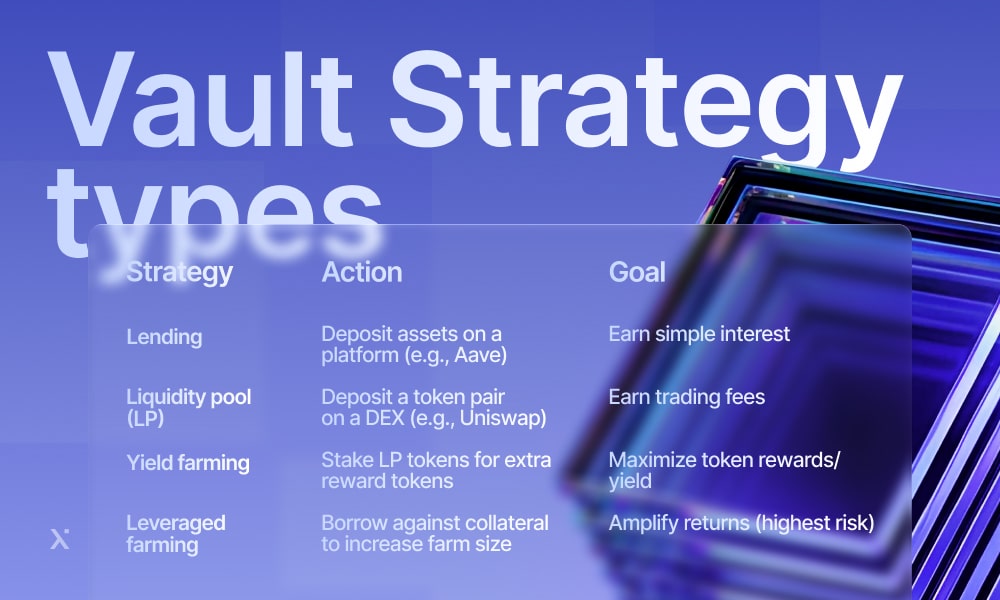
1. Simple lending
The strategy deposits assets into Compound or Aave. The yield comes from borrowers paying interest. It’s low risk, low return.
2. Liquidity provision (LP) & farming
The strategy enters a Liquidity Pool (e.g., ETH/USDC on Uniswap). It earns trading fees. Then, it takes the LP token receipt and stakes it in a “Gauge” to earn governance tokens. This is classic DeFi yield farming development at work – layering multiple sources of income (fees + rewards) into one product.
3. Leverage loops (the “Folding” strategy)
Here is where it gets spicy. A strategy can deposit ETH as collateral, borrow USDC, swap USDC for more ETH, and deposit that ETH again. Repeat 3 times.
- Result: You are now earning yield on 3x your initial capital.
- Risk: If the price of ETH drops, you get liquidated instantly.
4. Cross-chain vaults
With the rise of interoperability, some modern vaults move assets between blockchains (e.g., Ethereum to Arbitrum) to chase the highest yield. This requires advanced bridging infrastructure.
Protecting Ideas: How Blockchain Is Becoming the Guardian for Your Creations

Canton Network Wallet Development: A Guide on How to Do It Right (and What It'll Cost You)
Security
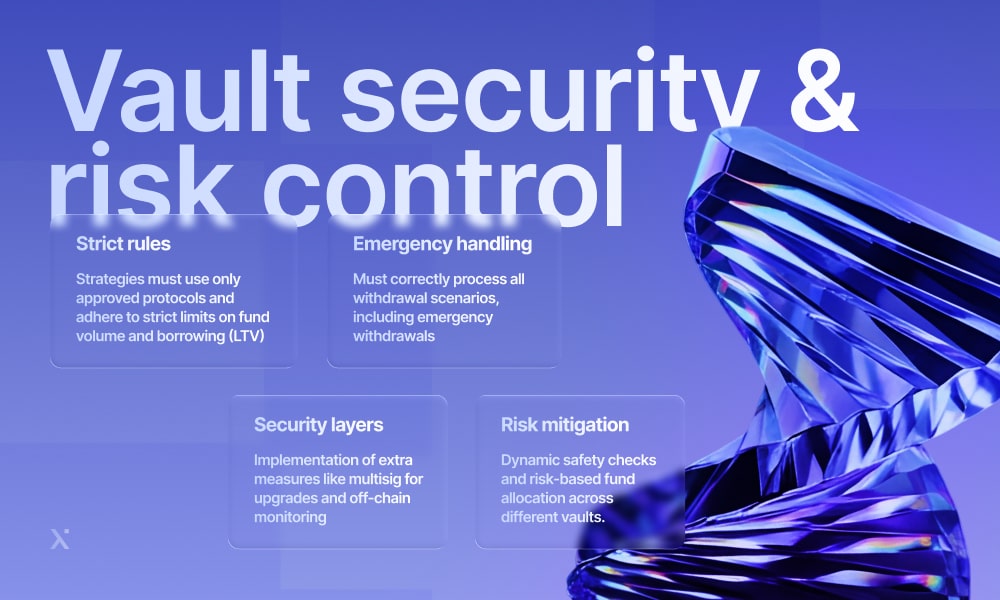
We cannot talk about DeFi without talking about risk. When you use a Vault, you are adding layers of risk. You have the risk of the Vault smart contract, the Strategy smart contract, and the external protocols (like Aave or Curve) that the strategy interacts with.
If any of those break, your funds are gone.
Risk management mechanisms
High-quality vaults implement strict safety checks:
- Debt limits: The Strategy cannot borrow more than a certain percentage of the pool.
- Emergency shutdown: A “Panic Button” that pauses all deposits and withdrawals if a bug is detected.
- Slippage protection: Ensuring that when the strategy swaps tokens, it doesn’t lose value due to low liquidity.
This is why security audit and risk management is a survival requirement. Before we deploy any vault logic for a client, it undergoes rigorous stress testing to simulate market crashes and malicious attacks.
The risk matrix
| Risk type | Description | Mitigation |
| Smart contract risk | Bugs in the code allowing theft. | Multiple audits & bug bounties. |
| Liquidation risk | Asset price drops, causing collateral loss in leverage strategies. | Automated deleveraging bots (Health Factor monitoring). |
| Peg risk | A stablecoin (e.g., USDT) loses its $1 value. | Diversification across multiple stablecoins. |
| Strategy risk | The underlying protocol (e.g., a new farm) gets hacked. | limiting allocation to risky protocols (e.g., max 5%). |
The role of data and transparency
One of the great lies of traditional finance is that you don’t need to know what your money is doing. In DeFi, verification is everything.
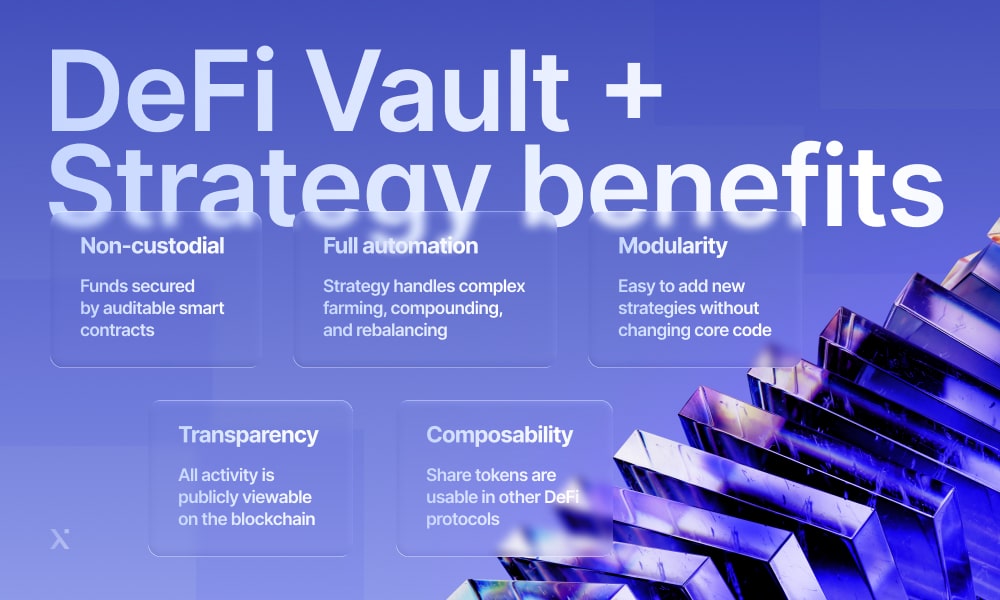
Because everything happens on-chain, you can technically track every cent. However, raw blockchain data is messy. A good Vault platform provides a dashboard showing:
- Current APY (Annual Percentage Yield).
- Historical performance.
- Exact asset allocation (Where is my money right now?).
Building these dashboards requires robust business intelligence solutions that can query the blockchain, index the data, and present it in a human-readable format. Investors need to see the “Harvest” events to believe them.
Crypto Payment Gateway: Costs, Benefits, Implementation

Enterprise Blockchain: Prom Promise to Profit
The “Standardization” revolution: ERC-4626
For a long time, every DeFi protocol built vaults differently. This was a nightmare for aggregators. If you wanted to build an app that tracked balances across Yearn, Beefy, and Badger, you had to write custom code for each one. Then came ERC-4626.
This is a tokenized vault standard. It creates a universal “interface” for vaults. It dictates exactly how a vault should handle deposits, withdrawals, and balance calculations.
- Before: Every vault spoke a different language.
- After: Every vault has a USB port. You just plug it in.
This standardization is massive for blockchain integration services, as it allows developers to build applications that can instantly interact with hundreds of different vaults without writing custom adapters for each one.
Diverse use cases: enterprise and private vaults
Vaults aren’t exclusively built for retail investors chasing temporary high returns. We are seeing the core Vault + Strategy logic being adapted for use cases across the financial world, particularly in areas demanding regulatory compliance and operational sophistication.
Treasury management and corporate DeFi
Large corporations, DAOs, and crypto projects often hold substantial treasuries. Managing these funds passively means missing out on yields, but manual management is costly and risky. Vaults offer a solution by providing a dedicated, transparent strategy for corporate treasury management.
For instance, a corporation could deposit its stablecoins into a permissioned Vault designed to only interact with audited, KYC-compliant lending pools. This setup automates cash flow and yield generation while maintaining essential oversight and adherence to internal financial policies.
Regulatory compliance and custom risk profiles
The biggest hurdle for traditional finance entering DeFi is compliance. They cannot use permissionless protocols where they might interact with sanctioned or unknown wallets. Instead of relying on open platforms, enterprises utilize the modular Vault architecture to build private, crypto compliance solutions.
They can hardcode restrictions into the Strategy contracts, dictating exactly which assets, protocols, and whitelisted counterparties can be involved. This transforms the Vault from a simple yield generator into a compliance engine tailored to their jurisdictional needs.
Enhancing utility in payment solutions
Vault logic can be integrated into consumer-facing applications that require high liquidity and instant rewards. For example, a service that uses crypto payment solutions. The stablecoins paid by customers don’t need to sit idle for settlement. They can be temporarily swept into an ultra-low-risk Vault Strategy (e.g., overnight lending) for the few hours they are held, automatically generating micro-yields for the platform before being paid out. This subtle automation improves the platform’s profitability without creating user friction.
How to get started with Vaults
You are ready to stop manual farming. How do you actually get into a vault?
- Get a wallet: You cannot interact with DeFi without a Web3 wallet (like MetaMask or Rabby). If you are building a platform, providing a seamless wallet experience is key. (Check our guide on how to build a crypto wallet to understand the security mechanics involved).
- Choose a chain: Ethereum Mainnet has the most liquidity but high fees. L2s like Arbitrum or Optimism, or sidechains like Polygon, are cheaper for smaller deposits.
- Pick a protocol: Stick to the battle-tested ones (Yearn, Beefy, etc) with billions in TVL (Total Value Locked).
- Approve and deposit: You will sign a transaction allowing the Vault to take your tokens, then a second transaction to actually deposit them.

Selecting Layer 2: Polygon vs Arbitrum vs Optimism
The “Approve” transaction is often where people get into trouble. When you approve a contract to spend your USDC, you are often giving it “infinite” permission by default. If that contract is malicious, they can drain your wallet later. Always use tools to revoke permissions you don’t need!
Web3 Antivirus by PixelPlex can help proactively secure your assets by letting you analyze your wallet risk and revoke high-risk approvals with a single click.
The future of yield: tokenized real world assets (RWAs)
The next frontier for vaults isn’t just crypto lending, it is the real world.
We are already seeing vaults that:
- Take USDC deposits.
- Lend that money to real-world businesses or buy US Treasury Bills.
- Pass the yield back to the depositor.
This requires a bridge between on-chain liquidity and off-chain legal structures. Tokenization platform development is exploding right now because it allows traditional assets (real estate, credit, stocks) to be wrapped into a Vault strategy.
Suddenly, a user in Argentina can earn a yield derived from US corporate credit, all accessed via a simple interface on their phone.
Tips for the wise investor
Before you throw your life savings into a smart contract, remember these three rules:
- APY is volatile: That “400% APY” you see? It usually lasts for about 6 hours. As more people deposit, the yield dilutes.
- Impermanent loss: If you enter a Vault that uses Liquidity Pool strategies (e.g., ETH-WBTC), you might lose money if one asset pumps significantly relative to the other, even if the APY looks high.
- Gas matters: Don’t deposit $100 into a vault if it costs $20 to deposit and $20 to withdraw. You will need a 40% return just to break even.

Blockchain Technology ETFs: A Smarter Way to Invest in Crypto Without Buying Bitcoin

Sustainable Crypto: How to Build an Eco-Friendly Mining Pool
Your own vault strategy
Perhaps you are not just an investor. Maybe you have a community or a DAO and you want to build a custom vault for your treasury.
This is a complex undertaking. You need to verify the math, ensure the private blockchain development environment is secure (if it’s internal), and design a UI that makes it easy for your users.
You also need to consider the front end. Users need to connect their wallets, see their balances updates in real-time, and trust that the numbers on the screen match the numbers on the blockchain. This is where high-quality dApp development services shine, creating that bridge between the complex code and the human user.
If you are looking to build a platform that allows users to stake tokens in exchange for rewards, you are essentially building a simplified vault. DeFi staking platform development follows many of the same principles regarding security and reward calculation logic.
Disclaimer: This article is for educational purposes only. DeFi involves risk, including the loss of principal. Always do your own research before depositing funds into smart contracts.

What Is Yield Farming and Why Is It So Popular?
Summary: the bank of the future is code
The Vault architecture (Strategy, Pool, Harvest) is likely the most important financial invention of the last decade. It democratizes sophisticated wealth management.
Previously, only high-net-worth individuals had access to “strategies” that automatically rebalanced and compounded. Everyone else just had a savings account. Today, anyone with an internet connection can access algorithmic trading strategies that were once the domain of Wall Street quants.
Whether you are looking to invest or looking to build, the direction is clear: finance is becoming automated, modular, and transparent.
Building the next generation
At PixelPlex, we build the infrastructure that powers these next-gen technologies. From creating custom strategies to auditing multi-million dollar vaults, our blockchain development team is ready to help you navigate the complexities of DeFi.
If you have an idea for a unique financial product, or you need to integrate vault mechanics into your existing business, reach out to us. We love solving hard problems.
FAQ
We can compare it to a robot hedge fund manager that pools money from many users to automate investment strategies and save you from paying high gas fees on your own.
Staking usually means locking tokens to secure a network for a relatively fixed rate, while a Vault actively moves your funds across different protocols to hunt for the best possible yield.
Yes, while Vaults aim to grow your funds, risks like smart contract bugs or market volatility (impermanent loss) mean your balance can technically decrease.
These are digital IOUs that prove your ownership of a percentage of the total pool, you burn them later to claim your original deposit plus any accumulated profit.
You certainly can, but you would likely spend hours managing positions and pay expensive gas fees for every single transaction, whereas a Vault socializes these costs across all users.
Harvesting is the automated process where the Vault collects rewards, sells them for the base asset, and reinvests the profit back into the pool to compound your earnings.
Most DeFi Vaults are flexible and allow withdrawals at any time, though some specific strategies might have short lock-up periods to prevent arbitrage abuse.
Yes, most Vaults charge a small performance fee on the profits generated (often around 10-20%) to incentivize the strategists who write and maintain the code.
Always check if the Vault has been audited by a reputable security firm and look for “timelocks,” which prevent developers from changing the code instantly without notice.