
The time to implement machine learning technology in your supply chain organization is now. It brings benefits and moves you forward in competition.
According to Statista, the entire supply chain management software market reached almost $25 billion in 2024. AI and machine learning development for supply chains are among the leading trends, along with big data analytics and digital transformations. We expect this trend to continue in 2026 with even greater impact.
In this overview, our ML experts share their thoughts regarding the potential of machine learning development for supply chain management. They tackle the critical “buy or build” decision, and highlight real-world case studies of successful implementation.
Key ML use cases
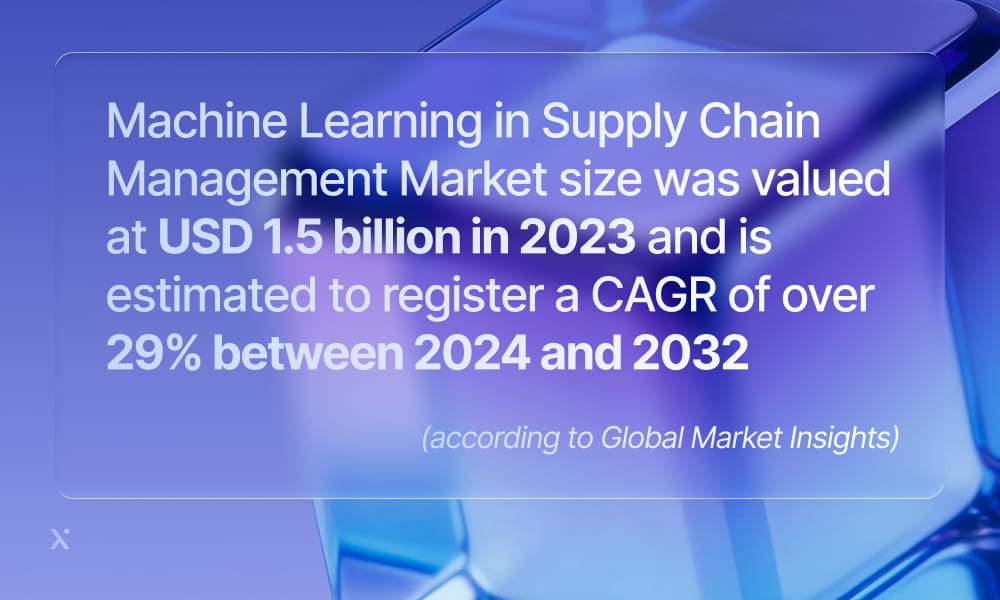
There are numerous research papers dedicated to the examination of the possibilities of deep learning development services and machine learning in supply chain management (SCM). The potential is high and promising in providing efficient management, inventory tracking, logistics, demand, and sales analysis, etc.
Demand forecasting & inventory optimization
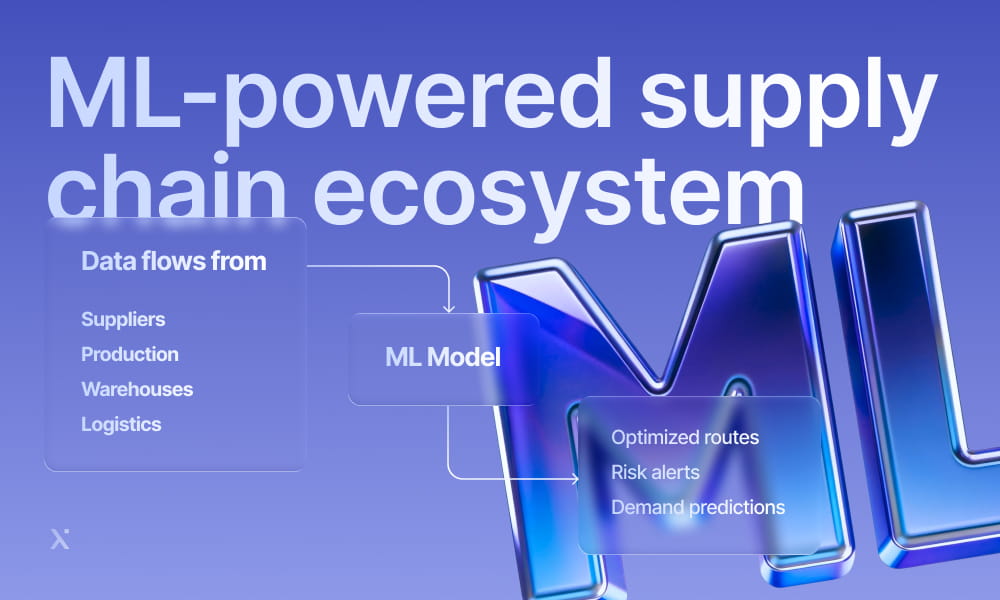
ML algorithms are capable of analyzing vast data sets to identify optimization gaps in inventory management. These systems explore complex supply and demand trends, generate accurate forecasts, and enable businesses to proactively avoid stock shortages and overstock. While historical sales data is crucial, it alone cannot accurately predict future demand, which is influenced by dynamic factors like seasons, promotions, and market shifts. Modern AI tools overcome this by scanning external signals, such as social media trends, product reviews, and news blogs, to detect emerging consumer preferences.
Furthermore, advanced analytics platforms can aggregate and analyze diverse data sources, including multimedia content. For instance, AI models can process news videos or social media images to help anticipate demand shocks, such as panic buying during a crisis, and visualize these insights on integrated supply chain dashboards.
AI also streamlines other critical functions. Platforms like Didero demonstrate their value in procurement, using algorithms to source and vet suppliers, manage orders, and automate invoicing.
Predictive maintenance & logistics intelligence
The same data analysis helps to evaluate market conditions, pricing patterns, and economic trends, and equips procurement teams with the insights. For example, ML systems evaluate data to anticipate worldwide or regional disruptions, such as logistical and weather-related events that could delay shipments. Predictive models also outline contingency plans for delays or shortages. For instance, pharmaceutical firms can simulate scenarios where essential production chemicals are scarce.
Supplier risk & fraud detection
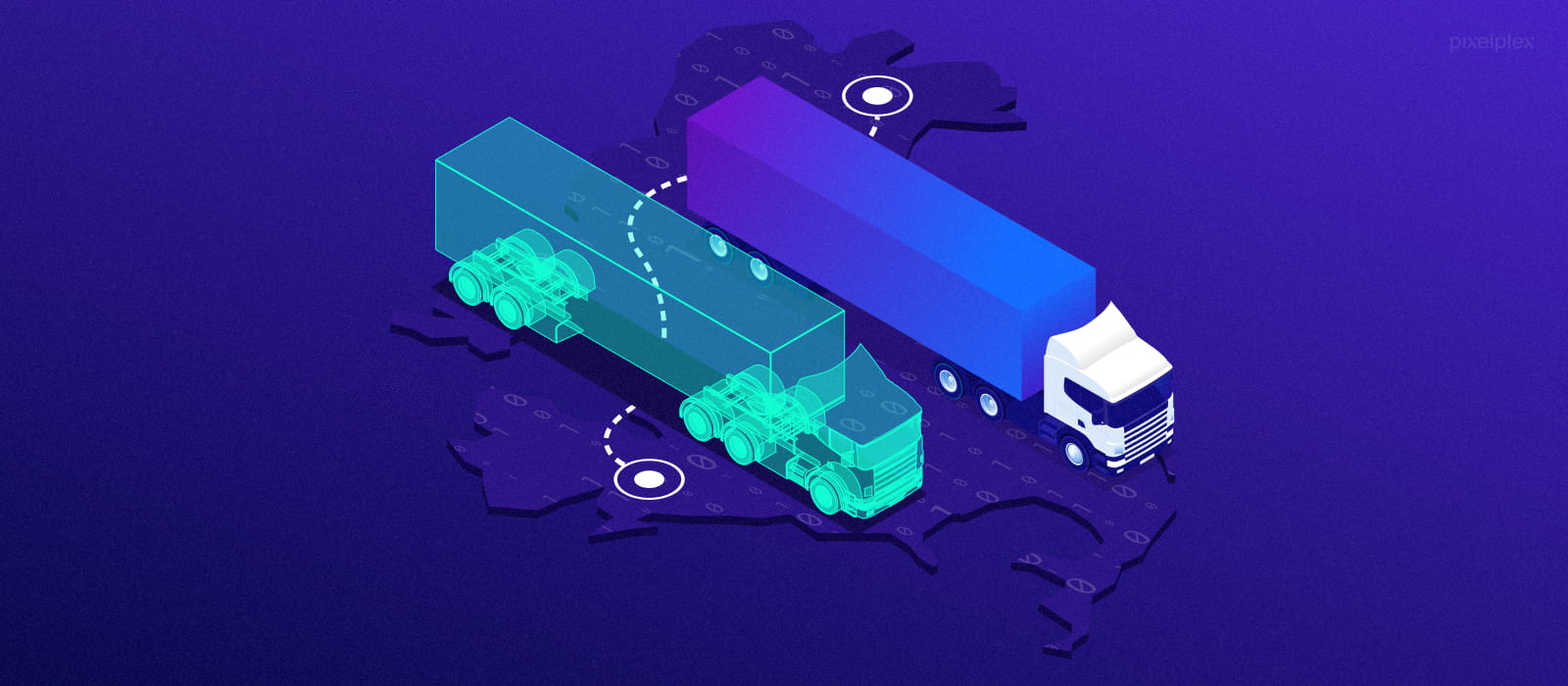
McKinsey forecasts that digital replicas of supply networks will emerge by 2030. These virtual models will map the entire journey from primary and backup suppliers through manufacturing and distribution to end customers, including all connecting logistics. Each link in the chain will be rated for operational risk, expense, and environmental impact. Procurement teams will thereby have a dynamic visual tool to simulate disruptions and test alternatives. Organizations using such technology will gain an edge in delivering products more quickly, affordably, and sustainably than their rivals.

Inside Machine Learning Development: What Businesses Should Know

Blockchain in Procurement: A Guide to Transparency, Efficiency, and Trust
Cost-benefit analysis
As we’ve figured out above, ML platforms bring significant benefits to the supply chain domain. Now, it’s time to decide whether it is worth developing an ML solution in-house or if the integration of a ready-made tool is a more suitable step. There are several factors that might affect this decision.
Competence of the team
Machine learning development services for supply chains require special skills and knowledge. Beyond standard code management, you must also oversee the data pipeline and model lifecycle.
Unlike conventional applications, where behavior shifts only with code updates, ML models can alter their output based on changes in input data. This work often involves specialized hardware like GPUs and large containerized environments. The probabilistic nature of these systems demands novel strategies for testing, monitoring, and system observability.
To know if your internal team is ready for machine learning app development, you should ask yourself these questions:
- Does your current team possess adequate software and infrastructure engineering knowledge?
- Will you need to recruit for missing competencies, and what is the expected timeline?
- Does integrating or constructing a platform entail working within your existing technical environment?
- Is it feasible to find the required specialists in your current job market, or would it be more effective to upskill your existing team in a particular area?

AI Business Ideas, Tools & Real-World Wins That Actually Spark Something New

What are AI agents? Key Types, Examples, and Benefits
Time to market
Regarding the timeline, it’s difficult to say which option is faster. Developing your own ML platform demands full engagement of the team and, as a result, their distraction from projects that could deliver more immediate competitive value.
On the other hand, procuring a third-party solution is also time-intensive. Research, assessments, and negotiations may take several months.
Hiring specialized talent might also be slow and challenging, as well as retraining the staff.
Here are the questions to consider:
- Can you hire rapidly enough to address skill shortages and boost capacity?
- Do you require a fully managed service, or is your team prepared to self-host and operate?
- Who will own and guide the platform development? Does your organization have a history of delivering complex software projects on schedule?
Costs
Costs of creating a bespoke solution typically include infrastructure, component licensing, and personnel salaries. Infrastructure expenses generally refer to recurring cloud service fees, which can sometimes be reduced through committed-use discounts. Some firms opt for on-premise hardware or colocation in third-party data centers.
When evaluating the cost of purchasing a tool, it’s vital to compare it against the substantial salary overhead of an internal build-and-operate team. Additional financial factors include hiring timelines, the opportunity cost of delayed deployment, ongoing maintenance, and the investment required to train your team on new technologies.
Points to discuss:
- What are the hiring requirements (e.g., senior or junior staff, local or international employees, salary ranges, etc.)?
- How much is the software licensing? How will costs scale as user numbers grow and the volume of managed models expands?
- What types of data must your platform retain (e.g., metrics, experiment data, datasets, model binaries)? What are your projected daily, monthly, and annual storage needs?
- Can you reliably estimate continuous integration/delivery (CI/CD) costs? For instance, what are the expenses for routine container security scans and integration testing per pull request?
Security
Achieving compliance is typically an organization-wide initiative. When executed effectively, it mitigates risk and opens new business avenues and entire market segments, as customers increasingly prioritize vendors who meet stringent standards.
True compliance involves embedding sound development practices directly into your team’s workflow and platform architecture. This often means integrating specific protocols and controls to enforce standards automatically. Many frameworks are built on security-by-design tenets, including attack surface reduction, the principle of least privilege, and clear separation of duties.
Before selecting an ML platform, address these key questions:
- Are you governed by standards such as FedRAMP, SOC 2, HIPAA, or GDPR? What specific technical and operational controls must you implement?
- Can the platform be deployed within your own cloud environment (e.g., a dedicated VPC)? Does an external solution support private registries for containers and packages?
- Are you permitted to store sensitive data on a vendor’s infrastructure?
- Do you need defenses against model hallucinations, prompt injection, or adversarial inputs?
Here are the estimated costs of building an ML tool in-house:
| Cost component | Description | Estimated range |
| Data engineering & infrastructure | Cost to collect, clean, and structure data. Cloud/on-premise compute, storage, and MLOps platforms. | $50k – $250k+ annually |
| ML talent | Salaries (data scientists, ML engineers, data architects) | $300k – $600k+ annually. High competition and turnover in the job market. |
| Model development & iteration | The iterative process of prototyping, training, validating, and tuning models | 6-18 months to initial value. High risk of project failure or models that don’t generalize well to real-world data. |
| Ongoing maintenance & updates | Monitoring model drift, retraining with new data, updating for new business rules, and ensuring system health. | 20-30% of initial dev cost annually. A hidden, perpetual cost often underestimated. |
| Opportunity cost & time to value | The lost benefit from delayed efficiency gains, cost savings, or competitive advantage while building internally. | High. Competitors with ready solutions may gain market share while your team is still in development. |

Top 10 AI Development Companies in 2026

AI in Transportation: Reimagining How We Move
Approximate costs of buying a third-party solution:
| Cost component | Description | Approximate cost range |
| Software licensing | SaaS subscription (annual/monthly) or a license fee. Based on users, volume, or features. | SaaS: $50k – $500k+ per year. Perpetual license: $250k – $2M+ (one-time, plus ~20% annual maintenance). |
| Implementation & configuration | One-time professional services fee | $100k – $500k+. Depends on project |
| Data integration | Cost to connect the solution to ERP, WMS, TMS, etc., via APIs, ETL pipelines, or connectors. | $50k – $200k+ |
| Training & change management | Training end-users (planners, logistics managers) | $20k – $100k (materials, workshops, consultant-led sessions) |
| Scalability & customization fees | Costs for adding new users/facilities, custom reports, etc. | Custom features: $25k – $150k+ per module. Scaling fees often +15-30% to base license |
Making the strategic choice: build, buy, or hybrid?
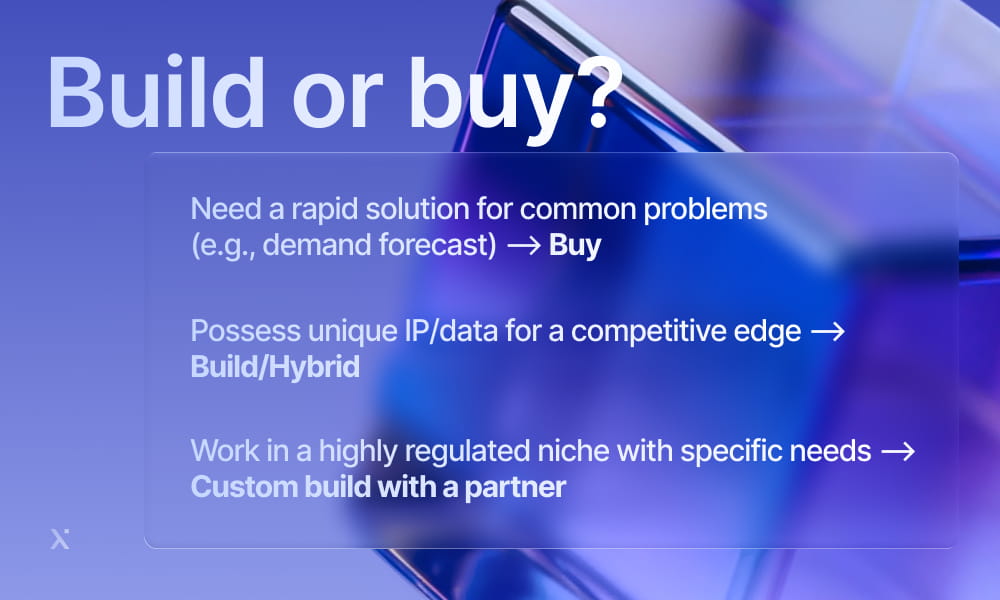
First, it is worth noting that even a fully packaged, out-of-the-box machine learning platform needs adjustment. Another thing is that buying a tool doesn’t mean addressing all the challenges with one solution. Sometimes businesses need a bunch of tools, as well as time to customize them.
- Buying means purchasing software. It is quick, but might lack long-term flexibility due to vendor constraints.
- Building means creating this software in-house. This approach guarantees a tailored solution, but it is quite expensive and time-consuming.
In practice, however, the lines blur. Purchasing a platform can involve slow procurement cycles, complex technical evaluations, and bureaucratic hurdles. Conversely, a skilled internal team can sometimes develop and deploy a custom solution rapidly, achieving a strong return on investment. Moreover, even a so-called end-to-end SaaS product requires substantial configuration, making “buying” still feel a lot like “building.”
On the one hand, open-source frameworks are license-free. On the other hand, they remain a third-party dependency outside your direct control. While forking and fully customizing a project is theoretically possible, it is rarely practical. Besides, such solutions necessitate your own integration, maintenance, and operational effort. While popular projects benefit from documentation and community support, they rarely offer formal service-level agreements. That is why open-source software takes its place in the “build” column.
Below is the table summarizing the most common ML solutions for supply chain and the preferred mode of development. However, each project is unique and should be assessed from the point of view of its viability for a certain company.
| ML solution | Build / Buy | Reason |
| Demand forecasting | Buy | Major cloud providers (AWS, Google, Azure) and specialty vendors (Blue Yonder, Kinaxis) offer mature and continuously updated models that ingest various data sources (sales, promotions, weather) out-of-the-box. |
| Predictive maintenance | Hybrid | Buy a core IoT/analytics platform. Build the final model logic specific to your unique equipment, failure modes, and sensor data, as this is a key competitive advantage. |
| Inventory optimization | Buy | The math (stochastic optimization, safety stock models) is complex but standard. Leading solutions integrate directly with your ERP and forecasting data, providing a faster, more reliable ROI than a custom build. |
| Dynamic route optimization | Buy | Requires massive, real-time geospatial data feeds (maps, traffic) and powerful solvers. Specialized vendors (e.g., tools from Google OR-Tools, NextBillion.ai) have solved this at scale. |
| Warehouse picking optimization | Build | This is highly specific to your warehouse layout, automation systems (e.g., AMRs, conveyors), and Warehouse Management System (WMS). |
| Supplier risk & performance analytics | Hybrid | Buy third-party risk data feeds. Build the analytics dashboard and scoring algorithm that weights factors according to your specific business priorities and risk tolerance. |
| Computer vision services for quality inspection | Build | Heavily dependent on your specific products, packaging, and quality standards. Requires training custom models on images of your items, making an off-the-shelf solution ineffective. |
| ML for fraud detection | Build | Fraud patterns are unique to your business processes, partners, and data. A custom model can learn your specific “normal” and is harder for bad actors to predict and circumvent. |

Top 10 Machine Learning Development Companies
How to choose a proper vendor?
If you decide to buy a solution or start with addressing a machine learning consulting company, here are the criteria that you should take into consideration while choosing a partner.
| Criteria | What to look for |
| Domain expertise | Proven experience and certifications in your industry (e.g., retail, pharma, automotive). |
| Platform flexibility & APIs | RESTful/GraphQL APIs with full documentation. Pre-built connectors for major ERPs (SAP, Oracle). |
| Reference cases | Detailed case studies with named clients. Quantifiable KPIs (e.g., “30% reduction in stockouts”). Willingness to provide direct customer references. |
| Security & compliance | Certifications: ISO 27001, SOC 2 Type II. Data encryption (AES-256 at rest, TLS 1.3 in transit). GDPR/CCPA-ready data processing agreements. |
| Total cost of ownership (TCO) | Clear 3-5 year cost projection (license, implementation, maintenance). No hidden scaling fees. |
| Roadmap & support | Published product roadmap (next 6-18 months). SLA: <1 hour for critical issues, 24/7 support. Dedicated Customer Success Manager and regular model updates. |

The Agent Payments Protocol (AP2): A New Standard for Autonomous Commerce
Digital Twins for Supply Chain: Benefits and Real-World Applications

Crypto Payment Gateway: Costs, Benefits, Implementation
Real-world success stories
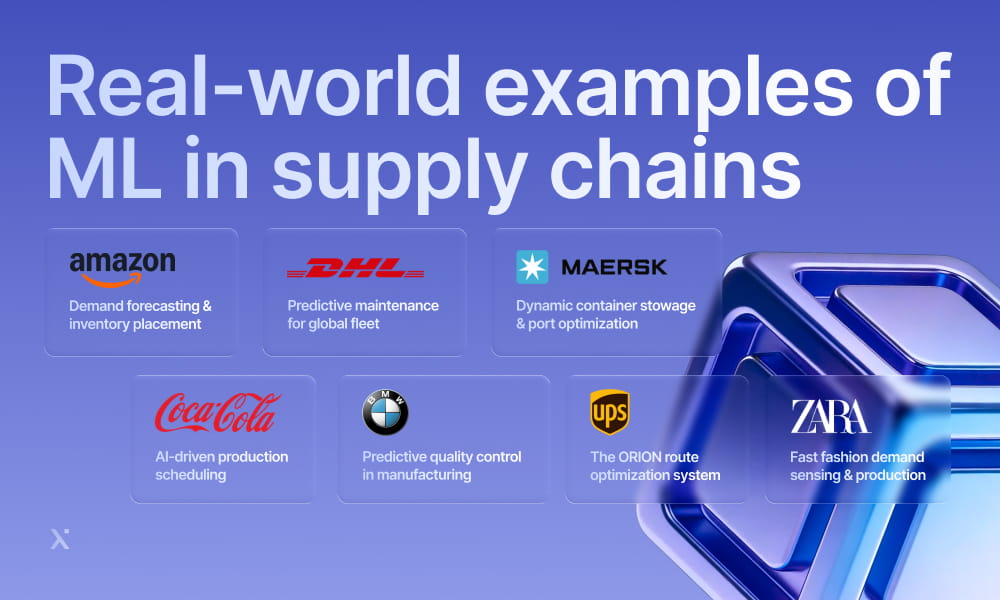
Here are real-world examples of machine learning development services for the supply chains of major companies.
Amazon
Amazon’s core competitive advantage is its fulfillment network, powered by sophisticated ML. Their systems forecast where, when, and what exactly demand will occur. Models analyze hundreds of signals, from individual search history to broader regional trends, to pre-position millions of products in fulfillment centers closest to predicted demand. This enables Prime one-day and same-day delivery while minimizing expensive long-haul shipping and storage costs. Besides, Amazon fulfillment workers report deliveries possible within three hours of an order, powered by on-site AI and robotics.
DHL
DHL equipped its delivery vehicles and cargo aircraft with IoT sensors. ML algorithms enhance IoT development services, as sensors analyze real-time data on engine performance, vibration, and temperature, and predict mechanical failures before they happen. This shift from scheduled or reactive maintenance to predictive maintenance has reduced unplanned vehicle downtime by over 25%, ensuring on-time deliveries and optimizing fleet utilization. DHL also employs enterprise AI development for multi-faceted efficiency gains: routing optimization via traffic analytics, space-maximizing packaging through OptiCarton, customer support chatbots, intelligent supply monitoring, and robotic automation for parcel sorting.
Maersk
The world’s largest shipping company uses ML to solve the immensely complex “container stowage” puzzle. Algorithms determine the optimal placement of thousands of containers on a vessel, considering weight, destination, cargo type, and stability. This improves fuel efficiency and port turnaround times. Furthermore, ML models predict port congestion and suggest optimal sailing speeds and alternative routes, saving millions in fuel and demurrage costs.
Coca-Cola
At its bottling plants, Coca-Cola uses ML to optimize production scheduling in real-time. Models integrate data from point-of-sale systems, weather forecasts, local events, and truck GPS locations to dynamically adjust production lines. This ensures the right products are bottled and shipped just in time to meet localized demand spikes, reducing inventory holding costs and product obsolescence.
BMW
BMW employs ML in its production supply chain for predictive quality. By analyzing data from cameras and sensors on the assembly line, algorithms can detect microscopic defects in parts or paint finishes that are invisible to the human eye. More strategically, they correlate this quality data with information from their tier-1 and tier-2 suppliers (e.g., steel batch data, component tolerances) to predict and prevent quality issues before they escalate, ensuring zero-defect manufacturing.
UPS
UPS’s On-Road Integrated Optimization and Navigation (ORION) system is one of the largest operational ML projects in logistics. It analyzes delivery addresses, packages, traffic patterns, and customer preferences to calculate the most efficient route for each driver. ORION saves UPS an estimated $300-400 million annually by reducing fuel consumption, shortening delivery miles, and improving driver efficiency. It makes over 200,000 route adjustments per minute.
Zara
The retailer Zara (Inditex) uses ML for ultra-responsive “demand sensing.” By analyzing real-time sales data from stores, social media trends, and even what items customers are trying on but not buying, their models provide near-instantaneous feedback to design and production teams. This allows them to adjust production volumes and designs within days, minimizing overstock of unpopular items and capitalizing on viral trends faster than competitors, a core tenet of their fast-fashion model.
Here are some ML implementation figures regarding the success of the mentioned companies. The numbers are taken from public case studies, reports, and estimates.
| Company | Key implementation figures & results |
| Amazon | >15% reduction in forecast error ~20% decrease in out-of-stock events ~10% reduction in logistics costs by placing inventory closer to predicted demand |
| DHL | >70% accuracy in predicting component failures ~30% reduction in unplanned vehicle downtime ~25% decrease in maintenance costs through optimized service scheduling |
| Maersk | ~30% faster container stowage planning ~5-10% improvement in vessel space utilization |
| Coca-Cola | ~20% improvement in production line efficiency ~15-20% reduction in raw material waste |
| BMW | >90% accuracy in identifying potential defects early ~5% reduction in rework and scrap costs |
| UPS | ~100 million miles saved annually ~10 million gallons of fuel saved per year ~100,000 metric tons reduction in CO₂ emissions annually |
| Zara | ~2-3 weeks from design to store <10% of inventory marked down |
Why partner with PixelPlex for your ML journey?
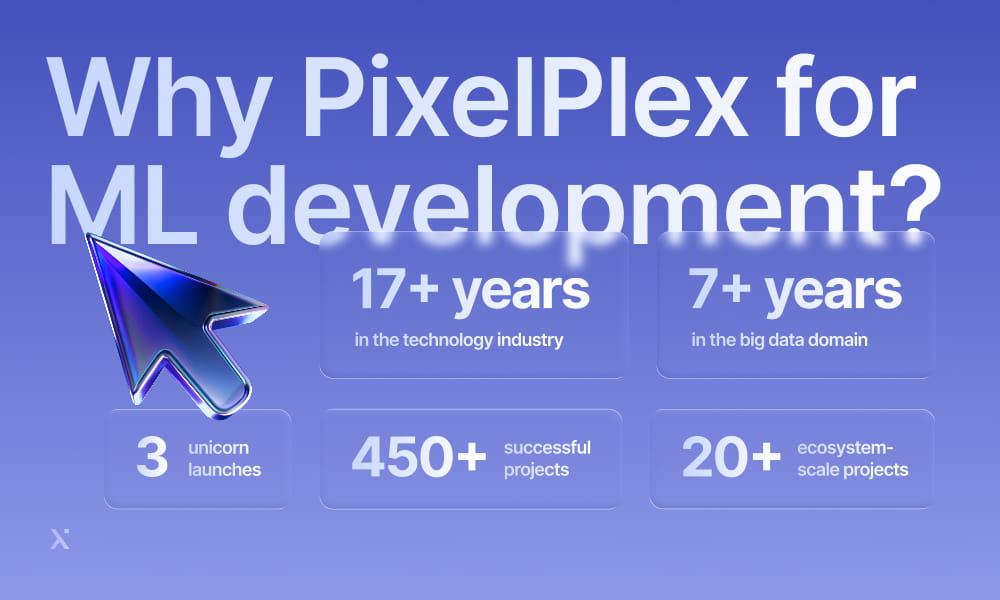
At PixelPlex, we co-own the vision and share the risk.
Our experts integrate ML technology at the core of solutions, combining it strategically with blockchain, IoT, and metaverse frameworks. Before project execution, the team invests in deep research to build proprietary, scalable systems that deliver a lasting competitive edge.
With a team of roughly 100 engineers, PixelPlex holds expertise in web/mobile development, blockchain, AR/VR, and data science, including neural network training and deep learning implementation. Recent work includes pioneering solutions on the Canton Network, such as the Canton Loop self-custodial wallet. The team actively scouts emerging technologies to ensure their solutions remain cutting-edge.
The company’s portfolio exceeds 450 projects, serving a clientele from Fortune 500 and Forbes 2000 companies, including Intel, Microsoft, Oracle, and BMW. PixelPlex is ranked by Clutch as a top provider in enterprise app and custom software development, and a leading European app development firm.
- Hypemarket warehouse automation with digital twins: This platform accelerates fulfillment and enhances the delivery precision of the warehouse. It integrates digital management tools with physical warehouse operations.
- Web3 security solution: This is a protective solution to safeguard users from fraud, phishing attacks, and hazardous smart contracts. It’s like an intermediary that screens interactions between users and dApps.
- AI-powered retina analysis tool: It’s a diagnostic assistant for retinal diseases, employing ML to identify ocular conditions and support improved patient treatment plans.
| 1M+ smart contracts on mainnet | 10M+ users scaled in the first 18 months | $1.2B raised by our clients |
| $50M end-users onboarded across our clients’ dApps | 0 exploits since day 1 | 3 unicorns exceeding $1B in value |

Digital Transformation in Supply Chain: Key Trends, Technologies, and Use Cases

IoT in Automotive: Use Cases, Examples, & Challenges
The future ML-driven supply chain
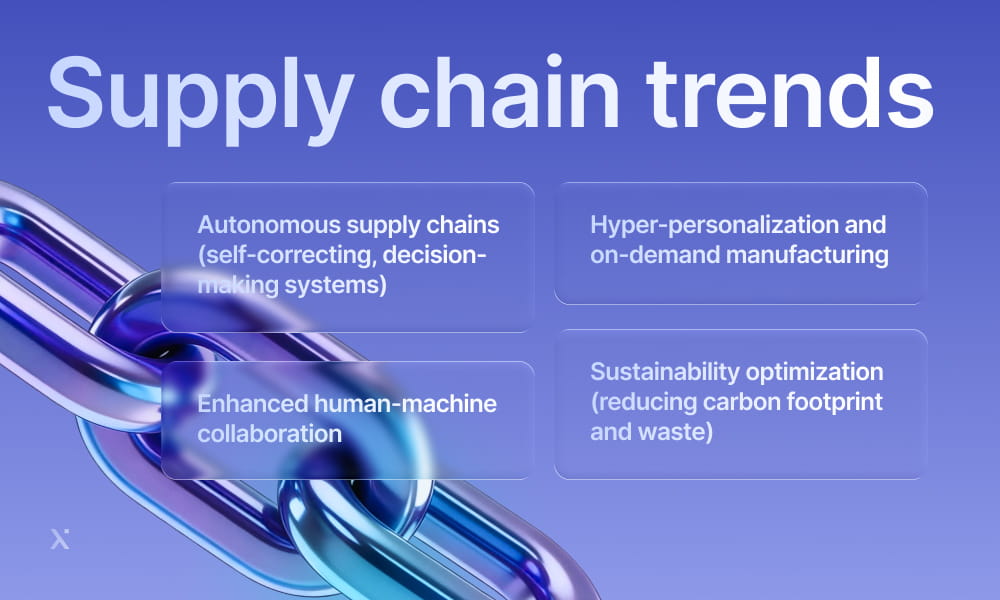
According to the Procurement Imperative 2030 report (developed by Economist Impact and co-sponsored by SAP), there are the following trends that will impact the supply chain domain in the next five years:
- Globalization slowdown: geopolitical tension and world conflicts force companies to adapt their sourcing strategies. By 2030, supply chains will become closer to regional and local partners in order to mitigate risks.
- Talent shortages: in the future, there will be a higher demand for specialists with specialized technical skills. Therefore, companies have to react to the possible talent gap and proactively invest in training and upskilling.
- Cybersecurity threats: supply chain systems actively use cloud technologies and IoT that are exposed to cyber attacks. That is why cybersecurity will be the top priority for the logistics and procurement businesses.
- Climate changes: changing weather conditions, as well as finite resources, will force companies to look for ways to reduce carbon emissions, apply sustainability principles, and comply with regulations.
Now, let’s look at how these trends will reflect technologically. Supply chain software development companies need to expand their expertise in the following areas:
- Autonomous supply chains: systems that use AI to automate operational tasks (like reordering stock) and strategic decisions (like rerouting shipments around a storm) with minimal human intervention. The goal is a self-correcting, end-to-end flow of goods.
- Hyper-personalization & on-demand manufacturing: the ability to produce and deliver products customized to an individual customer’s exact specifications. Instead of mass production, items are made in small batches or single units only after an order is placed, drastically reducing inventory waste.
- Sustainability optimization: applying machine learning to make supply chains greener. This includes calculating the lowest-emission delivery routes, optimizing energy use in warehouses, and minimizing material waste in production and packaging.
- Enhanced human-machine collaboration (AI as a co-pilot): a partnership model where AI handles data analysis, generates forecasts, and suggests optimal actions, while human experts provide strategic oversight, apply business context, and make the final judgment calls.
Conclusion
In a world where AI and ML technologies are becoming a must, the biggest risk is inaction. ML algorithms have the potential to bring considerable benefits to businesses in the supply chain domain. However, the path isn’t one-size-fits-all. It is important to assess your unique needs, data maturity, and strategic goals.
McKinsey research indicates that transforming supply chain operations into an AI-driven, data-centric function typically requires between six and eighteen months. This significant undertaking demands a clear business vision, defined objectives, and the active commitment of all stakeholders. To craft an effective roadmap, organizations might address reliable partners (such as PixelPlex) that will build a scalable system that delivers sustained performance improvements.
FAQ
Machine learning development is the process of creating systems that learn from data and improve their performance without explicit programming. ML involves data preparation, algorithm selection, model training, validation, and deployment. The quality of the output depends on the input data. If the initial data is unbiased and clean, the system turns it into actionable insights for tasks like forecasting, automation, and decision support.
Among the challenges, we can mention cybersecurity threats, potential staff resistance (due to cumbersome interfaces), and significant implementation costs. To address the first issue, comprehensive security frameworks are recommended. As for the second one, structured feedback can identify pain points, and training programs aid in adaptation. High costs can be managed with a phased investment strategy. Implement changes incrementally, allowing budgets to adjust and the organization to integrate new tools gradually.
There is no fixed amount. It depends on the complexity of the problem and the algorithm inside the solution. Simple tasks may need thousands of records, while deep learning models can require millions. However, the quality and relevance of data are more important than the volume to build a reliable and unbiased model.
Datasets can be updated through real-time streaming, scheduled batch imports, or manual uploads. To ensure ongoing accuracy, retraining pipelines are often automated. So, the system incorporates new data, maintains model relevance, and adapts to changing patterns with minimal manual intervention.
An ML solution may be a beneficial solution if your business deals with large volumes of data and you have to make repetitive decisions based on that data. Besides, ML might help with tasks like demand forecasting, customer segmentation, or anomaly detection. At the discovery phase, our experts discuss your business problems and decide whether they align with ML’s strengths.
ROI timing varies. Some applications, like process automation, can deliver savings within months. Others, such as predictive systems, may require a longer period (6 to 18 months). During that time, the system fully integrates into workflows and accumulates enough operational impact to offset development and deployment costs.