
Online education opened the door to learning for many people. Proof didn’t get the same upgrade. Most credentials are still just artifacts: a PDF, a badge link, a line in a profile. They’re easy to copy and annoying to verify. The bigger issue is what they don’t show, what the learner actually did, how they performed, and whether the result holds up. So students end up defending their own achievements, while platforms and employers waste time checking basics and still miss fakes.
Blockchain technology deserves attention in this context for one simple reason: it can transform trust-based verifications into verifiable records. In the field of eLearning, this usually has nothing to do with hype or marketing gimmicks. The useful part is the infrastructure. You can issue credentials that are easily verifiable without contacting the issuer, link them to clear evidence of learning completion or assessment, and automate access, payments, and certificate issuance using smart contracts if the process logic is straightforward.


Virtual Reality Employee Training: How Can Businesses Benefit From It in 2026?

A Detailed Guide to the Metaverse in Education
Where blockchain actually shows up in eLearning
Blockchain technology doesn’t change how people learn, but rather what constitutes valid proof once that learning takes place outside the platform. Most eLearning products work well within their own environment. The problem arises when someone outside the platform needs to trust the results. A link to a badge is easy to copy. A PDF certificate is easy to alter. A database entry is useless if the verifier can’t access it or doesn’t want to wait for an email response.
This is also why credentialing is one of the first areas where blockchain adoption shows up in education. In 2025, over 20% of global educational institutions adopted blockchain for credentialing and eLearning verification, mainly to speed up checks and reduce credential fraud.
Credentials that can be verified without phone calls
Most certificates are simply files. They look good in a folder or on a LinkedIn profile, but as soon as someone tries to verify them, problems arise. Either you have to trust a screenshot, or send a request to the platform and wait for a response, or simply give up on verification because it’s too time-consuming. A blockchain-based certificate retains the familiar format but adds something that ordinary certificates lack: a record that a third party can verify independently. No correspondence, no requests like “please confirm this student’s details,” and no unnoticed retroactive changes. In the fields of regulatory compliance and professional training, this change is significant, as verification should be a routine step rather than a separate process.
Learner records that don’t get stuck inside one platform
Most platforms store information about learning progress, grades, course completion, and exam results in their own databases. This works as long as the student remains on the platform. Changing providers, switching to a new training program, applying for a job — and suddenly, achievement data becomes inaccessible. People have to retake courses, collect screenshots, or export data that no one fully trusts. Using blockchain to store learning data is one way to solve the problem of information portability. You can verify a specific achievement when needed without providing your entire account history, and platforms don’t need to constantly store old records or create complex data migration projects to maintain access to transcripts.
Rules enforced by code, not support tickets
Smart contracts sound like something related to finance, but in the field of eLearning, their useful applications are simple and practical. For example:
- Unlock a course after payment clears
- Issue a certificate after an exam is passed
- Enforce prerequisites across modules
- Handle refunds or access windows consistently
Once these rules are implemented, platforms will spend less time dealing with unusual situations and more time improving the product.
Incentives and peer-to-peer models, when engagement is the product
Some educational products are based on participation, contribution, and interaction within a community, rather than just passive consumption. This is where token mechanics and peer-to-peer marketplaces can prove useful. For example, learners can earn rewards for things that actually take effort, such as finishing a course, mentoring others, and contributing useful content. Instructors, in turn, can publish materials directly and get paid without a marketplace setting the rules or taking a large cut. These models are not universally applicable and can backfire if the reward system is poorly designed, but in niche educational communities, they can provide higher engagement than traditional gamification.
DAO-style platforms for communities that want shared control
This is the far edge of the spectrum. In DAO-style education, blockchain isn’t there to deliver lessons. It’s there to manage who gets to make decisions. Members can vote on things like curriculum updates, what gets funded, and which rules the platform follows. The user interface may be imperfect, and implementation is still in its early stages, but this model is already being tested in professional communities where participants want more control over platform development than simply “terms of service”.
Common blockchain use cases in eLearning
| Use case | Problem it solves | What blockchain changes |
| Credential verification | Certificates are easy to fake and hard to validate | Credentials become independently verifiable records |
| Learner records | Data is locked inside one platform | Learning history becomes portable and shareable by the learner |
| Course access and payments | Manual checks and inconsistent rule enforcement | Access and issuance rules run automatically via smart contracts |
| Incentive systems | Low engagement and poor completion rates | Reward logic becomes transparent and harder to game |
| Peer-to-peer learning | High platform fees and limited creator ownership | Direct creator–learner interaction and portable reputation signals |
| DAO-based platforms | Centralized decision-making | Governance becomes shared, traceable, and rule-based |
This makes sense when trust, verification, or coordination becomes a real bottleneck. If credentials need to be verified outside the platform, data needs to be transferred between different systems, or rules are applied manually on a large scale, blockchain can help. If none of this applies to your situation, it’s usually an overkill solution.

Blockchain in Payment Services: Trends, Technologies, and Development Best Practices

Blockchain in IoT: Data Everywhere, Trust Nowhere?
Types of blockchain eLearning applications
Not all blockchain-based educational products look the same or solve the same problems. In practice, blockchain is used in a wide variety of eLearning applications, each with its own audience, business model, and risk profile. The key difference lies not in the degree of decentralization of the product, but in which part of the learning process truly needs more robust guarantees than those that a conventional database can provide.
Below are the main types of blockchain eLearning applications that show up in real products today.
| App type | Core features | Target users |
| Credential platforms | Verifiable certificates, public validation, and expiration rules | Employers, certifiers, regulators |
| Corporate training systems | Audit logs, automated certification, and access control | Enterprises, partners, internal teams |
| Skill marketplaces | Peer-to-peer payments, reputation, and direct publishing | Freelancers, experts, learners |
| LMS alternatives | Cross-platform records, transcript portability | Universities, academic institutions |
| Microlearning apps | Modular access, flexible monetization, creator payouts | Individual learners, content creators |
Pros and cons of blockchain eLearning apps
Blockchain in eLearning is not a free upgrade. It solves real problems, but it also introduces new ones. Teams usually get into trouble when they only look at what blockchain enables and ignore what it complicates. A useful comparison has to cover both sides, without pretending that decentralization is always the right answer.
Where blockchain eLearning apps tend to work better
These advantages become apparent when ensuring trust, verification, or coordination becomes too costly to carry out manually.
What teams gain:
- Data that can’t be quietly altered. Once a credential or result is recorded, it can’t be edited later to “fix” a mistake or smooth over an issue. That immutability matters in compliance, certification, and any setting where records need to stand the test of time.
- Transparent credential verification. Credentials don’t depend on the platform being responsive or even still around. Anyone who needs to verify them can do it independently, without emails or admin access.
- Global reach without custom integrations. Blockchain-based credentials don’t care about borders, systems, or institutions. The same record can be checked by an employer in another country without special agreements or data-sharing setups.
- Fewer intermediaries in certain models. In marketplaces or creator-led education, blockchain can reduce reliance on centralized platforms that control pricing, payouts, and access.
- More control for learners over their data. Instead of handing over a full profile or transcript, users can share only what’s relevant: one certificate, one result, one proof of completion.
Where blockchain adds friction or cost
These shortcomings do not mean that blockchain should be abandoned entirely, but they do indicate the need to honestly assess all the risks before deciding to implement it.
Common trade-offs:
- Higher development and maintenance costs. Smart contracts, security reviews, and blockchain integrations add work. There’s no way around that. Even simple logic needs to be designed and tested carefully.
- UX complexity, especially early on. Wallets, keys, and transaction flows can confuse users who just want to take a course. If the UX isn’t handled well, adoption suffers quickly.
- Regulatory uncertainty. Education, data protection, and financial rules don’t always play nicely with decentralized systems. This is especially relevant for public institutions and regulated training programs.
- Onboarding friction related to wallets. Even when wallets are abstracted, they introduce concepts many users aren’t familiar with. For mainstream audiences, this can become a drop-off point.
Blockchain vs. traditional eLearning apps
| Parameter | Traditional apps | Blockchain apps |
| Credential trust | Relies on platform authority | Verifiable without the issuer |
| Data integrity | Editable by admins | Immutable once recorded |
| Verification process | Manual or platform-dependent | Independent and automated |
| User data control | Platform-owned | User-controlled sharing |
| Development cost | Lower upfront | Higher due to the blockchain layer |
| UX simplicity | Familiar, low friction | Requires careful design to avoid friction |
| Compliance handling | Clear but centralized | Powerful, but regulatory context matters |

Top 10 Blockchain Development Companies in 2026

Top Full-Service Web3 Development Companies 2026
Real-world examples of blockchain in eLearning
It’s easy to talk about theory. It’s harder to point to products that actually run, issue credentials, and serve real users. Blockchain in education is no longer experimental in the narrow sense. There are working platforms, though they vary in scale and maturity.
Below are examples of how different models are being implemented in practice.
Blockchain-based credential platforms
Several platforms focus almost entirely on issuing and verifying credentials. They don’t try to replace learning management systems. Instead, they sit on top of existing education or training programs and anchor certificates to blockchain records.
In these systems:
- Universities and training providers issue digital diplomas or certificates
- Employers verify them without contacting the institution
- Learners store credentials in digital wallets
The main value is operational. Institutions reduce verification workload, and graduates don’t need to request paper transcripts every time they apply for something.
NFT-powered certification systems
Some platforms use NFTs to represent certificates. The NFT itself is not about speculation. It acts as a unique, non-duplicable token that represents completion of a course or program.
In practice:
- A learner completes a program
- A certificate NFT is minted to their wallet
- The NFT links to verifiable metadata about the achievement
This model works best in tech-focused communities where users are already comfortable with wallets. In more traditional audiences, NFT-based credentials require careful UX design to avoid confusion.
Tokenized learning ecosystems
A few education platforms experiment with token economies. Learners can earn tokens for completing modules, mentoring others, or contributing valuable content. Tokens may unlock additional courses, provide discounts, or be exchanged within the ecosystem.
Where it works:
- Community-driven learning platforms
- Professional networks with active participation
- Internal training programs with measurable engagement
Where it struggles:
- If rewards are poorly designed
- If users focus on farming tokens instead of learning
Notable blockchain eLearning platforms
| Platform | Focus | Blockchain role |
| Digital diploma platforms (e.g., university credential systems) | Academic and professional credentials | Anchors diplomas to verifiable blockchain records |
| NFT-based certification apps | Course completion tokens | Issues unique NFT certificates with metadata |
| Tokenized learning ecosystems | Community engagement and rewards | Tracks contributions and distributes incentives |

Top 10 Blockchain Use Cases In 2026: How Your Business Can Ride the Wave

Enterprise Blockchain: Prom Promise to Profit
Key features of a blockchain eLearning app
A blockchain eLearning app is still an eLearning app first. People need to enroll, learn, complete something, and walk away with proof they can use later. The blockchain part usually supports a few specific moments: identity, credential ownership, verification, and rule enforcement. If you try to put everything on-chain, the scope balloons and the product gets slower, harder to use, and harder to maintain.
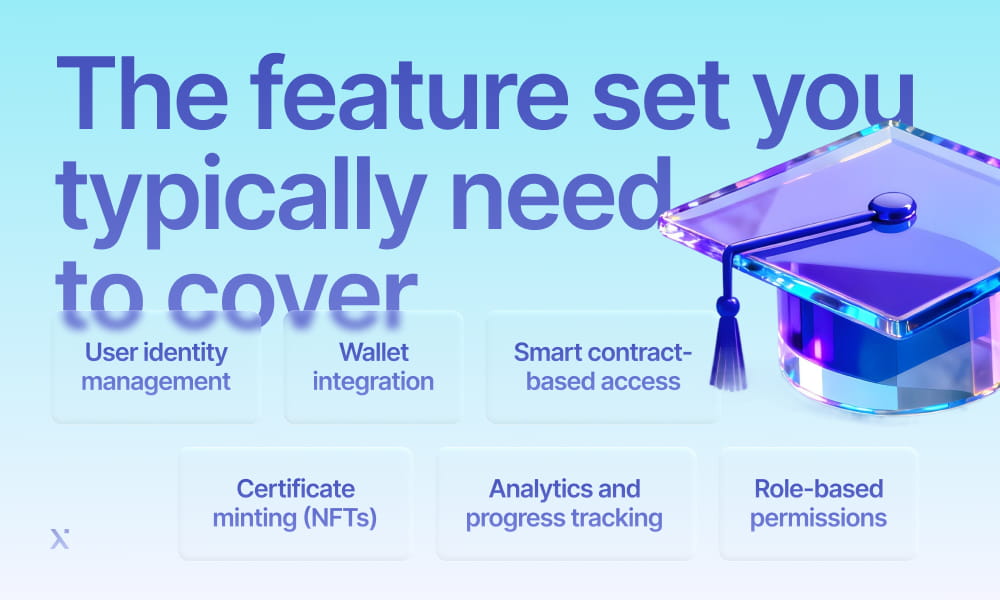
User identity management
This is where most products either get it right or create chaos. You need a consistent way to answer basic questions: who completed the course, who owns the credentials, and who is allowed to share them. Some apps directly link identity to the wallet. Others hide the wallet behind a regular account to maintain a consistent user experience. Either way, the identity model must withstand real-world scenarios, such as email address changes, account recovery, and duplicate users.
Wallet integration
A wallet is where credentials live, whether they’re NFTs or another verifiable format. The wallet experience decides how many users you lose before they ever start learning. Web3-native users will connect to MetaMask and move on. Everyone else expects “log in, get access.”
Most eLearning products end up choosing one of two routes:
- User-managed wallets for Web3 audiences
- Custodial or abstracted wallets for mainstream learners who don’t want to think about keys
Smart contract-based access
Smart contracts are useful when access rules need to be consistent and auditable. In eLearning, that usually means simple logic that otherwise creates support tickets.
Common examples:
- course unlock after payment
- certificate issuance after passing an exam
- prerequisite enforcement between modules
- access expiration for time-bound programs
If you can’t describe the rule in one sentence, it’s usually not a good candidate for a first version.
Certificate minting (NFTs)
NFT certificates are a packaging choice. The real requirement is a credential that can be verified later, outside your platform, without asking you to confirm it.
If you mint certificates as NFTs, you need to think through:
- What data goes on-chain vs off-chain
- How revocation or expiration works
- What happens if the learner loses access to their wallet
This is also where you decide what a proof means in your product. Completion is one level. Assessment-backed credentials are another.
Analytics and progress tracking
Blockchain does not replace analytics. You still need to know where people drop off, what they complete, and what they ignore. Most teams keep detailed learning activity off-chain for performance reasons and only record outcomes that need to be verifiable later.
If you skip analytics early, you end up building based on opinions rather than facts. The platform looks busy, but you have no clue what’s working.
Role-based permissions
Education products rarely have a single user type. Even a simple platform usually has learners, instructors, and admins. Add credential issuance, and make permissions non-optional.
You need clear boundaries for things like:
- Who can publish courses
- Who can issue credentials
- Who can revoke or reissue credentials
- Who can view verification and audit logs
This is also where you prevent the “one-admin-account-can-edit-everything” problem that breaks trust.
Features vs. business value
| Feature | Business impact |
| User identity management | Prevents credential misuse and ties achievements to the right person |
| Wallet integration | Gives learners ownership of credentials and supports portable verification |
| Smart contract-based access | Reduces manual enforcement and makes access rules predictable |
| Certificate minting (NFTs) | Creates verifiable, tamper-resistant credentials that can be checked externally |
| Analytics and progress tracking | Shows what users actually do and supports iteration based on data |
| Role-based permissions | Reduces operational risk and protects issuance and verification workflows |

Blockchain in Procurement: A Guide to Transparency, Efficiency, and Trust

Blockchain for Business: Beyond Cryptocurrency to Real-World Value
Technology stack for blockchain eLearning app development
Blockchain eLearning app development usually has two worlds that need to cooperate. One is the regular product stack: UI, backend, database, analytics, and content delivery. The other is the blockchain layer: smart contracts, wallets, on-chain proofs, and storage choices. The trick is deciding what belongs where.
Stack selection rules that save time later
If you want a simple filter before committing:
- If verification must be universal, lean toward Ethereum-compatible networks and tooling.
- If your audience is not crypto-native, plan for embedded wallets from day one.
- If credentials must last, treat storage as a product feature, not an implementation detail.
- Keep learning activity off-chain, record outcomes and proofs only.
Recommended tech stack
| Layer | Technologies |
| Blockchain network | Ethereum, Polygon, BNB Chain |
| Smart contracts | Solidity |
| Frontend | React, Next.js |
| Backend | Node.js, NestJS |
| Storage | IPFS, Arweave |
| Wallets and identity | WalletConnect-compatible wallets, embedded or custodial wallet layer |

How to Select The Best Blockchain Platform for Your Project
10 Best Programming Languages for Blockchain Development
How to start your blockchain eLearning app
Most founders start in the wrong place. They pick a chain, argue about NFTs vs VCs, then realize they still don’t know what they’re building or who needs to trust it. In eLearning, blockchain only earns its keep when you’re solving a verification problem that keeps coming back, not when you’re adding Web3 because it sounds modern. Most blockchain eLearning projects don’t fail because of the tech. They stall because the team never agreed on what the credential is supposed to prove or who actually needs to trust it. Once that’s clear, the rest becomes a sequence of decisions, not a guessing game.
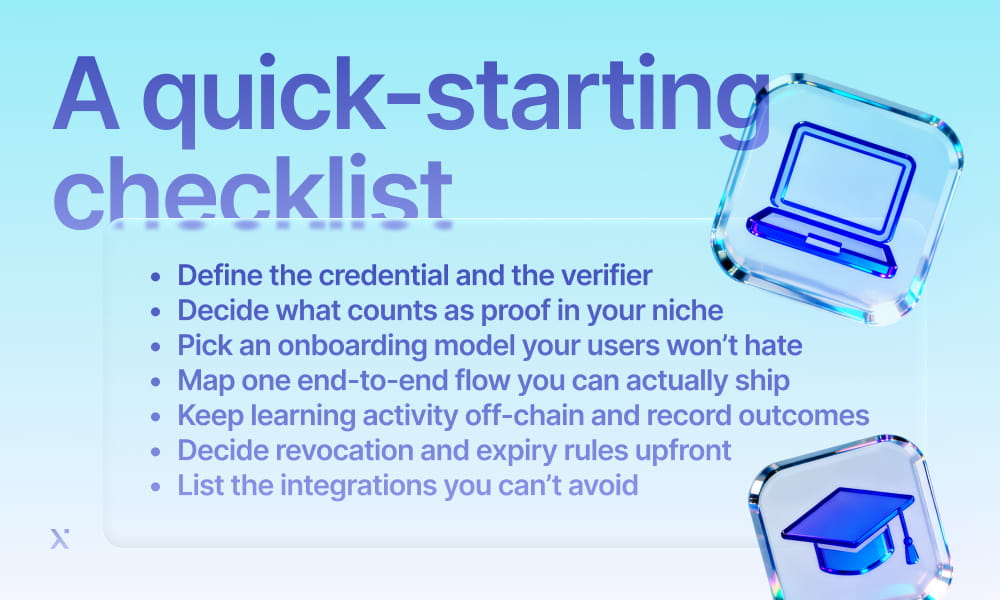
If you start with the verifier, define the proof, and keep the first release tight, the architecture follows. Skip that clarity, and you end up debating chains and token models while the real problem stays undefined.
Blockchain eLearning app development tends to fail in predictable ways. The first is over-tokenization: adding tokens or NFTs where they don’t solve a real problem. The second is a user interface that assumes users understand how wallets, keys, and transaction fees work. The third is ignoring rules around data, minors, accreditation, or compliance until late in the process. None of these limitations are technical. They are errors inherent in the development process.
Blockchain eLearning app development process
A blockchain eLearning app is not built in one straight line. You’re building a normal learning platform and a trust layer around it. If you try to develop both at once without clear checkpoints, you end up with a half-finished LMS and smart contracts that don’t match the real product flow. A healthier process is staged. Each stage answers a specific question before you move on.
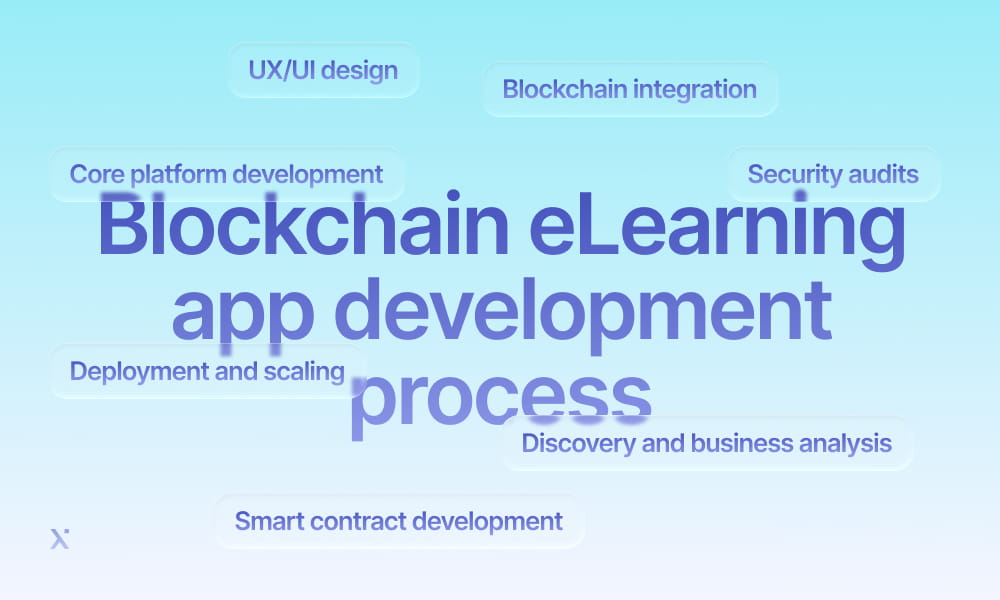
Blockchain eLearning app development phases and deliverables
| Phase | What happens | Deliverables |
| Discovery and analysis | Define use case, proof model, compliance, and scope | Product scope, requirements, and estimate |
| UX/UI design | Map end-to-end learner and verifier flow | Prototype, user journeys, UI kit |
| Smart contract development | Build and test issuance/verification logic | Contracts, tests, testnet deployment |
| Core platform development | Build LMS features and admin tools | Working platform, APIs, analytics events |
| Blockchain integration | Connect wallet, contracts, storage, verification | End-to-end issuance and verification |
| Security audits | Review contracts and platform security | Audit results, fixes, hardened release |
| Deployment and scaling | Launch, monitor, prepare for growth | Production setup, monitoring, and scaling plan |
A Comprehensive Guide to Blockchain Application Development

Web3 Development: What It Takes to Build the Future
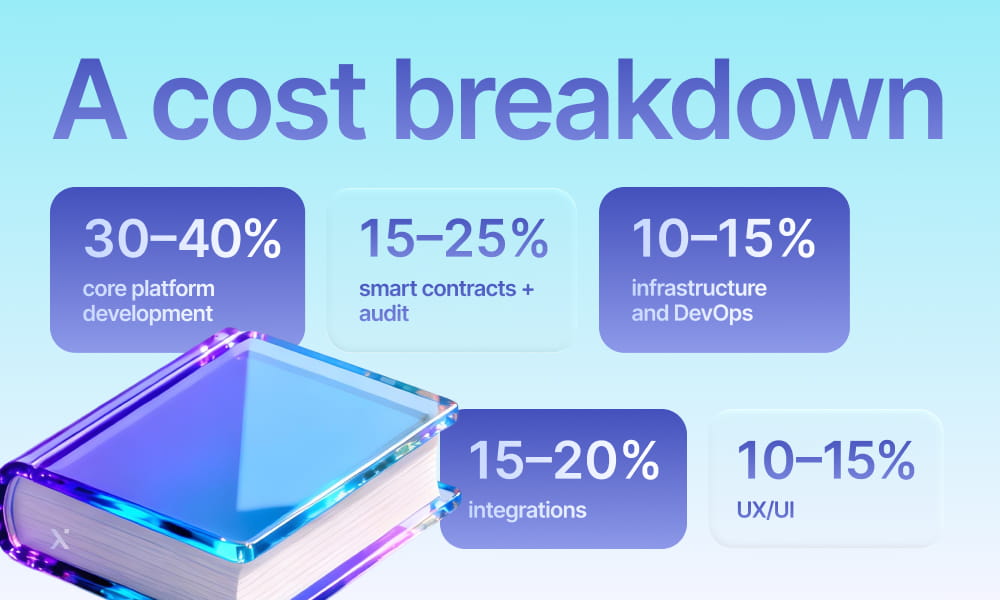
How much does it cost to develop a blockchain-based eLearning app?
Cost is where a lot of blockchain education projects either get serious or quietly disappear. The technology is not the only driver. In most cases, scope decisions matter more than the chain you pick.
What really drives the cost
App complexity
A simple flow, enroll, complete, issue credential, verify, is one project. A platform with multiple user roles, dashboards, analytics, token rewards, and governance logic is another. Every additional state the system can be in adds development and testing time.
Blockchain selection
Ethereum-compatible chains are common and well supported. That lowers risk, but gas fees, scaling strategy, and infrastructure still affect the budget. A permissioned network or a custom chain setup increases both setup time and long-term maintenance.
Smart contract logic
Minting a basic certificate is straightforward. Adding revocation rules, expiration logic, payment-based access, upgrade paths, or multi-issuer support increases contract complexity. More logic means more testing and audit effort.
Integrations
Most real eLearning products connect to something: payment gateways, LMS systems, HR platforms, identity providers, SSO, and reporting tools. Each integration adds edge cases and ongoing maintenance.
Compliance requirements
If your platform handles personal data, minors, accredited education, or regulated training, you’ll need stronger data separation, logging, and documentation. Compliance work is not optional, and it affects architecture decisions early.

Web3 Development Cost: Breaking Down What Really Drives the Price

Digital Transformation Strategy: Best Practices
Typical cost ranges for blockchain eLearning app development
These are broad estimates. Final numbers depend on scope and region, but they give a realistic starting point.
- MVP:
$60,000 – $120,000
Includes core learning flow, credential issuance, basic wallet integration, and verification UI. - Full-scale platform:
$150,000 – $350,000+
Includes multi-role dashboards, integrations, advanced contract logic, analytics, reporting, and production-grade infrastructure. - Ongoing maintenance:
15% – 25% of the initial development cost per year
Covers hosting, monitoring, contract updates, minor feature improvements, and support.
If your estimate is far below this range for a production-grade product, something is likely missing: security, audit, scaling, or integration work.

Planning Web3 App Development Cost: Team, Timeline, And Hidden Expenses

Blockchain Development Cost in 2026: What Goes Into the Price Tag
Why PixelPlex is the right partner
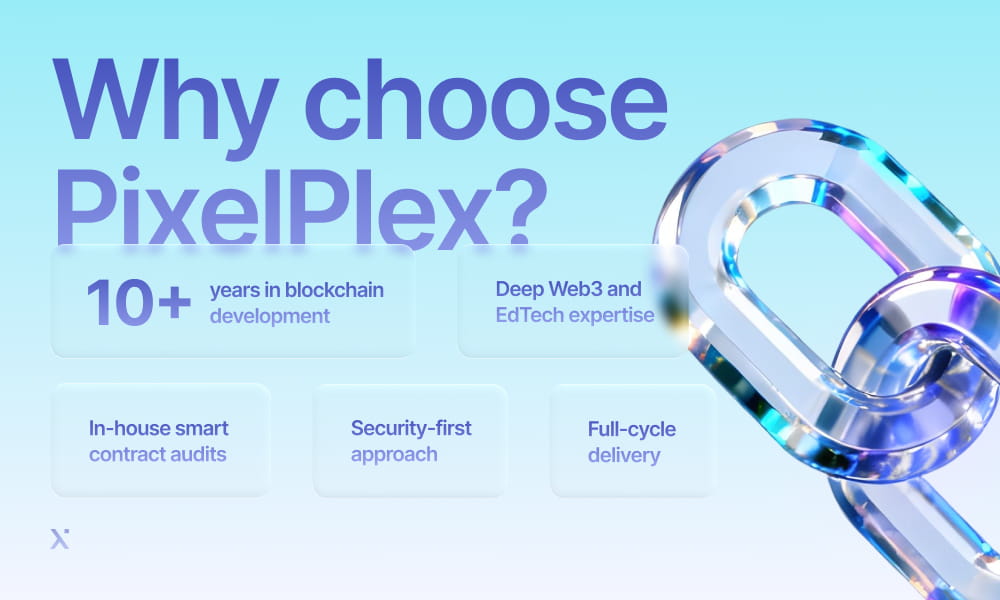
PixelPlex has over 10 years of hands-on blockchain development experience. We’ve worked with public networks, private infrastructures, identity layers, tokenized models, and enterprise integrations. That background matters when your product needs to work outside a demo environment.
Strong foundation in smart contract development
In education platforms, contracts are usually responsible for issuance logic, ownership, revocation, and access enforcement. Even simple contracts need careful design, testing, and review. A small bug in issuance logic can turn into a reputational problem fast.
Our smart contract development practice covers:
- Contract architecture and logic design
- Unit testing and edge-case validation
- Gas optimization and performance review
- In-house security audits before deployment
We keep the contract surface area focused on what actually needs to be on-chain, and move the rest to the backend where it belongs.
Web3 expertise beyond contracts
Blockchain in eLearning also means wallet flows, identity management, metadata storage, and integration with off-chain systems. This is where many projects get complicated. Through our Web3 development services, we handle:
- wallet integration and abstraction
- credential minting and metadata management
- blockchain integration with LMS and HR systems
- on-chain and off-chain storage architecture
The result is a product that feels consistent from the user’s perspective, even if the underlying architecture is layered.
Security-first approach
Credential systems are trust systems. That means security is not optional. We audit contracts in-house, review access controls at the platform level, and test transaction flows under real conditions. Issuance rights, revocation rules, and role-based permissions are treated as core product logic, not backend details.
Full-cycle delivery
From discovery to deployment, we work across the entire lifecycle:
- Product discovery and technical validation
- UX/UI design
- Smart contract development
- Core platform engineering
- Blockchain integration services
- Security audits
- Deployment and ongoing support
As a blockchain e-learning app development company, our focus is practical. If blockchain strengthens your verification model, we will implement it carefully. If it adds cost without a clear benefit, we say that upfront.
The goal is not to add complexity. It’s to build a platform where credentials hold up, workflows are predictable, and the architecture can scale when adoption grows.

The Power of Blockchain for Startups: Advantages and Use Cases

Top Blockchain Companies Revealed: How to Choose the Right Development Partner
Conclusion
Blockchain in eLearning is not about trends or token mechanics. It’s about fixing weak points in verification, ownership, and rule enforcement. If credentials need to travel and hold up outside your platform, a well-designed blockchain layer can remove the friction that traditional systems keep pushing onto users and admins.
The key is focus. Start with a clear use case, keep the scope tight, and build the trust layer around real product needs. With the right approach and the right team, blockchain becomes infrastructure, not overhead.
If you’re exploring blockchain app development services for your eLearning product, make sure the conversation starts with your credential model and user flow, not with the chain name. That’s where durable systems are built.
FAQ
Don’t move everything blindly; start by cleaning up existing data. Then, gradually build a trusted data set, typically using references to internal records and metadata. The goal isn’t to recreate the past, but to simplify future verification and ensure that past credentials can be verified where they matter.
If you rely on user-managed wallets, recovery is on the learner, which is fine for Web3-native audiences and painful for everyone else. If you use embedded or custodial wallets, you can offer normal account recovery flows, but you also take on more responsibility. Pick your model early, because it affects support load, UX, and risk.
No. Blockchain can prove that a credential was issued and hasn’t been altered. It can’t make an unaccredited program accredited. Recognition still depends on the institution, the regulator, and the rules in that jurisdiction. Blockchain helps with the verification step. It doesn’t grant legitimacy by itself.
When you’re not sure what problem you’re solving, if the team is debating chains and token models but hasn’t defined who verifies the credential and what counts as proof, you need blockchain consulting before you build anything. A short strategy phase can save months of development by confirming whether blockchain is actually justified, and if it is, what the smallest viable scope looks like.
Tokenization services can work for internal incentives, milestone rewards, or access tiers, but only if the reward system is tied to real outcomes. In corporate training, simplicity usually wins. If tokens add friction or create gaming behavior, they’ll hurt completion rates instead of improving them.