
Teams want apps that feel just as reliable, flexible, and secure as MetaMask, which immediately brings up a practical question: what does it take to build something on that level, and how much does it cost?
Crypto adoption keeps rising, and with it, the demand for tools that help users manage assets, interact with dApps, and stay in control of their keys. This growth is increasingly powered by stablecoins: the stablecoin transfer volume surpassed $4 trillion in the first half of 2025. As expectations grow, the market leans on familiar, proven solutions. One of the strongest reference points is MetaMask, a wallet that shaped how millions of users connect to Web3. For companies exploring their own wallet products, this becomes the natural comparison.

Wallet costs are hard to estimate because every “MetaMask-like” build is different. Even a simple non-custodial wallet needs secure key handling, encryption, and solid RPC integrations. Add the features users expect from MetaMask — swaps, NFTs, bridging, stronger security — and the price changes again.
This guide breaks the work into clear layers and connects features to real development effort, so you can plan the budget with fewer surprises.
Our perspective comes from direct work with Web3 architecture, mobile and extension wallets, node infrastructure, and security-critical blockchain applications. We have seen what makes these systems stable, where they fail, and how much effort each component requires at scale. This background allows us to talk about real development costs, not abstract assumptions.
This article will be useful for founders, product owners, technical leads, and teams preparing to build a wallet from scratch or evaluate white-label alternatives, especially those considering custom Web3 wallet development and trying to size scope, timelines, and budget before committing to a build.

Web3 Development: What It Takes to Build the Future
A Comprehensive Guide to Blockchain Application Development
What defines a crypto wallet app like MetaMask?
There’s a wide range of wallet designs, but the underlying mechanics are similar. MetaMask raised expectations for non-custodial products by combining user-controlled keys with a smooth layer for signing, network access, and dApp interaction. To gauge the scope of a MetaMask-like build, it’s useful to break the wallet into core components.
What these wallets do (and don’t) store
A crypto wallet doesn’t “hold” coins the way a bank app holds money. Your assets live on the blockchain. The wallet is the tool that holds the keys and signs actions that let you move those assets.
What the wallet stores
- Seed phrase / private keys — stored locally, then locked down (this is the crown jewel)
- An encrypted vault (plus whatever unlock method you choose: password/biometrics)
- The boring config stuff: selected networks, RPC endpoints, custom chains you added
- A local cache so the app feels fast (recent activity, token metadata, UI state)
What the wallet doesn’t store:
- The tokens themselves
- Your live balances (those are pulled from the network when needed)
- dApp logic or state
- Any on-chain identity (that exists on-chain, not inside the app)
That split is what shapes the whole product. Wallet engineering is about protecting keys, reading the network reliably, and making signing and confirmations predictable — not about storing “assets” locally.
How non-custodial wallets work
In a non-custodial wallet, the keys belong to the user — not the app, not the vendor, not a support team. When someone creates a wallet, the app generates a seed phrase, derives the private keys from it, and stores that key material locally in encrypted form. Nothing “custodial” happens behind the scenes. The app is basically a key manager plus a signing tool.
When the user sends tokens or interacts with a dApp, the wallet doesn’t ask a server to approve anything. It builds the transaction, signs it on the device using the private key, and then broadcasts the signed transaction through an RPC provider (or a node the team runs). The important part is where the signature is created: on the user’s side, with a key that should never leave local storage.
That’s also why backends are optional — and why good wallets keep them on a short leash. If a backend exists, it’s usually there for convenience, such as push notifications, price charts, token metadata, analytics, swap quote routing, and possibly faster history indexing. It shouldn’t be in the business of handling private keys, ever.
The upside of this model is control and transparency. The downside is there’s no safety net. If you mess up entropy, key derivation, encryption, or the signing flow, you’re not shipping a “bug.” You’re shipping a security risk with a straight line to user funds.
Types of wallet interactions with blockchains
Wallets “talk” to blockchains in a few different modes — and each one comes with its own failure cases.
- Reading data. This is the constant background work: checking balances, pulling token lists, loading NFT metadata, reading contract state, and showing fee estimates. Most of the time, a wallet is just asking the network, “What does this address have right now?”
- Simulating. Before a wallet lets a transaction go out, it usually tries to “dry-run” it. Not perfectly — just enough to answer basic questions: will it fail, how much gas will it actually burn, and what is this contract call really doing? This is also where decoding helps, especially with approvals, because “Approve” can mean anything from a normal spend limit to handing a contract the keys to your tokens.
- Writing and signing. This is the point of no return. The wallet builds the transaction (or receives it from a dApp), signs it locally, and broadcasts it. It also handles approvals, token allowances, and dApp sessions – often through an injected provider based on an EIP that standardizes wallet communication with dApps.
- Network switching. Users jump chains constantly. The wallet has to switch RPC endpoints, handle different fee models and chain parameters, support custom networks, and sometimes deal with non-EVM logic that doesn’t behave like Ethereum at all.
At MetaMask scale, you can’t treat this as a set of one-off integrations. Multi-chain support forces you to build these behaviors as separate, testable parts, because “the same” transaction won’t behave the same way on every network. RPC providers respond differently, fee logic changes, and standards evolve — and the wallet must continue to work through all of it.
Typical architecture layers
A MetaMask-style crypto wallet development may appear simple on the surface, but under the hood, it’s a set of separate layers that must remain in sync. If you blur them together, every new feature becomes a risky change across the entire codebase.
- Key management. Creating the seed phrase, turning it into keys, then keeping that key material locked down on the device (or inside the extension vault). If you support hardware wallets or Secure Enclave/KeyStore, it also falls under this category.
- Wallet core. The basic engine: derive addresses, build transactions, sign them, estimate fees, track nonces, and keep everything consistent when users fire off multiple actions in a row.
- Network layer. Talking to RPC endpoints, switching networks, dealing with chain-specific quirks, and having fallbacks when a provider lags or drops.
- Contract handling. This is where the wallet handles tokens and NFTs in real-world terms: reading standards like ERC-20/ERC-721, handling approvals and allowances, encoding calls, decoding the responses, and translating the “contract language” into something a normal user can understand before signing.
- dApp connectivity. The wallet must act as a bridge between the user and the app they open. In extensions, that means an injected provider. On mobile, it’s usually WalletConnect. Either way, you need clear permissions and session controls, so a dApp can’t stay connected longer than it should.
- UI layer. This is the trust layer. Onboarding, asset screens, confirmation and approval prompts, settings, notifications — the parts that decide whether the wallet feels clean and predictable or confusing and risky.
- Backend (optional). A non-custodial wallet can still utilize servers, but only for helper services, including prices, metadata, notifications, analytics, swap quotes, and indexing. The rule is simple: if it touches private keys, it doesn’t belong here.
This structure defines the scope of crypto wallet development and strongly affects cost calculation, timelines, and required expertise.
Before we proceed to the features, it is helpful to compare wallet models and understand how their security and ownership models differ.
Comparison of main wallet types
| Wallet type | Ownership model | Where keys live | Security profile | Typical use cases |
| Non-custodial | User controls keys | Local device storage with encryption | High, depending on user hygiene | Personal wallets, DeFi, dApps |
| Custodial | Service controls keys | Company-managed infrastructure | Medium, depending on provider trust | Exchanges, fintech apps |
| Hybrid | Mixed control model | Split between the user device and the server | Medium to high, flexible | Apps balancing UX and security |
| MPC | Keys are split into shares | Distributed across devices/servers | Very high, no single point of failure | Enterprise wallets, advanced Web3 apps |
Custodial vs. Non-Custodial Wallet: Everything You Need To Know

AI and Crypto: Top 15 Promising Use Cases and Applications
Think of MPC as splitting the private key into pieces, so that no single place ever holds the full key. Each piece (or “share”) lives separately, for example, on a device and a server. When you sign a transaction, those shares work together to produce a signature. You still receive a valid, signed transaction, but the full key never exists as a single file that someone can steal.
Core features of a MetaMask-like wallet
Key storage alone doesn’t make a wallet viable. MetaMask has established itself as a benchmark in terms of user experience, multi-chain interoperability, and interaction with decentralized applications. The features listed below represent the minimum required for a wallet to compete in this class.
Feature checklist: MVP vs. full product
| Feature | MVP | Full product |
| User onboarding | ✓ | Enhanced flows, education prompts |
| Seed phrase generation & backup | ✓ | Advanced backup options |
| Private key storage | ✓ | Hardware wallet support |
| Multi-chain support | Limited | Full EVM + optional non-EVM |
| Token management | ✓ | Auto-detection, advanced metadata |
| dApp browser | Basic | Full dApp permissions and session control |
| Transaction history | ✓ | Indexed history with filtering |
| Fiat on-ramps | Optional | Integrated providers, localized flows |
| In-app swaps | Optional | Aggregators, routing logic |
| Push notifications | Optional | Granular notifications, on-chain alerts |
| NFT support | Optional | Rich previews, collection insights |
| Security controls | Basic | Simulation, phishing checks |
| Hardware wallet integrations | Optional | Multiple devices and standards |

What Is MVP in Software Development?

AI MVP Development: How to Validate Ideas Fast Without Breaking the Budget
What technologies are required for crypto wallet development?
A MetaMask-level crypto wallet development is a pile of layers where each does a specific job, like talking to networks, signing transactions, rendering the UI, protecting keys, and keeping the app responsive. What you choose for each layer decides how long the build takes, how much it costs to test and maintain, and how stable the wallet feels once real users get their hands on it.
| Technology area | Options | Typical use cases |
| Nodes & RPC | Self-hosted nodes, Infura, Alchemy, QuickNode | Network data, transaction broadcast, event polling |
| EVM frameworks | Ethers.js, Web3.js, Viem | Contract calls, signing, ABI encoding |
| Non-EVM stacks | Solana Web3.js, Rust, Anchor | Solana transactions, program interactions |
| Mobile frameworks | React Native, Flutter | Cross-platform wallet apps |
| Extension frameworks | React, Svelte | Browser extensions with injected providers |
| Backend | Node.js microservices, Go services, PostgreSQL | Notifications, indexing, routing logic |
| Smart contract tools | Hardhat, Foundry, Truffle | Deployment, testing, ABI management |
| Connectivity standards | WalletConnect, EIP-1193 | dApp integration |
| Signing standards | EIP-712, EIP-1559 | Structured data signing, gas fee markets |
| Encryption & storage | AES-256, PBKDF2, Secure Enclave, KeyStore | Protecting key material |
| Cloud & HSM | AWS KMS, GCP KMS, Azure HSM | Secure computation, backend protection |
| QA tools | Jest, Detox, Cypress, local blockchain nodes | Automated testing for Web3 flows |

Inside Crypto Wallet MVP Development: Process, Costs, and Real-World Lessons
What Is a Blockchain Wallet?
Crypto wallet development process
The process for building a MetaMask-level wallet always runs through the same stages. The sequence is set. But here’s the kicker: wallets aren’t like regular apps. What really trips people up is realizing that those early, rushed choices — the small decisions — are exactly what turn into months of expensive rework later.
Discovery
This is where you make the uncomfortable calls. What is in the first release, and what is deliberately not in it? Which chains matter, and which ones are you willing to say no to for now? Whether you are building a basic wallet that signs and sends, or a wallet that lives inside dApps all day. If discovery stays vague, everything after it becomes guesswork, and the scope will keep “growing a little” until it is too big to test properly.
The same discipline applies to Web3 Android app development. Mobile introduces additional constraints — battery life, background process limits, secure enclave access, and platform-specific key storage. Ignoring these early leads to architecture that works on paper but fails under real mobile conditions. Whether targeting iOS, Android, or both, the core principles remain the same: separate concerns, isolate critical paths, and test interfaces, not implementations.
Architecture and boundaries
A wallet stays maintainable only if core domains are separated from the start and enforced through narrow, testable interfaces. Key handling and vault logic should be fully isolated (unlock/lock, account derivation, signing) with no dependency on tokens, dApps, or UI state. RPC and network switching should live in a dedicated transport layer that owns chain config, retries, and fallback behavior. dApp sessions should be a separate module that manages connection state, permissions, persistence, and revocation. The UI then acts as a consumer of these services, not the place where security decisions or business rules happen. When this step is skipped and development starts screen-first, hidden coupling appears immediately — new features trigger regressions across signing, sessions, and networking — QA effort grows non-linearly, and delivery timelines collapse because the product becomes brittle under real-world use.
Flows and wireframes
Wallet UX encompasses not only onboarding screens and a visually appealing token list, but also includes other key elements. It is the set of moments where people can approve the wrong thing. Teams typically map the core paths first, including create or import, backup and verification, signing and approvals, network switching, token and NFT views, connected dApps, and the “something went wrong” states. Wireframes are useful here because they expose confusion early, before engineers spend weeks building a flow that users will not understand.
UI design
After the structure is defined, design is what makes the experience feel stable. Wallet UI is judged on clarity, not creativity. Users need to understand the network, the signing request, the fee, and what will happen next. If the screens feel inconsistent or overloaded, users tend to interpret it as risk, not just poor design.
Core build
This is where it stops being a prototype and starts being a wallet. Seed creation or import, encrypted storage, lock rules, signing, fee estimates, nonce handling, all of it. Then you hit the unglamorous work that keeps the app from feeling broken: background refresh, caching, token discovery, and history sync. Most teams learn the same thing here: a “basic wallet” is only basic on paper.
Backend helpers (if you need them)
Even non-custodial wallets often add small backend services, but only for convenience features. Notifications, token and NFT metadata, crash reporting, analytics, and sometimes indexing for faster history. The line stays simple: no keys, no seed phrases, no signing. Still, these services add real operating work, because now you have uptime, monitoring, and incident response to think about.
Node and RPC setup
RPC is a part of the product, not a background detail. When a provider is slow or down, users see missing balances, stuck transactions, and broken history. That is why teams usually use more than one provider, build fallbacks, and monitor them early. If you wait until launch to do this, users will be the ones telling you it is broken.
QA and security testing
A wallet usually looks fine until a user does three things at once. They switch networks, hit retry on a “stuck” transaction, and the token list is still syncing. Then the app wakes up, and the dApp reconnects, and one provider reports fees differently from the other. That’s where bugs live, so QA has to chase the combinations, not just the clean demo flows. On the security side, the focus is narrower: protect keys, make signing hard to misunderstand, don’t leak sensitive data, and block the obvious ways people get tricked into bad approvals.
Beta
Beta is the first time you see the wallet the way users do. They won’t follow your test script. They’ll import on a new phone, chain-hop constantly, connect to whatever dApp shows up in a chat, and approve things fast. What you get back is not “small improvements.” It’s the stuff you have to fix before people decide the wallet can’t be trusted.
Launch and ongoing maintenance
A wallet does not calm down after release. Chains upgrade. RPC providers have outages. WalletConnect changes, new EIPs become expected, and token lists break. Also, dApps may change their flows. If you plan this like a one-time build, you will be surprised. If you plan it like a product you will be maintaining every month, the budgeting and timelines start to make sense.
This is where most of the work happens during crypto wallet development. The solution stops being a prototype and becomes a real wallet. You build a full-fledged engine: seed generation, import flow, encrypted storage, locking rules, signing logic, fee evaluation, nonce handling, and so on. Then you move on to the less-glamorous work that prevents the app from feeling broken: background refresh, smart caching, consistent token discovery, and history synchronization. Here, every team learns the same thing: what looks like a “basic wallet” in your plan is only basic on paper.
How to Build a Crypto Wallet: a Complete Guide
Crypto Wallets Get Brain: How AI Crypto Wallet Development is Creating a Smarter and Safer Financial Future
How much does it cost to develop a crypto wallet like MetaMask?
The pricing for a MetaMask-level wallet changes frequently because the project scope evolves rapidly. You decide to add a few networks, launch on mobile, bump up the security level, or throw in swaps and NFTs — the budget immediately explodes. A basic, one-network wallet with simple signing is fundamentally different from a multi-chain platform with DeFi modules. The ranges we quote reflect the typical reality for services in this space.

What drives the budget?
Feature complexity is always the first major jump. Simple seed phrase flows, and basic signing logic are fine. However, features like multi-chain routing, swaps, or NFT support introduce genuine, complex challenges. Any time a function needs to interact with the RPC layer, invoke a smart contract, or rely on dApp connectivity, the cost immediately increases. There’s no way around it: you have to test every single combination against every network and edge case possible.
Platform choice also heavily dictates the cost. A mobile-first wallet (iOS and Android) always costs more than a browser extension. Why? Mobile devices demand separate, specialized security modules, native biometric integration, and more complex QA cycles. Most teams attempt to build both, which instantly doubles the UI development workload and significantly increases the QA requirements.
Security level is arguably the biggest cost driver of all. Adding structured-data signing, real-time phishing checks, simulation logic, password vaults, or Secure Enclave support drastically expands the scope. Higher security demands more specialized penetration testing, more demanding QA, and hardening the entire infrastructure.
Scaling and custom integrations
As soon as you support more than one chain, the work becomes more complex. One EVM network is the straightforward case. Add a second, and you are suddenly juggling more RPC endpoints, different fee and gas behavior, new chain IDs, token lists, and signing rules that do not always line up. It is no longer “build it once and reuse it.” And if you bring in non-EVM chains, you are essentially building another track in parallel, which is where time and cost can quickly escalate.
Now, smart contract integrations are mandatory anytime a wallet deals with DeFi protocols or NFT marketplaces. You have to handle ABI, approvals, swaps, and data decoding. If your wallet needs custom routing logic, internal audits, and direct integrations on top of that? It immediately raises both your costs and your timelines, no question.
Finally, custom modules accelerate costs fast. Swaps require dealing with aggregators, simulation, and complex approval handling. Bridges depend on cross-chain logic and separate RPC flows. Staking modules introduce validator logic, contract dependencies, and significant testing. Note that these features not only incur upfront costs, but also significantly increase your long-term maintenance expenses.
The cost per feature module
These ranges are based on the actual spent building the wallet end-to-end, including UX and design, mobile or extension development, the backend required to support it, and QA. The price swings mostly come down to scope. More chains, stricter security requirements, and launching on multiple platforms from the start all contribute to the increased estimate.
| Feature module | Design | Backend | Mobile / extension | QA & security | Total |
| Onboarding & seed phrase | $3k–$6k | — | $8k–$15k | $3k–$6k | $14k–$27k |
| Key storage & encryption | $2k–$4k | — | $10k–$18k | $6k–$10k | $18k–$32k |
| Multi-chain support | $3k–$7k | — | $15k–$30k | $8k–$15k | $26k–$52k |
| Token management | $3k–$6k | $4k–$8k | $10k–$18k | $5k–$9k | $22k–$41k |
| NFT support | $2k–$5k | $4k–$8k | $8k–$16k | $4k–$8k | $18k–$37k |
| dApp browser / provider | $4k–$8k | — | $12k–$20k | $6k–$10k | $22k–$38k |
| In-app swaps | $4k–$8k | $8k–$20k | $15k–$30k | $8k–$15k | $35k–$73k |
| Fiat on-ramps | $2k–$4k | $4k–$10k | $8k–$15k | $3k–$6k | $17k–$35k |
| Notifications | $1k–$3k | $6k–$12k | $5k–$10k | $2k–$5k | $14k–$30k |
| Hardware wallet support | $3k–$5k | — | $12k–$22k | $6k–$10k | $21k–$37k |
| Security & simulation | $3k–$6k | — | $15k–$25k | $10k–$20k | $28k–$51k |
These ranges reflect the typical cost structure for wallets aiming for that MetaMask-level functionality. The bottom line is simple: the more chains, features, and complex integrations you pack in, the higher the cost climbs. Security is a major factor here as well: projects requiring advanced protection layers always fall into the upper ranges, while simpler MVPs sit firmly near the lower boundaries. Your decision on the platform — mobile, extension, or both — also drastically shifts the final budget.

Web3 Development Cost: Breaking Down What Really Drives the Price

Smart Contract Development Cost Demystified: What Every Business Should Know
The cost by wallet type
While individual modules help estimate complexity, most teams think in terms of complete product tiers. The next table categorizes features into realistic wallet categories — MVP, full multi-chain, and enterprise-grade — to illustrate how these components come together in actual project budgets for crypto wallet development.
| Wallet type | Typical scope | Estimated cost |
| MVP wallet | One EVM chain, onboarding, signing, basic token list, simple dApp connection, optional notifications | $60k–$120k |
| Full multi-chain wallet | Multiple EVM chains, swaps, NFTs, advanced UI, strong security, analytics backend, dApp browser | $150k–$350k |
| Enterprise-grade wallet | Multi-chain + non-EVM, MPC or hardware integrations, deep security, staking, bridging, customizable modules | $400k–$800k+ |
In crypto wallet development, these budgets account for everything: design, engineering, QA, backend services, and setting up all the necessary long-term infrastructure. MVPs remain affordable because they adhere to a single chain and bypass complex modules. Multi-chain wallets, however, immediately introduce dependency hell and massive testing requirements. You see the highest budgets for enterprise-grade solutions. These include features such as MPC, bridging, staking, and support for both EVM and non-EVM ecosystems. They demand continuous security reviews, constant monitoring, and extensive QA, which is why those costs hit the absolute top end of the range.
Top 10 Blockchain Development Companies in 2025

DeFi Vaults Explained: How to Turn Lazy Crypto Into an Automated Yield Machine
Cost optimization strategies
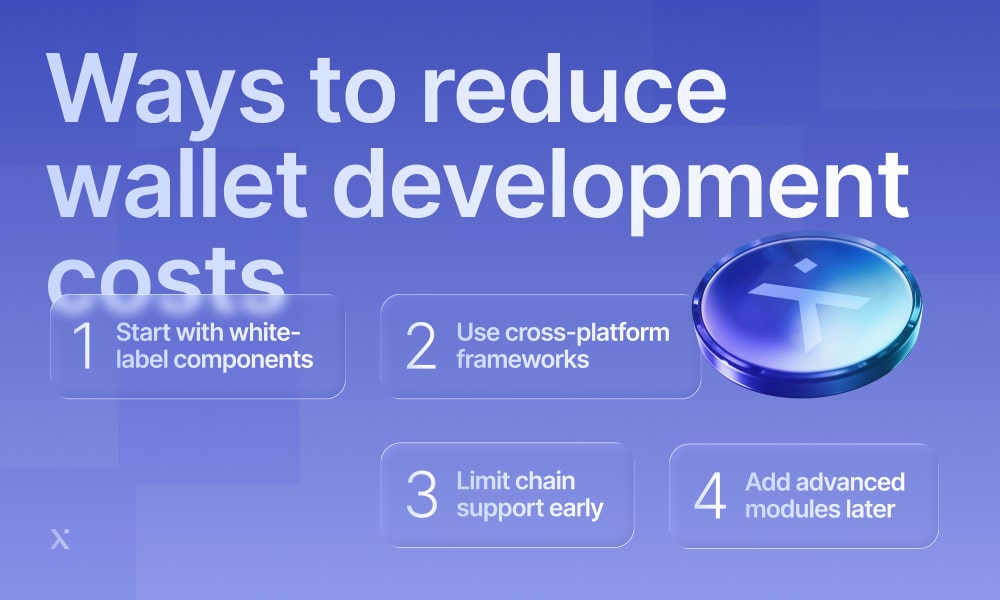
Not every wallet needs to match the scope of a full MetaMask competitor on day one. With the right strategy, teams can absolutely shorten timelines and cut crypto wallet development costs — without sacrificing security or ruining the user experience. The following techniques help you control complexity and keep those early budgets manageable.
When to choose white label development
White label crypto wallet development reduces cost by providing a pre-built wallet core, ready-made signing logic, and existing chain integrations. They work well for teams that want a quick launch or do not require deep customization. Most white-label products already include onboarding, key storage, token management, and basic dApp connectivity.
Use cases where white-label fits:
- Early-stage startups validating demand
- Businesses that need a branded wallet fast
- Teams that do not need advanced modules at launch
Choosing white label crypto exchange software development makes sense when you need a fast, predictable launch with a stable set of features. Most core logic is already built and tested, resulting in a shorter time to market. Custom architecture becomes the better choice when the wallet requires advanced security, multi-chain routing, or features such as swaps and staking. It also gives full control over branding and UX, which white-label solutions cannot match.
When custom architecture pays off
A custom crypto wallet development becomes the better option when the product requires advanced modules, unique UI flows, multiple blockchains, or specialized security features. Scaling also becomes easier with custom architecture because each module is tailored to the expected usage patterns.
Good candidates for custom builds:
- Products that require multi-chain routing
- Wallets with swaps, staking, or bridging
- Enterprise-grade solutions with MPC or hardware integration
- Projects with complex branding and UX goals
Reducing cost with cross-platform frameworks
If you use frameworks like React Native or Flutter, you can ship both iOS and Android versions using a mostly shared UI codebase. In crypto wallet development, it is still necessary to write native modules for secure key storage, but the majority of the UI flows, components, and screens are completely reusable. This strategy is particularly effective if you are focused on reaching a mobile-first user base immediately.
Savings typically come from:
- Shared interface development
- Fewer duplicated screens
- Unified QA cycles
Cutting unnecessary networks at the MVP stage
Most teams overestimate the number of chains they need at launch. Supporting too many networks early increases RPC dependency, testing complexity, and data-handling overhead. MVP development benefits from starting with one or two high-traffic chains and adding the rest after user feedback.
The advantages are as follows:
- Shorter development cycle
- Simpler architecture
- Lower QA effort
- Reduced RPC expenses

How Much Does AI Development Cost in 2025?

Cryptocurrency Exchange Development Cost: Key Factors & Estimates
Hidden costs teams always forget about during crypto wallet development
Even when you nail down the core feature scope, budget allocations still tend to stray off track due to all the hidden “non-feature” work. This is the type of work that requires actual engineering time, tooling, and ongoing expenditures, but it somehow never appears in the initial estimates. Yet, every single one of those items is absolutely essential for every production release during crypto wallet development.
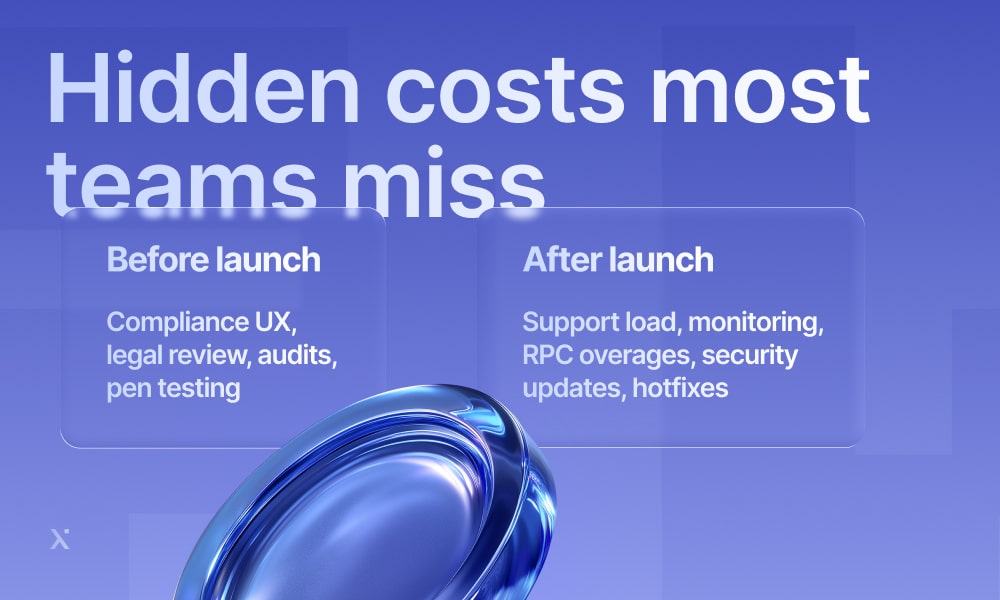
Compliance and licensing
If you add fiat on-ramps, routing, swaps, or any flow that involves regulated providers, compliance becomes an integral part of product delivery. Even if you outsource KYC/AML to a partner, you still need:
- UI and UX for verification and error states
- Data retention rules and consent management
- Regional restrictions, blocking logic, and country-specific provider availability
- Legal review of how you message custody, risk, and fees
For custodial or hybrid models, the compliance scope expands further due to custody obligations, reporting requirements, and operational controls.
Support and user education
Non-custodial wallets shift responsibility to the user. That creates predictable support pressure. You will need:
- In-app education during onboarding and key backup
- Knowledge base and troubleshooting flows
- Support tooling, analytics, and crash reporting
- Clear “what we can’t recover” messaging, plus loss scenarios handling
Reducing tickets is not just copywriting. It also requires product design and engineering time.
Smart contract audits (when applicable)
Most wallets use third-party protocols instead of deploying their own contracts, but audits are still performed in two common cases. The first is when you provide your own contracts, for example, for routing, rewards, token lists, or custom exchange logic. The second is when the wallet integrates with contracts in a way that poses a real risk to the user and requires verification. If you do deploy your own contracts, budget for the cost of auditing and subsequent fixes, as audit results often lead to refactoring rather than minor fixes.

How to Audit a Smart Contract in the Most Efficient Way

From Code to Confidence: Inside Smart Contract Audit Pricing
Node provider bills and RPC reliability costs
RPC costs are the bills you feel once the wallet has real users. The app is constantly asking the network for data, balances, tokens, NFT metadata, and transaction status, and every one of those calls has a price.
It gets more expensive when traffic spikes, when you support multiple chains, and when you add the reliability work that users never see, fallback providers, monitoring, and health checks. Without that, a single provider hiccup turns into missing balances and “my wallet is stuck” reports. A lot of teams budget for one RPC provider. Most end up adding a second one later, after the first incident.
Cloud infrastructure for backend services
Even a non-custodial wallet may require some backend work. Teams add services for push notifications, token and NFT metadata, crash reports and analytics, and sometimes indexing to improve the speed of history and token discovery. None of that should ever touch private keys, but it still costs money to run. You are paying for compute, storage, monitoring, and the time it takes to respond when something breaks.
Continuous security checks
You don’t “complete” security. You maintain it. This means keeping dependencies up-to-date, re-verifying signatures and decryptions after updates, and monitoring for new phishing and dApp attacks. A bug bounty program can help, but it also increases the amount of ongoing triage and bug fixing.
UI redesigns after beta feedback
Wallet UX is where trust is won or lost. Beta often reveals friction points:
- Misunderstood signing screens
- Confusing permission prompts
- Poor token discovery behavior
- Feature overload in the asset view
Design changes cascade into engineering and QA. If you do not plan for iteration, timeline slips.
Emergency hotfix budget
Once a wallet is live, things can break at the worst possible time. An RPC provider can drop, a chain update can disrupt fee estimates, a token list change can render balances incorrect, or assets can disappear. Additionally, third-party services such as on-ramps, swap tools, or analytics SDKs can fail after an update. It is worth setting aside a budget for quick fixes and, when needed, rushed app store releases.
dApp integration maintenance
dApp connectivity is never really “done.” dApps change their connection flow, WalletConnect updates, and what used to work can stop working overnight. New EIPs also become expected over time. Treat this as ongoing maintenance, not a one-time integration you can ship and forget.
Security requirements and their impact on cost
Security can’t be implemented on a “we’ll figure it out later” basis. In a wallet, it affects how keys are stored, what users see when approving something, and how much testing is required in extreme cases. This is why two wallets with the same feature set can cost very different amounts. If you’re trying to match MetaMask’s security level, this usually has the biggest impact on your score.
| Security requirement | What it protects against | What you need to build | Cost impact |
| Threat modeling | Common attack paths (phishing, malware, insufficient RPC data) | Define realistic threats, set security rules, and plan negative tests | Medium |
| Key management | Key/seed theft, unsafe recovery | Seed generation, secure vault, signing flow, import/recovery UX | High |
| Encryption | Vault cracking, data leaks | Strong encryption + password/key-derivation setup, lock/timeout logic | High |
| Multi-factor authentication | Unauthorized access to the app | Biometrics/passcode gates, extra checks for sensitive actions | Medium |
| Anti-phishing checks | Fake sites, malicious dApps, approval scams | Site warnings, risky approval alerts, safer permission prompts | Medium–High |
| Secure Enclave / KeyStore | Local key extraction on mobile | Hardware-backed storage, native modules, device-change handling | Medium–High |
| Transaction simulation | Blind signing, hidden transaction effects | Pre-check transactions, decode actions, clearer confirmation screens | High |
| Smart contract safety | Dangerous approvals, spoofed tokens, unknown calls | Better decoding, risk flags, safe fallbacks when decoding fails | Medium–High |
| Bug bounty programs | Unknown issues found after launch | Set up reporting + triage, fix pipeline, disclosure process | Medium |
If the budget is limited, the priority is simple. Key management and encryption always come first. After that, you choose protections based on how your wallet will be used. A wallet that facilitates swaps and connects to numerous dApps resides in a high-risk area, so implementing anti-phishing checks, transaction simulation, and enhanced contract decoding is worthwhile. A basic single-chain wallet, focused on simple transfers, has less exposure, allowing it to remain lighter, as long as the fundamentals are executed properly.

The State of Crypto Regulations and Laws in 2025
Crypto Compliance: Key Regulations and Consequences of Non-Compliance
Realistic timeline for crypto wallet development
Most of the surprises in the schedule are related to scope and testing. Adding more chains and DeFi modules will automatically introduce more unusual edge cases. The ranges below are typical, not fixed. Actual timelines vary depending on the team, the platforms you’re supporting, the level of security, the providers you rely on, and the extent to which you refine the user interface after testing.
| Wallet scope | Typical timeline | Usually includes | What most often slows teams down |
| Lightweight MVP | 8–14 weeks | 1 chain (or 1–2 EVM), onboarding + seed backup, encrypted storage, send/receive, basic token view, simple activity history | Getting signing and nonce handling right, picking reliable RPC providers, and enough QA for “simple” flows |
| Multi-chain production wallet | 14–26 weeks | Multiple EVM chains, network switching, better token/metadata handling, stronger dApp sessions/permissions, clearer confirmation screens, and optional notifications | Testing across chains (each behaves differently), gas/fee logic differences, dApp compatibility issues |
| Wallet with swaps, bridging, and staking | 20–36+ weeks | Swaps (quotes, approvals, slippage), bridging + cross-chain status, staking interactions, stronger risk checks | DeFi edge cases (failed approvals, stale quotes, delayed confirmations), heavier security review, extra UX iterations after beta |
| Enterprise-grade wallet with compliance modules | 24–52+ weeks | MPC and/or hardware support, compliance workflows, policy/admin controls (if needed), monitoring and incident readiness, formal security testing | Legal/compliance reviews, third-party vendor timelines, audit and documentation requirements, higher reliability bar |
Conclusion
A wallet like MetaMask is easy to sell in a slide deck: NFTs, swaps, ten networks, WalletConnect, and a handful of settings. The true difficulty only arrives after launch. People rush to import their seed phrase onto a new device, constantly switch networks, connect to any dodgy dApp a friend sends them, click “Approve” to skip the warnings, and then absolutely blame the wallet when something goes wrong.
That’s why the cost estimates for crypto wallet development services vary so wildly. Money isn’t spent on drawing “screens”; it’s spent on stability in real-world use. It encompasses key protection, readable signatures, seamless network switching, robust RPC backups, multi-chain testing, and resolving those critical bugs that you’ll only discover once you’re live.
If you want to control both the product and the budget, don’t rush to add every possible feature. Launch the product with the core processes working perfectly, and then observe where your users encounter problems or confusion. Add additional features based on this observed behavior.
FAQ
Crypto wallet development (MetaMask is no exception) requires a well-coordinated team of experts. The core of the team is developers and QA engineers. These employees are extremely difficult to hire part-time if you’re connecting dApps, signing standards, or supporting multiple blockchains.
A project manager, designer, security engineer, and backend developer can work part-time in the early stages if the workload is limited and the backend remains small.
It’s difficult to be 100% accurate in this situation, especially in crypto wallet development, where usage patterns can shift quickly after launch. It’s best to remain realistic and be prepared for change. Infrastructure costs aren’t always the same, as any change (NFT metadata, token discovery, multi-chain network) can only increase costs. The best idea is to build in a reserve for additional costs from the start.
Cross-chain refers to the movement of value between different networks. That adds steps, waiting, partial failures, and “where is my money” moments. That is why cross-chain features are more expensive to build and maintain.
Generally, feedback can be received immediately. However, the first week after launching a wallet is often spent resolving user interface issues and obvious bugs. After a couple of weeks, users have usually completed enough real transactions to form an opinion. They’ll have spotted the issues (or noticed that things just work), and they’ll be able to explain it without guessing. Give them a bit of time — good feedback needs to be put into actual use.
Only track what actually helps improve the wallet: crash reports, performance metrics, and whether the core flows complete end to end (create/import, backup, send/receive, dApp connect). It’s also fine to track feature usage at a high level — just enough to understand what people rely on most. Don’t collect anything that points to a specific user or wallet — no addresses, and never keys, seed phrases, or raw transaction data. Keep logs for a short period and clearly inform users about what you collect and why.
It can help, but it won’t automatically earn users’ trust. Many teams open-source the storage or signing pieces because that’s what security folks actually want to review, and keep the rest closed. That’s a sensible middle ground — just treat it as a commitment, not a stunt. Open-source means you’ll be maintaining it: taking bug reports, shipping fixes, and staying on top of security over time.