If healthcare could talk, its data would probably never stop. Good thing big data analytics can help clinicians hear the patterns hiding inside the noise.
A patient checks in, a lab processes another test, a new scan is added to a record – moments like these happen nonstop, all across cities, regions, and entire countries.
Chaos. Or simply healthcare in its natural state. One thing is clear: the industry isn’t short on data.
It’s buried under it.
Yet without the right analytical tools, most of this information stays fragmented – a situation that gives big data analytics a chance to finally take a step in. Reflecting this shift, the global big data analytics in healthcare market is projected to grow to around $327.6 billion by 2034, at an annual growth rate of roughly 19% from 2025 onward.
As an experienced healthcare software development company, we build tools used in daily care. We know how a proper solution should work and how it can shift daily tasks for the better. Based on that, we gathered 20 cases that show how big data changes the field.

Leveraging Data Analytics in Pharma: 7 Transformative Use Cases
What is the role of big data analytics in healthcare?
Healthcare creates more information than anyone could sort through on their own. Big data analytics brings it into one place, making it possible to notice problems that weren’t visible before and to shape care around each patient’s situation.
In other words, big data analytics powers the systems that make healthcare more efficient and more responsive. In practice, it means:
- More informed clinical decisions arise as clearer patterns in labs and history give clinicians earlier warnings and better guidance on effective treatments.
- Operational and financial optimization improves when analytics reveal bottlenecks like idle equipment or unusual billing.
- Support for research and innovation grows as large datasets help researchers spot promising drug candidates and validate ideas.
- Better population health management emerges when aggregated data shows where risks are rising and which communities need attention.
So, for the question of what happens when healthcare finally learns to use all the data it already has, we have a simple answer:
Better decisions at every level.
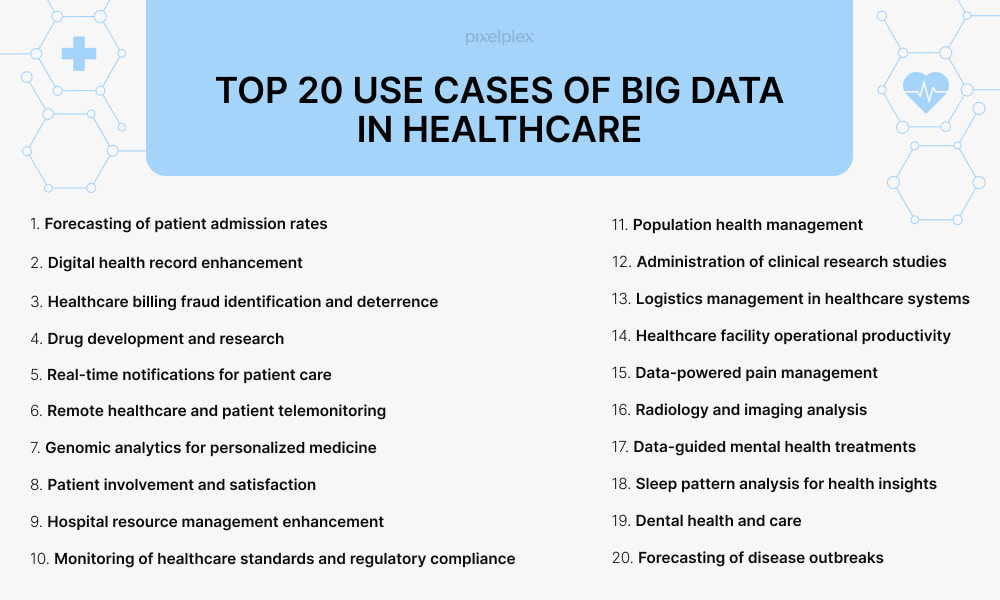
Top 20 big data analytics in healthcare use cases
Now it’s time to look at the use cases themselves. Big data analytics reaches into nearly every corner of modern healthcare, and to make its impact easier to explore, we’ve grouped the examples into 6 clear categories.
| Category | What it covers |
| Smarter clinical diagnostics | Looks at how data helps clinicians notice early changes in a patient’s condition and make more confident decisions at critical moments. |
| Hospital performance optimization | Shows how hospitals use insight from everyday operations to plan ahead and create a smoother experience for both staff and patients. |
| Intelligent healthcare records | Focuses on making medical records easier to trust and use by keeping information consistent as it moves across systems. |
| Innovation in research | Describes how deeper datasets speed up discovery and bring clarity to decisions throughout the research process. |
| Population health insights | Explains how communities reveal their health needs through patterns and how those insights help health systems respond sooner. |
| Personalized care analytics | Shows how a closer look at individual data helps shape treatments that fit each patient rather than relying on one general care. |
Smarter clinical diagnostics
1. Real-time notifications for patient care
Why it matters: Real-time data gives doctors an early heads-up when a patient’s condition begins to shift.
Hospitals move fast, and a patient’s state can shift in a moment. Big data tools help staff keep track of these small changes.
When a heart rate jumps or oxygen drops, the system sends a note to the care team instead of waiting for the next round of checks. A so-called quiet safety net that taps a doctor on the shoulder when something feels off. This gives them a chance to step in before a “minor concern” becomes something more serious in an environment where every minute matters.
2. Data-powered pain management
Why it matters: Pain is personal, and understanding someone’s unique patterns helps clinicians personalize the treatments.
Pain rarely looks the same in two patients, even when they share a diagnosis. One may struggle through the day, and another may feel only a light ache. This shows that their bodies respond to treatment in different ways.
Clinicians study each patient’s records to see what shapes that pain. For example, one person may do better with a medicine taken at a set time. Another may improve when therapy lines up with better sleep. These patterns guide care that fits the patient and avoids guesswork that adds unnecessary risks.
3. Data-guided mental health treatments
Why it matters: Globally, more than a billion people live with a mental health condition, so clear patterns can help teams understand what drives their symptoms.
Mental health rarely has a single cause. Work stress, sleep issues, physical conditions, social factors – they all mix together. When clinicians look at past episodes, sleep habits, and treatment notes, they see links that explain why symptoms rise or fade.
This helps them shape plans that match the patient’s life. A therapist can adjust medicine earlier or change the pace of sessions when the records show a clear need. When clinics study many cases together, they find paths that support better care for more people.
4. Sleep pattern analysis for health insights
Why it matters: Small shifts in sleep often appear before other signs of trouble, so sleep data can act as an early warning.
Many people track their sleep with phones, smartwatches, or other simple tools. Surveys show that more than 1⁄3 of adults in the U.S. have tried some form of sleep-tracking tech, and that number keeps rising.
When this sleep data sits next to a patient’s health record, links start to show. Poor rest can line up with anxiety, low energy, high blood pressure, or pain that comes and goes. Researchers who study large groups see wider trends as well. Their work shows how daily habits shape sleep and how those changes affect community health.
5. Radiology and imaging analysis
Why it matters: The sooner a condition is noticed, the more options a patient has, and imaging data helps reveal what the eye alone might miss.
Modern scanners create a large amount of detail, and a radiologist studies each image with care. Still, no one can recall every pattern from years of work. When imaging data from many patients comes together, small signs stand out more clearly and earlier. Different imaging methods benefit from big data in different ways, and seeing this laid out makes the impact even clearer:
| Imaging type | What big data helps detect | How it supports radiologists |
| X-ray | Early fractures, subtle lung changes, faint structural shifts | Points radiologists toward details that may be overlooked during a quick scan |
| CT | Unexpected densities, early inflammation, hidden lesions | Uses comparisons across thousands of scans to reveal areas worth a closer look |
| MRI | Tissue or small neurological changes | Helps connect small signals that make sense when viewed across time or populations |
| Ultrasound | Variations in blood flow or organ texture | Brings more consistency to diagnostic readings |
Tools that read these large sets, including computer vision software, guide the specialist toward areas that need a closer look. This reduces the chance that a faint signal slips past during a busy day. The radiologist still makes the final call, and now they have support from a broad record of past images that strengthens their judgment.
Hospital performance optimization
6. Forecasting of patient admission rates
Quick takeaway: Early signals from past admissions give hospitals a head start before waiting rooms fill up.
Hospitals don’t have predictable days. One morning feels calm, and the next brings a sudden flu outbreak, a holiday rush, or a stretch of extreme weather that fills every waiting room. Big data helps these swings make more sense. By looking back at years of admission records and seasonal patterns, hospitals start to spot the quiet signals that hint at what tomorrow might bring.
The study conducted in Auckland, New Zealand shows how this works in practice: by combining past admissions with lab data on circulating respiratory viruses, hospitals were able to forecast severe respiratory hospitalizations up to 3 weeks ahead, giving them time to prepare for pressure on beds and staff.
Internet of Things technology becomes another early signal in this picture. When connected thermometers, oximeters, or other home devices start showing rising fevers or drops in oxygen across a community, hospitals can see the pattern before patients even arrive. These quiet shifts in everyday data can hint that a wave of admissions is forming.
7. Hospital resource management enhancement
Quick takeaway: Predictive planning helps hospitals run with fewer gaps in staff, space, and supplies.
Picture a team that learns one unit is short on staff each morning at 7. Or that an operating room stays empty on the same day each week. When hospitals study daily data through predictive analytics, these patterns suddenly become much easier to spot.
The same logic applies to supplies. Teams often guess how many gowns or syringes they need, but predictive analytics services give them a clearer view of the next set of procedures and the season ahead. No more empty shelves at the worst possible moment. No more storage rooms filled with bulk orders that were never needed. Small changes like this make the day easier for staff and help patients get steady care.
8. Logistics management in healthcare systems
Quick takeaway: Early signs in supply trends give hospitals time to act before shelves start to thin.
Logistics sits in the background of care, but hospitals depend on it each day. Big data helps these teams see what the facility will need in the next few days or even weeks.
Patterns in supply use often reveal themselves earlier than people expect. A supplier begins to fall behind, a specific item suddenly becomes scarce, or demand spikes across the country. When trend warnings like these appear, teams can adjust long before the shelves empty. This is also where supply chain development services help hospitals refine their planning and strengthen the flow of essential goods.
9. Healthcare facility operational productivity
Quick takeaway: Spotting where energy quietly drains away gives hospitals a chance to cut costs without cutting care.
Hospitals cover large spaces and run a wide range of equipment. This leads to high bills. Energy use alone can strain a budget. Some rooms stay warm when no one is there. A scanner may run at night when the day’s work is done. Analytics tools track these patterns and point to the places that drain the most power. Many facilities now focus on energy consumption optimization for this reason, since energy can eat up 5–10% of the total budget while hospitals use far more energy per square foot than a typical office building.
Predictive maintenance helps as well. A team can plan service before a device fails in the middle of the day. This prevents sudden stops in care and keeps the facility running without stress.
10. Healthcare billing fraud identification and deterrence
Quick takeaway: Early detection of unusual billing patterns keeps small mistakes from turning into costly problems.
Billing departments see an endless stream of claims every day, and somewhere in that pile can be simple mistakes. Manual reviews catch some of it, but it’s easy for small inconsistencies to slip through unnoticed. With access to years of billing behavior, analytics tools and machine learning solutions help teams spot when something doesn’t quite add up.
Maybe a clinic begins reporting far more procedures than similar facilities. Maybe a provider suddenly bills for services outside their usual scope. Or a claim lands on someone’s desk that doesn’t match the patient’s records at all. Instead of relying on instinct alone, the system flags these moments for a closer look – almost like having an extra set of eyes that never gets tired. For finance departments, that early nudge saves hours of digging and prevents losses that once went unnoticed for months.
Intelligent healthcare records
11. Digital health record enhancement
What this means: A patient’s record becomes easier to read, making their story clearer and more dependable for anyone involved in their care.
Just imagine opening a patient’s chart inside a set of digital health records and seeing a clear timeline of the entire treatment journey: what worked, which symptoms improved, when complications appeared. Analytics brings patterns to the surface that once stayed buried and reduces the manual work nurses and clinicians often take on to keep records clean.
These records improve further when paired with blockchain technology, often set up with help from a blockchain development company. The system tracks each change and keeps the file steady as it moves between clinics. An example of this approach is the Patientory mobile app we delivered, which combines secure blockchain storage with unified access to medical records and wellness data.
12. Monitoring of healthcare standards and regulatory adherence
What this means: Early signs of a slip in compliance give hospitals time to fix it before it grows.
Hospitals follow many rules that guide care, reporting, and safety. Staff can’t track every detail by hand during a busy day. Digital record systems help with this work by watching how care unfolds and pointing to moments that fall outside the expected path.
Instead of waiting for an audit or a complaint to reveal an issue, hospitals can see early signs of inconsistency. With help from data visualization services, they spot these signs fast. Clear charts show where care is strong and where support is needed, which keeps daily practice in line with the standards that patients and regulators count on.
Innovation in research
13. Drug development and research
In a nutshell: Data narrows the search, reducing the trial-and-error approach that has long made drug development such a slow and uncertain process.
Drug discovery has a slow pace. Teams look through large sets of gene and protein data. They search for small signs that point to a useful target. However, big data tools make this work more direct by comparing many molecular patterns at once and showing links that once took years to see.
Recent studies in AI-native biotech report that AI-found molecules reach Phase I with an 80–90% success rate. This helps teams understand how a drug acts in the body and which patients respond well. The pace of this work is far ahead of what researchers saw ten years ago.
14. Administration of clinical research studies
In a nutshell: Real-time data helps clinical trials stay on track, from finding the right participants to making confident decisions once the study ends.
Clinical trials call for quick and clear choices. The work starts with finding the right people. Big data speeds this step by matching records to the study needs.
The trial then runs on a steady stream of data. Teams see how each person responds from day to day. They change the schedule or treatment plan when the numbers show a clear shift. And when the trial ends, they face a large set of notes and readings. Big data tools, supported by data analytics services, cut that load, so patterns across groups appear fast, and teams can decide whether to move ahead or stop the work.
Population health insights
15. Public health management
At its core: Data reveals early warning signs in a population, allowing planners to prepare for what’s coming.
Population health looks at the daily life of a region. It follows how people grow older, when they get sick, and how they heal. Big data tools pull information from many corners and turn it into a clearer picture of what a community truly needs.
A health system might notice a slow rise in asthma-related visits in one district. Instead of waiting for it to turn into a crisis, planners can step in earlier and adjust clinic resources. Predictive models take this even further. They show where new hotspots may appear, which groups are becoming more vulnerable, and where limited resources should go before demand spikes.
16. Forecasting of disease outbreaks
At its core: Forecasting helps break the chain of spread before it reaches the point where a contained outbreak becomes a global threat.
Continuing the theme of spotting community health trends early, outbreaks rarely come out of nowhere. They often begin with subtle signals: a few unusual symptoms here or a slight rise in fevers there. Big data tools gather these signals from clinical records and environmental data. Then they blend everything into a real-time alert system for emerging risks.
This method showed clear value in recent global health crises. When COVID-19 first took shape, the Canadian group BlueDot used an AI tool to scan open reports and caught a cluster of pneumonia cases in Wuhan. The alert went out days before major health agencies shared their first notes.
17. Patient involvement and satisfaction
At its core: Clear signs of how patients feel help build trust in the care they receive.
Patients share their views in many places. One person writes a long review. Another leaves a short note after an appointment. A third posts a quick comment in an app. But big data brings these small signals into one view. While sentiment analysis reads the tone in the comments and helps staff see what patients value and where problems appear.
With time, steady patterns form. A unit may earn strong praise. A service line may show the same concern week after week. Small changes based on this view can lift the patient’s day, and people often take a more active role in their care when they feel heard.
18. Remote healthcare and patient telemonitoring
At its core: Telemonitoring turns everyday health data into quiet signals that help guide care at the right moment.
Remote care brings support to people who cannot get to a clinic with ease. Simple tools track heart rate, sleep, and other steady signs through the day. Big data and telemedicine technology read the numbers and alert the care team when something starts to change.
Mobile technology plays a steady role on the patient side. They offer a quick way to check progress between visits. Short alerts and follow-ups keep the patient and the care team in steady contact through home-based care.
Personalized care analytics
19. Genomic analytics for personalized medicine
Here’s the point: Genetic insight turns broad treatment plans into therapies shaped around each person’s unique biology.
For years, physicians relied on broad treatment guidelines that worked “well enough” for most people. But genes tell a different story. Two patients with the same diagnosis can react completely differently to the same medication simply because of small variations in their DNA. Big data helps make sense of these variations. It sifts through enormous genomic datasets and, with the support of artificial intelligence solutions, highlights which markers are tied to disease risk or unusual drug responses.
As this field grows, care teams can move from general treatments to therapies shaped around someone’s biological blueprint.
20. Dental health and care
Here’s the point: Digital models and AR/VR technologies make orthodontic care more predictable and more comfortable for patients.
Dental exams once relied only on what the dentist could see in the chair. Big data widens that view. It brings dental records and study results into one place and shows how problems form and how they may be prevented.
Orthodontic work shows this change in a clear way. Large sets of dental data and digital models help teams design appliances that fit well and work with less strain. Some practices are already using virtual simulations, technologies developed with the support of an AR/VR development company, and 3D modeling to preview outcomes before treatment begins, giving patients a better sense of what to expect.
Big Data Security Analytics Explained: Key Use Cases, Benefits, and Tools
Next step: How PixelPlex is building the data foundation healthcare needs
Big data has already changed what healthcare is capable of, and every example above shows how much potential is sitting in systems hospitals use every day. The next step is making that potential reliable – and that often requires the right partner.
As a big data consulting and engineering company, PixelPlex helps healthcare organizations turn scattered information into something they can trust and act on. The goal is simple: give providers a data backbone that supports clearer decisions and improves patient care. We help build that foundation by:
- Unifying disconnected systems into secure data platforms;
- Building analytics workflows that bring early signals and hidden patterns to the surface;
- Streamlining data-heavy processes freeing up clinicians time;
- Enabling research and innovation by creating adaptive data foundations.
The main challenge is making big data work in a steady way inside your organization. If you want to turn raw numbers into long-term value, our team can plan the path and build the systems that support it. Contact PixelPlex to start that work and see where your data can take you.