Canton onboarding support covers the work between a tested Daml prototype and a live MainNet application: validator approval, SV sponsorship, party and token setup, and featured app review. This guide maps each onboarding track, compares support models, and shows which tasks to hand off and which to keep in-house.
Canton onboarding support is help with the technical and governance steps an organization completes to run a validator, host parties and launch an application on Canton Network. That covers approvals and node deployment, party and Daml package setup, and readiness checks before production.
Canton Network onboarding happens in stages. DevNet needs no Tokenomics Committee approval, though the validator’s egress IP still has to be on the SV allowlist. TestNet and MainNet add committee review and an onboarding secret from an SV sponsor.
You need Canton onboarding support services when one of these jobs has no owner on your team:
- validator approval and SV sponsor coordination
- node deployment and egress IP allowlisting
- Daml package (DAR) setup across environments
- registry-token onboarding with each issuer
- the featured app submission
PixelPlex built 5N ID and Canton Loop for FiveNorth and runs its own Canton products, ccview.io and Console Wallet. Our Canton blockchain development team wrote this guide from that work.
What Canton onboarding support services cover
Some tracks are gated by governance, some by an issuer and some only by your own node design, and a validator team often runs several at once.
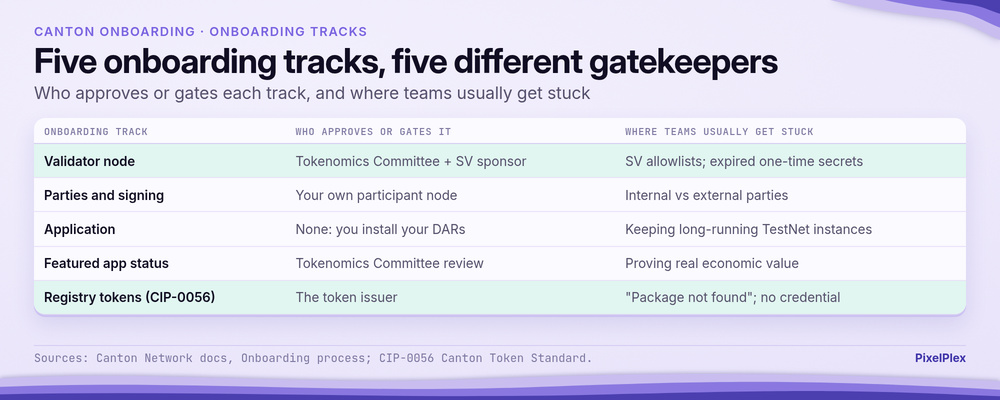
| Onboarding track | Who approves or gates it | What you provide | Where teams usually get stuck |
| Validator node | Canton Foundation Tokenomics Committee approval for TestNet/MainNet plus a Super Validator (SV) sponsor | egress IPs (up to three per network), onboarding secret, Kubernetes or Docker Compose deployment | waiting for SVs to add the IP to allowlists; expired one-time secrets |
| Parties and signing | your own participant node (no external approval) | party IDs; for external signing, keys held outside the node and onboarding through the Ledger API | choosing internal vs external parties; wallet connectivity through the CIP-0103 dApp API |
| Application | none to deploy; you install your Daml packages (DARs) on your node | DARs, environments on DevNet, TestNet and MainNet | keeping long-running TestNet instances; network upgrades reach DevNet first |
| Featured app status | Tokenomics Committee review via the Canton Foundation form | description, logo, screenshots, docs links, party ID, activity markers | proving activity reflects real economic value |
| Registry tokens (CIP-0056, e.g. USDCx, CBTC) | the token issuer | Utility DAR upload, TransferPreapproval, issuer KYC and on-chain credential | “package not found” errors; transfers rejected until the credential exists |
The highest-friction steps are usually Tokenomics Committee approval, SV allowlisting and registry-token setup under the Canton Token Standard.
Choosing a Canton onboarding support model
Canton onboarding support ranges from a Slack channel to a team that ships your app. Three questions decide the model: who operates the validator, who writes the Daml, and who signs approvals for your legal entity.
| Support model | What you get | What stays with your team | Best fit |
| Self-service with community support | Official docs, Slack channels including #validator-operations and #validator-operations-onboarding, forum.canton.network, GitHub repos including canton-network/splice, digital-asset/cn-quickstart, and digital-asset/daml, plus community office hours for new developers. See the official support channels. | Everything: node, approvals, Daml code, upgrades | Teams with in-house Daml and DevOps skills and time to wait for answers |
| Node-as-a-service (hosted validator from an existing operator) | A running node operated by the provider | Your app, parties, Daml packages; ask the provider to install DARs you need, for example the Utility DARs for registry tokens | Teams that do not want to run infrastructure, and individuals: the Canton Foundation asks people without a corporate email domain to have an existing operator run a node on their behalf |
| Development partner | Architecture, Daml development, node deployment and integration, testing, production launch, featured app application package | Business decisions, legal entity, approvals signed in your name | Teams launching a product on a deadline |
| Hybrid (hosted node + development partner) | Hosted infrastructure plus engineering help | Ownership of the product | Teams that want neither to run nodes nor to build a Daml team first |
Hosted-node offers differ: some providers operate only the validator, others also install DARs and handle upgrades. Ask which before you sign.
The Canton Foundation validator request form is for applicants that want to be their own validator operator. Applications are posted publicly to the tokenomics-announce mailing list.
- Do we need to operate our own validator, or can an existing operator run it for us?
- Who will sponsor our validator onboarding at a Super Validator?
- Who will write, test, package, and maintain the Daml code?
- Who will handle upgrades, node monitoring, and production incidents?
- Are we comfortable with our validator application being posted publicly?
Your answers point to a model:
- Pick self-service if you already have Daml and DevOps engineers and the launch date is flexible.
- Pick node-as-a-service if the app is ready but nobody wants to run validator infrastructure.
- Pick a development partner or the hybrid model if the product, the Daml code and the MainNet date all depend on outside onboarding support services. PixelPlex works in these last two models.
The validator form rejects personal email domains and aliases, and the Canton Foundation points individuals without a corporate email domain to existing operators instead. A solo developer can still build and test on DevNet, which needs no Tokenomics Committee approval. The node’s egress IP still has to be on the Super Validator allowlist before it can connect.
Canton Network Validator Node: Requirements, Operations, and Economics After CIP-0096

Canton Development and a New Vision for Blockchain in Finance: Use Cases, Features, and Cost
From DevNet to MainNet: the Canton Network onboarding sequence
Step 1. Get approval and an SV sponsor
Validator onboarding is done per network, not once for the whole stack. TestNet and MainNet both need approval from the Tokenomics Committee of the Canton Foundation, requested through the validator request form, plus an onboarding secret from your Super Validator sponsor.
Step 2. Open network access
Give your sponsoring SV the egress IP of your validator. Canton allows up to three IPs per network.
Super Validators usually adopt a new IP allowlist in 2 to 7 days, according to the Canton Network documentation. During that window, deploy the node with Kubernetes, which is preferred, or Docker Compose. Route all traffic to SVs through the approved egress IP, or the connectivity checks below will fail.
You can confirm approval by querying SV Scan URLs from that IP. The default configuration needs access to at least two thirds of SVs for both Scan and sequencers, so partial connectivity can look like an application issue when it is actually an allowlist or routing issue.
Step 3. Move through the three environments
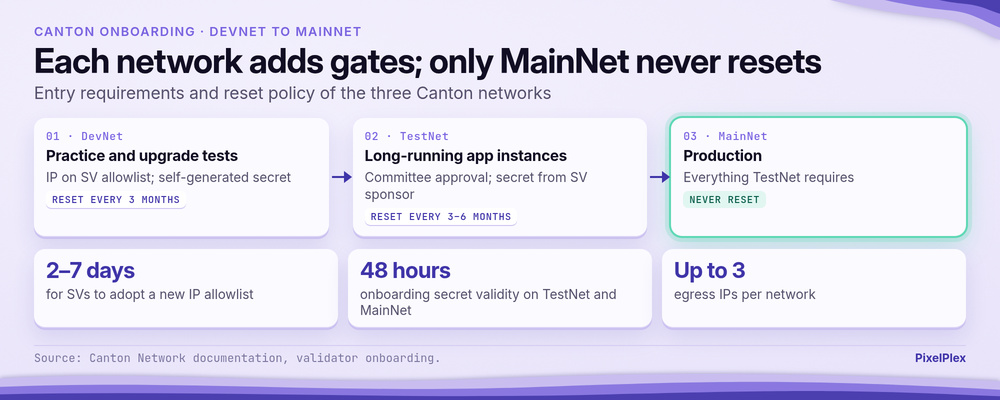
A Canton Network onboarding plan moves in order: DevNet first, then testnet, then mainnet.
| Network | Entry requirements | Reset policy | Use it for |
| DevNet | egress IP on SV allowlist; self-generated secret | reset every 3 months; upgraded first | practice, testing node upgrades before they reach MainNet |
| TestNet | Tokenomics Committee approval, allowlisted IP, onboarding secret from SV sponsor | reset every 3 to 6 months, never at the same time as DevNet | long-running app instances and composed-app testing (the docs encourage app providers to keep them) |
| MainNet | everything TestNet requires | never reset | production |
Step 4. Onboard parties and signing
For many institutional apps, the first decision is where the signing keys sit. External party onboarding runs through the Ledger API, so transactions are signed with keys held outside the node.
The Wallet Gateway exposes the CIP-0103 dApp API. A compatible dApp can connect to a wallet, list accounts, and request transactions; signing providers plug into the same gateway. Failures here often hide elsewhere: a signing request that fails in the wallet can trace back to a missing party, a missing DAR or a missing issuer credential, so Canton smart contract development and node checks belong in the same review.
Step 5. Onboard registry tokens
CIP-0056 defines the token standard that registry tokens such as USDCx and CBTC follow. Noves, a Canton data provider, describes the operational side in its registry token lifecycle: Canton Coin works on every participant out of the box, while registry tokens need extra issuer and package steps.
The flow has four stages: upload the Utility DAR bundle once per node, sign a TransferPreapproval for direct transfers scoped per issuer admin, pass the issuer’s own KYC and receive an on-chain Credential, then start querying balances.
Two errors show up most. Missing DARs produce a “package not found” style error. A signed preapproval with no credential still gets transfers rejected. Each new issuer repeats the KYC stage. If you use a node-as-a-service provider, ask the provider to install the DARs as part of validator onboarding.
An onboarding secret lets the SV recognize your validator on its first connection. On TestNet and MainNet, the SV provides it manually, and it is one-time use with a 48-hour validity window. If it expires, you request a new one. On DevNet, you can generate the secret yourself through an API call, and it is valid for 1 hour.
Featured app onboarding: from review to rewards
Canton’s Featured App Request is open to anyone building an app for Canton Network. If the app is within two weeks of production, the team can start the featured app process. The request goes to the Tokenomics Committee, which may ask for a demo call before approval.
The form separates three types: Basic Featured App, Featured Asset-Moving App and Featured Asset App.
- Complete development and deploy a functional app on Canton Network.
- Prepare short and long descriptions, logo, screenshots, contact information, and documentation links.
- Fill out the request form with party IDs, app type, user profile, and sponsor details.
- Await Tokenomics Committee review; the timeline varies.
- After approval, the app is listed as described in the getting your app featured guidance.
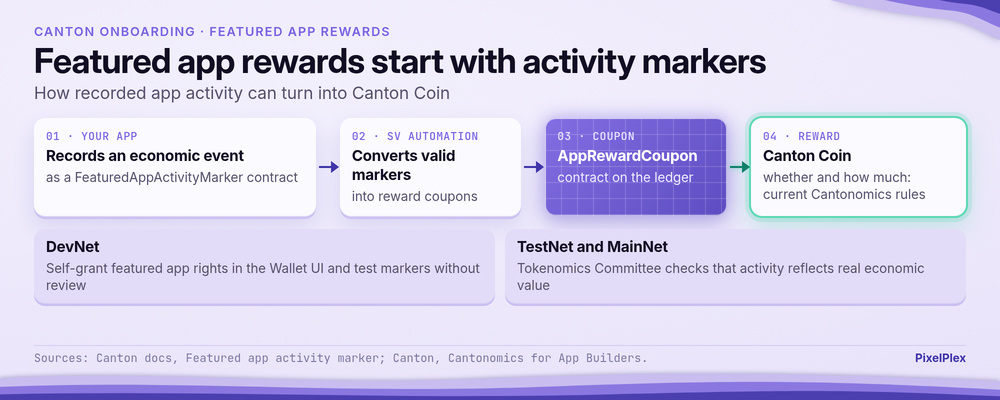
DevNet is different from TestNet and MainNet. On DevNet, a validator operator can self-grant featured app rights in the Wallet UI and test activity markers without formal review. On TestNet and MainNet, the committee assesses whether recorded activities represent real economic value and whether marker creation is appropriate.
| Review area | What reviewers look for | What onboarding support prepares |
| Deployment | functional app on Canton Network, not a concept | DevNet/TestNet deployment, party IDs for the form |
| Standards | relevant CIPs such as the token standard | CIP-0056 and CIP-0103 compatibility checks |
| Activity markers | activity that reflects genuine economic value | marker design and DevNet self-feature tests |
| Documentation | user docs, technical overview, support channels | docs package and support runbook |
| Security and operations | basic security practices, reliable operation | review of Daml code and node setup |
Rewards depend on how the app records economically meaningful events as FeaturedAppActivityMarker contracts. SV automation can convert valid markers into AppRewardCoupon contracts; whether and how much they pay in Canton Coin depends on the current Cantonomics rules. Canton says in Cantonomics for App Builders that the majority of rewards flow to applications over time. For teams preparing for review, we pair onboarding support with Daml smart contract audit work when contract logic or marker creation needs a second review.

Canton Network Reward System: How Canton Coin Pays Developers to Build Real Value

DAML Development for Business: A Practical Guide to Building Multi-Party Applications
Onboarding your own users: KYC, wallets and signing
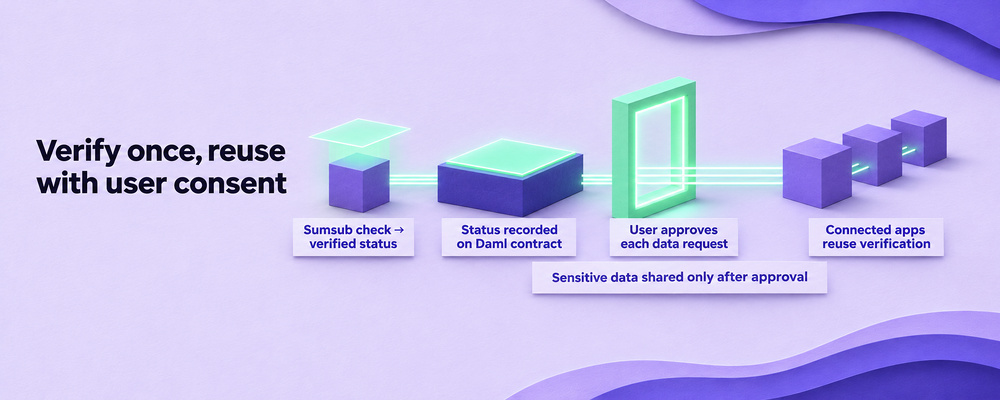
Then come your end users. PixelPlex helped deliver 5N ID with FiveNorth as a unified know your customer (KYC) platform where a user completes verification once, then can access services from any connected project on Canton.
Verification runs through a Sumsub integration, while proof of the user’s status is recorded on a Daml smart contract. Two custom Daml smart contracts handle verification status and consent, so personal data is shared only after the user explicitly approves a request. Connected apps get reusable digital identity without copying sensitive data into every product.
Every utility-generating activity on 5N ID creates a Canton reward coupon. 5N ID integrates with Canton Loop, a self-custodial wallet that uses passkeys for biometric login and transaction signing, with a UI built for Canton’s two-step transaction model. The Canton Loop case notes that DEXes and swap services can integrate the wallet to onboard users and sign transactions, a common requirement in Canton wallet development projects.
What a good Canton onboarding support service includes
Canton onboarding support should connect application design, privacy rules and network operations into one delivery plan. A missing party role or an unprepared deployment artifact can delay a MainNet launch as much as a broken contract.
| Stage | Deliverable | Why it shortens time to MainNet |
| Discovery and network architecture | participant role and privacy mapping, legacy system integration assessment, technical network roadmap | approvals and sponsors are requested for the right topology from day one |
| Privacy mapping and ledger design | sub-transaction visibility map per party, auditor and regulator | fewer Daml rewrites after review |
| Daml smart contract engineering | Daml packages (DARs) ready to install | packages are versioned before DevNet |
| Node deployment and system integration | validator or participant node on Kubernetes or Docker Compose, allowlisted egress IP | the 2–7 day allowlist wait runs in parallel with coding |
| Multi-party simulation and testing | DevNet and TestNet scenarios across parties | composed-app issues surface before production |
| Production deployment and network governance | MainNet launch, featured app request package, upgrade plan | MainNet is never reset, so the first release must be clean |
When you compare providers, check these points:
- Daml and Canton production references you can open
- experience coordinating with SV sponsors and the Tokenomics Committee
- Kubernetes and Splice upgrade runbooks
- wallet and CIP-0103 signing support
- registry-token onboarding experience
- a named incident contact for MainNet
A good ticket tells the responder whether the problem sits in Daml code and smart contracts, in the node and its deployment, or in an API integration.
Include this in every support request:
- Daml and Canton version
- Network: DevNet, TestNet, or MainNet
- Splice version
- Deployment type and cloud provider
- Relevant error logs and a minimal reproduction, with logs sanitized of private keys, JWTs, and passwords
- When the issue started

Canton Network Wallet Development: A Guide on How to Do It Right (and What It'll Cost You)
How Canton Solves the Privacy Problem for Institutional On-Chain Finance
How PixelPlex helps with Canton onboarding
We take teams from discovery and privacy mapping through Daml engineering and node integration to multi-party testing, MainNet launch and the featured app package. Our Canton application development team also handles Canton exchange development when a product needs trading or settlement logic.
For FiveNorth, we delivered Canton Loop, the first non-custodial wallet on Canton Network. According to our Canton Loop case study, it became a Featured Application within days of launch and generated 31.29M Canton Coin (about $3M USD) in revenue for the client.
Two Canton products are our own. ccview.io, also known as CantonView, is a Canton Network explorer and analytics tool that analyzes 12 unique metrics in real time. Console Wallet is the first browser extension wallet for Canton Network.
FAQ
Canton does not publish a total timeline for Canton Network onboarding, and Tokenomics Committee review times vary. Per Canton documentation, a Super Validator allowlist update usually takes 2 to 7 days, and an onboarding secret is valid for 48 hours. Run the allowlist wait in parallel with development, and leave room for committee review, issuer KYC and TestNet runs.
No. Existing operators can host your node. The Foundation form is for teams that want to run their own, and individuals without a corporate email domain are directed to existing operators.
An SV sponsor is a Super Validator that sponsors your onboarding. The sponsor receives your egress IPs and provides the onboarding secret on TestNet and MainNet.
Yes. DevNet needs no committee approval, only an allowlisted IP. It uses a self-generated secret valid for 1 hour and resets every 3 months. You can also self-grant featured app rights there to test activity markers.
You can apply within 2 weeks of production. The application goes through Tokenomics Committee review. Expect a possible demo call.
According to Noves, missing Utility DARs produce package-not-found errors. A preapproval without the issuer credential is still rejected, and each new issuer repeats KYC.
Per Canton documentation: versions of Daml, Canton and Splice, the network, your deployment and cloud provider, sanitized logs, a reproduction and when the issue started.