A bank can own millions in bonds and still struggle to use them when collateral is due. Canton offers a way to move those assets between institutions without rebuilding the entire financial system.
Can a bank holding $50 million in government bonds use them to cover an urgent margin call on a Friday night?
Through traditional settlement rails, rarely. Even though the bonds are completely digital, moving them relies on intermediaries whose operating windows close at the end of the business day. The asset is safe and liquid, but it stays locked inside a depository until Monday morning.
Tokenized securities on Canton Network work around this bottleneck: the bond stays in the depository while a digital twin of it moves between the institutions that need it. But moving a token doesn’t automatically transfer legal ownership. Below, we walk through how tokenized bonds actually work on Canton, and where the legal question of who owns them gets answered.
What are tokenized securities, and what does Canton change?
So what are tokenized securities in practice? A tokenized security is a regulated financial instrument (such as a bond or a share) issued or represented as a token on a digital ledger. Depending on its legal structure, the token can represent direct ownership or rights to an asset held by a custodian. What tokenization changes is how these rights are recorded and transferred.
If bonds are already electronic, why bother with real world asset tokenization at all? Because the records are fragmented. Bank A tracks its holdings in one database, Bank B uses another, and a central depository maintains its own records. Moving a bond between them involves multiple instructions, checks, and manual reconciliations. If an institution along that chain operates only during business hours, the entire transfer may be delayed.
Fixing that coordination gap is what asset tokenization is really about. Canton Network explained in one line: it lets these institutions coordinate transactions through connected applications. A bond registry and a cash ledger, say, can settle both sides of a trade at once, and the bond moves only if the payment clears. Nobody outside the trade sees the details.
Tokenized securities, security tokens and STOs: Clearing up the terms
Canton can coordinate how securities move between institutions. But what rights does a buyer actually receive when holding a token? The answer starts with three terms the market often uses interchangeably:
- Tokenized security: A financial instrument issued or represented in token form.
- Security token: Any digital token that qualifies as a security under financial regulation, however it was issued.
- Security token offering (STO): The process of selling securities to investors in token form, often structured like a private placement. The mechanics belong to a security token offering platform.
The label, though, matters less than the legal claim behind it. In January 2026, SEC staff tackled exactly that by looking at who creates a token and how its rights are documented, and sorted tokenized securities into three models:
| Model (SEC, 2026) | How it works | What the holder has |
| Issuer-sponsored | The issuer or its agent keeps official records on the ledger, or uses ledger transfers to update its register | Direct rights in the security, against the issuer |
| Third-party custodial | An intermediary holds the security and issues a token representing an interest in it | A securities entitlement in the custodian’s books, with claims against the custodian |
| Third-party synthetic | A third party creates a separate contract tied to another security’s price or performance | Contractual rights against the token’s issuer, with no claim on the underlying security |
The custodial model may sound new, but traditional markets already work this way. When a pension fund buys a corporate bond today, its name doesn’t appear on the issuer’s register. The fund holds a securities entitlement in its custodian’s books, and the custodian holds it through a central securities depository. A custodial token on Canton mirrors that tiered structure: the bond stays in custody while its digital representation moves between institutions.
The synthetic model is where the real risk hides. Its holder has no claim on the bond at all, only on whoever issued the token, so that issuer’s solvency matters as much as the bond’s.
Tokenized private securities, such as private credit and unlisted bonds, follow the same rules. Putting a private placement on a ledger can make it easier to track lenders and distribute interest. It doesn’t make the debt freely tradable, though: investor accreditation, resale limits, and transfer restrictions all stay in place.

An All-Encompassing Guide To Real Estate Tokenization

Diving Into Carbon Credit Tokenization: From Definition and Benefits to Project Implementation
Digital twins vs. digital-native securities on Canton
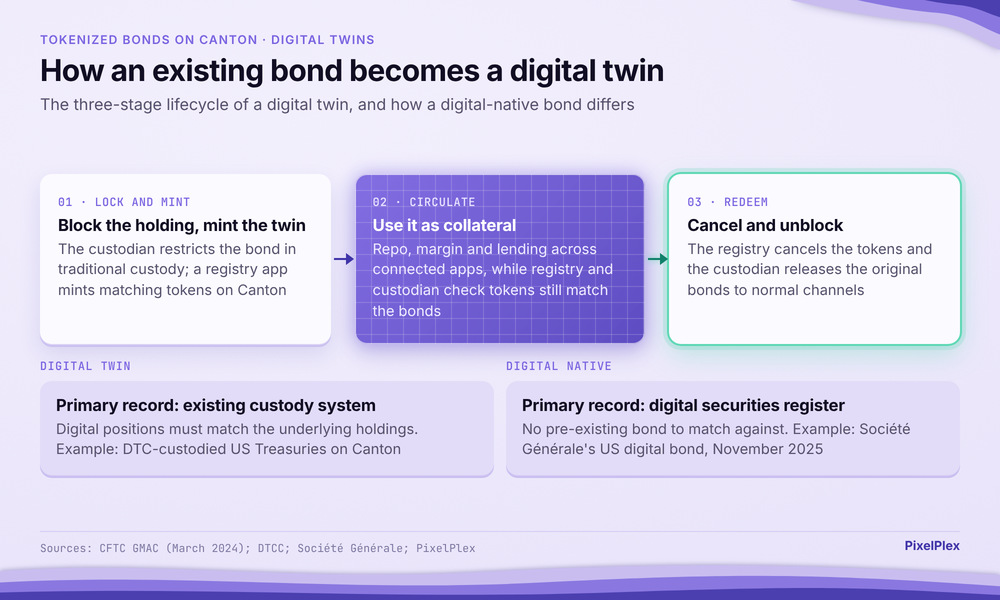
Institutions can bring securities onto Canton as digital twins of existing assets or issue new ones as digital-native securities. The choice determines where the official ownership record lives.
Where the terms originate
Two tokens can look alike on Canton yet rest on very different records. In March 2024, the CFTC’s Global Markets Advisory Committee (GMAC) adopted an advisory classification based on where an asset’s original record is kept:
- Digital twin: A digital representation of an existing asset held in another system, such as a traditional central securities depository. The two records must stay consistent.
- Digital native: An asset issued with its primary record on a distributed ledger, without a separate original asset record to reconcile against.
Neither label, however, decides who legally owns the asset or which record wins in a dispute. That depends on the legal agreements and rules governing the security.
How an existing bond becomes a digital twin on Canton
Consider a UK government bond held through CREST, the UK’s securities settlement system. To represent this holding on Canton, the underlying position would first be blocked from conflicting transactions. An authorized registry application could then create a matching digital asset on Canton Network. No new bonds are created: the original holding stays in custody while its digital representation is used in permitted transactions.
Canton’s CIP-56 token standard provides common interfaces for transferring these assets between compatible applications. It supports registry-specific approvals and allows securities and payments to be exchanged in a single transaction when both assets support the required settlement workflow.
This approach has already been demonstrated in live institutional transactions. In December 2025, DTCC announced plans to tokenize DTC-custodied US Treasuries on Canton. By July 2026, DTC had completed production trades using tokenized securities on Canton and Besu.
How the two models change recordkeeping
With a digital twin, institutions keep two records in step: the underlying securities in traditional custody and their representations on Canton. Parties in the same Canton workflow share one consistent record, but the digital positions must still match what the custodian holds.
A digital-native bond removes that check because there’s no pre-existing bond to match against. It doesn’t end all reconciliation, though: custodians still keep client records, and payments and financial reporting still need to be accounted for.
Digital twin vs. digital native: Recordkeeping differences
| Dimension | Digital twin | Digital native |
| Primary record | Existing securities or custody system | Designated digital securities register |
| Main reconciliation | Digital positions must match the underlying holdings | Other institutional records reconcile against the primary digital register |
| Other records | Custody, cash and financial reporting records remain necessary | Custody, cash and financial reporting records may still be required |
| Main operational risk | Digital positions and underlying holdings become inconsistent | Errors or failures in the primary digital register |
Why banks may prefer digital twins
For a bank facing a margin call, the priority is to use bonds it already owns, not issue new ones. A digital twin does exactly that, and the bank’s custody setup stays as it is.
Digital-native issuance serves a different purpose: creating new securities directly on digital infrastructure. In November 2025, Société Générale issued its first digital bond in the United States on Canton Network, using Broadridge’s tokenization technology. SG-FORGE registered the bonds as security tokens, DRW bought them, and BNY acted as paying agent.
1. Locking and minting
Before anything moves on Canton, the custodian identifies the specific bond holding and restricts it in traditional custody so it can’t be used elsewhere. Once that position is locked, the registry application mints tokens representing the same underlying position on the network.
2. Circulation and regular reconciliation
Institutions can then use the digital twin across connected Canton applications for collateral, repo, or margin. Behind the scenes, the registry operator and the custodian keep checking that the number of tokens still matches the bonds held in custody.
3. Redemption and return
When a bank wants to return to conventional market rails, the process runs in reverse. The registry cancels the digital tokens on Canton, and the custodian unblocks the original bonds so they can be used through normal channels again.
Securities registers on Canton: Ownership and control
Here’s a question that comes up in almost every tokenization project: if a bond lives in a Canton app, is that app the official register? Usually not. Canton can record who holds what and move positions between parties, but the legal record sits wherever the law and the bond’s own documents put it.
How official ownership records are kept
In the United States, most securities are held indirectly. As DTCC explains, securities deposited with DTC, the US central securities depository, are typically registered under its nominee, Cede & Co. Brokers and custodians maintain separate records of their clients’ holdings across internal accounts. Tokenizing a DTC position doesn’t alter this arrangement.
Direct registration skips that chain. The issuer, or a transfer agent working for it, writes each investor’s name into the register itself. That means more admin per holder, which is why it tends to suit tokenized private securities. A note placed with a dozen institutions is easy to track name by name. Europe adds its own constraint. Under CSDR, any transferable security traded on a trading venue has to be recorded in book-entry form at a CSD by the intended settlement date, so a listed EU bond can’t keep its only record in a Canton app. The DLT Pilot Regime is one of the few exemptions.
These legal distinctions create three operational models for digital debt registers:
Securities register models
| Model | Official records | Canton’s role | Main responsibility |
| Digital twin | Existing securities register and custody records | Represents existing holdings in connected workflows | Keep tokens consistent with underlying positions |
| Issuer-sponsored native | Digital register maintained by the issuer or agent | Supports the primary securities register | Maintain legally valid ownership records |
| Intermediated native | Designated register and intermediary records | Connects securities with custody and settlement applications | Maintain records of investor entitlements |
Hong Kong’s September 2026 digital green bond issuance shows how these responsibilities can be divided. The government issued around HK$20 billion in bonds using HSBC Orion as the digital platform, while the Hong Kong Monetary Authority’s Central Moneymarkets Unit (CMU) handled clearing and settlement through its links to Euroclear and Clearstream.
HSBC Orion is a separate platform from the shared Canton Network, but the lesson carries over: technology can run the ledger, while a regulated institution stays responsible for the official record.
Why automated ledgers still require legal intervention
Code is good at following rules and bad at exceptions. If a position gets booked twice, or a court freezes an investor’s holding, the ledger has no way of knowing what’s right. That call belongs to whoever holds legal authority over four things:
- Issuance: Creating or canceling securities positions while keeping the recorded supply accurate.
- Transfers: Checking investor eligibility and enforcing restrictions on transfers or pledges.
- Corrections: Resolving incorrect records and carrying out authorized legal instructions.
- Corporate actions: Maintaining the records needed for coupon payments, redemptions, and other lifecycle events.
Much of tokenization platform development comes down to building these controls in: transfer restrictions, approval steps before a position changes, and so on. The app only enforces the rules, though. The law and the institutions behind the bond decide what those rules are.
Tokenized bonds on Canton Network: What the Gilts and Eurobonds pilot showed
Euroclear’s 2024 pilot remains one of the most detailed public tests of tokenizing RWAs on Canton. It checked whether existing securities could move between collateral workflows without waiting for separate settlement cycles. The pilot focused on Gilts and Eurobonds, the workhorses of bank financing, because the real hurdle is mobilizing assets institutions already hold, not creating demand for new digital debt. Euroclear’s report cites mid-2023 figures of nearly £2.4 trillion in Gilts and over €12.97 trillion in Eurobonds.
What Euroclear tokenized and tested in 2024
Rather than issuing new debt, Euroclear partnered with Digital Asset and the World Gold Council to create digital twins of existing Gilts, Eurobonds, and physical gold, then simulated trades between independent repo, margin, and registry applications on Canton.
Euroclear pilot at a glance
| Metric | Detail |
| Pilot period | June–July 2024 |
| Results published | October 2, 2024 |
| Participants | 27 organizations (16 active participants and 11 observers) |
| Assets represented | Digital twins of Gilts, Eurobonds and gold |
| Applications | 11 applications: 6 registry and 5 margin |
| Canton nodes | 14 |
| Workflows tested | 6 linked scenarios across 5 transaction types |
| Transactions processed | 500+ |
| Environment | Canton Network TestNet; no new bond issuance |
How registry and margin applications worked together
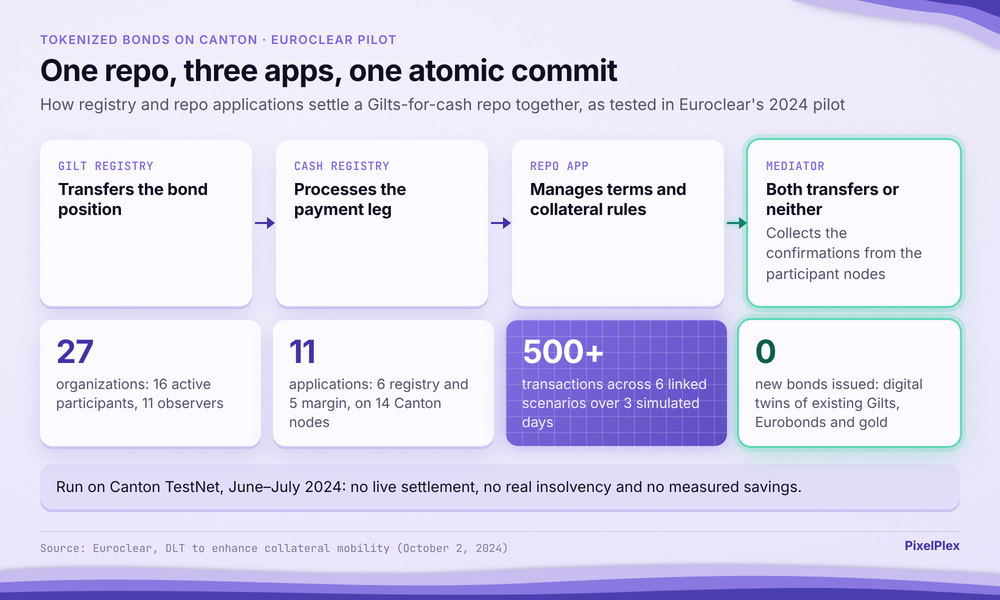
Registry applications tracked positions in tokenized Gilts, Eurobonds, cash, and gold, while separate financing and margin applications handled the trades. Canton let them coordinate without a shared central database.
A repo trade shows how this worked. When a firm exchanges Gilts for cash, three applications need to work together:
- The Gilt registry transfers the bond position.
- The cash registry processes the payment leg.
- The repo application manages the trade terms and collateral requirements.
Canton brings these actions together as one atomic transaction. The relevant participant nodes check their parts of the trade, while a network component called the mediator collects the required confirmations. If the checks succeed, both transfers go through together. If one fails, neither takes place. Mapping each application’s role this way is usually the first step in Canton blockchain development for collateral workflows.
What the pilot demonstrated, and what it didn’t
The most important result of the Euroclear pilot came after the first trade. Assets received in one transaction could immediately meet another obligation, which participants tested in six linked scenarios over three simulated days.
Euroclear pilot: Six connected transactions across three simulated days
| Day | Workflow | Assets involved | Operational takeaway |
| 1 | Repo | Gilts against GBP cash | Bond and cash legs settled simultaneously across connected applications |
| 1 | Cleared repo margin call | Gilts received in repo | The investor pledged newly received Gilts toward another obligation |
| 1 | Derivatives variation margin | Cash received in repo | The prime broker deployed received cash to satisfy a separate margin call |
| 2 | Securities lending | Eurobonds against tokenized gold | Participants exchanged debt securities against gold without moving physical bullion |
| 2 | Derivatives variation margin | Tokenized gold | The prime broker pledged tokenized gold to cover a margin requirement |
| 3 | Simulated default | Pledged cash and gold | The secured party obtained control of collateral through an authorized closeout process |
In other words, collateral really could hop between repo, securities lending, and margin apps. The pilot also tested a closeout following a simulated counterparty default, with the stated goal of demonstrating a perfected securities interest over the collateral. The legal section below looks at how that scenario worked and what it couldn’t prove.
What it didn’t show matters just as much:
- Simulated settlement: Transactions ran on Canton TestNet without live securities or cash settlement.
- No real insolvency: The closeout tested a technical workflow, not how competing legal claims would be resolved in court.
- No measured financial savings: The report did not establish actual reductions in operating costs or regulatory capital requirements.

How Can Gold Tokenization Transform the Financial Industry?

Asset Tokenization: Digitized Commodities as a New Investment Opportunity
What changes for collateral givers and takers on Canton
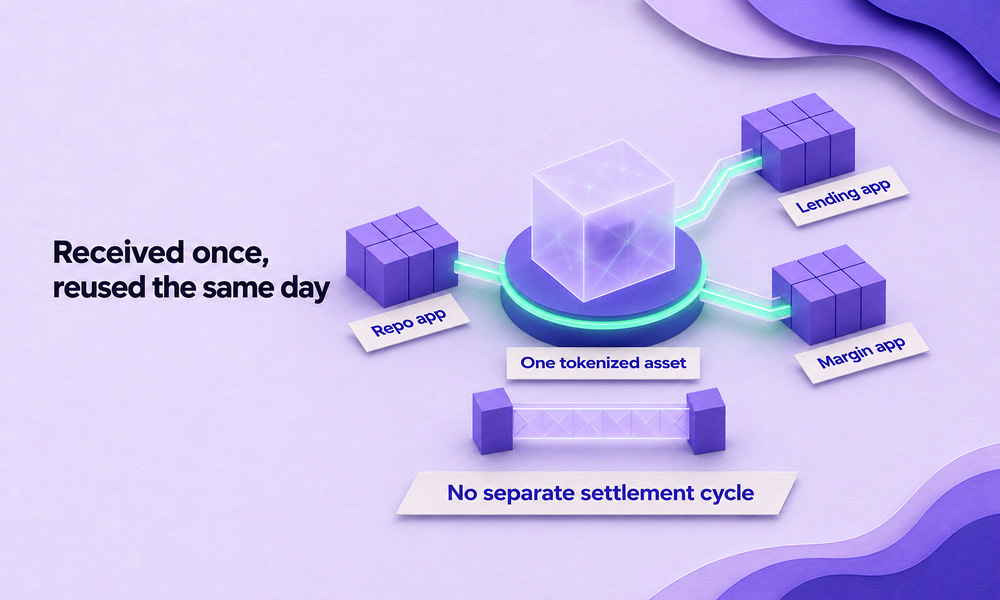
For treasury desks, tokenized bonds are of little use if they stay trapped in a silo. Canton helps mobilize them across connected applications, within the limits set by custody and settlement rules.
Collateral mobility across Canton applications
Canton allows institutions to move collateral between connected trading and margin platforms without waiting for a separate settlement cycle. Its contract rules prevent the same digital position from being transferred twice.
Another bank will accept the token as collateral only if four conditions are met:
- System connectivity: The counterparties and relevant custody systems must be connected through compatible Canton applications.
- Collateral eligibility: The receiving bank must approve the bond under its risk policy and apply applicable haircuts.
- Legal enforceability: The relevant agreements must recognize the tokenized position and establish the receiver’s rights under applicable law.
- Custody control: For a digital twin, the underlying securities must be protected against conflicting transactions outside Canton.
Settlement outside traditional banking hours
Canton Network lets institutions transfer tokenized bonds outside normal market hours. With atomic delivery versus payment (DvP), the bond and cash move together, so neither side delivers without receiving the other asset. A trade that completes on-chain isn’t automatically final in the legal sense, though. Finality comes from the payment arrangement and the rules of the system that settles the cash.
Cash can be the main hurdle, because traditional payment systems keep fixed operating hours. The Bank of England’s CHAPS, for instance, doesn’t run on weekends, and its weekday opening won’t move to 01:30 until September 2027. In August 2025, Digital Asset announced a completed Saturday repo transaction on Canton, financing tokenized US Treasuries with Circle’s USDC. The working group behind it included Bank of America, Citadel Securities, Société Générale, and DTCC.
Central bank infrastructure is also adapting. The ECB launched Pontes on September 21, 2026, to support tokenized asset settlement in central bank money. Longer operating hours are planned by 2028, although Pontes operates separately from Canton.
Corporate actions and bond servicing
Paying a bond coupon today runs through several institutions: the issuer pays a paying agent, and depositories and custodians pass the money on to holders, each keeping its own records.
Daml Finance shows how smart contracts can simplify this process through contract versioning. In Digital Asset’s example, an investor exchanges 800,000 units of a bond for the same amount of its updated version, plus a $32,000 coupon payment. Both actions happen in one atomic transaction. The previous contract version is archived, preventing the same coupon from being claimed twice.
This is an application capability, not something every Canton bond gets automatically. Issuers still need to fund payments and meet their tax and reporting obligations. Intermediaries stay involved even for digital-native bonds: Citi served as issuing and paying agent for Hana Bank’s $100 million digital note on Euroclear’s D-FMI platform in September 2026, a separate infrastructure from Canton.
Fewer reconciliations between institutions
When a bank pledges bonds, both sides traditionally update their records through separate messages and reconciliations. On Canton, authorized parties share one record of the pledge, so no separate confirmations are needed. Each institution must still reconcile its Canton records with internal accounting and external custody accounts.
Bondholder and collateral-taker workflows
| Workflow | Traditional infrastructure | On connected Canton apps | Still depends on |
| Margin pledge | Instructions and updates across custody and collateral systems | Applications coordinate the pledge and update its status | Legal agreements, asset eligibility |
| Repo settlement | Bond and cash transfers follow established DvP processes and operating hours | Compatible bond and cash transfers commit together | Payment asset, legal finality rules |
| Coupon payment | Payment processing through issuers, agents, and custodians | Daml Finance-style workflows link coupon payments to bond updates | Issuer funding, tax obligations, paying agents |
| Status tracking | Matching custody reports against internal records | Synchronized updates for authorized parties | Integration with internal ledgers and depositories |

Introduction to Stablecoins. Use Cases and Examples
The legal layer: Security interests and enforceability on Canton
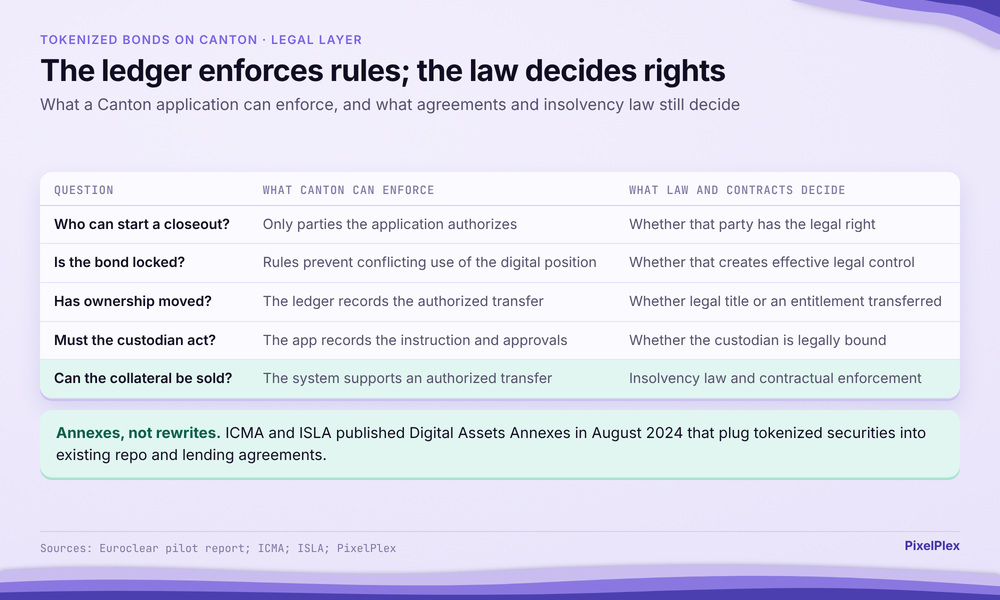
A bond can be locked as collateral on Canton, but that alone doesn’t guarantee the lender can claim it if the borrower defaults. The lender also needs legally enforceable rights to the asset. That’s why the underlying agreements matter as much as the technology.
What happens when a counterparty defaults
In the US, that enforceable right often takes the form of a perfected security interest, or what Euroclear’s pilot report calls a perfected securities interest: a claim that holds up against competing creditors. Without proper legal protection, the pledge could be challenged during insolvency proceedings, even if Canton shows the bonds locked in the lender’s favor.
Euroclear’s 2024 Canton pilot put the perfected securities interest to the test through a simulated prime broker default. The secured party requested a closeout, and the custodian approved the transfer of pledged assets after the required offline documentation and signatures were completed. But the default was simulated, so the pilot didn’t establish how those rights would hold up in a real insolvency dispute.
Here’s how the split between software and law looks:
Legal rights vs technical control
| Question | What Canton can enforce | What law and contracts decide |
| Who can start a closeout? | Only parties authorized by the application can initiate the action | Whether the party has the legal right to close out |
| Is the bond locked? | Application rules can prevent conflicting use of the digital position | Whether that restriction creates effective legal control |
| Has ownership moved? | The ledger records the authorized transfer | Whether legal title or a securities entitlement has transferred |
| Must the custodian act? | The application records the instruction and required approvals | Whether the custodian is legally bound to follow it |
| Can the collateral be sold? | The system can support an authorized transfer | Applicable insolvency law and contractual enforcement rights |
Do institutions need to change their master agreements?
Usually not by rewriting them. Starting from scratch would be slow and costly, so the industry took a different route.
Institutions can keep their existing contracts and attach a standardized add-on, known as an annex. Trade associations created these annexes specifically for digital assets: ICMA and ISLA each published a Digital Assets Annex in August 2024 covering tokenized traditional securities and digital cash, followed by the Digital Bonds Annex in April 2026 for natively digital debt.
The annexes set out how eligible digital securities are delivered and treated under the existing agreement, including in a repo, where title passes outright. They don’t make every token movement legally effective on their own. That still depends on the asset’s legal structure and governing law, and margin pledges outside repo and securities lending are documented separately.
Take a bank exchanging tokenized Gilts for cash through a repo on Canton. The bank agrees to repurchase the bonds the next day, but the platform becomes unavailable before the transaction can be completed. How should the parties value the securities or settle their outstanding obligations? The Digital Assets Annex covers this case. If a platform becomes inoperable through no one’s fault, affected trades become terminable on demand, without triggering an immediate cash closeout. If the failure is one party’s fault, it counts as an event of default, but only the trades on that platform terminate.
How Daml and platform rules support legal agreements
Legal agreements define rights on paper, but transactions happen in software. Daml lets developers turn those terms into application rules that can’t be skipped.
For example, if a contract requires a custodian’s sign-off before collateral can be transferred to the secured party, Daml blocks the transfer on-ledger until the custodian approves it. A trader can’t bypass the rulebook because the application simply provides no path to do so.
The limit runs both ways, though. Daml can’t grant rights the agreements don’t contain, which is why Daml smart contract development starts from the legal documents, not the code.

DAML Development Services: Everything You Need to Know
Privacy and disclosure: Who sees what on Canton Network?
Institutions won’t put collateral on a ledger where rivals can track their balance sheets. Public blockchains broadcast activity to everyone, inviting front-running and revealing trading strategies. The Canton blockchain drops the broadcast model and shares data only on a strict need-to-know basis.
How Canton keeps trades invisible to competitors
Canton protects trading secrecy through two straightforward mechanisms:
1. Private transaction views and blind sequencing
Instead of sending a complete record of a trade to the entire network, Canton breaks transactions into isolated slices called “views.” Each party only receives the slice required for its specific task. If your institution isn’t part of a trade, its node receives nothing about it.
A sequencer then puts these encrypted messages into a single order, so every node handles conflicting transactions the same way. It sees which nodes each message is addressed to, but not what’s inside. The assets, amounts, and contract terms stay encrypted.
2. Daml visibility roles
Who sees each slice is controlled mainly by two roles in the Daml smart contract:
- Signatories are the primary counterparties. Because the contract can’t exist without their authorization, they see it in full.
- Observers have read-only access. They can monitor the contract in real time, but can’t alter or sign transactions.
Unless an institution is a signatory or observer on a contract, or takes part in a transaction that uses it, it doesn’t receive that contract at all. A competing desk on the exact same network won’t see a trade’s size, price, or even a hint that it happened.
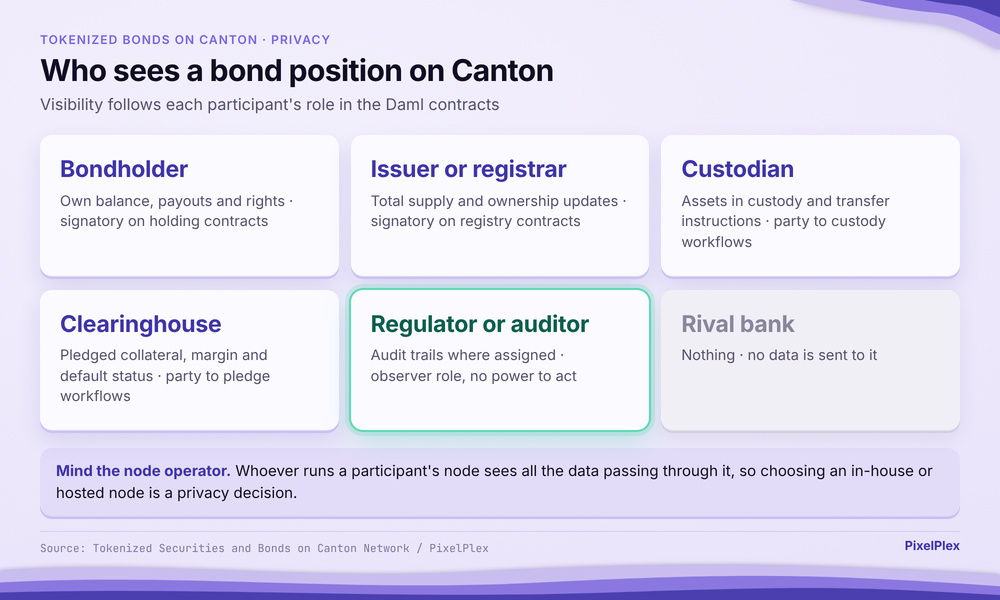
Who sees a bond position?
Privacy from competitors doesn’t mean hiding from supervisors. Visibility follows each participant’s role:
Who sees a bond position
| Participant | What they see | Access mechanism |
| Bondholder | Own balance, payouts, and rights | Signatory on holding contracts |
| Issuer or registrar | Total supply and ownership updates | Signatory on registry contracts |
| Custodian | Assets in custody and transfer instructions | Party to custody workflows |
| Clearinghouse | Pledged collateral, margin, and default status | Party to pledge workflows |
| Regulator or auditor | Audit trails for contracts where assigned | Observer role |
| Rival bank | Nothing | No data sent |
This eases a long-standing tension between confidentiality and supervision. A regulator or auditor added as an observer can follow the relevant contracts as they change, without any power to act on them, although formal reporting duties still apply. One practical caveat: whoever runs a participant’s node sees all the data passing through it, so choosing between an in-house node and a third-party operator is a privacy decision, not just an IT one.

How Canton Solves the Privacy Problem for Institutional On-Chain Finance
Where tokenized securities regulation stands in 2026
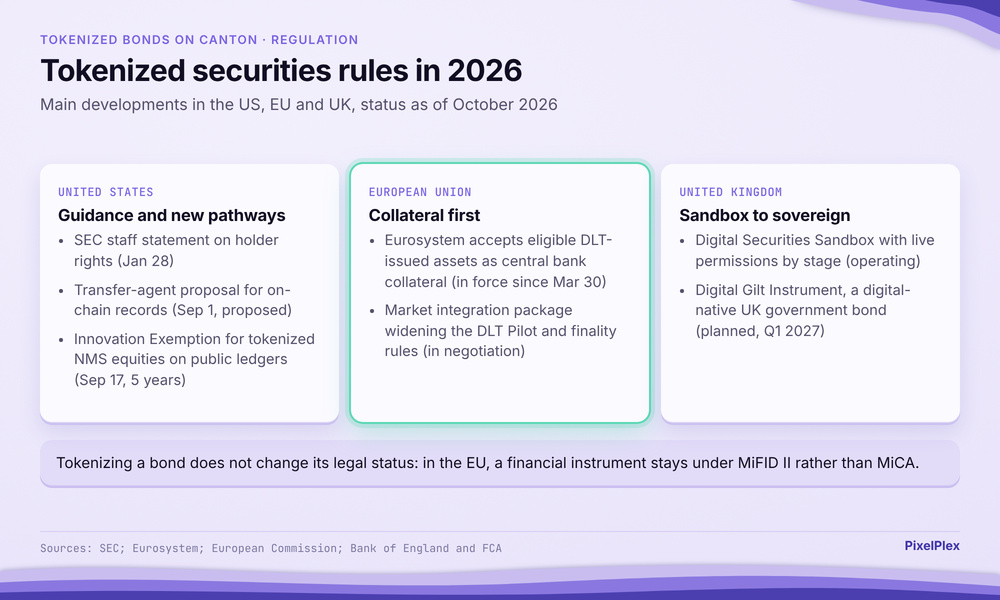
The US, EU, and UK have taken different approaches to tokenized securities regulation. The table summarizes the main developments as of October 2026.
Tokenized securities regulation in 2026
| Jurisdiction | Development | Status (Oct 2026) | What it changes |
| US | SEC staff statement, Jan 28 | Staff guidance | Clarifies holder rights across issuer, custodial, and synthetic models |
| US | Transfer-agent proposal, Sep 1 | Proposed | Would modernize rules for on-chain securityholder records |
| US | Innovation Exemption, Sep 17 | 5-year temporary | Permits trading tokenized NMS equities (public ledgers only) |
| EU | Eurosystem collateral rule, Mar 30 | In force | Accepts eligible DLT-issued assets as collateral for central bank credit |
| EU | Market integration package | In negotiation | Widens DLT pilot and updates settlement finality rules |
| UK | Digital Securities Sandbox | Operating | Grants live trading and settlement permissions via stages |
| UK | Digital Gilt Instrument | Planned, Q1 2027 | Clears path for the first digital native UK government bond |
United States
In the US, existing investor protections still apply to tokenized securities, and two developments show how the infrastructure is adapting:
- Securities custody: In December 2025, an SEC staff no-action letter cleared DTC to tokenize Russell 1000 stocks, major index ETFs, and US Treasuries it already holds. DTCC and more than 30 firms completed initial limited-production trades in July 2026, and on October 28, 2026, the DTCC Tokenization Service went live, integrated with Canton Network and DTCC’s private Besu network.
- Tokenized collateral: CFTC staff guidance from December 2025 addresses the use of tokenized assets as collateral for futures and swaps. Eligibility, valuation and enforceable rights still need to be assessed.
Trading follows a separate path. The SEC’s September 2026 five-year exemption lets certain venues trade tokenized NMS stocks, meaning shares listed on US national exchanges, on public, permissionless blockchains. That condition applies only to venues using the exemption, not to Canton-based bond and collateral transactions.
European Union
In the EU, tokenizing a bond doesn’t change its legal status. If it qualifies as a financial instrument under MiFID II, existing securities rules apply rather than MiCA. Tax reporting under the crypto asset reporting framework is a separate regime and doesn’t govern how bonds are issued. Three developments matter most:
- DLT trading and settlement: The DLT Pilot Regime allows authorized operators to trade and settle eligible securities under specific regulatory exemptions. Eligible bonds must have an issue size below €1 billion, and debt with embedded derivatives or hard-to-understand structures is excluded.
- Central bank collateral: Since March 30, 2026, the Eurosystem has accepted qualifying DLT-issued securities, settled through eligible CSDs, as collateral for central bank credit.
- Settlement finality reforms: A December 2025 Commission package would expand the DLT Pilot Regime and update settlement finality rules. The Council agreed its position on October 9, 2026, but the reforms aren’t law yet.
United Kingdom
The UK is bringing digital securities into live markets through its Digital Securities Sandbox, run jointly by the Bank of England and the FCA. Firms that reach Gate 2 can carry out approved activities with real securities within regulatory limits. HSBC became the first to reach this stage in July 2026, followed by ClearToken in September. Since June, firms have also been able to apply to use specific stablecoins for settlement.
The next milestone is the Digital Gilt Instrument (DIGIT), a new government bond planned for issuance by Q1 2027 on HSBC Orion. Unlike Euroclear’s Canton pilot, which tested digital representations of existing bonds, DIGIT will test issuing sovereign debt directly on a digital register.
Benefits of tokenized securities on Canton, and their limits
Speed is only part of the benefits of tokenized securities on Canton. The bigger wins are collateral that moves between apps and trades that stay private, as long as the legal rights and cash rails behind them hold up.
Where institutions can benefit
- Faster collateral reuse. Tokenized bonds received in one trade can be used in another without waiting for a separate settlement cycle. Euroclear’s 2024 pilot ran exactly that chain.
- Atomic settlement. Canton coordinates bond and cash transfers in one transaction, reducing delivery risk. Tradeweb did this live with tokenized US Treasuries and USDCx in July 2026.
- Institutional privacy. Positions stay hidden from everyone who isn’t part of the trade, including competitors on the same network.
- Fewer reconciliations. Counterparties work from the same record of a trade instead of chasing each other for confirmations.
Three risks and dependencies to consider
- Legal enforceability. A token transfer doesn’t automatically establish ownership or collateral rights. Unclear legal arrangements can leave lenders exposed if a counterparty defaults.
- Settlement-asset risk. Stablecoins and tokenized deposits carry issuer risks that central bank money avoids, and atomic settlement doesn’t remove them.
- Integration and liquidity. Canton can operate around the clock, but transactions still depend on connected custody systems and willing counterparties. A transferable bond isn’t necessarily a liquid one.
Canton Network 2026’s DeFi Boom: Top Profitable Solutions to Build
What to decide before launching tokenized bonds on Canton
A tokenized bond can work perfectly on Canton and still fail an institution’s legal or risk checks. Three questions should be settled before development begins.
1. Are we issuing a new bond or tokenizing an existing one?
The stake: Where the official ownership record lives.
The answer decides which institutions stay involved, how ownership is recorded, and, for a native bond, whether the new register is legally recognized. An experienced asset tokenization company will ask this question before any architecture work.
2. Who is legally accountable if an intermediary fails?
The stake: Protecting investors and collateral takers.
The issuer and its partners must define what rights the token provides, who is responsible for the assets, and how to fix incorrect records or respond to a custodian’s insolvency. A smart contract can enforce transfer restrictions, but it can’t settle legal disputes on its own.
3. How will the trade settle with cash?
The stake: Settlement finality and liquidity.
Atomic settlement removes the risk of delivering bonds without payment, but institutions still have to choose the payment asset (tokenized deposits, stablecoins, or central bank money) and define when a transfer becomes legally final.
Tokenized bond pre-issuance readiness checklist
These decisions should be agreed across legal, treasury, and operations before the technical architecture is finalized.
| Decision area | What must be established | Responsible parties |
| Asset structure | Digital twin or digital-native issuance | Issuer, legal counsel |
| Ownership rights | What legal rights the token provides | Issuer, legal counsel |
| Securities register | Which record is authoritative and who maintains it | Issuer, registrar, CSD |
| Custody and control | Asset segregation and key management responsibilities | Custodian, registry operator |
| Collateral eligibility | Which assets counterparties accept and how collateral rights are enforced | Treasury, legal counsel |
| Cash settlement | Payment asset and conditions for settlement finality | Treasury, operations |
| Transfer permissions | Investor eligibility and required approvals | Issuer, compliance |
| Servicing and recovery | Corporate actions, error correction, and exit procedures | Issuer, registry operator |
Once these decisions are documented, developers can translate them into Daml permissions, Canton workflows, and integrations with custody and payment systems. Blockchain consulting at this stage helps turn legal decisions into a technical specification, while enterprise blockchain development covers the integrations themselves.

Canton Network's Next Chapter: From Infrastructure to the Application Economy

Canton Development and a New Vision for Blockchain in Finance: Use Cases, Features, and Cost
How PixelPlex turns institutional requirements into Canton applications
Writing Daml is only part of the job. Institutional applications also need to connect with existing financial systems, meet security requirements, and handle real transaction volumes. PixelPlex builds and supports Canton applications that run in production.
Our Canton blockchain development experience includes:
- Production data infrastructure. Our CC Suite infrastructure has indexed over 520 million Canton updates and served 55 million API requests. CC View provides structured network data and APIs for analytics, monitoring, and integrations.
- Secure signing and asset management. We built Console Wallet, the first non-custodial wallet designed natively for Canton, where keys never leave the user’s device. It has reached over 250,000 users and recorded more than 17 million transactions.
- Lending and identity workflows. For Ergonia, we developed an uncollateralized lending platform on Canton, including Daml contracts and backend development. For 5N ID, we built two custom Daml contracts to manage identity verification and user consent.
- Live MainNet settlement. In July 2026, we participated in non-custodial cross-chain atomic swaps alongside Arqitech, MPCH, and sFOX. Our work with Arqitech included auditing Daml contracts and reviewing cross-chain settlement logic.
For tokenized securities projects, the issuer and its legal advisers define the ownership rights and contractual obligations. We turn those requirements into Daml workflows, connect them to the necessary infrastructure, and test how transactions behave when they succeed, fail, or need approval.
Conclusion
Two years ago, moving a Gilt from a repo straight into a margin call was something people demoed on a test network. Euroclear’s 2024 pilot showed what tokenized securities could do for collateral. By July 2026, DTC was moving real, DTC-custodied securities on Canton in limited production trades, and in October it opened its tokenization service to participants. For desks sitting on bonds they can’t mobilize fast enough, that’s a genuine change. What the technology doesn’t change is who gets the final word. A Daml contract can lock a bond and hand it to the right party, but a credit committee will still ask whether the perfected securities interest behind that transfer would hold up in court. Projects that answer this first, by settling legal title, the cash leg, and custodian connections before any code is written, have a much better chance in risk review. Leave it for later, and the trade will likely stall there.
FAQ
They’re ordinary regulated securities, such as bonds or shares, whose ownership is recorded or represented on a distributed ledger. What you actually hold depends on how the token is set up. It might be the security itself, an entitlement held through a custodian, or a separate contract that only tracks the security’s price.
In economic terms, they usually aren’t. Unless it’s a synthetic product, a tokenized bond pays the same coupons, matures on the same date, and carries the same issuer risk. The difference shows up in settlement. On connected Canton apps, the bond and the cash can move in one transaction, without waiting for separate systems to open or confirm.
It comes down to where the official record lives. A digital twin represents a bond that already sits in a traditional system, such as a central depository, so the two records have to be kept in sync. A digital-native bond is issued straight onto the ledger. If the law recognizes that register, it becomes the primary record of who owns the bond.
No. The 2024 pilot worked with digital twins of Gilts and Eurobonds that already existed, and every trade ran in a simulated environment. Not a single new bond was issued, and the official registers stayed exactly as they were.
Yes, as long as the counterparty is willing to take them and the collateral taker’s security interest would hold up under the governing law. Central banks are moving too. Since March 30, 2026, the Eurosystem has accepted qualifying DLT-issued securities, settled through eligible CSDs, as collateral for its credit operations.
Not on its own. A transfer changes an entry on the ledger, and the governing law and custody agreements decide what that entry means. In one structure it passes legal title to the buyer, and in another it only gives the buyer a claim against a custodian.
Only the parties the contract names. The buyer, seller, custodian, and registrar each see the part of the trade they need, and a rival bank on the same network sees nothing at all. Regulators and auditors get access if they’re added to the contract as observers.
Mostly the same securities laws as before, applied to a new record format. In the EU, a tokenized bond that counts as a MiFID II financial instrument stays under securities rules and the DLT Pilot Regime, not MiCA. In the UK, live activity runs through the Digital Securities Sandbox. US firms follow federal securities law, with SEC and CFTC staff guidance filling in the details for tokenized assets.