Send ETH from Ethereum to Canton through CC Bridge, and what lands is ccETH. A lending app built around cETH may refuse it. If it does, the transfer worked, but the asset is wrong.
The bridge issues ccETH, and a separate protocol issues cETH. Both are backed 1:1 by ether. The trip takes minutes to an hour, and the token stays with you. So check which token will land, who stands behind it and how you get back out. The five options below sit at different layers, and treating them as interchangeable apps is the fastest way to pick the wrong Canton Network bridge.
How Canton interoperability works
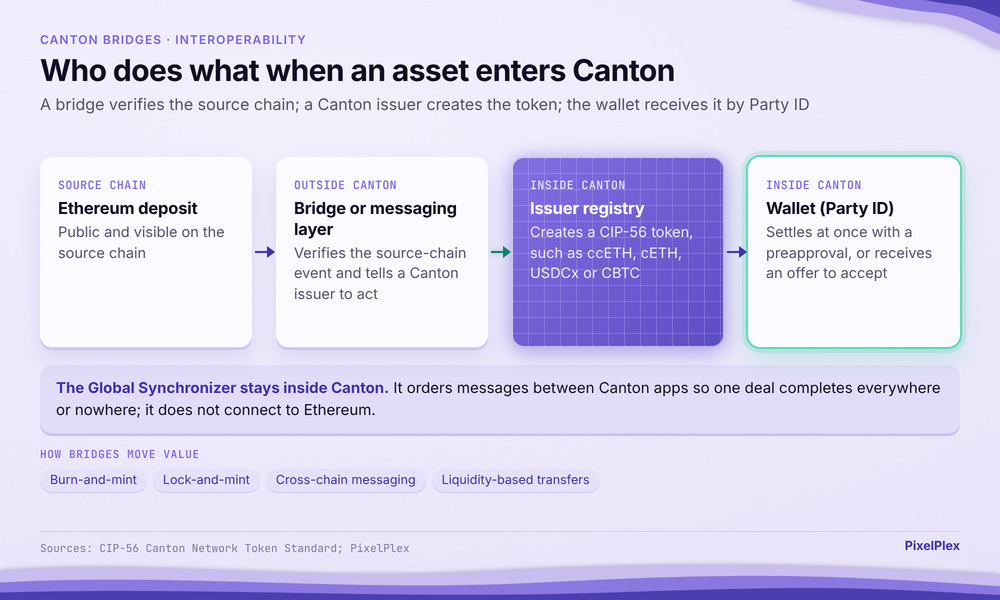
Canton interoperability rests on three layers that are easy to confuse. The Canton Network links many separate applications, and each keeps its own data. The Global Synchronizer passes messages between them in a set order, so one deal can complete across several apps at once or not at all. It works only inside Canton and does not connect to Ethereum.
CIP-56, the Canton Network Token Standard, defines how wallets and apps hold, transfer and allocate tokens from any issuer’s registry. It gives compliant tokens a common interface. It does not carry an asset in from another blockchain. That job belongs to an external blockchain bridge or messaging protocol, which verifies the source-chain event and tells a Canton issuer to act.
This is why cross-chain bridges built for EVM networks cannot treat Canton as one more chain with a different RPC. Recipients are identified by a Party ID instead of a 0x address. Contract data is visible only to the parties involved and the nodes hosting them. Receiving can take consent too. Depending on the token’s registry, a transfer either settles at once or arrives as an offer the recipient accepts or rejects. An unanswered offer expires after a set period, one day by default in the reference Splice wallet. For Canton Coin, settling at once requires a TransferPreapproval contract with an expiry date. Other tokens follow their registry’s own rules.
Bridges usually move assets between chains in one of four ways:
- Burn-and-mint: the issuer destroys tokens on one chain and creates them on the other.
- Lock-and-mint: the original stays locked on the source chain while a backed representation is minted on Canton.
- Cross-chain messaging: a protocol carries verified instructions, and token movement is one of its uses.
- Liquidity-based transfers: a provider pays out from inventory on the destination side. A non-custodial atomic swap on Canton is a related design: two parties exchange assets directly.
One route can combine several models, and a “private route” describes who sees a transfer rather than how the asset is issued.
Which assets can you move to Canton?
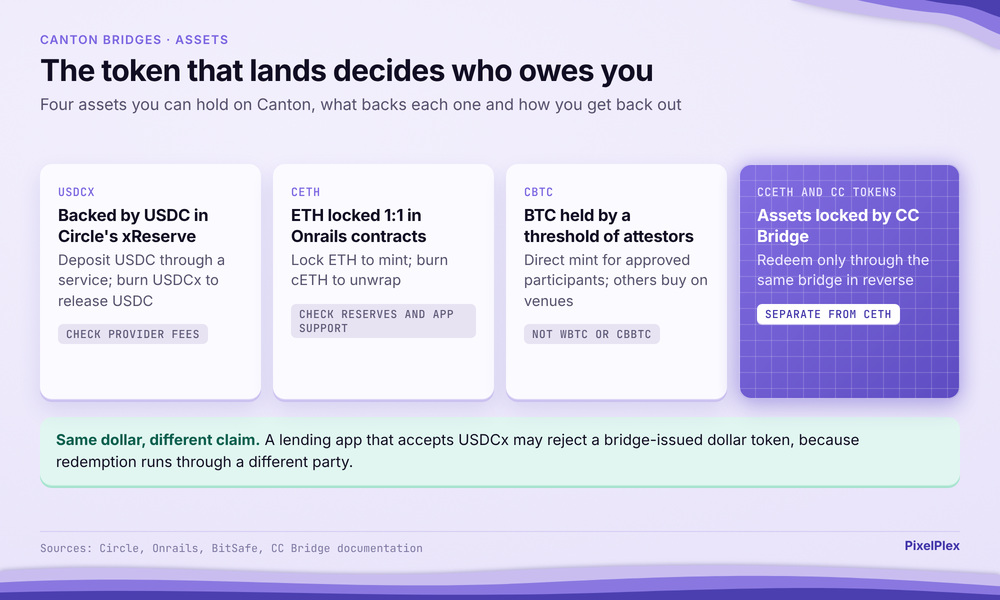
Whatever arrives on Canton is a claim on someone, and the table shows on whom.
| Asset on Canton | Backing / issuer | Entry and redemption route | What to verify |
| USDCx | USDC in Circle’s xReserve; token created by a decentralized protocol on Canton | Deposit USDC through a service; burn USDCx to release USDC | Your provider’s fees on top of Circle’s |
| cETH | ETH locked 1:1 in contracts of the cETH protocol, Onrails | Lock ETH to mint; burn cETH to unwrap | Reserve and supply data, and whether your app accepts cETH |
| CBTC | BTC on Bitcoin addresses spendable only by a threshold of attestors | Direct mint and redemption for approved Canton participants; others buy on venues | That it is CBTC, unrelated to WBTC or cbBTC |
| Bridge-issued tokens such as ccETH | Assets locked by the bridge on the source chain | The same bridge in reverse | Whether your target app accepts it |
Say a Canton lending app accepts USDCx as collateral, and you arrive with a bridge-issued dollar token. Both track one dollar. The app may still reject yours, and redemption runs through a different party. For the basics, see what stablecoins are. To issue your own, see our stablecoin development services.
Top 5 Canton Network bridges and interoperability options
CC Bridge and BitSafe’s Bitcoin bridge take an asset on one chain and deliver a counterpart on Canton. Circle xReserve and cETH back assets you reach through someone else’s interface. Chainlink CCIP is a protocol that issuers and developers integrate.
Disclosure: CC Bridge, Console Wallet, CC View, CC Trace and the Intercepta screening layer are built by PixelPlex, the publisher of this article. This review relies on public documentation, not independent testing.
CC Bridge
CC Bridge is an operated crypto bridge between Ethereum and Canton. It runs four routes:
- Ethereum to Canton. You deposit on Ethereum, and the token lands at the recipient’s Party ID.
- Canton to Ethereum. A Canton balance pays out to a regular Ethereum address.
- Canton to Ethereum with a stealth payout. The same route, but your own funds land at a one-time address.
- Private Ethereum to Ethereum. Both ends stay on Ethereum, and the leg in between is recorded on Canton.
The interface offers ETH and seven ERC-20s. The docs say an asset’s official version arrives where one exists. Every pair shown today delivers a cc-prefixed token. ETH arrives as ccETH, backed 1:1 by locked ETH, redeemable only through CC Bridge and separate from cETH.
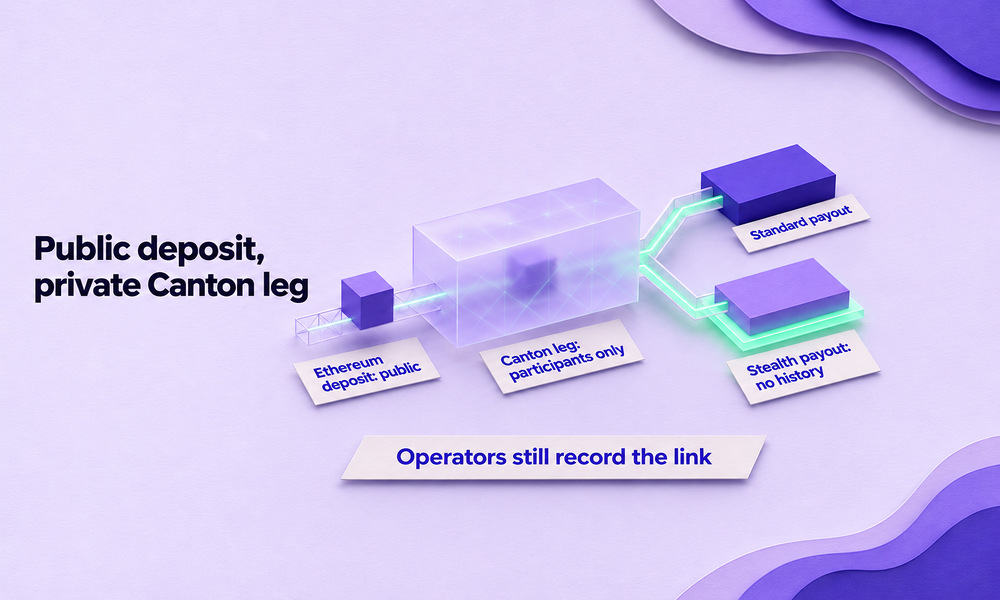
In the private route, the deposit is public on Ethereum and the Canton leg is readable only by its participants. On both routes that pay out on Ethereum, you choose a regular address or, for your own funds, a one-time stealth address. A regular payout can usually be matched to the deposit by amount and timing. A stealth payout lands at an address with no public history. The operators record the link either way, and stealth addressing never applies to a Canton recipient.
Intercepta screens every transfer three times: while you type, at intake and before payout. What happens after a flag depends on when and why it fires:
- Before the deposit. The transfer never starts, so there is nothing to hold or refund.
- Sanctions match after the deposit. Funds are held, with no automatic refund.
- Stolen-fund link after the deposit. Delivery is refused, and funds are refunded only where the law allows. Otherwise they are held.
- Possible false alarm. A person reviews the case.
Finality first means nothing is released until the Ethereum deposit passes the bridge’s confirmation threshold, which the statuses page puts at about ten minutes. The bridge is designed so that a reorganization does not cause a double payout. Temporary errors are retried automatically. After a permanent failure, the same token returns to the sending address, usually within ten minutes.
The fee page lists no service or delivery fee, so you pay Ethereum gas. Every Ethereum payout is signed by 2-of-3 operators, and the roadmap adds independent validators in Stage 2. For ETH and the listed ERC-20s, it works as a direct self-serve Canton bridge.
Circle xReserve and USDCx
Circle xReserve is the reserve behind USDCx rather than a Canton Network bridge with its own front end. Circle runs xReserve contracts holding USDC on Ethereum and Arc. Once a deposit is verified, an attestation lets the Canton side mint USDCx. The way back is a burn, an attestation and release of USDC.
There are three roles here. Circle controls the reserve, a decentralized protocol on Canton creates USDCx, and a service such as HIFI gives you access. Circle connects xReserve only to partner blockchains, and Canton is one of them. Deposits carry no Circle fee, and withdrawing to Ethereum costs about 2 USDC in gas and forwarding fees, plus anything your provider adds. Circle xReserve fits treasury teams that need dollars with named reserve backing. Our stablecoin development guide covers such reserve designs.
BitSafe and CBTC
BitSafe runs the Bitcoin bridge behind CBTC, a Canton token backed 1:1 by BTC. As with any cross-chain bridge, the key question is who can release the reserve. Deposited BTC sits on Bitcoin addresses that only a threshold of attestor nodes, mostly run by institutional operators, can spend through FROST signatures. No single operator holds the full key. We could not find the exact threshold in BitSafe’s public docs. Reserves can be checked through a Chainlink proof-of-reserve feed.
This is the only route in the top five that starts on Bitcoin, and it is built for institutions. Minting and redeeming directly takes a Canton validator, a party with minter credentials and approved access to BitSafe’s API. Everyone else buys CBTC over the counter or on Canton venues.
cETH
cETH, issued by Onrails, is an asset first, and the interface for getting it is a separate question. It is minted 1:1 against ETH locked in protocol contracts, follows CIP-56, and is burned on Canton to unwrap back to ETH. Locked balances and supply are described as verifiable on-chain. In April 2026, Consensys Diligence audited its Ethereum contracts. The Canton side was out of scope.
The site points integrators to documentation and a test environment, and we could not confirm a self-serve transfer screen. No unlinkability is claimed. Reserves are public by design, so Canton lending, collateral and trading apps can accept cETH with backing they can check. That suits holders who want ETH working in DeFi apps on Canton and teams that build such apps, often with a DeFi development company.
Chainlink CCIP
The Canton Network Chainlink integration runs through CCIP, Chainlink’s messaging and token transfer protocol, and has published Canton documentation. With CCIP on Canton, an issuer moves CIP-56 or registry-issued instruments across configured lanes.
On mainnet, the CCIP Directory lists operational lanes between Canton and just two chains, Ethereum and Base, carrying two tokens, RIZE and USD1. It is a tool for issuers, typically with a blockchain development company doing the integration.
Canton bridge comparison
Use this as a status check before committing to a Canton Network bridge.
| Solution | Access / status | Confirmed networks and directions | Supported transfer scope | Fees / timing |
| CC Bridge | Live, self-serve | Ethereum and Canton both ways, with stealth payouts; private Ethereum-to-Ethereum via Canton | ETH and seven ERC-20s as cc tokens | No bridge fee; gas extra; about 10 min |
| Circle xReserve | Live, via services such as HIFI | Ethereum or Arc and Canton, both ways | USDC and USDCx | No Circle deposit fee; about 2 USDC to withdraw to Ethereum |
| BitSafe CBTC | Live, direct mint for approved institutions | Bitcoin and Canton both ways | BTC and CBTC | Mint after about 6 Bitcoin confirmations, roughly 60 min |
| cETH | Live per site, integration on request | Ethereum and Canton both ways | ETH and cETH | No published fee schedule |
| Chainlink CCIP | Mainnet lanes operational; issuers deploy their own token pools | Canton with Ethereum and Base, both ways | RIZE and USD1 | Fees paid in Canton Coin |
Risks and checks before choosing a route
Crypto bridges remain prime targets because they control value on two networks at once. Every cross-chain bridge here has a party that can release funds, whether operators, an issuer, attestors or a lane owner. Reserves add custody risk, finality adds delay, and sanctions screening can stop a sound transfer without making the route compliant for your organization. For your own controls, see crypto compliance solutions and transaction monitoring software.
| Check | What to confirm | Why it matters |
| Trust and custody | Who holds the backing and who signs payouts | Sets your worst case |
| Amount and time | Net amount and time window | Fees change the net result |
| Visibility | What stays public and what operators record | Source-chain data stays public |
| Compliance | Screening points and what a flag triggers | A hold and a refund are different outcomes |
| Failures and refunds | Retry rules and where refunds go | Often to the sending address, which may not be yours |
| Recipient readiness | Party ID, active preapproval or pending offer | An unready recipient can stall delivery |
Picture an exchange withdrawal bridged straight away. If the transfer fails, the refund goes back to the exchange’s address, not to your account there. The bridge did its job, and the money still went somewhere you cannot reach.
Three mistakes to avoid with any Canton Network bridge:
- Approving tokens on a lookalike site instead of the official bridge URL.
- Bridging into a token your target app does not accept.
- Counting on a return route the provider has not documented for your asset.
Other routes and protocols worth knowing
Two narrower routes fill gaps the top five leave. Bridge by Temple brings stablecoins into Canton from EVM networks, useful because CC Bridge currently offers no USDC pair. The SEND bridge suits Send wallet users moving selected Base assets to Canton. Neither works as a general Canton bridge.
For issuers, the Canton Network LayerZero integration went live in March 2026 to carry Canton-issued assets to other chains. LayerZero’s official chain definitions include a Canton mainnet endpoint. Before relying on it, check that the app you use offers a Canton bridge route through LayerZero.
How to bridge USDC or ETH from Ethereum to Canton
ETH follows the CC Bridge Ethereum-to-Canton route. CC Bridge currently offers no USDC pair, so USDC needs another route, such as a service built on Circle xReserve with its own access terms. Another Canton bridge may differ in screens and signatures.
- Set up a Canton wallet that supports the asset, such as Console Wallet, and note your Party ID. Preapprovals expire, so check the date if you rely on one.
- Connect an EVM wallet you control, then pick CC Bridge for ETH or an xReserve service for USDC.
- Check the exact token you will receive. ETH through CC Bridge arrives as ccETH, not cETH, and USDC through xReserve arrives as USDCx.
- Enter the recipient’s Party ID and confirm they can accept the token: CC Bridge requires an active preapproval for that token, and other services set their own rules.
- Review the amount received, gas and any fee. USDC needs a token approval first, and ETH does not. Sign each transaction your wallet requests.
- Wait for finality and processing, then confirm the asset is usable in your wallet.
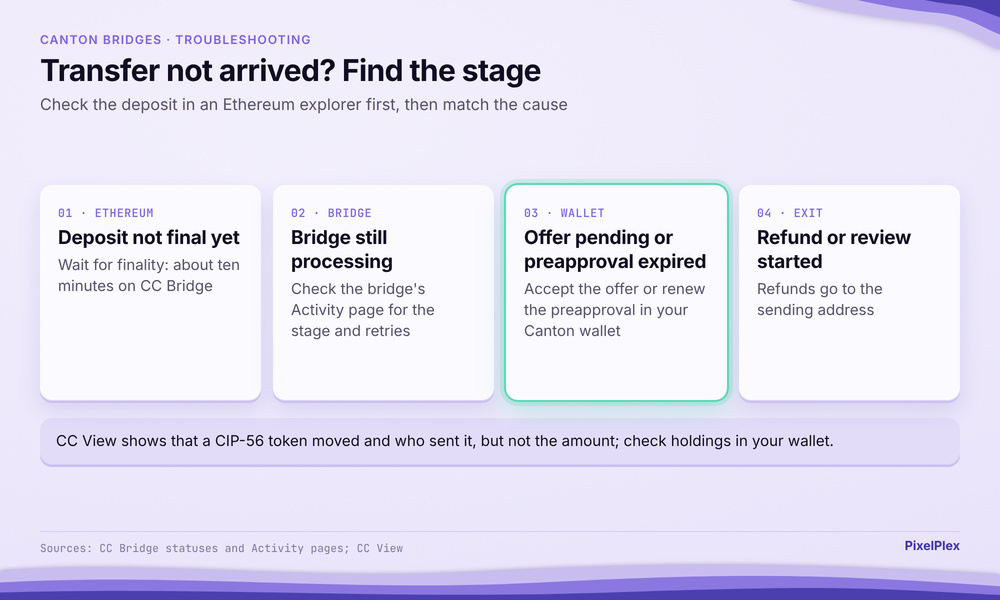
An Ethereum explorer shows the deposit and confirmations, and the CC Bridge Activity page shows the stage, retries and refunds. In CC View, a CIP-56 transfer appears as a private transaction: you see the token, sender, registry and time, but not the amount. Balances are shown only for Canton Coin, so check holdings in your wallet. Its Offers page shows pending offers, and Preapprovals lists Canton Coin preapprovals.
Conclusion: when a business needs a custom integration
Across all five options, the choice comes down to the token you need and who stands behind it.
A public blockchain bridge interface fits occasional transfers. It falls short for scheduled transfers, settlement inside your own app, treasury operations or internal approval rules. The work then shifts to signing policies, reconciling Ethereum and Canton records, handling exceptions, screening counterparties and keeping audit-ready records.
CC Suite brings together seven PixelPlex products for Canton, including CC Bridge, Console Wallet, CC View, Intercepta and the CC Trace investigation tool. As a Canton blockchain development company, PixelPlex designs integrations on these components, including trading venues through Canton Network exchange development. If your Canton bridge needs go beyond a standard interface, our team can help plan the integration.
FAQ
There is no single best crypto bridge for every case. The best cross-chain bridge is the one that delivers an asset your target app accepts and documents a way back.
Only if the route is connected to Circle xReserve, since USDCx is minted against USDC held there. Other routes may deliver a different dollar token, so check the name in the quote.
None of the routes reviewed lists Canton Coin itself for transfer to Ethereum. Turning Canton Coin into an Ethereum asset is a swap, handled by separate products.
Any route ending on Canton needs a wallet and a Party ID. CC Bridge requires an active preapproval. Elsewhere, a transfer may instead arrive as an offer you accept.
Partly. CC View shows that a CIP-56 token moved and who sent it. It does not show the amount, and it shows balances only for Canton Coin.
On CC Bridge, a technical failure is retried and then refunded to the sending address. A sanctions match is held with no automatic refund, and a possible false positive goes to human review.