A supervisor asks a custodian to show how a tokenized bond moved between counterparties and why its anti-money laundering (AML) controls allowed the transfer. On Canton, the answer has to come without exposing client positions or trading relationships to the market.
The scenario is illustrative, but the tension is real, and Canton privacy in institutional finance explains why institutions care about it. On the Canton Network, crypto transaction monitoring starts with two questions: what evidence can the institution lawfully obtain, and who is allowed to see it? This guide won’t replace a conversation with your compliance team and supervisor, but it should make that conversation shorter.
What privacy changes in transaction monitoring
On a transparent public chain, an analyst can open an explorer, pick an address and follow the money. The picture is incomplete, since addresses carry no names and off-chain deals stay hidden, but the transfers are open to anyone.
The Canton Network blockchain is public as well, with validators admitted through sponsorship, yet each party receives only the parts of a transaction it is entitled to see. That rule sits at the heart of the Canton privacy model. For the wider architecture, see Canton Network explained.
The data lands on participant nodes, which host parties and process data on their behalf. The Canton ledger model defines what a node receives for its parties: the events they are informed of, such as contracts being created or archived, choices being exercised and the contract data their role allows. The exact fields depend on the application and on each party’s rights. Synchronizer components, such as sequencers and mediators, order transactions and coordinate confirmations without seeing their payloads.
Now picture our custodian. It sees its own trade in full. It does not see its counterparty’s other clients, the other legs of a composite deal or anything happening in unrelated applications. Even an observer has limits: it sees a contract being created and archived, but later actions and the contract’s earlier history are not automatically shared with it.
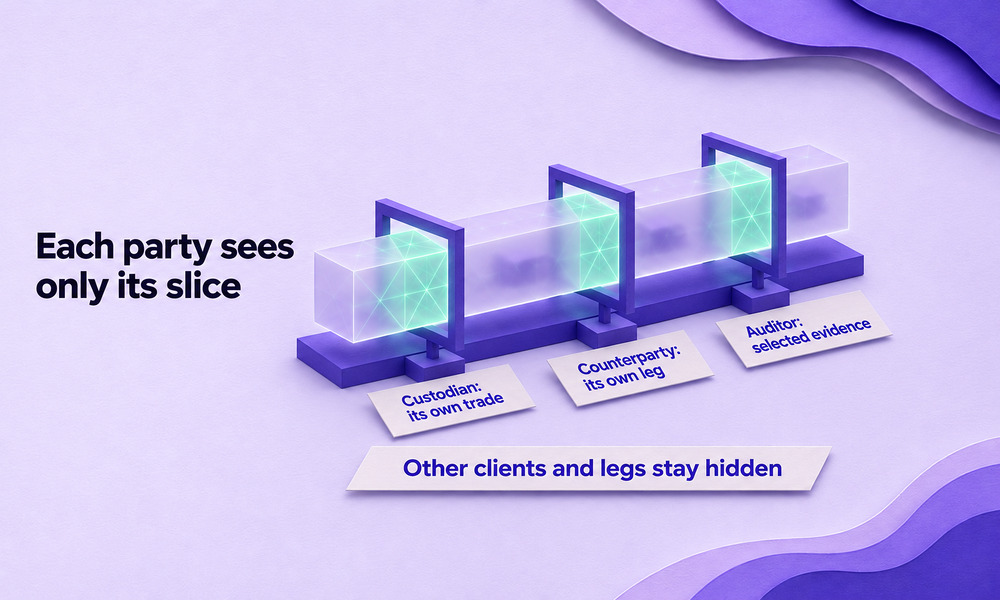
Visibility is decided in the Daml code: signatories and controllers determine who must authorize an action, and observers determine who else hears about it. If auditors need visibility, someone has to model it into the contracts, which is a typical task for Daml development services. That is why crypto transaction monitoring on Canton depends on combining several sources and knowing exactly where each source’s visibility ends.
Where compliance evidence comes from
No single source answers every question an investigator will ask. A ledger event proves that something changed. KYB documents explain who stands behind a party. A risk label is someone’s analytical judgment. In crypto transaction monitoring, each needs its own quality check.
Table 1. Compliance data sources and their limits
| Source | Evidence it can provide | What it cannot establish | Required control |
| Own participant node | Events and contracts in hosted parties’ view | Others’ private history; events removed by pruning | Check read rights; archive before pruning |
| Counterparty information | Trade documents, KYC/KYB records, permitted details of hidden legs | Whether each statement is true | Verify sender, disclosure basis and version |
| Public network data and CC View | Observed activity, counterparty graphs, infrastructure links | Legal identity, purpose or private payloads | Record period, coverage and attribution confidence |
| External risk-data providers | Sanctions data, risk labels, analytics | Absence of risk for unknown parties | Track list version and label origin |
Public sources have edges too. The documented Scan API scope covers Canton Coin activity and governance and leaves out most custom Daml apps. CC View, a Canton Network explorer, goes further. Still, its updates stream separates public updates, which carry content, from private ones that carry only metadata. An empty public record therefore leaves open whether an operation took place.
Before the first settlement, our custodian can vet a Canton Network counterparty with CC View and hold the results up against its onboarding files:
- Get the party ID straight from the verified organization. As the Canton topology docs show, the readable prefix is not a certified company name.
- Compare the declared hosting setup with the profiles. CC View’s hosted parties data marks hosting as threshold-resolved, so treat it as an inference.
- See how long the party has been visible and whether its behavior has shifted.
- Check linked apps and observed counterparties in the counterparty graph, then confirm ownership and control in the KYB file.
- Resolve every mismatch with KYB documents before you approve.
Treat a long record, validator status or Featured App status as background for the KYB review.
Build monitoring around counterparty risk
Monitoring connects who a customer is with what that customer does. Know-your-customer (KYC) and KYB checks tie each party ID to a verified customer, and a risk profile records what that customer is expected to trade, in what volumes and where. Rules compare each operation with the profile. When something doesn’t fit, an alert opens a case and a responsible officer records the decision.
KYC workflows on blockchain establish who the customer is. Know your transaction controls ask a different question: does this operation make sense for that customer? Blockchain AML decisions need both answers, and KYC on blockchain covers the onboarding side.
A risk score earns trust only if someone can explain it, so keep its factors and the reason behind every change. Use it to set the order of review, and build each case on evidence.
Know your transaction (KYT) rules can borrow their logic from the Financial Action Task Force (FATF) red flag indicators for virtual assets, which cover the size and frequency of transactions, unusual transaction patterns and activity inconsistent with the customer’s profile. The numbers below are illustrative configuration examples, not regulatory thresholds.
Table 2. Monitoring scenarios: signal, context and response
| Scenario | Detection logic | Legitimate explanation to test | Response |
| Threshold breach | Transfer or 24-hour total above the profile limit, e.g. 3x usual size | Planned large trade, raised limit | Request context; hold if policy requires |
| Structuring | Linked transfers under single limits that together exceed a limit within e.g. 7 days | Settlement schedule, retries | Merge into one case; ask for the rationale |
| Unusual counterparty behavior | New counterparties, assets or timing outside the profile | New business line or migration | Refresh KYB and the risk profile |
| High velocity | Assets leave within e.g. 1 hour of arrival, in a pattern unusual for the role | Settlement cycles, collateral moves | Check purpose; investigate unexplained legs |
To keep these rules accurate, analysts combine the activity of linked parties only when the link is confirmed. The team also reconciles technical command retries with completions, as the command deduplication guide explains, so a velocity rule doesn’t count one intent twice. Even then, an alert opens a question; it doesn’t prove money laundering.
Travel Rule and sanctions checks
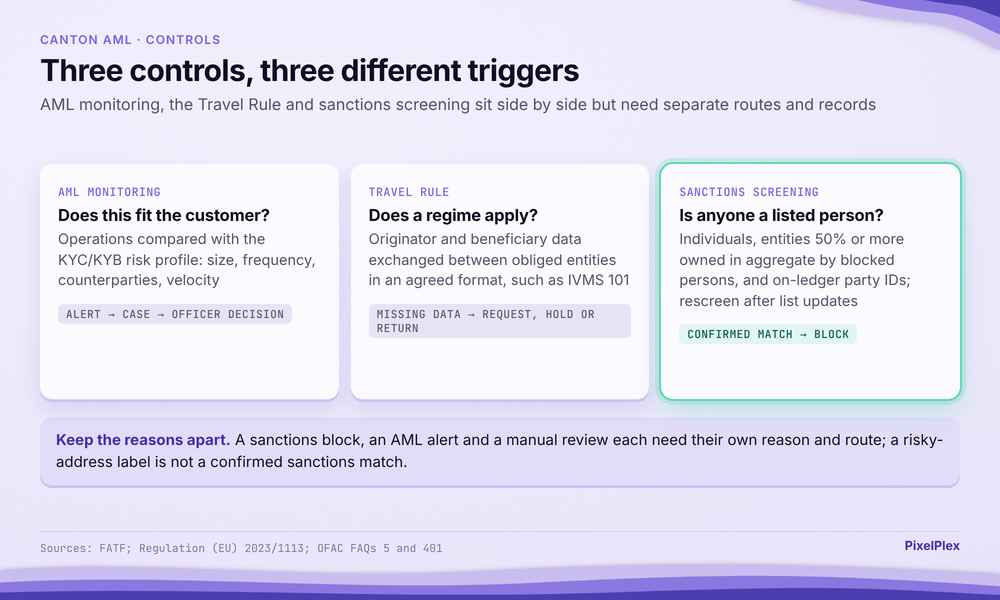
Both checks sit next to crypto transaction monitoring, but each has its own legal trigger, so treat them as separate controls.
Travel Rule: decide the regime first
The FATF glossary excludes from virtual assets digital representations of fiat, securities and other financial assets already covered elsewhere in the FATF Recommendations. So a tokenized bond and a crypto-asset transfer can share a network and still fall under different regimes, depending on the asset, the parties and the jurisdiction.
In the EU, the Travel Rule for crypto-asset transfers sits in Regulation (EU) 2023/1113. MiCA is a separate act, covered in MiCA regulation explained.
When a regime applies, obliged entities exchange originator and beneficiary data in an agreed format, with a verified recipient, over a secure channel and under a message ID tied to the operation. IVMS 101 standardizes only the data model. Personal data stays out of public explorers, and an on-ledger transfer does not satisfy the Travel Rule by itself; Travel Rule crypto requirements explains what does.
If data arrives incomplete, the receiving provider asks for what’s missing, works to a set deadline and documents the outcome. Under the European Banking Authority (EBA) Travel Rule guidelines, it should reject or return the transfer, or hold the funds, when missing data prevents unambiguous identification of the parties. For the sending provider, the rule is stricter: Article 14(8) of Regulation (EU) 2023/1113 bars it from executing any transfer until the required information is complete.
Sanctions screening
Screening covers individuals and legal entities, the people who own or control them, and on-ledger identifiers such as party IDs. Under U.S. rules, Office of Foreign Assets Control (OFAC) obligations apply to digital currency. As OFAC FAQ 401 notes, entities owned 50% or more in aggregate by blocked persons are treated as blocked too. Other jurisdictions set their own criteria.
Lists change, so rescreen active counterparties after each update and resolve name matches with extra attributes, following the steps in OFAC FAQ 5. An address flagged in a risk database and a confirmed match with a sanctioned person are different grounds for a decision. A sanctions block, an AML alert and a manual review each need their own reason and route.
Choose and integrate the compliance layer
Three approaches cover different parts of the job. The right mix depends on which gaps your team is ready to own.
Table 3. Participant capabilities, external monitoring or a custom build
| Approach | What it covers | Main gap | Integration and ownership |
| Built-in participant capabilities | Entitled events, contract state and API authorization | No KYB, risk scoring, case management or reporting | Institution builds controls and archive |
| External crypto transaction monitoring tool | Enrichment, rules and case tools | Canton coverage and private data access need confirming | Vendor runs the service; institution owns decisions |
| Custom build | Controls fitted to your assets and Daml workflows | Team maintains sources, rules and protocol changes | Product owner and compliance own it |
Many teams combine them: an external service screens participant events, while decisions and sensitive data stay in-house. That integration is the core of our transaction monitoring software work.
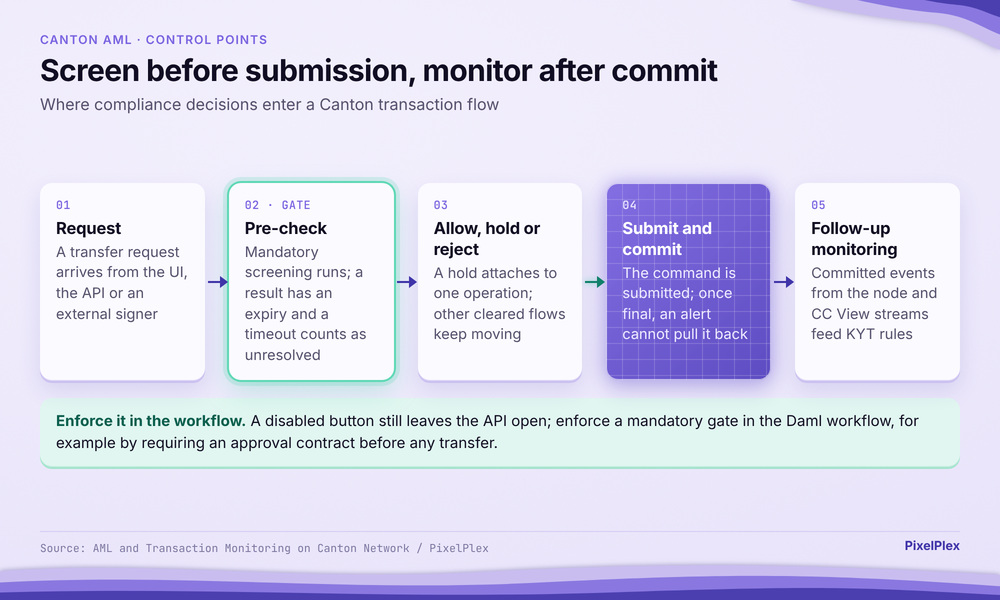
Placement matters as much as the tool. The pre-check belongs before anything irreversible happens: a request arrives, the control runs, the answer is allow, hold or reject, and only then is the command submitted. A disabled UI button still leaves the API open to automated and externally signed submissions. If a control must be mandatory for an asset, the workflow and authorization have to enforce it, for example by requiring an approval contract before any transfer. That is a Canton application development task, since Daml does not call a screening API on its own.
Give each screening result an expiry time, rescreen when material data changes and decide in advance what happens when a provider times out, treating an unknown result as unresolved risk. A hold attaches to one operation or case, so other cleared flows keep moving. Incoming flows need their own review: a Canton Coin transfer preapproval lets a party receive transfers without approving each one. Events from the CC View transfers stream arrive after commit, which makes them useful for follow-up monitoring and too late for blocking. Fail-open defaults, permanent exemptions and promises to reverse final settlement don’t belong in this design.
Investigations, access and regulatory evidence
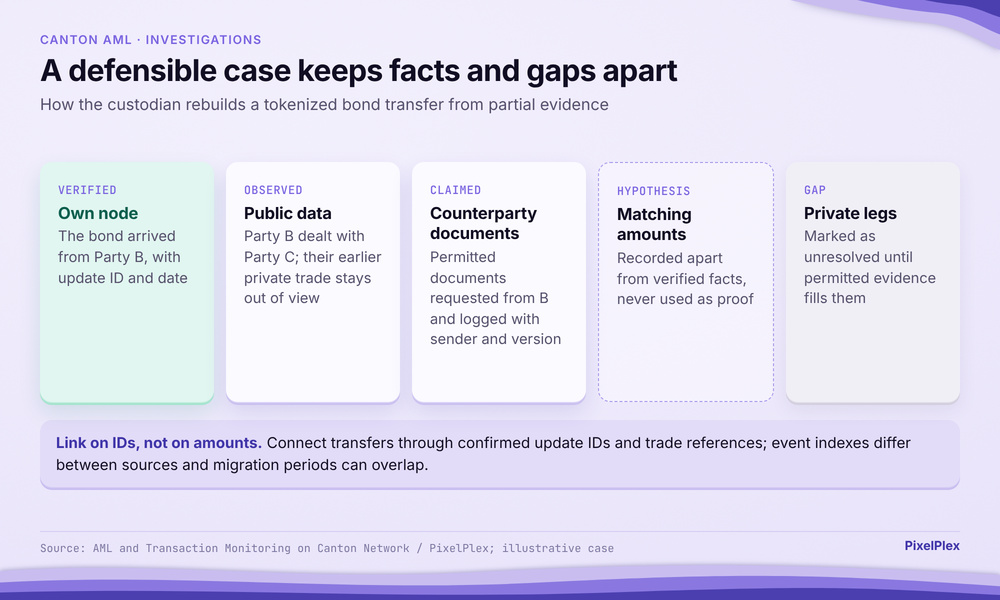
When an alert fires, the investigation rebuilds as much of the chain as the evidence allows: the institution’s own events, public records and documents a counterparty may share. Links between transfers should rest on confirmed update IDs and trade references. Matching on amount or time alone is tempting but risky: as the Scan bulk data API docs note, event indexes differ between sources and migration periods can overlap.
Back to our custodian. Its node confirms that the bond arrived from Party B. Public data shows that B dealt with Party C, while their earlier private trade stays out of view. The analyst asks B for permitted documents and marks the gap in the file. The file records matching amounts as a hypothesis and keeps it apart from verified facts and counterparty claims.
The CC Suite overview positions CC Trace for multi-hop tracing, case files and alerts on watched parties. Even so, CC Trace transaction tracing can only work with the data the institution can lawfully obtain.
Access
Each role sees what its job requires. Analysts work their assigned blockchain AML cases, the money laundering reporting officer (MLRO) sees escalations and reporting material, administrators see service logs, and auditors read a defined scope. Apply least privilege and ask for extra approval before sensitive exports. Log every view, change, export and disclosure, drawing on controls such as those in NIST SP 800-53. A security audit and risk management review can test these boundaries before go-live. Regulators typically receive records through agreed access or a controlled export; the scope follows the request and the applicable law.
Reporting
When a supervisor asks about a case, the evidence package should answer without follow-up calls. It holds operation and update IDs, dates, parties and, where available, amounts, plus the KYC and screening versions used, the rule that fired and a timeline ending in a reasoned decision. This audit export differs from a suspicious activity or transaction report (SAR/STR), which follows its own regime. Link these records from the start, because a manual decision’s reasoning is hard to reconstruct months later.
Retention
Retention needs a matrix by record type and legal basis, with legal hold, controlled deletion, search on request and tested restores. One example: in the United States, 31 CFR 501.601 requires persons subject to OFAC rules to keep records of covered transactions for at least 10 years after the transaction date. That period does not apply to every record or jurisdiction. Node pruning can delete old events, so archive them before it runs. Protect the decision log with append-only or write-once (WORM) storage and integrity checks. A hash shows that a known record changed, but it can’t prove that nothing is missing. And an immutable decision log is no excuse to keep personal data forever.
What to put in place before production
Before go-live, each of these should be true:
- Scope and decision owners are approved in writing.
- Every mandatory control has a data source, read rights and an archive tested against pruning and stream gaps.
- Each active party ID maps to a verified entity, and sanctions list updates trigger rescreening.
- Monitoring rules have been tested on every execution path, including the API and incoming flows.
- Roles and approvals have worked on a test case.
- The team has rehearsed an evidence export and a provider outage.
Roll out in stages. Start with mandatory controls and evidence, then tune the KYT rules on historical data. Shadow mode is a good way to try new analytical rules; mandatory sanctions blocks stay on throughout. Blockchain consulting can help set this order. Canton blockchain development covers nodes and archives. A Daml smart contract audit looks for ways around the controls.
Some mistakes come up again and again in blockchain AML programs. Teams that watch only their own operations miss the counterparty’s side of the story, so add verified external evidence. Teams that don’t keep history can’t explain past decisions, so archive from day one. And cases run in scattered spreadsheets lose the evidence trail, which one case record with an action log keeps intact.
Table 4. Metrics that show whether monitoring works
| Metric | Calculation or measurement | Interpretation risk |
| Automated screening coverage | Operations with all mandatory checks completed ÷ operations in scope | A timeout is not a completed check |
| False-positive share | Alerts closed as false with a documented reason ÷ reviewed alerts | Dividing by all transactions hides the rate; a missing SAR/STR does not make an alert false |
| Investigation time | Median and 95th percentile from opening to decision | Averages hide long cases |
| Counterparty coverage | Active counterparties with current checks ÷ active counterparties in scope | Track high-risk counterparties separately |
Measure each metric over a fixed period. Fewer alerts mean little unless coverage and decision quality hold.
Conclusion
A supervisor can get verifiable evidence from an application on the Canton Network blockchain without the transaction graph being laid open to the market. Getting there takes permitted data, recorded reasons, controlled disclosure and evidence that can be reproduced later. Blockchain compliance on Canton is a design task, and whether a design is acceptable still depends on the applicable regime. If you are preparing a launch, PixelPlex can review your data, control points and integrations as part of our crypto compliance solutions.
FAQ
No. An explorer shows observed activity. It can’t confirm legal ownership, licenses, beneficial owners or authority to act.
No single answer covers the network. It depends on the asset, service, party status and jurisdiction, and some tokenized instruments fall under other rules.
Through access the institution has designed, such as an auditor party in the workflow or a controlled export of an evidence package. A right to request records covers those records and leaves the rest of the Canton Network private.
A predefined policy takes over. Mandatory checks stay pending or go to manual review, and the timeout is logged as an incomplete check. Lower-risk flows may take another route only where policy allows it.
Only within the data available to it. Private legs stay as gaps until permitted evidence fills them.
Yes, with limits. Crypto transaction monitoring rules and KYC integrations can be added later, but pruned events and screening results that were never stored are gone for good. A mandatory pre-submission gate may also need changes to the Daml workflows.