Canton covalidation lets several independent validators confirm transactions for one party, so one outage no longer stops a wallet, asset or app and, with a threshold above 1, no compromised node confirms alone. It covers how multi-hosted parties work, what covalidation services include, what they cost and how to prepare your architecture.
Canton covalidation, also called multi-hosting a party, lets one party on the Canton blockchain be hosted by several independent validators that confirm its transactions together. Digital Asset announced covalidation services on November 19, 2026, when Canton Network counted 750+ validators. It raises fault tolerance; it cannot fix correlated operator failures.
What Is Canton Covalidation and Why It Matters Now
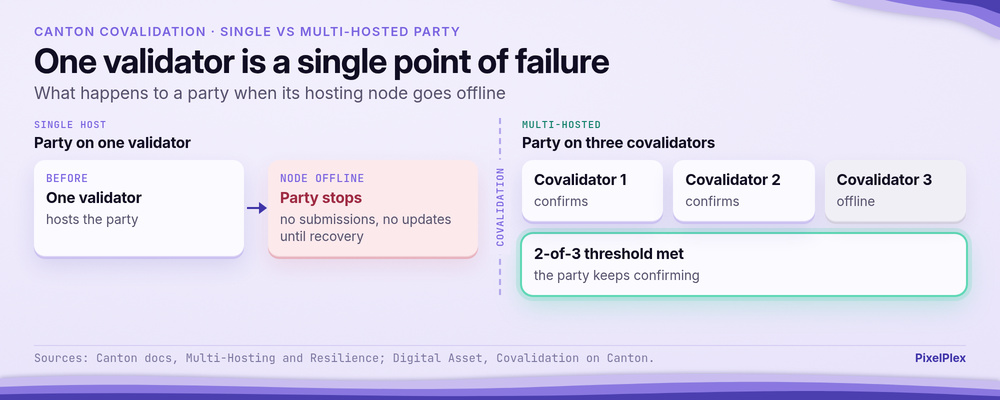
Covalidators are the independent node operators that share this job. A party hosted on one validator has a single point of failure. Per Canton docs, if that node goes offline, the party cannot submit transactions or receive updates until it recovers.
Why Canton Privacy Needs Its Own Approach to Resilience
Public chains share every transaction with a common validator set, often through a public mempool. Under the Canton privacy model each party lives on a specific validator, and the global synchronizer delivers transaction views only to the validators hosting the involved parties (Digital Asset). Redundancy is added party by party, and the global synchronizer keeps every added host in sync.
How Multi-Hosted Parties Work
Party-to-Participant Mapping and Onboarding
Multi-hosting lives in Canton’s topology. A party-to-participant mapping lists the validators that host a party and the permission of each. Every hosting validator must sign it; until then it stays a proposal. An external party also signs with its own key. New parties name extra hosts at onboarding through the Ledger API fields otherConfirmingParticipantUids and confirmationThreshold (Canton docs).
Adding hosting nodes to an existing party is called party replication. Canton treats it as a separate workflow, more involved than onboarding a new multi-hosted party. Observation permission can pre-stage a migration target.
Hosting Permission Levels
| Level | What the node can do | Available for | Typical use |
| Submission | Submits commands for the party | Local parties only | Backend automation |
| Confirmation | Confirms transactions; external parties submit through it | Local and external | Covalidators |
| Observation | Receives data, cannot submit or confirm | Local and external | Read-only replicas, audit, migration |
Confirmation Threshold and Operator Independence
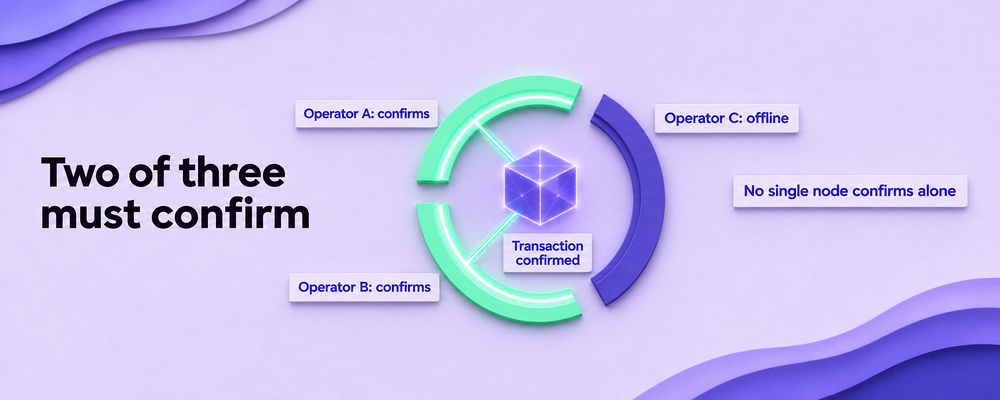
The confirmation threshold sets how many hosts must confirm. The default is 1: any host can confirm, which helps availability but not against a malicious host. In 2-of-3, one node can be offline and no single node confirms alone. Higher thresholds add protection, but also latency and less room for outages. Digital Asset adds that each covalidator should be run by a different organization, because one operator’s breach or outage could take all its nodes down.
- Use a separate organization for each confirming node.
- Spread nodes across regions and clouds.
- Keep the confirmation threshold below the number of confirming nodes.

Zero-Leakage Vaults: Building High-Stakes Canton Network Wallets
What Covalidation Services Include and Who Offers Them
Service Scope and SLA Checklist
Covalidation services cover the covalidator nodes themselves, plus node recovery, workflow automation, technical support and SLAs. DA’s May 2026 automation for party onboarding across covalidators and DAR synchronization made this model practical at scale; DA says customers keep control of topology and DARs. According to DA’s primer, its own service retains ledger history for 30 days and keeps validator keys in a KMS.
Before signing, we check:
- Uptime per node and for the threshold as a whole
- Recovery time and history retention
- Who uploads and vets DARs on every covalidator
- Separate legal entity and infrastructure per operator
- Exit terms for removing a node from the mapping
First Providers and Adopters
Per Digital Asset’s announcement, DA, MPCH and Kiln were among the first to offer covalidation services. DA also invites node and key providers to its partner network, so validator infrastructure teams can become covalidators. Early adopters (TokenPost): T-RIZE runs multi-hosted parties, Bron integrated DA Covalidation, and 5N Loop by Five North became the first Canton wallet where every new participant is multi-hosted, with DA and MPCH as covalidators.

As the first wallet on Canton where every new participant is multi-party hosted, we’re able to deliver best-in-class resiliency for our users. Working with DA and MPCH as independent node operators enables us to maximize resiliency while retaining control over which providers we trust.

Yiannis Varelas
CEO Five North
Covalidation vs Other Resilience and Validator Models
Canton documentation lists four resilience options. Downtime tolerance and the validator infrastructure you can run decide the fit.
| Option | Availability | Malicious-operator protection | Complexity | Cost |
| One validator with backups | Down until restore | None | Lowest | Lowest |
| Multi-hosting on 2+ validators | No restore wait | Yes, if threshold above 1 | Medium | Grows per confirming host |
| Plus observation nodes | Adds read-only replicas | As confirming set | Medium to high | No confirmation load, extra storage |
| Across several synchronizers | Multi-synchronizer access | Depends on threshold | Highest | Highest |
Self-Hosted, Validator as a Service and Covalidation
Validator as a service (Node-as-a-Service) outsources operations but usually keeps one provider and one confirming node. Our Canton validator guide covers running your own.
| Model | Who runs nodes | Topology control | Fault tolerance |
| Self-hosted | Your team | You | Single point of failure |
| Validator as a service | One provider | You, via provider | One provider, one node |
| Covalidation | Several independent operators | You, with your DARs | Survives outages within threshold |
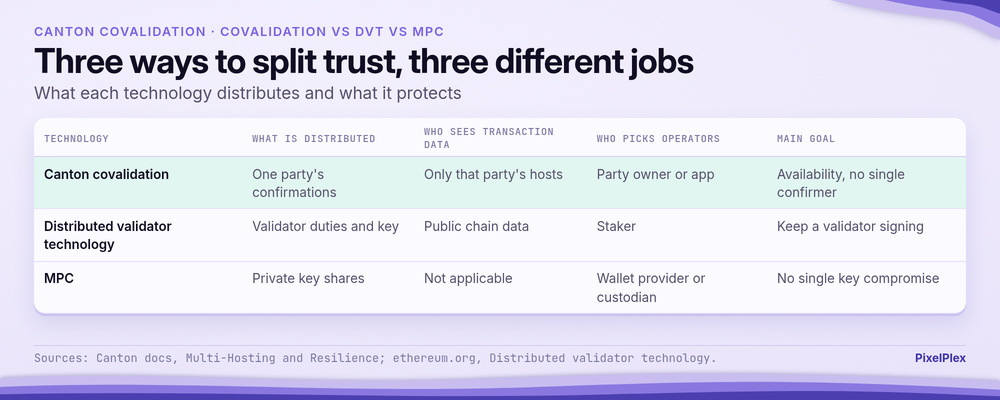
Covalidation vs Distributed Validator Technology vs MPC
They guard different things: a party’s confirmations, a staking validator, a private key.
| Technology | What is distributed | Who sees transaction data | Who picks operators | Main goal |
| Canton covalidation | One party’s confirmations | Only that party’s hosts | Party owner or app | Availability, no single confirmer |
| Distributed validator technology | Validator duties and key | Public chain data | Staker | Keep a validator signing |
| MPC | Private key shares | Not applicable | Wallet provider or custodian | No single key compromise |
Distributed validator technology splits one validator’s private key across a cluster, while MPC wallet development can secure a covalidated party’s own key.

Canton Network's Next Chapter: From Infrastructure to the Application Economy
Covalidation Economics and Who Needs It
Each Confirmation host processes and confirms transactions on its own, so traffic consumption rises proportionally; Canton docs tie the exact increase to the number of confirming validators and the threshold. Provider fees and your own monitoring come on top. CIP-0120 would pay part of validator rewards to confirming validators, but as of November 25, 2026 it is still Proposed. More on Canton network rewards.
Today validator rewards follow Canton Coin burned for traffic purchases. CIP-0120, created June 29, 2026, bases them on actual traffic usage, splits them between submitting and confirming validators to reward multi-hosting, and excludes rejected transactions so spam cannot farm rewards.
Canton covalidation fits:
- Issuers of tokenized collateral that must stay transferable 24/7
- Canton wallet development projects whose transfers must work during an outage
- 24/7 marketplaces and asset bridges
- Apps seeking Featured status: DA links covalidation to qualification, so confirm current criteria with the Tokenomics Committee
- Apps where no single operator, including the owner, may approve alone
One validator with database backups is enough for internal tools, pilots and parties that tolerate a restore window.
How to Prepare Your App or Wallet for Covalidation
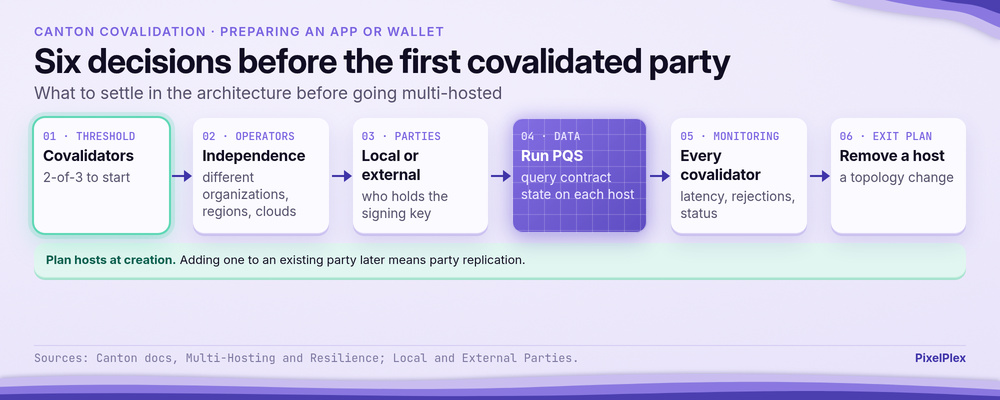
- Choose the number of covalidators and the confirmation threshold; 2-of-3 is the setup DA’s primer starts from.
- Pick operators from different organizations, regions and clouds, so no shared validator infrastructure fails at once.
- Decide between local and external parties. External parties keep their own signing key and sign the mapping themselves.
- Plan data availability too: run the Participant Query Store (PQS), whose offsets may differ slightly per host.
- Monitor each covalidator for latency, rejections and status.
- Write the exit plan: removing a host is a topology change, while adding one later means party replication.
Our Canton network development team designs multi-hosted parties in at the architecture stage of Canton application development projects. Through Daml development we keep DAR packages identical on every covalidator. We integrate covalidation services and monitor them with our Canton network solutions: CC View tracks validator health in real time and CC Trace alerts on watched parties. We also engineered the first version of Loop for Five North.
Canton Loop: how we built the first self-custodial wallet on Canton Network
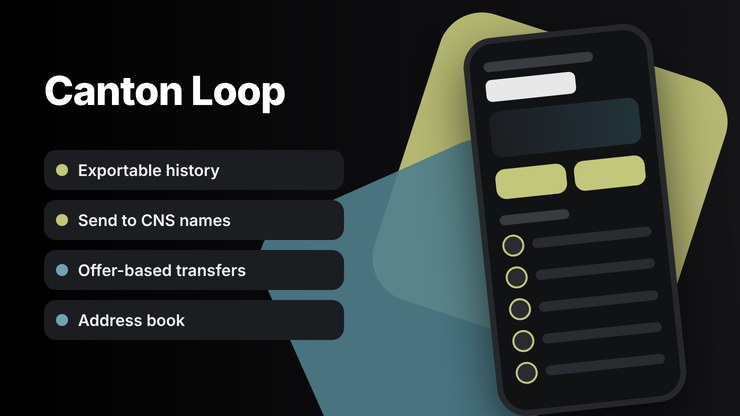
PixelPlex built Canton Loop for FiveNorth, a non-custodial Canton wallet with passkey sign-in and keys kept on the device. The wallet plugs into the protocol's incentive layer and was featured in the official Canton ecosystem marketplace within days of launch.
2.5 months from the first consultation to MVP
Featured Application on the Canton network
Top 10 position on the official Canton Coin Validator Leaderboard
31.29M Canton Coin in revenue ($3M USD) for the client
Explore this case studyFor wallets, assets and apps that cannot pause, build covalidation in from day one. Start with three covalidators from different organizations at 2-of-3, then tune the threshold against latency and traffic cost.

Canton Development and a New Vision for Blockchain in Finance: Use Cases, Features, and Cost
FAQ
Hosting one Canton party on several validators run by independent covalidators, so a threshold of them confirms each transaction.
Two hosts at threshold 1 give failover but no protection from a bad host. Three at 2-of-3 cover both.
Only to the hosts you add. The global synchronizer sends transaction views to those validators and no one else.
Validator as a service hands one node to one provider. Covalidation spreads confirmation across several independent operators.
No. Distributed validator technology splits one validator’s key; covalidation keeps keys separate and adds validators.
Yes, via party replication, a more involved workflow than onboarding a new party.