In 2025, banks and trading firms financed tokenized Treasuries against stablecoins on Canton Network, on a Saturday. Here is how those trades worked step by step and what the model looks like more than a year later.
Tokenized Treasuries used to be a slide in innovation decks. On Canton Network, they became collateral in live repo trades between Wall Street firms in 2025, financed with stablecoins. In October 2026, DTCC opened a commercial service that tokenizes securities held at its depository.
The repo market itself still runs on schedules written decades ago. Cash and collateral stop moving when payment systems close on Friday, and every bank keeps spare funds parked in case something goes wrong over the weekend.
Our team builds Daml applications and data products on Canton Network every day. We put this guide together for treasury and collateral teams who want to understand how tokenized Treasuries work in on-chain repo before they plan their own pilot.
What tokenized Treasuries on Canton Network are
A tokenized Treasury is a digital record of a US Treasury security that can move on a blockchain. The bond itself stays where it always was, at a custodian or central securities depository. The token is its digital twin, and whoever holds the token holds the claim on the bond.
Treasuries have become one of the busiest corners of real world asset tokenization, and repo is where they matter most to banks. That is the use case here: tokenized US Treasuries as collateral.
On Canton, the digital twin lives inside a Daml contract. The contract names the owner of the position and the parties allowed to see or move it. That makes the token useful as collateral, because the rules of a pledge can be written into the contract itself.
Canton is a public network built for regulated finance. Each participant connects through a validator node and keeps only the data it is entitled to see. A shared layer called the Global Synchronizer orders transactions across applications.
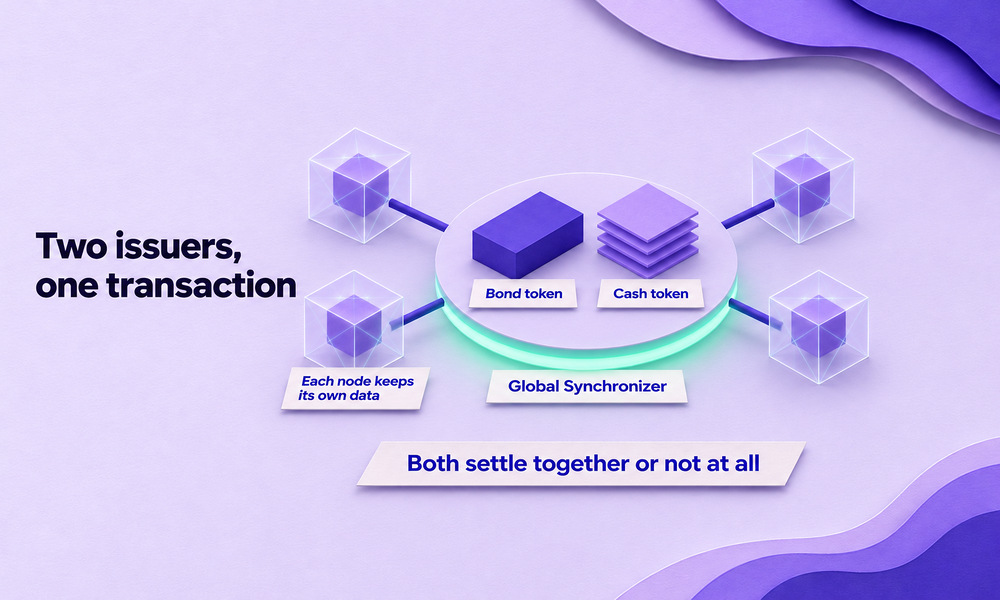
The short version of Canton Network explained for a repo desk is simple. A bond token and a cash token issued by different firms can settle in the same transaction.
So what is tokenized collateral in practice? It is any tokenized asset pledged to secure an obligation, such as a repo loan or a margin call.
Tokenized Treasuries are the obvious first candidate, since US government debt is widely accepted as collateral, that is also why the first Canton repo trades used them.
Euro government bonds joined the same repo workflows in December 2025, and gilts followed in January 2026. Firms tokenizing RWAs on Canton now use them as collateral next to Treasuries.
Traditional Treasury position vs tokenized Treasury on Canton
| Feature | Traditional position | Tokenized Treasury on Canton |
| Where the bond sits | Custodian or CSD account | Same custodian or CSD, locked for the token |
| What moves in a trade | Book entries between accounts | The token, inside a Daml contract |
| Transfer hours | Payment and depository operating hours | Any time the network is running |
| Who sees the position | Custodian and account holder | Only the parties named in the contract |
| Use as collateral | Pledged through settlement cycles | Pledged and released by contract actions |

Asset Tokenization From A to Z: Explanation, Benefits, Limitations, and Real-Life Use Cases

How to Launch a Security Token Offering Platform: Comparing Custom STOs vs Ready-Made Options
Why collateral stops moving on Friday evening
Repo is the plumbing of short-term funding. A firm sells securities with a promise to buy them back later, which in practice makes it a loan secured by those securities.
This huge market depends on systems that keep office hours. When the payment rails and the depository close on Friday, collateral sits where it is until Monday morning, whatever happens in the markets in between.
Here is what a typical Friday close looks like for a collateral desk:
- Last trades are booked before the payment system cutoff
- Positions are checked against the custodian’s records
- Spare cash is parked to cover any margin call over the weekend
- Collateral that is not needed stays idle until Monday
Manual processes and double reconciliation
Each side of a repo keeps its own record of the trade, and so does the custodian. Before the weekend, operations staff match those records line by line and chase every break.
The work is slow because the data lives in different systems that were never designed to agree in real time. A mismatch found at 5 p.m. on Friday often cannot be fixed until the next business day.
Buffers and lost income
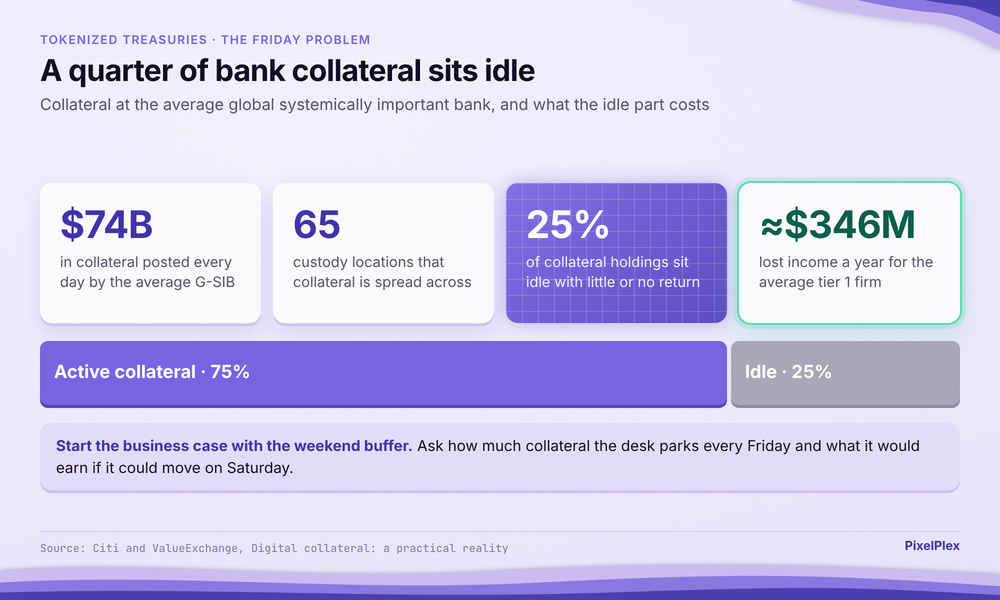
Because collateral cannot move on Saturday, banks hold extra cash and securities as a safety cushion. That cushion earns little or nothing. A Citi and ValueExchange study found that the average global systemically important bank posts about $74 billion in collateral every day across 65 custody locations.
The same study says about 25% of collateral holdings sit idle with little or no return. For the average tier 1 firm, it puts the lost income at around $346 million a year.
Valuing exposure over the weekend
Markets keep moving when settlement systems stop. News on a Saturday can change the value of collateral that nobody can top up or release until Monday.
Risk teams handle this by assuming the worst. They apply bigger haircuts and hold larger buffers, and weekend exposure becomes a cost of doing business.
Changing that takes more than a new trading app. It needs enterprise blockchain development work that connects the ledger to risk systems, so exposure can be recalculated on a Saturday.
What the Friday cutoff costs a collateral desk
| Friction | What happens | Cost to the bank |
| Payment system cutoff | Cash cannot move after Friday close | Funding needs must be covered in advance |
| Separate records | Each party reconciles its own books | Staff time and late breaks |
| Idle buffers | Spare collateral parked for the weekend | Lost interest income |
| Weekend price moves | Exposure cannot be rebalanced | Larger haircuts and risk limits |
The 2025 Canton repo trades: what happened
In 2025, a working group of banks and trading firms ran repo trades on Canton with real assets and real money. Canton’s own materials describe two rounds in July and October 2025. Cross-border trades followed in December.
The July trade was public first. The official release from August 12, 2025 described a financing of US Treasuries against USDC. Tradeweb executed it, and it settled on Canton on a Saturday.
Participants and dates
The July working group included Bank of America, Circle, Citadel Securities, Cumberland DRW, Digital Asset, DTCC, Hidden Road, Société Générale, Tradeweb and Virtu Financial. The firms did not disclose who played which role in the trade, citing confidentiality.
The October round brought in two new names, Brale and M1X Global, and new stablecoins for the cash leg. Its results were announced on December 9, 2025.
Who took part in the 2025 Canton repo trades
| Participant | Type of firm | Known role |
| DTCC (through DTC) | Central securities depository | Held the underlying Treasuries |
| Tradeweb | Trading venue | Executed the repo |
| Circle | Stablecoin issuer | USDC minted and redeemed on Canton |
| Digital Asset | Technology provider | Built Canton and coordinated the work |
| Bank of America, Citadel Securities, Cumberland DRW, Hidden Road, Société Générale, Virtu Financial | Banks, dealers and prime brokers | Roles not disclosed |
| Brale, M1X Global | Stablecoin and collateral firms | Joined the October round |
Why the trades ran on a Saturday
The choice of day was the point. A repo settled on a Saturday shows that funding no longer has to wait for Monday.
For a bank, that changes the weekend from a frozen period into a normal trading window. If a client needs cash on Sunday, the desk can lend against tokenized collateral without waiting for the payment system to reopen. That kind of collateral mobility is what the working group set out to prove.
What was live in the trades
These were not simulations on a test network. The Treasuries were real securities held at DTC, the USDC was real stablecoin money, and the parties were regulated firms acting under their own names.
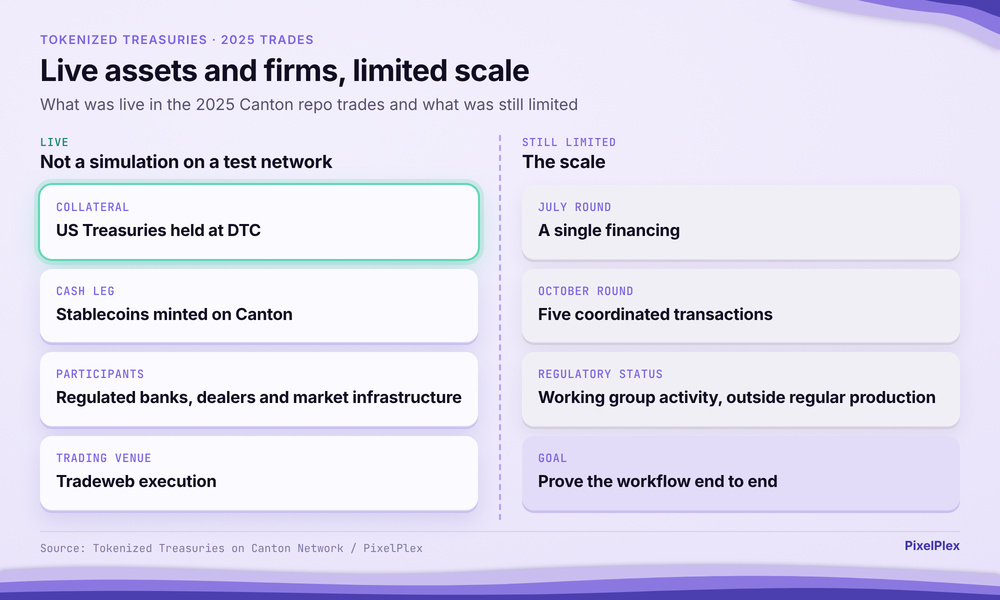
What stayed limited was the scale. The July round was a single financing, and the October round had five coordinated transactions. The goal was to prove the workflow end to end.
What was live in 2025 and what was still limited
| Element | Status in 2025 |
| Collateral | Live US Treasuries held at DTC |
| Cash leg | Live stablecoins minted on Canton |
| Participants | Regulated banks, dealers and market infrastructure |
| Trading venue | Live Tradeweb execution |
| Volume | A handful of transactions |
| Regulatory status | Working group activity, outside regular production |
How the Canton on-chain repo trade worked, step by step
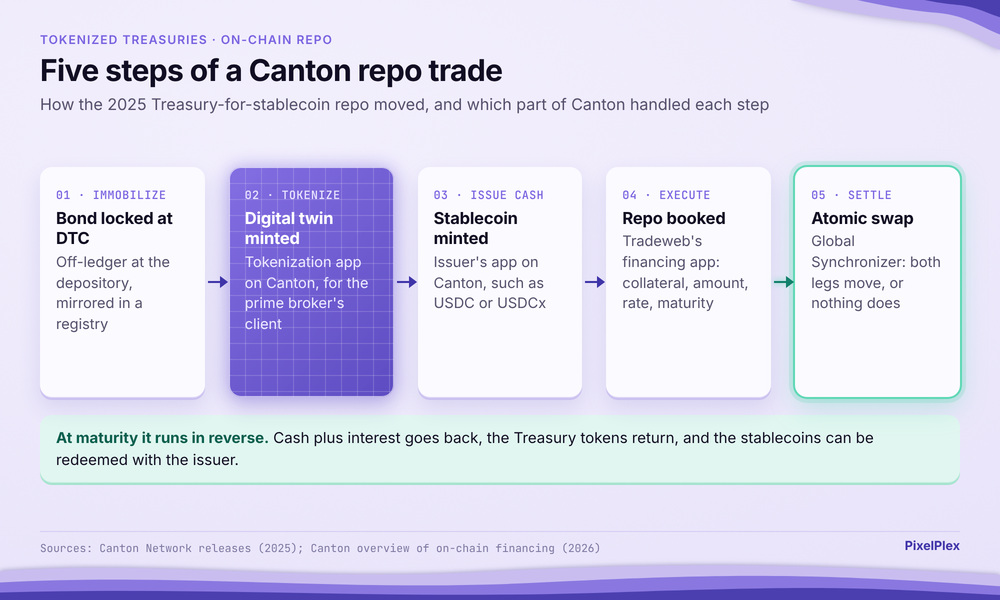
The public releases describe the trades at a high level. Combined with Canton’s own overview of on-chain financing, they show five steps, each handled by a specific application or component on the network.
Each step below is tied to the part of Canton that performs it. Where the firms did not publish a detail, we say so instead of guessing.
Five steps of the Canton repo trade
| Step | What happens | Where it happens on Canton | Who acts |
| 1. Immobilize | Treasuries are locked at the depository | Off-ledger at DTC, mirrored in a registry | Depository, prime broker |
| 2. Tokenize | A digital twin is created for the locked bonds | Tokenization app on Canton | Prime broker for its client |
| 3. Issue cash | Stablecoins are minted on Canton | Stablecoin issuer’s app | Issuer, cash lender |
| 4. Execute | Repo terms are agreed and booked | Tradeweb’s financing app | Borrower, lender |
| 5. Settle and repay | Both legs swap atomically, then reverse at maturity | Global Synchronizer | All stakeholders in the trade |
Immobilizing the securities at the depository
The process starts where the bond already lives. In the July trade, prime brokers held client Treasuries in custodied accounts at DTC, the depository arm of DTCC.
To create a token, the bond has to be locked so it cannot be sold or pledged twice. Canton’s overview states that collateral stays locked at existing custodians and depositories while its token moves on the network.
Tokenization and the digital twin in a Canton app
Once the bond is locked, a tokenization application on Canton creates its digital twin. In 2025, prime brokers enabled their clients to create these on-chain Treasuries. In 2026, DTCC launched its own Tokenization Service, which mints tokens backed one to one by securities held at DTC.
The token is a Daml contract with a clear owner and a list of parties allowed to see it. Because smart contracts on Canton enforce these rules on every action, the token cannot be moved by anyone who is not authorized in the contract.
Issuing and moving stablecoins on Canton
The cash side needs a token too. In July 2025, USDC was minted and redeemed on Canton for the trade, so both legs of the repo lived on the same network.
The October round added more options for the cash leg, and later trades used USDCx, a USDC-backed stablecoin on Canton minted through Circle’s xReserve. Each issuer runs its own app on Canton, and the lender holds the stablecoins in its own party until the trade settles.
Executing the repo in a financing app on Canton
The trade itself was booked on Tradeweb, which runs a financing application on Canton. Borrower and lender agree the terms there: the collateral, the cash amount, the rate and the maturity.
Building this kind of app is a job for Canton Network smart contract development. The repo terms and the unwind both have to be modeled as Daml workflows that several firms can act on.
Teams often design the opening leg of a repo first and leave the return for later. On Canton it pays to model both legs together, including early termination and collateral substitution. If the closing leg is an afterthought, you end up with manual steps at maturity, which is exactly what on-chain repo is supposed to remove.
Atomic exchange through the Global Synchronizer and repayment
When both sides confirm, the Global Synchronizer orders the transaction and the involved validators commit it. The Treasury token goes to the lender and the stablecoins go to the borrower in one step, or nothing moves at all.
At maturity the process runs in reverse. The borrower returns the cash plus interest, the lender returns the tokenized Treasuries, and the stablecoins can be redeemed with the issuer.
The releases did not publish the term or rate of the 2025 trades, so this part follows the standard repo design. In practice, the term is set in the financing app when the trade is booked.
Code, Capital, and Compliance: A Deep Dive into Canton Network Smart Contract Development

DAML Development for Business: A Practical Guide to Building Multi-Party Applications
Why stablecoins were the cash leg on Canton
A repo needs cash, and cash on a ledger needs a token. Stablecoins were the practical choice in 2025, because issuers could mint and redeem them on Canton on demand.
Debates about what stablecoins are usually focus on reserves and redemption. For repo, one property matters more: a dollar stablecoin can sit in the same transaction as the bond token.
That is what turns stablecoin collateral and Treasury collateral into parts of one trade. With cash on a separate payment rail, the bond could move right away while the money waited for the next payment window.
The cash leg did not stay limited to one coin. The October round used several stablecoins, which showed that the same repo app can accept stablecoin collateral from more than one issuer.
Banks have a second option for the cash leg: tokenized deposits. In 2026, Canton’s overview lists tokenized bank deposits on LSEG’s DiSH platform next to stablecoins for financing trades.
Cash leg options for repo on Canton
| Cash leg | Who issues it | How it settles | Main question for a bank |
| Stablecoin (USDC, USDCx and others) | Regulated stablecoin issuer | Same transaction as the bond token | Counterparty and redemption risk of the issuer |
| Tokenized bank deposit | Commercial bank | Same transaction, on a deposit platform | Which banks’ deposits the lender accepts |
| Off-chain cash | Payment system | Separate step, within payment hours | Timing gap between the legs |
Firms that want their own settlement token usually look at two paths. One is to build a token in-house, following stablecoin development methods for reserves and licensing. The other is to integrate tokens that already trade on Canton.
The first path takes longer and brings regulatory work, while the second gets a repo pilot running faster. Either way, the token has to support minting and redemption on demand, or the cash leg becomes the new bottleneck.
Treasury teams also ask how the stablecoin will be treated on the balance sheet. That answer depends on the issuer and the jurisdiction, so it belongs in the pilot’s legal workstream from day one.
Some banks decide to issue their own token for repo. That work usually goes to a stablecoin development company that can handle both issuance and the Canton integration.
Atomic settlement on Canton and what it removes
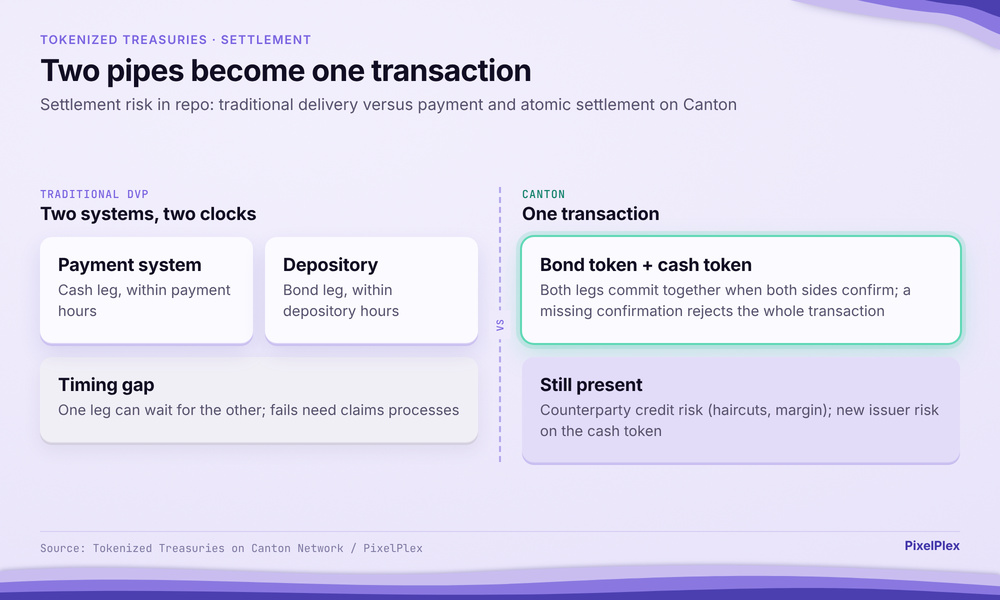
In a traditional repo, the bond and the cash move through different systems. Even with delivery versus payment, each leg depends on its own operator finishing on time.
Atomic settlement removes that gap. On Canton, the two legs are steps of one transaction, and the protocol commits both or neither.
This matters most for settlement risk, the chance that one side delivers and the other does not. On a shared distributed ledger, a lender does not end up holding a delivered bond while waiting for cash.
Atomic settlement also simplifies failure handling. If a confirmation is missing, the whole transaction is rejected, and there is no half-settled trade to unwind on Monday.
Settlement risk in repo: traditional vs Canton
| Risk | Traditional repo | Atomic settlement on Canton |
| Principal risk between legs | Present while one leg waits | Removed, both legs move together |
| Failed settlement | Fails and claims processes | Transaction rejected as a whole |
| Timing risk | Tied to cutoffs and cycles | Settles when both sides confirm |
| Counterparty credit risk | Present | Still present, managed by haircuts and margin |
| Issuer risk on the cash token | Not applicable | New risk to assess |
The last two rows matter. Atomic settlement does not make the counterparty more creditworthy, and it adds a new question about the token used for cash.
Rehypothecation on Canton: the full collateral lifecycle
Rehypothecation is when a firm reuses collateral it received to secure its own obligations. It keeps funding markets efficient, but in the traditional setup every reuse means another settlement step and another reconciliation.
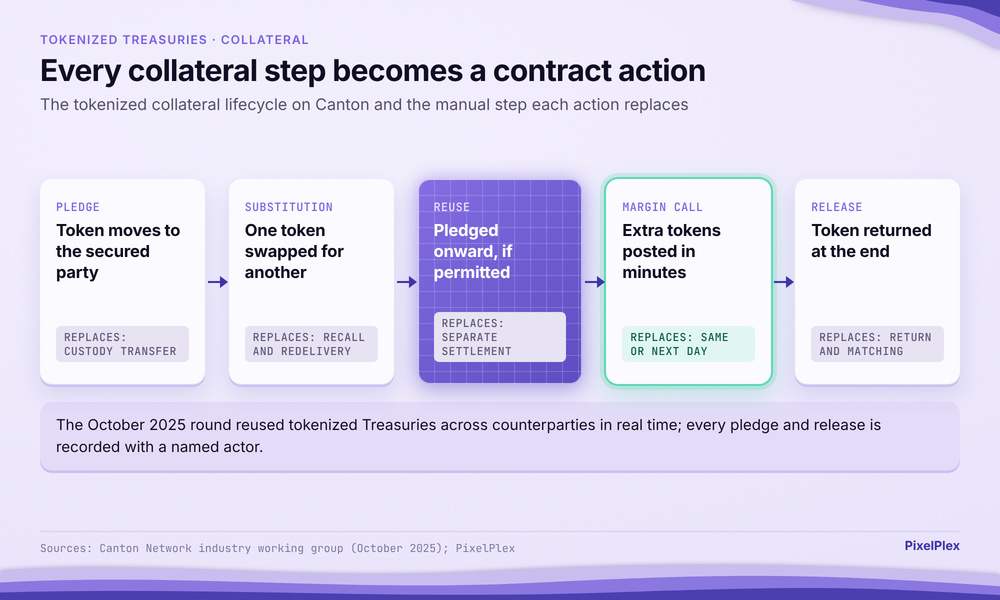
In the October 2025 round, the working group showed this on Canton. Tokenized Treasuries were reused as collateral across counterparties in real time, within one coordinated set of trades.
On Canton, reuse is a contract action. The holder of a token can pledge it onward if the original contract allows it, and the chain of rights stays visible to the parties that need it.
That gives risk teams a clearer picture of rehypothecation chains than they usually have. Every pledge and every release is recorded on the ledger with a named actor, which supports collateral mobility without losing track of who holds what.
Collateral lifecycle on Canton
| Stage | Contract action on Canton | What it replaces |
| Pledge | Token moves to the secured party under pledge terms | Transfer between custody accounts |
| Substitution | One token swapped for another of equal value | Recall and redelivery |
| Reuse | Secured party pledges the token onward, if permitted | Separate settlement and reconciliation |
| Margin call | Extra tokens posted in minutes | Same-day or next-day delivery |
| Release | Token returned when the obligation ends | Return instruction and matching |
A margin call in this model works the same way as any other step. The secured party asks for more collateral, and the pledgor can answer on a Sunday with Treasury tokens or stablecoin collateral. The same contract actions work for securities lending, where recalls and returns become ledger events.
Intraday liquidity: what 24/7 Canton settlement adds to a week
Intraday liquidity is the cash a bank needs during the day to meet payments before incoming funds arrive. It is the most time-sensitive kind of liquidity a treasury desk manages.
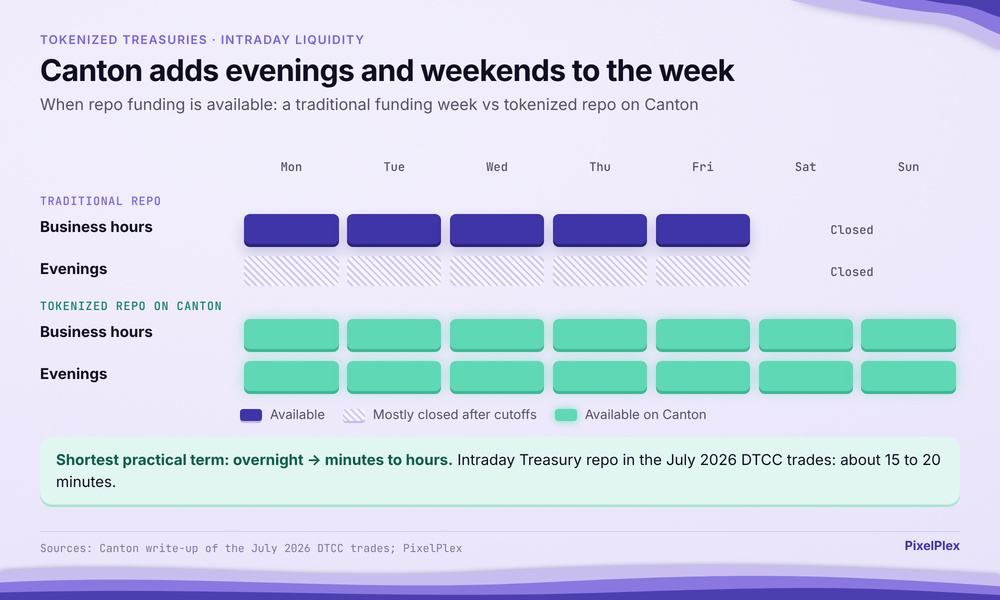
A traditional funding week has about five working days with fixed cutoffs. On Canton, the network keeps running, so evenings and weekends become usable funding time too.
Before tokenization, collateral could raise cash only while the depository and the payment system were both open. That limit shaped how long repo trades lasted and how much intraday liquidity a desk had to hold back.
In the July 2026 DTCC production trades, intraday Treasury repo ran for about 15 to 20 minutes, according to Canton’s write-up of the event. Traditional repo usually runs at least overnight.
The same write-up quotes Marex saying a firm can now run a repo for four hours or over the weekend. A treasury desk can borrow for the exact window it needs, which frees intraday liquidity for other payments.
A funding week: traditional repo vs tokenized repo on Canton
| Time window | Traditional repo | Tokenized repo on Canton |
| Weekday business hours | Available | Available |
| Weekday evenings | Mostly closed after cutoffs | Available |
| Saturday and Sunday | Closed | Available |
| Shortest practical term | Overnight | Minutes to hours |
| Margin call on a weekend | Covered by buffers set on Friday | Met with tokenized collateral |
More hours do not mean every desk will trade around the clock. The value is in having the option when a margin call or a funding gap appears at an inconvenient time.
The economics of tokenized collateral on Canton
The business case rests on cost lines every collateral desk knows, from idle buffers to funding terms. Tokenized collateral on Canton touches each of them.
Where tokenized collateral changes the cost base
| Cost line | Today | With tokenized collateral on Canton |
| Idle buffers | Sized for weekends and cutoffs | Smaller, since collateral can move any time |
| Reconciliation | Each party matches its own records | Parties read the same contract state |
| Funding term | Overnight minimum | Terms down to minutes |
| Collateral reuse | Slow, settlement step for each reuse | Contract action in real time |
| New costs | None | Token issuance, node operation, integration |
The scale is large. The US repo market alone averaged about $12.6 trillion in daily exposures in the third quarter of 2025, according to the Office of Financial Research.
The Citi and ValueExchange research mentioned above puts the cost of idle collateral at around $346 million a year for the average tier 1 firm. Even a partial cut in buffers would cover a lot of integration work.
The same research found that up to 77% of firms expect to work with some form of tokenized collateral in 2026. That expectation is what makes a shared network valuable, because tokenized collateral only helps if counterparties accept it.
There are new costs too. Banks pay for running or renting a validator node and for integrating the ledger with their books. Firms that issue their own collateral tokens also budget for tokenization platform development.
For most banks, the biggest gain is likely to come from collateral mobility. Moving the same pool of Treasuries faster lets a desk fund more activity with the same assets:
- Fewer idle buffers held for weekends
- Shorter funding terms matched to real needs
- Faster substitution when a bond is needed elsewhere
- Less manual reconciliation at the end of the day
When banks build the business case for tokenized repo, they often start with transaction fees. In our experience, the stronger number is the size of the weekend buffer. Ask the treasury desk how much collateral it parks every Friday and what that cash would earn if it could move on Saturday.

How Can Gold Tokenization Transform the Financial Industry?
Canton Network 2026’s DeFi Boom: Top Profitable Solutions to Build
How Canton privacy made the trade possible
None of the banks in the working group would have traded on a ledger where competitors could see their positions. Canton privacy in institutional finance rests on one rule: a party sees only the parts of a transaction it is entitled to see.
Technically, privacy on Canton works through views. Each transaction is split into views, and each one is encrypted for its recipients. The synchronizer that orders the messages sees encrypted data, so it cannot read the terms.
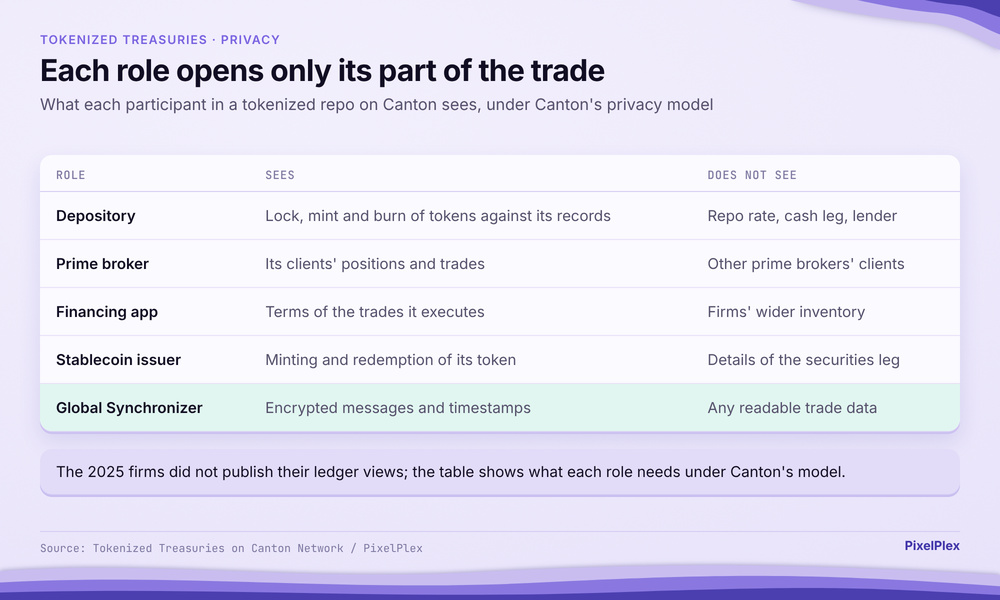
The firms did not publish their ledger views, and the official release notes that role allocations were withheld. The sections below show what each role needs to see under Canton’s model. The firms have not disclosed their actual data.
What the depository saw
The depository needs to know that a bond in its records is locked and that a token now stands for it. It also needs to see the token burned when the bond is released.
It has no reason to see the repo rate, the cash leg or the identity of the lender. On Canton, those parts of the transaction are simply not sent to its node.
What the prime broker saw
The prime broker sees its own clients’ positions and the trades it arranges for them. That includes the tokens it helped create and the repos they back.
It does not see the clients of other prime brokers, even when they trade on the same app. This was a precondition for several prime brokers joining the same network.
What the financing app saw
Tradeweb’s financing app needs the terms of the trades it executes. It sees the terms of each repo it books, including the parties.
It does not see a firm’s wider inventory or its trades on other apps. Teams that build such apps usually rely on Canton Network blockchain development expertise to set these visibility rules correctly from the start.
What each role sees in a tokenized repo on Canton
| Role | Sees | Does not see |
| Depository | Lock, mint and burn of tokens against its records | Repo rate, cash leg, lender |
| Prime broker | Its clients’ positions and trades | Other prime brokers’ clients |
| Financing app | Terms of trades it executes | Firms’ wider inventory |
| Stablecoin issuer | Minting and redemption of its token | Details of the securities leg |
| Global Synchronizer | Encrypted messages and timestamps | Any readable trade data |
What Canton Network gives that a general-purpose chain does not
Tokenized Treasury funds already trade on several public chains. Repo between banks is a different job, and the 2025 trades show why the working group picked Canton.
On a general-purpose chain, every node sees every transaction. That is fine for a fund token held by many investors and a problem for a bank’s repo book.
Canton keeps the open access of a public network while limiting data to the parties in each trade. It also connects separate apps through the Global Synchronizer, so a bond token from one issuer and a cash token from another can settle together.
Canton vs a general-purpose public chain for repo
| Requirement for bank repo | General-purpose public chain | Canton blockchain |
| Position privacy | All transactions visible | Visible only to stakeholders |
| Atomic settlement across apps | Possible within one chain, data public | Built in through the Global Synchronizer |
| Known operators | Anonymous validators | Super validators known by name |
| Contract language | General-purpose languages | Daml with explicit rights and parties |
| Fit with existing custody | Varies | Token backed by assets locked at custodians |
None of this makes a general-purpose chain useless for finance. For repo between regulated firms, the Canton blockchain removes several blockers before the first trade.
Daml is a big part of that advantage. Banks new to the language often start with Daml development support for their first workflows.

Canton Network's Next Chapter: From Infrastructure to the Application Economy

Canton Network Reward System: How Canton Coin Pays Developers to Build Real Value
Where tokenized repo on Canton stands in 2026
A year after the first trades, the picture looks different. Some parts of the 2025 workflow now run in production, and some still wait for rules or for bank systems to catch up.
Most of the progress came from market infrastructure. Depositories and trading venues moved first, and banks are following at their own pace.
Tokenized repo on Canton: status in late 2026
| Area | Status | Main development |
| Tokenized Treasuries from the depository | Live | DTCC Tokenization Service launched in October 2026 |
| Production trades | Done, limited scope | DTCC production trades in July 2026 |
| CCP acceptance | Early | CFTC pilot, CME and JSCC involvement |
| Legal framework | Improving | SEC no-action letter for DTC, US and UK laws on digital assets |
| Bank systems | Biggest gap | Integration with batch-based back offices |
What moved from pilot to regular operations
In July 2026, DTCC ran production trades with DTC-tokenized assets on Besu and Canton, with more than 30 firms taking part. The use cases included Treasury repo, securities lending, collateral pledges and CCP margin workflows.
On July 1, 2026, Tradeweb also reported a real-time trade in which Franklin Templeton transferred a tokenized Treasury to Virtu Financial against USDCx on Canton. It was an outright sale on the same rails that repo uses.
Securities lending and collateral pledges ran on those rails too. That matters for banks that fund several desks from one pool of tokenized Treasuries.
The bigger step came on October 28, 2026, when DTCC’s Tokenization Service went live with 34 securities and 20 participants, Finadium reported. Canton is one of its two launch networks, which means tokenized US Treasuries from the depository are now available as a service.
Recognition of tokenized collateral by central counterparties
Clearinghouses decide what counts as eligible margin, so their stance sets the pace for tokenized collateral. In April 2026, Japan Securities Clearing Corporation started a proof of concept with Digital Asset, Mizuho and Nomura to test Japanese government bonds as digital collateral on Canton.
At the July 2026 DTCC event, J.P. Morgan posted tokenized assets to meet a CCP margin requirement at CME Group. It was a single event, and it put a major US clearinghouse on production rails.
Regulators are moving too. In December 2025, the CFTC launched a pilot for digital assets as derivatives collateral and issued guidance on tokenized collateral such as Treasuries and money market funds.
These are early steps. Each CCP still sets its own list of eligible tokens and haircuts, so banks should plan for acceptance to grow one clearinghouse at a time.
Legal certainty
Lawyers need to know who owns a token and what happens to a pledge in insolvency. Without clear answers, a token cannot serve as collateral at scale.
In the US, DTC received an SEC no-action letter for its tokenization service. DTCC announced its partnership with Digital Asset on Canton on December 17, 2025.
The GENIUS Act, signed in July 2025, set a federal framework for payment stablecoins, which affects the cash leg. In the UK, the Property (Digital Assets etc) Act 2025 confirmed that digital assets can be personal property.
Canton’s overview also states that the working group proved legal perfection of the security interest in its trades. For a bank, that is a starting point, and its own counsel will still review each structure.
Monitoring duties stay in place as well. Many banks extend their crypto compliance solutions to cover token flows on Canton.
Whether participants’ systems are ready for real time
The ledger runs around the clock, but many bank systems still close the books once a day. A repo settled on Saturday needs to reach the general ledger and the risk engine without waiting for Monday’s batch.
This is usually the slowest part of any project. Collateral desks feel it first, because a margin call met on Sunday has to show up in Monday’s reports.
Banks connect Canton to their core systems through event streams and APIs. The blockchain integration layer often takes more effort than the Daml code.
Staffing matters as well. If collateral can move on Sunday, someone has to be able to approve it, or the bank needs clear rules for automated approvals within set limits.
How to run a tokenized repo pilot on Canton
A good pilot is small and real. It uses one asset and a short list of counterparties, and it runs on live infrastructure. Most banks follow a similar sequence.
Tokenized repo pilot plan on Canton
| Phase | Main tasks | Typical owner |
| Scope | Pick the workflow, asset and cash leg | Treasury or repo desk |
| Legal | Review token structure, pledge and insolvency | Legal and compliance |
| Connection | Choose own node, node as a service or hosted setup | IT architecture |
| Build | Daml workflows for repo, pledge and unwind | Development team |
| Integrate | Feeds to books, risk and reporting | Operations and IT |
| Run | Live trades with chosen counterparties | Business owner |
Before the first trade, the pilot team should agree on a short checklist:
- Which Treasuries will be tokenized, and through which service
- Which stablecoin or tokenized deposit will serve as the cash leg
- Which counterparties join on day one
- How margin calls and substitutions will be handled on weekends
- Which numbers will define success
Most banks bring in a partner for the token layer. An asset tokenization company can set up the registry and the digital twin while the bank’s own team focuses on the trading workflow.
The token layer is only part of the build. The repo and unwind logic still has to be written as Daml workflows and tested with every counterparty.
Testing should cover weekend scenarios, such as a margin call on Sunday or a collateral substitution late on Friday. Each scenario should run end to end with real counterparties before go-live.
A smart contract review closes the build phase. An independent Daml smart contract audit checks the repo and pledge logic before any live trade.
Pick a problem that only exists because the old system closes, such as a Friday funding gap or a Sunday margin call. A pilot that solves it gives the business a clear before-and-after story, and that story makes the case for the next phase much easier.

Canton Development and a New Vision for Blockchain in Finance: Use Cases, Features, and Cost

A Complete Guide to Crypto-Asset Reporting Framework and DAC8
How PixelPlex helps
PixelPlex is a General Partner of the Canton Foundation. We have been building software since 2007 and have delivered more than 450 projects. On Canton, our team builds and runs its own products, including CC View, an official Canton Network featured app, and the Console wallet, built natively for Canton.
For tokenized repo and collateral projects, we usually cover:
- Scoping the first workflow and mapping who sees what
- Daml workflows for repo, pledge and margin calls
- Validator setup and integration with core banking and custody systems
- Tokenization of collateral and cash tokens
Every engagement starts with the business case. We look at the size of the weekend buffer and the counterparties ready to trade before anyone writes code.
Our wider fintech blockchain development work helps when a Canton project needs to connect to payment rails or client apps. If your desk is weighing a first on-chain repo pilot, drop us a line and we will talk it through.
FAQ
Tokenized collateral is an asset represented as a token on a ledger and pledged to secure an obligation, such as a repo loan or a margin call. The underlying asset stays with a custodian while the token moves between parties.
A tokenized Treasury represents a specific US Treasury security locked at a depository. A tokenized fund represents shares in a fund that holds Treasuries, so the holder owns fund units instead of the bonds themselves.
In on-chain repo, the borrower pledges tokenized US Treasuries to the lender in exchange for cash tokens. At maturity, the cash comes back with interest and the Treasury tokens return to the borrower.
The cash leg had to live on the same ledger as the bonds for atomic settlement. Stablecoins such as USDC could be minted and redeemed on Canton, so both legs could settle in one transaction.
It orders the transaction and coordinates confirmations from the parties involved. It sees only encrypted data, so it does not learn the terms of the trade.
Yes, in limited cases so far. J.P. Morgan used tokenized assets for CCP margin at CME Group in July 2026, and wider use depends on each clearinghouse’s rules.
Yes, if the contract allows it. The October 2025 trades showed tokenized Treasuries reused as collateral across counterparties in real time.
It depends on the asset and on how many bank systems need to connect. A narrow pilot with a hosted setup moves much faster than a custom build with its own validator and full integration.