
Two agencies can read the same brief and quote $50,000 and $300,000 for it. Neither is necessarily wrong. They priced different products because the brief never said which one it wanted.
The biggest mistake you can make is asking for an estimate before deciding how your business actually moves money. Whether you’re building a digital wallet or a full neobank, choices like building your own accounting ledger versus renting one, or deciding whose banking license you rely on, completely change the engineering work required. Each of these choices is a fork: one decision that sends the whole budget down a different path. And current fintech trends like embedded finance and instant payouts keep adding new ones.
So if you want a realistic estimate of fintech app development cost, settle those forks first and talk to developers second. In this guide, we go through the financial and regulatory choices one by one and show where each of them lands on the final bill.
Fintech app development cost comes in three layers
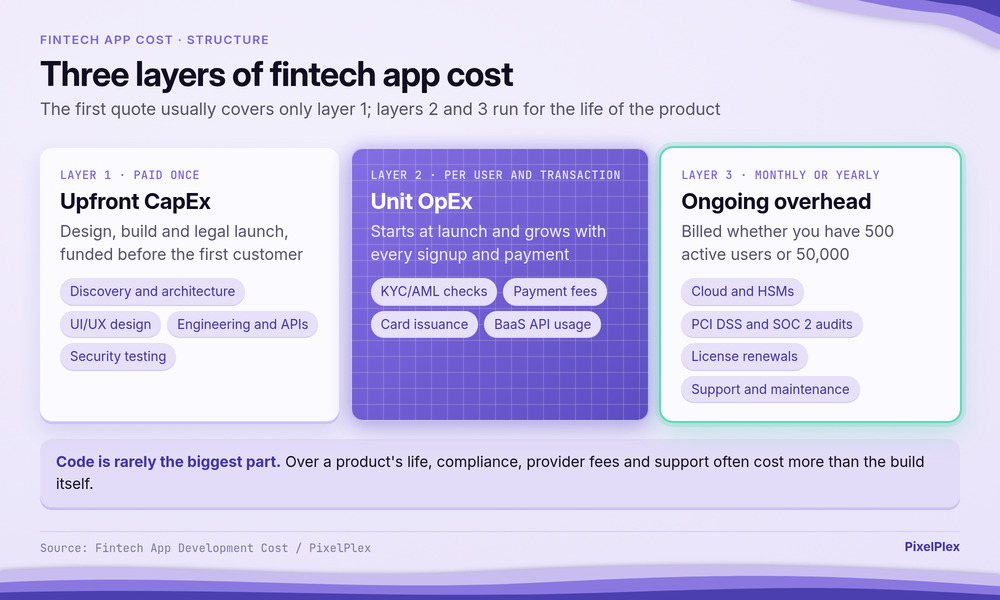
Layer 1: Upfront capital expenditure (CapEx)
This is the money you spend once, to design the product, build it, and get it legally launched. When you ask an agency about the cost to develop a fintech app, this is the number you’ll hear, and often the only one. It has to be fully funded before a single customer signs up.
What it includes:
- Discovery and solution architecture (deciding the structural forks)
- UI/UX design and prototyping
- Core software engineering and API integrations
- Initial security testing and compliance readiness
Layer 2: Operational unit economics (Unit OpEx)
This layer starts the day your fintech app goes live. Every new signup and every transaction triggers a small fee, paid to whichever vendor runs the ID check or moves the money. Nobody sends you a quote for it, either. It simply grows as your user base grows.
What it includes:
- Identity verification and KYC/AML checks (paid per check)
- Payment gateway fees (a percentage and fixed fee per transaction)
- Card issuance and processing fees (paid per physical or virtual card)
- Banking-as-a-Service API usage fees
Layer 3: Ongoing infrastructure and compliance overhead
Think of this as the cost of keeping the lights on. Keeping your fintech app secure and legally compliant after launch is billed monthly or yearly, and the bill shows up whether you ship new features or not, and whether you have 500 active users or 50,000.
What it includes:
- Cloud hosting and secure infrastructure (AWS, GCP, hardware security modules)
- Annual regulatory audits (PCI DSS, SOC 2)
- Mandatory license renewals and legal reporting
- Ongoing technical support and code maintenance
How app category sets your baseline budget
The single biggest predictor of the cost to develop a fintech app is what it does with money. Every fintech product falls somewhere on this scale:
- Read money: Personal finance trackers and similar apps only show data. Nothing actually moves, so the compliance load is light and there’s no customer money to lose.
- Move money: Digital wallets and money transfer apps send funds from one account to another. Once money moves, you need payment integrations and fraud controls, and card data brings PCI DSS into the picture.
- Hold and manage money: Neobanks and lending platforms keep customer funds or lend money out. Regulators watch these products closely, the accounting gets complicated, and mistakes are very expensive.
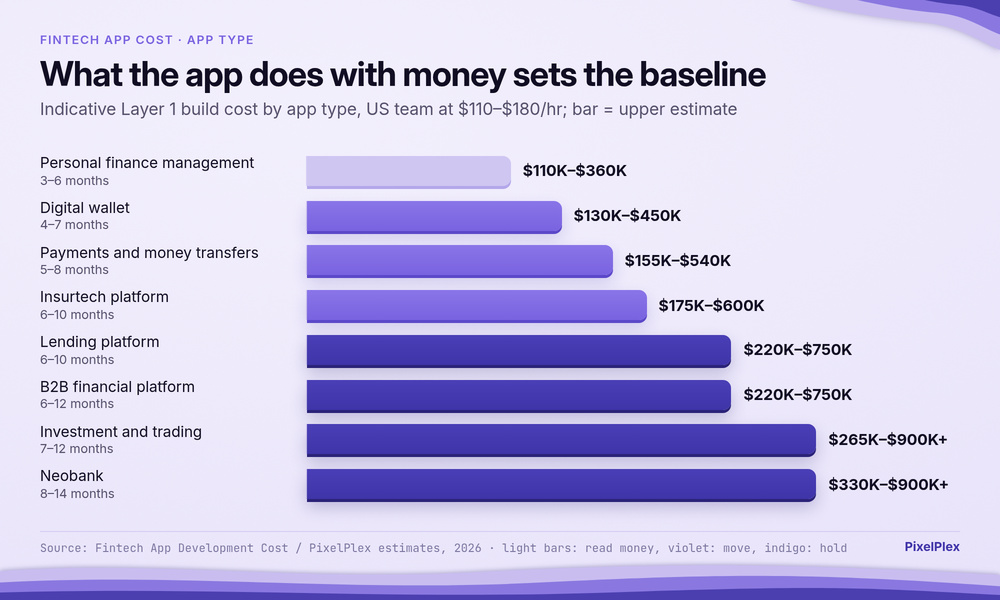
Understanding how to build a fintech banking app starts with placing it on this scale. The ranges below represent Layer 1 CapEx only: code construction by a US-based team at a blended $110–$180/hr, the same basis as the feature breakdown that follows. A nearshore or offshore team typically builds the same scope for half to two-thirds of that.
Eight archetypes and their baselines
| App type | Indicative build cost | Delivery timeline | Complexity |
| Personal finance management (PFM) | $110,000–$360,000 | 3–6 months | Low to medium |
| Digital wallet | $130,000–$450,000 | 4–7 months | Medium |
| Payments and money transfers | $155,000–$540,000 | 5–8 months | Medium to high |
| Insurtech platform | $175,000–$600,000 | 6–10 months | High |
| Lending platform | $220,000–$750,000 | 6–10 months | High |
| B2B financial platform | $220,000–$750,000 | 6–12 months | High |
| Investment and trading | $265,000–$900,000+ | 7–12 months | Very high |
| Neobank | $330,000–$900,000+ | 8–14 months | Very high |
Note: Quotes near the $50,000 end almost always assume an offshore team and an MVP scope, which is why they look so different from the ranges above.

Building Strategic Value with Blockchain FinTech App Development

How to Develop a Peer-to-Peer Lending Application: PixelPlex’s Detailed Guide
Where the engineering hours go
To understand where fintech app development cost actually goes, look at the app module by module. The most reliable way to measure a feature’s complexity is by the engineering hours it takes to build it securely.
The costs below use the same $110–$180/hr US rate as the table above. The hours, however, stay the same wherever your team sits – they reflect the true architectural weight of each component.
Feature-by-feature cost breakdown
| Core feature | Est. hours | Indicative cost | What drives the cost up |
| Authentication and onboarding | 200–400 | $22,000–$72,000 | Multi-factor auth, biometric login, device binding, session security, onboarding UI/UX design |
| KYC/KYB verification | 150–350 | $17,000–$63,000 | Number of document types and countries, KYB depth, manual review flows |
| Ledger and balance management | 400–900 | $44,000–$162,000 | Double-entry integrity, multi-currency, reconciliation, audit trail |
| Payments and transfers | 300–700 | $33,000–$126,000 | Number of payment rails, idempotency, failure and retry handling |
| Card issuance | 250–600 | $28,000–$108,000 | Virtual vs physical, processor integration, card lifecycle controls |
| P2P transfers | 150–350 | $17,000–$63,000 | Contact matching, instant settlement, fraud checks on each send |
| Limits and rules | 150–300 | $17,000–$54,000 | Configurable per-user and per-product limits, velocity rules |
| Risk engine and AML monitoring | 300–800 | $33,000–$144,000 | Rule sophistication, ML scoring, case management, alert tuning |
| Notifications | 80–200 | $9,000–$36,000 | Channels (push, SMS, email), transactional reliability |
| Analytics and reporting | 200–450 | $22,000–$81,000 | Regulatory reports, real-time dashboards, export formats |
| Support tooling and admin | 150–400 | $17,000–$72,000 | Internal back office, role permissions, dispute handling |
Two modules dominate this budget: the ledger and the risk engine. Together they account for $77,000–$306,000 of a US build, about 30% of the cost of the full feature set. Both are cheap to build badly, expensive to build right, and nearly impossible to replace once real money flows through them.
That’s why buying often beats building here: purpose-built transaction monitoring software is usually cheaper to adopt than to write, and machine learning for fraud detection cuts the manual reviews that otherwise grow with every user.
The hidden financial risks of early architecture choices
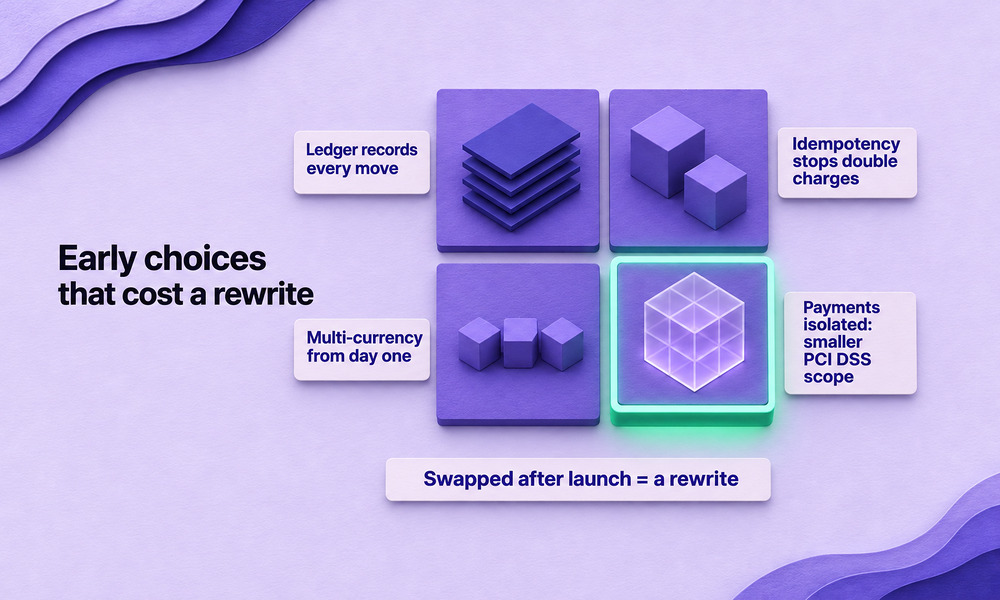
Building vs. buying your core ledger
If a standard app glitches, a screen freezes; if a custom ledger glitches, real customer money disappears. The ledger tracks exactly who owns what. Building your own saves monthly software fees, but programming flawless double-entry accounting carries enormous risk. When BaaS provider Synapse went bankrupt in 2024, its records of customer funds didn’t match what its partner banks actually held, leaving a $60–$90 million shortfall. The business choice is direct: pay a recurring fee for a battle-tested ledger, or accept the risk of building your own.
Preventing double charges on dropped connections
In fintech mobile app development, a dropped connection can charge your customer twice if the server doesn’t actively block duplicate requests. When a network drops mid-transfer, the phone automatically retries the payment. Without a built-in safeguard (known as idempotency), the system processes both. Tagging every transaction with a unique ID on day one takes almost no engineering time. Skipping it to launch faster sets you up for double charges, manual refunds, and angry customers disputing payments.
Planning the database for multiple currencies
Startups naturally build their database around a single currency at launch. However, adding euros or pesos to a system hardcoded for a single currency means tearing out and rebuilding the foundation of your fee, balance, and reporting logic. Teams that anticipate international expansion often design the database for multiple currencies from the beginning, simply to avoid a massive rewrite later, even if the extra currencies stay switched off at launch.
Separating payments from the rest of the code
PCI DSS auditors look at every system that stores, processes, or transmits card data. So if card handling is spread all over your fintech app, guess what gets audited? All of it. During an MVP build, it’s tempting to let payment code sit right next to things like user profiles. Nobody notices until the compliance review, and by then it’s expensive. Spending a little more upfront to keep payments in their own isolated module means future audits only cover that one component. A well-structured mobile app backend architecture builds in this separation from the start.
Security as its own budget line
A lot of founders assume that if they hire good engineers, the fintech app will be secure by default. So “security” ends up folded into general development hours, with no line of its own. In fintech, though, much of security is something you pay outsiders for, such as independent security audits or dedicated key management.
The trouble with costs that have no budget line is that nobody sees them. When deadlines slip, they’re the first things to get pushed back, quietly. Then launch week arrives, and the sponsor bank asks for independent security test results before it will approve your fintech app. That’s usually when the missing line item becomes very visible.
The math behind a separate security budget is pretty simple. According to IBM’s 2026 study, the average breach in financial services costs $6.3 million, and only 37% of breached organizations had encrypted sensitive data both at rest and in transit. A penetration test, by contrast, typically runs $10,000–$20,000 for two products. As insurance goes, that’s cheap. Payment tokenization is worth a look too. If raw card numbers never reach your servers, there’s less to steal, and your PCI DSS scope gets smaller.
The regulatory fork: How compliance models dictate your budget
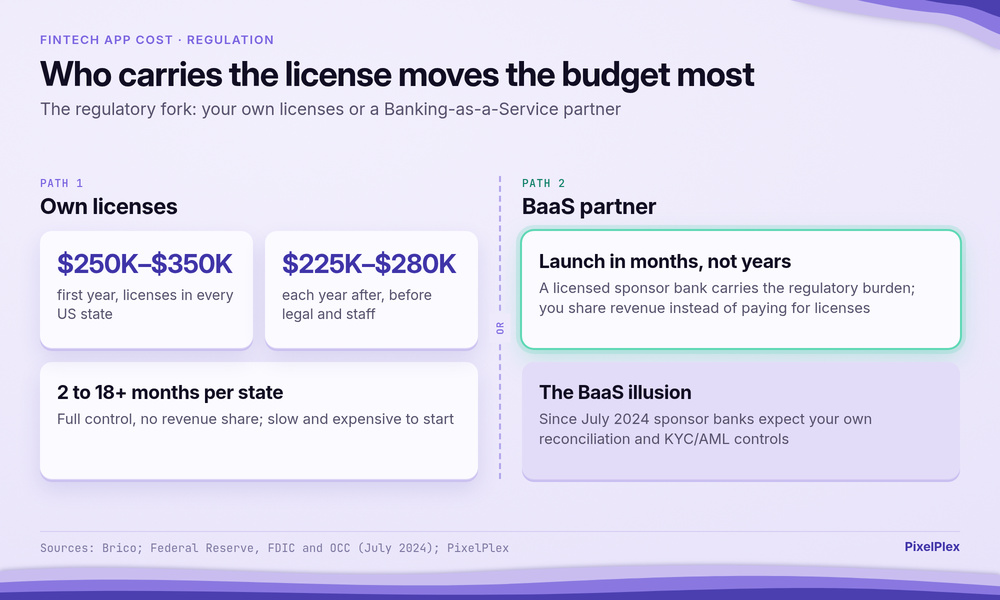
You can build a flawless fintech app, but it can’t legally process a single dollar without regulatory authorization. This creates the regulatory fork – the business decision that moves fintech app development cost more than any other: who carries the legal burden of your product. You have two choices, and each radically changes your timeline and budget:
- Acquiring your own licenses: You apply for the authorizations yourself, such as US money transmitter licenses. In return, you fully control your fintech app and keep the revenue a partner would otherwise take a cut of. The downside is a high cost that doesn’t stop after year one. Licensing in every US state runs roughly $250,000–$350,000 in the first year and $225,000–$280,000 each year after that, not counting legal and staff costs. Approvals take time as well: anywhere from 2 to 18+ months per state.
- Using a Banking-as-a-Service (BaaS) partner: Here, a licensed sponsor bank carries the regulatory burden, and you focus on building the fintech app. You can launch in months instead of years, and instead of paying for licenses upfront, you share revenue with the bank. What you give up is independence. If the bank changes its compliance rules, has an outage, or rewrites its terms, that becomes your problem too.
For most MVP launches, BaaS is the rational starting point, and it’s the model behind most embedded finance products. However, don’t fall for the BaaS illusion – the belief that the partner handles all compliance. After the Federal Reserve, FDIC, and OCC jointly warned banks about third-party risks in July 2024, sponsor banks sharply tightened their due diligence. Today, they increasingly expect you to show your own reconciliation and KYC/AML controls before you launch. BaaS removes the licensing cost, but it no longer removes the engineering work of building compliance software.
The baseline cost of compliance
Founders often mistake compliance for a single, flat fee. In reality, it’s a series of separate “taxes” triggered by specific features of your fintech app. The moment you add a new capability, such as storing cards or onboarding business customers, you trigger a new layer of mandatory engineering and external audit fees.
The table below breaks down these isolated requirements.
Compliance costs by regulatory standard
| Standard | What it requires | Indicative implementation and audit cost | When it applies |
| PCI DSS (v.4.0.1) | Protection of cardholder data across 12 requirements | Up to $40,000 for a QSA-assisted self-assessment; $30,000–$200,000 for a full Report on Compliance |
When you store, process, or transmit card data |
| KYC/AML | Customer identification, due diligence including beneficial owners, sanctions screening, transaction monitoring | $30,000–$150,000 to build the program, plus per-check verification fees | When you move money; required by bank partners |
| SOC 2 | Controls tested against the AICPA Trust Services Criteria | Type 1 around $15,000–$40,000; Type 2 around $30,000–$80,000+, readiness included |
When selling to enterprises or passing bank due diligence (financial services buyers usually expect Type 2) |
| PSD2/SCA and open banking | Strong Customer Authentication and secure account access | $20,000–$80,000 for SCA and 3-D Secure implementation | For payment services in the EU |
| GDPR | Lawful processing, data minimization, data subject rights, breach notification | $10,000–$60,000 for data mapping, documentation, and controls | Whenever you process personal data of people in the EU |
| Financial licensing | Authorization, capital requirements, and ongoing reporting | Own licenses in every US state: $250,000–$350,000 in year one, $225,000–$280,000 a year after; BaaS replaces this with fees |
When you hold funds or issue payment instruments in your own name |
You don’t need to cut features to lower compliance costs. Often, it’s enough to keep sensitive data off your own servers. Tokenize card payments so the numbers never pass through your infrastructure, and a PCI DSS audit that could cost up to $200,000 a year shrinks to a routine self-assessment. RegTech solutions do something similar for onboarding, swapping custom identity code for a simple fee per check. And if you touch digital assets, dedicated crypto compliance solutions step in to screen the wallets that standard tools miss.
Smarter architecture saves money, but cutting corners on compliance is an expensive gamble. Look at Block: in 2025, Cash App’s parent company paid $80 million to 48 state regulators and another $40 million to New York’s financial regulator over AML failures. Against numbers like that, setting up anti-money laundering automation on day one is a small price to pay. You can outsource data storage, but you can’t outsource regulatory risk.

What Are the Seven Use Cases of Machine Learning in FinTech?
Navigating open banking and PSD3 uncertainty
Your compliance budget can’t be set in stone. The legal standards for how apps connect to bank accounts are changing in both the US and the EU, which leaves teams building on uncertain ground.
In the US, the CFPB rolled out its Section 1033 open banking rule in 2024. Then a federal court put the deadlines on hold in October 2025, and the CFPB is now reconsidering the rule. Europe is in the middle of its own shift. Teams still follow PSD2 today, but lawmakers reached a provisional deal on PSD3 and the Payment Services Regulation in late 2025. Once those take effect, you’ll have to spend real development hours updating your bank connections to match the new rules.
This uncertainty affects your engineering choices today. In the EU, PSD2 already requires secure account access, so that cost is fixed. In the US, with no binding mandate right now, it’s temporarily off the table. But the final rules will come on both sides of the Atlantic. Any architecture that depends on accessing bank data or authenticating customers should be built to adapt. Hardcoding your fintech app to today’s temporary rules is a reliable way to buy yourself an expensive rewrite later.

MiCA Regulation Explained: New Framework for Regulating Crypto Assets
Integrations: Where development CapEx becomes OpEx
Third-party APIs are usually the fastest part of a fintech build to integrate, which gives many founders a false sense of how cheap they are. This is where fintech app development cost stops being a one-time number: the real cost is the fee you agree to pay on every user and every transaction for as long as your fintech app runs.
To make those fees concrete, we’ll use Stripe’s published US list prices as of October 2026. Each category charges differently, and the pricing structure matters as much as the headline rate:
Ongoing integration costs: Stripe example
| Provider category | Stripe product | How it charges | Impact on unit economics |
| Identity verification | Stripe Identity | $1.50 per ID and selfie check; $0.50 per US SSN lookup |
A fixed cost for every user you onboard. Only completed checks are billed, so users who abandon the flow cost nothing |
| Bank data | Financial Connections | $1.50 per account verification; $0.10 per balance check; $0.30 per connected bank per user per month for a transactions feed |
Monthly fees keep running for every connected account, active or not |
| Payments | Stripe Payments | 2.9% + 30¢ per US card payment; ACH at 0.8%, capped at $5 |
The fixed 30¢ makes small payments disproportionately expensive |
| Card issuing | Stripe Issuing | $0.10 per virtual card; $3.50 per physical card; $15 per dispute |
Physical cards cost 35 times more than virtual ones, though a share of interchange revenue can offset part of the cost |
| Fraud screening | Stripe Radar | From $0.05 per screened transaction, or from $10 per month; basic card fraud protection is included with payments |
Grows with transaction volume, not user count |
Here’s what those prices mean for a single US user who verifies their identity, links a bank account, and gets a virtual card:
- ID and selfie verification: $1.50
- SSN lookup: $0.50
- Bank account verification: $1.50
- Virtual card issuance: $0.10
Total: $3.60 per user.
With a physical card instead of a virtual one, that jumps to $7.00. It doesn’t sound like much until you scale it. At 100,000 users, you’ve paid $360,000 in API fees just to open accounts, and nobody has made a transaction or brought in a cent of revenue yet. Newer ideas like KYC on blockchain try to lower this by letting a user reuse one verified identity, so every new app doesn’t have to check them from scratch.
The micro-transaction trap and zombie subscriptions
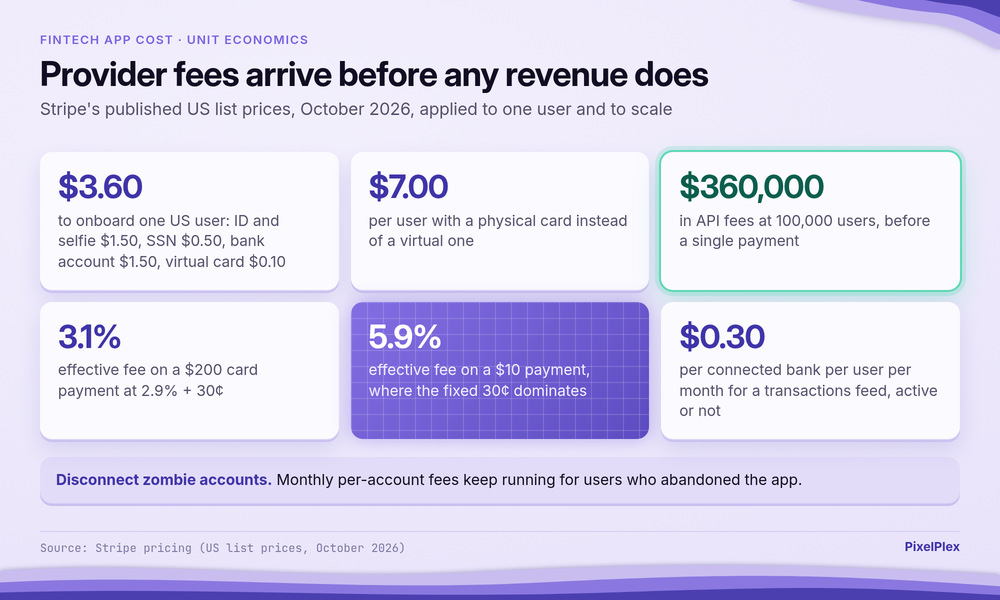
At 2.9% + 30¢, a $200 card payment carries an effective fee of about 3.1%. A $10 payment carries 5.9%, because the fixed 30¢ dominates the math. A fintech app built around small transactions, like a digital wallet for everyday payments, starts with its unit economics under pressure.
Subscription pricing has its own trap. Stripe charges $0.30 per connected bank, per user, every month for a transactions feed, and other bank data providers, including Plaid, also price some products as a monthly fee per connected account. If you don’t disconnect users who have abandoned your fintech app, you keep paying for these zombie accounts, quietly draining your operating budget.

Crypto Payment Gateway: Costs, Benefits, Implementation

Introduction to Stablecoins. Use Cases and Examples
Team, rates, and project stages
With scope, compliance, and integrations defined, the remaining question is how the work is organized and what the team costs.
Rates by region and role
Once the regulatory model is settled, the next biggest lever on fintech app development cost is where your team sits. The US and the main outsourcing regions are measured differently, though, so they’re shown separately.
In the US, most fintech teams are in-house or onshore, so the clearest benchmark is what an employee actually costs. For outsourcing regions, the benchmark is what a delivery firm charges per hour.
US in-house costs by role
| Role | Median salary | Hourly wage | Employer cost per hour |
| Software developer | $135,980 | $65/hr | $95/hr |
| Network architect | $134,050 | $64/hr | $94/hr |
| Information security analyst | $129,180 | $62/hr | $91/hr |
| QA analyst or tester | $104,300 | $50/hr | $73/hr |
| Project manager | $102,320 | $49/hr | $72/hr |
| Compliance officer | $80,730 | $39/hr | $57/hr |
Source: U.S. Bureau of Labor Statistics, 2025–2026
Agency rates sit above these figures because a delivery firm also covers management, unbilled time, and margin. Even before any of that, a median US developer already costs an employer around $95 an hour.
Outsourcing rates by region
| Region | Junior developer | Senior developer | Change vs. prior year |
| Latin America | $33–$45/hr | $60–$75/hr | −7.1% |
| Central & Eastern Europe | $31–$39/hr | $64–$76/hr | −4.4% |
| South & Southeast Asia | $24–$31/hr | $31–$41/hr | ≈ −8% |
Source: Accelerance 2026 Global Software Development Rates & Trends Guide
In-house vs. outsourcing: The hybrid baseline
One common budgeting mistake is comparing an agency’s hourly rate with an employee’s salary as if they were the same thing. They aren’t. A $100,000 salary works out to about $48 an hour on paper, but add benefits and the business is really paying around $70. So the in-house versus outsourcing question is less about rates and more about how you want to spend your capital and your time:
- In-house teams: You get the most control, and the knowledge stays inside the company. On the other hand, hiring strong engineers takes months, and once they’re on payroll, you pay them whether or not there’s enough work for everyone.
- Outsourced teams: An agency gets you to market faster and keeps your spending flexible. You get specialists right away, from ledger engineers to UI/UX design teams who know how regulated onboarding works, and you can grow or shrink the team between phases. The price is that you hand over some of the day-to-day control.
Plenty of fintech startups end up somewhere in the middle, with a hybrid model. A small in-house core, often just a product owner and a chief architect, sets the direction and keeps hold of the intellectual property, while an external fintech team supplies the delivery capacity. Offshore software development can lower labor costs a lot, as long as the partner has real fintech experience.
How the budget splits across stages
A fintech app development project is far more than core engineering. Budget allocation follows a predictable curve across the build, with specific drivers controlling the timeline at each phase:
Fintech build budget split by stage
| Stage | Share of build budget | What drives the timeline |
| Discovery | 5–10% | Clarity of the business model, regulatory scoping, number of stakeholders |
| UI/UX design | 8–12% | Number of screens, onboarding complexity, accessibility requirements |
| Architecture | 5–8% | Build-vs-buy decisions, multi-currency, scaling and audit requirements |
| Core development | 40–45% | Feature scope, ledger complexity, number of payment flows |
| Integrations | 10–15% | Number of third-party providers and their documentation quality |
| QA and security | 12–18% | Test coverage, penetration testing, regulatory testing |
| Release | 3–5% | App store review, production readiness, partner sign-off |
| Post-launch support | 15–20% of build, annually | Ongoing maintenance, updates, and monitoring after release |
Discovery is usually the first thing founders cut to save money, and it almost never actually saves any. This is the stage where the forks get decided. If you skip it, those decisions still have to be made, only now they happen mid-development, where changing your mind means rewriting code rather than editing a document. Good UI/UX design pays off for a different reason. In fintech mobile app development, onboarding is where you spend money on verification, and it’s also where users decide whether they’re staying.
Let’s look at a typical US startup launching through a BaaS partner, with KYC/AML onboarding, P2P money transfers, virtual cards, and basic risk monitoring. Built by a US team at $110–$180/hr, it costs roughly $420,000–$1,080,000, split across three buckets.
1. Features: about 55% of the bill
- Onboarding, authentication, and KYC: $38,000–$99,000
- Ledger and balances: $44,000–$108,000
- Payments and P2P transfers: $50,000–$126,000
- Virtual card issuing: $28,000–$63,000
- Risk, limits, and AML monitoring: $50,000–$117,000
- Notifications and admin panel: $25,000–$67,000
Subtotal: $235,000–$580,000
2. Delivery work: about 40% of the bill
- Discovery and architecture: $57,000–$142,000
- UI/UX design: $41,000–$101,000
- QA and security testing: $62,000–$153,000
- Release and DevOps: $16,000–$41,000
Subtotal: $176,000–$437,000
3. External checks: the last few percent
- Penetration test (web and mobile): $10,000–$20,000
- QSA-assisted PCI DSS self-assessment: up to $40,000
Subtotal: $10,000–$60,000

The Intelligent Bank: Moving Beyond Automation to Strategic AI
Scoping your build: MVP vs. full-scale product
In fintech, an MVP is the smallest version of your fintech app that can handle real money safely and solve one specific financial problem for real users. The point is to spend as little as possible while you prove there’s demand, before you commit hundreds of thousands of dollars to a full platform. If MVP development in fintech has one rule, it’s this: you can cut features, but you can’t cut controls.
What goes into a fintech app MVP
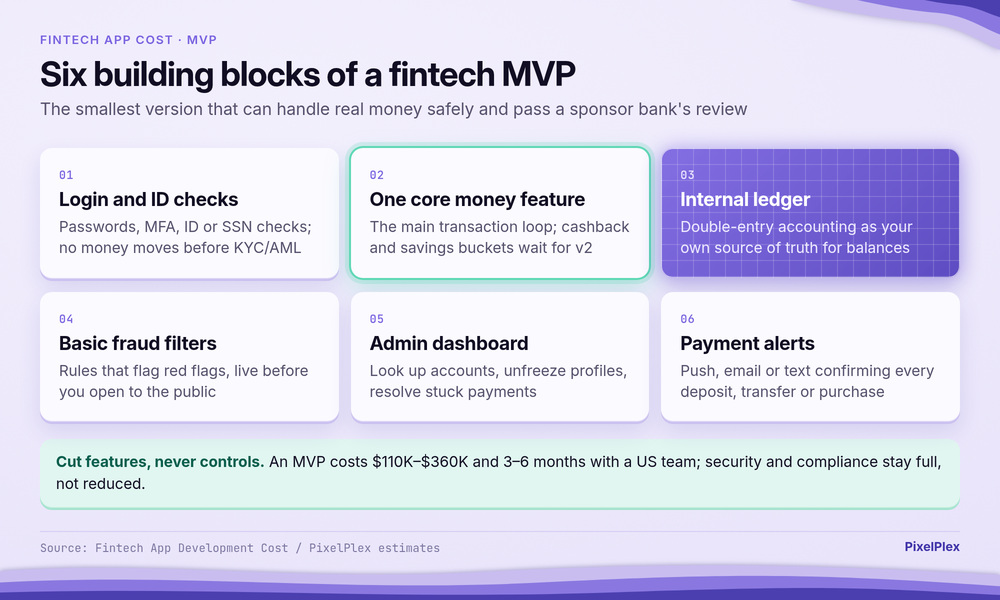
To launch legally and get sign-off from your bank partner, your MVP must focus on six practical building blocks:
- User login and ID checks: The onboarding screens that handle passwords, multi-factor authentication, and ID or SSN checks. You can’t legally process a single dollar until the user passes the KYC/AML checks your sponsor bank and regulators require.
- Your one core money feature: The main transaction loop your fintech app was built for. Secondary features like cashback rewards, savings buckets, or bill splitting can easily wait for version two.
- The internal accounting system: A double-entry ledger that tracks account balances and logs every deposit and withdrawal. Relying on external bank APIs for real-time balances is a recipe for math errors and overdrafts; your fintech app needs its own reliable source of truth.
- Basic fraud filters: Automated rules that flag suspicious behavior, such as a brand-new account attempting a $20,000 transfer at 2:00 AM. Sponsor banks expect these red flags to be live before you open to the public.
- An internal admin dashboard: A basic back office that lets your operations team look up accounts, unfreeze locked profiles, and resolve stuck payments without asking developers to run custom database queries.
- Payment alerts: Push notifications, emails, or texts confirming every deposit, transfer, or purchase. Trust in fintech is fragile, and instant confirmation reassures users that their money is safe.
Why compare MVP to a full-scale product?
Founders often mistake an MVP for a “cheaper version” of the final product, when in reality it’s a different operational model.
An MVP trades automated software features for temporary manual work. You accept manual reporting, manual fraud reviews, and more customer support effort in exchange for a lower upfront CapEx and a 3-to-6-month launch timeline. A partner experienced in MVP development will push the scope toward this core rather than away from it. Comparing both endpoints clarifies the capital you need to reach initial traction versus what you’ll need to scale:
MVP vs. full-scale fintech product comparison
| Dimension | Minimum viable product | Full enterprise product | Deferred risks and trade-offs |
| Scope | One core money flow, one user type | Multiple products on a shared ledger | The architecture must allow extension without a rewrite |
| Indicative cost (US team) | $110,000–$360,000 | $330,000–$900,000+ | Each later feature costs more if the base wasn’t designed for it |
| Timeline | 3–6 months | 8–14 months | Faster validation, though competitors have time to catch up |
| Currencies | One | Multi-currency | Adding currencies later is costly if the data model ignores them |
| Regulatory model | Usually a BaaS partner | BaaS or own license | Partner dependency and revenue share until you license |
| Risk and fraud | Rule-based monitoring | ML scoring, case management | Manual review workload grows with every user |
| Reporting | Core regulatory and operational reports | Full analytics and regulatory suite | Manual reporting effort until it’s automated |
| Security and compliance | Full, not reduced | Full | None: this is never deferred |
After launch: The costs that keep running
Many teams treat a fintech app’s launch day as the finish line for major spending. In fintech, launch is simply where development CapEx turns into recurring operational expense.
The costs that don’t stop at launch
| Expense category | Frequency | Indicative annual cost |
| Cloud infrastructure | Monthly | $24,000–$120,000, scaling with users and transaction volume |
| Transaction and provider fees | Per transaction and per user | Scales directly with volume; often the largest recurring cost at scale |
| SOC 2 recertification | Annual | $20,000–$50,000, depending on scope and assessment type |
| License maintenance and reporting | Annual and ongoing | Varies widely by jurisdiction and license type; none under BaaS |
| Tier-2 and tier-3 support | Ongoing | $40,000–$150,000 depending on user base and complexity |
| Compliance updates | Ongoing | $20,000–$80,000 as regulations change |
| Maintenance and updates | Ongoing | Typically 15–20% of the initial build cost each year |
The line item that surprises founders most is compliance updates. Remember the open banking and PSD3 changes we covered earlier? Once those rules are final, your live code will have to change too. It’s far safer to budget for that every year than to treat it as an emergency when it happens.

Fintech’s New Brain: Why Machine Learning is the Real Reason Your Bank Suddenly Understands You
Why initial budgets grow 1.5x
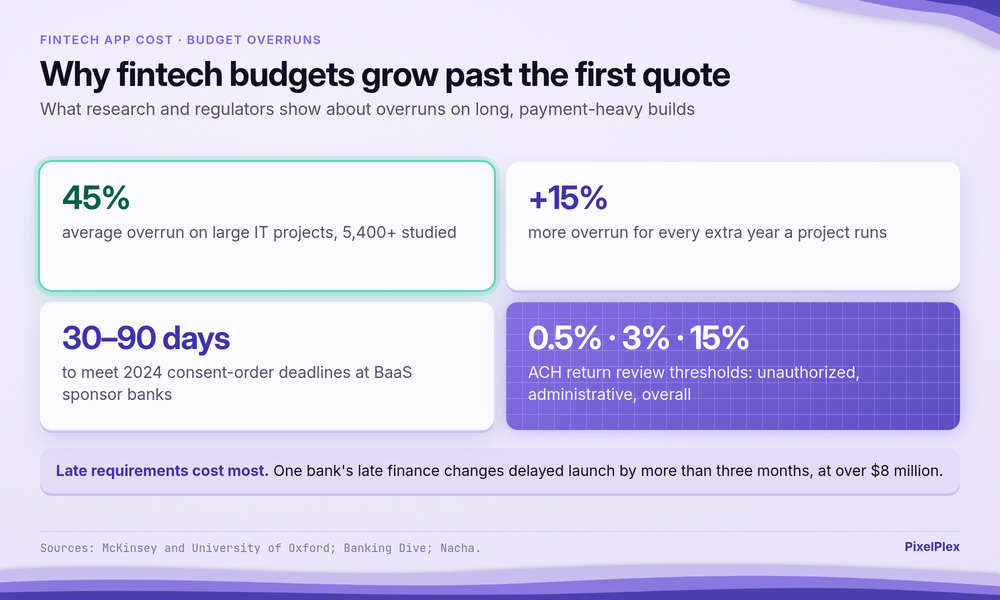
Fintech app development cost grows when decisions left open at the start get settled mid-build, which is exactly when they cost the most to change. Research by McKinsey and the University of Oxford across more than 5,400 IT projects found that large ones run 45% over budget on average, with software projects at the highest risk. Fintech adds four pressures of its own:
- Long timelines let scope drift. The same research found that every additional year a project runs increases its cost overrun by 15%. Fintech builds are long by nature, and an own-license path adds state approvals that can take 18 months or more. The longer the build, the more time requirements have to change underneath it.
- The bank partner changes the rules mid-build. In 2024, regulators issued a wave of consent orders against BaaS sponsor banks, with compliance deadlines that typically ran 30–90 days. Banks passed those new obligations straight down to their fintech partners, and some dropped fintech partners altogether, forcing them into an unplanned migration to a new bank.
- Payments fail more often than estimates assume. A successful payment follows one path, while a failed one can follow many: returns, disputes, partial refunds, reversals. The ACH network itself treats some level of returns as unavoidable and runs a full system for handling them, with review thresholds of 0.5% for unauthorized returns, 3% for administrative returns, and 15% for returns overall. Estimates built around the successful flow leave this work out.
- Late requirements are the most expensive ones. A requirement found just before launch has to be retrofitted into code that was built without it. McKinsey describes a bank whose finance team joined only months before go-live, and the resulting changes delayed launch by more than three months at a cost of over $8 million. In fintech, the bank’s due diligence, the compliance review, and the penetration test all tend to arrive late.

The 6 Leading Digital Transformation Trends in Financial Services
Cutting build costs without creating regulatory debt
Cutting the cost to develop a fintech app comes down to a simple test: Does this decision permanently reduce engineering scope, or does it merely create hidden regulatory debt you’ll pay for later?
Tactics that save money safely
| Cost reduction tactic | Estimated savings | Associated risk or trade-off |
| Use a BaaS partner instead of your own license | Removes most upfront licensing cost | Partner dependency, revenue share, and exposure to partner terms |
| Tokenize card data to shrink PCI DSS scope | Substantially lower PCI audit cost | Reliance on the processor and some vendor lock-in |
| Buy the ledger instead of building it | 30–50% of ledger build cost | Less flexibility; recurring license fee |
| Phase features across releases | 30–40% of v1 cost | Rework risk if the architecture isn’t designed for extension |
| Use nearshore or offshore delivery | Half to two-thirds of labor cost | Coordination overhead; requires strong product ownership |
| Use provider-hosted KYC and payment screens | 20–40% of onboarding build | Less control over UI/UX design and conversion |
| Adopt managed cloud services | Lower DevOps staffing cost | Higher unit cost at large scale |
Every tactic in the table reduces how much you build. None of them weakens how the money is protected, and that’s the line to hold. The cuts below look like savings on a spreadsheet, but each one creates regulatory debt that comes due later, usually at a far higher price:
- Handling raw card data instead of tokenizing it. As the compliance section showed, it turns a small self-assessment into a full PCI DSS audit costing up to $200,000 a year.
- Launching before KYC/AML monitoring is ready. Regulators don’t treat “we’ll add it later” as a plan, and Block’s $120 million in 2025 penalties shows what that costs.
- Running a ledger without reconciliation. When your records and your bank partner’s drift apart, customer money goes missing on paper, the same gap that surfaced at Synapse.
- Skipping the penetration test to hit a launch date. One breach in financial services averages $6.3 million, many times the cost of the test.
- Leaving out audit logs. When a bank partner or regulator asks who changed what and when, logs are the only answer, and they can’t be recreated after the fact.

What Is RegTech? Key Types and Benefits of RegTech Solutions
How to choose the right fintech app development company
A low estimate isn’t always a good deal. Often, it just means compliance and bank integrations were left out of the scope. When comparing fintech app development companies, look for the team that brings these requirements up first, even if its number is higher.
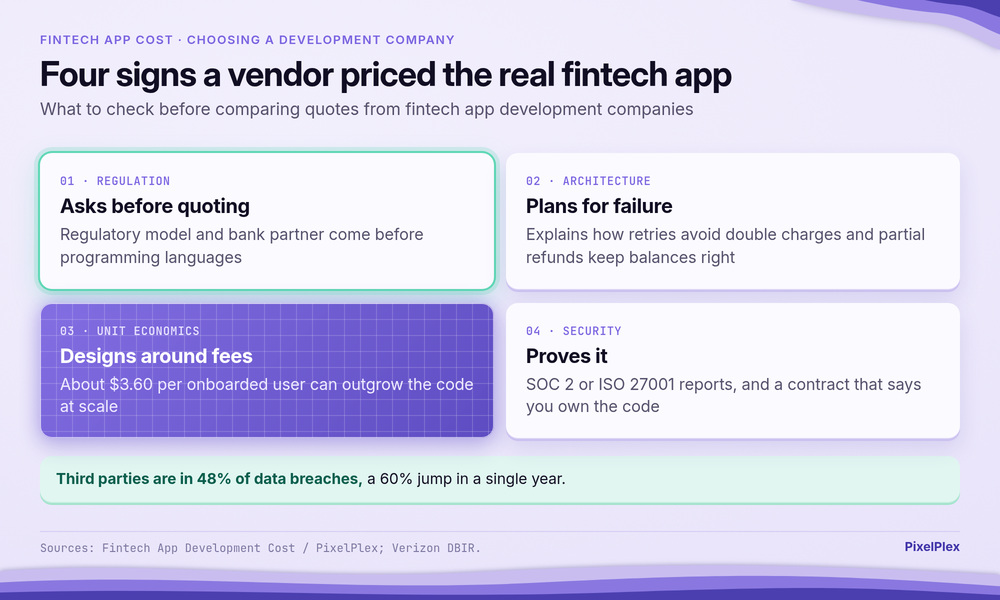
1. Regulatory questions before tech-stack answers
Watch what a vendor asks about first. A fintech-ready team wants to know your regulatory model and your bank partner before it talks about programming languages, because those answers shape the entire architecture of your fintech app. If a vendor quotes the cost to develop a fintech app without asking, it hasn’t avoided those decisions. It has made them for you, picking the cheapest option at every turn.
2. Real depth in financial architecture
Building a payment that works is the easy part. The real test is a payment that fails halfway through. Ask a team how it prevents a double charge when a request times out and gets retried, or how it keeps balances right when a refund only partly goes through. If the answers are vague, there’s a good chance that work isn’t in the estimate either.
3. Unit economics awareness
Some of your biggest costs never appear in the build quote. Every identity check, bank connection, and card your fintech app issues comes with a fee, and you pay it again for every new user. A good fintech app development company designs around those fees from day one, because at around $3.60 per onboarded user, they can end up costing more than the code itself at scale.
4. A security posture you can verify
Your development partner will have access to customer data and production systems, so its security becomes your problem. Third parties like vendors and software suppliers are now involved in 48% of data breaches, which is a 60% jump in a single year, and your bank partner may review your vendors during due diligence too. So don’t take security on trust: ask for SOC 2 or ISO 27001 reports, and make sure the contract says you own the code.
The pre-estimate checklist: How to avoid a 3x price spread
The single most effective way to get an accurate estimate of the cost to develop a fintech app is to answer the key forks before you ask for a price. If you leave these decisions open, vendors have to guess, and each one guesses differently. That’s where the spread comes from.
Providing the following seven deliverables narrows a wide pricing spread into a realistic, actionable budget:
Seven deliverables to prepare before requesting a quote
| Prepared deliverable | Why you must define it upfront |
| Core user flows (product brief) | Removes scope ambiguity. Defines what the fintech app does, for whom, and the screens your UI/UX design has to cover. |
| MVP boundary | Stops vendors from pricing the wrong product. Separates the minimum features needed for v1 from items deferred to v2. |
| Regulatory strategy | Eliminates the biggest cost fork. States whether you’re operating under a BaaS partner or your own license, and names your target jurisdictions. |
| Chosen or shortlisted providers | Replaces guesses with known APIs. Names the partners you’re using or considering for KYC, payments, bank data, and card issuance. |
| Compliance obligations | Surfaces hidden engineering work. Identifies requirements like PCI DSS scope, SOC 2, GDPR, and KYC/AML screening so the vendor doesn’t leave them out. |
| Non-functional requirements | Aligns infrastructure assumptions. Sets expected transaction volume, peak loads, uptime targets, and penetration testing requirements. |
| Target timeline and budget | Forces realistic trade-offs. Gives the vendor the constraints it needs to propose an architecture that fits, rather than an over-engineered default. |
Preparing this brief takes time, but it’s time spent deciding. Making these decisions internally is far cheaper than paying a vendor by the hour to discover them for you mid-build.
Use this list to fill in the deliverables above. Each point is a decision vendors would otherwise make for you.
1. Functional scope
- User roles: Define who can take sensitive actions, like unfreezing an account or adjusting a balance by hand.
- Failure scenarios: Describe what happens when a payment times out or is only partly refunded, since these cases take more work than the successful path.
- Account structure: Say whether users hold one currency or several, and whether their funds sit in individual or pooled accounts.
2. Regulatory framework
- Operating model: State whether you’ll launch through a BaaS partner or your own license, and in which states or countries.
- Identity checks: Set your KYC/AML rules for document verification and sanctions screening, including when a case goes to manual review.
- Card data: Decide whether raw card numbers will touch your servers. If they do, a small self-assessment turns into a full PCI DSS audit.
3. Integrations
- Providers: Name the providers you plan to use, or ask the agency to price a standard setup.
- Ledger: Decide whether you’ll license a ready-made ledger or build your own.
- User volumes: Share your expected users at launch and after a year, since provider fees are charged per user.
4. Performance and security
- Load and uptime: Give your expected transactions per second and an uptime target, such as 99.9%.
- Pre-launch checks: List the external sign-offs your bank partner expects, such as a penetration test or a SOC 2 Type 1 report.
How PixelPlex delivers fintech app development services
PixelPlex has been building software since 2007, with the last 11 years focused on blockchain. The team’s fintech work sits where regulated finance meets digital assets, and much of it runs in production today, from core wallet and identity layers for the Canton Network to PixelPlex’s own Know-Your-Transaction platform, which has uncovered more than 2 million dangerous transfers and flagged 100,000 suspicious entities for compliance teams.
PixelPlex’s fintech app development services include:
- Custom software development for financial platforms, ledgers, and back-office systems built around specific regulatory and business requirements.
- Mobile app development, including fintech mobile app development services for consumer and business banking, digital wallet, and money transfer apps.
- Crypto payment gateway development for products that accept or settle payments in digital assets.
- Crypto banking solutions that combine traditional banking functions with digital asset custody and transfer.
- Compliance and risk infrastructure built on Know-Your-Transaction, covering transaction monitoring, AML and CTF checks, and case management.
- Machine learning for fraud detection that scores transactions in real time and adapts to new fraud patterns, so manual reviews don’t grow with every new user.
- Discovery and solution architecture that settles the regulatory, build-versus-buy, and integration decisions before development begins.
For teams building at the intersection of traditional finance and digital assets, PixelPlex’s fintech blockchain development brings together payment, compliance, and infrastructure expertise in a single delivery team.
Conclusion
Fintech projects get expensive when developers have to rebuild features around late-stage regulatory surprises. To keep your fintech app development cost predictable, resolve your banking partnership and data architecture before kickoff, and keep version one as small as possible. The goal is simply to get a compliant product live before your funding runs dry. Extra features can wait for version two.
FAQ
With a US team, the upfront fintech app development cost runs from about $110,000 for a simple personal finance tool to upwards of $900,000 for a neobank or trading platform. Nearshore rates cut that by half or more. Just don’t stop at the build quote. Over a few years, ongoing compliance, support, and third-party API fees often add up to more than the build itself.
Your regulatory model. Choosing a BaaS partner versus acquiring your own license changes your budget and timeline more than any technology choice. On the software side, the double-entry ledger and risk engine are your most expensive modules, while third-party integration fees dominate long-term operating costs.
It depends on what your fintech app does. Tokenizing card data keeps PCI DSS to a small self-assessment, whereas a full assessment can cost $30,000–$200,000 a year. SOC 2 runs $15,000–$80,000 depending on the report type, and licenses in every US state cost $250,000–$350,000 in the first year alone. A BaaS partner absorbs most of the licensing burden.
A focused MVP takes 3–6 months, whereas a full platform takes 8–14 months. The biggest variable is regulatory approval: individual state licenses can take anywhere from 2 to 18+ months, while a BaaS partnership lets you launch in a matter of months.
No, and this is one of the most common mistakes. Features can be trimmed; compliance controls can’t, which is the first rule of fintech MVP development. Access control, encryption, audit trails, and mandatory KYC/AML rules need to work from the very first transaction. Bolting them on later tends to bring regulators to your door, along with a much bigger bill.
For early-stage teams, BaaS is the obvious pick. You skip years of approval delays and share transaction revenue with a sponsor bank instead. The risk is the vendor itself: when Synapse went under in 2024, users lost access to their money for weeks or months. So keep your own reconcilable records from day one, even if the bank holds the funds. Once your volume grows so high that the bank’s cut really hurts, that’s the time to get your own license.
After launch, you’ll be paying for cloud hosting, provider fees on every user and transaction, yearly PCI DSS and SOC 2 audits, support, and compliance updates whenever the rules change. Maintenance alone usually comes to 15–20% of the original build cost each year. As you grow, provider fees tend to become the largest recurring expense.
The safest way to lower the cost to develop a fintech app is to offload software risk, not compliance risk. Using third-party tools for card data and banking integrations saves months of expensive backend work. You save money by shrinking custom development and releasing in phases, never by touching access controls, encryption, or regulatory rules.