
An offshore software development proposal usually arrives with a rate card, and the rate is the easiest number to compare. However, it's also the least complete, as it leaves out the hours your managers spend steering the work, the features built twice, and the weeks lost when a key engineer is unavailable.
So, is an offshore team cheaper? It can be, depending on the engagement model, your management capacity, and how well the work is defined. In this guide, we’ll look at the models, the full cost, early risks, and the decisions that keep you in control.
What is offshore software development?
Offshore software development means building software with an engineering team in another country, usually several time zones away, under an ongoing agreement.
It’s different from buying one bounded deliverable from a contractor who picks the method, and from hiring freelancers, where continuity and security depend on one person. Location and engagement model are separate choices: a team in any location can work under staff augmentation, a dedicated team, fixed price, an offshore development center, or build-operate-transfer.
The biggest change on your side is organizational: cross-time-zone decisions need to be written down, and acceptance rules agreed in advance.
The market keeps growing. The Business Research Company estimates the offshore software development market at $204.3 billion in 2026 and projects about $348 billion by 2030, or 14.2% a year. In the wider IT outsourcing market, Straits Research expects offshore delivery to grow fastest through 2034, at 9.18% a year. Market growth doesn’t make any single engagement cheaper, though; that depends on the model, the team, and how the work is managed.
Offshore, nearshore, onshore, or hybrid?
Shared working time decides how fast a question becomes a decision, so weigh it like cost. The figures below assume a New York client and both teams on 9:00 to 17:00 local time, on January 14 and July 15, 2026. Cities are examples; regions span several time zones.
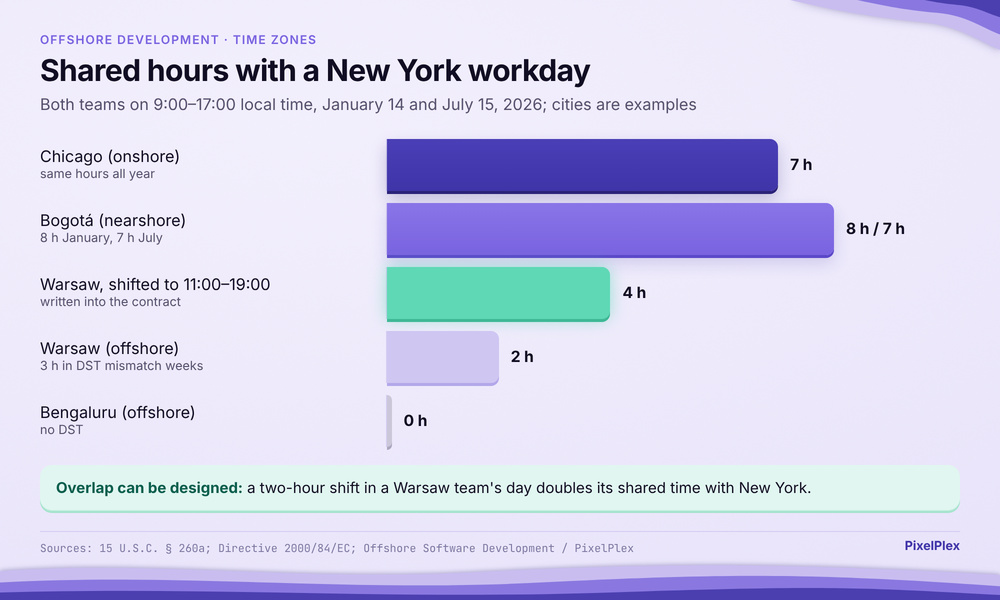
| Location model | Example overlap with New York | When it’s justified |
| Onshore | Chicago: 7 h all year | Heavy live collaboration or in-country data |
| Nearshore | Bogotá (no DST): 8 h in January, 7 h in July | Frequent synchronous work |
| Offshore, Central Europe | Warsaw: 2 h, or 3 h in DST mismatch weeks | Written specs and a short daily decision window |
| Offshore, South Asia | Bengaluru (no DST): 0 h on standard hours | Well-specified backlogs or shifted hours |
| Hybrid | Depends on each location | A local decision-maker plus scaled capacity |
Fewer shared hours mean more of the work must be written down in advance. Done well, that becomes an advantage: in a follow-the-sun setup, tasks set during your day move forward overnight, and the shared window is kept for decisions.
US and EU clocks change on different dates (15 U.S.C. § 260a; Directive 2000/84/EC), so the New York–Warsaw gap shrinks by an hour for a few weeks each year: in 2026, from March 8 to 28 and October 25 to 31.
Overlap can also be designed. A Warsaw team working 11:00 to 19:00 gives New York 4 shared hours instead of 2, so put any shifted schedule in the contract.
Team formation speed depends more on the vendor’s bench and notice periods than on the country. If live collaboration matters more than the rate, compare nearshore software development, where US clients often share most of the day with Latin American teams.
Offshore engagement models and where each one breaks
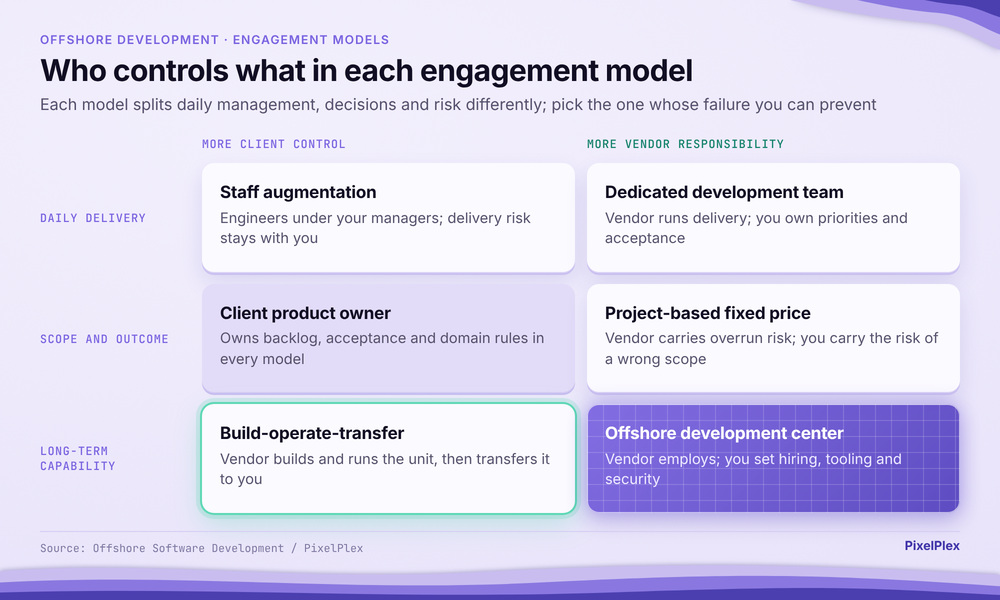
Each model splits daily management, decisions, and risk in its own way. Problems start when a model assumes more management capacity than the client has.
Dedicated development team
The vendor builds a team around your product and runs daily delivery, usually on time and materials. You own priorities and acceptance.
Staff augmentation
Engineers join your team under your managers, so delivery risk stays with you. If you choose this way, check that your managers have time to direct them, and screen candidates as you would when deciding how to hire the right developers. For short-term capacity, PixelPlex offers on-demand software development.
Project-based fixed price
The vendor commits to scope, price, and schedule and carries overrun risk. You carry the risk of a wrong scope.
Offshore development center (ODC)
An offshore development center (also called an offshore software development center) is a dedicated unit a vendor builds and runs for one client, with separate space, client-aligned security controls, and its own local leadership. The vendor remains the legal employer.
Governance is what sets a dedicated offshore development center apart from a large team. The client sets hiring, tooling, and security policy and sits on a steering group that reviews the center’s roadmap. With an ODC, you manage a capability as well as a backlog.
Build-operate-transfer (BOT)
In build-operate-transfer, the vendor sets up and runs the unit for an agreed period, then transfers it to you. Settle these points before the build starts:
- Transfer trigger, timing, and fee.
- What moves: people, contracts, equipment, licenses, possibly a legal entity.
- Employee consent under local labor law.
- Release from non-solicitation clauses.
- Support after the handover.
To see how the models fit your product, review PixelPlex offshore software development services.
Where each model breaks
| Model | Good fit | Where it breaks |
| Dedicated development team | Evolving product with a steady workload | No client product owner, so the team builds whatever demos well |
| Staff augmentation | Strong internal managers with skill gaps | Engineers wait for answers, and output drops unreported |
| Fixed price | Bounded, stable scope | Moving requirements turn acceptance into negotiation |
| Offshore development center | Long-term capacity with custom controls | It outgrows the work, or nobody knows who approves hires |
| Build-operate-transfer | You want to own the unit later | Vague transfer terms, or key people decline to move |
Pick the model whose failure you can prevent with the people you already have.
What to move offshore and what to keep in-house
Separate who does the work from who owns the decision. An external team can build almost anything, but four areas need an owner on your side: the product core, backlog priorities, acceptance criteria, and domain rules nobody writes down until asked.
Architecture sits in between. A vendor architect can design it, and solution architecture consulting adds an independent view. Someone on your side should still approve major decisions and explain them later, even in a dedicated offshore development center with its own architects.
Offshore software product development works best on bounded work: a first release scoped in discovery (for MVP development holding scope is what matters), mobile clients against a defined API, test automation, and integrations. Qtum is an example: the client came with clear requirements and a goal to keep burn rate low, and PixelPlex built a Proof-of-Stake protocol on a Bitcoin fork, a block explorer, wallets, and an SDK.
Once decision rights are settled, offshore custom software development can extend to core systems. Treat that step like any custom software development project: scope, architecture, and acceptance first.

App Development for Startups: Expert Strategies for Technology Decision Makers

R&D in Business: Building an Efficient R&D Strategy and PixelPlex Pro Tips for Industry Challenges
When offshore delivery makes sense
- A named product owner answers questions within an agreed window.
- Next quarter’s backlog is clear enough to estimate.
- Local hiring can’t supply the skills on your timeline.
- Work can be accepted against written criteria.
When to hold off or fix things first
- Your managers have no time budgeted for the vendor.
- The architecture lives in one person’s head.
- Requirements change daily, and cost is the only goal.
- Data-residency and privacy constraints haven’t been assessed.
- You expect the vendor to define the product.
The real cost structure of offshore software development
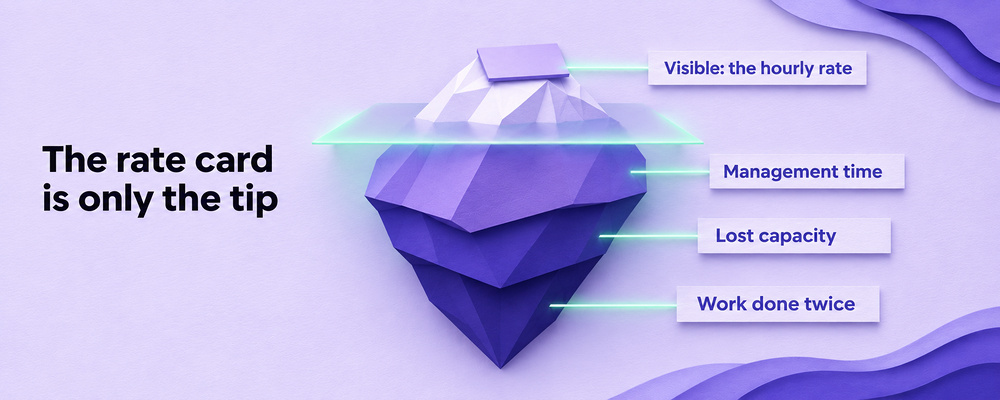
An hourly rate is simple to compare, but it covers only one hour of one role. Rates multiplied by planned hours give you the monthly budget, and total cost adds everything it takes to make the team productive.
Whether delivery management, QA, tools, and replacements are in the rate depends on the contract, so get it in writing.
Visible and hidden cost lines
| Cost line | What you pay for | How to check |
| Rates (visible) | Vendor hours by role | Rate card with inclusions |
| Client management (hidden) | Priorities, reviews, governance | Manager time × loaded cost |
| Onboarding and ramp-up (hidden) | Capacity lost while people learn | Ramp weeks × monthly cost |
| Idle time (hidden) | Hours blocked on answers or access | Blocked time in the tracker |
| Turnover (hidden) | Replacement and lost context | Replacement terms in the contract |
| Knowledge transfer (hidden) | Expert time and handovers | Hours × loaded cost |
| Licenses and tools (visible) | Seats and environments | List of license owners |
| Travel (visible) | Kickoff and review visits | Trips × average cost |
| Rework and re-acceptance (hidden) | Redoing and retesting work | Reopened tickets |
Hidden lines are paid mostly in your team’s time and rarely appear on an invoice, so estimate them before comparing quotes.
Salaries vs billing rates
A salary is what an employee earns. A billing rate is what a vendor charges per hour, with overhead and margin. A freelancer’s rate is a third measure, so keep them apart.
| Metric | Value | Source and period |
| US software developer median salary | $135,980 per year | BLS Occupational Outlook Handbook, May 2025 |
| The same salary per hour | $65.38 (÷ 2,080 hours) | Calculated from BLS |
Offshore and nearshore rates vary widely by country, seniority, and what the rate includes, so compare written quotes built on identical role definitions. The examples below use illustrative numbers; replace them with your quotes.
Why the lowest rate can cost more
Two hypothetical vendors quote $45 and $55 per hour for 8,800 hours: $396,000 versus $484,000. If Vendor A needs 0.2 FTE more of your management ($240,000 loaded cost), that adds $48,000.
Vendor A then stays cheaper only while its extra rework stays under about 10% of hours ($40,000 ÷ $396,000). At 20%, it costs $523,200. A pilot shows which case you’re in; a quote can’t.

Top 8 Cross-Platform App Development Frameworks in 2026

iOS vs Android Development: What Is More Profitable for Your Business?
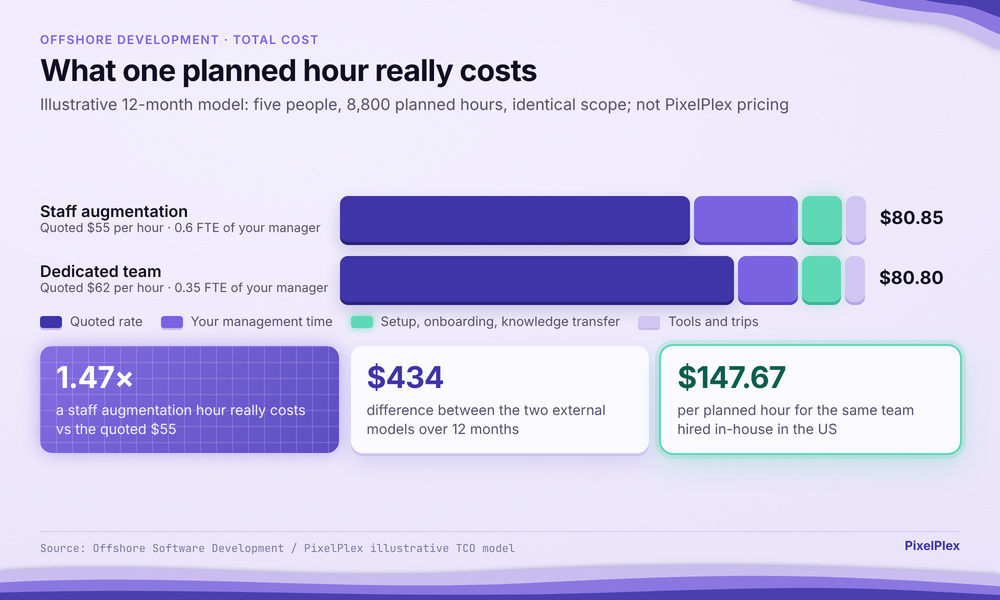
A comparable 12-month TCO model
Every scenario uses the same team: a senior tech lead, three mid-to-senior engineers, and a mid-level QA engineer, full-time for 12 months at 1,760 planned hours each (8,800 total). In-house means US hires. Scope is identical, the product owner is excluded, and equal hours don’t guarantee equal output.
All inputs are illustrative assumptions, not market statistics or PixelPlex pricing:
- Salaries: $180,000 (lead), 3 × $150,000, and $120,000 (QA), totaling $750,000.
- Employer costs of 30% ($225,000), $20,000 in recruiting per hire, and $9,000 in equipment and workspace per person.
- Rates: $55 per hour for staff augmentation, $62 per hour for the dedicated development team (includes a part-time vendor delivery manager).
- Client manager at $240,000 per year ($115 per hour): 0.5 FTE in-house, 0.6 for staff augmentation, 0.35 for the dedicated team.
- Ramp-up: half a month of direct cost. Knowledge transfer: 60 expert hours in-house, 100 externally.
- External setup: $16,900 (60 due diligence hours plus $10,000 legal) plus interviews: 60 hours for staff augmentation, 20 for the dedicated team.
- Tools: $2,400 per person. Two $8,000 trips for external teams.
TCO = direct cost + setup + management + tools + onboarding + knowledge transfer + overhead.
| Cost line | Calculation | In-house / staff augmentation / dedicated team |
| Direct cost | Salaries + employer costs; hours × rate | $975,000 / $484,000 / $545,600 |
| Recruiting and setup | Hires × recruiting fee; setup + interview hours × $115 | $100,000 / $23,800 / $19,200 |
| Client management | FTE × manager cost | $120,000 / $144,000 / $84,000 |
| Tools | People × tools cost | $12,000 in each |
| Onboarding | Direct cost ÷ 24 | $40,625 / $20,167 / $22,733 |
| Knowledge transfer | Expert hours × $115 | $6,900 / $11,500 / $11,500 |
| Overhead | Equipment in-house; trips for external teams | $45,000 / $16,000 / $16,000 |
| Total, 12 months | Sum of the lines above | $1,299,525 / $711,467 / $711,033 |
| Per planned hour | Total ÷ 8,800 | $147.67 / $80.85 / $80.80 |
The external models end up $434 apart: the dedicated team’s rate adds $61,600, lighter management saves $60,000, and setup and onboarding cover the rest. A staff augmentation hour really costs $80.85, about 1.47 times the quoted $55. Hiring lead time isn’t priced.
Sensitivity checks:
- Rework at 10% of hours adds $97,500 in-house, $48,400 for staff augmentation, and $54,560 for the dedicated team.
- Management at 0.8 FTE for staff augmentation adds $48,000 ($759,467); at 0.5 FTE for the dedicated team, $36,000 ($747,033).

Low-Code or No-Code App Development Platform: Which One to Choose?

Monolithic vs. Microservices - Which One Is Better?
Why offshore projects fail: risks and early warning signs
General IT failure rates say little about offshore development specifically, so this section tracks mechanisms and early signals instead.
Common reasons offshore projects fail
Missing owners and late acceptance criteria show up in the readiness lists above. During delivery, watch for these as well:
- A vendor picked on rate alone.
- A contract silent on IP, code access, and exit.
- Too little overlap for the decisions the product needs.
- Knowledge that stays with one or two people.
Early signs and contract protection
| Risk | Early sign | Contract protection |
| Communication | Standups turn into status reading, and no decision gets logged | Overlap hours and response times in the SLA |
| Quality | Acceptance demos show only the happy path | Acceptance criteria per increment; a defect warranty |
| Knowledge concentration | Only one person can answer architecture questions | Documentation as a deliverable; a key-person clause |
| Legal | The vendor can’t name its subcontractors | IP assignment with a chain of title |
| Data security | Requests for shared accounts or production data in test | Data processing agreement; audit rights |
| Blurred responsibility | The plan says “both teams” own acceptance | RACI annex with one accountable role per area |
The scenarios below show the first three risks after a few unnoticed weeks.
Three hypothetical warning scenarios
These are illustrative examples, not PixelPlex client stories.
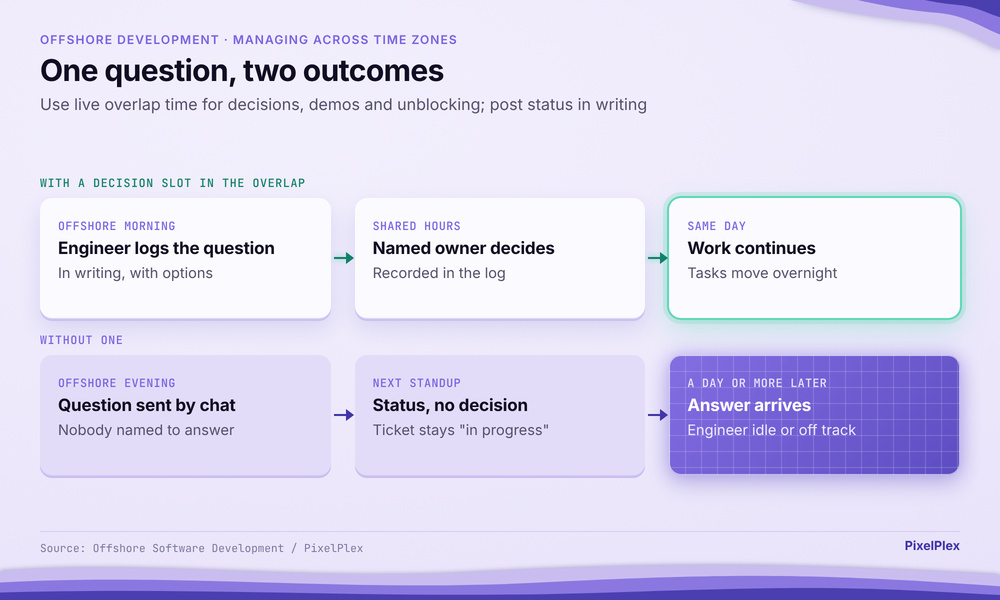
Week 2. Tickets sit “in progress” for three standups, and evening questions wait two days. Another status meeting won’t help. Name who answers questions and holds a decision slot in the overlap.
Week 3. Demos look fine, but defects appear after merge and pull requests lack tests. Adding testers late won’t fix it. Add tests to the Definition of Done, review pull requests yourself for two sprints, and track defect escape rate.
Week 4. One engineer on the offshore development team runs every deployment. Don’t rely on that person. Write a runbook, rotate deployments, and treat a bus factor of one as a defect.
Contract terms to settle before development starts
This is practical guidance, not legal advice. Have counsel in each relevant jurisdiction review the draft.
| Clause | What to define | Check before signing |
| IP ownership | Assignment of deliverables; license for vendor components | Vendor holds IP from staff and subcontractors |
| NDA | Scope, duration, exceptions | Covers subcontractors; survives termination |
| SLA | Response times, key roles, replacement time, credits | How each metric is measured |
| Jurisdiction | Governing law; courts or arbitration | Enforceable where the vendor has assets |
| Exit and transition | Notice, transition help, exit rates | Transition plan attached as an annex |
| Audit rights | Scope, notice, frequency, cost | Covers subcontractors |
| Personal data processing | Processor terms, sub-processors, transfers, breach notice | Separate data processing agreement |
IP and personal data need the closest look: gaps there are hard to fix after work starts.
Ask any offshore software development company who owns the work as it’s created. Under US law, commissioned work is “work made for hire” only in the categories of 17 U.S.C. § 101 with a written agreement, and computer programs aren’t one of them. Transfers need a signed writing (§ 204(a)), so contracts use explicit assignment. Other countries have their own rules, and the vendor must hold rights from its own staff.
For vendor components that ship in your code, confirm the license is perpetual, irrevocable, and survives termination. List shipped open-source dependencies and their licenses.
Acceptance and change requests
Define criteria per increment, the review period, and what a lapse means, and read deemed-acceptance clauses closely. Change requests need a written path from estimate to approval. Your choice of Agile vs Waterfall decides whether these rules live in a fixed spec or in per-sprint acceptance. The QA and testing process defines the evidence behind each sign-off, and an independent testing partner can audit it.
Personal data
An NDA doesn’t create the processor obligations of GDPR Article 28. For GDPR-covered data leaving the EEA, Chapter V requires an adequacy decision (Article 45) or safeguards (Article 46), such as the Standard Contractual Clauses in Commission Implementing Decision (EU) 2021/914. Since Schrems II (Case C-311/18, 2020), exporters using SCCs must also check, case by case, whether the destination country’s law protects the data. Check the Commission’s current adequacy list.
How to manage a distributed team without losing ownership
Four roles carry the weight: the client product owner (PO), the client technical owner (TO), the vendor delivery manager (DM), and the vendor tech lead (TL). If nobody can be the technical owner internally, IT consulting can cover that role.
Use live overlap time for decisions, demos, and unblocking; post status in writing. Whichever software development methodologies you follow, record decisions, approval rights, and escalation time limits.
The Definition of Done lists what an increment needs before acceptance: tests, review, documentation, and a staging deployment. Reports from the offshore development team should cover accepted work and open risks as well as hours.
Who owns which decision
RACI means Responsible (does the work), Accountable (signs off; one per area), Consulted (input before), and Informed (told after). The table assumes a dedicated development team. Under staff augmentation, code quality accountability moves to the client; under the offshore development center model, the steering group also approves staffing.
| Area | Accountable | Responsible; consulted or informed |
| Backlog priorities | PO | PO; TL consulted |
| Increment acceptance | PO | TL; client QA consulted |
| Architecture | TO | TL; engineers consulted |
| Code quality | TL | Engineers; TO consulted |
| Production release | TO | DM; PO informed |
| Staffing | DM | DM; engineering manager consulted |
| Documentation | TL | Engineers; TO consulted |
Settle any row with two accountable roles before the first sprint; that’s where acceptance disputes start.
Metrics worth tracking
Compare each team with its own baseline. Velocity uses a team’s own estimation units, so it can’t rank two teams. Lines of code and accepted AI suggestions measure volume rather than productivity, which matters more as AI in software development becomes routine.
| Metric | How it’s calculated | Alarm threshold (illustrative) |
| Velocity | Items or points accepted per sprint | 25% below the three-sprint average, two sprints running |
| Defect escape rate | Post-acceptance defects ÷ all defects | 1.5× baseline over two releases |
| Cycle time | Median time from start to acceptance | 30% above baseline for three weeks |
| Bus factor | Fewest people whose loss stalls a critical component | 1 on any critical component |
| Turnover | Departures ÷ average headcount, rolling 12 months | Any unplanned exit of a lead |
Read the metrics together: velocity rising with the defect escape rate means speed is bought with quality. These thresholds aren’t research-based standards; set yours after three or four sprints.

Vibe Coding vs Traditional Coding: Are You Building Software or Technical Debt?

The Complete Guide to AI Agents Development in 2026
Security, access, and personal data
Security in offshore development comes down to who can reach what, and how fast you can revoke it. Check each point:
- Segmentation: separate environments, with masked or synthetic test data.
- Least privilege: role-based access, no shared accounts.
- Production access: named, time-bound, logged.
- Personal data: inventoried, accessed only when needed.
- Audit: reviewable access logs.
- Revocation: identity-provider accounts, disabled in one step.
ISO/IEC 27001:2022 sets requirements for an information security management system. Certification bodies, not ISO, issue the certificates, and each one covers a defined scope.
A SOC 2 report is an independent CPA firm’s examination of a vendor’s controls, evaluated against the AICPA Trust Services Criteria. A Type 1 report checks whether controls are designed properly at a single point in time. A Type 2 report also tests whether they actually worked over a period. When you review a vendor’s SOC 2 report, start with the auditor’s opinion, then check the system description for scope, the test results for exceptions, and the controls the vendor expects you to run on your side. Neither an ISO certificate nor a SOC 2 report proves your project is secure; that depends on your own access, data, and environments.
Vendor due diligence beyond the portfolio
A portfolio shows what a vendor has built. Due diligence shows who will build for you and what happens when something breaks. The rules for choosing a development partner apply; the checks below are specific to offshore development, and any offshore software development company on your shortlist should pass them.
| Area | Evidence to ask for | Red flag |
| Legal | Registration, template agreement, staff IP assignment | No proof of IP from its own people |
| Technical competence | Interviews with the proposed engineers; a walkthrough of a comparable system | Only presales staff available |
| Processes | A real sprint: backlog, Definition of Done, sprint report | Reports show hours only |
| Security | ISO/IEC 27001 certificate scope; SOC 2 Type 2 report and its period | Scope excludes the delivery site |
| References | Two references, one from an ended engagement | No ended engagement to call |
A vendor that answers these checks with documents rather than promises is worth a pilot. Go through the full checklist below before you hire offshore development team members; for an offshore software development center, add a site visit and a labor-law review.
Legal
- Is the signing entity the one that employs the engineers?
- Which subcontractors would we get, and can we veto them?
Technical competence
- Can the tech lead explain the trade-offs in a system they built?
- How are code review, testing, and technical debt handled?
Processes
- Who writes acceptance criteria, and who signs off?
- How are change requests estimated and approved?
- How fast is a departing engineer replaced, and who pays for ramp-up?
Security
- When was the last security incident, and how fast was the client told?
- Which sub-processors would touch our data?
References
- What went wrong in a past engagement, and how was it fixed?
- Can we talk to an engineer who has worked on one account for over a year?
From pilot to a stable team: the first 90 days
The path runs from due diligence to a pilot, onboarding, a full team, and a planned transfer or exit, even when the end state is an offshore development center. Start with the discovery phase, which produces the scope, risks, and acceptance criteria a pilot needs.
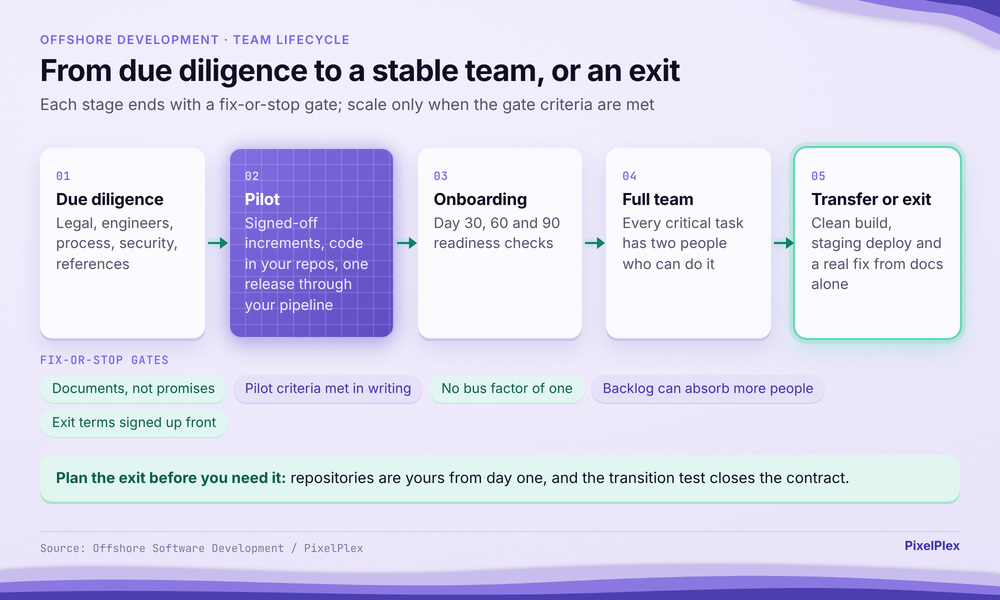
A pilot is a proof of concept for the collaboration: can this team ship production-bound work under these rules? Agree on completion criteria in writing:
- Increments signed off by your product owner.
- Code merged in your repositories, passing CI.
- One release through your pipeline.
On Smart Mall, an AI and iBeacon retail analytics platform, the work included an implementation-ready prototype and tests in two large retail outlets.
Scale the offshore development team only when these are met, the backlog can absorb more people, and every critical task has two people who can do it.
This is a working template, not a promised PixelPlex timeline or a universal standard.
Day 30
- Result: access through your identity provider; Definition of Done and RACI agreed.
- Owner: client TO (access), client PO (acceptance), vendor DM (working agreements).
- Readiness check: every engineer has merged a reviewed change; the access list matches the roster.
Day 60
- Result: backlog refined a sprint ahead; velocity, cycle time, and defect escape baselines set.
- Owner: vendor DM with the client PO.
- Readiness check: two sprints without unplanned scope renegotiation; a decision log in use.
Day 90
- Result: releases and incidents run on runbooks; no bus factor of one.
- Owner: vendor TL, verified by the client TO.
- Readiness check: someone other than the tech lead ships a release; a handover drill works from documentation alone.
Plan the exit before you need it
Write the exit into the contract at signing and keep its materials current. A transfer covers:
- Repositories: yours from day one, with the vendor as a collaborator and full history.
- Pipelines: build and deploy as code; credentials rotated at handover.
- Infrastructure: as code, plus settings and a secrets inventory.
- Dependencies: versions and licenses.
- Documentation: decision records, runbooks, known issues.
- Access: every account and key, revoked after transfer.
- Data: schemas, backups, and migration scripts.
Then prove it works. While the outgoing team is still under contract, the receiving team builds from a clean checkout, deploys to staging, and fixes a real defect using only the documentation. The contract should name the transition period, its rates, and this test as its end. In an offshore development center or BOT unit, people may move along with the code.

Top 10 Facts to Consider When Hiring a Blockchain Development Team

What Are Advantages & Disadvantages of Microservices Architecture?
Why choose PixelPlex for offshore software development?
PixelPlex is an offshore software development company with 17+ years in the technology industry and 450+ completed projects. Our model pairs overlapping hours and daily agile syncs with a follow-the-sun workflow, so two time zones can cover up to twice the working hours in a day. Delivery runs on documentation, automated reporting, and transparent KPIs.
What can we help with?
PixelPlex offshore software development services include:
- Product discovery. Architectural mapping and a technical specification before a team is sized.
- Solution architecture. Architecture and technical consulting.
- Dedicated teams. Team setup and scaling as the project changes.
- Custom development. Offshore custom software development, from full-stack engineering to mobile app development.
- QA and testing. Automated tests, load analysis, and security checks.
- MVP builds. First releases with a tested scope, a practical way to start offshore software product development.
Offshore engagements start at $8,000 per month, including development and QA, documentation and handovers, cloud architecture, and weekly reporting. To compare it with local hiring, run our quote through the TCO model above, internal costs included. Contact us, share your team structure and backlog, and we’ll propose an engagement model and pilot scope.
Conclusion
Offshore software development pays off when cost, risks, and decision rights are clear before the first sprint. Before offshore development starts, rerun the TCO model with your own quotes, name one owner for every decision, and agree on the exit terms.
Then run a pilot with written criteria to decide whether to scale. If the team ships accepted work through your pipeline and the overlap holds up, grow it step by step. If it doesn’t, the exit terms you signed keep the cost of changing course low.
FAQ
It’s a long-term arrangement in which a team several time zones away builds your software. The engagement model decides who manages the work and who carries the risk.
It depends on rates, planned hours, and the internal costs on top, such as management time, onboarding, and travel. Run written quotes with identical roles through a 12-month TCO model before comparing vendors.
Onshore is in your country, nearshore is a nearby one with similar hours, and offshore is a distant one. The practical difference is shared working time: nearshore teams overlap most of your day, offshore teams a few hours or none.
Start with what your side can provide. Managers with time to direct people suit staff augmentation; a product owner without spare managers suits a dedicated development team. The offshore development center model or BOT needs long-term governance.
Whoever the contract and applicable law say. In the US, software written by a contractor usually needs an explicit written assignment, so don’t rely on work-for-hire wording alone.
Often because of decisions made before work starts: no owner for priorities and acceptance, a contract silent on IP and exit, or too little overlap for the product. The signs show up within weeks.
Use the overlap for syncs and decisions and hand off the rest in writing, so work continues overnight. A decision log and a named domain contact for the offshore development team keep that loop running.
There’s no fixed duration. Domain complexity, access setup, and documentation quality drive it, so track readiness checks agreed before the pilot.