Blockchain interoperability lets separate networks exchange tokens, messages, and verified state, but every bridge depends on someone or something vouching for the other chain. This guide explains how cross-chain bridges and messaging protocols verify transfers, compares the main protocols, and turns the biggest bridge failures into practical design rules.
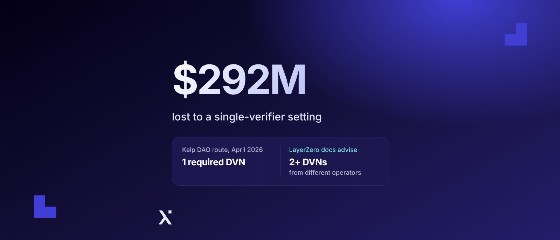
Blockchain interoperability is the ability of separate blockchains to exchange tokens, data, and instructions, with some party or proof vouching for what happened on the other chain. The topic carries more weight in 2026 because liquidity and users are split across L1s, rollups, appchains, and private networks, while bridges remain the most attacked part of crypto. Chainalysis counted about $2 billion stolen from bridges by August 2022, equal to 69% of funds stolen in 2022 up to that report. In April 2026, a single forged message drained about $292 million from Kelp DAO’s LayerZero-based bridge. Banks are building cross-chain rails too: Swift declared its blockchain ledger ready for initial use in July 2026, with 17 banks preparing pilots. This guide explains how bridges verify messages, compares the major interoperability protocols, and turns 2022–2026 bridge failures into design rules.
What Is Blockchain Interoperability?
Interoperability in blockchain means separate networks can exchange assets, messages, and verified state without forcing every participant into one base chain, one validator set, or one execution environment.
Why blockchains cannot read each other’s state
Each blockchain validates its own consensus. A smart contract on Ethereum has no native method to know that a Cosmos account voted, a Solana program emitted an event, or an Avalanche contract locked collateral.
Someone must carry the claim and prove it.
That “someone” can be a relayer that submits signed data, a validator set that attests to source-chain events, an oracle committee, or a light client that verifies another chain’s headers and proofs on-chain. The design changes the security model, cost, latency, and failure modes.
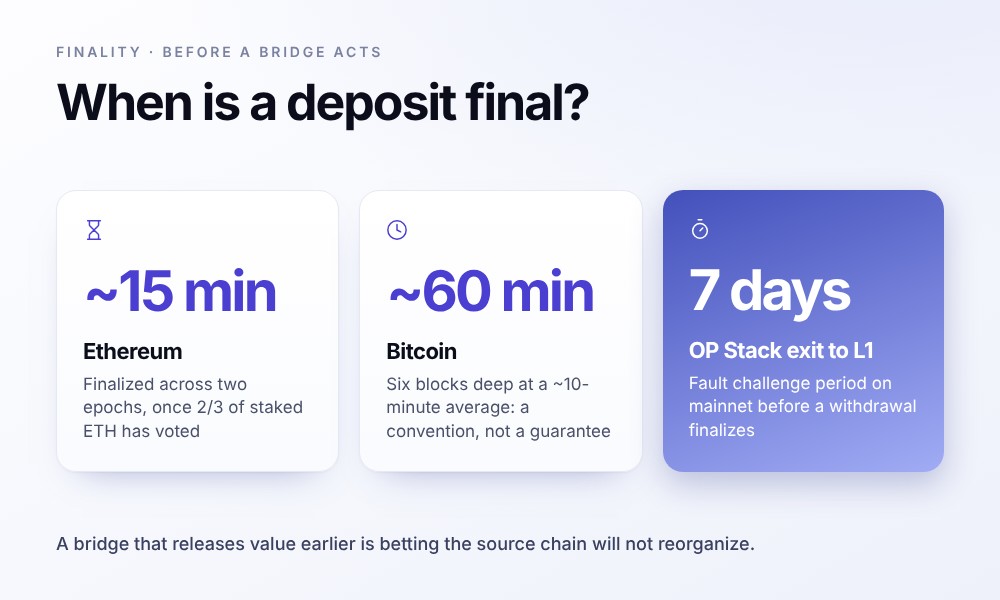
Finality complicates the job. Ethereum has economic finality after checkpoint finalization, while Bitcoin-style chains use probabilistic finality, where confidence rises as more blocks build on top. Some BFT chains offer deterministic finality after a quorum signs a block. A bridge that treats a transaction as final too early can move value on the destination chain before the source-chain event is irreversible.
Vitalik Buterin argued in January 2022 that the future is “multi-chain but not cross-chain” because a bridge cannot protect users against a 51% attack on the chain it reads from: if the source chain rewrites history, the bridge may have already released assets elsewhere. His point still stands. The industry built bridges anyway because users wanted liquidity across venues, applications wanted shared state, and enterprises did not want every asset to live on one public chain.
Interoperability vs a bridge vs a messaging protocol
Interoperability is the goal: two or more chains can coordinate actions with acceptable proof that the remote action occurred.
A cross-chain bridge is an application that moves assets between chains. One blockchain bridge might lock ETH on Ethereum and mint wrapped ETH elsewhere. Another might burn USDC on one chain and mint native USDC on another. A crypto bridge can be a simple asset mover or a front end over a messaging network.
A cross-chain messaging protocol, also called an interoperability protocol, is the transport and verification layer that bridges and applications build on. Examples include IBC, Chainlink CCIP, LayerZero, Wormhole, Axelar, and Hyperlane. These systems pass messages, prove or attest to source-chain events, and trigger execution on the destination chain. The application decides what the message means: mint, release, vote, liquidate, rebalance, or update a parameter.
Auditors care about this split. A bridge can be unsafe even if the underlying messaging protocol is sound, and a good application design can still be weakened by a poor verifier quorum, bad upgrade controls, or excessive executor authority.
What actually crosses chains: tokens, messages, state and function calls
Nothing physically leaves one blockchain. Cross-chain interoperability is accounting plus verification: one system observes or proves a source-chain fact, then another system changes state based on that fact.
- Fungible tokens, for example USDC moving from Ethereum to Base: burn on the source chain, attest, mint native tokens on the destination. The risk sits in the attestation and the mint authority.
- Arbitrary messages, such as a governance vote relayed to another chain: a verifier signs or proves the event and the destination contract executes. Forged, replayed or misrouted messages are the failure mode.
- State proofs, such as a balance or Merkle root proven through a light client: the destination verifies headers and Merkle proofs, so broken proof logic or a source-chain reorg is the risk.
- Cross-chain function calls, such as an Arbitrum contract triggering a deposit on Avalanche through general message passing: the payload carries the target, call data and gas, and weak access control on the target is what attackers look for.
The safest blockchain interoperability design depends on what crosses the boundary. A token transfer can often use burn-and-mint, while a governance action or liquidation path needs stricter replay protection, ordering rules, and verifier separation.

Polkadot Parachains vs Ethereum Shards vs Kusama: What's the Difference?

What Is the Difference Between Blockchain Consensus Algorithms?
Why Interoperability Matters in 2026
Product teams no longer deploy to one chain and call the job done. They deal with Ethereum rollups and other layer 2 networks, Solana and Cosmos appchains, each with its own fee market, wallets and finality assumptions. Liquidity splits across venues, so a market that looks deep in aggregate may still produce bad execution on the chain where the user arrives, and support teams handle users who deposited wrapped USDC where native USDC was required. Blockchain interoperability in 2026 is less about novelty and more about reducing that operational drag. IBC Eureka (IBC v2), launched in April 2025 as the canonical Cosmos to Ethereum connection, is one answer from the appchain side: Succinct describes it as uniting about 120 Cosmos chains with Ethereum.
Stablecoins and tokenized assets push the same way. Circle’s Cross-Chain Transfer Protocol uses native burn-and-mint for Circle-issued assets on supported chains: USDC, and on supported routes EURC and cirBTC. Circle began deprecating CCTP V1, reducing V1 burn limits from October 31, 2026; Circle plans a full pause of the V1 contracts on December 1, 2026, so integrators need to move to V2. Chainlink reports more than $84B in total cross-chain token value secured by CCIP as of September 2026, with $15B+ migrating in the preceding four months, including BitGo’s WBTC and Coinbase’s cbBTC. These are Chainlink’s own figures, yet they show what issuers want: controlled movement across chains rather than unmanaged copies. In stablecoin payment infrastructure, cross-chain interoperability now shapes treasury policy and reconciliation as much as engineering.
Banks are building their own rails. On July 9, 2026, Swift said its blockchain-based ledger was ready for initial use, with 17 banks from six continents preparing to pilot tokenised-deposit payments around the clock; the deposits stay on each bank’s own ledger and final settlement runs through existing systems. Chainlink also says 24 institutions, including Swift, DTCC, Euroclear, UBS and Wellington, used CCIP to distribute corporate actions data. For banks, interoperability means ledger-to-ledger coordination with privacy and settlement finality, far from a retail user hopping chains for a better yield.
How Cross-Chain Bridges Work: Four Asset Transfer Models
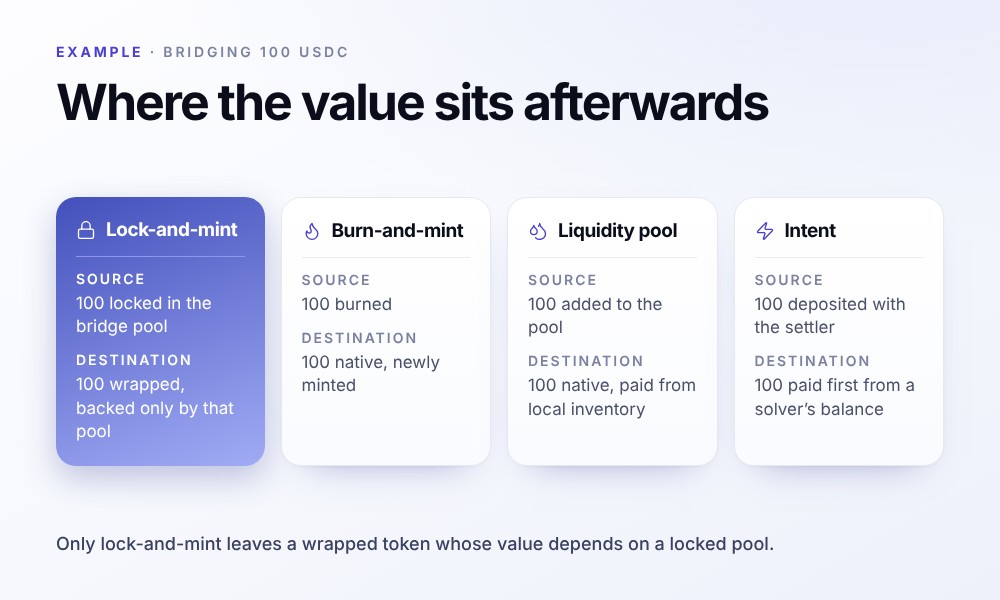
Behind a single “transfer” button, bridges use one of four asset models, each with its own trust boundary.
Lock-and-mint (wrapped tokens)
In a lock-and-mint design, the user deposits an asset into a contract or custody system on the source chain. The bridge then mints a corresponding token on the destination chain.
The locked pool is the target. If an attacker can drain it, the wrapped tokens on the destination chain become undercollateralized IOUs. Ronin and Wormhole used lock-and-mint designs, with incident details covered later.
Burn-and-mint (native issuance)
Burn-and-mint removes the pooled collateral problem. The token is burned on the source chain, and the issuer or protocol authorizes minting on the destination chain.
CCTP uses this model for native USDC movement. A transfer from Ethereum to Base burns USDC on Ethereum, Circle’s attestation service signs off on the burn, and the Base contract mints the same amount. Token frameworks such as LayerZero OFT and Wormhole NTT also support issuer-managed multi-chain tokens. The trade-off is direct: there is no pool to drain, but whoever can authorize a mint controls supply. Key management, attestation rules, rate limits, and monitoring become the center of the security model.
Liquidity pools and swaps
A liquidity-pool bridge holds inventory on both sides. The user deposits, or signals a transfer, on the source chain and receives the native asset from a pool on the destination chain.
LPs carry inventory risk across chains, and users can face slippage when pools are imbalanced. If the message layer lies about what happened on the source chain, a destination pool can be drained by fraudulent withdrawals.
Intents and solvers
Intent-based transfers shift execution to specialized fillers. A user signs an instruction such as, “I want 1,000 USDC on Base.” A solver fills that order from its own inventory in seconds, then gets repaid later after settlement is verified.
ERC-7683, the cross-chain intents standard proposed by Uniswap Labs and Across in April 2024 and revised with Ethereum Foundation contributors in 2025, defines a common structure for these orders and settlement flows. The user’s risk shrinks to the fill window, while the solver carries settlement and inventory risk.
| Model | How it works | Where the risk sits | Examples | Best for |
| Lock-and-mint | Asset is locked on the source chain, and a wrapped representation is minted on the destination chain. Redemption reverses the process. | Locked collateral pool, validator or guardian signatures, custody controls, and wrapper solvency. If the pool is compromised, the issued asset may lose backing. | Ronin-style wrapped assets, Wormhole-style wrapped assets, older cross-chain bridge designs. | Long-tail assets, chains without native issuer support, and cases where a wrapped asset is acceptable to the application. |
| Burn-and-mint | Native token is burned on the source chain, then minted on the destination chain after issuer or protocol authorization. | Mint authority, attestation logic, key management, rate limits, and issuer operations. Supply control is the main trust point. | Circle CCTP for USDC, EURC, and cirBTC; LayerZero OFT; Wormhole NTT. | Stablecoins, issuer-controlled tokens, tokenized assets, and applications that need canonical supply across chains. |
| Liquidity pool | Pools hold native assets on each chain. The user receives funds from destination inventory while accounting settles through bridge messages. | LP inventory, pool imbalance, slippage, and message verification. A false message can drain destination liquidity. | Swap-based bridge routes and liquidity networks that pay users from local inventory. | Payments, consumer transfers, and trading flows where users prefer native assets and fast delivery. |
| Intent/solver | User signs a desired outcome. A solver fills from its own balance, then claims repayment after proof or settlement. | Solver balance sheet, settlement verification, order validation, and dispute handling. User exposure is mostly the fill window. | ERC-7683-compatible systems, Across-style intent flows, solver-based routing. | Fast UX, wallet-integrated transfers, chain abstraction, and high-volume stablecoin movement. |
Atomic swaps predate most modern interoperability systems. Hash time-locked contracts lock both sides with the same hash and timeouts, so either both legs complete or both refund. The model never scaled into mainstream bridge infrastructure: both parties must stay online, both chains must support the same hash function and timelocks, and liquidity stays peer-to-peer. The party who reveals the secret last also gets a free option on the trade.

Introduction to Stablecoins. Use Cases and Examples

Asset Tokenization From A to Z: Explanation, Benefits, Limitations, and Real-Life Use Cases
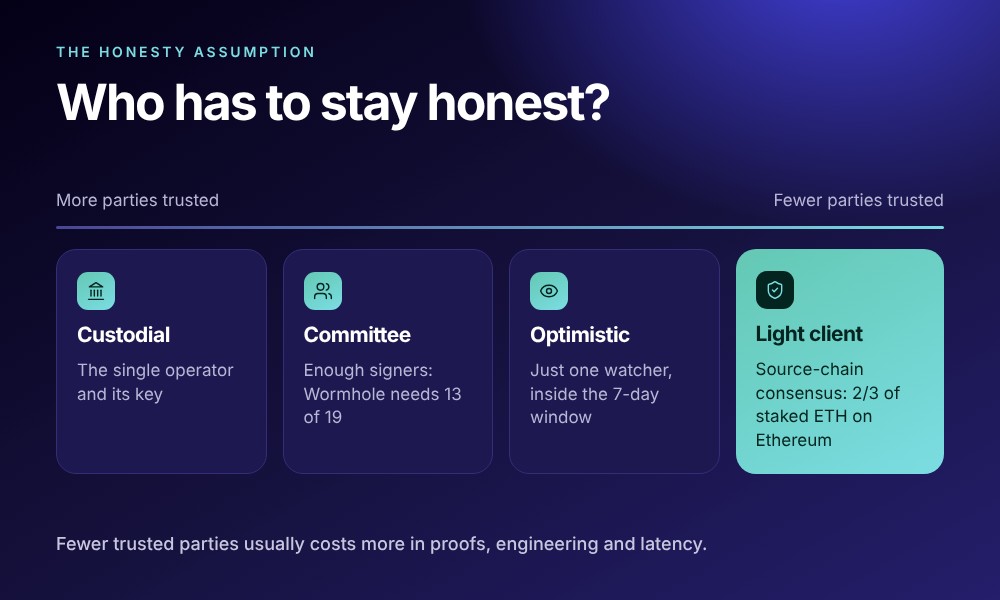
Who Verifies the Message: Trust Models Behind Interoperability Protocols
In cross-chain interoperability, the verification layer decides what must fail before funds are lost. Arjun Bhuptani of Connext framed this as the interoperability trilemma: trustless, extensible, generalizable. A design usually gets two of the three.
Native verification: light clients and ZK proofs
IBC uses native verification. Each chain runs an on-chain light client of the other chain and verifies headers plus Merkle proofs, without relying on an outside validator set.
A light client must understand the counterparty chain’s consensus and proof format. Ethereum cannot cheaply verify Cosmos consensus directly on-chain, so IBC Eureka uses Succinct’s SP1 zero-knowledge proofs of the light client instead.
You get stronger guarantees and pay for them in engineering time. Each new chain pair needs client work, and proof generation or verification costs still matter for production routing.
External verification: validators, guardians and committees
Many interoperability protocols use an external verifier group that observes the source chain, reaches threshold approval and hands an attestation to a relayer or executor.
Wormhole uses 19 Guardians, with 13 signatures required per message. Chainlink says CCIP’s default Committee Verifier has 16 independent node operators. Axelar uses a proof-of-stake validator set.
Eco’s 2026 risk classification places most federated bridge sets between 13 and 21 nodes. The count is only part of the model. Funds can be lost if enough signers collude, if enough keys are stolen, or if operations are weak across the threshold group.
Optimistic verification and challenge windows
Optimistic systems assume messages are valid unless someone proves fraud inside a challenge window.
Canonical bridges of optimistic rollups use a 7-day withdrawal period. Third-party bridges and intent solvers exist largely to give users speed while settlement waits underneath.
Watcher liveness is the weak spot. At least one honest watcher must be online, able to read the source chain, able to submit a challenge, and funded to do so before the window closes.
Application-configured security
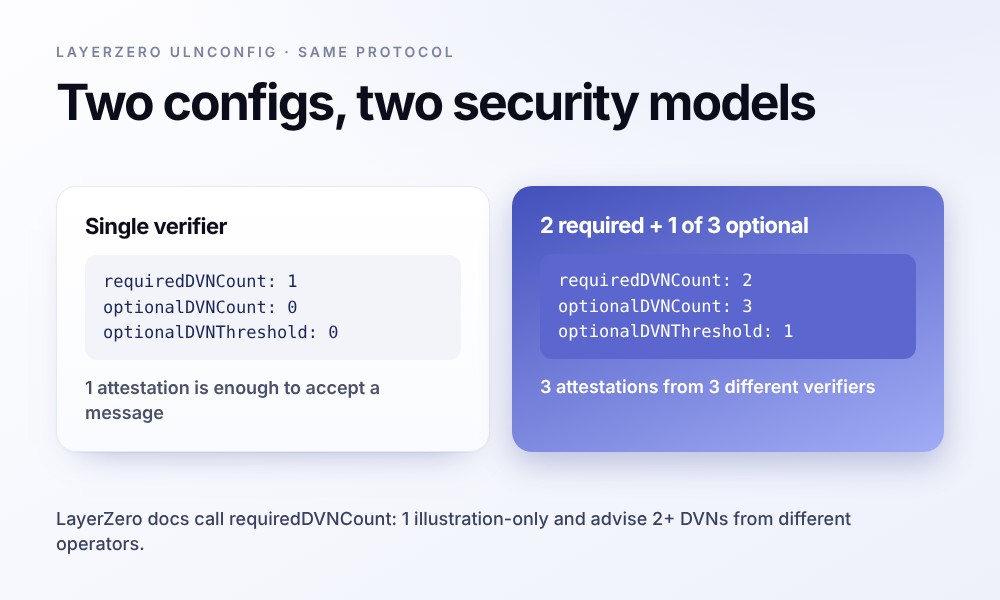
Some cross-chain messaging systems let the application choose its own security stack. LayerZero OApps choose which Decentralized Verifier Networks must attest, while an executor delivers the message. Hyperlane is permissionless, and applications choose Interchain Security Modules. CCIP 2.0, released in September 2026, lets issuers add their own Cross-Chain Verifiers, with both the default committee and the CCV required to sign.
That flexibility comes with ownership. Someone on your team now owns the verifier set, thresholds, block confirmations, executor permissions, rate limits and upgrade keys, and those settings deserve the same change control and alerting as contract code. A weak configuration can erase the benefit of a strong protocol: a 1-of-1 verifier setting is what failed at Kelp DAO, covered later in this article. A production change from 2-of-3 to 1-of-1 is a security event, even if no Solidity changed.
In this pattern, Verifier A and Verifier B must both attest, and at least one of Verifier C, D or E must also attest before the destination contract accepts the message. An attacker would need to compromise three independent operators at once. Compare that with a 1-of-1 configuration, where one compromised verifier can approve a bad message alone.
| Trust model | What must fail for funds to be lost | Typical latency | Cost profile | Examples |
| Light client / ZK | The verified source chain state is wrong, the light client is flawed, or the proof system is broken | Medium to high | Higher verification, proof, and integration cost | IBC, IBC Eureka with SP1 |
| External validator set | Threshold collusion, threshold key theft, or signing-policy failure | Low to medium | Ongoing validator, relayer, and monitoring cost | Wormhole, Axelar, CCIP default committee |
| Optimistic | Fraud occurs and no honest watcher challenges inside the window | High | Lower routine verification cost, higher monitoring requirement | Optimistic rollup canonical bridges |
| App-configured, multi-verifier | The configured quorum signs a bad message, or the app misconfigures the quorum | Low to medium | Depends on chosen verifiers and executors | LayerZero, Hyperlane, CCIP 2.0 CCVs |
| Custodial / single signer | One operator or key is compromised | Low | Low upfront cost, high trust concentration | Single-signer bridges, custodial routing |

ZK Rollups Explained: How Zero-Knowledge Scaling Works, Benefits, and Leading Projects

What Are Zk-SNARKs? Technology Overview, Usage, and Examples
Interoperability Protocols Compared: IBC, CCIP, LayerZero, Wormhole, Axelar, Hyperlane, CCTP
Picking an interoperability protocol comes down to what verifies the message, who can change its settings, and what asset or instruction is moving.
| Protocol | Verification model | Scope | Notable 2025–2026 detail | Good fit |
| IBC | Light clients, plus SP1 ZK for Ethereum via Eureka | Tokens and messages | IBC Eureka launched in April 2025, connecting about 120 Cosmos chains to Ethereum | Cosmos appchains, teams wanting trust-minimized links |
| Chainlink CCIP | Committee of 16 node operators plus optional issuer CCVs | Tokens, CCT, and messages | CCIP 2.0 launched in September 2026 with a compliance engine and configurable finality. Chainlink reports $84B+ token value | Tokenized assets, institutions |
| LayerZero | App-chosen DVNs plus executor | Messages, OFT tokens | After the April 2026 Kelp DAO exploit, LayerZero Labs’ own DVN refuses to be the sole required verifier | Multi-chain token issuers that will manage configs |
| Wormhole | 19 Guardians, 13-of-19 | Messages, NTT, wrapped transfers | Global Accountant checks token-transfer messages. $10M bug bounty | Solana-heavy flows |
| Axelar | Proof-of-stake validator set | General Message Passing to call a function on another chain | Focused on cross-chain contract calls | Apps needing cross-chain contract calls |
| Hyperlane | Permissionless deployment, app-selected ISMs | Messages, warp-route token transfers | New chains can connect without permission | New chains and rollups |
| Circle CCTP | Issuer attestation, burn-and-mint | USDC, EURC, cirBTC only | V1 deprecation started Oct. 31, 2026. Fast Transfer is about 8 to 20 seconds in V2 | Stablecoin flows |
Cross-chain token standards: OFT, NTT, CCT, xERC20 and ERC-7683
Token standards sit above the message layer: LayerZero’s OFT (Omnichain Fungible Token), Wormhole’s NTT (Native Token Transfers) and Chainlink’s CCT (Cross-Chain Token) each define how one token lives natively on many chains.
xERC20, also known as ERC-7281, gives the issuer per-bridge mint and burn rate limits, so one bridge failure cannot mint unlimited supply. ERC-7683 is different. It standardizes intents, not tokens.
For blockchain interoperability architecture, the issuer should own mint authority, bridge limits, and upgrade paths. Avoid locking the asset to one messaging vendor if the chosen standard allows several.
Why Cross-Chain Bridges Get Hacked: 2022–2026 Incidents
Chainalysis reported on August 2, 2022 that about $2 billion had been stolen in 13 cross-chain bridge hacks that year, equal to 69% of all funds stolen in 2022 to that date. Chainalysis data cited by Eco puts bridge losses above $2.5 billion for 2021–2023. Crystal Intelligence wrote in October 2026 that bridges are now the dominant route for moving stolen funds, with more than 75 bridge protocols in common use. Almost none of these losses came from exotic cryptography. They came from keys, thresholds, configuration, upgrades, infrastructure dependencies, and familiar smart contract vulnerabilities.
| Incident | Date | Loss | Root cause | Failure class |
| Ronin | March 2022 | about $625M | 5-of-9 validator threshold; Sky Mavis ran 4 validators and still held a delegated key for a 5th via Axie DAO; spear-phishing via a fake job offer; US Treasury attributed it to Lazarus Group | Key compromise, signer concentration |
| Wormhole | February 2022 | about $325M | Signature verification bug in the Solana contract, using a deprecated function, let the attacker mint 120,000 wETH without collateral; Jump Crypto replaced the funds | Verification bug |
| Nomad | August 2022 | $190M | Routine upgrade initialized the trusted root to zero, so any message looked proven; hundreds of wallets copied the exploit; about $36M returned by white hats | Upgrade/initialization error |
| Harmony Horizon | June 2022 | $100M | 2-of-5 multisig, two keys compromised | Small signer set |
| Multichain | July 2023 | more than $125M | Unauthorized withdrawals after the CEO was detained by Chinese police and the team lost access to MPC keys; project shut down | Custodial key concentration |
| Kelp DAO | April 2026 | about $292M, 116,500 rsETH | LayerZero-based bridge set to require one verifier; poisoned RPC infrastructure produced a valid attestation for a forged message | Single-verifier config, infrastructure compromise |
| Taiko | June 2026 | about $1.7M | A signing key meant to stay in secure hardware was exposed on GitHub, letting the attacker forge proofs | Key exposure |
| AFX Trade | July 2026 | $24.15M | Attacker obtained enough bridge validator keys to meet quorum | Key compromise at threshold |
Compromised keys and too-small signer sets
Ronin, Harmony, AFX Trade, and Multichain all point to the same failure mode: the threshold looked acceptable in a diagram, but the real control plane was much smaller.
A 5-of-9 validator set sounds distributed until one company effectively controls 5 signing paths. At that point, the blockchain bridge has a single operational choke point, even if the contract says otherwise.
Harmony’s 2-of-5 design had even less margin. AFX Trade shows the same threshold problem in 2026: once an attacker obtains enough validator keys to meet quorum, the destination chain cannot distinguish the forged instruction from a legitimate one. Multichain adds another variant, where custody and operational access were concentrated around a small group and then became unrecoverable after the CEO was detained by Chinese police.
The threat model must include human operators. Chainalysis says North Korean hackers stole $2.02 billion in 2025, up 51% year over year. These attackers do not need to break consensus if they can phish, coerce, or wait for the people who hold signing authority.
Verification and upgrade bugs
Wormhole and Nomad failed in the code path that answers one question: is this message proven?
In Wormhole, a signature verification bug in the Solana contract let the attacker mint 120,000 wETH without collateral.
Nomad failed somewhere else. A routine upgrade initialized the trusted root to zero, which made any message appear valid. Once the exploit transaction was public, hundreds of wallets copied it with minor changes. A bridge exploit can turn into a public withdrawal script within hours.
Upgrades, initializers and default values belong in the threat model of any contract that decides whether a cross-chain message is proven.
Single-verifier configurations and poisoned infrastructure: the Kelp DAO case
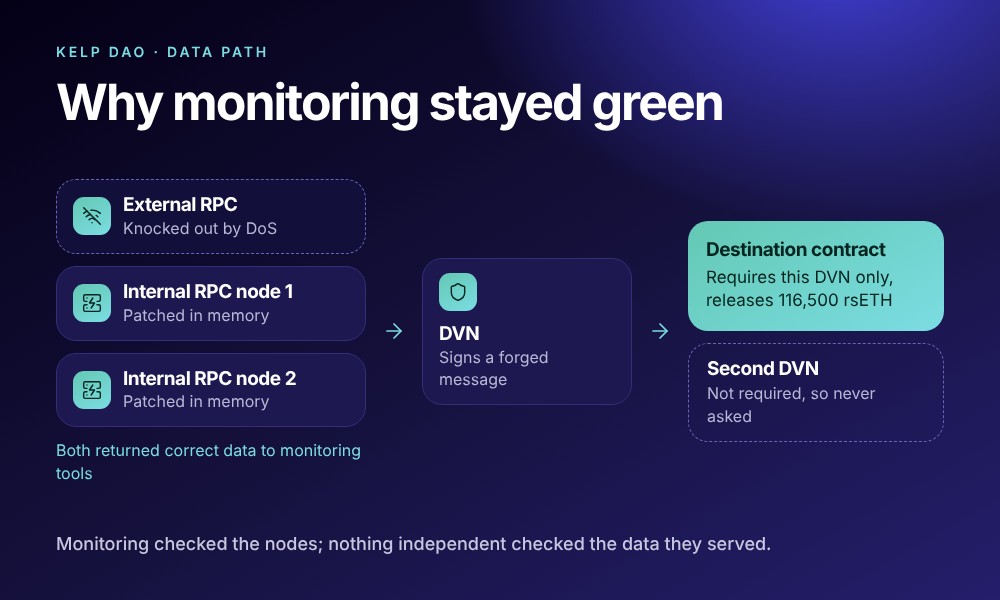
According to LayerZero Labs’ May 2026 incident report, the attacker socially engineered a LayerZero Labs developer on March 6, 2026 and harvested session keys. From there, the attacker moved into the RPC cloud environment and patched two internal RPC nodes in memory. Those nodes returned correct responses to LayerZero’s monitoring tools but served tampered RPC responses to the LayerZero Labs DVN.
On the day of the attack, April 18, a DoS against an external RPC provider pushed the DVN signing service onto the poisoned internal nodes. The DVN then signed a valid attestation for a forged message with no deposit behind it. The application required only that one DVN, so the destination contract released 116,500 rsETH.
LayerZero Labs stated the core failure plainly: “Because no second independent DVN was required to attest, the destination contract accepted the single valid attestation and unlocked rsETH.”
Mandiant and CrowdStrike attributed the attack to TraderTraitor, also tracked as UNC4899, a DPRK-linked group.
Afterward, LayerZero Labs’ DVN started refusing to be the sole required attestor, and the affected cloud environment was replaced rather than patched. For engineers, the takeaway is specific: the contracts did what the app configured them to do. The failure was a 1-of-1 verifier setting plus an RPC setup that an attacker could force onto two compromised nodes.

(In)Famous Smart Contract Hacks: Why They Happened and How to Avoid Them
Overview of DeFi Security Challenges and Best Practices to Overcome Them
How to Design a Secure Cross-Chain System
A secure cross-chain design treats every verifier, key, RPC endpoint and upgrade path as something that will eventually fail.
Independent verification paths
Do not rely on a single verifier. Any production cross-chain messaging route should require at least two independent verifiers operated by different organizations, with separate infrastructure, access controls, and operational teams.
Each verifier should also read the source chain through more than one RPC provider and node client, so one poisoned data source cannot produce a valid attestation, the exact gap behind Kelp DAO. Where cost and latency permit, use light-client verification or ZK verification instead of external attestation.
Finality, rate limits and circuit breakers
For large transfers, wait for source-chain finality before minting or releasing assets on the destination chain. Faster paths can exist, but only under a value cap. Chainlink says CCIP 2.0 lets issuers set faster-than-finality thresholds, which is the right model for high-frequency, low-value flows.
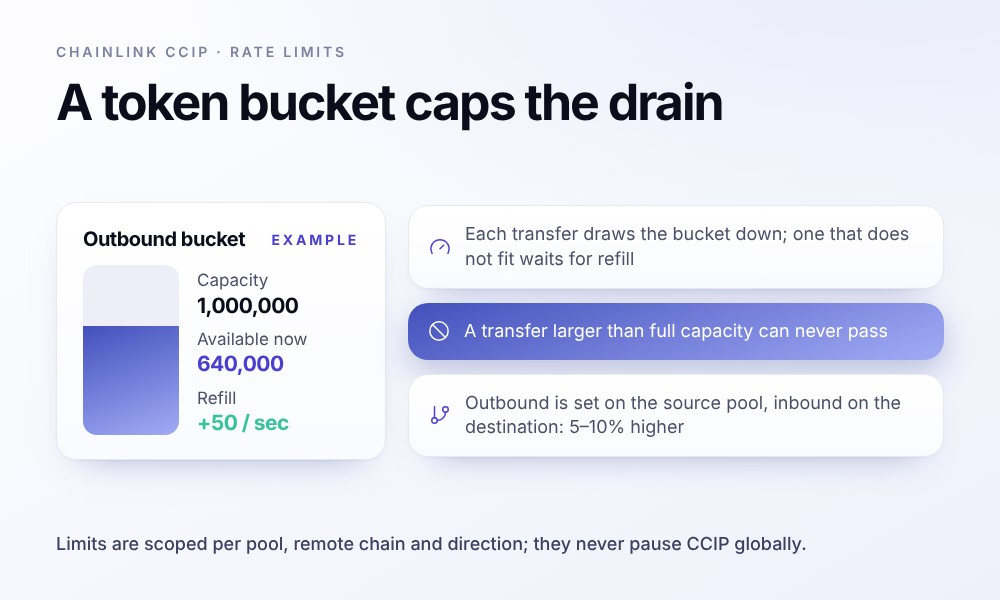
Use per-route and per-period minting or withdrawal limits, similar to xERC20-style controls. Add automatic pause logic when outflows exceed a defined threshold. Keep pause authority separate from upgrade authority so one compromised admin path cannot both change the system and suppress the response.
Key management and operational security
Signing keys belong in HSMs or MPC systems, not laptops, repos, CI variables, or shared cloud credentials. Taiko was a plain reminder. Keys should also be distributed across organizations, not concentrated inside one operator group, as Ronin showed.
Privileged access should be just-in-time, with short-lived credentials and multi-person review for IAM changes, the controls LayerZero adopted after its incident. Upgrades need timelocks and public notice.
Monitoring, transaction screening and incident response
Reconcile both sides continuously: locked versus minted, burned versus released, and escrow balances versus outstanding supply. Alert on any change to the verifier set, thresholds or contract implementation, and on unusual message volume.
Screen addresses and transactions before release using transaction monitoring tools. Stolen funds now move through bridges within minutes, so the runbook should already include contacts at exchanges and blockchain analytics firms.
Use an independent smart contract audit for contracts and a broader security audit and risk management review for keys, infrastructure, CI/CD, monitoring, and incident response. Wormhole runs a $10M bug bounty, which signals that even mature interoperability systems expect researchers to find edge cases.
Pre-launch checklist (each item maps to a failure above):
- Require at least two independent verifiers for every production route (Kelp DAO).
- Use different RPC providers and node clients behind each verifier.
- Set finality requirements by chain, asset, and transfer size.
- Define per-route minting and withdrawal limits before launch.
- Put signing keys in HSM or MPC custody, spread across organizations (Ronin, Harmony, Taiko).
- Keep admin, pause and upgrade keys separate, with timelocks and initialization tests on upgrades (Nomad).
- Add alerts for config changes, supply drift, and abnormal outflows.
- Test the incident runbook with engineering, legal, compliance, and operations.

DAML Development Services: Everything You Need to Know

A Network of Networks: How Canton Is Redesigning Financial Infrastructure
Interoperability for Regulated Finance and Private Networks
Regulated finance needs interoperability, but it often cannot accept public mempools, opaque bridge operators, or uncontrolled data exposure.
Atomic settlement instead of bridging: Canton Global Synchronizer
Canton Network takes a different approach from a typical bridge. Canton Network’s Global Synchronizer is a decentralized, transparently governed interoperability service that lets applications running on separate, sovereign Canton ledgers execute atomic transactions across each other without giving up privacy or control. Each party sees only the data it is entitled to see.
That differs from bridging. There is no wrapped copy and no window where one leg settled while the other did not. For repo, collateral, fund units, and other regulated instruments, that distinction affects credit exposure, operational risk, and legal finality.
Digital Asset says more than $8 trillion in tokenized assets move on Canton every month, including over $350 billion a day in US Treasury repo. Treat those as vendor figures; they still explain why capital-markets teams comparing blockchain interoperability solutions put Canton-style atomic settlement next to bridge designs.
Compliance and data exposure between private and public chains
Institutions need allowlists, sanctions screening, limits, and audit trails enforced on every cross-chain transfer.
Chainlink’s Automated Compliance Engine in CCIP 2.0 is one example of compliance checks inside the transfer path. Issuers can also encode rules in the token contract, the bridge contract, or both. For regulated transfers, policy enforcement must travel with the asset.
Private or permissioned ledgers need to connect without publishing full transaction records.
In many public vs private blockchain architectures, the public side should receive hashes, proofs, attestations, or selective disclosures rather than full books and records. The operator keeps auditable records without becoming a data warehouse for sensitive positions, which is why private blockchain development for these networks starts with privacy design and access control.
DAML Development Services: Everything You Need to Know
A Network of Networks: How Canton Is Redesigning Financial Infrastructure
How PixelPlex Has Built Cross-Chain Systems
We have built cross-chain systems where privacy, verification, refunds, and operator controls had to be part of the transaction path.
CC Bridge: moving ERC-20 assets between Ethereum and Canton
CC Bridge is built by PixelPlex, a Canton Network General Partner. It moves ERC-20 assets between Ethereum and Canton Network, with the transfer logic enforced by Daml smart contracts on Canton. Today it is an operated bridge, so users trust the operator’s key custody; the published roadmap replaces that with threshold validation by independent validators.
Authorization, transfer state, and refund logic are not handled as off-chain exceptions. They are part of the bridge flow: signed authorization is verified on chain, delivery waits for Ethereum finality, processing is idempotent, and a transfer that cannot complete is refunded automatically in the same token, typically within about ten minutes.
CC Bridge supports four routes:
- Ethereum to Canton
- Canton to Ethereum
- Canton to Ethereum with a stealth payout to a one-time address only the recipient can spend from
- Private Ethereum to Ethereum transfer, where the middle step is recorded on Canton instead of a public chain
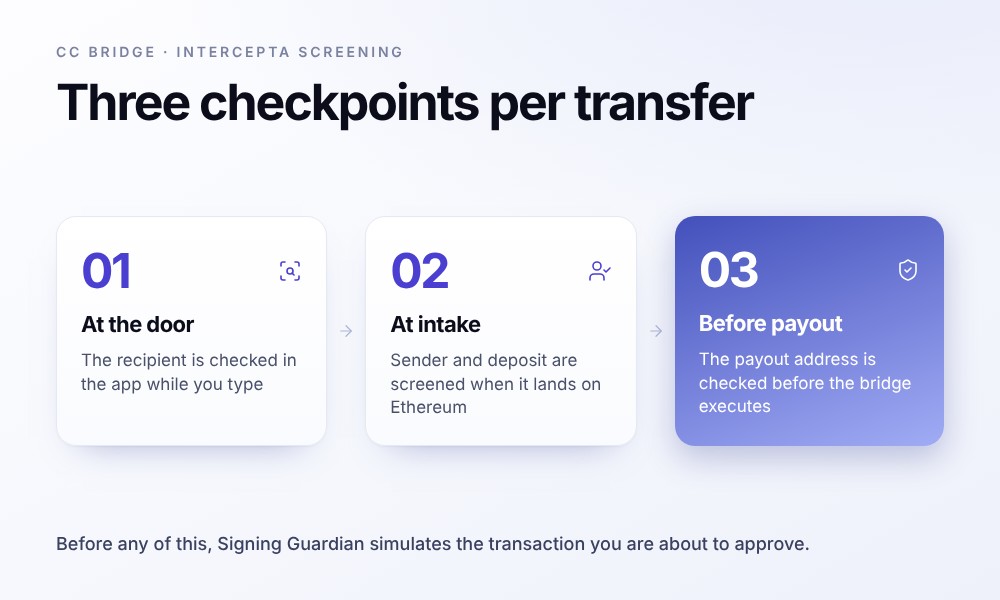
Every transfer is screened by Intercepta, PixelPlex’s real-time on-chain security and transaction monitoring platform, at three checkpoints: before the transfer starts, when the deposit lands on Ethereum, and before payout. The checks run on Intercepta’s Compliance Engine, Risk Screener and Risk Monitoring. Signing Guardian also simulates the transaction before the user approves it, which helps catch unexpected behavior before a signature leaves the wallet.
With Canton’s selective disclosure, a user can prove their side of a transfer to an auditor without publishing the full transaction trail to everyone. Transfers can also be followed on CC View, our Canton explorer and data API.
Our main lesson from CC Bridge: privacy and compliance controls belong in the bridge logic from day one, and refund paths belong in the protocol, not in a support ticket.
Echo and Qtum: interoperability at the protocol and VM level
For Echo, PixelPlex built a layer-2 network with EVM support, fast-finality consensus, an inter-blockchain communication protocol, and Bitcoin and Ethereum sidechains with DeFi-style bridges.
Because we controlled the chain design, finality rules, message format and signing assumptions went into the protocol specification instead of being patched into a bridge after launch.
For Qtum, the team worked on a UTXO-based chain using proof of stake on a Bitcoin fork, with Ethereum integration so EVM smart contracts run on a UTXO model.
Qtum shows blockchain interoperability at the virtual-machine level rather than as messages passed from chain A to chain B: one execution model made usable inside another accounting model.
Teams porting dApps between ecosystems hit the same issue: account-based assumptions from Ethereum do not map cleanly to UTXO state and balances.
Build, Integrate or Buy: Choosing a Blockchain Interoperability Approach
The right choice depends on who controls the asset, who verifies the message, what finality means, and how much operational responsibility your team can carry.
| Scenario | Recommended approach | Why | Watch out for |
| Moving USDC or EURC between chains | Circle CCTP V2, using native burn-and-mint | No wrapped asset, issuer-backed | V1 deprecation; chain coverage; Hooks permissions |
| Token issuer going multi-chain | Burn-and-mint framework, such as OFT, NTT, or CCT, with xERC20-style limits | Issuer keeps mint authority and per-bridge caps | Verifier configuration ownership; vendor lock-in |
| dApp that needs cross-chain contract calls | General message passing, such as Axelar GMP, LayerZero, CCIP, or Hyperlane | Call functions remotely | Replay protection, gas on destination, failed-execution handling |
| L2 app moving assets to and from Ethereum | Canonical rollup bridge for size, intents for speed | Inherits Ethereum security | 7-day exits on optimistic rollups; solver liquidity |
| Exchange or wallet routing users | Aggregator or intent routing plus allowlist of vetted routes | Best price and speed | Route risk scoring, screening, per-route limits |
| Bank or FI connecting a private ledger to other ledgers | Canton Global Synchronizer for atomic settlement among Canton apps, CCIP-style messaging or a custom bridge with compliance controls for public chains | Privacy and legal finality | Data exposure, operator records, regulatory approval |
In blockchain integration, stablecoin development and DeFi development projects alike, the decision starts with asset control and verification rather than vendor branding.
Questions to ask any interoperability provider
- Who verifies the source-chain event or message?
- What threshold is required before a message is accepted?
- Who can change verifier configuration, and how is that change announced?
- What finality rule is used for each supported chain?
- What rate limits, transfer caps, and pause controls exist?
- What audits and bug bounty programs cover the current release?
- What incidents has the provider had, and are the post-mortems public?
Cost and timeline follow from the number and type of chains (EVM, non-EVM, UTXO, permissioned), the verification model, how much custom contract logic the flow needs, and the monitoring and compliance work around it. Budget an audit per meaningful release, and budget monitoring separately, since blockchain interoperability solutions run across chains with different reorg, fee and outage behavior. Chainlink claims an in-house cross-chain build takes more than half a year and six figures in engineering per chain; treat that as a vendor estimate. A blockchain consulting review that maps chains, assets, verification assumptions and operational duties usually narrows the scope before any vendor is selected.
Blockchain Interoperability Challenges That Remain
Interoperability in blockchain still runs into one old problem: chains disagree on what “final” means. Bitcoin-style probabilistic finality, Ethereum’s checkpoint finality, deterministic finality in BFT networks, and app-chain-specific rules all create different waiting periods and reorg risk. A single global “confirmed” flag does not exist.
Liquidity stays split even with burn-and-mint, because each chain still needs its own market depth; standards are split too, so an issuer may maintain OFT, NTT, CCT or xERC20 implementations side by side.
UX remains brittle around destination gas and failed execution. A transfer can be verified correctly and still fail because the target call ran out of gas or hit an application check. Compliance data, including travel rule information, must also follow value across chains without leaking more data than required.
ZK light client work, such as SP1 in IBC Eureka, can reduce reliance on signer sets. Intent standards such as ERC-7683 can hide routing complexity from users. Proof costs, latency, and solver concentration remain open design questions.
How PixelPlex Helps
PixelPlex designs, builds, and audits cross-chain systems for enterprises and Web3 teams. Work includes bridge and messaging architecture, verifier and key setup, Canton blockchain development with Daml, smart contract audits, and monitoring with Intercepta. As a blockchain development company, PixelPlex focuses on the controls around assets, messages, upgrades, and operations.
A typical first step is an architecture and threat-model review of chains, assets, verifiers, and controls. It maps trust assumptions, admin rights, limits and monitoring gaps before any code changes.
FAQ
Blockchain interoperability is the ability for separate blockchain networks to exchange value, messages, proofs, or application state. It can support token transfers, cross-chain governance, settlement, identity checks, and app-to-app calls. The design may rely on validators, oracles, threshold signatures, optimistic checks, zero-knowledge proofs, or native consensus verification, depending on the risk profile and supported chains.
Cross-chain bridges are only as safe as their verification design and operations. Most large losses came from compromised keys, small signer sets, upgrade bugs, and single-verifier configurations. Teams should prefer native burn-and-mint or light-client routes where possible, use multi-verifier setups, apply rate limits, separate admin roles, test upgrades, and monitor signer, RPC, and message behavior continuously.
A blockchain bridge usually moves assets or mirrors asset state between chains. An interoperability protocol is broader: it can deliver arbitrary messages, trigger contracts, pass proofs, coordinate settlement, or support application logic across networks. Many bridges are built on messaging protocols, while some protocols include token transfer products as one use case.
An atomic swap lets two parties exchange assets across chains without minting, locking, or pooling a wrapped token. The trade either completes for both parties or fails for both, usually through hash-time-locked contracts or similar mechanisms. A bridge, by contrast, maintains continuity of an asset or message path across chains and often depends on external verification.
The Kelp DAO bridge exploit happened on April 18, 2026 and involved 116,500 rsETH, about $292 million. The LayerZero-based bridge required one DVN. According to LayerZero, the attacker poisoned RPC nodes behind that DVN and forced it onto them with a denial-of-service attack, producing a valid attestation for a forged message. LayerZero’s report attributes the incident to DPRK-linked TraderTraitor.
Enterprises should choose an interoperability protocol by verification model, control over the asset, compliance requirements, chain coverage and the operational burden their team can carry. CCTP fits USDC transfers. CCIP or similar models may fit issuer controls and compliance hooks. Canton Global Synchronizer fits atomic settlement between regulated applications. IBC fits Cosmos environments. Configurations and limits still need review.
You do not always need a cross-chain bridge to support multiple chains. Native issuance per chain through burn-and-mint, intent-based user transfers, or independent deployments may be cleaner. A bridge is needed when value, supply, permissions, or state must remain consistent across chains rather than existing as separate deployments with separate risk and liquidity profiles.